INTRODUCTION
TO THE DATA
SCIENCE
WORKFLOW
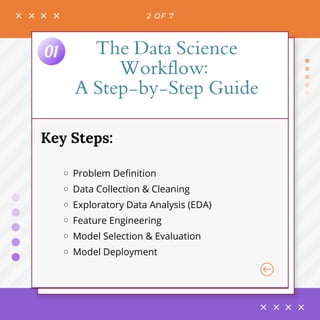
Key Steps:
Problem Definition
Data Collection & Cleaning
Exploratory Data Analysis (EDA)
Feature Engineering
Model Selection & Evaluation
Model Deployment
The Data Science
Workflow:
A Step-by-Step Guide
01
2 OF 7
Problem Definition:
Align your work with business objectives.
Understand the problem and define clear
goals.
Step 1: Problem
Definition & Step
02
2 OF 7
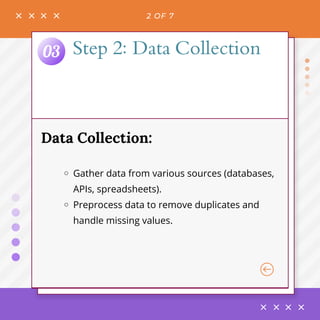
Data Collection:
Gather data from various sources (databases,
APIs, spreadsheets).
Preprocess data to remove duplicates and
handle missing values.
Step 2: Data Collection
03
2 OF 7
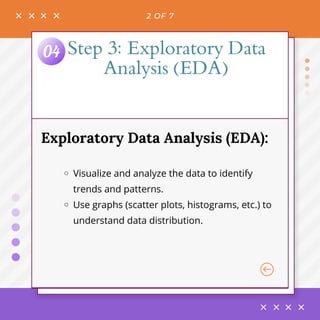
Exploratory Data Analysis (EDA):
Visualize and analyze the data to identify
trends and patterns.
Use graphs (scatter plots, histograms, etc.) to
understand data distribution.
Step 3: Exploratory Data
Analysis (EDA)
04
2 OF 7
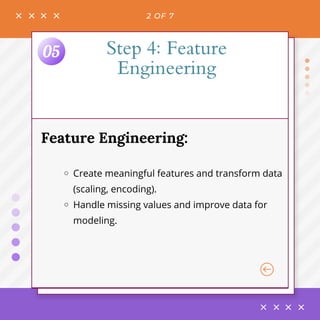
Feature Engineering:
Create meaningful features and transform data
(scaling, encoding).
Handle missing values and improve data for
modeling.
Step 4: Feature
Engineering
05
2 OF 7
Model Selection:
Choose the right model (classification,
regression, etc.).
Train and evaluate using appropriate metrics
(accuracy, precision, recall).
Step 5: Model Selection
06
2 OF 7
Model Deployment:
Deploy the model into production.
Monitor its performance and ensure its
scalability.
Step 6: Model
Deploymen
07
2 OF 7
KNOW MORE ABOUT
DATA SCIENCE ON
OUR WEBSITE
7 OF 7
https://bostoninstituteofanalytics.org/

Data Science Workflow - step by step guide

  • 1.
  • 2.
    Key Steps: Problem Definition DataCollection & Cleaning Exploratory Data Analysis (EDA) Feature Engineering Model Selection & Evaluation Model Deployment The Data Science Workflow: A Step-by-Step Guide 01 2 OF 7
  • 3.
    Problem Definition: Align yourwork with business objectives. Understand the problem and define clear goals. Step 1: Problem Definition & Step 02 2 OF 7
  • 4.
    Data Collection: Gather datafrom various sources (databases, APIs, spreadsheets). Preprocess data to remove duplicates and handle missing values. Step 2: Data Collection 03 2 OF 7
  • 5.
    Exploratory Data Analysis(EDA): Visualize and analyze the data to identify trends and patterns. Use graphs (scatter plots, histograms, etc.) to understand data distribution. Step 3: Exploratory Data Analysis (EDA) 04 2 OF 7
  • 6.
    Feature Engineering: Create meaningfulfeatures and transform data (scaling, encoding). Handle missing values and improve data for modeling. Step 4: Feature Engineering 05 2 OF 7
  • 7.
    Model Selection: Choose theright model (classification, regression, etc.). Train and evaluate using appropriate metrics (accuracy, precision, recall). Step 5: Model Selection 06 2 OF 7
  • 8.
    Model Deployment: Deploy themodel into production. Monitor its performance and ensure its scalability. Step 6: Model Deploymen 07 2 OF 7
  • 9.
    KNOW MORE ABOUT DATASCIENCE ON OUR WEBSITE 7 OF 7 https://bostoninstituteofanalytics.org/