Full download textbook at textbookfull.com
Data Science with Python 1st Edition Coll.
https://textbookfull.com/product/data-science-with-
python-1st-edition-coll/
OR CLICK BUTTON
DOWLOAD EBOOK
Download more textbookfull from https://textbookfull.com
More products digital (pdf, epub, mobi) instant
download maybe you interests ...
Data Science and Analytics with Python 1st Edition
Jesus Rogel-Salazar
https://textbookfull.com/product/data-science-and-analytics-with-
python-1st-edition-jesus-rogel-salazar/
Python Data Science Handbook Essential Tools for
Working with Data 1st Edition Jake Vanderplas
https://textbookfull.com/product/python-data-science-handbook-
essential-tools-for-working-with-data-1st-edition-jake-
vanderplas/
Python Data Science Handbook Essential Tools for
Working with Data 1st Edition Jake Vanderplas
https://textbookfull.com/product/python-data-science-handbook-
essential-tools-for-working-with-data-1st-edition-jake-
vanderplas-2/
Data Science from Scratch First Principles with Python
2nd Edition Joel Grus
https://textbookfull.com/product/data-science-from-scratch-first-
principles-with-python-2nd-edition-joel-grus/
Data Science from Scratch First Principles with Python
2nd Edition Grus Joel
https://textbookfull.com/product/data-science-from-scratch-first-
principles-with-python-2nd-edition-grus-joel/
Data science and complex networks : real cases studies
with Python First Edition Caldarelli
https://textbookfull.com/product/data-science-and-complex-
networks-real-cases-studies-with-python-first-edition-caldarelli/
Learning Data Mining with Python Layton
https://textbookfull.com/product/learning-data-mining-with-
python-layton/
Graph Data Science with Neo4j: Learn how to use Neo4j 5
with Graph Data Science library 2.0 and its Python
driver for your project Scifo
https://textbookfull.com/product/graph-data-science-with-
neo4j-learn-how-to-use-neo4j-5-with-graph-data-science-
library-2-0-and-its-python-driver-for-your-project-scifo/
Python for Data Science 2nd Edition John Paul Mueller
https://textbookfull.com/product/python-for-data-science-2nd-
edition-john-paul-mueller/
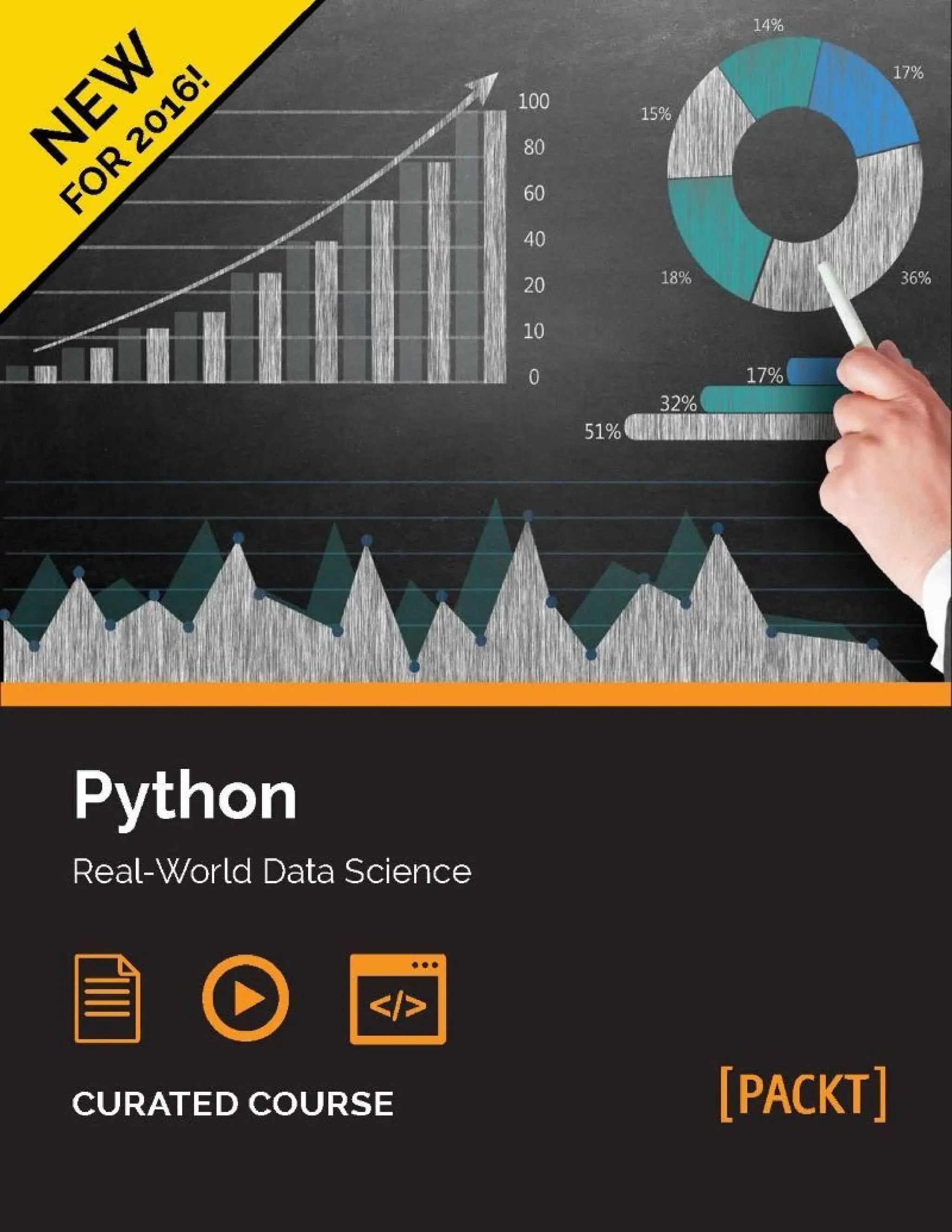
Python: Real-World Data
Science
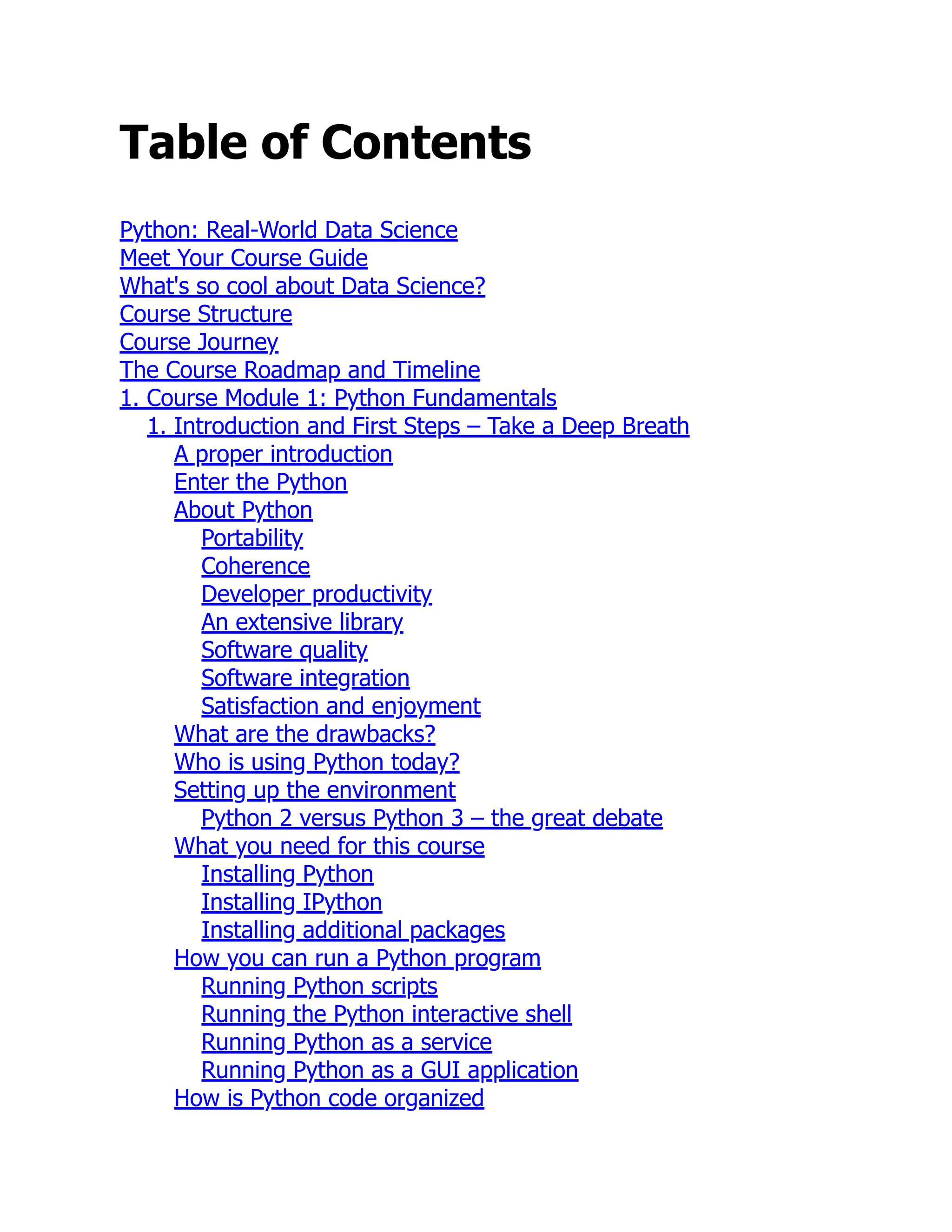
Table of Contents
Python: Real-World Data Science
Meet Your Course Guide
What's so cool about Data Science?
Course Structure
Course Journey
The Course Roadmap and Timeline
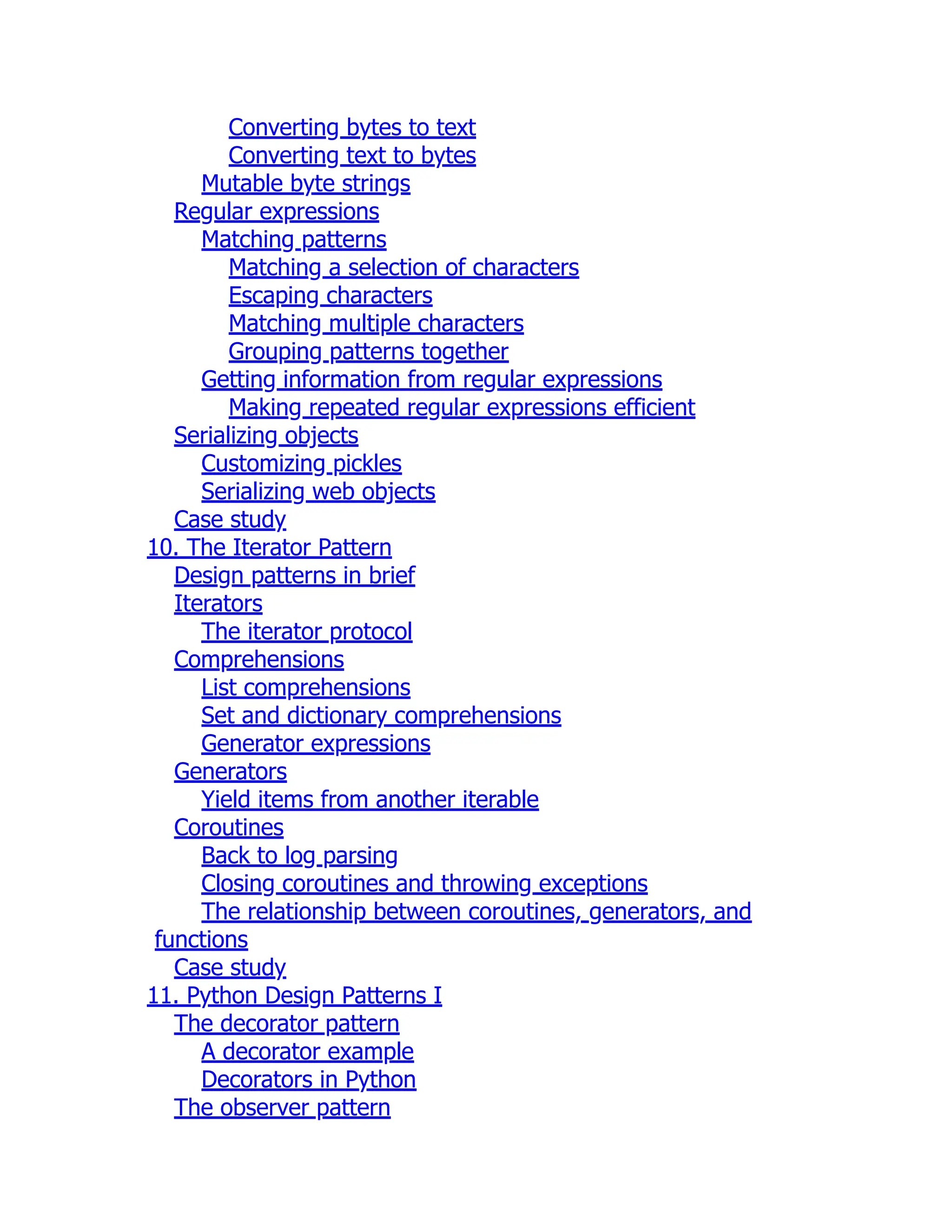
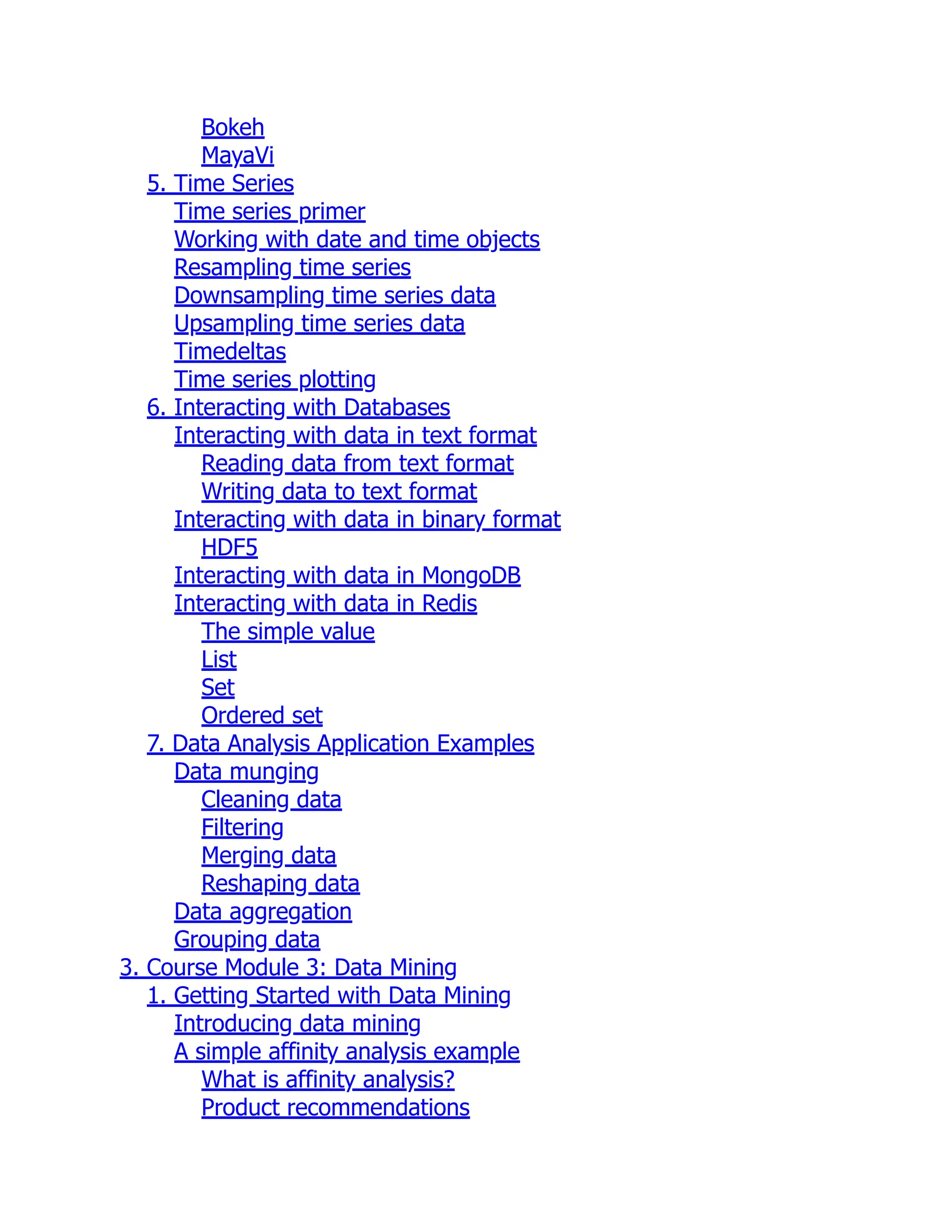
1. Course Module 1: Python Fundamentals
1. Introduction and First Steps – Take a Deep Breath
A proper introduction
Enter the Python
About Python
Portability
Coherence
Developer productivity
An extensive library
Software quality
Software integration
Satisfaction and enjoyment
What are the drawbacks?
Who is using Python today?
Setting up the environment
Python 2 versus Python 3 – the great debate
What you need for this course
Installing Python
Installing IPython
Installing additional packages
How you can run a Python program
Running Python scripts
Running the Python interactive shell
Running Python as a service
Running Python as a GUI application
How is Python code organized
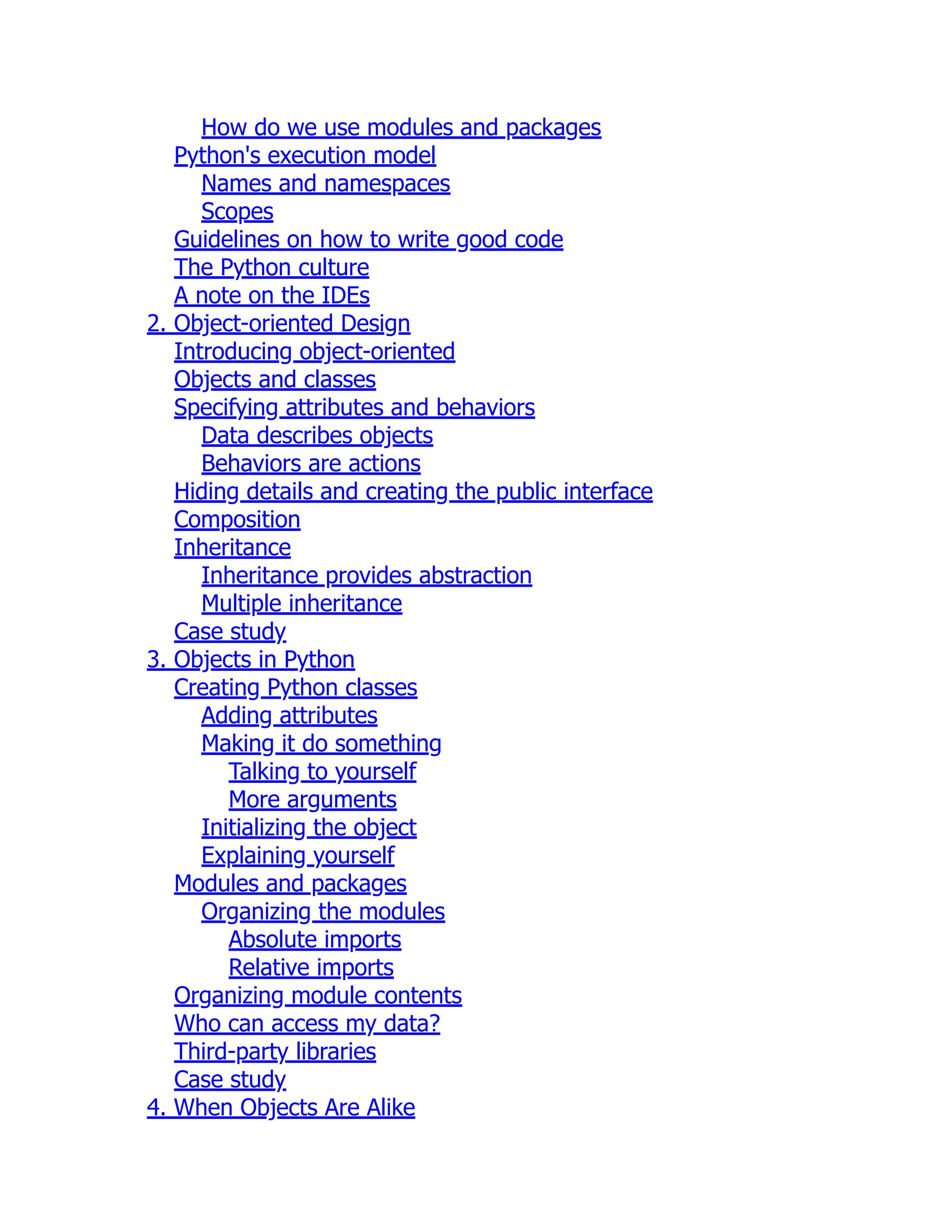
How do we use modules and packages
Python's execution model
Names and namespaces
Scopes
Guidelines on how to write good code
The Python culture
A note on the IDEs
2. Object-oriented Design
Introducing object-oriented
Objects and classes
Specifying attributes and behaviors
Data describes objects
Behaviors are actions
Hiding details and creating the public interface
Composition
Inheritance
Inheritance provides abstraction
Multiple inheritance
Case study
3. Objects in Python
Creating Python classes
Adding attributes
Making it do something
Talking to yourself
More arguments
Initializing the object
Explaining yourself
Modules and packages
Organizing the modules
Absolute imports
Relative imports
Organizing module contents
Who can access my data?
Third-party libraries
Case study
4. When Objects Are Alike
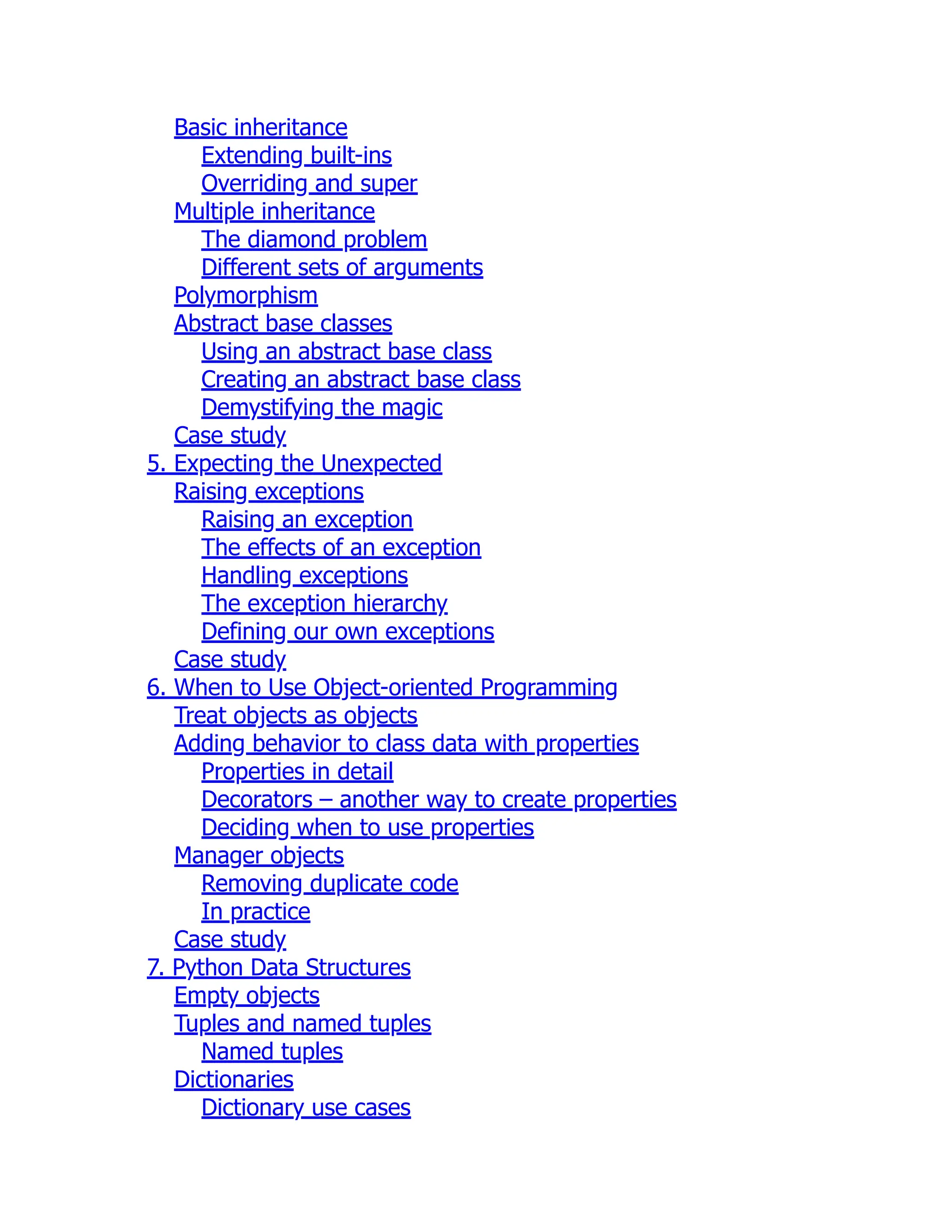
Basic inheritance
Extending built-ins
Overriding and super
Multiple inheritance
The diamond problem
Different sets of arguments
Polymorphism
Abstract base classes
Using an abstract base class
Creating an abstract base class
Demystifying the magic
Case study
5. Expecting the Unexpected
Raising exceptions
Raising an exception
The effects of an exception
Handling exceptions
The exception hierarchy
Defining our own exceptions
Case study
6. When to Use Object-oriented Programming
Treat objects as objects
Adding behavior to class data with properties
Properties in detail
Decorators – another way to create properties
Deciding when to use properties
Manager objects
Removing duplicate code
In practice
Case study
7. Python Data Structures
Empty objects
Tuples and named tuples
Named tuples
Dictionaries
Dictionary use cases
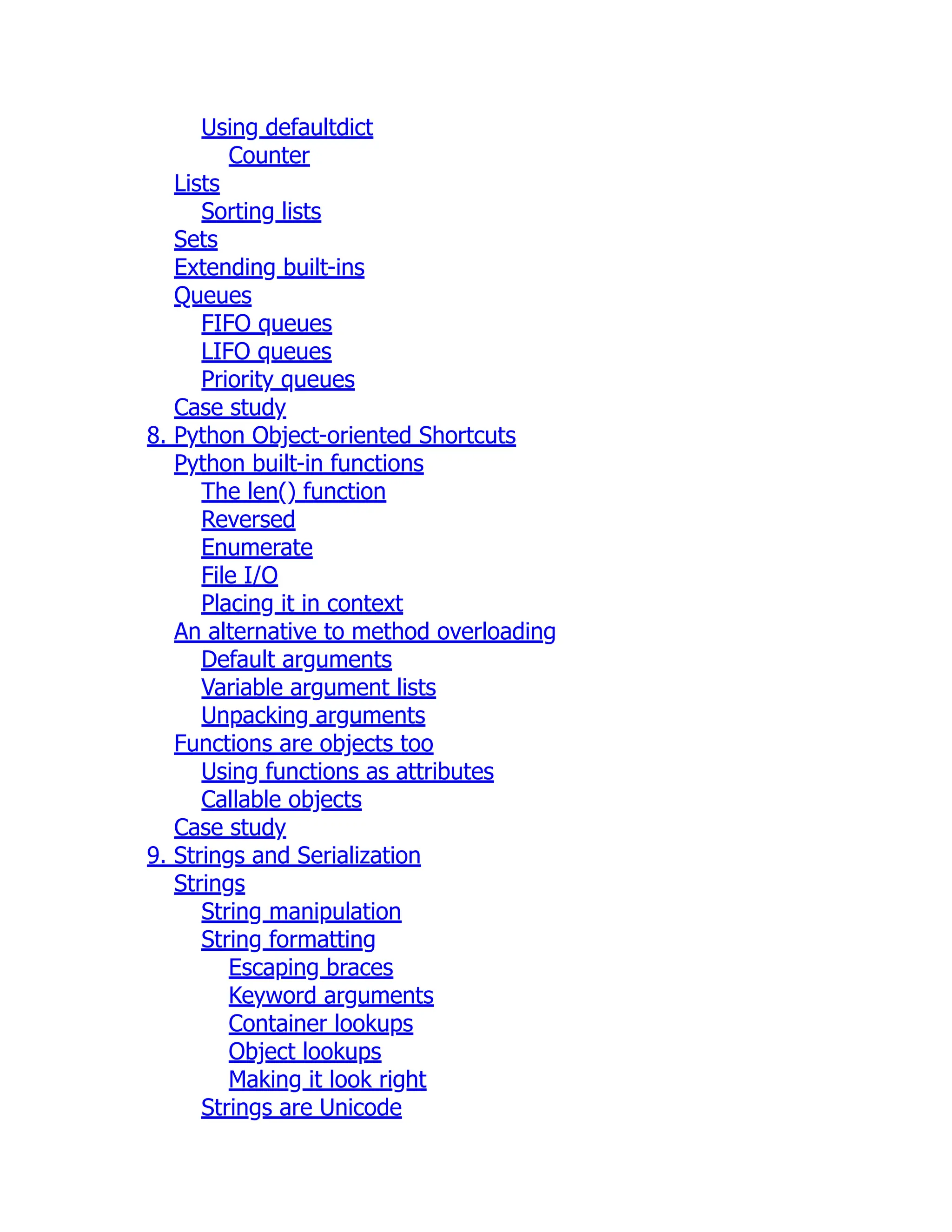
Using defaultdict
Counter
Lists
Sorting lists
Sets
Extending built-ins
Queues
FIFO queues
LIFO queues
Priority queues
Case study
8. Python Object-oriented Shortcuts
Python built-in functions
The len() function
Reversed
Enumerate
File I/O
Placing it in context
An alternative to method overloading
Default arguments
Variable argument lists
Unpacking arguments
Functions are objects too
Using functions as attributes
Callable objects
Case study
9. Strings and Serialization
Strings
String manipulation
String formatting
Escaping braces
Keyword arguments
Container lookups
Object lookups
Making it look right
Strings are Unicode
Converting bytes to text
Converting text to bytes
Mutable byte strings
Regular expressions
Matching patterns
Matching a selection of characters
Escaping characters
Matching multiple characters
Grouping patterns together
Getting information from regular expressions
Making repeated regular expressions efficient
Serializing objects
Customizing pickles
Serializing web objects
Case study
10. The Iterator Pattern
Design patterns in brief
Iterators
The iterator protocol
Comprehensions
List comprehensions
Set and dictionary comprehensions
Generator expressions
Generators
Yield items from another iterable
Coroutines
Back to log parsing
Closing coroutines and throwing exceptions
The relationship between coroutines, generators, and
functions
Case study
11. Python Design Patterns I
The decorator pattern
A decorator example
Decorators in Python
The observer pattern
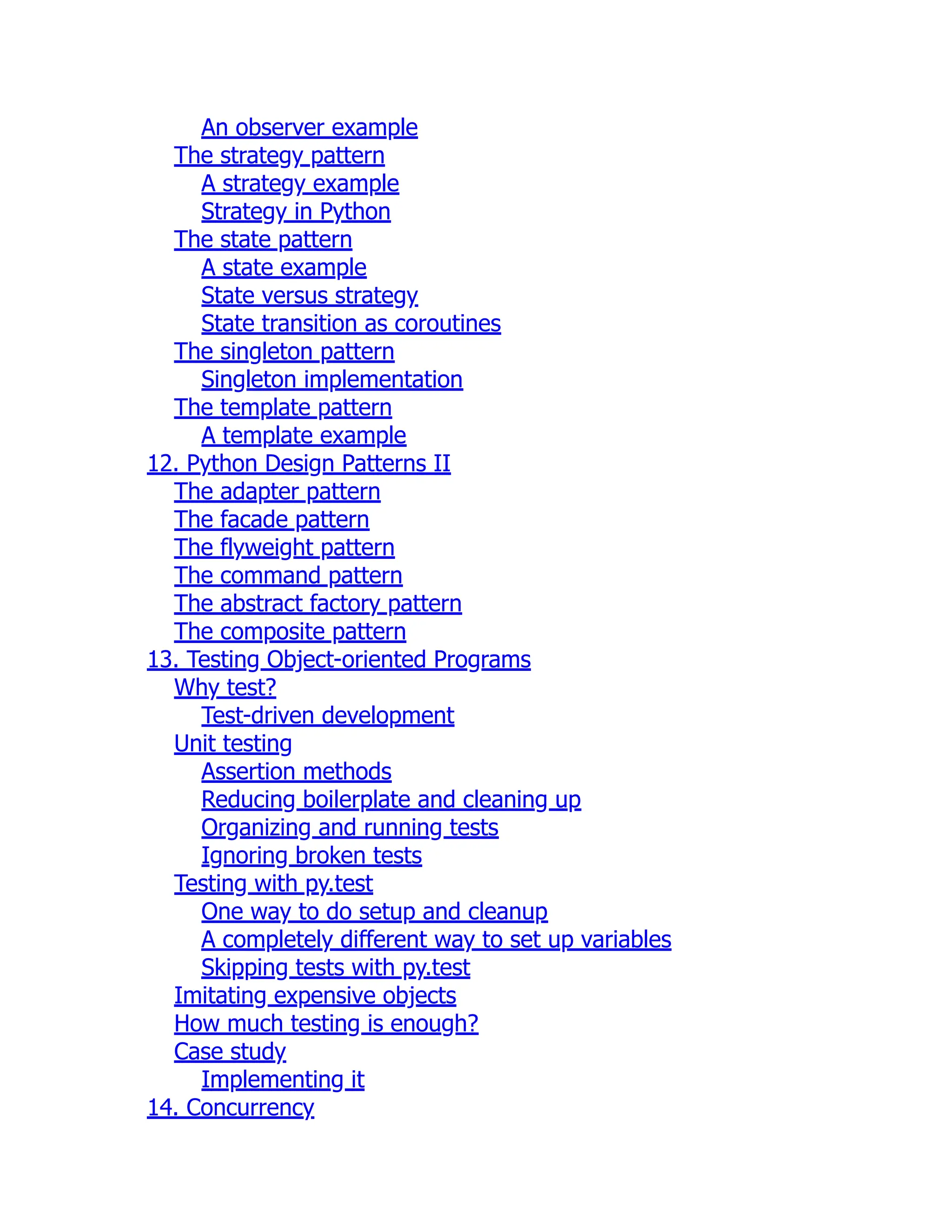
An observer example
The strategy pattern
A strategy example
Strategy in Python
The state pattern
A state example
State versus strategy
State transition as coroutines
The singleton pattern
Singleton implementation
The template pattern
A template example
12. Python Design Patterns II
The adapter pattern
The facade pattern
The flyweight pattern
The command pattern
The abstract factory pattern
The composite pattern
13. Testing Object-oriented Programs
Why test?
Test-driven development
Unit testing
Assertion methods
Reducing boilerplate and cleaning up
Organizing and running tests
Ignoring broken tests
Testing with py.test
One way to do setup and cleanup
A completely different way to set up variables
Skipping tests with py.test
Imitating expensive objects
How much testing is enough?
Case study
Implementing it
14. Concurrency
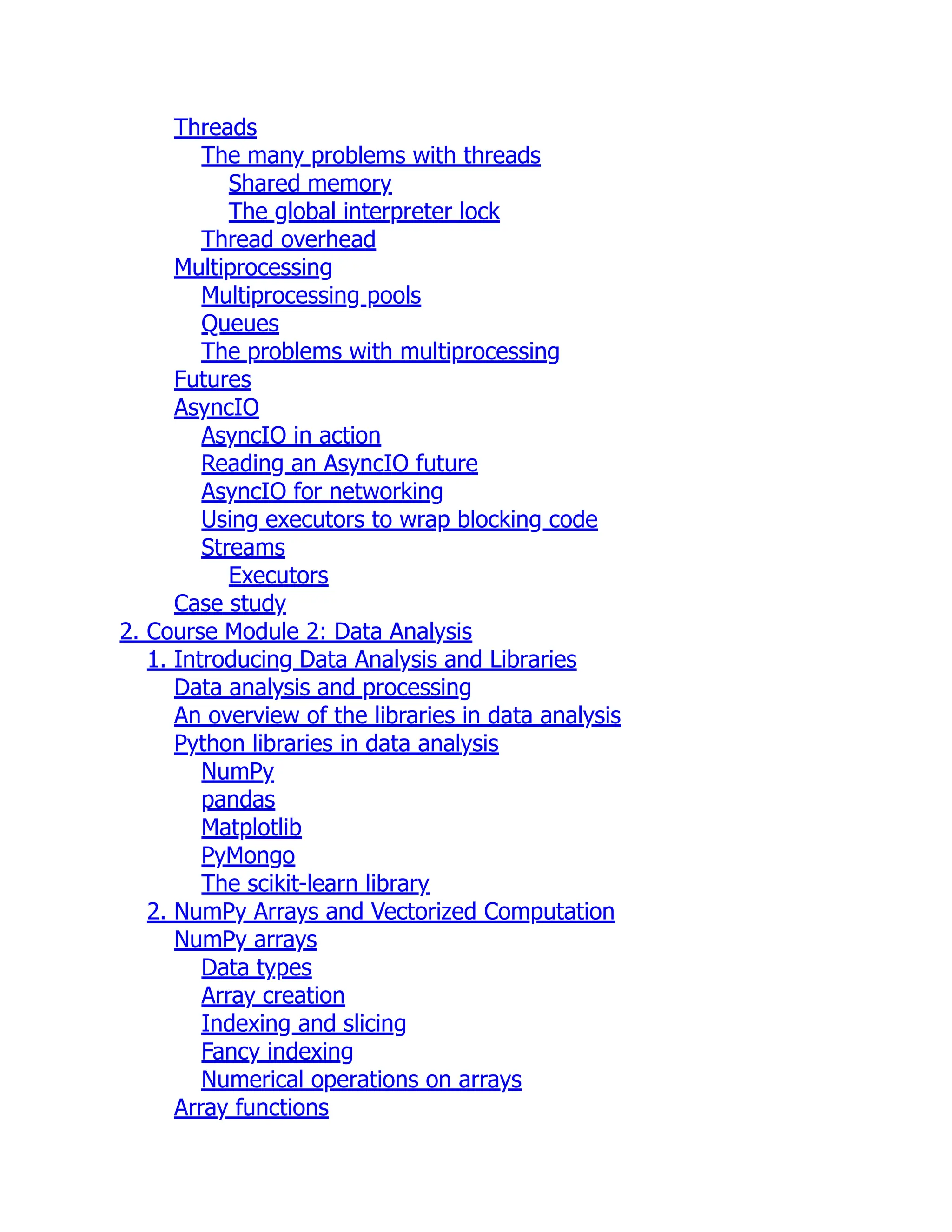
Threads
The many problems with threads
Shared memory
The global interpreter lock
Thread overhead
Multiprocessing
Multiprocessing pools
Queues
The problems with multiprocessing
Futures
AsyncIO
AsyncIO in action
Reading an AsyncIO future
AsyncIO for networking
Using executors to wrap blocking code
Streams
Executors
Case study
2. Course Module 2: Data Analysis
1. Introducing Data Analysis and Libraries
Data analysis and processing
An overview of the libraries in data analysis
Python libraries in data analysis
NumPy
pandas
Matplotlib
PyMongo
The scikit-learn library
2. NumPy Arrays and Vectorized Computation
NumPy arrays
Data types
Array creation
Indexing and slicing
Fancy indexing
Numerical operations on arrays
Array functions
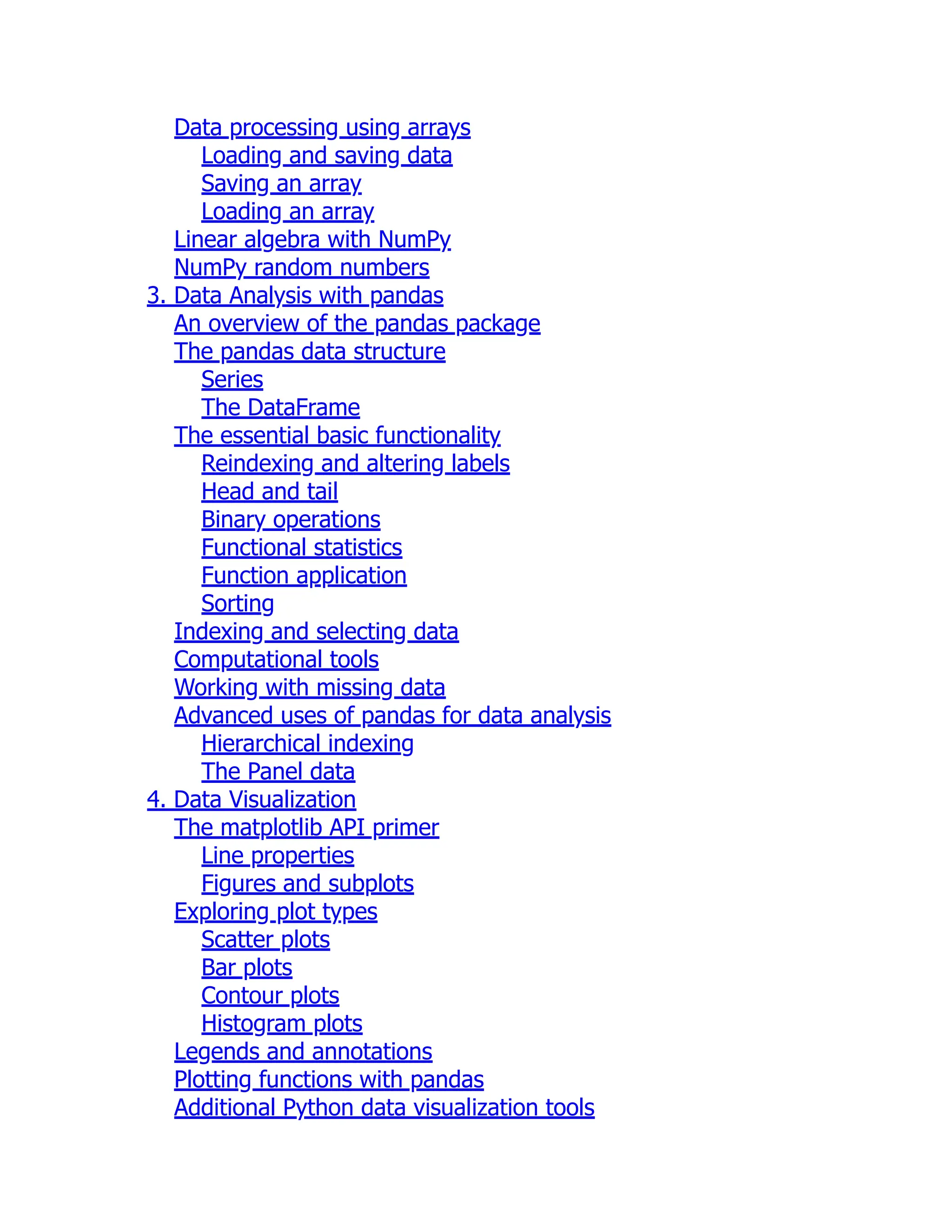
Data processing using arrays
Loading and saving data
Saving an array
Loading an array
Linear algebra with NumPy
NumPy random numbers
3. Data Analysis with pandas
An overview of the pandas package
The pandas data structure
Series
The DataFrame
The essential basic functionality
Reindexing and altering labels
Head and tail
Binary operations
Functional statistics
Function application
Sorting
Indexing and selecting data
Computational tools
Working with missing data
Advanced uses of pandas for data analysis
Hierarchical indexing
The Panel data
4. Data Visualization
The matplotlib API primer
Line properties
Figures and subplots
Exploring plot types
Scatter plots
Bar plots
Contour plots
Histogram plots
Legends and annotations
Plotting functions with pandas
Additional Python data visualization tools
Bokeh
MayaVi
5. Time Series
Time series primer
Working with date and time objects
Resampling time series
Downsampling time series data
Upsampling time series data
Timedeltas
Time series plotting
6. Interacting with Databases
Interacting with data in text format
Reading data from text format
Writing data to text format
Interacting with data in binary format
HDF5
Interacting with data in MongoDB
Interacting with data in Redis
The simple value
List
Set
Ordered set
7. Data Analysis Application Examples
Data munging
Cleaning data
Filtering
Merging data
Reshaping data
Data aggregation
Grouping data
3. Course Module 3: Data Mining
1. Getting Started with Data Mining
Introducing data mining
A simple affinity analysis example
What is affinity analysis?
Product recommendations
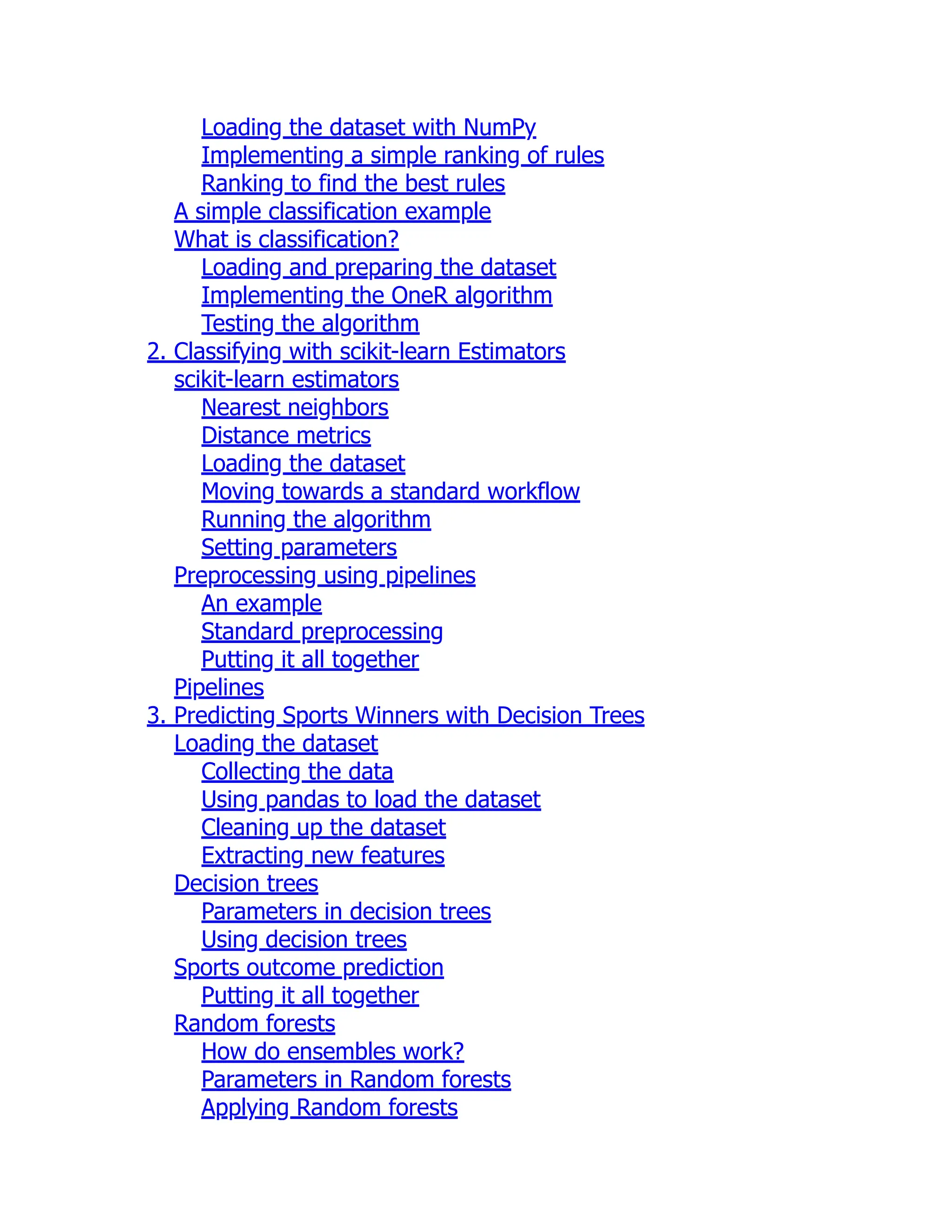
Loading the dataset with NumPy
Implementing a simple ranking of rules
Ranking to find the best rules
A simple classification example
What is classification?
Loading and preparing the dataset
Implementing the OneR algorithm
Testing the algorithm
2. Classifying with scikit-learn Estimators
scikit-learn estimators
Nearest neighbors
Distance metrics
Loading the dataset
Moving towards a standard workflow
Running the algorithm
Setting parameters
Preprocessing using pipelines
An example
Standard preprocessing
Putting it all together
Pipelines
3. Predicting Sports Winners with Decision Trees
Loading the dataset
Collecting the data
Using pandas to load the dataset
Cleaning up the dataset
Extracting new features
Decision trees
Parameters in decision trees
Using decision trees
Sports outcome prediction
Putting it all together
Random forests
How do ensembles work?
Parameters in Random forests
Applying Random forests
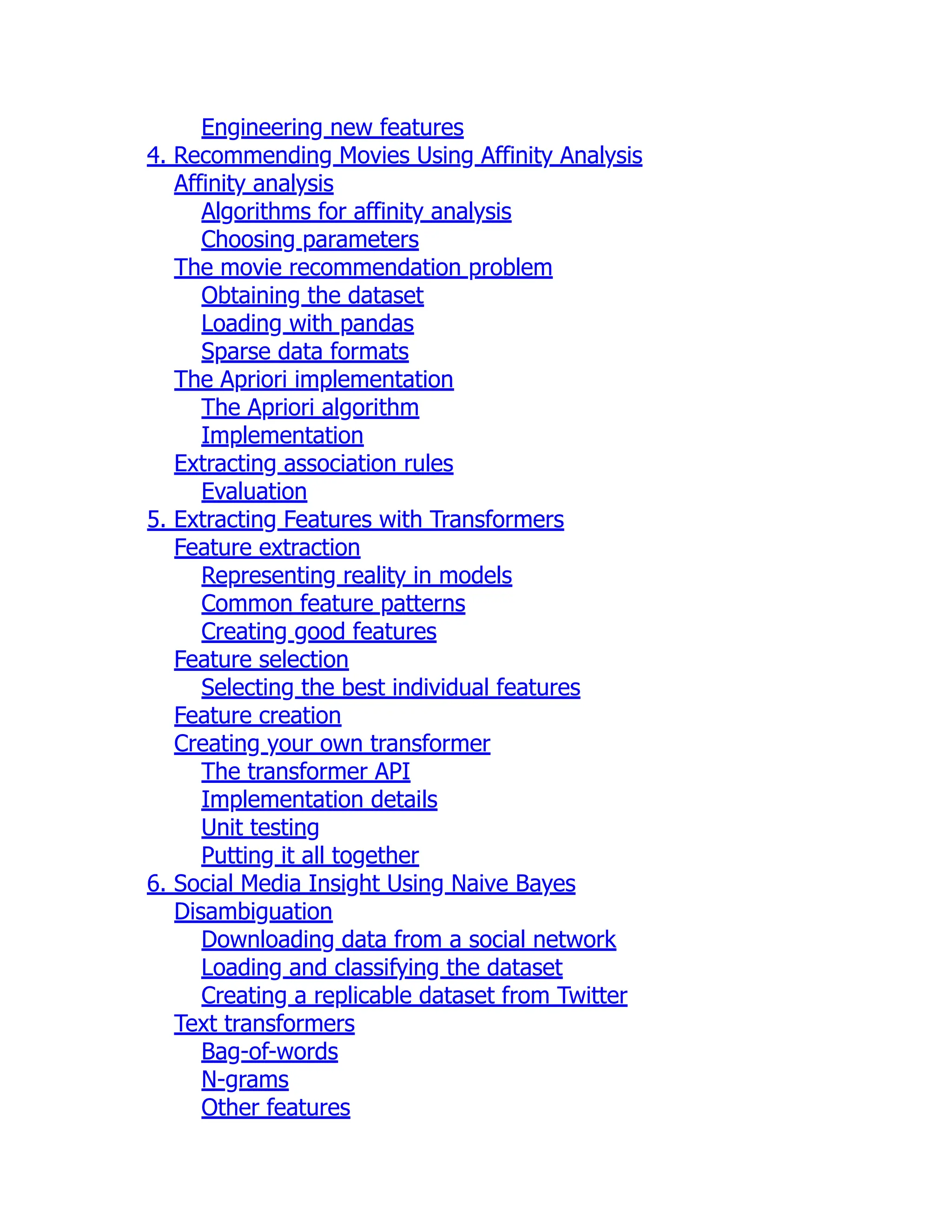
Engineering new features
4. Recommending Movies Using Affinity Analysis
Affinity analysis
Algorithms for affinity analysis
Choosing parameters
The movie recommendation problem
Obtaining the dataset
Loading with pandas
Sparse data formats
The Apriori implementation
The Apriori algorithm
Implementation
Extracting association rules
Evaluation
5. Extracting Features with Transformers
Feature extraction
Representing reality in models
Common feature patterns
Creating good features
Feature selection
Selecting the best individual features
Feature creation
Creating your own transformer
The transformer API
Implementation details
Unit testing
Putting it all together
6. Social Media Insight Using Naive Bayes
Disambiguation
Downloading data from a social network
Loading and classifying the dataset
Creating a replicable dataset from Twitter
Text transformers
Bag-of-words
N-grams
Other features
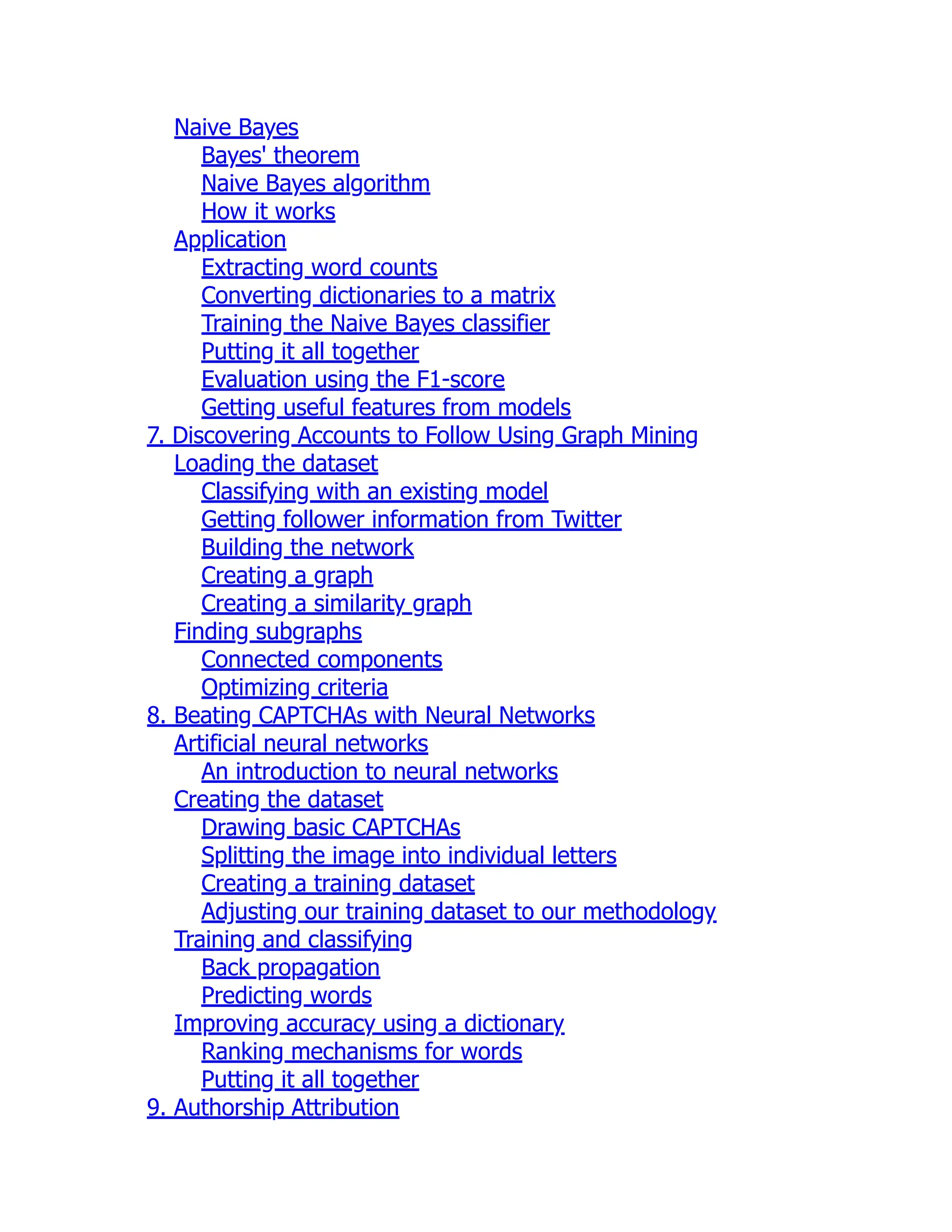
Naive Bayes
Bayes' theorem
Naive Bayes algorithm
How it works
Application
Extracting word counts
Converting dictionaries to a matrix
Training the Naive Bayes classifier
Putting it all together
Evaluation using the F1-score
Getting useful features from models
7. Discovering Accounts to Follow Using Graph Mining
Loading the dataset
Classifying with an existing model
Getting follower information from Twitter
Building the network
Creating a graph
Creating a similarity graph
Finding subgraphs
Connected components
Optimizing criteria
8. Beating CAPTCHAs with Neural Networks
Artificial neural networks
An introduction to neural networks
Creating the dataset
Drawing basic CAPTCHAs
Splitting the image into individual letters
Creating a training dataset
Adjusting our training dataset to our methodology
Training and classifying
Back propagation
Predicting words
Improving accuracy using a dictionary
Ranking mechanisms for words
Putting it all together
9. Authorship Attribution
Attributing documents to authors
Applications and use cases
Attributing authorship
Getting the data
Function words
Counting function words
Classifying with function words
Support vector machines
Classifying with SVMs
Kernels
Character n-grams
Extracting character n-grams
Using the Enron dataset
Accessing the Enron dataset
Creating a dataset loader
Putting it all together
Evaluation
10. Clustering News Articles
Obtaining news articles
Using a Web API to get data
Reddit as a data source
Getting the data
Extracting text from arbitrary websites
Finding the stories in arbitrary websites
Putting it all together
Grouping news articles
The k-means algorithm
Evaluating the results
Extracting topic information from clusters
Using clustering algorithms as transformers
Clustering ensembles
Evidence accumulation
How it works
Implementation
Online learning
An introduction to online learning
Another random document with
no related content on Scribd:
The Project Gutenberg eBook of Books and
how to make the most of them
This ebook is for the use of anyone anywhere in the United
States and most other parts of the world at no cost and with
almost no restrictions whatsoever. You may copy it, give it away
or re-use it under the terms of the Project Gutenberg License
included with this ebook or online at www.gutenberg.org. If you
are not located in the United States, you will have to check the
laws of the country where you are located before using this
eBook.
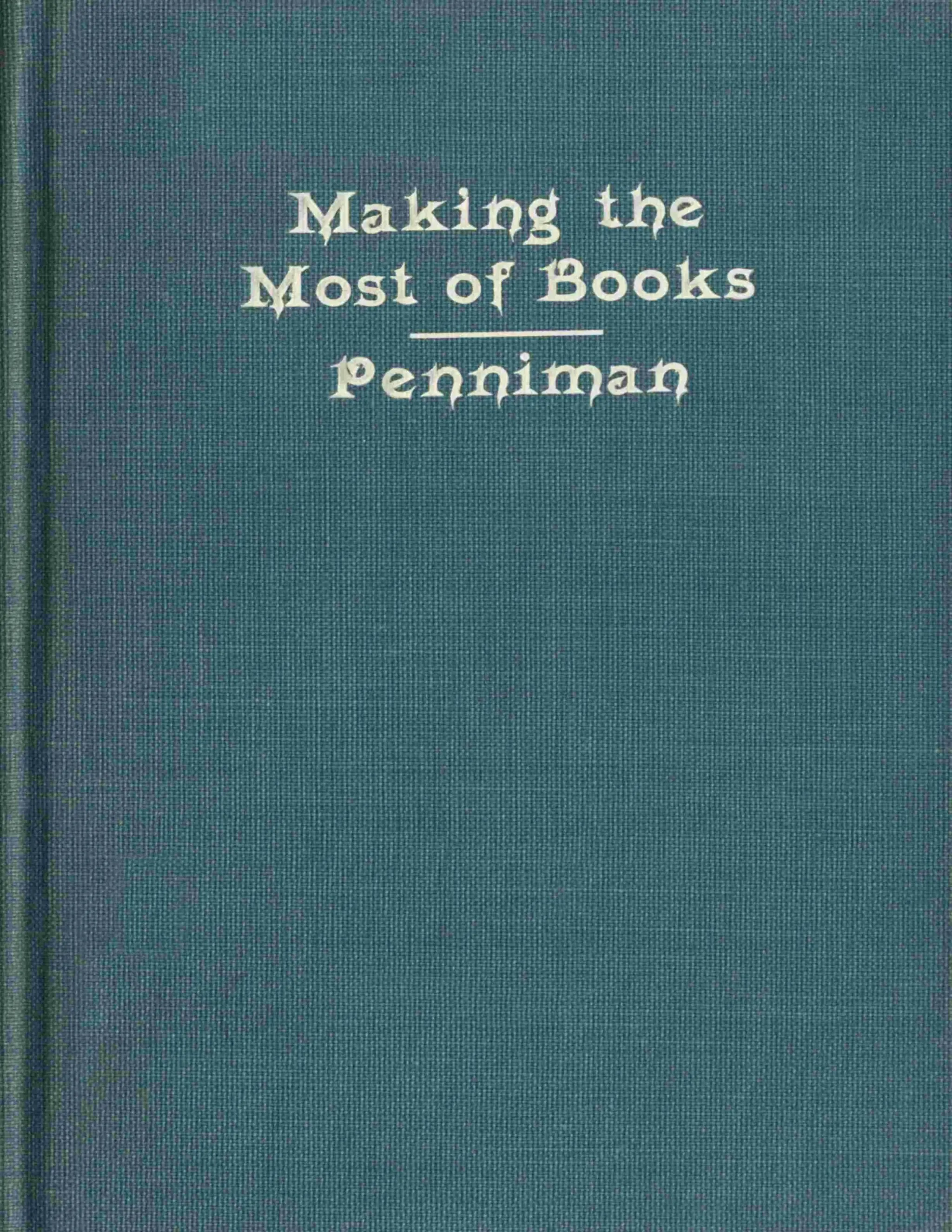
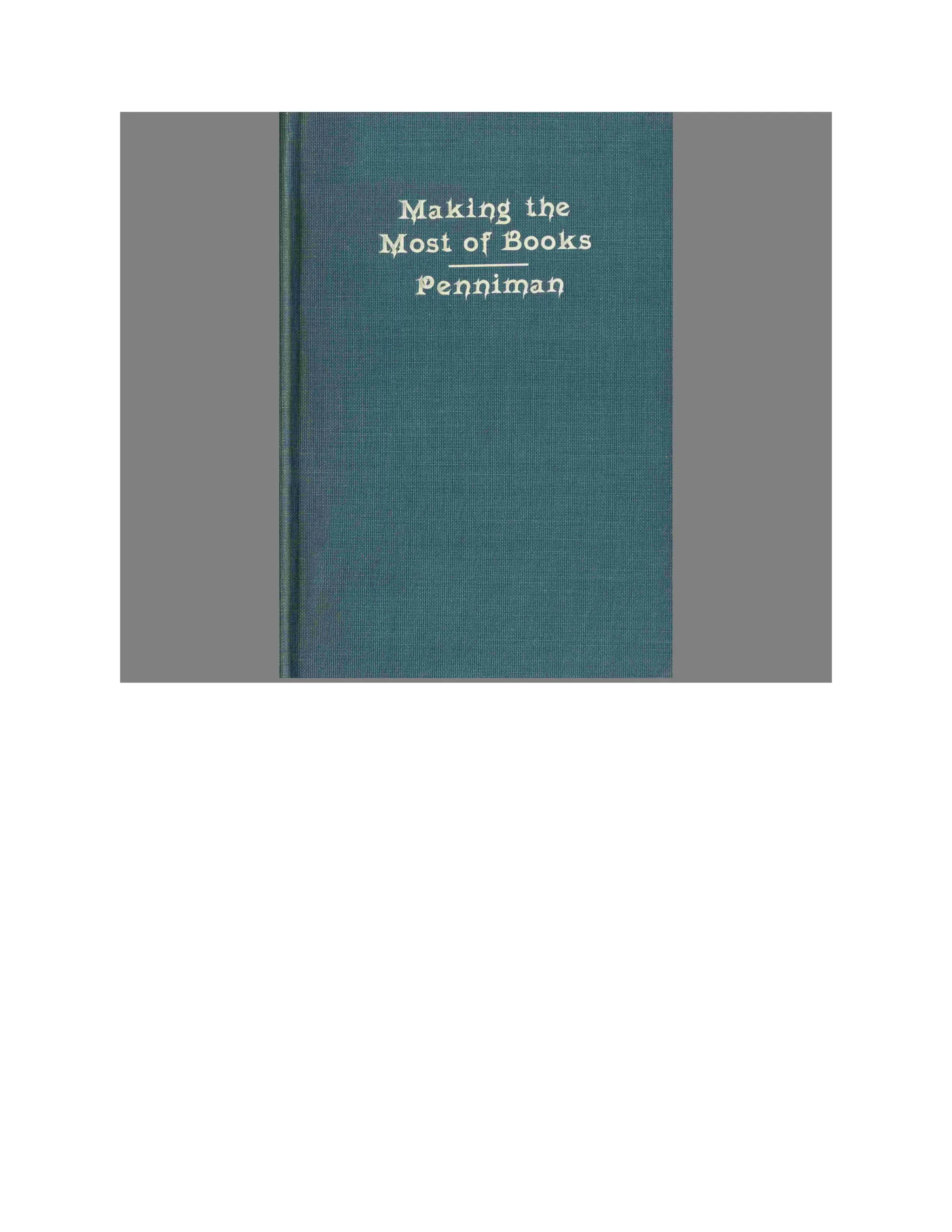
Title: Books and how to make the most of them
Author: James Hosmer Penniman
Release date: June 6, 2024 [eBook #73783]
Language: English
Original publication: Syracuse, NY: C. W. Bardeen, Publisher /
School Bulletin Publications, 1911
Credits: Jamie Brydone-Jack, Joeri de Ruiter and the Online
Distributed Proofreading Team at
https://www.pgdp.net (This file was produced from
images generously made available by The Internet
Archive)
*** START OF THE PROJECT GUTENBERG EBOOK BOOKS AND HOW
TO MAKE THE MOST OF THEM ***
Books and How to Make the
Most of Them
BY
JAMES HOSMER PENNIMAN
C. W. BARDEEN, PUBLISHER
Syracuse, N. Y.
Copyright, 1911, by C. W. Bardeen
There is probably no subject on which there has been more advice
given than on that of books and reading, but there are few upon
which advice is more necessary, for even so wise a man as Goethe
said, “I have been fifty years trying to learn how to read, and I have
not learned yet.”
CONTENTS
I. The Miracle of Books 9
II. How to Use Books 18
III. Cultivating the Memory 26
IV. What to Read and the Abuse of Books 31
V. The Art of Reading 40
VI. Classification of Books 54
VII. Poetry 62
VIII. Biography 70
IX. History 77
X. Fiction 85
XI. Libraries and the Care of Books 91
Books and How to Make the Most
of Them
CHAPTER I.
THE MIRACLE OF BOOKS.
A book is a miracle wrought by human agency. What more
wonderful than that the thought of a lifetime should be made visible
and concentrated so as to be carried in the pocket; that black lines
and dots upon a white page should bring before our minds the most
beautiful images. More remarkable than the telegraph or the
telephone, a book not only annihilates space but time, and carries
the voice of David or Homer across the seas of the ages.
The miracle of the widow’s cruse finds its literal realization in a
book. We may take all we can from it but there is just as much left
for others with the sole limitation that he gets the most from books
who has the most knowledge; to him that hath is given.
No other property is so peculiarly our own as our intellectual
possessions. They are always with us; no reversal of fortune can
deprive us of them. If we share our knowledge with another we still
have it, and perhaps in a more orderly and useful form as the result
of contact with a different mind, and the belief in the immortality of
the soul makes us sure that our mental acquisitions are taken with
us beyond the grave. Education and culture would be of small value
if they were to be terminated by the expiration of a few short years
of life. Books are the only work of man that may be said to be
omniscient. They are the stored-up memory of the race. As all our
experience of life would vanish without memory, so all accurate
knowledge of mankind would evaporate without books and we
should have nothing to depend upon but tradition.
Without books we should know nothing of the workings of the
mighty minds of Homer, Virgil, Dante, Shakespeare or Milton.
Without them Caesar, Napoleon and Washington would be traditions.
We can get but an imperfect idea of the history of our country
except from books. Books alone make books possible, and nothing is
more rare than a book which does not depend for its material on
other books.
Books stereotype and petrify language so that while the spoken
word is volatile and changeable we find in books the very words in
which we took delight years ago. We may cause to pass through our
minds the same thoughts in absolutely the same language that
interested Dr. Johnson or Milton; we may even follow out the mental
processes of Plato or Aristotle, and see what they enjoyed and note
what they thought.
Books intensify thought; a book is better than conversation in that
it may be brooded over, revised, extended, polished and continued
from time to time, but it cannot answer questions except those
anticipated by its author. A writer will put into a book thoughts that
he would not or could not express in conversation, and through his
books we may know intimately a man who was known only
superficially by his most familiar contemporaries.
Books not only acquaint us with the thoughts of the great men of
the past but they enable us to make permanent our own thoughts,
so that if our ideas are worthy of being perpetuated those who live
centuries hence may be as familiar with our minds as we are with
the minds of Milton or Dante. A book enables the thought of one
man to reach all other inquiring men in ages to come. Men of whom
their world was not worthy have gained late recognition through
their books; men whose minds were far in advance of their time
have handed down their thoughts in books which have at last found
appreciative readers.
The printing press has multiplied enormously our means of giving
currency to ideas, but thought is no more powerful now than in the
time of Plato or Aristotle. Men like these wrote books before the time
of Christ which are still consulted on the subjects of which they
treat. Many of the problems of life and death are as mysterious to us
as they were to them.
Better than any other relics the books of a nation show what it
really was. The Dark Ages are called so because few books were
written in them, and Africa is the Dark Continent because it has no
literature.
No other works of man have done so much to spiritualize the race
as books. The Laocoon is not as inspiring a creation as the Iliad, the
Cologne Cathedral is not as civilizing as Dante’s Divine Comedy, and
it has been said that the works of Goethe have advanced the
progress of mankind more than all the conquests of Napoleon. Books
have more soul than any other human work. A house without books
is as dark as a house without windows.
Literature is the most enduring of the fine arts. No painter,
sculptor, or architect has erected so permanent a memorial as the
poets have done. Statues may be broken, pictures may fade or be
consumed by fire, even the pyramids may crumble away, but the
thought contained in great books such as the Iliad and the Aeneid is
more nearly eternal than marble or bronze. Lowell’s Commemoration
Ode forms a more durable monument to Harvard’s dead heroes than
Memorial Hall. There have been other actions as fine as the charge
of the Light Brigade, but it is only those that the great poets have
sung that are truly immortal in our memories.
“For deeds doe die, however noblie donne,
And thoughts doe as themselves decay;
But wise words, taught in numbers for to runne,
Recorded by the Muses live for ay.”
—Spenser.
Among the most lasting works of men are mosaics; they are not
easily broken, their colors do not fade and their outlines do not grow
dim with time. In the museum of the Capitol at Rome is the famous
mosaic of Pliny’s doves, rendered familiar by so many copies: three
or four doves perched on a broad-brimmed cup, absolutely as
perfect in form and tint as when Pliny saw them two thousand years
ago. Yet these tiny bits of stone joined by cement are not as
permanent as the poems of Homer which have as much human
interest to-day as they had when Alexander read them in the
intervals of his pursuit of the Persians.
The plays of Shakespeare will last as long as the earth remains,
and he said,
“Not marble, nor the gilded monuments
Of princes, shall outlive this powerful rhyme.”
The love of great books is in itself a mark of greatness. Biography
teaches no more practical lesson than this; that the world’s really
noble men have spent little time in reading any books but the best,
and that there has been a general agreement among them as to
what the best books are. Socrates was familiar with Homer and
Aesop. Alexander slept with Homer under his pillow. Montaigne
alludes constantly to the Bible and to Cicero, Virgil, Horace, Seneca,
Ovid and other classical authors. Bacon makes frequent quotations
from the Bible and also shows a knowledge of Aesop, Cicero, Virgil,
Ovid, Seneca, Montaigne and other great writers. Emerson notes the
fact that Montaigne was in the libraries of Shakespeare and of Ben
Jonson. Emerson read Chaucer, Montaigne, Plutarch and Plato while
at college and knew Shakespeare almost by heart.
When we realize how few books the men of antiquity had we
understand that they were obliged to read not many things but
much. Homer probably had no books at all. Socrates had very few
and even Cicero, the accomplished scholar, few in comparison with a
modern library. He never read Dante or Milton or Shakespeare.
The habit of communing with great thoughts gives health and
vigor to the mind. Men who habitually read the classics have a
breadth of view and a toughness of mental fibre which cannot be
obtained by those whose highest inspiration is derived from the
newspaper and the last novel. Reading the best books gives an
elevation of thought which raises above the level of common things,
ennobles and makes fine the ordinary daily occupations, dignifies life
and makes it worth living. The woman who keeps her Bible open
while she is sewing and refreshes herself with the Psalms or the
Gospels is deriving mental as well as spiritual nourishment; without
such inspiration her labor would fade into the light of common day.
We need great books to take us out of ourselves, and to show us
in true perspective our relations to the past, the present and the
future. We may find from books if we have not learned from our own
observation the true heroism that is present in the pain and poverty
and distress of everyday life. “Books,” said Emerson, “impart
sympathetic activity to the moral powers. Go with mean people and
you think life is mean. Then read Plutarch, and the world is a proud
place, peopled with men of positive quality, with heroes and
demigods standing around us, who will not let us sleep.” Michael
Angelo said “When I read Homer I look to see if I am not twenty
feet tall.”
CHAPTER II.
THE USE OF BOOKS.
“He that shall make search after knowledge, let him seek it where
it is,” said Montaigne of books.
Whatever your purpose, books will help you to accomplish it. They
make the knowledge of mankind our own if we know how to avail
ourselves of them. Only the wise can get the best out of books, they
refuse to deliver their message to the ignorant.
Next to knowing a thing yourself the most necessary thing is
knowing where to find it, and the method of getting at the
information which is stored in books is an art that must be acquired.
It is an education to take up some subject and master it,
examining all the books about it and weighing all the varying and
conflicting opinions. You never realize the depth of human
knowledge and the difficulty of judging what the truth is, until you
have found out from your own experience the infinite labor of
mastering one small division of one subject.
From catalogues and bibliographies you may make a list of the
best works on the subject that you are investigating and you must
then quarry from these books what is of use to you and arrange it in
a logical and orderly way.
You need not read all the books; some contain what you already
know, and in many of them there is repetition of what you have
seen elsewhere. You glance through one and find little to the
purpose, the table of contents of another shows that here and there
is matter that should be looked over, at last you come to a work by a
great man, a master of the subject, every word of which must be
read and pondered on.
From these books you obtain references to others that you did not
know of; judgment must be shown in concentrating yourself on what
is of real value, and in not going out of your way to explore alluring
but useless by-paths. When you take many notes in blank books it is
difficult to refer to them unless you have an index, the making and
use of which requires time, but notes taken on one side of sheets of
loose paper may easily be sorted into large envelopes according to
the divisions of the subject, and as your investigations proceed and
your knowledge widens new divisions may readily be made. There is
a decided advantage in having all the notes of a kind together and
when they are on separate pieces of paper they may be pasted or
pinned in strips and their order changed at will. You may not have
your note book with you but a bit of blank paper can always be
obtained. These notes may be a word or two here to remind you of
an idea, a quotation there, accurately copied, and, most important of
all, such original thoughts as have occurred to you. You will
strengthen your mind and also improve your diction, by writing out
fully the ideas that occur to you while reading. When you do this,
you will not read so many books, but you will derive infinitely more
good from those you do read. You will pay more attention and will
be careful that what you read is worth noting.
Take notes freely and as much as possible in your own language.
“Writing maketh an exact man.” According to Dr. Watts, more is
gained by writing out once than by reading five times. What you
have taken notes of is thereby fixed in your mind and when you
have classified your subject according to its natural divisions you
have, in so doing, formed new associations which will help you to
remember it.
When your materials are collected and arranged, your work is half
done. What remains requires a mental faculty of a higher order:—the
power of coördination.
Just here the difference appears between a penny-a-liner and the
author of a book of permanent value. Both men may be industrious,
both may have good ideas, but the author has a breadth of mind
which enables him to coördinate his knowledge; he pursues a
connected chain of thought leading to definite conclusions, he has
assimilated what he has found in books, reinforced it by his own
observation and study, and the result is a compact and organic
whole, a material addition to the knowledge of the world.
In the Fable for Critics, Lowell thus describes the unorderly worker
among books:—
“Twould be endless to tell you the things that he knew,
All separate facts, undeniably true,
But with him or each other they’d nothing to do,
No power of combining, arranging, discerning,
Digested the masses he learned into learning.”
Try to see clearly the important divisions of a subject, to be fair
minded, to draw your own conclusions, to distinguish between the
probable and the improbable, to recognize the good points in each
side of conflicting theories. Especially learn to classify and arrange
the ideas you get from books and to unite them to what you already
know.
If you can enjoy the study of some special subject connected with
your occupation and keep at it long enough to make yourself master
of it, you may by so doing educate yourself. You should not only
study the actual operations, but you should also familiarize yourself
with what has been written about them, and should make an effort
to record a permanent advance made by your own exertions.
“Knowledge of books in a man of business, is as a torch in the
hands of one who is willing and able to show those who are
bewildered the way which leads to prosperity and welfare,” says the
Spectator. How much, for example, has been lost in treasure and
energy because politicians who have not read history and political
economy, ignorantly persist in methods that have failed ever since
the world began. “A prince without letters,” said Ben Jonson, “is a
pilot without eyes. All his government is groping.” “It is manifest that
all government of action is to be gotten by knowledge, and
knowledge, best, by gathering many knowledges, which is reading,”
wrote Sir Philip Sidney.
When you read a number of books on the same topic each throws
light on the other and you get deeper, clearer ideas. You think more.
One subject studied thoroughly has more educational value than
many looked at superficially. But while there is the greatest culture
value in taking up one line of thought and pursuing it as far as
possible, the importance of the broad foundation to build on must
always be kept before you. “What science and practical life alike
need is not narrow men, but broad men sharpened to a point,” says
Dr. Nicholas Murray Butler.
There is no occupation where a fund of general information is not
valuable, provided it be accurate. The knowledge of a little law is as
useful to the doctor as that of a little medicine is to the lawyer.
How much more useful a man is in all branches of his calling if he
knows thoroughly at least one part of it. You cannot do anything
that will add more to your value to yourself and to the world in
general than to study your occupation all your life. If your work as a
student ends with school or college, your usefulness will be limited
and you will always occupy a subordinate position.
Education is a life work, we have no time to waste, but we should
take time enough to do it well. Be satisfied with a slow advance if
you are getting ahead all the time, but do not be turned aside from
the track.
Do not make the mistake of supposing that converse with the
thoughts of men as preserved in books can take the place of
communion with living men. You will get warped and unreal ideas of
life if you do. Talk about what you read with intellectual people. We
are educated by association with men, by pictures, by music, by
nature as well as by the study of books. Commune with other men
but do not omit to commune with yourself, only by so doing can you
gain “that final and higher product of knowledge which we call
wisdom.” “Read to weigh and consider,” said Bacon, that means to
think. Wordsworth speaks of “knowledge purchased with the loss of
power,” and Huxley says, “the great end of life is not knowledge but
action. What men need is, as much knowledge as they can
assimilate and organize into a basis for action; give them more and
it may become injurious.”
CHAPTER III.
CULTIVATING THE MEMORY.
Most of us forget, as Andrew Lang says, “with an ease and
readiness only to be acquired by practice,” and would agree with
Montaigne that “if I be a man of some reading, yet I am a man of no
remembering.”
To recall what we read we must first of all pay attention to it.
Attention has been styled the mother of memory. It is naturally
united to interest, we attend best to what we care most about, but
we may watch over our minds and force them to return when they
wander and attention may be made habitual by repeated and
vigorous efforts of the will.
“There must be continuity of work,” says Thomas A. Edison, the
inventor, “when you set out to do a certain thing never let anything
disturb you from doing that. This power of putting the thought on
one particular thing, and keeping it there for hours at time, comes
from practice, and it takes a long while to get in the habit. I
remember, a long while ago, I could only think ten minutes on a
given subject before something else would come to my mind. But
after long practice I can now keep my mind for hours on one topic
without being distracted with thoughts of other matters.”
On the other hand those who find difficulty in focusing the mind
for long periods of time may be comforted by the following opinion
of Professor William James than whom there is no better authority
on matters of this kind: “The total mental efficiency of a man is the
resultant of the working together of all his faculties. He is too
complex a being for any one of them to have the casting vote. If any
one of them do have the casting vote, it is more likely to be the
strength of his desire and passion, the strength of the interest he
takes in what is proposed; concentration, memory, reasoning power,
inventiveness, excellence of the senses,—all are subsidiary to this.
No matter how scatter-brained the type of a man’s successive fields
of consciousness may be, if he really care for a subject, he will
return to it incessantly from his incessant wanderings, and first and
last do more with it, and get more result from it, than another
person whose attention may be more continuous during a given
interval, but whose passion for the subject is of a more languid and
less permanent sort.”
We must have a clear idea of what we read if we wish to retain it.
We cannot remember perfectly what we do not understand. We
must think about what we read, assimilate it and unite it to the
knowledge that we already possess. Every time we go over it in our
minds we make the impression clearer.
Professor James lays special stress on the aid to memory that is
derived by this association of ideas. “When we wish to fix a new
thing in either our own mind or a pupil’s, our conscious effort should
not be so much to impress and retain it as to connect it with
something else already there. The ‘secret of a good memory’ is thus
the secret of forming diverse and multiple associations with every
fact we care to retain. But this forming of associations with a fact—
what is it but thinking about the fact as much as possible? Briefly,
then, of two men with the same outward experiences, the one who
thinks over his experiences most, and weaves them into the most
systematic relations with each other, will be the one with the best
memory.”
When we read a number of books on the same subject the
memory is helped by the association of ideas, and on the other hand
we have high authority for the statement that the memory is
weakened by aimless reading. There is perhaps no one pursuit in
which so much precious time is wasted, no one in which the
energies of mankind are expended to so little purpose, as in such
reading. “Nothing, in truth,” says Dugald Stewart, “has such a
tendency to weaken not only the powers of invention but the
intellectual powers in general, as a habit of extensive and various
reading without reflection.”
The habit of sharing the results of reading is as useful to ourselves
as it is to others. The scholar of whom Chaucer wrote “gladly wolde
he lerne and gladly teche,” probably had no difficulty in
remembering what he read.
The reproduction of what you have read by conversation or by
writing aids the memory while strengthening the mind.
Faraday says, “I hold it as a great point in self-education that the
student should be continually engaged in forming exact ideas, and in
expressing them clearly by language.” Professor James remarks, “a
thing merely read or heard, and never verbally reproduced, contracts
the weakest possible adhesion in the mind. Verbal recitation or
reproduction is thus a highly important kind of reactive behavior on
our impressions.”
Moreover, while cultivating the memory, the reproduction of ideas
from the works of writers like Addison, Newman, and Matthew
Arnold is valuable in the formation of a clear and simple style. It was
by careful reading of Addison and by afterwards reproducing the
thought in his own language that Franklin when a boy formed the
habit of elegant and exact expression that made whatever he wrote
interesting.
CHAPTER IV.
WHAT TO READ AND THE ABUSE OF
BOOKS.
Many people live in first-class houses, stay at first-class hotels,
travel in first-class steamships and railway trains and then read third
or fourth-class books. For them one book is about as good as
another.
If one does not care for the world’s great books the fault is in him,
not in them, but he must realize the vastness of human knowledge
and understand that some of the wisest voices of all time have no
message for him.
There are nomadic readers who read as the gypsies live, camping
everywhere but for a night without purpose and without profit. Such
reading is mental dissipation. Desultory reading jumps from one
book to another. You might as well try to drink the sea as to read all
books. You must divide in order to conquer. Do not read blindly,
know what you are about. Have a definite aim and purpose. Do not
read the first book that comes to hand but when you hear of a book
that you ought to read make a note of it. By keeping a list of books
you may shape your course and make your reading a selection from
a selection.
Do not prefer the new to the meritorious; by following Emerson’s
advice “read no book until it has been out a year,” you will avoid
many loud-trumpeted books. There is uncertainty in reading a new
book, but the value of the old books is well known. We need make
no mistake.
Many of the oldest books are always new but there are books
which were once standards on historical and technical subjects that
are now as out of date as last year’s almanac. Be sure that what you
read is reliable and the best of its kind. Prefer quality to quantity.
Read the great books for yourself and do not be content with
reading other people’s impressions of them. Books about books are
seldom useful unless one has also read the works of which they
treat.
Let the books that you select be those that have the approval of
men competent to judge, but bear in mind that the wisest man
cannot select the books that will best suit others; each must choose
for himself. People are always glad to recommend the books that
have helped them but they cannot tell whether such books will help
you. You must find out for yourself, no one else can do it for you. Do
not be afraid to ask anyone who knows more than you do. There is
no information which people are so ready to give as about books,
indeed when you ask them they feel flattered. When Franklin wished
to make friends with a man that he suspected of hostile sentiments
he borrowed a book of him and returned it promptly.
To find out what the best books are is no difficult matter, but to
find out what are the best books for us requires a self-knowledge
that takes life-long study. In reading we must feel our way, we
cannot tell what is best for us all at once. We need to get acquainted
with our own minds, to learn what our powers and tastes are. This
takes time and thought and, more than all, fair-mindedness in order
that we may not form too high or too low an estimate of our
abilities. “If thou wouldst profit by thy reading, read humbly, simply,
honestly, and not desiring to win a character for learning,” said
Thomas a Kempis.
Have a clear view of literature, know what you like and why you
like it. Be honest with yourself, do not pretend to like what you do
not because other people do. Do not be afraid to be ignorant of
many things, it is the price you must pay for knowing a few things
well. It is only the stupid who pretend to know what they do not. An
educated man is not ashamed to say that he does not know. “The
acknowledgment of ignorance,” said Montaigne, “is one of the best
and surest testimonies of judgment that I can finde.” To know when
you do know a thing and when you do not, is the first step towards
the attainment of sound scholarship, and the next is to know where
to go for information. “Nothing is so prolific as a little known well.”
To have a general idea of what is worth reading and to know
where to turn for the books which are of vital importance to one’s
development must be the foundation of any plan for culture. It is
one of the most useful results of a liberal education that it gives a
broad view of the whole range of human thought, and shows what
to consider and what to reject; it teaches to distinguish as Lowell
says between literature and printed matter.
Follow the bent of your inclination but make a clear distinction
between the reading that you do with a purpose and that which you
do for pleasure, “what we read with inclination makes a strong
impression. What we read as a task is of little use,” said Doctor
Johnson, and he added “if we read without inclination, half the mind
is employed in fixing the attention, so there is but one half to be
employed on what we read.”
Much energy is wasted by conscientious readers over classic books
that are beyond their capacity. Plato and Aristotle are among the
greatest thinkers that the world has produced but their works are
not within the comprehension of every mind. Indeed Emerson says
that, “There are not in the world at any one time more than a dozen
persons who read and understand Plato.”
Do not think that because a statement is in print it is necessarily
true. You will often find conflicting statements in different books on
the same subject. “Some books are lies frae end to end,” said Burns.
Fortunately this can be said of few books but many contain
inaccuracies, mis-statements and exaggerations. Weigh and consider
all you read in the light of your own experience. Books like life of
which they are expressions and authors who produce them are of all
kinds, good and bad, uplifting and degrading, true and false. We
must value them for what they are, not for what they pretend to be,
and, setting aside our own preconceptions and prejudices, lay our
minds open to those who seriously and sincerely hold other views
than ours.
The author tries to make us feel what he feels and see what he
sees. Some can do this without effort on our part and others like
cuttle fish cover themselves with clouds of their own obscurity. We
soon learn from the way a writer expresses himself whether he is
accurate or not and we depend upon those whom we find careful in
making their statements.
We get to love and trust authors as we get to know our friends by
long and familiar converse. The writers we should know best, with
whose lives and complete works we should make ourselves familiar
are those who have beauty of character added to grace of
expression. Some men like Burns and Goldsmith endear themselves
to us in spite of pronounced weaknesses.
Books give pleasure not only by what they contain but also by the
manner in which it is expressed. Beauty of language as well as of
thought make the works of Cardinal Newman and Matthew Arnold
attractive whether we agree with their conclusions or not and
whether the subjects of which they treat are of interest to us or not.
Milton tells us that we should have a vigilant eye how books
demean themselves. There is in some ways more danger from evil
books than from evil companions. Bad companions cannot be with
us always and bad books may be. Schopenhauer calls “bad books,
those exuberant weeds of literature that choke the true corn,” and
even the gentle Charles Lamb speaks with contempt of “things in
books’ clothing.” The only use of poor books is to teach us by
comparison the value of good ones. Rousseau thought that “the
abuse of reading is destructive to knowledge. Imagining ourselves to
know everything we read, we conceive it unnecessary to learn it by
other means.”
“Literature is not shut up in books nor art in galleries: both are
taken in by unconscious absorption through the finer pores of mind
and character in the atmosphere of society,” said Lowell; and
Emerson wrote, “books are for the scholar’s idle times: when he can
read God directly, the hour is too precious to be wasted in other
men’s transcripts of their readings. But when the intervals of
darkness come, as come they must,—when the sun is hid and the
stars withdraw their shining,—we repair to the lamps which were
kindled by their ray, to guide our steps to the East again, where the
dawn is.”
“No man should consider so highly of himself as to think he can
receive but little light from books, nor so meanly as to believe he can
discover nothing but what is to be learned from them.” wrote Doctor
Johnson, and Professor Blackie says, “all knowledge which comes
from books comes indirectly, by reflection, and by echo; true
knowledge grows from a living root in the thinking soul; and
whatever it may appropriate from without, it takes by living
assimilation into a living organism, not by mere borrowing.”
CHAPTER V.
THE ART OF READING.
“The most important step toward getting mental power is the
acquisition of a right method in work and a just standard of
attainment,” says President Elliot. The secret of success in reading is
concentration. The mind must be focused like a lens on just those
books and just those parts of them that are needed to accomplish
the desired object. Have a definite purpose and do not allow yourself
to be turned aside from it. There are those who read merely to get
over a certain number of pages and say that they have read a book.
Printed words run before their eyes and make no impression on their
minds. In this age of hurry many rush through books as trains rush
through tunnels.
The true reader makes his reading give an account of itself. After
you have read a few pages stop and think it over and arrange it in
your mind. It takes time to ripen, the best growth is slow.
We can no more become acquainted with a book on a single
reading than we can know a man on a single meeting. “Between
reading and study there is the same difference as between a guest
and a friend,” said St. Bernard. Ruskin thought that reading the
same thing over and over again aided him greatly in getting
thoroughly to the bottom of matters; and Dr. W. T. Harris has
remarked, “it is my experience with great world poets that the first
reading yields the smallest harvest. Each succeeding reading
becomes more profitable in geometrical ratio. At first, Dante’s Divine
Comedy was a dumb show written over with hard, dogmatic
inscriptions. It has become to me the most eloquent exposition of
human freedom and divine grace.”
Bacon tells us that books are to be read in different ways. Some
are to be read here and there, others to be skimmed and a few to
be studied. Be content with gradual progress, the best growth is
slow, but keep constantly at it. Milton speaks of “industrious and
select reading,” and that is the only kind that gives true culture.
Says Walt Whitman, “the process of reading is not a half sleep,
but in the highest sense, an exercise, a gymnastic struggle; that the
reader is to do something for himself, must be on the alert, must
himself or herself construct indeed the poem, argument, history,
metaphysical essay—the text furnishing the hints, the clue, the start
or framework.”
“Men give me some credit for genius. All the genius I have lies in
this: when I have a subject in hand I study it profoundly; day and
night it is before me. I explore it in all its bearings. My mind
becomes pervaded with it. Then the effort which I make the people
are pleased to call the fruit of genius. It is the fruit of labor and
thought.”—Daniel Webster.
We must recognize the fact that there are many books of great
value to others that have no message for us. We may waste time in
reading good books that we do not understand. “It is of paramount
importance,” says Schopenhauer, “to acquire the art not to read.”
Books should be ladders to lift us to a higher mental plane. No
matter how long or how industriously we read, we can never be
elevated by trash. The more literature we ponder on and make our
own the better we are for it, but the little thoughts of inferior men
though they may serve to occupy our minds can never improve
them. And on the other hand the habit of associating with the
thoughts of noble men gives health and robustness to the mind,
which does not grow unless it is exerted on something worthy of its
strength.
The books that help us most are those which demand the exercise
of our highest powers, books which have a clear and definite
purpose and that appeal to the best that is in us. Such books are not
to be understood all at once, but every time we re-read them we get
new light upon them. We should not force ourselves to read what
we do not understand, but should read the best that we can enjoy
and if that is not the best there is, it will be in time if we persevere.
No other occupation is so well adapted to the profitable
employment of moments of leisure as reading. At any place, at any
time, without preparation we may read. Books are always ready to
do for us all that our mental state will admit. No man was ever so
wretched that he could not claim and receive the companionship and
sympathy of the best thought of the best men. No life is so cheerless
that it cannot be brightened by books.
Doctor Johnson thought that the most miserable man is he who
cannot read on a rainy day. How much those miss who have no love
of reading, how time must hang heavily on their hands in illness, in
bad weather, in the long evenings. Emerson liked to read and study
in a tumultuous privacy of storm.
Reading is often the only pleasure of the sick, bringing to their
rooms the heroes of all ages and the scenes of all climes so that
they may forget their sufferings in sailing the ocean with Columbus,
or leaving the smoke and turmoil of the city they may wander with
Thoreau in leafy nooks by the crystal waters of Walden. Sitting in a
poor room, ill-fed and ragged a man may entertain Sir Walter Scott
or Lord Macaulay and dismiss them without ceremony when he tires
of them. The fact that we can stop the talk of a book at will is one of
the greatest advantages of reading. Lord Macaulay might have bored
one but his books never do.
Reading is the great solace of old age and is one of the few
pleasures which increases as the years go by.
Life should be a happy medium between the practical and the
ideal; those successful men of business who have no taste for
literature often appreciate their deficiencies quite as much as do the
impractical idealists who have never accomplished anything of real
value. Darwin devoted his mental energies so entirely to the
consideration of facts, that he lost all taste for imaginative literature
and deeply regretted that his mind in this respect was warped and
one sided.
There are, however, many men who have become so dulled by the
practicalities of business that they consider it a waste of time to read
anything but the newspapers or the reports of the stock market. The

Data Science with Python 1st Edition Coll. download pdf

  • 1.
    Full download textbookat textbookfull.com Data Science with Python 1st Edition Coll. https://textbookfull.com/product/data-science-with- python-1st-edition-coll/ OR CLICK BUTTON DOWLOAD EBOOK Download more textbookfull from https://textbookfull.com
  • 2.
    More products digital(pdf, epub, mobi) instant download maybe you interests ... Data Science and Analytics with Python 1st Edition Jesus Rogel-Salazar https://textbookfull.com/product/data-science-and-analytics-with- python-1st-edition-jesus-rogel-salazar/ Python Data Science Handbook Essential Tools for Working with Data 1st Edition Jake Vanderplas https://textbookfull.com/product/python-data-science-handbook- essential-tools-for-working-with-data-1st-edition-jake- vanderplas/ Python Data Science Handbook Essential Tools for Working with Data 1st Edition Jake Vanderplas https://textbookfull.com/product/python-data-science-handbook- essential-tools-for-working-with-data-1st-edition-jake- vanderplas-2/ Data Science from Scratch First Principles with Python 2nd Edition Joel Grus https://textbookfull.com/product/data-science-from-scratch-first- principles-with-python-2nd-edition-joel-grus/
  • 3.
    Data Science fromScratch First Principles with Python 2nd Edition Grus Joel https://textbookfull.com/product/data-science-from-scratch-first- principles-with-python-2nd-edition-grus-joel/ Data science and complex networks : real cases studies with Python First Edition Caldarelli https://textbookfull.com/product/data-science-and-complex- networks-real-cases-studies-with-python-first-edition-caldarelli/ Learning Data Mining with Python Layton https://textbookfull.com/product/learning-data-mining-with- python-layton/ Graph Data Science with Neo4j: Learn how to use Neo4j 5 with Graph Data Science library 2.0 and its Python driver for your project Scifo https://textbookfull.com/product/graph-data-science-with- neo4j-learn-how-to-use-neo4j-5-with-graph-data-science- library-2-0-and-its-python-driver-for-your-project-scifo/ Python for Data Science 2nd Edition John Paul Mueller https://textbookfull.com/product/python-for-data-science-2nd- edition-john-paul-mueller/
  • 5.
  • 6.
    Table of Contents Python:Real-World Data Science Meet Your Course Guide What's so cool about Data Science? Course Structure Course Journey The Course Roadmap and Timeline 1. Course Module 1: Python Fundamentals 1. Introduction and First Steps – Take a Deep Breath A proper introduction Enter the Python About Python Portability Coherence Developer productivity An extensive library Software quality Software integration Satisfaction and enjoyment What are the drawbacks? Who is using Python today? Setting up the environment Python 2 versus Python 3 – the great debate What you need for this course Installing Python Installing IPython Installing additional packages How you can run a Python program Running Python scripts Running the Python interactive shell Running Python as a service Running Python as a GUI application How is Python code organized
  • 7.
    How do weuse modules and packages Python's execution model Names and namespaces Scopes Guidelines on how to write good code The Python culture A note on the IDEs 2. Object-oriented Design Introducing object-oriented Objects and classes Specifying attributes and behaviors Data describes objects Behaviors are actions Hiding details and creating the public interface Composition Inheritance Inheritance provides abstraction Multiple inheritance Case study 3. Objects in Python Creating Python classes Adding attributes Making it do something Talking to yourself More arguments Initializing the object Explaining yourself Modules and packages Organizing the modules Absolute imports Relative imports Organizing module contents Who can access my data? Third-party libraries Case study 4. When Objects Are Alike
  • 8.
    Basic inheritance Extending built-ins Overridingand super Multiple inheritance The diamond problem Different sets of arguments Polymorphism Abstract base classes Using an abstract base class Creating an abstract base class Demystifying the magic Case study 5. Expecting the Unexpected Raising exceptions Raising an exception The effects of an exception Handling exceptions The exception hierarchy Defining our own exceptions Case study 6. When to Use Object-oriented Programming Treat objects as objects Adding behavior to class data with properties Properties in detail Decorators – another way to create properties Deciding when to use properties Manager objects Removing duplicate code In practice Case study 7. Python Data Structures Empty objects Tuples and named tuples Named tuples Dictionaries Dictionary use cases
  • 9.
    Using defaultdict Counter Lists Sorting lists Sets Extendingbuilt-ins Queues FIFO queues LIFO queues Priority queues Case study 8. Python Object-oriented Shortcuts Python built-in functions The len() function Reversed Enumerate File I/O Placing it in context An alternative to method overloading Default arguments Variable argument lists Unpacking arguments Functions are objects too Using functions as attributes Callable objects Case study 9. Strings and Serialization Strings String manipulation String formatting Escaping braces Keyword arguments Container lookups Object lookups Making it look right Strings are Unicode
  • 10.
    Converting bytes totext Converting text to bytes Mutable byte strings Regular expressions Matching patterns Matching a selection of characters Escaping characters Matching multiple characters Grouping patterns together Getting information from regular expressions Making repeated regular expressions efficient Serializing objects Customizing pickles Serializing web objects Case study 10. The Iterator Pattern Design patterns in brief Iterators The iterator protocol Comprehensions List comprehensions Set and dictionary comprehensions Generator expressions Generators Yield items from another iterable Coroutines Back to log parsing Closing coroutines and throwing exceptions The relationship between coroutines, generators, and functions Case study 11. Python Design Patterns I The decorator pattern A decorator example Decorators in Python The observer pattern
  • 11.
    An observer example Thestrategy pattern A strategy example Strategy in Python The state pattern A state example State versus strategy State transition as coroutines The singleton pattern Singleton implementation The template pattern A template example 12. Python Design Patterns II The adapter pattern The facade pattern The flyweight pattern The command pattern The abstract factory pattern The composite pattern 13. Testing Object-oriented Programs Why test? Test-driven development Unit testing Assertion methods Reducing boilerplate and cleaning up Organizing and running tests Ignoring broken tests Testing with py.test One way to do setup and cleanup A completely different way to set up variables Skipping tests with py.test Imitating expensive objects How much testing is enough? Case study Implementing it 14. Concurrency
  • 12.
    Threads The many problemswith threads Shared memory The global interpreter lock Thread overhead Multiprocessing Multiprocessing pools Queues The problems with multiprocessing Futures AsyncIO AsyncIO in action Reading an AsyncIO future AsyncIO for networking Using executors to wrap blocking code Streams Executors Case study 2. Course Module 2: Data Analysis 1. Introducing Data Analysis and Libraries Data analysis and processing An overview of the libraries in data analysis Python libraries in data analysis NumPy pandas Matplotlib PyMongo The scikit-learn library 2. NumPy Arrays and Vectorized Computation NumPy arrays Data types Array creation Indexing and slicing Fancy indexing Numerical operations on arrays Array functions
  • 13.
    Data processing usingarrays Loading and saving data Saving an array Loading an array Linear algebra with NumPy NumPy random numbers 3. Data Analysis with pandas An overview of the pandas package The pandas data structure Series The DataFrame The essential basic functionality Reindexing and altering labels Head and tail Binary operations Functional statistics Function application Sorting Indexing and selecting data Computational tools Working with missing data Advanced uses of pandas for data analysis Hierarchical indexing The Panel data 4. Data Visualization The matplotlib API primer Line properties Figures and subplots Exploring plot types Scatter plots Bar plots Contour plots Histogram plots Legends and annotations Plotting functions with pandas Additional Python data visualization tools
  • 14.
    Bokeh MayaVi 5. Time Series Timeseries primer Working with date and time objects Resampling time series Downsampling time series data Upsampling time series data Timedeltas Time series plotting 6. Interacting with Databases Interacting with data in text format Reading data from text format Writing data to text format Interacting with data in binary format HDF5 Interacting with data in MongoDB Interacting with data in Redis The simple value List Set Ordered set 7. Data Analysis Application Examples Data munging Cleaning data Filtering Merging data Reshaping data Data aggregation Grouping data 3. Course Module 3: Data Mining 1. Getting Started with Data Mining Introducing data mining A simple affinity analysis example What is affinity analysis? Product recommendations
  • 15.
    Loading the datasetwith NumPy Implementing a simple ranking of rules Ranking to find the best rules A simple classification example What is classification? Loading and preparing the dataset Implementing the OneR algorithm Testing the algorithm 2. Classifying with scikit-learn Estimators scikit-learn estimators Nearest neighbors Distance metrics Loading the dataset Moving towards a standard workflow Running the algorithm Setting parameters Preprocessing using pipelines An example Standard preprocessing Putting it all together Pipelines 3. Predicting Sports Winners with Decision Trees Loading the dataset Collecting the data Using pandas to load the dataset Cleaning up the dataset Extracting new features Decision trees Parameters in decision trees Using decision trees Sports outcome prediction Putting it all together Random forests How do ensembles work? Parameters in Random forests Applying Random forests
  • 16.
    Engineering new features 4.Recommending Movies Using Affinity Analysis Affinity analysis Algorithms for affinity analysis Choosing parameters The movie recommendation problem Obtaining the dataset Loading with pandas Sparse data formats The Apriori implementation The Apriori algorithm Implementation Extracting association rules Evaluation 5. Extracting Features with Transformers Feature extraction Representing reality in models Common feature patterns Creating good features Feature selection Selecting the best individual features Feature creation Creating your own transformer The transformer API Implementation details Unit testing Putting it all together 6. Social Media Insight Using Naive Bayes Disambiguation Downloading data from a social network Loading and classifying the dataset Creating a replicable dataset from Twitter Text transformers Bag-of-words N-grams Other features
  • 17.
    Naive Bayes Bayes' theorem NaiveBayes algorithm How it works Application Extracting word counts Converting dictionaries to a matrix Training the Naive Bayes classifier Putting it all together Evaluation using the F1-score Getting useful features from models 7. Discovering Accounts to Follow Using Graph Mining Loading the dataset Classifying with an existing model Getting follower information from Twitter Building the network Creating a graph Creating a similarity graph Finding subgraphs Connected components Optimizing criteria 8. Beating CAPTCHAs with Neural Networks Artificial neural networks An introduction to neural networks Creating the dataset Drawing basic CAPTCHAs Splitting the image into individual letters Creating a training dataset Adjusting our training dataset to our methodology Training and classifying Back propagation Predicting words Improving accuracy using a dictionary Ranking mechanisms for words Putting it all together 9. Authorship Attribution
  • 18.
    Attributing documents toauthors Applications and use cases Attributing authorship Getting the data Function words Counting function words Classifying with function words Support vector machines Classifying with SVMs Kernels Character n-grams Extracting character n-grams Using the Enron dataset Accessing the Enron dataset Creating a dataset loader Putting it all together Evaluation 10. Clustering News Articles Obtaining news articles Using a Web API to get data Reddit as a data source Getting the data Extracting text from arbitrary websites Finding the stories in arbitrary websites Putting it all together Grouping news articles The k-means algorithm Evaluating the results Extracting topic information from clusters Using clustering algorithms as transformers Clustering ensembles Evidence accumulation How it works Implementation Online learning An introduction to online learning
  • 19.
    Another random documentwith no related content on Scribd:
  • 22.
    The Project GutenbergeBook of Books and how to make the most of them
  • 23.
    This ebook isfor the use of anyone anywhere in the United States and most other parts of the world at no cost and with almost no restrictions whatsoever. You may copy it, give it away or re-use it under the terms of the Project Gutenberg License included with this ebook or online at www.gutenberg.org. If you are not located in the United States, you will have to check the laws of the country where you are located before using this eBook. Title: Books and how to make the most of them Author: James Hosmer Penniman Release date: June 6, 2024 [eBook #73783] Language: English Original publication: Syracuse, NY: C. W. Bardeen, Publisher / School Bulletin Publications, 1911 Credits: Jamie Brydone-Jack, Joeri de Ruiter and the Online Distributed Proofreading Team at https://www.pgdp.net (This file was produced from images generously made available by The Internet Archive) *** START OF THE PROJECT GUTENBERG EBOOK BOOKS AND HOW TO MAKE THE MOST OF THEM ***
  • 25.
    Books and Howto Make the Most of Them BY JAMES HOSMER PENNIMAN C. W. BARDEEN, PUBLISHER Syracuse, N. Y.
  • 26.
    Copyright, 1911, byC. W. Bardeen
  • 27.
    There is probablyno subject on which there has been more advice given than on that of books and reading, but there are few upon which advice is more necessary, for even so wise a man as Goethe said, “I have been fifty years trying to learn how to read, and I have not learned yet.”
  • 28.
    CONTENTS I. The Miracleof Books 9 II. How to Use Books 18 III. Cultivating the Memory 26 IV. What to Read and the Abuse of Books 31 V. The Art of Reading 40 VI. Classification of Books 54 VII. Poetry 62 VIII. Biography 70 IX. History 77 X. Fiction 85 XI. Libraries and the Care of Books 91
  • 29.
    Books and Howto Make the Most of Them
  • 30.
    CHAPTER I. THE MIRACLEOF BOOKS. A book is a miracle wrought by human agency. What more wonderful than that the thought of a lifetime should be made visible and concentrated so as to be carried in the pocket; that black lines and dots upon a white page should bring before our minds the most beautiful images. More remarkable than the telegraph or the telephone, a book not only annihilates space but time, and carries the voice of David or Homer across the seas of the ages. The miracle of the widow’s cruse finds its literal realization in a book. We may take all we can from it but there is just as much left for others with the sole limitation that he gets the most from books who has the most knowledge; to him that hath is given. No other property is so peculiarly our own as our intellectual possessions. They are always with us; no reversal of fortune can deprive us of them. If we share our knowledge with another we still have it, and perhaps in a more orderly and useful form as the result of contact with a different mind, and the belief in the immortality of the soul makes us sure that our mental acquisitions are taken with us beyond the grave. Education and culture would be of small value if they were to be terminated by the expiration of a few short years of life. Books are the only work of man that may be said to be omniscient. They are the stored-up memory of the race. As all our experience of life would vanish without memory, so all accurate knowledge of mankind would evaporate without books and we should have nothing to depend upon but tradition. Without books we should know nothing of the workings of the mighty minds of Homer, Virgil, Dante, Shakespeare or Milton. Without them Caesar, Napoleon and Washington would be traditions. We can get but an imperfect idea of the history of our country except from books. Books alone make books possible, and nothing is
  • 31.
    more rare thana book which does not depend for its material on other books. Books stereotype and petrify language so that while the spoken word is volatile and changeable we find in books the very words in which we took delight years ago. We may cause to pass through our minds the same thoughts in absolutely the same language that interested Dr. Johnson or Milton; we may even follow out the mental processes of Plato or Aristotle, and see what they enjoyed and note what they thought. Books intensify thought; a book is better than conversation in that it may be brooded over, revised, extended, polished and continued from time to time, but it cannot answer questions except those anticipated by its author. A writer will put into a book thoughts that he would not or could not express in conversation, and through his books we may know intimately a man who was known only superficially by his most familiar contemporaries. Books not only acquaint us with the thoughts of the great men of the past but they enable us to make permanent our own thoughts, so that if our ideas are worthy of being perpetuated those who live centuries hence may be as familiar with our minds as we are with the minds of Milton or Dante. A book enables the thought of one man to reach all other inquiring men in ages to come. Men of whom their world was not worthy have gained late recognition through their books; men whose minds were far in advance of their time have handed down their thoughts in books which have at last found appreciative readers. The printing press has multiplied enormously our means of giving currency to ideas, but thought is no more powerful now than in the time of Plato or Aristotle. Men like these wrote books before the time of Christ which are still consulted on the subjects of which they treat. Many of the problems of life and death are as mysterious to us as they were to them. Better than any other relics the books of a nation show what it really was. The Dark Ages are called so because few books were written in them, and Africa is the Dark Continent because it has no literature.
  • 32.
    No other worksof man have done so much to spiritualize the race as books. The Laocoon is not as inspiring a creation as the Iliad, the Cologne Cathedral is not as civilizing as Dante’s Divine Comedy, and it has been said that the works of Goethe have advanced the progress of mankind more than all the conquests of Napoleon. Books have more soul than any other human work. A house without books is as dark as a house without windows. Literature is the most enduring of the fine arts. No painter, sculptor, or architect has erected so permanent a memorial as the poets have done. Statues may be broken, pictures may fade or be consumed by fire, even the pyramids may crumble away, but the thought contained in great books such as the Iliad and the Aeneid is more nearly eternal than marble or bronze. Lowell’s Commemoration Ode forms a more durable monument to Harvard’s dead heroes than Memorial Hall. There have been other actions as fine as the charge of the Light Brigade, but it is only those that the great poets have sung that are truly immortal in our memories. “For deeds doe die, however noblie donne, And thoughts doe as themselves decay; But wise words, taught in numbers for to runne, Recorded by the Muses live for ay.” —Spenser. Among the most lasting works of men are mosaics; they are not easily broken, their colors do not fade and their outlines do not grow dim with time. In the museum of the Capitol at Rome is the famous mosaic of Pliny’s doves, rendered familiar by so many copies: three or four doves perched on a broad-brimmed cup, absolutely as perfect in form and tint as when Pliny saw them two thousand years ago. Yet these tiny bits of stone joined by cement are not as permanent as the poems of Homer which have as much human interest to-day as they had when Alexander read them in the intervals of his pursuit of the Persians. The plays of Shakespeare will last as long as the earth remains, and he said,
  • 33.
    “Not marble, northe gilded monuments Of princes, shall outlive this powerful rhyme.” The love of great books is in itself a mark of greatness. Biography teaches no more practical lesson than this; that the world’s really noble men have spent little time in reading any books but the best, and that there has been a general agreement among them as to what the best books are. Socrates was familiar with Homer and Aesop. Alexander slept with Homer under his pillow. Montaigne alludes constantly to the Bible and to Cicero, Virgil, Horace, Seneca, Ovid and other classical authors. Bacon makes frequent quotations from the Bible and also shows a knowledge of Aesop, Cicero, Virgil, Ovid, Seneca, Montaigne and other great writers. Emerson notes the fact that Montaigne was in the libraries of Shakespeare and of Ben Jonson. Emerson read Chaucer, Montaigne, Plutarch and Plato while at college and knew Shakespeare almost by heart. When we realize how few books the men of antiquity had we understand that they were obliged to read not many things but much. Homer probably had no books at all. Socrates had very few and even Cicero, the accomplished scholar, few in comparison with a modern library. He never read Dante or Milton or Shakespeare. The habit of communing with great thoughts gives health and vigor to the mind. Men who habitually read the classics have a breadth of view and a toughness of mental fibre which cannot be obtained by those whose highest inspiration is derived from the newspaper and the last novel. Reading the best books gives an elevation of thought which raises above the level of common things, ennobles and makes fine the ordinary daily occupations, dignifies life and makes it worth living. The woman who keeps her Bible open while she is sewing and refreshes herself with the Psalms or the Gospels is deriving mental as well as spiritual nourishment; without such inspiration her labor would fade into the light of common day. We need great books to take us out of ourselves, and to show us in true perspective our relations to the past, the present and the future. We may find from books if we have not learned from our own
  • 34.
    observation the trueheroism that is present in the pain and poverty and distress of everyday life. “Books,” said Emerson, “impart sympathetic activity to the moral powers. Go with mean people and you think life is mean. Then read Plutarch, and the world is a proud place, peopled with men of positive quality, with heroes and demigods standing around us, who will not let us sleep.” Michael Angelo said “When I read Homer I look to see if I am not twenty feet tall.”
  • 35.
    CHAPTER II. THE USEOF BOOKS. “He that shall make search after knowledge, let him seek it where it is,” said Montaigne of books. Whatever your purpose, books will help you to accomplish it. They make the knowledge of mankind our own if we know how to avail ourselves of them. Only the wise can get the best out of books, they refuse to deliver their message to the ignorant. Next to knowing a thing yourself the most necessary thing is knowing where to find it, and the method of getting at the information which is stored in books is an art that must be acquired. It is an education to take up some subject and master it, examining all the books about it and weighing all the varying and conflicting opinions. You never realize the depth of human knowledge and the difficulty of judging what the truth is, until you have found out from your own experience the infinite labor of mastering one small division of one subject. From catalogues and bibliographies you may make a list of the best works on the subject that you are investigating and you must then quarry from these books what is of use to you and arrange it in a logical and orderly way. You need not read all the books; some contain what you already know, and in many of them there is repetition of what you have seen elsewhere. You glance through one and find little to the purpose, the table of contents of another shows that here and there is matter that should be looked over, at last you come to a work by a great man, a master of the subject, every word of which must be read and pondered on. From these books you obtain references to others that you did not know of; judgment must be shown in concentrating yourself on what
  • 36.
    is of realvalue, and in not going out of your way to explore alluring but useless by-paths. When you take many notes in blank books it is difficult to refer to them unless you have an index, the making and use of which requires time, but notes taken on one side of sheets of loose paper may easily be sorted into large envelopes according to the divisions of the subject, and as your investigations proceed and your knowledge widens new divisions may readily be made. There is a decided advantage in having all the notes of a kind together and when they are on separate pieces of paper they may be pasted or pinned in strips and their order changed at will. You may not have your note book with you but a bit of blank paper can always be obtained. These notes may be a word or two here to remind you of an idea, a quotation there, accurately copied, and, most important of all, such original thoughts as have occurred to you. You will strengthen your mind and also improve your diction, by writing out fully the ideas that occur to you while reading. When you do this, you will not read so many books, but you will derive infinitely more good from those you do read. You will pay more attention and will be careful that what you read is worth noting. Take notes freely and as much as possible in your own language. “Writing maketh an exact man.” According to Dr. Watts, more is gained by writing out once than by reading five times. What you have taken notes of is thereby fixed in your mind and when you have classified your subject according to its natural divisions you have, in so doing, formed new associations which will help you to remember it. When your materials are collected and arranged, your work is half done. What remains requires a mental faculty of a higher order:—the power of coördination. Just here the difference appears between a penny-a-liner and the author of a book of permanent value. Both men may be industrious, both may have good ideas, but the author has a breadth of mind which enables him to coördinate his knowledge; he pursues a connected chain of thought leading to definite conclusions, he has assimilated what he has found in books, reinforced it by his own
  • 37.
    observation and study,and the result is a compact and organic whole, a material addition to the knowledge of the world. In the Fable for Critics, Lowell thus describes the unorderly worker among books:— “Twould be endless to tell you the things that he knew, All separate facts, undeniably true, But with him or each other they’d nothing to do, No power of combining, arranging, discerning, Digested the masses he learned into learning.” Try to see clearly the important divisions of a subject, to be fair minded, to draw your own conclusions, to distinguish between the probable and the improbable, to recognize the good points in each side of conflicting theories. Especially learn to classify and arrange the ideas you get from books and to unite them to what you already know. If you can enjoy the study of some special subject connected with your occupation and keep at it long enough to make yourself master of it, you may by so doing educate yourself. You should not only study the actual operations, but you should also familiarize yourself with what has been written about them, and should make an effort to record a permanent advance made by your own exertions. “Knowledge of books in a man of business, is as a torch in the hands of one who is willing and able to show those who are bewildered the way which leads to prosperity and welfare,” says the Spectator. How much, for example, has been lost in treasure and energy because politicians who have not read history and political economy, ignorantly persist in methods that have failed ever since the world began. “A prince without letters,” said Ben Jonson, “is a pilot without eyes. All his government is groping.” “It is manifest that all government of action is to be gotten by knowledge, and knowledge, best, by gathering many knowledges, which is reading,” wrote Sir Philip Sidney. When you read a number of books on the same topic each throws light on the other and you get deeper, clearer ideas. You think more.
  • 38.
    One subject studiedthoroughly has more educational value than many looked at superficially. But while there is the greatest culture value in taking up one line of thought and pursuing it as far as possible, the importance of the broad foundation to build on must always be kept before you. “What science and practical life alike need is not narrow men, but broad men sharpened to a point,” says Dr. Nicholas Murray Butler. There is no occupation where a fund of general information is not valuable, provided it be accurate. The knowledge of a little law is as useful to the doctor as that of a little medicine is to the lawyer. How much more useful a man is in all branches of his calling if he knows thoroughly at least one part of it. You cannot do anything that will add more to your value to yourself and to the world in general than to study your occupation all your life. If your work as a student ends with school or college, your usefulness will be limited and you will always occupy a subordinate position. Education is a life work, we have no time to waste, but we should take time enough to do it well. Be satisfied with a slow advance if you are getting ahead all the time, but do not be turned aside from the track. Do not make the mistake of supposing that converse with the thoughts of men as preserved in books can take the place of communion with living men. You will get warped and unreal ideas of life if you do. Talk about what you read with intellectual people. We are educated by association with men, by pictures, by music, by nature as well as by the study of books. Commune with other men but do not omit to commune with yourself, only by so doing can you gain “that final and higher product of knowledge which we call wisdom.” “Read to weigh and consider,” said Bacon, that means to think. Wordsworth speaks of “knowledge purchased with the loss of power,” and Huxley says, “the great end of life is not knowledge but action. What men need is, as much knowledge as they can assimilate and organize into a basis for action; give them more and it may become injurious.”
  • 39.
    CHAPTER III. CULTIVATING THEMEMORY. Most of us forget, as Andrew Lang says, “with an ease and readiness only to be acquired by practice,” and would agree with Montaigne that “if I be a man of some reading, yet I am a man of no remembering.” To recall what we read we must first of all pay attention to it. Attention has been styled the mother of memory. It is naturally united to interest, we attend best to what we care most about, but we may watch over our minds and force them to return when they wander and attention may be made habitual by repeated and vigorous efforts of the will. “There must be continuity of work,” says Thomas A. Edison, the inventor, “when you set out to do a certain thing never let anything disturb you from doing that. This power of putting the thought on one particular thing, and keeping it there for hours at time, comes from practice, and it takes a long while to get in the habit. I remember, a long while ago, I could only think ten minutes on a given subject before something else would come to my mind. But after long practice I can now keep my mind for hours on one topic without being distracted with thoughts of other matters.” On the other hand those who find difficulty in focusing the mind for long periods of time may be comforted by the following opinion of Professor William James than whom there is no better authority on matters of this kind: “The total mental efficiency of a man is the resultant of the working together of all his faculties. He is too complex a being for any one of them to have the casting vote. If any one of them do have the casting vote, it is more likely to be the strength of his desire and passion, the strength of the interest he takes in what is proposed; concentration, memory, reasoning power,
  • 40.
    inventiveness, excellence ofthe senses,—all are subsidiary to this. No matter how scatter-brained the type of a man’s successive fields of consciousness may be, if he really care for a subject, he will return to it incessantly from his incessant wanderings, and first and last do more with it, and get more result from it, than another person whose attention may be more continuous during a given interval, but whose passion for the subject is of a more languid and less permanent sort.” We must have a clear idea of what we read if we wish to retain it. We cannot remember perfectly what we do not understand. We must think about what we read, assimilate it and unite it to the knowledge that we already possess. Every time we go over it in our minds we make the impression clearer. Professor James lays special stress on the aid to memory that is derived by this association of ideas. “When we wish to fix a new thing in either our own mind or a pupil’s, our conscious effort should not be so much to impress and retain it as to connect it with something else already there. The ‘secret of a good memory’ is thus the secret of forming diverse and multiple associations with every fact we care to retain. But this forming of associations with a fact— what is it but thinking about the fact as much as possible? Briefly, then, of two men with the same outward experiences, the one who thinks over his experiences most, and weaves them into the most systematic relations with each other, will be the one with the best memory.” When we read a number of books on the same subject the memory is helped by the association of ideas, and on the other hand we have high authority for the statement that the memory is weakened by aimless reading. There is perhaps no one pursuit in which so much precious time is wasted, no one in which the energies of mankind are expended to so little purpose, as in such reading. “Nothing, in truth,” says Dugald Stewart, “has such a tendency to weaken not only the powers of invention but the intellectual powers in general, as a habit of extensive and various reading without reflection.”
  • 41.
    The habit ofsharing the results of reading is as useful to ourselves as it is to others. The scholar of whom Chaucer wrote “gladly wolde he lerne and gladly teche,” probably had no difficulty in remembering what he read. The reproduction of what you have read by conversation or by writing aids the memory while strengthening the mind. Faraday says, “I hold it as a great point in self-education that the student should be continually engaged in forming exact ideas, and in expressing them clearly by language.” Professor James remarks, “a thing merely read or heard, and never verbally reproduced, contracts the weakest possible adhesion in the mind. Verbal recitation or reproduction is thus a highly important kind of reactive behavior on our impressions.” Moreover, while cultivating the memory, the reproduction of ideas from the works of writers like Addison, Newman, and Matthew Arnold is valuable in the formation of a clear and simple style. It was by careful reading of Addison and by afterwards reproducing the thought in his own language that Franklin when a boy formed the habit of elegant and exact expression that made whatever he wrote interesting.
  • 42.
    CHAPTER IV. WHAT TOREAD AND THE ABUSE OF BOOKS. Many people live in first-class houses, stay at first-class hotels, travel in first-class steamships and railway trains and then read third or fourth-class books. For them one book is about as good as another. If one does not care for the world’s great books the fault is in him, not in them, but he must realize the vastness of human knowledge and understand that some of the wisest voices of all time have no message for him. There are nomadic readers who read as the gypsies live, camping everywhere but for a night without purpose and without profit. Such reading is mental dissipation. Desultory reading jumps from one book to another. You might as well try to drink the sea as to read all books. You must divide in order to conquer. Do not read blindly, know what you are about. Have a definite aim and purpose. Do not read the first book that comes to hand but when you hear of a book that you ought to read make a note of it. By keeping a list of books you may shape your course and make your reading a selection from a selection. Do not prefer the new to the meritorious; by following Emerson’s advice “read no book until it has been out a year,” you will avoid many loud-trumpeted books. There is uncertainty in reading a new book, but the value of the old books is well known. We need make no mistake. Many of the oldest books are always new but there are books which were once standards on historical and technical subjects that are now as out of date as last year’s almanac. Be sure that what you read is reliable and the best of its kind. Prefer quality to quantity.
  • 43.
    Read the greatbooks for yourself and do not be content with reading other people’s impressions of them. Books about books are seldom useful unless one has also read the works of which they treat. Let the books that you select be those that have the approval of men competent to judge, but bear in mind that the wisest man cannot select the books that will best suit others; each must choose for himself. People are always glad to recommend the books that have helped them but they cannot tell whether such books will help you. You must find out for yourself, no one else can do it for you. Do not be afraid to ask anyone who knows more than you do. There is no information which people are so ready to give as about books, indeed when you ask them they feel flattered. When Franklin wished to make friends with a man that he suspected of hostile sentiments he borrowed a book of him and returned it promptly. To find out what the best books are is no difficult matter, but to find out what are the best books for us requires a self-knowledge that takes life-long study. In reading we must feel our way, we cannot tell what is best for us all at once. We need to get acquainted with our own minds, to learn what our powers and tastes are. This takes time and thought and, more than all, fair-mindedness in order that we may not form too high or too low an estimate of our abilities. “If thou wouldst profit by thy reading, read humbly, simply, honestly, and not desiring to win a character for learning,” said Thomas a Kempis. Have a clear view of literature, know what you like and why you like it. Be honest with yourself, do not pretend to like what you do not because other people do. Do not be afraid to be ignorant of many things, it is the price you must pay for knowing a few things well. It is only the stupid who pretend to know what they do not. An educated man is not ashamed to say that he does not know. “The acknowledgment of ignorance,” said Montaigne, “is one of the best and surest testimonies of judgment that I can finde.” To know when you do know a thing and when you do not, is the first step towards the attainment of sound scholarship, and the next is to know where to go for information. “Nothing is so prolific as a little known well.”
  • 44.
    To have ageneral idea of what is worth reading and to know where to turn for the books which are of vital importance to one’s development must be the foundation of any plan for culture. It is one of the most useful results of a liberal education that it gives a broad view of the whole range of human thought, and shows what to consider and what to reject; it teaches to distinguish as Lowell says between literature and printed matter. Follow the bent of your inclination but make a clear distinction between the reading that you do with a purpose and that which you do for pleasure, “what we read with inclination makes a strong impression. What we read as a task is of little use,” said Doctor Johnson, and he added “if we read without inclination, half the mind is employed in fixing the attention, so there is but one half to be employed on what we read.” Much energy is wasted by conscientious readers over classic books that are beyond their capacity. Plato and Aristotle are among the greatest thinkers that the world has produced but their works are not within the comprehension of every mind. Indeed Emerson says that, “There are not in the world at any one time more than a dozen persons who read and understand Plato.” Do not think that because a statement is in print it is necessarily true. You will often find conflicting statements in different books on the same subject. “Some books are lies frae end to end,” said Burns. Fortunately this can be said of few books but many contain inaccuracies, mis-statements and exaggerations. Weigh and consider all you read in the light of your own experience. Books like life of which they are expressions and authors who produce them are of all kinds, good and bad, uplifting and degrading, true and false. We must value them for what they are, not for what they pretend to be, and, setting aside our own preconceptions and prejudices, lay our minds open to those who seriously and sincerely hold other views than ours. The author tries to make us feel what he feels and see what he sees. Some can do this without effort on our part and others like cuttle fish cover themselves with clouds of their own obscurity. We soon learn from the way a writer expresses himself whether he is
  • 45.
    accurate or notand we depend upon those whom we find careful in making their statements. We get to love and trust authors as we get to know our friends by long and familiar converse. The writers we should know best, with whose lives and complete works we should make ourselves familiar are those who have beauty of character added to grace of expression. Some men like Burns and Goldsmith endear themselves to us in spite of pronounced weaknesses. Books give pleasure not only by what they contain but also by the manner in which it is expressed. Beauty of language as well as of thought make the works of Cardinal Newman and Matthew Arnold attractive whether we agree with their conclusions or not and whether the subjects of which they treat are of interest to us or not. Milton tells us that we should have a vigilant eye how books demean themselves. There is in some ways more danger from evil books than from evil companions. Bad companions cannot be with us always and bad books may be. Schopenhauer calls “bad books, those exuberant weeds of literature that choke the true corn,” and even the gentle Charles Lamb speaks with contempt of “things in books’ clothing.” The only use of poor books is to teach us by comparison the value of good ones. Rousseau thought that “the abuse of reading is destructive to knowledge. Imagining ourselves to know everything we read, we conceive it unnecessary to learn it by other means.” “Literature is not shut up in books nor art in galleries: both are taken in by unconscious absorption through the finer pores of mind and character in the atmosphere of society,” said Lowell; and Emerson wrote, “books are for the scholar’s idle times: when he can read God directly, the hour is too precious to be wasted in other men’s transcripts of their readings. But when the intervals of darkness come, as come they must,—when the sun is hid and the stars withdraw their shining,—we repair to the lamps which were kindled by their ray, to guide our steps to the East again, where the dawn is.” “No man should consider so highly of himself as to think he can receive but little light from books, nor so meanly as to believe he can
  • 46.
    discover nothing butwhat is to be learned from them.” wrote Doctor Johnson, and Professor Blackie says, “all knowledge which comes from books comes indirectly, by reflection, and by echo; true knowledge grows from a living root in the thinking soul; and whatever it may appropriate from without, it takes by living assimilation into a living organism, not by mere borrowing.”
  • 47.
    CHAPTER V. THE ARTOF READING. “The most important step toward getting mental power is the acquisition of a right method in work and a just standard of attainment,” says President Elliot. The secret of success in reading is concentration. The mind must be focused like a lens on just those books and just those parts of them that are needed to accomplish the desired object. Have a definite purpose and do not allow yourself to be turned aside from it. There are those who read merely to get over a certain number of pages and say that they have read a book. Printed words run before their eyes and make no impression on their minds. In this age of hurry many rush through books as trains rush through tunnels. The true reader makes his reading give an account of itself. After you have read a few pages stop and think it over and arrange it in your mind. It takes time to ripen, the best growth is slow. We can no more become acquainted with a book on a single reading than we can know a man on a single meeting. “Between reading and study there is the same difference as between a guest and a friend,” said St. Bernard. Ruskin thought that reading the same thing over and over again aided him greatly in getting thoroughly to the bottom of matters; and Dr. W. T. Harris has remarked, “it is my experience with great world poets that the first reading yields the smallest harvest. Each succeeding reading becomes more profitable in geometrical ratio. At first, Dante’s Divine Comedy was a dumb show written over with hard, dogmatic inscriptions. It has become to me the most eloquent exposition of human freedom and divine grace.” Bacon tells us that books are to be read in different ways. Some are to be read here and there, others to be skimmed and a few to
  • 48.
    be studied. Becontent with gradual progress, the best growth is slow, but keep constantly at it. Milton speaks of “industrious and select reading,” and that is the only kind that gives true culture. Says Walt Whitman, “the process of reading is not a half sleep, but in the highest sense, an exercise, a gymnastic struggle; that the reader is to do something for himself, must be on the alert, must himself or herself construct indeed the poem, argument, history, metaphysical essay—the text furnishing the hints, the clue, the start or framework.” “Men give me some credit for genius. All the genius I have lies in this: when I have a subject in hand I study it profoundly; day and night it is before me. I explore it in all its bearings. My mind becomes pervaded with it. Then the effort which I make the people are pleased to call the fruit of genius. It is the fruit of labor and thought.”—Daniel Webster. We must recognize the fact that there are many books of great value to others that have no message for us. We may waste time in reading good books that we do not understand. “It is of paramount importance,” says Schopenhauer, “to acquire the art not to read.” Books should be ladders to lift us to a higher mental plane. No matter how long or how industriously we read, we can never be elevated by trash. The more literature we ponder on and make our own the better we are for it, but the little thoughts of inferior men though they may serve to occupy our minds can never improve them. And on the other hand the habit of associating with the thoughts of noble men gives health and robustness to the mind, which does not grow unless it is exerted on something worthy of its strength. The books that help us most are those which demand the exercise of our highest powers, books which have a clear and definite purpose and that appeal to the best that is in us. Such books are not to be understood all at once, but every time we re-read them we get new light upon them. We should not force ourselves to read what we do not understand, but should read the best that we can enjoy and if that is not the best there is, it will be in time if we persevere.
  • 49.
    No other occupationis so well adapted to the profitable employment of moments of leisure as reading. At any place, at any time, without preparation we may read. Books are always ready to do for us all that our mental state will admit. No man was ever so wretched that he could not claim and receive the companionship and sympathy of the best thought of the best men. No life is so cheerless that it cannot be brightened by books. Doctor Johnson thought that the most miserable man is he who cannot read on a rainy day. How much those miss who have no love of reading, how time must hang heavily on their hands in illness, in bad weather, in the long evenings. Emerson liked to read and study in a tumultuous privacy of storm. Reading is often the only pleasure of the sick, bringing to their rooms the heroes of all ages and the scenes of all climes so that they may forget their sufferings in sailing the ocean with Columbus, or leaving the smoke and turmoil of the city they may wander with Thoreau in leafy nooks by the crystal waters of Walden. Sitting in a poor room, ill-fed and ragged a man may entertain Sir Walter Scott or Lord Macaulay and dismiss them without ceremony when he tires of them. The fact that we can stop the talk of a book at will is one of the greatest advantages of reading. Lord Macaulay might have bored one but his books never do. Reading is the great solace of old age and is one of the few pleasures which increases as the years go by. Life should be a happy medium between the practical and the ideal; those successful men of business who have no taste for literature often appreciate their deficiencies quite as much as do the impractical idealists who have never accomplished anything of real value. Darwin devoted his mental energies so entirely to the consideration of facts, that he lost all taste for imaginative literature and deeply regretted that his mind in this respect was warped and one sided. There are, however, many men who have become so dulled by the practicalities of business that they consider it a waste of time to read anything but the newspapers or the reports of the stock market. The