2-1
Brealey, Myers, andAllen
Principles of Corporate Finance
12th Edition
2
C H A P T E R
HOW TO CALCULATE
PRESENT VALUES
Slides by Matthew Will
Copyright © 2017 McGraw-Hill Education. All rights reserved. No reproduction or distribution without the prior written consent of McGraw-Hill Education.
2-2
Copyright © 2017 McGraw-Hill Education. All rights reserved. No reproduction or distribution without the prior written consent of McGraw-Hill Education.
Topics Covered
• Future Values and Present Values
• Looking for Shortcuts—Perpetuities and
Annuities
• More Shortcuts—Growing Perpetuities and
Annuities
• How Interest Is Paid and Quoted
2-3
Present Value and Future Value
Present Value
Value today of a
future cash flow.
Future Value
Amount to which
an investment will
grow after earning
interest
2-4
Copyright © 2017 McGraw-Hill Education. All rights reserved. No reproduction or distribution without the prior written consent of McGraw-Hill Education.
Future Values
Future Value of $100 = FV
t
r)
1
(
100
$
FV 


2-5
Copyright © 2017 McGraw-Hill Education. All rights reserved. No reproduction or distribution without the prior written consent of McGraw-Hill Education.
Future Values
t
r)
1
(
100
$
FV 


Example - FV
What is the future value of $100 if interest is
compounded annually at a rate of 7% for two
years?
49
.
114
$
)
07
.
1
(
100
$
49
.
114
)
07
.
1
(
)
07
.
1
(
100
$
2








FV
FV
2-6
0
200
400
600
800
1000
1200
1400
1600
1800
0 1 2 3 4 5 6 7 8 9 10 11 12 13 14 15 16 17 18 19 20
FV
of
$100
Number of Years
0% 5%
10% 15%
Future Values with Compounding
Interest Rates
2-7
Present Value
1
factor
discount
=
PV C

Present value = PV
2-8
Present Value
Discount factor = DF = PV of $1
Discount factors can be used to compute the
present value of any cash flow
t
r)
1
(
1
DF 

2-9
Copyright © 2017 McGraw-Hill Education. All rights reserved. No reproduction or distribution without the prior written consent of McGraw-Hill Education.
• The PV formula has many applications. Given
any variables in the equation, you can solve for
the remaining variable. Also, you can reverse
the prior example.
100
49
.
114
PV
DF
PV
2
)
07
.
1
(
1
2
2






C
Present Value
2-10
0
20
40
60
80
100
120
0 1 2 3 4 5 6 7 8 9 10 11 12 13 14 15 16 17 18 19 20
PV
of
$100
Number of Years
0% 5%
10% 15%
Present Values with Compounding
Interest Rates
2-11
Copyright © 2017 McGraw-Hill Education. All rights reserved. No reproduction or distribution without the prior written consent of McGraw-Hill Education.
Valuing an Office Building
Step 1: Forecast cash flows
Cost of building = C0 = 700,000
Sale price in Year 1 = C1 = 800,000
Step 2: Estimate opportunity cost of capital
If equally risky investments in the capital market
offer a return of 7%, then
Cost of capital = r = 7%
2-12
Copyright © 2017 McGraw-Hill Education. All rights reserved. No reproduction or distribution without the prior written consent of McGraw-Hill Education.
Valuing an Office Building
Step 3: Discount future cash flows
Step 4: Go ahead if PV of payoff exceeds
investment
664
,
747
PV )
07
.
1
(
000
,
800
)
1
(
1


 
r
C
664
,
47
000
700
664
,
747
NPV


 ,
2-13
Net Present Value
r
C
C


1
=
NPV
investment
required
-
PV
=
NPV
1
0
2-14
Copyright © 2017 McGraw-Hill Education. All rights reserved. No reproduction or distribution without the prior written consent of McGraw-Hill Education.
Risk and Present Value
• Higher risk projects require a higher rate of
return
• Higher required rates of return cause lower
PVs
664
,
747
.07
1
800,000
PV
7%
at
$800,000
of
PV 1




C
2-15
Copyright © 2017 McGraw-Hill Education. All rights reserved. No reproduction or distribution without the prior written consent of McGraw-Hill Education.
Risk and Present Value
286
,
714
.12
1
800,000
PV
12%
at
$800,000
of
PV 1




C
664
,
747
.07
1
800,000
PV
7%
at
$800,000
of
PV 1




C
2-16
Copyright © 2017 McGraw-Hill Education. All rights reserved. No reproduction or distribution without the prior written consent of McGraw-Hill Education.
Risk and Net Present Value
$14,286
700,000
-
714,286
=
NPV
investment
required
-
PV
=
NPV

2-17
Copyright © 2017 McGraw-Hill Education. All rights reserved. No reproduction or distribution without the prior written consent of McGraw-Hill Education.
Net Present Value Rule
• Accept investments that have positive net
present value
Example
Use the original example. Should we accept
the project given a 10% expected return?
273
,
27
$
1.10
800,000
+
-700,000
=
NPV 
2-18
Copyright © 2017 McGraw-Hill Education. All rights reserved. No reproduction or distribution without the prior written consent of McGraw-Hill Education.
Rate of Return Rule
• Accept investments that offer rates of return in
excess of their opportunity cost of capital
Example
In the project listed below, the foregone
investment opportunity is 12%. Should we
do the project?
14.3%
or
.143
700,000
,000
700
800,000
investment
profit
Return 



2-19
Copyright © 2017 McGraw-Hill Education. All rights reserved. No reproduction or distribution without the prior written consent of McGraw-Hill Education.
Multiple Cash Flows
For multiple periods we have the discounted cash flow
(DCF) formula
t
t
r
C
r
C
r
C
)
1
(
)
1
(
)
1
(
0 ....
PV 2
2
1
1












T
t
r
C
t
t
C
1
)
1
(
0
0
NPV
2-20
Net Present Values
Present value
Year 0
30,000/1.12
870,000/1.122
Total
= $26,786
= $693,559
= $20,344
$30,000
Year
0 1 2
$ 870,000
-$700,000
2-21
Copyright © 2017 McGraw-Hill Education. All rights reserved. No reproduction or distribution without the prior written consent of McGraw-Hill Education.
Shortcuts
• Sometimes there are shortcuts that make
it very easy to calculate the present value
of an asset that pays off in different
periods. These tools allow us to cut
through the calculations quickly.
2-22
Copyright © 2017 McGraw-Hill Education. All rights reserved. No reproduction or distribution without the prior written consent of McGraw-Hill Education.
Shortcuts
Perpetuity - Financial concept in which a cash
flow is theoretically received forever.
PV
lue
present va
flow
cash
Return
C
r 

2-23
Copyright © 2017 McGraw-Hill Education. All rights reserved. No reproduction or distribution without the prior written consent of McGraw-Hill Education.
Shortcuts
Perpetuity - Financial concept in which a cash
flow is theoretically received forever.
r
C1
0
PV
rate
discount
flow
cash
flow
cash
of
PV


2-24
Copyright © 2017 McGraw-Hill Education. All rights reserved. No reproduction or distribution without the prior written consent of McGraw-Hill Education.
Present Values
Example
What is the present value of $1 billion every
year, for all eternity, if you estimate the
perpetual discount rate to be 10%?
billion
10
$
PV 10
.
0
bil
$1


2-25
Copyright © 2017 McGraw-Hill Education. All rights reserved. No reproduction or distribution without the prior written consent of McGraw-Hill Education.
Present Values
Example - continued
What if the investment does not start making
money for 3 years?
  billion
51
.
7
$
PV 3
1.10
1
10
.
0
bil
$1



2-26
Copyright © 2017 McGraw-Hill Education. All rights reserved. No reproduction or distribution without the prior written consent of McGraw-Hill Education.
How to Value Annuities
Annuity - An asset that pays a fixed sum each
year for a specified number of years
  








 t
r
r
r
C
1
1
1
annuity
of
PV
2-27
Copyright © 2017 McGraw-Hill Education. All rights reserved. No reproduction or distribution without the prior written consent of McGraw-Hill Education.
Perpetuities & Annuities
PV Annuity Factor (PVAF) - The present value
of $1 a year for each of t years
 
t
r
r
r )
1
(
1
1
PVAF 


2-28
Short Cuts
Annuity - An asset that pays a fixed sum each
year for a specified number of years.
r
C
Perpetuity (first
payment in year 1)
Perpetuity (first payment
in year t + 1)
Annuity from year
1 to year t
Asset Year of Payment
1 2…..t t + 1
Present Value
t
r
r
C
)
1
(
1





























t
r
r
C
r
C
)
1
(
1
2-29
Copyright © 2017 McGraw-Hill Education. All rights reserved. No reproduction or distribution without the prior written consent of McGraw-Hill Education.
Example
Tiburon Autos offers you “easy payments” of $5,000 per year, at the
end of each year for 5 years. If interest rates are 7%, per year, what is
the cost of the car?
Costing an Installment Plan
5,000
Year
0 1 2 3 4 5
5,000 5,000 5,000 5,000
 
 
 
 
20,501
NPV
Total
565
,
3
07
.
1
/
000
,
5
814
,
3
07
.
1
/
000
,
5
081
,
4
07
.
1
/
000
,
5
367
,
4
07
.
1
/
000
,
5
673
,
4
07
.
1
/
000
,
5
5
4
3
2






Present Value
at year 0
2-30
Copyright © 2017 McGraw-Hill Education. All rights reserved. No reproduction or distribution without the prior written consent of McGraw-Hill Education.
Winning Big at the Lottery
Example
The state lottery advertises a jackpot prize of $590.5
million, paid in 30 installments over 30 years of
$19.683 million per year, at the end of each year. If
interest rates are 3.6% what is the true value of the
lottery prize?
 
million
5
.
357
$
Value
036
.
1
036
.
1
036
.
1
683
.
19
lue
Lottery va 30











2-31
Copyright © 2017 McGraw-Hill Education. All rights reserved. No reproduction or distribution without the prior written consent of McGraw-Hill Education.
Annuity Due
Annuity due - Level stream of cash flows starting
immediately
How does it differ from an ordinary annuity?
How does the future value differ from an ordinary annuity?
)
1
(
FV
FV Annuity
due
Annuity r



)
1
(
PV
PV Annuity
due
Annuity r



2-32
Copyright © 2017 McGraw-Hill Education. All rights reserved. No reproduction or distribution without the prior written consent of McGraw-Hill Education.
Annuities Due: Example
)
1
(
FV
FV Annuity
AD r



Example: Suppose you invest $429.59 annually at
the beginning of each year at 10% interest. After 50
years, how much would your investment be worth?
𝐹𝑉𝐴𝐷 = $429.59 ×
1
.10
−
1
.10(1 + .10)50
× 1.1050 × 1.10
= $550,003.81
2-33
Copyright © 2017 McGraw-Hill Education. All rights reserved. No reproduction or distribution without the prior written consent of McGraw-Hill Education.
Paying Off a Bank Loan
Example - Annuity
You are purchasing a TV for $1,000. You are
scheduled to make 4 annual installments.
Given a rate of interest of 10%, what is the
annual payment?
 
47
.
315
$
PMT
PMT
=
$1,000 4
)
10
.
1
(
10
.
1
10
.
1


 
2-34
Copyright © 2017 McGraw-Hill Education. All rights reserved. No reproduction or distribution without the prior written consent of McGraw-Hill Education.
FV Annuity Short Cut
Future Value of an Annuity – The future value
of an asset that pays a fixed sum each year for a
specified number of years.
 





 



r
r
C
t
1
1
annuity
of
FV
2-35
FV Annuity Short Cut
Example
What is the future value of $20,000 paid at the end of
each of the following 5 years, assuming your
investment returns 8% per year?
 
332
,
117
$
08
.
1
08
.
1
000
,
20
FV
5






 



2-36
Copyright © 2017 McGraw-Hill Education. All rights reserved. No reproduction or distribution without the prior written consent of McGraw-Hill Education.
Constant Growth Perpetuity
g
r
C

 1
0
PV
g = the annual growth rate of the cash flow
2-37
Copyright © 2017 McGraw-Hill Education. All rights reserved. No reproduction or distribution without the prior written consent of McGraw-Hill Education.
Constant Growth Perpetuity
g
r
C

 1
0
PV
NOTE: This formula can be
used to value a perpetuity
at any point in time.
g
r
C
PV t
t

 1
2-38
Copyright © 2017 McGraw-Hill Education. All rights reserved. No reproduction or distribution without the prior written consent of McGraw-Hill Education.
Constant Growth Perpetuity
Example
What is the present value of $1 billion paid at the end
of every year in perpetuity, assuming a rate of return
of 10% and a constant growth rate of 4%?
billion
667
.
16
$
04
.
10
.
1
PV0



2-39
Effective Interest Rates
Annual Percentage Rate - Interest rate that is
annualized using simple interest
Effective Annual Interest Rate - Interest rate
that is annualized using compound interest
2-40
EAR & APR Calculations
Annual Percentage Rate (APR):
*where MR = monthly interest rate
1
)
MR
1
(
EAR 12



Effective Annual Interest Rate (EAR):
12
MR
APR 

2-41
Effective Interest Rates
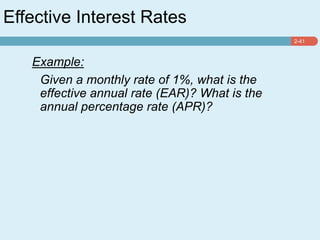
Example:
Given a monthly rate of 1%, what is the
effective annual rate (EAR)? What is the
annual percentage rate (APR)?
2-42
Effective Interest Rates
12.00%
or
.12
=
12
.01
=
APR
12.68%
or
.1268
=
1
.01)
+
(1
=
EAR
=
1
.01)
+
(1
=
EAR
12
12

-
r
-
Example:
Given a monthly rate of 1%, what is the
effective annual rate (EAR)? What is the
annual percentage rate (APR)?

Data Science Solution.pptx

  • 1.
    2-1 Brealey, Myers, andAllen Principlesof Corporate Finance 12th Edition 2 C H A P T E R HOW TO CALCULATE PRESENT VALUES Slides by Matthew Will Copyright © 2017 McGraw-Hill Education. All rights reserved. No reproduction or distribution without the prior written consent of McGraw-Hill Education.
  • 2.
    2-2 Copyright © 2017McGraw-Hill Education. All rights reserved. No reproduction or distribution without the prior written consent of McGraw-Hill Education. Topics Covered • Future Values and Present Values • Looking for Shortcuts—Perpetuities and Annuities • More Shortcuts—Growing Perpetuities and Annuities • How Interest Is Paid and Quoted
  • 3.
    2-3 Present Value andFuture Value Present Value Value today of a future cash flow. Future Value Amount to which an investment will grow after earning interest
  • 4.
    2-4 Copyright © 2017McGraw-Hill Education. All rights reserved. No reproduction or distribution without the prior written consent of McGraw-Hill Education. Future Values Future Value of $100 = FV t r) 1 ( 100 $ FV   
  • 5.
    2-5 Copyright © 2017McGraw-Hill Education. All rights reserved. No reproduction or distribution without the prior written consent of McGraw-Hill Education. Future Values t r) 1 ( 100 $ FV    Example - FV What is the future value of $100 if interest is compounded annually at a rate of 7% for two years? 49 . 114 $ ) 07 . 1 ( 100 $ 49 . 114 ) 07 . 1 ( ) 07 . 1 ( 100 $ 2         FV FV
  • 6.
    2-6 0 200 400 600 800 1000 1200 1400 1600 1800 0 1 23 4 5 6 7 8 9 10 11 12 13 14 15 16 17 18 19 20 FV of $100 Number of Years 0% 5% 10% 15% Future Values with Compounding Interest Rates
  • 7.
  • 8.
    2-8 Present Value Discount factor= DF = PV of $1 Discount factors can be used to compute the present value of any cash flow t r) 1 ( 1 DF  
  • 9.
    2-9 Copyright © 2017McGraw-Hill Education. All rights reserved. No reproduction or distribution without the prior written consent of McGraw-Hill Education. • The PV formula has many applications. Given any variables in the equation, you can solve for the remaining variable. Also, you can reverse the prior example. 100 49 . 114 PV DF PV 2 ) 07 . 1 ( 1 2 2       C Present Value
  • 10.
    2-10 0 20 40 60 80 100 120 0 1 23 4 5 6 7 8 9 10 11 12 13 14 15 16 17 18 19 20 PV of $100 Number of Years 0% 5% 10% 15% Present Values with Compounding Interest Rates
  • 11.
    2-11 Copyright © 2017McGraw-Hill Education. All rights reserved. No reproduction or distribution without the prior written consent of McGraw-Hill Education. Valuing an Office Building Step 1: Forecast cash flows Cost of building = C0 = 700,000 Sale price in Year 1 = C1 = 800,000 Step 2: Estimate opportunity cost of capital If equally risky investments in the capital market offer a return of 7%, then Cost of capital = r = 7%
  • 12.
    2-12 Copyright © 2017McGraw-Hill Education. All rights reserved. No reproduction or distribution without the prior written consent of McGraw-Hill Education. Valuing an Office Building Step 3: Discount future cash flows Step 4: Go ahead if PV of payoff exceeds investment 664 , 747 PV ) 07 . 1 ( 000 , 800 ) 1 ( 1     r C 664 , 47 000 700 664 , 747 NPV    ,
  • 13.
  • 14.
    2-14 Copyright © 2017McGraw-Hill Education. All rights reserved. No reproduction or distribution without the prior written consent of McGraw-Hill Education. Risk and Present Value • Higher risk projects require a higher rate of return • Higher required rates of return cause lower PVs 664 , 747 .07 1 800,000 PV 7% at $800,000 of PV 1     C
  • 15.
    2-15 Copyright © 2017McGraw-Hill Education. All rights reserved. No reproduction or distribution without the prior written consent of McGraw-Hill Education. Risk and Present Value 286 , 714 .12 1 800,000 PV 12% at $800,000 of PV 1     C 664 , 747 .07 1 800,000 PV 7% at $800,000 of PV 1     C
  • 16.
    2-16 Copyright © 2017McGraw-Hill Education. All rights reserved. No reproduction or distribution without the prior written consent of McGraw-Hill Education. Risk and Net Present Value $14,286 700,000 - 714,286 = NPV investment required - PV = NPV 
  • 17.
    2-17 Copyright © 2017McGraw-Hill Education. All rights reserved. No reproduction or distribution without the prior written consent of McGraw-Hill Education. Net Present Value Rule • Accept investments that have positive net present value Example Use the original example. Should we accept the project given a 10% expected return? 273 , 27 $ 1.10 800,000 + -700,000 = NPV 
  • 18.
    2-18 Copyright © 2017McGraw-Hill Education. All rights reserved. No reproduction or distribution without the prior written consent of McGraw-Hill Education. Rate of Return Rule • Accept investments that offer rates of return in excess of their opportunity cost of capital Example In the project listed below, the foregone investment opportunity is 12%. Should we do the project? 14.3% or .143 700,000 ,000 700 800,000 investment profit Return    
  • 19.
    2-19 Copyright © 2017McGraw-Hill Education. All rights reserved. No reproduction or distribution without the prior written consent of McGraw-Hill Education. Multiple Cash Flows For multiple periods we have the discounted cash flow (DCF) formula t t r C r C r C ) 1 ( ) 1 ( ) 1 ( 0 .... PV 2 2 1 1             T t r C t t C 1 ) 1 ( 0 0 NPV
  • 20.
    2-20 Net Present Values Presentvalue Year 0 30,000/1.12 870,000/1.122 Total = $26,786 = $693,559 = $20,344 $30,000 Year 0 1 2 $ 870,000 -$700,000
  • 21.
    2-21 Copyright © 2017McGraw-Hill Education. All rights reserved. No reproduction or distribution without the prior written consent of McGraw-Hill Education. Shortcuts • Sometimes there are shortcuts that make it very easy to calculate the present value of an asset that pays off in different periods. These tools allow us to cut through the calculations quickly.
  • 22.
    2-22 Copyright © 2017McGraw-Hill Education. All rights reserved. No reproduction or distribution without the prior written consent of McGraw-Hill Education. Shortcuts Perpetuity - Financial concept in which a cash flow is theoretically received forever. PV lue present va flow cash Return C r  
  • 23.
    2-23 Copyright © 2017McGraw-Hill Education. All rights reserved. No reproduction or distribution without the prior written consent of McGraw-Hill Education. Shortcuts Perpetuity - Financial concept in which a cash flow is theoretically received forever. r C1 0 PV rate discount flow cash flow cash of PV  
  • 24.
    2-24 Copyright © 2017McGraw-Hill Education. All rights reserved. No reproduction or distribution without the prior written consent of McGraw-Hill Education. Present Values Example What is the present value of $1 billion every year, for all eternity, if you estimate the perpetual discount rate to be 10%? billion 10 $ PV 10 . 0 bil $1  
  • 25.
    2-25 Copyright © 2017McGraw-Hill Education. All rights reserved. No reproduction or distribution without the prior written consent of McGraw-Hill Education. Present Values Example - continued What if the investment does not start making money for 3 years?   billion 51 . 7 $ PV 3 1.10 1 10 . 0 bil $1   
  • 26.
    2-26 Copyright © 2017McGraw-Hill Education. All rights reserved. No reproduction or distribution without the prior written consent of McGraw-Hill Education. How to Value Annuities Annuity - An asset that pays a fixed sum each year for a specified number of years             t r r r C 1 1 1 annuity of PV
  • 27.
    2-27 Copyright © 2017McGraw-Hill Education. All rights reserved. No reproduction or distribution without the prior written consent of McGraw-Hill Education. Perpetuities & Annuities PV Annuity Factor (PVAF) - The present value of $1 a year for each of t years   t r r r ) 1 ( 1 1 PVAF   
  • 28.
    2-28 Short Cuts Annuity -An asset that pays a fixed sum each year for a specified number of years. r C Perpetuity (first payment in year 1) Perpetuity (first payment in year t + 1) Annuity from year 1 to year t Asset Year of Payment 1 2…..t t + 1 Present Value t r r C ) 1 ( 1                              t r r C r C ) 1 ( 1
  • 29.
    2-29 Copyright © 2017McGraw-Hill Education. All rights reserved. No reproduction or distribution without the prior written consent of McGraw-Hill Education. Example Tiburon Autos offers you “easy payments” of $5,000 per year, at the end of each year for 5 years. If interest rates are 7%, per year, what is the cost of the car? Costing an Installment Plan 5,000 Year 0 1 2 3 4 5 5,000 5,000 5,000 5,000         20,501 NPV Total 565 , 3 07 . 1 / 000 , 5 814 , 3 07 . 1 / 000 , 5 081 , 4 07 . 1 / 000 , 5 367 , 4 07 . 1 / 000 , 5 673 , 4 07 . 1 / 000 , 5 5 4 3 2       Present Value at year 0
  • 30.
    2-30 Copyright © 2017McGraw-Hill Education. All rights reserved. No reproduction or distribution without the prior written consent of McGraw-Hill Education. Winning Big at the Lottery Example The state lottery advertises a jackpot prize of $590.5 million, paid in 30 installments over 30 years of $19.683 million per year, at the end of each year. If interest rates are 3.6% what is the true value of the lottery prize?   million 5 . 357 $ Value 036 . 1 036 . 1 036 . 1 683 . 19 lue Lottery va 30           
  • 31.
    2-31 Copyright © 2017McGraw-Hill Education. All rights reserved. No reproduction or distribution without the prior written consent of McGraw-Hill Education. Annuity Due Annuity due - Level stream of cash flows starting immediately How does it differ from an ordinary annuity? How does the future value differ from an ordinary annuity? ) 1 ( FV FV Annuity due Annuity r    ) 1 ( PV PV Annuity due Annuity r   
  • 32.
    2-32 Copyright © 2017McGraw-Hill Education. All rights reserved. No reproduction or distribution without the prior written consent of McGraw-Hill Education. Annuities Due: Example ) 1 ( FV FV Annuity AD r    Example: Suppose you invest $429.59 annually at the beginning of each year at 10% interest. After 50 years, how much would your investment be worth? 𝐹𝑉𝐴𝐷 = $429.59 × 1 .10 − 1 .10(1 + .10)50 × 1.1050 × 1.10 = $550,003.81
  • 33.
    2-33 Copyright © 2017McGraw-Hill Education. All rights reserved. No reproduction or distribution without the prior written consent of McGraw-Hill Education. Paying Off a Bank Loan Example - Annuity You are purchasing a TV for $1,000. You are scheduled to make 4 annual installments. Given a rate of interest of 10%, what is the annual payment?   47 . 315 $ PMT PMT = $1,000 4 ) 10 . 1 ( 10 . 1 10 . 1    
  • 34.
    2-34 Copyright © 2017McGraw-Hill Education. All rights reserved. No reproduction or distribution without the prior written consent of McGraw-Hill Education. FV Annuity Short Cut Future Value of an Annuity – The future value of an asset that pays a fixed sum each year for a specified number of years.             r r C t 1 1 annuity of FV
  • 35.
    2-35 FV Annuity ShortCut Example What is the future value of $20,000 paid at the end of each of the following 5 years, assuming your investment returns 8% per year?   332 , 117 $ 08 . 1 08 . 1 000 , 20 FV 5           
  • 36.
    2-36 Copyright © 2017McGraw-Hill Education. All rights reserved. No reproduction or distribution without the prior written consent of McGraw-Hill Education. Constant Growth Perpetuity g r C   1 0 PV g = the annual growth rate of the cash flow
  • 37.
    2-37 Copyright © 2017McGraw-Hill Education. All rights reserved. No reproduction or distribution without the prior written consent of McGraw-Hill Education. Constant Growth Perpetuity g r C   1 0 PV NOTE: This formula can be used to value a perpetuity at any point in time. g r C PV t t   1
  • 38.
    2-38 Copyright © 2017McGraw-Hill Education. All rights reserved. No reproduction or distribution without the prior written consent of McGraw-Hill Education. Constant Growth Perpetuity Example What is the present value of $1 billion paid at the end of every year in perpetuity, assuming a rate of return of 10% and a constant growth rate of 4%? billion 667 . 16 $ 04 . 10 . 1 PV0   
  • 39.
    2-39 Effective Interest Rates AnnualPercentage Rate - Interest rate that is annualized using simple interest Effective Annual Interest Rate - Interest rate that is annualized using compound interest
  • 40.
    2-40 EAR & APRCalculations Annual Percentage Rate (APR): *where MR = monthly interest rate 1 ) MR 1 ( EAR 12    Effective Annual Interest Rate (EAR): 12 MR APR  
  • 41.
    2-41 Effective Interest Rates Example: Givena monthly rate of 1%, what is the effective annual rate (EAR)? What is the annual percentage rate (APR)?
  • 42.
    2-42 Effective Interest Rates 12.00% or .12 = 12 .01 = APR 12.68% or .1268 = 1 .01) + (1 = EAR = 1 .01) + (1 = EAR 12 12  - r - Example: Givena monthly rate of 1%, what is the effective annual rate (EAR)? What is the annual percentage rate (APR)?