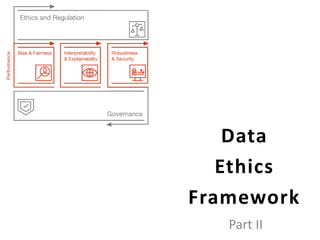
Data
Ethics
Framework
Part II
3. Use Data that is Proportionate to
the User Need
Whether your proposed data collection, storage
or analysis is proportionate will depend on:
• the user need and expected returns/public
benefit, which according to Principle 1, you
should be able to clearly demonstrate
• the type of data (personal or non-personal)
• whether personal data can be de-identified, also
known as pseudonymizing or anonymizing
• how and where you got the data
De-identifying Personal Data
Before Use
• It is good practice to work with data that has been de-
identified to the greatest degree possible.
• This process is often called anonymization, although it
is important to note that many forms of data can never
be fully and irreversibly anonymized
• Pseudonymization means the processing of personal
data in such manner that the personal data can no
longer be attributed to a specific person without the
use of additional information.
– It is a related process of removing the most re-identifying
components of the data and storing them separately.
Anonymized Pseudonymized
• If data is anonymized to the greatest degree
possible, it is likely to be out of scope of data
protection law as it is no longer considered
personal data.
• Pseudonymized data, however, is usually
subject to the same laws as fully identifiable
personal data.
Synthetic data
• You may also be able to use synthetic data ,
replacing sensitive data with a set of plausible
values, where individual citizens would not be
identifiable.
• Synthetic data is becoming increasingly popular
for training machine learning models while
preserving individuals privacy.
• The model can then be used to make predictions
on real data.
Synthetic data II
• Synthetic data is only as good as the underlying
generative methods used to produce it which can
impact the performance of the model on making
predictions on real data.
• This can be a useful approach when working on
very sensitive data or specific machine learning
applications such as computer vision.
 You should assess the proportionality of your proposed
approach i.e. whether it is necessary and appropriate. The
following questions must be answered in multidisciplinary
teams made up of data practitioners and subject matter
and operational experts:
– Is the measure suitable to achieve the aim?
– Is the measure necessary to achieve the aim?
– Would the proposed use of data be deemed inappropriate
by those who provided the data?
– Would the proposed use of data for secondary purposes
make it less likely that people would want to give that data
again for the primary purpose it was collected for?
Some Other Ways
…to understand if the data you intend to use is
proportionate to the user need are:
 user research or speaking to the user, customer,
public about your plans
 getting advice from ethics committees and individual
experts,
 reviewing public dialogue studies on how citizens
feel about data use,
 speaking to colleagues in different disciplines to get
a broader view of the policy issue, including your
organization’s Data Protection Officer or Ethics
Manager
Data Sources
Usually organizations (incl. government) relies on four
sources of data for analysis:
• repurposed operational data
• repurposed third party data e.g. social media
• statistics (derived from some other form of raw data)
• purposefully collected data (through new processes)
P.S. “data repurposing” means taking a data asset previously
used for one (or more) specific purpose(s) and using that
data set for a completely different purpose.
Repurposed Operational Data
• You must consider the proportionate use of
departmental operational data i.e. data
collected through the operation of the
department or a delivery of one of its services.
• Although most organizations have well-
established processes for using operational
data to improve services, proportionality must
be considered for each new piece of work.
Repurposed Third-party Data
• If obtaining personal data from sources, other
than directly from an individual, you must be able
to make this fair and transparent. This means
being able to provide data subjects with the
information listed in law and regulations within a
reasonable period,
• You also need to determine if you are obtaining
any special category personal data or data
relating to criminal convictions and offences
which law and regulations gives more protection
Social media data
Social media data must be used responsibly*.
Using some social media data may be considered
too intrusive to use without an individuals
consent.
It can also be difficult to determine the
representativeness of social media data when
working at regional/national or international
level.
* The Government Social Research (GSR) profession from UK has published
guidelines for using social media data responsibly in research.
Web Scraped Data
• You need to consider if using web scraped data is
appropriate for the intended data analysis. You should
also ensure individuals’ privacy is respected.
• Although information is publicly accessible, this does
not automatically provide a lawful basis for processing.
• Scraping information can be controversial when site
owners/users/citizens consider the information as
private. Even where its use is legal, individuals may feel
scraping of particular websites is not ethical.
• If scraping social media sites and forums, decide
whether your intended use is intrusive or breaches
user/customer/citizen trust.
When web scraping you must:
• always respect website terms and conditions and
robots exclusion protocol (like robots.txt)
• make sure you do not breach intellectual property
rights if you republish any data sourced from the web
• schedule web scraping activities to minimize the
impact on target websites
• not scrape websites anonymously - make sure an
identifiable IP address is visible
• have data protection processes in place to manage any
personal data you unintentionally collect
Purposefully, Newly Collected Data
• If you are collecting new data specifically
designed for your project through a tool or
application, an End User Licensing Agreement
(EULA) must be presented to users.
• To ensure informed consent, the EULA must
fully explain the terms and conditions of their
data disclosure, including the objective of the
data collection and when it will be destroyed.
Statistics
• Production is generally covered by a statutory “Code of
Practice” for statistics and subject to independent
regulation, ensuring that these data uphold rigorous
quality standards, are well documented and are free
from bias.
• Statistics can originate from survey, census and
operational data sources, but have usually undergone
extensive post-processing and quality assurance.
• For the Official Statistics (released by government
agencies), they are already aggregated and released
according to strict statistical disclosure procedures so
there is a lower risk of disproportionate use.
4. Understand the limitations of
the data
Things to consider when deciding if a source
of data is suitable include:
1) provenance (for example how and why the data
was collected)
2) errors in the data
3) bias (from historical decision making, or
unrepresentative surveys or social media)
4) if metadata and field names are ambiguous
Provenance
Specifically assess the impact of:
• the source of the data, such as a transactional service,
survey, administrative task in a public sector organization,
a government department, social media or open dataset
• whether the data was collected by humans or an
automated system
• how well the data reflects its target population
• any likely omissions, exclusions or systematic biases
• patterns in the data and whether they are likely to stay
static or change over time
• quality assurance processes when the data was collected
• the sampling strategy used to collect the data
• any other problems surrounding data collection
Errors
• Errors in data are inevitable; however it can be difficult
to understand how frequent they are, if they are
random, the cause and ways to mitigate or remove
them.
• Errors are not always immediately obvious, especially
in large datasets. Simple data visualizations can be the
best way of spotting anomalies and systematic errors.
• You will need to consider and document how identified
errors will impact the work.
• If you find errors in the way data is collected or
interpreted, report them to policy or operational staff.
Bias
• You should be aware of the types of bias that can exist in
the data you are using by reviewing how the data was
collected.
• There are many ways in which bias can be introduced into
datasets, through collection techniques, limited
representativeness of a particular cohort and social bias
from historical decision making.
• Carefully considering potential bias and its impacts on
outputs from data analysis is technically well established.
When using data in more contexts, it’s critical to involve
policy or subject matter experts to fully consider types of
bias which might not be immediately obvious to a data
practitioner.
 Measurement bias
Bias in measurement is the selection of data or samples in a
way that does not represent the true parameters (or
distribution) of the population.
 Social bias
Any data sources about customers/citizens, collected from
services, surveys, or elsewhere will contain some level of
social bias as the information is based on historic decisions
and actions by humans, or was shaped by laws no longer in
force.
Bias in training data leads to bias in algorithms. Machine
learning is a data-driven technology and the characteristics
of the data are reflected in the properties of the algorithms
(More will come in Principle 5).
 Social media
Data from social media sources may give valuable real
time or historic insight, but the data should be properly
investigated to identify any representation or selection
bias.
Include metrics and caveats about who or what the data
is representative of, and importantly, what you cannot
determine from the data.
 Practitioner bias
Data practitioners and others involved in a project may
inadvertently introduce their own confirmation bias
into the design of projects, analyses, or interpreting
outputs. Ensuring a diverse team from a range of
backgrounds is a good way to mitigate potentially
damaging practitioner bias.
Survey Methodology
• Surveys must be carefully designed and used to ensure
they cover your target population. Low response rates
may mean it’s inappropriate to use survey data.
• If the proportion of non-respondents or ‘invisible data’
is too high in a survey, it may be irresponsible to
describe the results of work with this data as
representative. Determining your proportion of
‘invisible data’ is also crucial when using machine
learning to spot correlation or network effects.
• Response and selection bias affect the generalizability
of findings. With high bias, you can’t infer that patterns
exist beyond the sample who responded.

Data Ethics Framework 2.pptx

  • 1.
  • 2.
    3. Use Datathat is Proportionate to the User Need Whether your proposed data collection, storage or analysis is proportionate will depend on: • the user need and expected returns/public benefit, which according to Principle 1, you should be able to clearly demonstrate • the type of data (personal or non-personal) • whether personal data can be de-identified, also known as pseudonymizing or anonymizing • how and where you got the data
  • 3.
    De-identifying Personal Data BeforeUse • It is good practice to work with data that has been de- identified to the greatest degree possible. • This process is often called anonymization, although it is important to note that many forms of data can never be fully and irreversibly anonymized • Pseudonymization means the processing of personal data in such manner that the personal data can no longer be attributed to a specific person without the use of additional information. – It is a related process of removing the most re-identifying components of the data and storing them separately.
  • 4.
    Anonymized Pseudonymized • Ifdata is anonymized to the greatest degree possible, it is likely to be out of scope of data protection law as it is no longer considered personal data. • Pseudonymized data, however, is usually subject to the same laws as fully identifiable personal data.
  • 5.
    Synthetic data • Youmay also be able to use synthetic data , replacing sensitive data with a set of plausible values, where individual citizens would not be identifiable. • Synthetic data is becoming increasingly popular for training machine learning models while preserving individuals privacy. • The model can then be used to make predictions on real data.
  • 6.
    Synthetic data II •Synthetic data is only as good as the underlying generative methods used to produce it which can impact the performance of the model on making predictions on real data. • This can be a useful approach when working on very sensitive data or specific machine learning applications such as computer vision.
  • 7.
     You shouldassess the proportionality of your proposed approach i.e. whether it is necessary and appropriate. The following questions must be answered in multidisciplinary teams made up of data practitioners and subject matter and operational experts: – Is the measure suitable to achieve the aim? – Is the measure necessary to achieve the aim? – Would the proposed use of data be deemed inappropriate by those who provided the data? – Would the proposed use of data for secondary purposes make it less likely that people would want to give that data again for the primary purpose it was collected for?
  • 8.
    Some Other Ways …tounderstand if the data you intend to use is proportionate to the user need are:  user research or speaking to the user, customer, public about your plans  getting advice from ethics committees and individual experts,  reviewing public dialogue studies on how citizens feel about data use,  speaking to colleagues in different disciplines to get a broader view of the policy issue, including your organization’s Data Protection Officer or Ethics Manager
  • 9.
    Data Sources Usually organizations(incl. government) relies on four sources of data for analysis: • repurposed operational data • repurposed third party data e.g. social media • statistics (derived from some other form of raw data) • purposefully collected data (through new processes) P.S. “data repurposing” means taking a data asset previously used for one (or more) specific purpose(s) and using that data set for a completely different purpose.
  • 10.
    Repurposed Operational Data •You must consider the proportionate use of departmental operational data i.e. data collected through the operation of the department or a delivery of one of its services. • Although most organizations have well- established processes for using operational data to improve services, proportionality must be considered for each new piece of work.
  • 11.
    Repurposed Third-party Data •If obtaining personal data from sources, other than directly from an individual, you must be able to make this fair and transparent. This means being able to provide data subjects with the information listed in law and regulations within a reasonable period, • You also need to determine if you are obtaining any special category personal data or data relating to criminal convictions and offences which law and regulations gives more protection
  • 12.
    Social media data Socialmedia data must be used responsibly*. Using some social media data may be considered too intrusive to use without an individuals consent. It can also be difficult to determine the representativeness of social media data when working at regional/national or international level. * The Government Social Research (GSR) profession from UK has published guidelines for using social media data responsibly in research.
  • 13.
    Web Scraped Data •You need to consider if using web scraped data is appropriate for the intended data analysis. You should also ensure individuals’ privacy is respected. • Although information is publicly accessible, this does not automatically provide a lawful basis for processing. • Scraping information can be controversial when site owners/users/citizens consider the information as private. Even where its use is legal, individuals may feel scraping of particular websites is not ethical. • If scraping social media sites and forums, decide whether your intended use is intrusive or breaches user/customer/citizen trust.
  • 14.
    When web scrapingyou must: • always respect website terms and conditions and robots exclusion protocol (like robots.txt) • make sure you do not breach intellectual property rights if you republish any data sourced from the web • schedule web scraping activities to minimize the impact on target websites • not scrape websites anonymously - make sure an identifiable IP address is visible • have data protection processes in place to manage any personal data you unintentionally collect
  • 15.
    Purposefully, Newly CollectedData • If you are collecting new data specifically designed for your project through a tool or application, an End User Licensing Agreement (EULA) must be presented to users. • To ensure informed consent, the EULA must fully explain the terms and conditions of their data disclosure, including the objective of the data collection and when it will be destroyed.
  • 16.
    Statistics • Production isgenerally covered by a statutory “Code of Practice” for statistics and subject to independent regulation, ensuring that these data uphold rigorous quality standards, are well documented and are free from bias. • Statistics can originate from survey, census and operational data sources, but have usually undergone extensive post-processing and quality assurance. • For the Official Statistics (released by government agencies), they are already aggregated and released according to strict statistical disclosure procedures so there is a lower risk of disproportionate use.
  • 17.
    4. Understand thelimitations of the data Things to consider when deciding if a source of data is suitable include: 1) provenance (for example how and why the data was collected) 2) errors in the data 3) bias (from historical decision making, or unrepresentative surveys or social media) 4) if metadata and field names are ambiguous
  • 18.
    Provenance Specifically assess theimpact of: • the source of the data, such as a transactional service, survey, administrative task in a public sector organization, a government department, social media or open dataset • whether the data was collected by humans or an automated system • how well the data reflects its target population • any likely omissions, exclusions or systematic biases • patterns in the data and whether they are likely to stay static or change over time • quality assurance processes when the data was collected • the sampling strategy used to collect the data • any other problems surrounding data collection
  • 19.
    Errors • Errors indata are inevitable; however it can be difficult to understand how frequent they are, if they are random, the cause and ways to mitigate or remove them. • Errors are not always immediately obvious, especially in large datasets. Simple data visualizations can be the best way of spotting anomalies and systematic errors. • You will need to consider and document how identified errors will impact the work. • If you find errors in the way data is collected or interpreted, report them to policy or operational staff.
  • 20.
    Bias • You shouldbe aware of the types of bias that can exist in the data you are using by reviewing how the data was collected. • There are many ways in which bias can be introduced into datasets, through collection techniques, limited representativeness of a particular cohort and social bias from historical decision making. • Carefully considering potential bias and its impacts on outputs from data analysis is technically well established. When using data in more contexts, it’s critical to involve policy or subject matter experts to fully consider types of bias which might not be immediately obvious to a data practitioner.
  • 21.
     Measurement bias Biasin measurement is the selection of data or samples in a way that does not represent the true parameters (or distribution) of the population.  Social bias Any data sources about customers/citizens, collected from services, surveys, or elsewhere will contain some level of social bias as the information is based on historic decisions and actions by humans, or was shaped by laws no longer in force. Bias in training data leads to bias in algorithms. Machine learning is a data-driven technology and the characteristics of the data are reflected in the properties of the algorithms (More will come in Principle 5).
  • 22.
     Social media Datafrom social media sources may give valuable real time or historic insight, but the data should be properly investigated to identify any representation or selection bias. Include metrics and caveats about who or what the data is representative of, and importantly, what you cannot determine from the data.  Practitioner bias Data practitioners and others involved in a project may inadvertently introduce their own confirmation bias into the design of projects, analyses, or interpreting outputs. Ensuring a diverse team from a range of backgrounds is a good way to mitigate potentially damaging practitioner bias.
  • 23.
    Survey Methodology • Surveysmust be carefully designed and used to ensure they cover your target population. Low response rates may mean it’s inappropriate to use survey data. • If the proportion of non-respondents or ‘invisible data’ is too high in a survey, it may be irresponsible to describe the results of work with this data as representative. Determining your proportion of ‘invisible data’ is also crucial when using machine learning to spot correlation or network effects. • Response and selection bias affect the generalizability of findings. With high bias, you can’t infer that patterns exist beyond the sample who responded.