Welcome
DATA-DRIVEN SITE SELECTION LEVERAGING
MACHINE LEARNING
MULLAGURI PRITHVI
TEJA
PHARM - D
034/032024
10/18/2022
www.clinosol.com | follow us on social media
@clinosolresearch
1
WHAT IS MACHINE LEARNING:
• Machine learning is a part of artificial intelligence that helps
computers find patterns in data. This allows them to make
predictions on new data.
• There are 4 different types of machine learining:
1) Supervised learning.
2) Unsupervised learning.
3) Semi-supervised learning.
4) Reinforcement learning.
10/18/2022
www.clinosol.com | follow us on social media
@clinosolresearch
2
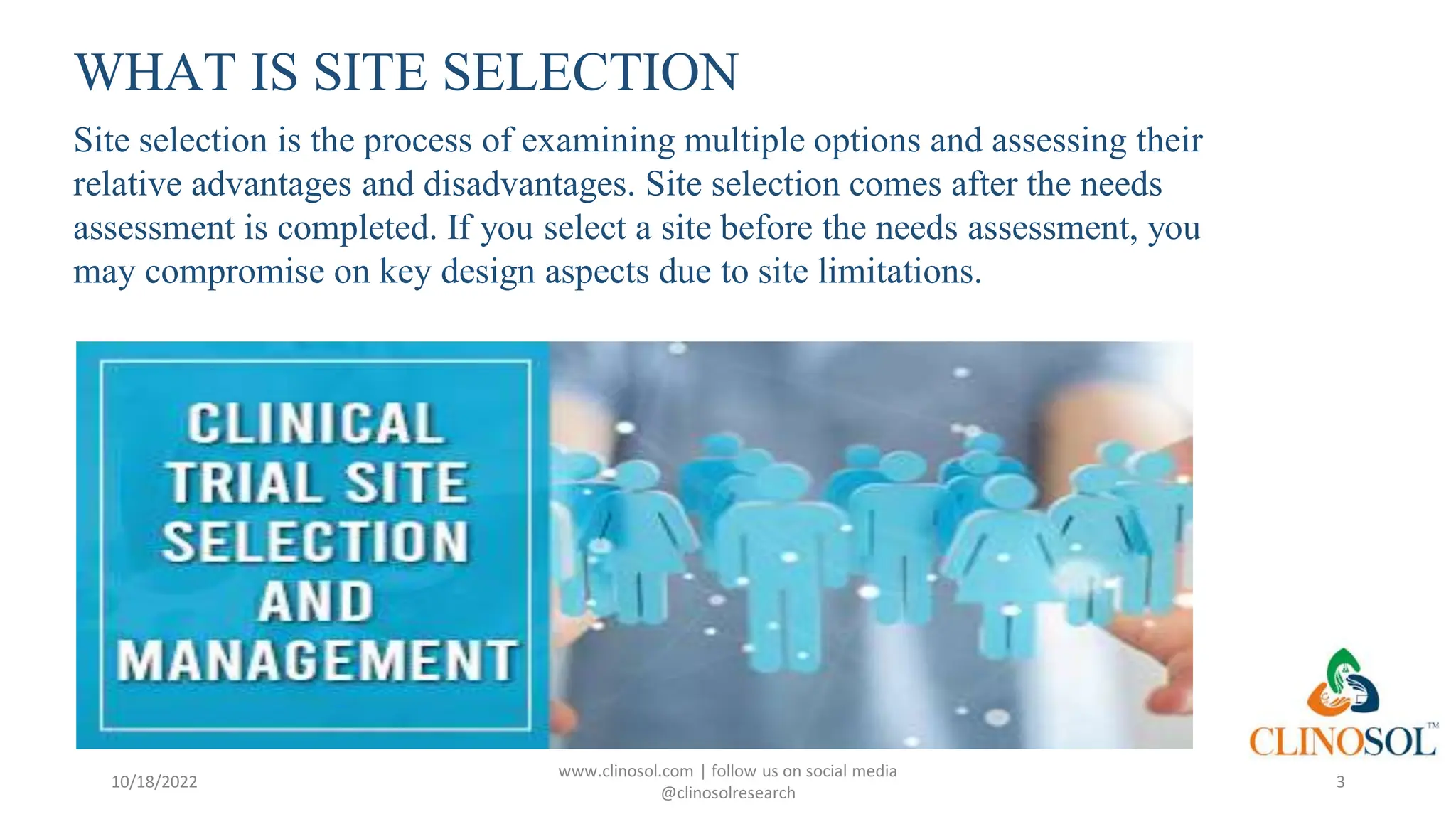
WHAT IS SITE SELECTION
Site selection is the process of examining multiple options and assessing their
relative advantages and disadvantages. Site selection comes after the needs
assessment is completed. If you select a site before the needs assessment, you
may compromise on key design aspects due to site limitations.
10/18/2022
www.clinosol.com | follow us on social media
@clinosolresearch
3
FACTORS INFLUENCING SITE SELECTION
1) Staff Qualifications:
Take into consideration the staff availability, their credentials, their experience
in clinical research and how their performance adheres to regulatory and ethical
guidelines.
2) Facilities and Equipment:
Does the facility have adequate space available for the clinical trial, drug and
device storage space, storage of important documents and equipment needed
for the study?
3) Site Profile and Timelines:
What kind of site is it? (hospital, clinical, non-profit, government or private
site), what is the site’s Institutional Review Board (IRB) meeting timeframe
and contract negotiation timeline?
10/18/2022
www.clinosol.com | follow us on social media
@clinosolresearch
4
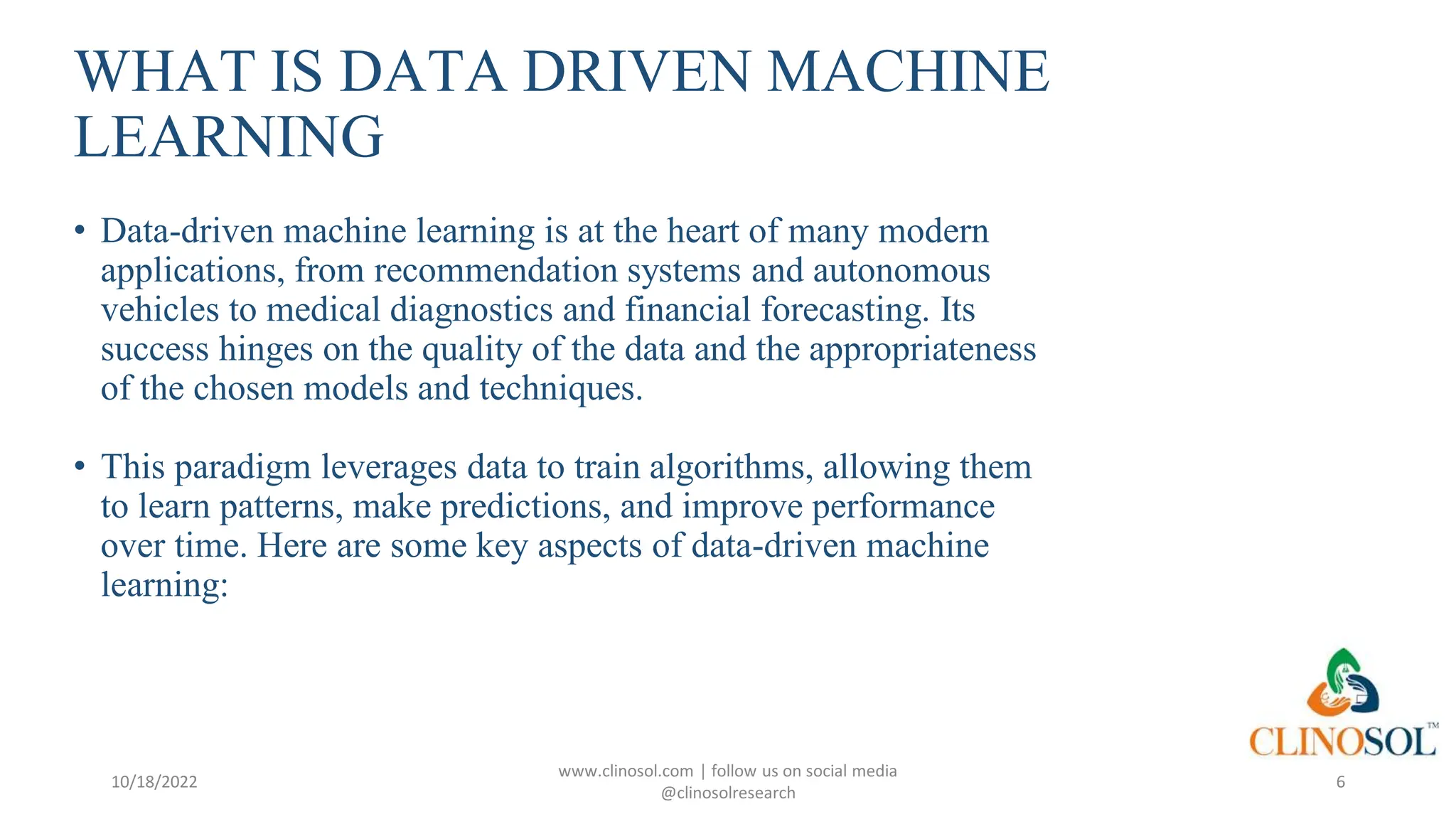
4) Population Profile and Access:
Takes into consideration the eligible participants availability and proximity to
the site, their condition, any similar ongoing trials, recruitment capabilities and
the resources available for conducting research.
5) Past Performance:
Look into the past clinical trials conducted at the site, especially trials that had
similar enrollment timelines, enrollment targets and past enrollment rates.
6) Competition:
Look at any current trials which target the same population profile. Are the
trials taking place in close proximity to your site? (This would have an impact
on participant recruitment).
7) Location:
Is the site located in a central area that is easy for participants to get to? Is it
close to amenities, including public transport, airports and hotels (for interstate
and international participants)?
10/18/2022
www.clinosol.com | follow us on social media
@clinosolresearch
5
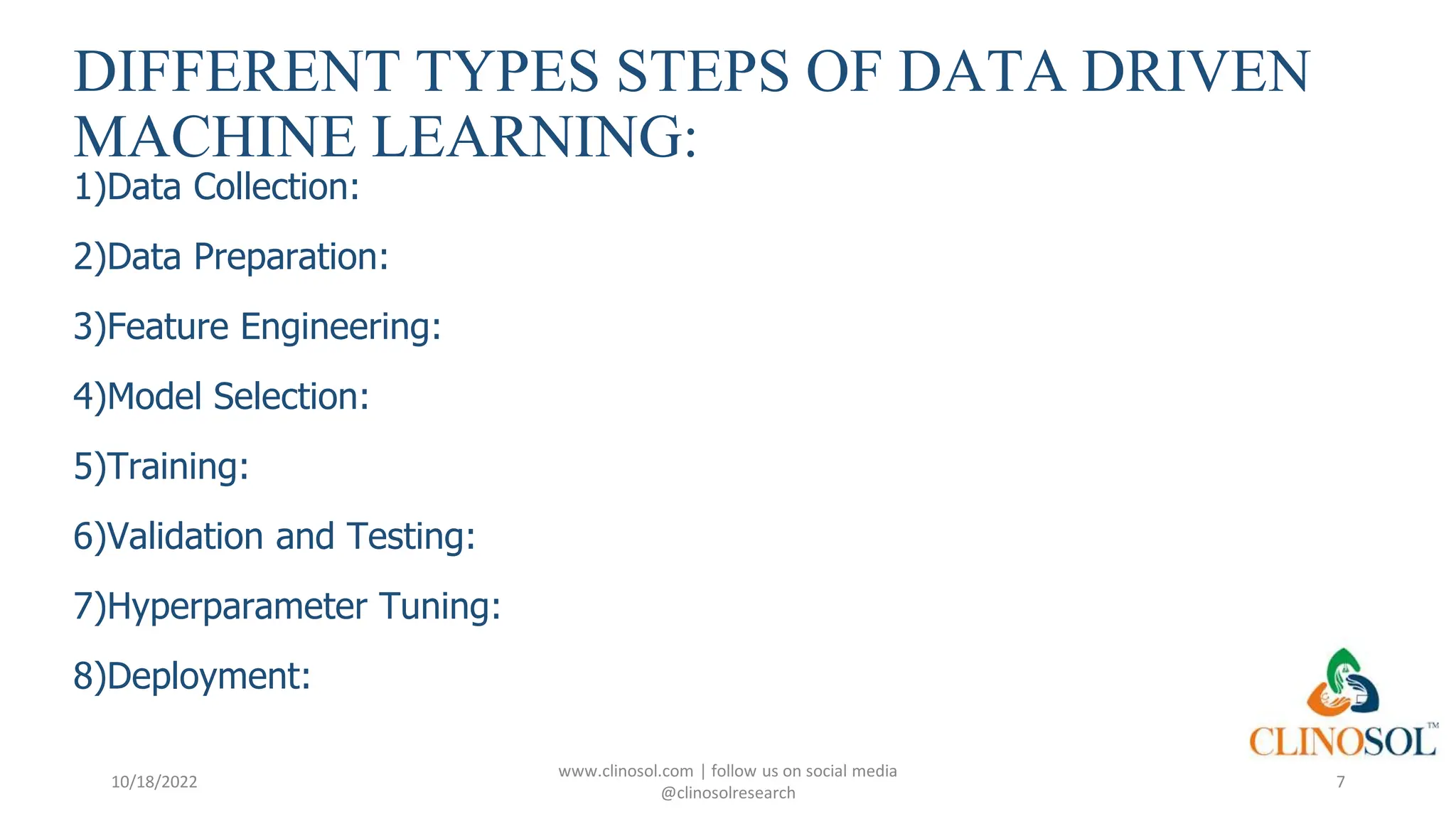
WHAT IS DATA DRIVEN MACHINE
LEARNING
• Data-driven machine learning is at the heart of many modern
applications, from recommendation systems and autonomous
vehicles to medical diagnostics and financial forecasting. Its
success hinges on the quality of the data and the appropriateness
of the chosen models and techniques.
• This paradigm leverages data to train algorithms, allowing them
to learn patterns, make predictions, and improve performance
over time. Here are some key aspects of data-driven machine
learning:
10/18/2022
www.clinosol.com | follow us on social media
@clinosolresearch
6
DIFFERENT TYPES STEPS OF DATA DRIVEN
MACHINE LEARNING:
1)Data Collection:
2)Data Preparation:
3)Feature Engineering:
4)Model Selection:
5)Training:
6)Validation and Testing:
7)Hyperparameter Tuning:
8)Deployment:
10/18/2022
www.clinosol.com | follow us on social media
@clinosolresearch
7
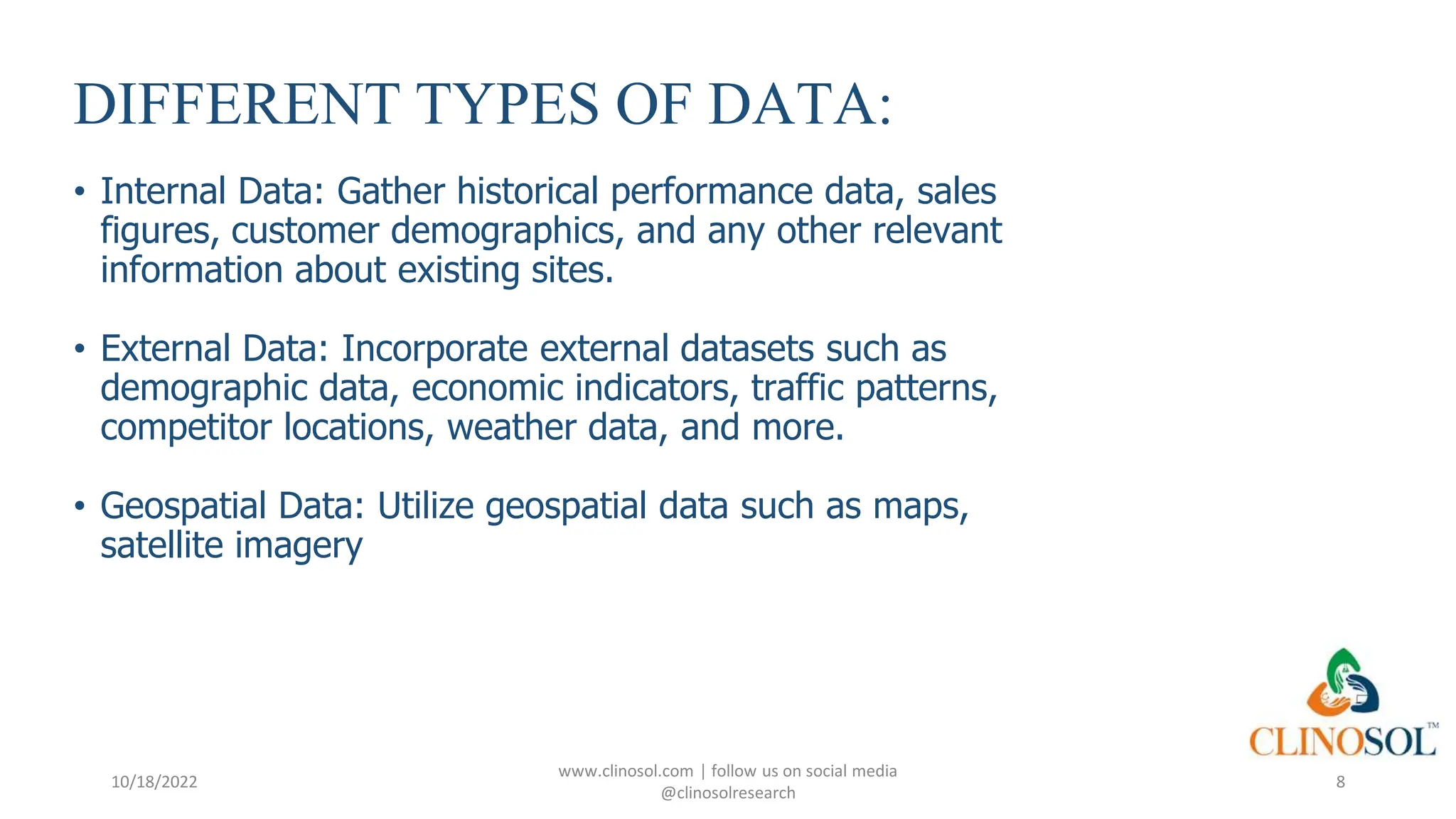
DIFFERENT TYPES OF DATA:
• Internal Data: Gather historical performance data, sales
figures, customer demographics, and any other relevant
information about existing sites.
• External Data: Incorporate external datasets such as
demographic data, economic indicators, traffic patterns,
competitor locations, weather data, and more.
• Geospatial Data: Utilize geospatial data such as maps,
satellite imagery
10/18/2022
www.clinosol.com | follow us on social media
@clinosolresearch
8
CHALLENGES :
1) DATA PRIVACY AND SECURITY:
In the realm of Big Data Analytics and Machine Learning, data
privacy and security emerge as paramount concerns. As
organizations and research institutions gather and analyze vast
amounts of data, ensuring the protection of sensitive information
becomes crucial.
2) Security Threats:
The proliferation of data also attracts malicious entities aiming to
exploit vulnerabilities. Threats such as data breaches, unauthorized
access, and cyber-attacks pose significant risks.
10/18/2022
www.clinosol.com | follow us on social media
@clinosolresearch
9
3) Regulatory Compliance:
As data privacy regulations, such as the General Data Protection
Regulation (GDPR) and the California Consumer Privacy Act
(CCPA), become more stringent, organizations must adhere to
regulatory frameworks. Non-compliance not only leads to legal
repercussions but also erodes trust among stakeholders.
10/18/2022
www.clinosol.com | follow us on social media
@clinosolresearch
10
REAL WORLD HEALTH CARE
APPLICATION:
• In the realm of healthcare, Big Data Analytics (BDA) combined
with Machine Learning (ML) has revolutionized the landscape of
medical diagnosis and patient care. The integration of electronic
health records, genomic data, medical imaging, and real-time
monitoring devices has enabled healthcare professionals to
extract actionable insights, predict potential health risks, and
personalize treatment plans. BDA facilitates the analysis of vast
datasets to identify patterns, anomalies, and correlations that may
not be apparent through traditional methods. ML algorithms,
ranging from supervised learning for predictive modeling to deep
learning for image and signal processing, play a pivotal role in
extracting meaningful information from these complex datasets.
10/18/2022
www.clinosol.com | follow us on social media
@clinosolresearch
11
• For instance, in diagnostic imaging, ML algorithms can analyze
medical images such as X-rays, MRIs, and CT scans to detect
abnormalities, tumors, or early signs of diseases with high
accuracy. Similarly, predictive models can assess a patient's
risk factors based on their medical history, genetic
predisposition, and lifestyle factors to preemptively identify and
mitigate potential health issues.
10/18/2022
www.clinosol.com | follow us on social media
@clinosolresearch
12
REFERENCES:
• 1)https://www.researchgate.net/publication/378108443_L
everaging_Big_Data_Analytics_to_Enhance_Machine_Lear
ning_Algorithms
• 2)https://www.advarra.com/blog/strategies-for-successful-
site-selection-in-clinical-trials/
• 3)https://www.sas.com/en_gb/insights/articles/analytics/m
achine-learning-
algorithms.html#:~:text=There%20are%20four%20types
%20of,%2Dsupervised%2C%20unsupervised%20and%20
reinforcement.
10/18/2022
www.clinosol.com | follow us on social media
@clinosolresearch
13
Thank You!
www.clinosol.com
(India | Canada)
9121151622/623/624
info@clinosol.com
10/18/2022
www.clinosol.com | follow us on social media
@clinosolresearch
14

Data-Driven Site Selection: Leveraging Machine Learning

  • 1.
    Welcome DATA-DRIVEN SITE SELECTIONLEVERAGING MACHINE LEARNING MULLAGURI PRITHVI TEJA PHARM - D 034/032024 10/18/2022 www.clinosol.com | follow us on social media @clinosolresearch 1
  • 2.
    WHAT IS MACHINELEARNING: • Machine learning is a part of artificial intelligence that helps computers find patterns in data. This allows them to make predictions on new data. • There are 4 different types of machine learining: 1) Supervised learning. 2) Unsupervised learning. 3) Semi-supervised learning. 4) Reinforcement learning. 10/18/2022 www.clinosol.com | follow us on social media @clinosolresearch 2
  • 3.
    WHAT IS SITESELECTION Site selection is the process of examining multiple options and assessing their relative advantages and disadvantages. Site selection comes after the needs assessment is completed. If you select a site before the needs assessment, you may compromise on key design aspects due to site limitations. 10/18/2022 www.clinosol.com | follow us on social media @clinosolresearch 3
  • 4.
    FACTORS INFLUENCING SITESELECTION 1) Staff Qualifications: Take into consideration the staff availability, their credentials, their experience in clinical research and how their performance adheres to regulatory and ethical guidelines. 2) Facilities and Equipment: Does the facility have adequate space available for the clinical trial, drug and device storage space, storage of important documents and equipment needed for the study? 3) Site Profile and Timelines: What kind of site is it? (hospital, clinical, non-profit, government or private site), what is the site’s Institutional Review Board (IRB) meeting timeframe and contract negotiation timeline? 10/18/2022 www.clinosol.com | follow us on social media @clinosolresearch 4
  • 5.
    4) Population Profileand Access: Takes into consideration the eligible participants availability and proximity to the site, their condition, any similar ongoing trials, recruitment capabilities and the resources available for conducting research. 5) Past Performance: Look into the past clinical trials conducted at the site, especially trials that had similar enrollment timelines, enrollment targets and past enrollment rates. 6) Competition: Look at any current trials which target the same population profile. Are the trials taking place in close proximity to your site? (This would have an impact on participant recruitment). 7) Location: Is the site located in a central area that is easy for participants to get to? Is it close to amenities, including public transport, airports and hotels (for interstate and international participants)? 10/18/2022 www.clinosol.com | follow us on social media @clinosolresearch 5
  • 6.
    WHAT IS DATADRIVEN MACHINE LEARNING • Data-driven machine learning is at the heart of many modern applications, from recommendation systems and autonomous vehicles to medical diagnostics and financial forecasting. Its success hinges on the quality of the data and the appropriateness of the chosen models and techniques. • This paradigm leverages data to train algorithms, allowing them to learn patterns, make predictions, and improve performance over time. Here are some key aspects of data-driven machine learning: 10/18/2022 www.clinosol.com | follow us on social media @clinosolresearch 6
  • 7.
    DIFFERENT TYPES STEPSOF DATA DRIVEN MACHINE LEARNING: 1)Data Collection: 2)Data Preparation: 3)Feature Engineering: 4)Model Selection: 5)Training: 6)Validation and Testing: 7)Hyperparameter Tuning: 8)Deployment: 10/18/2022 www.clinosol.com | follow us on social media @clinosolresearch 7
  • 8.
    DIFFERENT TYPES OFDATA: • Internal Data: Gather historical performance data, sales figures, customer demographics, and any other relevant information about existing sites. • External Data: Incorporate external datasets such as demographic data, economic indicators, traffic patterns, competitor locations, weather data, and more. • Geospatial Data: Utilize geospatial data such as maps, satellite imagery 10/18/2022 www.clinosol.com | follow us on social media @clinosolresearch 8
  • 9.
    CHALLENGES : 1) DATAPRIVACY AND SECURITY: In the realm of Big Data Analytics and Machine Learning, data privacy and security emerge as paramount concerns. As organizations and research institutions gather and analyze vast amounts of data, ensuring the protection of sensitive information becomes crucial. 2) Security Threats: The proliferation of data also attracts malicious entities aiming to exploit vulnerabilities. Threats such as data breaches, unauthorized access, and cyber-attacks pose significant risks. 10/18/2022 www.clinosol.com | follow us on social media @clinosolresearch 9
  • 10.
    3) Regulatory Compliance: Asdata privacy regulations, such as the General Data Protection Regulation (GDPR) and the California Consumer Privacy Act (CCPA), become more stringent, organizations must adhere to regulatory frameworks. Non-compliance not only leads to legal repercussions but also erodes trust among stakeholders. 10/18/2022 www.clinosol.com | follow us on social media @clinosolresearch 10
  • 11.
    REAL WORLD HEALTHCARE APPLICATION: • In the realm of healthcare, Big Data Analytics (BDA) combined with Machine Learning (ML) has revolutionized the landscape of medical diagnosis and patient care. The integration of electronic health records, genomic data, medical imaging, and real-time monitoring devices has enabled healthcare professionals to extract actionable insights, predict potential health risks, and personalize treatment plans. BDA facilitates the analysis of vast datasets to identify patterns, anomalies, and correlations that may not be apparent through traditional methods. ML algorithms, ranging from supervised learning for predictive modeling to deep learning for image and signal processing, play a pivotal role in extracting meaningful information from these complex datasets. 10/18/2022 www.clinosol.com | follow us on social media @clinosolresearch 11
  • 12.
    • For instance,in diagnostic imaging, ML algorithms can analyze medical images such as X-rays, MRIs, and CT scans to detect abnormalities, tumors, or early signs of diseases with high accuracy. Similarly, predictive models can assess a patient's risk factors based on their medical history, genetic predisposition, and lifestyle factors to preemptively identify and mitigate potential health issues. 10/18/2022 www.clinosol.com | follow us on social media @clinosolresearch 12
  • 13.
    REFERENCES: • 1)https://www.researchgate.net/publication/378108443_L everaging_Big_Data_Analytics_to_Enhance_Machine_Lear ning_Algorithms • 2)https://www.advarra.com/blog/strategies-for-successful- site-selection-in-clinical-trials/ •3)https://www.sas.com/en_gb/insights/articles/analytics/m achine-learning- algorithms.html#:~:text=There%20are%20four%20types %20of,%2Dsupervised%2C%20unsupervised%20and%20 reinforcement. 10/18/2022 www.clinosol.com | follow us on social media @clinosolresearch 13
  • 14.
    Thank You! www.clinosol.com (India |Canada) 9121151622/623/624 info@clinosol.com 10/18/2022 www.clinosol.com | follow us on social media @clinosolresearch 14