https://www.dartlang.org/events/2014/flight-school/
Familiar
Looks like Java
Looks like C#
Behaves like JavaScript &
ActionScript
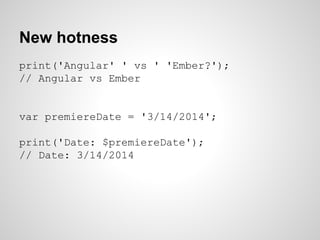
New hotness
print('Angular' ' vs ' 'Ember?');
// Angular vs Ember
var premiereDate = '3/14/2014';
print('Date: $premiereDate');
// Date: 3/14/2014
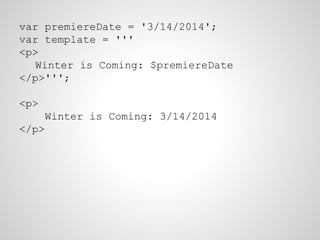
var premiereDate = '3/14/2014';
var template = '''
<p>
Winter is Coming: $premiereDate
</p>''';
<p>
Winter is Coming: 3/14/2014
</p>
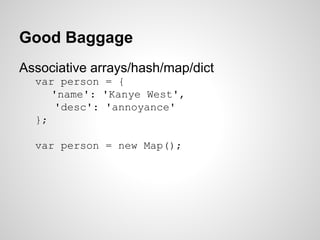
Good Baggage
Associative arrays/hash/map/dict
var person = {
'name': 'Kanye West',
'desc': 'annoyance'
};
var person = new Map();
Good Baggage
Arrays/Lists
var brands = ['Subaru', 'Tesla'];
var brands = new List();
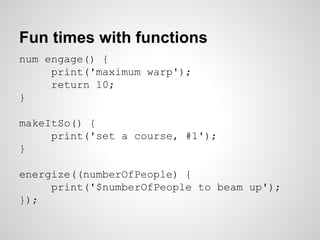
Fun times with functions
num engage() {
print('maximum warp');
return 10;
}
makeItSo() {
print('set a course, #1');
}
energize((numberOfPeople) {
print('$numberOfPeople to beam up');
});
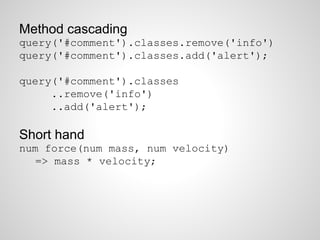
Method cascading
query('#comment').classes.remove('info')
query('#comment').classes.add('alert');
query('#comment').classes
..remove('info')
..add('alert');
Short hand
num force(num mass, num velocity)
=> mass * velocity;
Truthiness is the falsiness
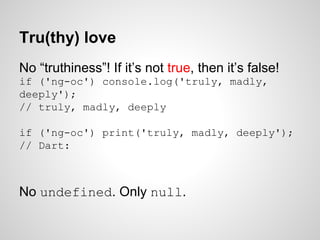
Tru(thy) love
No “truthiness”! If it’s not true, then it’s false!
if ('ng-oc') console.log('truly, madly,
deeply');
// truly, madly, deeply
if ('ng-oc') print('truly, madly, deeply');
// Dart:
No undefined. Only null.
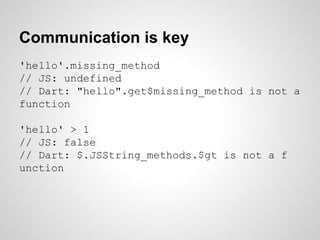
Communication is key
'hello'.missing_method
// JS: undefined
// Dart: "hello".get$missing_method is not a
function
'hello' > 1
// JS: false
// Dart: $.JSString_methods.$gt is not a f
unction
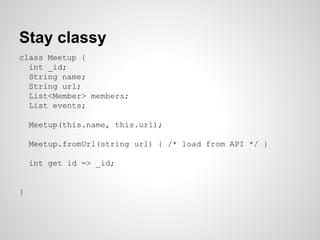
class Meetup {
int _id;
String name;
String url;
List<Member> members;
List events;
Meetup(this.name, this.url);
Meetup.fromUrl(string url) { /* load from API */ }
int get id => _id;
}
Stay classy
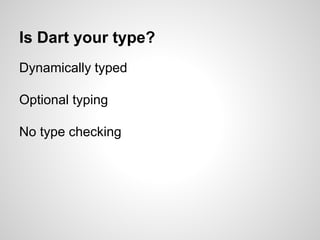
Is Dart your type?
Dynamically typed
Optional typing
No type checking
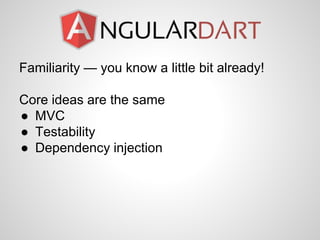
Familiarity — you know a little bit already!
Core ideas are the same
● MVC
● Testability
● Dependency injection
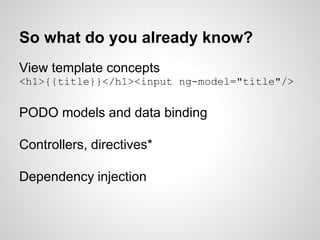
So what do you already know?
View template concepts
<h1>{{title}}</h1><input ng-model="title"/>
PODO models and data binding
Controllers, directives*
Dependency injection
Ng-Dart dependency injection
m.factory('userRepo', ['$http',
function($http) {
return {
getUser: function(id) { /*... */ }
}
}]);
class UserRepo {
UserRepo(Http httpService) { }
User getUser(int id) { /*... */ }
}
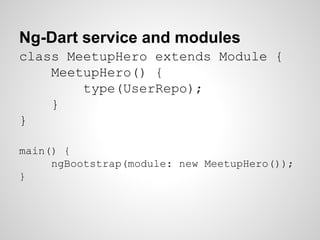
Ng-Dart service and modules
class MeetupHero extends Module {
MeetupHero() {
type(UserRepo);
}
}
main() {
ngBootstrap(module: new MeetupHero());
}
Ng-Dart controllers
@NgController(
'selector': 'meetup-controller',
'publishAs': 'ctrl')
class MeetupController {
List<Member> rsvps = [];
void addRsvp(m){ rsvps.add(m); }
}
<div meetup-controller>
<button
ng-click='ctrl.addRsvp(member)'/>
</div>
Ng-Dart directives
AngularJS manages UI with controller and
directives
AngularDart merges the concepts and adds
another
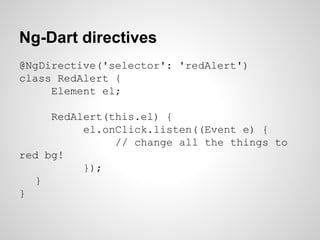
Ng-Dart directives
@NgDirective('selector': 'redAlert')
class RedAlert {
Element el;
RedAlert(this.el) {
el.onClick.listen((Event e) {
// change all the things to
red bg!
});
}
}
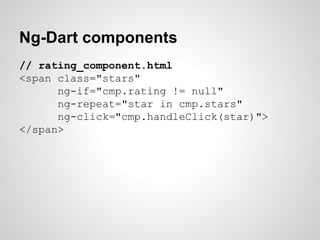
Ng-Dart components
// rating_component.html
<span class="stars"
ng-if="cmp.rating != null"
ng-repeat="star in cmp.stars"
ng-click="cmp.handleClick(star)">
</span>
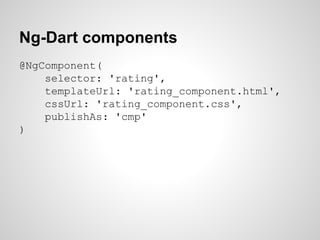
Ng-Dart components
@NgComponent(
selector: 'rating',
templateUrl: 'rating_component.html',
cssUrl: 'rating_component.css',
publishAs: 'cmp'
)
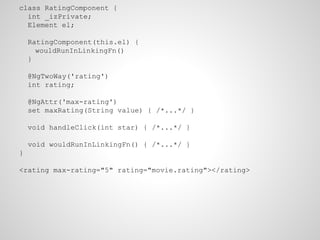
class RatingComponent {
int _izPrivate;
Element el;
RatingComponent(this.el) {
wouldRunInLinkingFn()
}
@NgTwoWay('rating')
int rating;
@NgAttr('max-rating')
set maxRating(String value) { /*...*/ }
void handleClick(int star) { /*...*/ }
void wouldRunInLinkingFn() { /*...*/ }
}
<rating max-rating="5" rating="movie.rating"></rating>
ng-show all the things
Routing, filters, testing, scope, testing & more
Metaprogramming
Tree shaking
Server-side Dart
dart2js
Polymer
Futures/Promises
& more
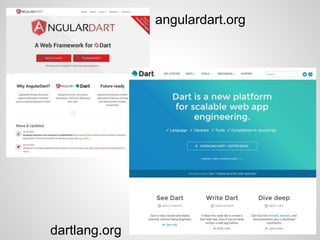
angulardart.org
dartlang.org
25% off with code
LDEB25
40% off print, 50% off
ebook with code DART
25% off with code
pragprogDart2014
ng-book.com
Connecting flight with
Google Developer Group: OC
Miles Pickens

Dart and AngularDart

Editor's Notes

  • #4 It might be awhile before Dart reaches Australia!
  • #6 As little surprises as possible New engineers can get on board quickly Classical OOP, lexical this
  • #7 Mult-line strings and expression interpolation = templates are built in!
  • #8 multi-line strings multi-line strings with interpolate makes templating super easy
  • #9 can use object literal - familiar! can use array literal - familiar!
  • #10 can use object literal - familiar! can use array literal - familiar!
  • #11 Again - familiarity with how to write functions But we can drop the function keyword to be more terse Notice return type for engage not only drop function but can drop return type Anonymous functions dont need function keyword - terser!
  • #12 Cascading method calls help you save on code bloat Fat arrow functions are useful for one-liners that return a value, like getters
  • #14 Dart’s treatment of booleans is designed to avoid the strange behaviors that can arise when many values can be treated as true. How many bugs come from truthiness brain farts? Developers from other languges are confused by this.
  • #15 Now that we know we already know Dart syntax, let’s zoom out. Javascript doesnt tell you anything useful except undefined. Why
  • #16 Private vars with _ prefix Terse constructor Name constructor because of no overloading Getter and setters Optional generics Lexical this
  • #17 Adding types will not prevent your program from compiling and running—even if your annotations are incomplete or plain wrong. Your program will have exactly the same semantics no matter what type annotations you add. documentation for humans and for machines Static checker aids with early error detection. Will not stop compilation.
  • #19 Take all the HTML you already know and bring it over into an AngularDart app Still no need to force your domain models to extend a parent object like Knockout and Ember Manage UI interactions with controllers and directives like AngularJS, sort of.
  • #20 Dart class is a little easier to read and code Dependency injection with the constructor - done by type and not by name
  • #21 Register our dependencies with type()
  • #23 AngularJS uses two different objects for managing UI interactions Directives to manipulate the DOM. They are declarative, and can be viewed as a way to extend HTML. Controllers are imperative. They are unaware of the DOM, and can contain application logic. AngularDart directives merge the two concepts. Controllers are directives that create a new scope Directives don’t create a new scope. Directives are used with existing HTML elements Components are for custom elements, reusable widgets and take advantage of shadow DOM. Create a new isolate scope.
  • #24 Used to extend or enhance existing elements. Think of showing a tooltip when hovering over a link. Here we want to set everything’s background to red. Can have multiple directives on the same element like in AngularJS
  • #25 Reuse your knowledge of Angular views from AngularJS Built in directives are still namespaced the same way Uses shadow-dom from HTML5 web components
  • #26 Although custom elements can contain other elements, they can’t be combined into a single element.
  • #27 Simply use annotations inside of the class to set up data binding Keep using your knowledge of Angular templates with components and directives Although custom elements can contain other custom elements, they can’t be combined into the same element.