dando amor
Appendix
2 3
TABLE OF CONTENTS
OUR TEAM	 4
RATIONALE	 8
PROCESS	9
THE ORGANIZATION	 10
STRATEGIC RESEARCH	 11
PUBLIC OPINION SURVEYS	 20
STORIES	22
4 5
OUR TEAM
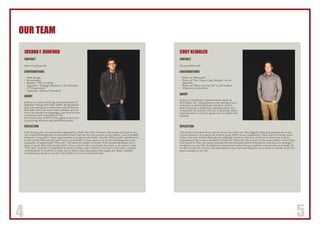
JOSHUA F. DUNFORD
CONTACT
dun11013@byui.edu
CONTRIBUTIONS
•	 Slide design
•	 Presentation
•	 Booklet: ‘Why we Help”
•	 Appendix: “Strategic Research - The Benefits 	
of Volunteerism”
•	 Appendix: “Joshua F. Dunford”
ABOUT
Joshua is a senior studying communications at
Brigham Young University Idaho. He graduates
July 2016 and plans to attend law school shortly
thereafter. He is an avid reader, debater, and car
lover. He speaks two languages, has lived on two
continents, and is president of the
Pre-Law Society at BYU-I. He aspires to become
a practicing attorney and published author.
CODY KLINGLER
CONTACT
kli13003@byui.edu
CONTRIBUTIONS
•	 Writer of “Rationale”
•	 Writer of “Our Team: Cody Klingler” in the
appendix
•	 Writer of “What You Can Do” in the booklet
•	 Allocation Committee
ABOUT
Cody is a Healthcare Administration major at
BYU-Idaho. He will graduate in the Spring of 2017,
and plans to attend graduate school to receive
both a masters in healthcare administration and
in business. He and his wife live in Rexburg, Idaho
and both share a love for sports, travel, family and
animals.
REFLECTION
I am starting my own non-profit organization. That’s the kind of impact this project has had on me.
As I worked through this I remembered that I am not the only person on the planet. I am incredibly
fortunate, I was given many opportunities to progress and make valuable albeit small contributions
to this world. Other people have been less fortunate. I have spent a lot of time thinking about the
inequality of opportunity. “Why me?” has been the subject of much of the pondering about why I
have so much that other people don’t. I have come to the conclusion that there is no answer to the
“Why me?” question. It happened, because of where and to whom I was born. I can make valuable
contributions. It would be a crime not to. That’s what this project has taught me. Make valuable
contributions, because you have the ability to do so. I will do just that.
REFLECTION
This project has opened my eyes in more ways than one. The biggest thing that jumped out to me
is how unaware I was about all of these great NPO’s in our community. I had heard of Dando Amor
before, but only of their Shoes4Love campaign. I had no idea how much more there was to their
organization, but I am so thankful I found out. What they do is some of the most selfless work I have
ever heard of. They are always putting the less fortunate before themselves, and that is a message I
needed in my own life. It helped me realize how lucky I have it, and how easy it is for us to help. All
we did was ask the owners, and immediately they had something for us to work on. Dando Amor is a
great example in my life.
6 7
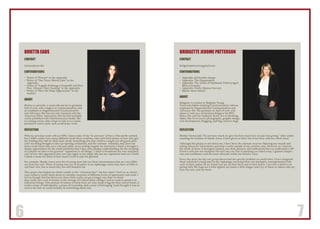
BRIDGETTE JEROME PATTERSON
CONTACT
bridgettepatterson@gmail.com
CONTRIBUTIONS
•	 Appendix and booklet design
•	 Appendix: The Organization
•	 Appendix: The Needs of Orphaned, Puberty-aged 	
	 Boys in Ecuador
•	 Appendix: Public Opinion Surveys
•	 Dando Amor liaison
ABOUT
Bridgette is a senior at Brigham Young
University-Idaho studying Communication with an
emphasis in Organizational Communication and
Advocacy. She will graduate in April of 2016, and
plans to work as a curriculum designer for BYU-
Idaho. She and her husband, Keith, live in Rexburg,
Idaho. She loves travel, photography, graphic design,
web development, blogging, quilting, and her dogs.
REFLECTION
Mother Teresa said, “It’s not how much we give but how much love we put into giving.” After under-
standing the mission of Dando Amor, I have given so little, but it has been with my whole heart.
Although this project is not about me, I have been the ultimate receiver. Opening my mouth and
asking others for information and help is miles outside of my comfort zone. However, as I learned
the needs of these 18 teenaged orphans, saw their pictures, and understood that we could make a dif-
ference with just one backpack for each boy, my fear of speaking out faded away, I gained compas-
sion and confidence, and the inner advocate inside me found a voice.
Every day since the day our group discovered the specific problem we could solve, I have imagined
these wonderful young men in the orphanage receiving their own backpack, monogrammed with
each of their names. In my mind I see joy on their faces and in their hearts. I am now a believer in
giving fully. My hugs are a little tighter, my kisses a little longer, and I try to listen to others with my
ears, my eyes, and my heart.
BRIETTA EADS
CONTACT
brietta@byui.edu
CONTRIBUTIONS
•	 Writer of “Process” in the Appendix
•	 Writer of “Our Team: Brietta Eads” in the
Appendix
•	 Writer of “Legally Defining a Nonprofit and How 	
They Allocate Their Funding” in the Appendix
•	 Writer of “How We Help: Opportunity” in the
booklet
ABOUT
Brietta is currently 21-years-old and set to graduate
Fall of 2016, with a degree in Communication, and
an emphasis in Organizational Communication
and Advocacy. She has not only interned with the
American Heart Association, but has had multiple
works published with Charleston-area media. She
is a strong writer, with a hope to take it to a more
persuasive career path, such as advocacy work.
REFLECTION
With my previous work with an NPO, i knew some of the “in and outs” of how a Non-profit worked,
but I didn’t realize how many different kinds there could be, what each kind meant, or how they got
the funding they did for their basic needs. Something else that i believe caught me off guard quite
a bit was being brought to this eye-opening realization, and the constant reminder, that there are
these social issues that are a real and, sadly, never ending tragedy for humanity. I think it brought a
deeper appreciation for the small problems that I face, and a deeper understanding for the meaning
of a phrase we take so for granted- “opposition in all things.” I think it broadened my very simplistic
view of how this opposition does not only apply to my single life, but my experience here as a whole.
I think it made me think of how much I tend to take for granted.
For example, Dando Amor cares for 18 young men that are from circumstances that are very differ-
ent from my own. These 18 young men are in Ecuador, in an orphanage where they have so little to
call their own, but so much they are still thankful for.
This project has helped me think outside or the “American box”- the box where I feel we, as Ameri-
cans, refuse to really think about or consider countries of different levels of opportunity and need. I
feel as though this has shown me that a little really can go a longer way than we think.
$200 really isn’t a lot of money to the average US citizen (after college), and we tend to spend it on
ridiculous things. This amount of money to these boys not only sends a bag for their school books, it
sends a sense of individuality, a sense of ownership, and a sense of belonging. I just thought it was so
cool to see that we could actually do something about that.
8 9
RATIONALE PROCESS
WHY DID WE SELECT THIS ORGANIZATION?
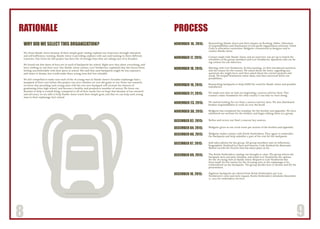
We chose Dando Amor because of their simple goal: raising orphans out of poverty through education
and self-sufficiency training. Dando Amor is providing orphans with care and training in three different
countries. Our focus for this project has been the 18 teenage boys they are taking care of in Ecuador.
We found out that these 18 boys are in need of backpacks for school. Right now they share everything, and
have nothing to call their own. Our Dando Amor contact, Lori Nordstrom, explained that this leaves them
feeling uncomfortable with their peers at school. She said that used backpacks might be less expensive
and easier to donate, but would make these young men feel less valuable.
We felt compelled to make sure each of the 18 young men in Dando Amor’s Ecuador orphanage had a
backpack of their own before this project was over, whether we won the grant or not. From our research,
we know that providing each young man with his own new backpack will increase his chances of
graduating from high school, and become a healthy and productive member of society. We know our
decision to help is a small thing, compared to all of their needs, but we hope that because of our research
and advocacy we are able to help Dando Amor reach their simple goal, and that we can help each young
man in their orphanage feel valued.
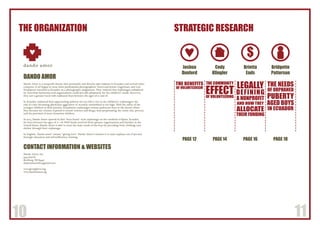
NOVEMBER 16, 2015: Researching Dando Amor and their impact on Rexburg, Idaho. Allocation
of responsibilities and finalization of non-profit organization selection. Voted
Cody to allocation committee. Bridgette volunteered as designer and to
contact Dando Amor.
Contact made with Dando Amor, and an interview was set up to match the
schedules of the group members and Lori Nordstrom. Questions also are be-
ing written for our interview.
Meeting with Lori Nordstrom. In this meeting, we first introduced ourselves
and the reason for the contact. We asked about the letter, regarding any
questions she might have, and then asked about the current projects and
needs. We helped brainstorm some ideas, and then narrowed down our
possibilities.
Researching backpacks to help fulfill the need for Dando Amor and possible
subsidiaries.
We made sure that we had our beginning 5 sources and key facts. This
created a basic foundation for what exactly it was that we were doing.
Bridgette has completed the template for the booklet and appendix. We have
submitted our sections for the booklet, and begin editing them as a group.
Refine and review our final 5 sources/ key sources.
Bridgette gives us our word count per section of the booklet and appendix.
Bridgette makes contact with Kettle Embroidery. They agree to embroider
the backpacks and help subsidize a part of the cost for the backpacks.
Josh takes photos for the group. All group members turn in reflections,
biographies, finalized key facts and sources. Cody finished the Rationale.
Brietta records the Process that has taken place so far.
The Kettle Embroidery catalog was brought to class. The group selects the
backpack style and price finalists, and email Lori Nordstrom the options
for the 18 young men at Dando Amor. Request to Lori Nordstrom has
been made for the names for the 18 young men at the orphanage to be
embroidered on the backpacks. The group decides how to format and fill the
presentation.
Eighteen backpacks are odered from Kettle Embroidery per Lori
Nordstrom’s color and style request. Kettle Embroidery schedules December
17, 2015 for embroidery services.
We started looking for our final 5 sources and key facts. We also distributed
booklet responsibilities to work on over the break
Icon made byFreepik from www.flaticon.com and licensed under CC by 3.0
DECEMBER 09, 2015:
DECEMBER 07, 2015:
DECEMBER 06, 2015:
DECEMBER 04, 2015:
DECEMBER 02, 2015:
NOVEMBER 30, 2015:
NOVEMBER 23, 2015:
NOVEMBER 21, 2015:
NOVEMBER 19, 2015:
NOVEMBER 18, 2015:
NOVEMBER 17, 2015:
DECEMBER 10, 2015:
10 11
STRATEGIC RESEARCHTHE ORGANIZATION
DANDO AMOR
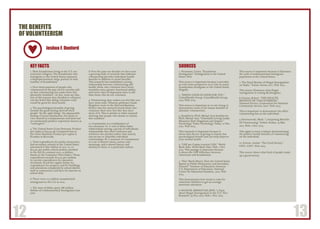
Dando Amor is a nonprofit charity that personally and directly aids orphans in Ecuador, and several other
countries. It all began in 2009 when professional photographers Travis and Jennie Gugelman, and Lori
Nordstrom travelled to Ecuador on a photography assignment. They realized that orphanages subsidized
by American businesses and organizations could provide adequately for the children’s needs. However,
they saw a greater need with orphaned boys between the ages of 12 and 18.
In Ecuador, orphaned boys approaching puberty are too old to live in the children’s’ orphanages; the
risk of a boy becoming physically aggressive or sexually uninhibited is too high. With the safety of the
younger children as their priority, Ecuadorian orphanages release pubescent boys to the streets where
they become the victims, exposed to sexual violence and drugs, thus perpetuating the crime rate, poverty,
and the potential of more homeless children.
In 2013, Dando Amor opened its first “boys home” style orphanage on the outskirts of Quito, Ecuador,
for boys between the ages of 12 –18. With funds received from sponsor organizations and families in the
United States, Dando Amor is able to meet the basic needs of the boys by providing food, clothing, and
shelter through their orphanage.
In English, “dando amor” means, “giving love”. Dando Amor’s mission is to raise orphans out of poverty
through education and self-sufficiency training.
CONTACT INFORMATION & WEBSITES
Dando Amor, Inc.
4455 Jud St.
Rexburg, ID 83440
dadnoamorinfo@gmail.com
www.givinglove.org
www.dandoamor.org
dando amor
$
PAGE 12 PAGE 14 PAGE 16 PAGE 18
THE NEEDS
OF ORPHANED
PUBERTY
AGED BOYS
IN ECUADOR
THE COMMUNITY
EFFECTOF VOLUNTEERING
LEGALLY
DEFINING
A NONPROFIT
AND HOW THEY
ALLOCATE
THEIR FUNDING
Joshua
Dunford
Cody
Klingler
Brietta
Eads
Bridgette
Patterson
THE BENEFITS
OF VOLUNTEERISM
12 13
THE BENEFITS
OF VOLUNTEERISM
1.	Neumann, Caryn. “Ecuadorian
Immigrants.” Immigration to the United
States. Web.
This source is important because it provides
us with some perspective as to why so many
Ecuadorians immigrate to the United States
illegally.
2.	“DOING GOOD IS GOOD FOR YOU.”
UnitedHealth Group. UnitedHealth Group,
2013. Web. 2015.
This source is important as we are trying to
demonstrate some of the innate benefits of
altruistic volunteerism.
3.	Strahilevitz Ph.D. Michal Ann Strahilevitz
Ph.D, Michal Ann. “Charitable Giving Guide:
Maximize Both Happiness and Impact.”
Psychology Today. Psychology Today, 12 Dec.
2012. Web. 2015.
This research is important because it
shows that the act of giving to charity has
psychological benefit and can help improve
your mental health.
4.	“GDP per Capita (current US$).” World
Bank Data. World Bank Data. Web. 1 Nov.
2015. This passage is important because
it shows the GDP difference between
Americans and Ecuadorians.
5.	“How Much Money Does the United States
Spend on Public Elementary and Secondary
Schools?” Institute of Education Sciences.
U.S. Department of Education, National
Center for Education Statistics., 2015. Web.
2015.
This demonstrates how much it costs for
American Children to get an average
american education.
6.	MANUEL KROGSTAD, JENS. “5 Facts
about Illegal Immigration in the U.S.” Pew
Research. 19 Nov. 2015. Web. 1 Nov. 2015.
1.	Most Ecuadorians living in the U.S. are
economic refugees. The Ecuadorians who
immigrate to the United States represent
a disproportionately large portion of total
number of Ecuadorians.
2.	Over three-quarters of people who
volunteered in the past twelve months told
us that volunteering has made them feel
physically healthier—in fact, most say that
one of the reasons they decided to volunteer
was the belief that doing volunteer work
would be good for their health.
3.	The psychological benefits of giving
include the good feeling derived when
people “do the right thing”, the pleasurable
feeling of moral satisfaction, the desire to
view oneself as compassionate and kind and
an emotionally positive experience known as
“warm-glow”.
4.	The United States Gross Domestic Product
per capita is $53,041.98. Compared that to
the Gross Domestic Product per capita in
Ecuador at $6,002.89.
5.	Total expenditures for public elementary
and secondary schools in the United States
amounted to $621 billion in 2011–12, or
$12,401 per public school student enrolled
in the fall (in constant 2013–14 dollars,
based on the Consumer Price Index). These
expenditures include $11,014 per student
in current expenditures for operation
of schools; $1,018 for capital outlay (i.e.,
expenditures for property and for buildings
and alterations completed by school district
staff or contractors); and $370 for interest on
school debt.
6.	There were 11.3 million unauthorized
immigrants in the U.S. in 2014.
7.	The state of Idaho spent 188 million
dollars on Undocumented Immigrants Last
year.
Joshua F. Dunford
8.	Over the past two decades we have seen
a growing body of research that indicates
volunteering provides individual health
benefits in addition to social benefits.
This research has established a strong
relationship between volunteering and
health: those who volunteer have lower
mortality rates, greater functional ability,
and lower rates of depression later in life
than those who do not volunteer.
9.	Volunteering time makes you feel like you
have more time. Wharton professor Cassie
Mogilner wrote in the Harvard Business
Review that her research found those who
volunteer their time feel like they have
more of it. This is similar to other research
showing that people who donate to charity
feel wealthier.
10.	Community is a combination of
two elements: A) A web of affect laden
relationships among a group of individuals,
relationships that often crisscross and
reinforce one another-rather than merely
one-on-one or chainlike individual
relationships; B) A measure of commitment
to a set of shared values, norms, and
meanings, and a shared history and
identity-in short, to a particular culture.
KEY FACTS
This source is important because it illustrates
the scale of undocumented immigrant
population in the United States.
7.	The Fiscal Burden of Illegal Immigration
on Idaho.” Farius. Farius, 2011. Web. 2015.
This source illustrates what illegal
immigration is costing Rexburgians.
8.	Grimm, Robert. “THE HEALTH
BENEFITS OF VOLUNTEERING.”
National Service. Corporation for National
Community Service, 2007. Web. 2015.
This is important to demonstrate the effect
volunteering has on the individual.
9.	Horoszowski, Mark. “5 Surprising Benefits
Of Volunteering.” Forbes. Forbes, 19 Mar.
2015. Web. 1 Nov. 2015.
This again is more evidence demonstrating
the positive health benefits of volunteering
on the individual.
10.	Etzioni, Amitai. “The Good Society.”
GWU. GWU. Web. 2015.
This source shows what kind of people make
up a good society.
SOURCES
14 15
1.	Joanna Saisan, M.S.W., Melinda Smith,
M.A., and Gina Kemp, M.A, “Volunteering
and its Surprising Benefits” September 2015.
Web.
This source is important because it shows
that volunteering will teach you new skills
that you never knew you had, and can also
help polish the skills you already have.
2.	Ten Professional Development Benefits of
Volunteering (Everything I Learned in Life
I Learned through Volunteering). Mary V.
Merrill, LSW, Merrill Associates. 2005. Web.
This resource asks, what better way is there
to serve your community, then to give a
little back? Volunteering will benefit us in
more ways than we realize.
3.	Douglas LaBier, Ph.D., “How Volunteering
Affects the Volunteer”, Huffington Post,
2010. Web.
This article is important because it shows
how volunteering reshapes people’s values.
4.	Huiting Wu, Points of Light Institute, 2011.
Web.
This source shows how volunteering creates
a more cohesive community.
5.	Mike Michalowicz, “Learn
Entrepreneurship By Volunteering”, 2012.
Web.
This article proves how volunteering allows
you to express yourself and meet new
people.
6.	Idealist.org, “The Benefits of Volunteering”
Web.
This source mentions the difference
volunteering has on a community.
1.	Just because volunteer work is unpaid
does not mean the skills you learn are basic.
Many volunteering opportunities provide
extensive training.
2.	What better way is there to connect with
your community and give a little back? As
a volunteer, you certainly return to society
some of the benefits that society gives you.
3.	We’ve found that volunteer activity
often reshapes or redirects people’s values,
perspectives and even their life goals in
several ways. It can spur new growth and
awareness, both spiritually and emotionally.
4.	People feel stronger connection to
community, more strength of his/her
connection to the community, as represented
by the strength of feelings toward the
community, including attachment,
awareness, and commitment.
5.	People volunteer because they get more
out of the experience than what they put
into it.
6.	Volunteering is one of the best ways
we know of to make a difference in your
community. Whatever your passion, however
you get involved, volunteering offers a way
to have a real and lasting impact on
the world.
7.	You can experience the real world through
hands-on work. And you can explore your
major or career interests at the same time.
8.	Not only do you get to gain experience,
but you meet people who can be a potential
reference when you’re job hunting if you
made the right impression, or they may
recommend a place to apply.
9.	Also, volunteering in a new industry will
give you knowledge to help you switch
fields.As a volunteer you help: Support
families (daycare and eldercare), Improve
THE COMMUNITY EFFECT
OF VOLUNTEERING
CODY KLINGLER
7.	Collegeboard.org, “Volunteering: How
Helping Others Helps You” Web.
This resource brings up the topic of real
world work, through volunteering.
8.	Volunteernow.org, “The Benefits of
Volunteering” Web.
This source pushes for people to volunteer,
because they think it can create connections
for later job opportunities.
9.	Mark Horoszowski, “5 Surprising Benefits
of Volunteering” Forbes, 2015, Web.
This source says that volunteering will help
develop new skills that are helpful on your
resume.
10.	UC San Diego, ucsd.edu, “Community
Service: Top 10 Reasons to Volunteer”, 2015,
Web.
This Universities study shows how
many different people you can help by
volunteering.
KEY FACTS SOURCES
schools (tutoring, literacy), Support youth
(mentoring and after-school programs),
Beautify the community (beach and park
cleanups).
10.	As a volunteer you help: Support
families (daycare and eldercare), Improve
schools (tutoring, literacy), Support youth
(mentoring and after-school programs),
Beautify the community (beach and park
cleanups).
16 17
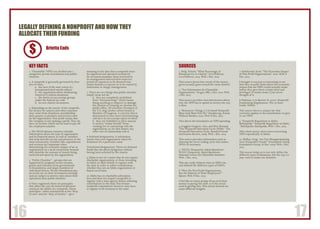
LEGALLY DEFINING A NONPROFIT AND HOW THEY
ALLOCATE THEIR FUNDING
1.	Delp, Valorie. “What Percentage of
Donations Go to Charity.” LoveToKnow.
LoveToKnow, 2015. Web. 1 Dec. 2015.
This source shows how much of the money
given actually goes toward the cause desired.
2.	“Tax Information for Charitable
Organizations.” Irs.gov. IRS, 2 Nov. 2012. Web.
1 Dec. 2015.
This source provides vital information about
why the NPO has to spend its money the way
it does.
3.	“Resources: Things a U.S.-based Nonprofit
Must (and Must Not) Do.” Idealist.org. Action
Without Borders, 2015. Web. 8 Dec. 2015.
This shows the boundaries on NPO spending.
4.	Goggins Gregory, Ann, and Don Howard.
“The Nonprofit Starvation Cycle (SSIR).” The
Nonprofit Starvation Cycle. Stanford Social
Innovation Review, 2009. Web. 1 Dec. 2015.
This source provides information such as
showing the never ending cycle that makes
NPO’s so necessary.
5.	“NCCS | Frequently Asked Questions.”
NCCS | Frequently Asked Questions.
National Center for Charitable Statistics.
Web. 1 Dec. 2015.
This site really defined what an NPO was,
and defined the different types of NPO’s.
6.	“How Do Non-Profit Organizations
Pay the Salaries of Their Employees?” -
Quora. Web. 8 Dec. 2015.
I feel like so many people focus on if their
money is paying the staff, or if the actual
need is getting met. This article showed me
some different insights.
1.	“Charitable” NPO’s are divided into 2
categories: private foundations and public
charities.
2.	A nonprofit is generally governed by four
sets of rules:
a.	 the laws of the state where it’s
incorporated (and maybe others)
b.	 the regulations about fundraising
wherever it solicits donations
c.	 the limits on tax-exempt groups
under the federal tax code
d.	 its own charter documents
3.	Depending on the nature of the nonprofit,
the money for salaries and other expenses
may come from donations, membership
dues, grants, or products and services sold
by the organization. Non profit means that
the company is not making a profit. They do
have an income which can be used to pay off
the employees salaries.
4.	The NCCS dataset contains valuable
information about the type of organization
and its financial status, as well as variables
that help describe its size and presence in the
local community. Variables like expenditures
and revenue are important when
determining the economic impact of an 29
organization on a local community because
they describe the amount of money being
received and spent by the organization.
5.	“Public Charities” – groups that are
supported by program service income,
grants and contracts from governments
or foundations, and larger numbers of
individual donors. Private foundations pay
an excise tax on their investment earnings
and are subject to stricter rules about their
operations than public charities.
6.	Once organized, there are principles
that affect the way the board of directors
conducts the affairs of a nonprofit. These
principles—often summarized as the “duty
of care” and the “duty of loyalty”—give
Brietta Eads
meaning to the idea that a nonprofit must
be organized and operated exclusively
for its stated purposes; those involved in
its management and activities must not
permit its resources to be diverted into
undue benefits to anyone or to be wasted by
inattention or sloppy management.
7.	There are two things that public charities
simply must not do:
a.	 they are completely prohibited
from “electioneering,” which means
doing anything to improve or damage
the chances of winning an election for
public office. All elections: President of
the U.S., dog catcher, school board or
Member of Congress. A 501(c)(3) that is
determined to have been electioneering
will have its tax-exempt status revoked.
b.	 they are forbidden to allow anyone
to receive “undue benefit” from
working for or contracting with the
organization, or, for that matter, any
other sort of relationship with it.
8.	Solicited designations. A solicitation
means that your organization asked for
donations for a particular cause.
Unsolicited designations. These are donated
funds that the donor designates without
having been solicited by the charity.
9.	Idaho is one of 11 states that do not require
charitable organizations, or those intending
to solicit on their behalf, to register with
the state in order to solicit contributions,
whether they are an Idaho organization or
based out-of-state.
10.	Idaho has no charitable solicitation
laws and does not require nonprofits to
register with a state agency before soliciting
contributions in the state. Out-of-state
nonprofit corporations, however, may have
to register to do business in the state.
$
KEY FACTS
7.	Sobolewski, Scott. “The Economic Impact
of Non-Profit Organizations.” 2010. Web. 8
Dec. 2015.
I thought it was just so interesting to see
that they actually think about the economic
impact that the NPO would actually make
before they give them certain titles and
privileges. It makes sense, I just never
thought of it.
8.	Fishman, S. & Barrett, R. (2012). Nonprofit
Fundraising Registration: The 50 State
Guide. NOLO.
This source shows a unique law that
currently applies to the contribution we give
to our NPO.
9.	“Nonprofit Regulation in Idaho -
Ballotpedia.” Nonprofit Regulation in Idaho
- Ballotpedia. Balotpedia. Web. 1 Dec. 2015.
This whole source shows laws concerning
NPO’s specifically in Idaho.
10.	McRay, Greg. “Are You Misappropriating
Your Nonprofit’s Funds?” Foundation Group.
Foundation Group, 16 Dec. 2009. Web. 1 Dec.
2015.
This source helps us to not only define the
different types of donations, but the way we
may want to make our donation.
SOURCES
18 19
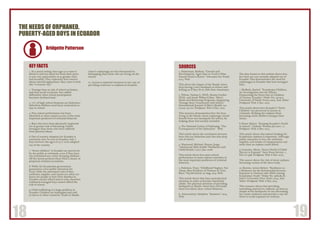
THE NEEDS OF ORPHANED,
PUBERTY-AGED BOYS IN ECUADOR
1.	In a social setting, boys age 9-12 want to
blend in and not stand out from their peers
in any way, particularly as to gender roles
and sexuality. They especially feel concern
about outward appearance; they want to look
like “everyone else.”
2.	Teenage boys at risk of school exclusion,
and thus social exclusion, face added
difficulties when school participation
becomes dysfunctional.
3.	71% of high school dropouts are fatherless;
fatherless children need more motivation to
stay in school.
4.	Poor school performance has been
identified in some reports as one of the most
important predictors of criminal behavior.
5.	Boys who have been physically neglected
are at greater risk of becoming violent
teenagers than those who have suffered
from physical abuse.
6.	Out of country adoption for Ecuador is
extremely rare. In 2013 in Ecuador, only 2
boys between the ages of 13-17 were adopted
out of the country.
7.	“Street children” in Ecuador are perceived
by the public as criminals, even if they have
not committed any crime. Keeping children
off the streets protects them from a future of
perpetual criminal accusation.
8.	While the Ecuadorian government
guarantees a free public education for
every child, the associated costs of fees,
uniforms, supplies, and transit are often too
heavy for people to bear. Poor families in
Ecuador cannot afford school costs, therefore
orphaned teenaged boys cannot afford the
cost of school.
9.	Child trafficking is a huge problem in
Ecuador. Children are kidnapped and sold
as slaves to other countries. Youth in Dando
Bridgette Patterson
Amor’s orphanage are less threatened by
kidnapping than those who are living on the
streets.
10.	Access to material resources is one way of
providing resilience to orphans in Ecuador.
1.	Huberman, Barbara. “Growth and
Development, Ages Nine to Twelve What
Parents Need to Know.” Advocates for Youth.
2015. Web.
This shows the impact of the Dando Amor
boys having a new backpack at school, and
feeling as if they fit in with their classmates.
2.	Wilson, Nathan J., P.H.D., Reinie Cordier
P.H.D., and Sarah Wilkes-Gillan. “Men’s
Sheds and Mentoring Programs: Supporting
Teenage Boys’ Connection with School.”
International Journal of Men’s Health 13.2
(2014): 92-100. ProQuest. Web. 6 Dec. 2015.
This resource demonstrates how the boys
living in the Dando Amor orphanage would
benefit from new backpacks for school, by
helping them feel socially included.
3.	The National Center of Fathering. “The
Consequences of the Fatherless.” Web.
This article shows the correlation between
boys who are fatherless and who also drop
out of school.
4.	Westwood, Michael, Pinzon, Jorge.
“Adolescant Male health.”Paediatrics and
Child Health v.13(1); Jan. 2008.
This article shows how poor school
performance in some reports correlates to
the most important predictors of criminal
behavior.
5.	Pedersen, Tracy. “Childhood Neglect, Not
Abuse, Best Predictor of Violence in Teen
Boys.” PsychCentral. 20 Aug. 2014. Web.
This article shows that boys need physical
attention in order to become functional
adults. The physical attention of providing
backpacks to Dando Amor boys will make
them less likely show violent behavior.
6.	 Intercountry Adoption. “Statistics.” 2014.
Web.
KEY FACTS
The data found on this website shows how
few boys are ever actually adopted out of
Ecuador. This demonstrates the need for
orphanages in Ecuador that host teenaged
boys.
7.	McBride, Rachel. “Ecuadorian Children:
An Investigation into the Effects
Frequenting the Street has on Children
of Cuenca, Ecuador.” Order No. 1417974
University of North Texas, 2003. Ann Arbor:
ProQuest. Web. 6 Dec. 2015.
This article shows how Ecuador’s “Street
Children” are perceived in society as
criminals. Helping the orphans from
becoming street children changes their
future.
8.	Fieser, Robyn. “Keeping Ecuador’s Youth
in School.” Catholic Woman Jul 2007: 17.
ProQuest. Web. 6 Dec. 2015.
This article shows that school funding for
Ecuadorian orphans is important. Although
public education is free, the uniforms,
supplies, and modes of transportation cost
more than an orphan could afford.
9.	Gonzalez, Mario. “Secret World of Child
Slavery is Exposed.” Inter Press Service: 1.
Feb 02 1998. ProQuest. Web. 6 Dec. 2015.
This source shows the risk of street orphans
becoming victims of the slave trade.
10.	Berzins, Anton Robert. “Resilience as
a Moderate for the Relationship between
Exposure to Violence and Affect among
Ecuadorian Youth.” Order No. 3580284 St.
John’s University (New York), 2014. Ann
Arbor: ProQuest. Web. 6 Dec. 2015.
This resource shows that providing
something material to orphans, an item as
simple as the backpacks we are advocating
for, create resilience and provide a way for
them to avoid exposure to violence.
SOURCES
20 21
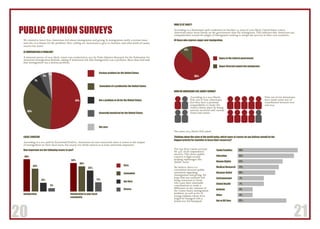
PUBLIC OPINION SURVEYS
IS IMMIGRATION A PROBLEM?
A national survey of 1000 likely voters was conducted in 2013 by Pulse Opinion Research for the Federation for
American Immigration Reform, asking if Americans felt that immigration was a problem. More than half said
that immigration was a serious problem.
Serious problem for the United States
Somewhat of a problemfor the United States
Not a problem at all for the United States
Generally beneficial for the United States
Not sure
51%
35%
7%
5%
2%
We wanted to know how Americans feel about immigration and giving. Is immigration really a serious issue,
and who is to blame for the problem? How willing are Americans to give to charities, and what kinds of causes
receive the most?
LOCAL CONCERN
According to a 2011 poll by Economist/YouGov, Americans are less concerned when it comes to the impact
of immigration on their local areas, but nearly two thirds rated it as at least somewhat important.
How important are the following issues to you?
Very
48%
34%
13%
5%
34%
30%
25%
11%
Angry at the federal government
Anger directed toward the immigrants
Not Very
Somewhat
Unsure
Immigration Immigration in your local
community
WHO IS AT FAULT?
According to a Rasmussen poll conducted on October 13, 2009 of 1,000 likely United States voters,
Americans place more blame on the government than the immigrants. This indicates that Americans are
compassionate toward the plight of immigrants seeking to escape the poverty in thier own countries.
Of those who express anger over immigration:
83%
12%
HOW DO AMERICANS FEEL ABOUT GIVING?
According to a 2014 Harris
Poll, one in four Americans
feel they have a personal
responsibility to make the
world a better place by being
actively involved with various
issues and causes.
The same 2014 Harris Poll asked:
Thinking about the state of the world today, which types of causes do you believe should be the
biggest priority for charities to focus their resources?
Nine out of ten Americans
have made some sort of
contribution between 2010
and 2013.
Youth/Families
Education
Human Rights
Medical Research
Disaster Relief
Environmental
Global Health
Animals
Other
Not at All Sure
16%
15%
12%
11%
10%
7%
7%
4%
4%
13%
The top three causes account
for 43% of all respondent’s
answers. This shows public
concern is high toward
helping orphanages like
Dando Amor.
We believe there is a
correlation between public
sentiment regarding
immigration and giving. We
hope that our research will
bring awareness to those
who want their charitable
contributions to make a
difference in the vastness of
the Unites States immigration
problem, as well as for 18
young orphans whose lives
might be changed with a
brand new $16 backpack.
22 23
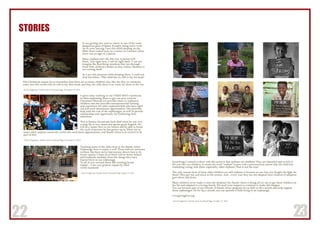
It was getting late, and we where in one of the most
dangerous parts of Quito, Ecuador doing some work.
As we were leaving I saw this child sleeping on the
filthy floor tucked away in a corner of a market where
there was no sign of a parent.
Many orphans start life this way. A parent tells
them, "stay right here, I will be right back." I can not
imagine the horrifying emotions that run through
these little children's bodies as they realize, Mommy is
not coming back!
As I saw this innocent child sleeping there, I could not
help but think...."This child has no crib to lay his head."
Teaching some of the older boys in the Dando Amor
Orphanage how to repair a roof! These kids are awesome
workers, but have never had anyone shown how to do
house repairs. I hope all of them will be better fathers
and husbands someday from the things they have
learned here in our orphanage.
To all of you worried about ME teaching house
repairs…I am very good at repairs by third
world standards!
-Travis Gugleman, Dando Amor Facebook Page, January 9, 2015
Something I wanted to show with this series is that orphans are children! They are beautiful and so full of
life just like our children. It seems the word “orphan” comes with a preconceived notion that the child has
something wrong with them, especially, older orphans! That is not the case!
The only reason most of these older children are still orphans is because no one has ever fought the fight for
them! They get lost and stuck in the system. And…every year they are not adopted their chances of adoption
goes down and down.
Many children never make it onto the adoption list. Dando Amor is doing all we can to get these children on
the list and adopted to a loving family. We need your support to continue to make this happen.
You can become part of our Friends of Dando Amor program for as little as $8 a month and help support
these orphanages. Or for $35 a month you can sponsor a child living in an orphanage.
www.givinglove.org
-Travis Gugleman, Dando Amor Facebook Page, October 27, 2014
I spent today working in our (VERY HOT) warehouse
in Haiti separating shoes to get out next week for
Christmas! Shoes4Love provides shoes to orphaned
children and also provides entrepreneurial training
and experience for older orphaned kids who have aged
out and need educational opportunities. The proceeds
help with the cost of the orphanages, as well as provide
scholarships and opportunity for furthering their
education.
This is Stanley his parents both died when he was very
young. He is very smart and speaks great English. He
will be a leader here in his Nation and be able to break
the cycle of poverty he has grown up in. There are so
STORIES
This Christmas season let us remember that there are so many children who, like the One we celebrate,
come into this world with no crib to lay their head, and they are told, there is no room for them in the inn.
-Travis Gugleman, Dando Amor Facebook Page, December 10, 2014
many older orphans across the world who need these opportunities, and Dando Amor is so excited to be
part of this!
-Travis Gugleman, Dando Amor Facebook Page, December 12, 2014
dando amor

Dando Amor Appendix

  • 1.
  • 2.
    2 3 TABLE OFCONTENTS OUR TEAM 4 RATIONALE 8 PROCESS 9 THE ORGANIZATION 10 STRATEGIC RESEARCH 11 PUBLIC OPINION SURVEYS 20 STORIES 22
  • 3.
    4 5 OUR TEAM JOSHUAF. DUNFORD CONTACT dun11013@byui.edu CONTRIBUTIONS • Slide design • Presentation • Booklet: ‘Why we Help” • Appendix: “Strategic Research - The Benefits of Volunteerism” • Appendix: “Joshua F. Dunford” ABOUT Joshua is a senior studying communications at Brigham Young University Idaho. He graduates July 2016 and plans to attend law school shortly thereafter. He is an avid reader, debater, and car lover. He speaks two languages, has lived on two continents, and is president of the Pre-Law Society at BYU-I. He aspires to become a practicing attorney and published author. CODY KLINGLER CONTACT kli13003@byui.edu CONTRIBUTIONS • Writer of “Rationale” • Writer of “Our Team: Cody Klingler” in the appendix • Writer of “What You Can Do” in the booklet • Allocation Committee ABOUT Cody is a Healthcare Administration major at BYU-Idaho. He will graduate in the Spring of 2017, and plans to attend graduate school to receive both a masters in healthcare administration and in business. He and his wife live in Rexburg, Idaho and both share a love for sports, travel, family and animals. REFLECTION I am starting my own non-profit organization. That’s the kind of impact this project has had on me. As I worked through this I remembered that I am not the only person on the planet. I am incredibly fortunate, I was given many opportunities to progress and make valuable albeit small contributions to this world. Other people have been less fortunate. I have spent a lot of time thinking about the inequality of opportunity. “Why me?” has been the subject of much of the pondering about why I have so much that other people don’t. I have come to the conclusion that there is no answer to the “Why me?” question. It happened, because of where and to whom I was born. I can make valuable contributions. It would be a crime not to. That’s what this project has taught me. Make valuable contributions, because you have the ability to do so. I will do just that. REFLECTION This project has opened my eyes in more ways than one. The biggest thing that jumped out to me is how unaware I was about all of these great NPO’s in our community. I had heard of Dando Amor before, but only of their Shoes4Love campaign. I had no idea how much more there was to their organization, but I am so thankful I found out. What they do is some of the most selfless work I have ever heard of. They are always putting the less fortunate before themselves, and that is a message I needed in my own life. It helped me realize how lucky I have it, and how easy it is for us to help. All we did was ask the owners, and immediately they had something for us to work on. Dando Amor is a great example in my life.
  • 4.
    6 7 BRIDGETTE JEROMEPATTERSON CONTACT bridgettepatterson@gmail.com CONTRIBUTIONS • Appendix and booklet design • Appendix: The Organization • Appendix: The Needs of Orphaned, Puberty-aged Boys in Ecuador • Appendix: Public Opinion Surveys • Dando Amor liaison ABOUT Bridgette is a senior at Brigham Young University-Idaho studying Communication with an emphasis in Organizational Communication and Advocacy. She will graduate in April of 2016, and plans to work as a curriculum designer for BYU- Idaho. She and her husband, Keith, live in Rexburg, Idaho. She loves travel, photography, graphic design, web development, blogging, quilting, and her dogs. REFLECTION Mother Teresa said, “It’s not how much we give but how much love we put into giving.” After under- standing the mission of Dando Amor, I have given so little, but it has been with my whole heart. Although this project is not about me, I have been the ultimate receiver. Opening my mouth and asking others for information and help is miles outside of my comfort zone. However, as I learned the needs of these 18 teenaged orphans, saw their pictures, and understood that we could make a dif- ference with just one backpack for each boy, my fear of speaking out faded away, I gained compas- sion and confidence, and the inner advocate inside me found a voice. Every day since the day our group discovered the specific problem we could solve, I have imagined these wonderful young men in the orphanage receiving their own backpack, monogrammed with each of their names. In my mind I see joy on their faces and in their hearts. I am now a believer in giving fully. My hugs are a little tighter, my kisses a little longer, and I try to listen to others with my ears, my eyes, and my heart. BRIETTA EADS CONTACT brietta@byui.edu CONTRIBUTIONS • Writer of “Process” in the Appendix • Writer of “Our Team: Brietta Eads” in the Appendix • Writer of “Legally Defining a Nonprofit and How They Allocate Their Funding” in the Appendix • Writer of “How We Help: Opportunity” in the booklet ABOUT Brietta is currently 21-years-old and set to graduate Fall of 2016, with a degree in Communication, and an emphasis in Organizational Communication and Advocacy. She has not only interned with the American Heart Association, but has had multiple works published with Charleston-area media. She is a strong writer, with a hope to take it to a more persuasive career path, such as advocacy work. REFLECTION With my previous work with an NPO, i knew some of the “in and outs” of how a Non-profit worked, but I didn’t realize how many different kinds there could be, what each kind meant, or how they got the funding they did for their basic needs. Something else that i believe caught me off guard quite a bit was being brought to this eye-opening realization, and the constant reminder, that there are these social issues that are a real and, sadly, never ending tragedy for humanity. I think it brought a deeper appreciation for the small problems that I face, and a deeper understanding for the meaning of a phrase we take so for granted- “opposition in all things.” I think it broadened my very simplistic view of how this opposition does not only apply to my single life, but my experience here as a whole. I think it made me think of how much I tend to take for granted. For example, Dando Amor cares for 18 young men that are from circumstances that are very differ- ent from my own. These 18 young men are in Ecuador, in an orphanage where they have so little to call their own, but so much they are still thankful for. This project has helped me think outside or the “American box”- the box where I feel we, as Ameri- cans, refuse to really think about or consider countries of different levels of opportunity and need. I feel as though this has shown me that a little really can go a longer way than we think. $200 really isn’t a lot of money to the average US citizen (after college), and we tend to spend it on ridiculous things. This amount of money to these boys not only sends a bag for their school books, it sends a sense of individuality, a sense of ownership, and a sense of belonging. I just thought it was so cool to see that we could actually do something about that.
  • 5.
    8 9 RATIONALE PROCESS WHYDID WE SELECT THIS ORGANIZATION? We chose Dando Amor because of their simple goal: raising orphans out of poverty through education and self-sufficiency training. Dando Amor is providing orphans with care and training in three different countries. Our focus for this project has been the 18 teenage boys they are taking care of in Ecuador. We found out that these 18 boys are in need of backpacks for school. Right now they share everything, and have nothing to call their own. Our Dando Amor contact, Lori Nordstrom, explained that this leaves them feeling uncomfortable with their peers at school. She said that used backpacks might be less expensive and easier to donate, but would make these young men feel less valuable. We felt compelled to make sure each of the 18 young men in Dando Amor’s Ecuador orphanage had a backpack of their own before this project was over, whether we won the grant or not. From our research, we know that providing each young man with his own new backpack will increase his chances of graduating from high school, and become a healthy and productive member of society. We know our decision to help is a small thing, compared to all of their needs, but we hope that because of our research and advocacy we are able to help Dando Amor reach their simple goal, and that we can help each young man in their orphanage feel valued. NOVEMBER 16, 2015: Researching Dando Amor and their impact on Rexburg, Idaho. Allocation of responsibilities and finalization of non-profit organization selection. Voted Cody to allocation committee. Bridgette volunteered as designer and to contact Dando Amor. Contact made with Dando Amor, and an interview was set up to match the schedules of the group members and Lori Nordstrom. Questions also are be- ing written for our interview. Meeting with Lori Nordstrom. In this meeting, we first introduced ourselves and the reason for the contact. We asked about the letter, regarding any questions she might have, and then asked about the current projects and needs. We helped brainstorm some ideas, and then narrowed down our possibilities. Researching backpacks to help fulfill the need for Dando Amor and possible subsidiaries. We made sure that we had our beginning 5 sources and key facts. This created a basic foundation for what exactly it was that we were doing. Bridgette has completed the template for the booklet and appendix. We have submitted our sections for the booklet, and begin editing them as a group. Refine and review our final 5 sources/ key sources. Bridgette gives us our word count per section of the booklet and appendix. Bridgette makes contact with Kettle Embroidery. They agree to embroider the backpacks and help subsidize a part of the cost for the backpacks. Josh takes photos for the group. All group members turn in reflections, biographies, finalized key facts and sources. Cody finished the Rationale. Brietta records the Process that has taken place so far. The Kettle Embroidery catalog was brought to class. The group selects the backpack style and price finalists, and email Lori Nordstrom the options for the 18 young men at Dando Amor. Request to Lori Nordstrom has been made for the names for the 18 young men at the orphanage to be embroidered on the backpacks. The group decides how to format and fill the presentation. Eighteen backpacks are odered from Kettle Embroidery per Lori Nordstrom’s color and style request. Kettle Embroidery schedules December 17, 2015 for embroidery services. We started looking for our final 5 sources and key facts. We also distributed booklet responsibilities to work on over the break Icon made byFreepik from www.flaticon.com and licensed under CC by 3.0 DECEMBER 09, 2015: DECEMBER 07, 2015: DECEMBER 06, 2015: DECEMBER 04, 2015: DECEMBER 02, 2015: NOVEMBER 30, 2015: NOVEMBER 23, 2015: NOVEMBER 21, 2015: NOVEMBER 19, 2015: NOVEMBER 18, 2015: NOVEMBER 17, 2015: DECEMBER 10, 2015:
  • 6.
    10 11 STRATEGIC RESEARCHTHEORGANIZATION DANDO AMOR Dando Amor is a nonprofit charity that personally and directly aids orphans in Ecuador, and several other countries. It all began in 2009 when professional photographers Travis and Jennie Gugelman, and Lori Nordstrom travelled to Ecuador on a photography assignment. They realized that orphanages subsidized by American businesses and organizations could provide adequately for the children’s needs. However, they saw a greater need with orphaned boys between the ages of 12 and 18. In Ecuador, orphaned boys approaching puberty are too old to live in the children’s’ orphanages; the risk of a boy becoming physically aggressive or sexually uninhibited is too high. With the safety of the younger children as their priority, Ecuadorian orphanages release pubescent boys to the streets where they become the victims, exposed to sexual violence and drugs, thus perpetuating the crime rate, poverty, and the potential of more homeless children. In 2013, Dando Amor opened its first “boys home” style orphanage on the outskirts of Quito, Ecuador, for boys between the ages of 12 –18. With funds received from sponsor organizations and families in the United States, Dando Amor is able to meet the basic needs of the boys by providing food, clothing, and shelter through their orphanage. In English, “dando amor” means, “giving love”. Dando Amor’s mission is to raise orphans out of poverty through education and self-sufficiency training. CONTACT INFORMATION & WEBSITES Dando Amor, Inc. 4455 Jud St. Rexburg, ID 83440 dadnoamorinfo@gmail.com www.givinglove.org www.dandoamor.org dando amor $ PAGE 12 PAGE 14 PAGE 16 PAGE 18 THE NEEDS OF ORPHANED PUBERTY AGED BOYS IN ECUADOR THE COMMUNITY EFFECTOF VOLUNTEERING LEGALLY DEFINING A NONPROFIT AND HOW THEY ALLOCATE THEIR FUNDING Joshua Dunford Cody Klingler Brietta Eads Bridgette Patterson THE BENEFITS OF VOLUNTEERISM
  • 7.
    12 13 THE BENEFITS OFVOLUNTEERISM 1. Neumann, Caryn. “Ecuadorian Immigrants.” Immigration to the United States. Web. This source is important because it provides us with some perspective as to why so many Ecuadorians immigrate to the United States illegally. 2. “DOING GOOD IS GOOD FOR YOU.” UnitedHealth Group. UnitedHealth Group, 2013. Web. 2015. This source is important as we are trying to demonstrate some of the innate benefits of altruistic volunteerism. 3. Strahilevitz Ph.D. Michal Ann Strahilevitz Ph.D, Michal Ann. “Charitable Giving Guide: Maximize Both Happiness and Impact.” Psychology Today. Psychology Today, 12 Dec. 2012. Web. 2015. This research is important because it shows that the act of giving to charity has psychological benefit and can help improve your mental health. 4. “GDP per Capita (current US$).” World Bank Data. World Bank Data. Web. 1 Nov. 2015. This passage is important because it shows the GDP difference between Americans and Ecuadorians. 5. “How Much Money Does the United States Spend on Public Elementary and Secondary Schools?” Institute of Education Sciences. U.S. Department of Education, National Center for Education Statistics., 2015. Web. 2015. This demonstrates how much it costs for American Children to get an average american education. 6. MANUEL KROGSTAD, JENS. “5 Facts about Illegal Immigration in the U.S.” Pew Research. 19 Nov. 2015. Web. 1 Nov. 2015. 1. Most Ecuadorians living in the U.S. are economic refugees. The Ecuadorians who immigrate to the United States represent a disproportionately large portion of total number of Ecuadorians. 2. Over three-quarters of people who volunteered in the past twelve months told us that volunteering has made them feel physically healthier—in fact, most say that one of the reasons they decided to volunteer was the belief that doing volunteer work would be good for their health. 3. The psychological benefits of giving include the good feeling derived when people “do the right thing”, the pleasurable feeling of moral satisfaction, the desire to view oneself as compassionate and kind and an emotionally positive experience known as “warm-glow”. 4. The United States Gross Domestic Product per capita is $53,041.98. Compared that to the Gross Domestic Product per capita in Ecuador at $6,002.89. 5. Total expenditures for public elementary and secondary schools in the United States amounted to $621 billion in 2011–12, or $12,401 per public school student enrolled in the fall (in constant 2013–14 dollars, based on the Consumer Price Index). These expenditures include $11,014 per student in current expenditures for operation of schools; $1,018 for capital outlay (i.e., expenditures for property and for buildings and alterations completed by school district staff or contractors); and $370 for interest on school debt. 6. There were 11.3 million unauthorized immigrants in the U.S. in 2014. 7. The state of Idaho spent 188 million dollars on Undocumented Immigrants Last year. Joshua F. Dunford 8. Over the past two decades we have seen a growing body of research that indicates volunteering provides individual health benefits in addition to social benefits. This research has established a strong relationship between volunteering and health: those who volunteer have lower mortality rates, greater functional ability, and lower rates of depression later in life than those who do not volunteer. 9. Volunteering time makes you feel like you have more time. Wharton professor Cassie Mogilner wrote in the Harvard Business Review that her research found those who volunteer their time feel like they have more of it. This is similar to other research showing that people who donate to charity feel wealthier. 10. Community is a combination of two elements: A) A web of affect laden relationships among a group of individuals, relationships that often crisscross and reinforce one another-rather than merely one-on-one or chainlike individual relationships; B) A measure of commitment to a set of shared values, norms, and meanings, and a shared history and identity-in short, to a particular culture. KEY FACTS This source is important because it illustrates the scale of undocumented immigrant population in the United States. 7. The Fiscal Burden of Illegal Immigration on Idaho.” Farius. Farius, 2011. Web. 2015. This source illustrates what illegal immigration is costing Rexburgians. 8. Grimm, Robert. “THE HEALTH BENEFITS OF VOLUNTEERING.” National Service. Corporation for National Community Service, 2007. Web. 2015. This is important to demonstrate the effect volunteering has on the individual. 9. Horoszowski, Mark. “5 Surprising Benefits Of Volunteering.” Forbes. Forbes, 19 Mar. 2015. Web. 1 Nov. 2015. This again is more evidence demonstrating the positive health benefits of volunteering on the individual. 10. Etzioni, Amitai. “The Good Society.” GWU. GWU. Web. 2015. This source shows what kind of people make up a good society. SOURCES
  • 8.
    14 15 1. Joanna Saisan,M.S.W., Melinda Smith, M.A., and Gina Kemp, M.A, “Volunteering and its Surprising Benefits” September 2015. Web. This source is important because it shows that volunteering will teach you new skills that you never knew you had, and can also help polish the skills you already have. 2. Ten Professional Development Benefits of Volunteering (Everything I Learned in Life I Learned through Volunteering). Mary V. Merrill, LSW, Merrill Associates. 2005. Web. This resource asks, what better way is there to serve your community, then to give a little back? Volunteering will benefit us in more ways than we realize. 3. Douglas LaBier, Ph.D., “How Volunteering Affects the Volunteer”, Huffington Post, 2010. Web. This article is important because it shows how volunteering reshapes people’s values. 4. Huiting Wu, Points of Light Institute, 2011. Web. This source shows how volunteering creates a more cohesive community. 5. Mike Michalowicz, “Learn Entrepreneurship By Volunteering”, 2012. Web. This article proves how volunteering allows you to express yourself and meet new people. 6. Idealist.org, “The Benefits of Volunteering” Web. This source mentions the difference volunteering has on a community. 1. Just because volunteer work is unpaid does not mean the skills you learn are basic. Many volunteering opportunities provide extensive training. 2. What better way is there to connect with your community and give a little back? As a volunteer, you certainly return to society some of the benefits that society gives you. 3. We’ve found that volunteer activity often reshapes or redirects people’s values, perspectives and even their life goals in several ways. It can spur new growth and awareness, both spiritually and emotionally. 4. People feel stronger connection to community, more strength of his/her connection to the community, as represented by the strength of feelings toward the community, including attachment, awareness, and commitment. 5. People volunteer because they get more out of the experience than what they put into it. 6. Volunteering is one of the best ways we know of to make a difference in your community. Whatever your passion, however you get involved, volunteering offers a way to have a real and lasting impact on the world. 7. You can experience the real world through hands-on work. And you can explore your major or career interests at the same time. 8. Not only do you get to gain experience, but you meet people who can be a potential reference when you’re job hunting if you made the right impression, or they may recommend a place to apply. 9. Also, volunteering in a new industry will give you knowledge to help you switch fields.As a volunteer you help: Support families (daycare and eldercare), Improve THE COMMUNITY EFFECT OF VOLUNTEERING CODY KLINGLER 7. Collegeboard.org, “Volunteering: How Helping Others Helps You” Web. This resource brings up the topic of real world work, through volunteering. 8. Volunteernow.org, “The Benefits of Volunteering” Web. This source pushes for people to volunteer, because they think it can create connections for later job opportunities. 9. Mark Horoszowski, “5 Surprising Benefits of Volunteering” Forbes, 2015, Web. This source says that volunteering will help develop new skills that are helpful on your resume. 10. UC San Diego, ucsd.edu, “Community Service: Top 10 Reasons to Volunteer”, 2015, Web. This Universities study shows how many different people you can help by volunteering. KEY FACTS SOURCES schools (tutoring, literacy), Support youth (mentoring and after-school programs), Beautify the community (beach and park cleanups). 10. As a volunteer you help: Support families (daycare and eldercare), Improve schools (tutoring, literacy), Support youth (mentoring and after-school programs), Beautify the community (beach and park cleanups).
  • 9.
    16 17 LEGALLY DEFININGA NONPROFIT AND HOW THEY ALLOCATE THEIR FUNDING 1. Delp, Valorie. “What Percentage of Donations Go to Charity.” LoveToKnow. LoveToKnow, 2015. Web. 1 Dec. 2015. This source shows how much of the money given actually goes toward the cause desired. 2. “Tax Information for Charitable Organizations.” Irs.gov. IRS, 2 Nov. 2012. Web. 1 Dec. 2015. This source provides vital information about why the NPO has to spend its money the way it does. 3. “Resources: Things a U.S.-based Nonprofit Must (and Must Not) Do.” Idealist.org. Action Without Borders, 2015. Web. 8 Dec. 2015. This shows the boundaries on NPO spending. 4. Goggins Gregory, Ann, and Don Howard. “The Nonprofit Starvation Cycle (SSIR).” The Nonprofit Starvation Cycle. Stanford Social Innovation Review, 2009. Web. 1 Dec. 2015. This source provides information such as showing the never ending cycle that makes NPO’s so necessary. 5. “NCCS | Frequently Asked Questions.” NCCS | Frequently Asked Questions. National Center for Charitable Statistics. Web. 1 Dec. 2015. This site really defined what an NPO was, and defined the different types of NPO’s. 6. “How Do Non-Profit Organizations Pay the Salaries of Their Employees?” - Quora. Web. 8 Dec. 2015. I feel like so many people focus on if their money is paying the staff, or if the actual need is getting met. This article showed me some different insights. 1. “Charitable” NPO’s are divided into 2 categories: private foundations and public charities. 2. A nonprofit is generally governed by four sets of rules: a. the laws of the state where it’s incorporated (and maybe others) b. the regulations about fundraising wherever it solicits donations c. the limits on tax-exempt groups under the federal tax code d. its own charter documents 3. Depending on the nature of the nonprofit, the money for salaries and other expenses may come from donations, membership dues, grants, or products and services sold by the organization. Non profit means that the company is not making a profit. They do have an income which can be used to pay off the employees salaries. 4. The NCCS dataset contains valuable information about the type of organization and its financial status, as well as variables that help describe its size and presence in the local community. Variables like expenditures and revenue are important when determining the economic impact of an 29 organization on a local community because they describe the amount of money being received and spent by the organization. 5. “Public Charities” – groups that are supported by program service income, grants and contracts from governments or foundations, and larger numbers of individual donors. Private foundations pay an excise tax on their investment earnings and are subject to stricter rules about their operations than public charities. 6. Once organized, there are principles that affect the way the board of directors conducts the affairs of a nonprofit. These principles—often summarized as the “duty of care” and the “duty of loyalty”—give Brietta Eads meaning to the idea that a nonprofit must be organized and operated exclusively for its stated purposes; those involved in its management and activities must not permit its resources to be diverted into undue benefits to anyone or to be wasted by inattention or sloppy management. 7. There are two things that public charities simply must not do: a. they are completely prohibited from “electioneering,” which means doing anything to improve or damage the chances of winning an election for public office. All elections: President of the U.S., dog catcher, school board or Member of Congress. A 501(c)(3) that is determined to have been electioneering will have its tax-exempt status revoked. b. they are forbidden to allow anyone to receive “undue benefit” from working for or contracting with the organization, or, for that matter, any other sort of relationship with it. 8. Solicited designations. A solicitation means that your organization asked for donations for a particular cause. Unsolicited designations. These are donated funds that the donor designates without having been solicited by the charity. 9. Idaho is one of 11 states that do not require charitable organizations, or those intending to solicit on their behalf, to register with the state in order to solicit contributions, whether they are an Idaho organization or based out-of-state. 10. Idaho has no charitable solicitation laws and does not require nonprofits to register with a state agency before soliciting contributions in the state. Out-of-state nonprofit corporations, however, may have to register to do business in the state. $ KEY FACTS 7. Sobolewski, Scott. “The Economic Impact of Non-Profit Organizations.” 2010. Web. 8 Dec. 2015. I thought it was just so interesting to see that they actually think about the economic impact that the NPO would actually make before they give them certain titles and privileges. It makes sense, I just never thought of it. 8. Fishman, S. & Barrett, R. (2012). Nonprofit Fundraising Registration: The 50 State Guide. NOLO. This source shows a unique law that currently applies to the contribution we give to our NPO. 9. “Nonprofit Regulation in Idaho - Ballotpedia.” Nonprofit Regulation in Idaho - Ballotpedia. Balotpedia. Web. 1 Dec. 2015. This whole source shows laws concerning NPO’s specifically in Idaho. 10. McRay, Greg. “Are You Misappropriating Your Nonprofit’s Funds?” Foundation Group. Foundation Group, 16 Dec. 2009. Web. 1 Dec. 2015. This source helps us to not only define the different types of donations, but the way we may want to make our donation. SOURCES
  • 10.
    18 19 THE NEEDSOF ORPHANED, PUBERTY-AGED BOYS IN ECUADOR 1. In a social setting, boys age 9-12 want to blend in and not stand out from their peers in any way, particularly as to gender roles and sexuality. They especially feel concern about outward appearance; they want to look like “everyone else.” 2. Teenage boys at risk of school exclusion, and thus social exclusion, face added difficulties when school participation becomes dysfunctional. 3. 71% of high school dropouts are fatherless; fatherless children need more motivation to stay in school. 4. Poor school performance has been identified in some reports as one of the most important predictors of criminal behavior. 5. Boys who have been physically neglected are at greater risk of becoming violent teenagers than those who have suffered from physical abuse. 6. Out of country adoption for Ecuador is extremely rare. In 2013 in Ecuador, only 2 boys between the ages of 13-17 were adopted out of the country. 7. “Street children” in Ecuador are perceived by the public as criminals, even if they have not committed any crime. Keeping children off the streets protects them from a future of perpetual criminal accusation. 8. While the Ecuadorian government guarantees a free public education for every child, the associated costs of fees, uniforms, supplies, and transit are often too heavy for people to bear. Poor families in Ecuador cannot afford school costs, therefore orphaned teenaged boys cannot afford the cost of school. 9. Child trafficking is a huge problem in Ecuador. Children are kidnapped and sold as slaves to other countries. Youth in Dando Bridgette Patterson Amor’s orphanage are less threatened by kidnapping than those who are living on the streets. 10. Access to material resources is one way of providing resilience to orphans in Ecuador. 1. Huberman, Barbara. “Growth and Development, Ages Nine to Twelve What Parents Need to Know.” Advocates for Youth. 2015. Web. This shows the impact of the Dando Amor boys having a new backpack at school, and feeling as if they fit in with their classmates. 2. Wilson, Nathan J., P.H.D., Reinie Cordier P.H.D., and Sarah Wilkes-Gillan. “Men’s Sheds and Mentoring Programs: Supporting Teenage Boys’ Connection with School.” International Journal of Men’s Health 13.2 (2014): 92-100. ProQuest. Web. 6 Dec. 2015. This resource demonstrates how the boys living in the Dando Amor orphanage would benefit from new backpacks for school, by helping them feel socially included. 3. The National Center of Fathering. “The Consequences of the Fatherless.” Web. This article shows the correlation between boys who are fatherless and who also drop out of school. 4. Westwood, Michael, Pinzon, Jorge. “Adolescant Male health.”Paediatrics and Child Health v.13(1); Jan. 2008. This article shows how poor school performance in some reports correlates to the most important predictors of criminal behavior. 5. Pedersen, Tracy. “Childhood Neglect, Not Abuse, Best Predictor of Violence in Teen Boys.” PsychCentral. 20 Aug. 2014. Web. This article shows that boys need physical attention in order to become functional adults. The physical attention of providing backpacks to Dando Amor boys will make them less likely show violent behavior. 6. Intercountry Adoption. “Statistics.” 2014. Web. KEY FACTS The data found on this website shows how few boys are ever actually adopted out of Ecuador. This demonstrates the need for orphanages in Ecuador that host teenaged boys. 7. McBride, Rachel. “Ecuadorian Children: An Investigation into the Effects Frequenting the Street has on Children of Cuenca, Ecuador.” Order No. 1417974 University of North Texas, 2003. Ann Arbor: ProQuest. Web. 6 Dec. 2015. This article shows how Ecuador’s “Street Children” are perceived in society as criminals. Helping the orphans from becoming street children changes their future. 8. Fieser, Robyn. “Keeping Ecuador’s Youth in School.” Catholic Woman Jul 2007: 17. ProQuest. Web. 6 Dec. 2015. This article shows that school funding for Ecuadorian orphans is important. Although public education is free, the uniforms, supplies, and modes of transportation cost more than an orphan could afford. 9. Gonzalez, Mario. “Secret World of Child Slavery is Exposed.” Inter Press Service: 1. Feb 02 1998. ProQuest. Web. 6 Dec. 2015. This source shows the risk of street orphans becoming victims of the slave trade. 10. Berzins, Anton Robert. “Resilience as a Moderate for the Relationship between Exposure to Violence and Affect among Ecuadorian Youth.” Order No. 3580284 St. John’s University (New York), 2014. Ann Arbor: ProQuest. Web. 6 Dec. 2015. This resource shows that providing something material to orphans, an item as simple as the backpacks we are advocating for, create resilience and provide a way for them to avoid exposure to violence. SOURCES
  • 11.
    20 21 PUBLIC OPINIONSURVEYS IS IMMIGRATION A PROBLEM? A national survey of 1000 likely voters was conducted in 2013 by Pulse Opinion Research for the Federation for American Immigration Reform, asking if Americans felt that immigration was a problem. More than half said that immigration was a serious problem. Serious problem for the United States Somewhat of a problemfor the United States Not a problem at all for the United States Generally beneficial for the United States Not sure 51% 35% 7% 5% 2% We wanted to know how Americans feel about immigration and giving. Is immigration really a serious issue, and who is to blame for the problem? How willing are Americans to give to charities, and what kinds of causes receive the most? LOCAL CONCERN According to a 2011 poll by Economist/YouGov, Americans are less concerned when it comes to the impact of immigration on their local areas, but nearly two thirds rated it as at least somewhat important. How important are the following issues to you? Very 48% 34% 13% 5% 34% 30% 25% 11% Angry at the federal government Anger directed toward the immigrants Not Very Somewhat Unsure Immigration Immigration in your local community WHO IS AT FAULT? According to a Rasmussen poll conducted on October 13, 2009 of 1,000 likely United States voters, Americans place more blame on the government than the immigrants. This indicates that Americans are compassionate toward the plight of immigrants seeking to escape the poverty in thier own countries. Of those who express anger over immigration: 83% 12% HOW DO AMERICANS FEEL ABOUT GIVING? According to a 2014 Harris Poll, one in four Americans feel they have a personal responsibility to make the world a better place by being actively involved with various issues and causes. The same 2014 Harris Poll asked: Thinking about the state of the world today, which types of causes do you believe should be the biggest priority for charities to focus their resources? Nine out of ten Americans have made some sort of contribution between 2010 and 2013. Youth/Families Education Human Rights Medical Research Disaster Relief Environmental Global Health Animals Other Not at All Sure 16% 15% 12% 11% 10% 7% 7% 4% 4% 13% The top three causes account for 43% of all respondent’s answers. This shows public concern is high toward helping orphanages like Dando Amor. We believe there is a correlation between public sentiment regarding immigration and giving. We hope that our research will bring awareness to those who want their charitable contributions to make a difference in the vastness of the Unites States immigration problem, as well as for 18 young orphans whose lives might be changed with a brand new $16 backpack.
  • 12.
    22 23 It wasgetting late, and we where in one of the most dangerous parts of Quito, Ecuador doing some work. As we were leaving I saw this child sleeping on the filthy floor tucked away in a corner of a market where there was no sign of a parent. Many orphans start life this way. A parent tells them, "stay right here, I will be right back." I can not imagine the horrifying emotions that run through these little children's bodies as they realize, Mommy is not coming back! As I saw this innocent child sleeping there, I could not help but think...."This child has no crib to lay his head." Teaching some of the older boys in the Dando Amor Orphanage how to repair a roof! These kids are awesome workers, but have never had anyone shown how to do house repairs. I hope all of them will be better fathers and husbands someday from the things they have learned here in our orphanage. To all of you worried about ME teaching house repairs…I am very good at repairs by third world standards! -Travis Gugleman, Dando Amor Facebook Page, January 9, 2015 Something I wanted to show with this series is that orphans are children! They are beautiful and so full of life just like our children. It seems the word “orphan” comes with a preconceived notion that the child has something wrong with them, especially, older orphans! That is not the case! The only reason most of these older children are still orphans is because no one has ever fought the fight for them! They get lost and stuck in the system. And…every year they are not adopted their chances of adoption goes down and down. Many children never make it onto the adoption list. Dando Amor is doing all we can to get these children on the list and adopted to a loving family. We need your support to continue to make this happen. You can become part of our Friends of Dando Amor program for as little as $8 a month and help support these orphanages. Or for $35 a month you can sponsor a child living in an orphanage. www.givinglove.org -Travis Gugleman, Dando Amor Facebook Page, October 27, 2014 I spent today working in our (VERY HOT) warehouse in Haiti separating shoes to get out next week for Christmas! Shoes4Love provides shoes to orphaned children and also provides entrepreneurial training and experience for older orphaned kids who have aged out and need educational opportunities. The proceeds help with the cost of the orphanages, as well as provide scholarships and opportunity for furthering their education. This is Stanley his parents both died when he was very young. He is very smart and speaks great English. He will be a leader here in his Nation and be able to break the cycle of poverty he has grown up in. There are so STORIES This Christmas season let us remember that there are so many children who, like the One we celebrate, come into this world with no crib to lay their head, and they are told, there is no room for them in the inn. -Travis Gugleman, Dando Amor Facebook Page, December 10, 2014 many older orphans across the world who need these opportunities, and Dando Amor is so excited to be part of this! -Travis Gugleman, Dando Amor Facebook Page, December 12, 2014
  • 13.