GRADES 1 to 12
DAILY LESSON LOG
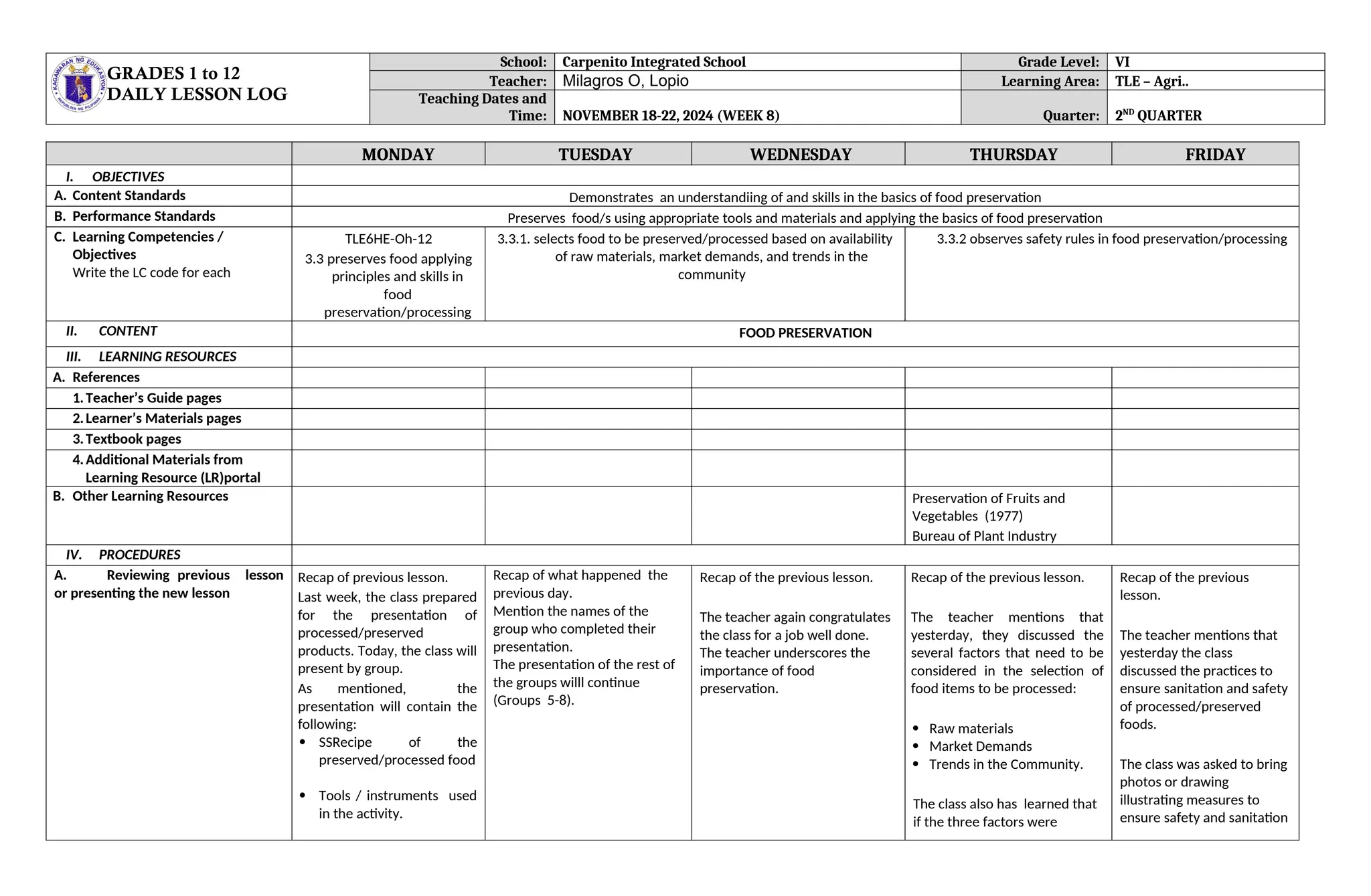
School: Carpenito Integrated School Grade Level: VI
Teacher: Milagros O, Lopio Learning Area: TLE – Agri..
Teaching Dates and
Time: NOVEMBER 18-22, 2024 (WEEK 8) Quarter: 2ND
QUARTER
MONDAY TUESDAY WEDNESDAY THURSDAY FRIDAY
I. OBJECTIVES
A. Content Standards Demonstrates an understandiing of and skills in the basics of food preservation
B. Performance Standards Preserves food/s using appropriate tools and materials and applying the basics of food preservation
C. Learning Competencies /
Objectives
Write the LC code for each
TLE6HE-Oh-12
3.3 preserves food applying
principles and skills in
food
preservation/processing
3.3.1. selects food to be preserved/processed based on availability
of raw materials, market demands, and trends in the
community
3.3.2 observes safety rules in food preservation/processing
II. CONTENT FOOD PRESERVATION
III. LEARNING RESOURCES
A. References
1.Teacher’s Guide pages
2.Learner’s Materials pages
3.Textbook pages
4.Additional Materials from
Learning Resource (LR)portal
B. Other Learning Resources Preservation of Fruits and
Vegetables (1977)
Bureau of Plant Industry
IV. PROCEDURES
A. Reviewing previous lesson
or presenting the new lesson
Recap of previous lesson.
Last week, the class prepared
for the presentation of
processed/preserved
products. Today, the class will
present by group.
As mentioned, the
presentation will contain the
following:
 SSRecipe of the
preserved/processed food
 Tools / instruments used
in the activity.
Recap of what happened the
previous day.
Mention the names of the
group who completed their
presentation.
The presentation of the rest of
the groups willl continue
(Groups 5-8).
Recap of the previous lesson.
The teacher again congratulates
the class for a job well done.
The teacher underscores the
importance of food
preservation.
Recap of the previous lesson.
The teacher mentions that
yesterday, they discussed the
several factors that need to be
considered in the selection of
food items to be processed:
 Raw materials
 Market Demands
 Trends in the Community.
The class also has learned that
if the three factors were
Recap of the previous
lesson.
The teacher mentions that
yesterday the class
discussed the practices to
ensure sanitation and safety
of processed/preserved
foods.
The class was asked to bring
photos or drawing
illustrating measures to
ensure safety and sanitation
 Equipment used in the
activity
 Steps in
preserving/processing of
food
 Name and role of each
member of the group
The teacher suggested the
inclusion of a workplan, cost
estimates, photo
documentation. This is
optional.
considered this would be a
good source of income for the
learners.
.
in food
processing/preservation.
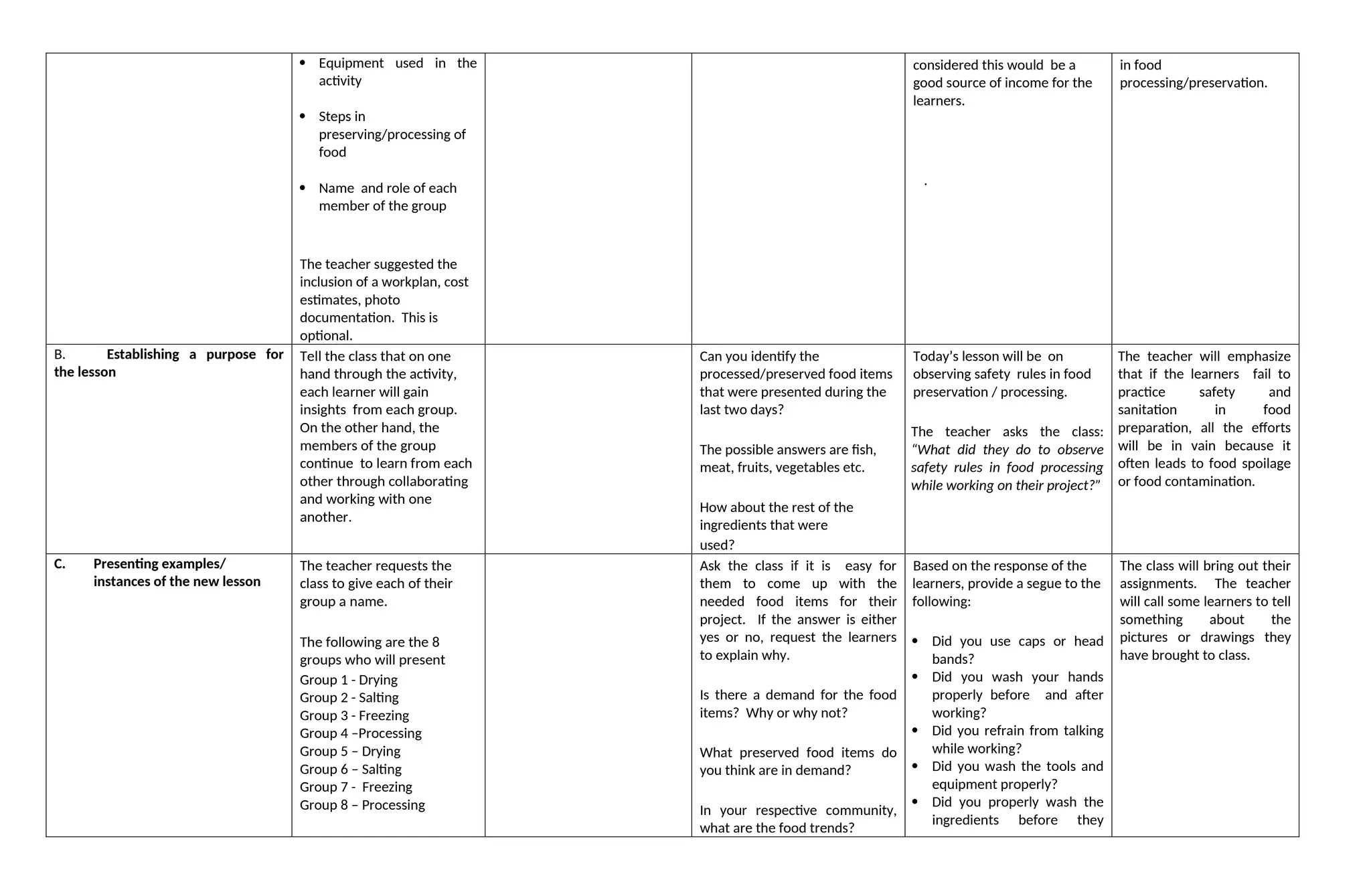
B. Establishing a purpose for
the lesson
Tell the class that on one
hand through the activity,
each learner will gain
insights from each group.
On the other hand, the
members of the group
continue to learn from each
other through collaborating
and working with one
another.
Can you identify the
processed/preserved food items
that were presented during the
last two days?
The possible answers are fish,
meat, fruits, vegetables etc.
How about the rest of the
ingredients that were
used?
Today’s lesson will be on
observing safety rules in food
preservation / processing.
The teacher asks the class:
“What did they do to observe
safety rules in food processing
while working on their project?”
The teacher will emphasize
that if the learners fail to
practice safety and
sanitation in food
preparation, all the efforts
will be in vain because it
often leads to food spoilage
or food contamination.
C. Presenting examples/
instances of the new lesson
The teacher requests the
class to give each of their
group a name.
The following are the 8
groups who will present
Group 1 - Drying
Group 2 - Salting
Group 3 - Freezing
Group 4 –Processing
Group 5 – Drying
Group 6 – Salting
Group 7 - Freezing
Group 8 – Processing
Ask the class if it is easy for
them to come up with the
needed food items for their
project. If the answer is either
yes or no, request the learners
to explain why.
Is there a demand for the food
items? Why or why not?
What preserved food items do
you think are in demand?
In your respective community,
what are the food trends?
Based on the response of the
learners, provide a segue to the
following:
 Did you use caps or head
bands?
 Did you wash your hands
properly before and after
working?
 Did you refrain from talking
while working?
 Did you wash the tools and
equipment properly?
 Did you properly wash the
ingredients before they
The class will bring out their
assignments. The teacher
will call some learners to tell
something about the
pictures or drawings they
have brought to class.
Order of presentation will be
agreed by the class.
were used?
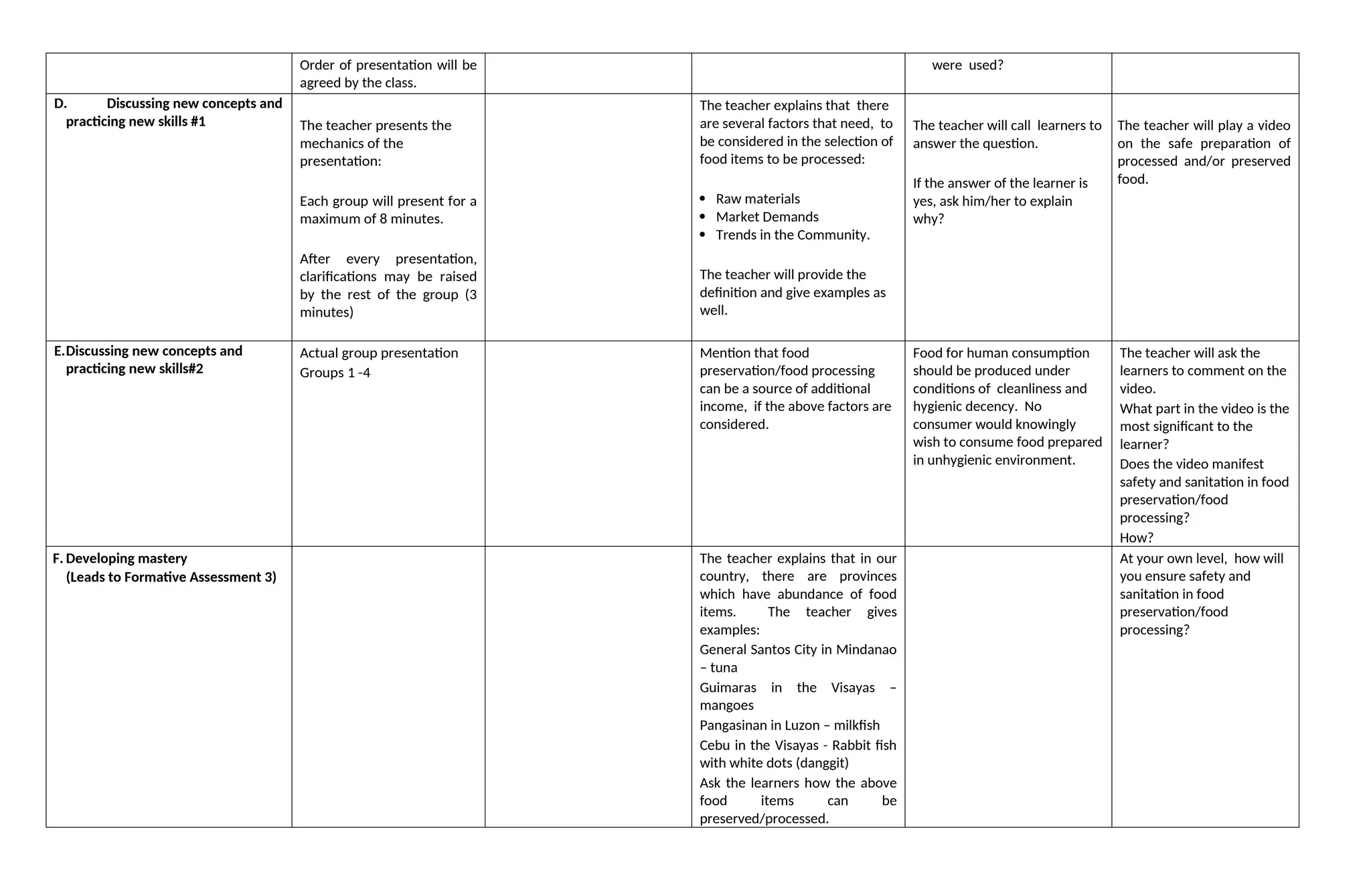
D. Discussing new concepts and
practicing new skills #1 The teacher presents the
mechanics of the
presentation:
Each group will present for a
maximum of 8 minutes.
After every presentation,
clarifications may be raised
by the rest of the group (3
minutes)
The teacher explains that there
are several factors that need, to
be considered in the selection of
food items to be processed:
 Raw materials
 Market Demands
 Trends in the Community.
The teacher will provide the
definition and give examples as
well.
The teacher will call learners to
answer the question.
If the answer of the learner is
yes, ask him/her to explain
why?
The teacher will play a video
on the safe preparation of
processed and/or preserved
food.
E.Discussing new concepts and
practicing new skills#2
Actual group presentation
Groups 1 -4
Mention that food
preservation/food processing
can be a source of additional
income, if the above factors are
considered.
Food for human consumption
should be produced under
conditions of cleanliness and
hygienic decency. No
consumer would knowingly
wish to consume food prepared
in unhygienic environment.
The teacher will ask the
learners to comment on the
video.
What part in the video is the
most significant to the
learner?
Does the video manifest
safety and sanitation in food
preservation/food
processing?
How?
F. Developing mastery
(Leads to Formative Assessment 3)
The teacher explains that in our
country, there are provinces
which have abundance of food
items. The teacher gives
examples:
General Santos City in Mindanao
– tuna
Guimaras in the Visayas –
mangoes
Pangasinan in Luzon – milkfish
Cebu in the Visayas - Rabbit fish
with white dots (danggit)
Ask the learners how the above
food items can be
preserved/processed.
At your own level, how will
you ensure safety and
sanitation in food
preservation/food
processing?
G. Finding practical applications of
concepts and skills in daily living
Engage the learners in the
discussion by asking them, “
when you go to the province
during summer, what foods are
abundant in their areas?
What are done by their
relatives/friends in order to
preserve them?
Cleanliness and sanitation not
only includes maintenance of
clean and well-sanitized
surfaces of all equipment, but
also proper disposal of wastes.
H. Making generalizations and
abstractions about the lesson
Mention that food
preservation/food processing
can be a source of additional
income, if the above factors are
considered.
Think of other ways to ensure
that processed foods are
prepared observing the
principles of sanitation and
safety.
Underscore the importance
of sanitation and safety in
food processing / food
preservation.
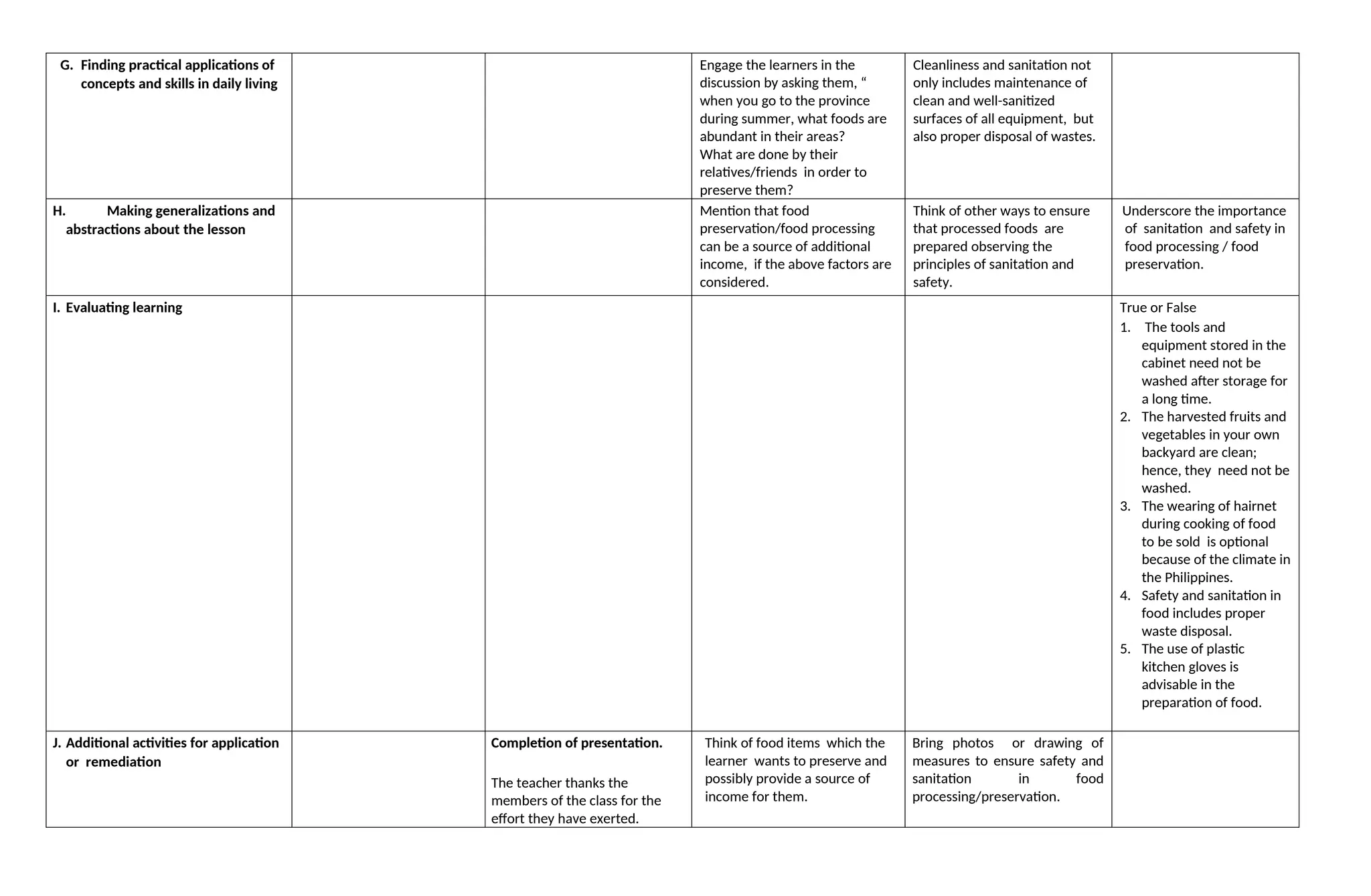
I. Evaluating learning True or False
1. The tools and
equipment stored in the
cabinet need not be
washed after storage for
a long time.
2. The harvested fruits and
vegetables in your own
backyard are clean;
hence, they need not be
washed.
3. The wearing of hairnet
during cooking of food
to be sold is optional
because of the climate in
the Philippines.
4. Safety and sanitation in
food includes proper
waste disposal.
5. The use of plastic
kitchen gloves is
advisable in the
preparation of food.
J. Additional activities for application
or remediation
Completion of presentation.
The teacher thanks the
members of the class for the
effort they have exerted.
Think of food items which the
learner wants to preserve and
possibly provide a source of
income for them.
Bring photos or drawing of
measures to ensure safety and
sanitation in food
processing/preservation.
The teacher mentions that
he/she was impressed with all
of the presentation. (if
applicable)
Remember that if a group was
not able to deliver well, it may
reflect on the guidance
provided by the teacher during
the preparation.
V. REMARKS
Prepared by: Checked by:
MILAGROS O. LOPIO EDDIE D. ARAYAN
Class Adviser Principal I

Daily Lesson Log for Technology and Livelihood Ed 6_Q2_W8.docx

  • 1.
    GRADES 1 to12 DAILY LESSON LOG School: Carpenito Integrated School Grade Level: VI Teacher: Milagros O, Lopio Learning Area: TLE – Agri.. Teaching Dates and Time: NOVEMBER 18-22, 2024 (WEEK 8) Quarter: 2ND QUARTER MONDAY TUESDAY WEDNESDAY THURSDAY FRIDAY I. OBJECTIVES A. Content Standards Demonstrates an understandiing of and skills in the basics of food preservation B. Performance Standards Preserves food/s using appropriate tools and materials and applying the basics of food preservation C. Learning Competencies / Objectives Write the LC code for each TLE6HE-Oh-12 3.3 preserves food applying principles and skills in food preservation/processing 3.3.1. selects food to be preserved/processed based on availability of raw materials, market demands, and trends in the community 3.3.2 observes safety rules in food preservation/processing II. CONTENT FOOD PRESERVATION III. LEARNING RESOURCES A. References 1.Teacher’s Guide pages 2.Learner’s Materials pages 3.Textbook pages 4.Additional Materials from Learning Resource (LR)portal B. Other Learning Resources Preservation of Fruits and Vegetables (1977) Bureau of Plant Industry IV. PROCEDURES A. Reviewing previous lesson or presenting the new lesson Recap of previous lesson. Last week, the class prepared for the presentation of processed/preserved products. Today, the class will present by group. As mentioned, the presentation will contain the following:  SSRecipe of the preserved/processed food  Tools / instruments used in the activity. Recap of what happened the previous day. Mention the names of the group who completed their presentation. The presentation of the rest of the groups willl continue (Groups 5-8). Recap of the previous lesson. The teacher again congratulates the class for a job well done. The teacher underscores the importance of food preservation. Recap of the previous lesson. The teacher mentions that yesterday, they discussed the several factors that need to be considered in the selection of food items to be processed:  Raw materials  Market Demands  Trends in the Community. The class also has learned that if the three factors were Recap of the previous lesson. The teacher mentions that yesterday the class discussed the practices to ensure sanitation and safety of processed/preserved foods. The class was asked to bring photos or drawing illustrating measures to ensure safety and sanitation
  • 2.
     Equipment usedin the activity  Steps in preserving/processing of food  Name and role of each member of the group The teacher suggested the inclusion of a workplan, cost estimates, photo documentation. This is optional. considered this would be a good source of income for the learners. . in food processing/preservation. B. Establishing a purpose for the lesson Tell the class that on one hand through the activity, each learner will gain insights from each group. On the other hand, the members of the group continue to learn from each other through collaborating and working with one another. Can you identify the processed/preserved food items that were presented during the last two days? The possible answers are fish, meat, fruits, vegetables etc. How about the rest of the ingredients that were used? Today’s lesson will be on observing safety rules in food preservation / processing. The teacher asks the class: “What did they do to observe safety rules in food processing while working on their project?” The teacher will emphasize that if the learners fail to practice safety and sanitation in food preparation, all the efforts will be in vain because it often leads to food spoilage or food contamination. C. Presenting examples/ instances of the new lesson The teacher requests the class to give each of their group a name. The following are the 8 groups who will present Group 1 - Drying Group 2 - Salting Group 3 - Freezing Group 4 –Processing Group 5 – Drying Group 6 – Salting Group 7 - Freezing Group 8 – Processing Ask the class if it is easy for them to come up with the needed food items for their project. If the answer is either yes or no, request the learners to explain why. Is there a demand for the food items? Why or why not? What preserved food items do you think are in demand? In your respective community, what are the food trends? Based on the response of the learners, provide a segue to the following:  Did you use caps or head bands?  Did you wash your hands properly before and after working?  Did you refrain from talking while working?  Did you wash the tools and equipment properly?  Did you properly wash the ingredients before they The class will bring out their assignments. The teacher will call some learners to tell something about the pictures or drawings they have brought to class.
  • 3.
    Order of presentationwill be agreed by the class. were used? D. Discussing new concepts and practicing new skills #1 The teacher presents the mechanics of the presentation: Each group will present for a maximum of 8 minutes. After every presentation, clarifications may be raised by the rest of the group (3 minutes) The teacher explains that there are several factors that need, to be considered in the selection of food items to be processed:  Raw materials  Market Demands  Trends in the Community. The teacher will provide the definition and give examples as well. The teacher will call learners to answer the question. If the answer of the learner is yes, ask him/her to explain why? The teacher will play a video on the safe preparation of processed and/or preserved food. E.Discussing new concepts and practicing new skills#2 Actual group presentation Groups 1 -4 Mention that food preservation/food processing can be a source of additional income, if the above factors are considered. Food for human consumption should be produced under conditions of cleanliness and hygienic decency. No consumer would knowingly wish to consume food prepared in unhygienic environment. The teacher will ask the learners to comment on the video. What part in the video is the most significant to the learner? Does the video manifest safety and sanitation in food preservation/food processing? How? F. Developing mastery (Leads to Formative Assessment 3) The teacher explains that in our country, there are provinces which have abundance of food items. The teacher gives examples: General Santos City in Mindanao – tuna Guimaras in the Visayas – mangoes Pangasinan in Luzon – milkfish Cebu in the Visayas - Rabbit fish with white dots (danggit) Ask the learners how the above food items can be preserved/processed. At your own level, how will you ensure safety and sanitation in food preservation/food processing?
  • 4.
    G. Finding practicalapplications of concepts and skills in daily living Engage the learners in the discussion by asking them, “ when you go to the province during summer, what foods are abundant in their areas? What are done by their relatives/friends in order to preserve them? Cleanliness and sanitation not only includes maintenance of clean and well-sanitized surfaces of all equipment, but also proper disposal of wastes. H. Making generalizations and abstractions about the lesson Mention that food preservation/food processing can be a source of additional income, if the above factors are considered. Think of other ways to ensure that processed foods are prepared observing the principles of sanitation and safety. Underscore the importance of sanitation and safety in food processing / food preservation. I. Evaluating learning True or False 1. The tools and equipment stored in the cabinet need not be washed after storage for a long time. 2. The harvested fruits and vegetables in your own backyard are clean; hence, they need not be washed. 3. The wearing of hairnet during cooking of food to be sold is optional because of the climate in the Philippines. 4. Safety and sanitation in food includes proper waste disposal. 5. The use of plastic kitchen gloves is advisable in the preparation of food. J. Additional activities for application or remediation Completion of presentation. The teacher thanks the members of the class for the effort they have exerted. Think of food items which the learner wants to preserve and possibly provide a source of income for them. Bring photos or drawing of measures to ensure safety and sanitation in food processing/preservation.
  • 5.
    The teacher mentionsthat he/she was impressed with all of the presentation. (if applicable) Remember that if a group was not able to deliver well, it may reflect on the guidance provided by the teacher during the preparation. V. REMARKS Prepared by: Checked by: MILAGROS O. LOPIO EDDIE D. ARAYAN Class Adviser Principal I