Privileged Management Access:
Daily Cybersecurity Tips: Unlocking
the Digital Fortress
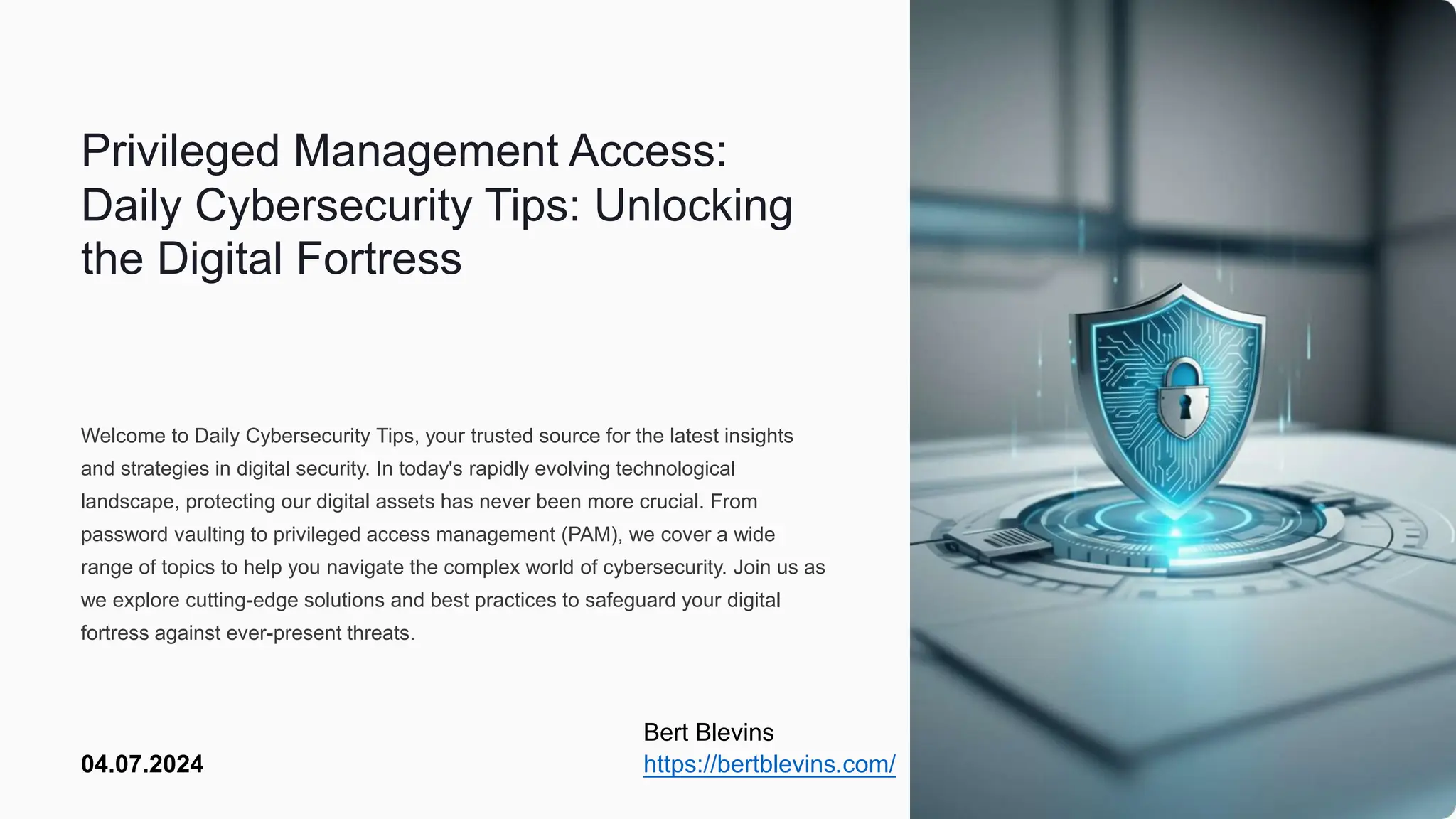
Welcome to Daily Cybersecurity Tips, your trusted source for the latest insights
and strategies in digital security. In today's rapidly evolving technological
landscape, protecting our digital assets has never been more crucial. From
password vaulting to privileged access management (PAM), we cover a wide
range of topics to help you navigate the complex world of cybersecurity. Join us as
we explore cutting-edge solutions and best practices to safeguard your digital
fortress against ever-present threats.
Bert Blevins
https://bertblevins.com/
04.07.2024
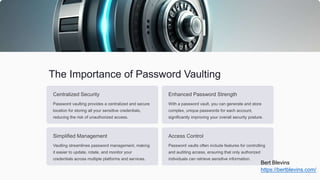
The Importance of Password Vaulting
Centralized Security
Password vaulting provides a centralized and secure
location for storing all your sensitive credentials,
reducing the risk of unauthorized access.
Enhanced Password Strength
With a password vault, you can generate and store
complex, unique passwords for each account,
significantly improving your overall security posture.
Simplified Management
Vaulting streamlines password management, making
it easier to update, rotate, and monitor your
credentials across multiple platforms and services.
Access Control
Password vaults often include features for controlling
and auditing access, ensuring that only authorized
individuals can retrieve sensitive information.
Bert Blevins
https://bertblevins.com/
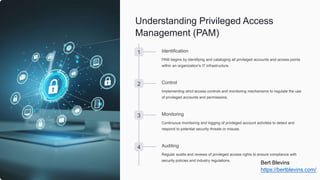
Understanding Privileged Access
Management (PAM)
1 Identification
PAM begins by identifying and cataloging all privileged accounts and access points
within an organization's IT infrastructure.
2 Control
Implementing strict access controls and monitoring mechanisms to regulate the use
of privileged accounts and permissions.
3 Monitoring
Continuous monitoring and logging of privileged account activities to detect and
respond to potential security threats or misuse.
4 Auditing
Regular audits and reviews of privileged access rights to ensure compliance with
security policies and industry regulations.
Bert Blevins
https://bertblevins.com/
The Rise of Chatbot Engineering in
Cybersecurity
Automated Threat
Detection
Chatbots powered by AI can
continuously monitor systems for
potential security threats,
providing real-time alerts and
responses.
User Education
Interactive chatbots can educate
users on cybersecurity best
practices, helping to reduce
human error and improve overall
security awareness.
Incident Response
In the event of a security incident,
chatbots can guide users through
initial response procedures and
escalate issues to human experts
when necessary.
Bert Blevins
https://bertblevins.com/
Exploring Local Administrator Password
Solution (LAPS)
1 Centralized Management
LAPS provides a centralized system for managing and rotating local administrator passwords
across an organization's Windows devices.
2 Automated Password Rotation
LAPS automatically changes local administrator passwords at regular intervals, reducing the
risk of compromised credentials.
3 Secure Storage
Passwords are securely stored in Active Directory, with access controls to ensure only
authorized personnel can retrieve them.
4 Simplified Auditing
LAPS includes built-in auditing features, making it easier to track password access and
changes for compliance purposes.
Bert Blevins
https://bertblevins.com/
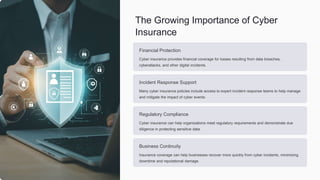
The Growing Importance of Cyber
Insurance
Financial Protection
Cyber insurance provides financial coverage for losses resulting from data breaches,
cyberattacks, and other digital incidents.
Incident Response Support
Many cyber insurance policies include access to expert incident response teams to help manage
and mitigate the impact of cyber events.
Regulatory Compliance
Cyber insurance can help organizations meet regulatory requirements and demonstrate due
diligence in protecting sensitive data.
Business Continuity
Insurance coverage can help businesses recover more quickly from cyber incidents, minimizing
downtime and reputational damage.
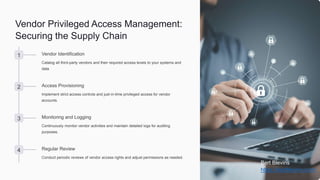
Vendor Privileged Access Management:
Securing the Supply Chain
1 Vendor Identification
Catalog all third-party vendors and their required access levels to your systems and
data.
2 Access Provisioning
Implement strict access controls and just-in-time privileged access for vendor
accounts.
3 Monitoring and Logging
Continuously monitor vendor activities and maintain detailed logs for auditing
purposes.
4 Regular Review
Conduct periodic reviews of vendor access rights and adjust permissions as needed.
Bert Blevins
https://bertblevins.com/
Identity Security: The Foundation of Modern
Cybersecurity
Multi-Factor Authentication
Implement strong MFA across all
systems to verify user identities
and prevent unauthorized access.
Identity Governance
Establish robust policies and
procedures for managing user
identities throughout their
lifecycle.
Adaptive Authentication
Utilize AI-driven systems to
analyze user behavior and adjust
authentication requirements in
real-time.
Bert Blevins
https://bertblevins.com/
Distributed File System (DFS) Security
Best Practices
1 Access Controls
Implement granular access controls and permissions to ensure users can only access the
files and folders they need.
2 Encryption
Use strong encryption for data in transit and at rest to protect sensitive information stored in
the DFS.
3 Monitoring and Auditing
Regularly monitor DFS access and usage, maintaining detailed audit logs for security and
compliance purposes.
4 Replication Security
Secure DFS replication traffic between servers to prevent data interception or tampering
during synchronization.
Bert Blevins
https://bertblevins.com/
Identity Threat Detection and Response
(ITDR): Proactive Defense
1 Continuous Monitoring
Implement real-time monitoring of user identities and access patterns across all
systems and applications.
2 Anomaly Detection
Utilize AI and machine learning algorithms to identify unusual behavior or potential
identity-based threats.
3 Automated Response
Deploy automated response mechanisms to quickly contain and mitigate identity-
related security incidents.
4 Forensic Analysis
Conduct thorough post-incident analysis to understand the root cause and improve
future defenses.
Bert Blevins
https://bertblevins.com/
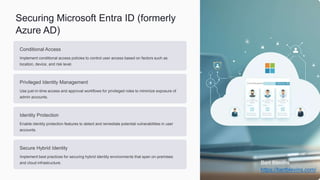
Securing Microsoft Entra ID (formerly
Azure AD)
Conditional Access
Implement conditional access policies to control user access based on factors such as
location, device, and risk level.
Privileged Identity Management
Use just-in-time access and approval workflows for privileged roles to minimize exposure of
admin accounts.
Identity Protection
Enable identity protection features to detect and remediate potential vulnerabilities in user
accounts.
Secure Hybrid Identity
Implement best practices for securing hybrid identity environments that span on-premises
and cloud infrastructure. Bert Blevins
https://bertblevins.com/
Cloud Infrastructure Entitlement Management
(CIEM)
Discovery and Visibility
Gain comprehensive visibility into
all identities, permissions, and
resources across multi-cloud
environments.
Least Privilege
Enforcement
Automatically identify and remove
excessive permissions to enforce
the principle of least privilege.
Continuous Monitoring
Implement real-time monitoring
and alerting for potential
misconfigurations or policy
violations in cloud entitlements.
Bert Blevins
https://bertblevins.com/
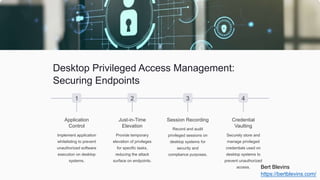
Desktop Privileged Access Management:
Securing Endpoints
1
Application
Control
Implement application
whitelisting to prevent
unauthorized software
execution on desktop
systems.
2
Just-in-Time
Elevation
Provide temporary
elevation of privileges
for specific tasks,
reducing the attack
surface on endpoints.
3
Session Recording
Record and audit
privileged sessions on
desktop systems for
security and
compliance purposes.
4
Credential
Vaulting
Securely store and
manage privileged
credentials used on
desktop systems to
prevent unauthorized
access. Bert Blevins
https://bertblevins.com/
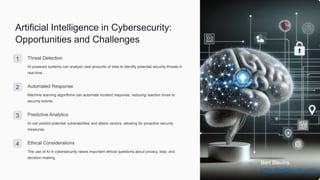
Artificial Intelligence in Cybersecurity:
Opportunities and Challenges
1 Threat Detection
AI-powered systems can analyze vast amounts of data to identify potential security threats in
real-time.
2 Automated Response
Machine learning algorithms can automate incident response, reducing reaction times to
security events.
3 Predictive Analytics
AI can predict potential vulnerabilities and attack vectors, allowing for proactive security
measures.
4 Ethical Considerations
The use of AI in cybersecurity raises important ethical questions about privacy, bias, and
decision-making.
Bert Blevins
https://bertblevins.com/
Responding to a Data Breach: Best
Practices
1 Containment
Quickly isolate affected systems to prevent further data loss or unauthorized access.
2 Assessment
Conduct a thorough investigation to determine the scope and impact of the breach.
3 Notification
Inform affected parties and relevant authorities in accordance with legal and
regulatory requirements.
4 Recovery
Implement measures to restore systems and data, addressing vulnerabilities to
prevent future incidents.
Bert Blevins
https://bertblevins.com/
Leveraging Chatbots for Cybersecurity
Education
Personalized Learning
Chatbots can provide tailored
cybersecurity education based on
individual user roles and
knowledge levels.
24/7 Availability
AI-powered chatbots offer round-
the-clock access to cybersecurity
information and guidance.
Interactive Scenarios
Chatbots can simulate real-world
cybersecurity scenarios, allowing
users to practice their skills in a
safe environment.
Bert Blevins
https://bertblevins.com/
About the Presenter
Phone
832-281-0330
Email
info@incgpt.com
LinkedIn
https://www.linkedin.com
/in/bertblevins/
Qualifications
Bachelor's Degree in
Advertising, Master of
Business Administration
Bert Blevins is a passionate and experienced professional who is constantly seeking knowledge and professional
development. With a diverse educational background and numerous certifications, Bert is dedicated to making a
positive impact in the field of server security and privilege management.
Bert Blevins
https://bertblevins.com/

Daily Cybersecurity Tips and Tricks with solutions

  • 1.
    Privileged Management Access: DailyCybersecurity Tips: Unlocking the Digital Fortress Welcome to Daily Cybersecurity Tips, your trusted source for the latest insights and strategies in digital security. In today's rapidly evolving technological landscape, protecting our digital assets has never been more crucial. From password vaulting to privileged access management (PAM), we cover a wide range of topics to help you navigate the complex world of cybersecurity. Join us as we explore cutting-edge solutions and best practices to safeguard your digital fortress against ever-present threats. Bert Blevins https://bertblevins.com/ 04.07.2024
  • 2.
    The Importance ofPassword Vaulting Centralized Security Password vaulting provides a centralized and secure location for storing all your sensitive credentials, reducing the risk of unauthorized access. Enhanced Password Strength With a password vault, you can generate and store complex, unique passwords for each account, significantly improving your overall security posture. Simplified Management Vaulting streamlines password management, making it easier to update, rotate, and monitor your credentials across multiple platforms and services. Access Control Password vaults often include features for controlling and auditing access, ensuring that only authorized individuals can retrieve sensitive information. Bert Blevins https://bertblevins.com/
  • 3.
    Understanding Privileged Access Management(PAM) 1 Identification PAM begins by identifying and cataloging all privileged accounts and access points within an organization's IT infrastructure. 2 Control Implementing strict access controls and monitoring mechanisms to regulate the use of privileged accounts and permissions. 3 Monitoring Continuous monitoring and logging of privileged account activities to detect and respond to potential security threats or misuse. 4 Auditing Regular audits and reviews of privileged access rights to ensure compliance with security policies and industry regulations. Bert Blevins https://bertblevins.com/
  • 4.
    The Rise ofChatbot Engineering in Cybersecurity Automated Threat Detection Chatbots powered by AI can continuously monitor systems for potential security threats, providing real-time alerts and responses. User Education Interactive chatbots can educate users on cybersecurity best practices, helping to reduce human error and improve overall security awareness. Incident Response In the event of a security incident, chatbots can guide users through initial response procedures and escalate issues to human experts when necessary. Bert Blevins https://bertblevins.com/
  • 5.
    Exploring Local AdministratorPassword Solution (LAPS) 1 Centralized Management LAPS provides a centralized system for managing and rotating local administrator passwords across an organization's Windows devices. 2 Automated Password Rotation LAPS automatically changes local administrator passwords at regular intervals, reducing the risk of compromised credentials. 3 Secure Storage Passwords are securely stored in Active Directory, with access controls to ensure only authorized personnel can retrieve them. 4 Simplified Auditing LAPS includes built-in auditing features, making it easier to track password access and changes for compliance purposes. Bert Blevins https://bertblevins.com/
  • 6.
    The Growing Importanceof Cyber Insurance Financial Protection Cyber insurance provides financial coverage for losses resulting from data breaches, cyberattacks, and other digital incidents. Incident Response Support Many cyber insurance policies include access to expert incident response teams to help manage and mitigate the impact of cyber events. Regulatory Compliance Cyber insurance can help organizations meet regulatory requirements and demonstrate due diligence in protecting sensitive data. Business Continuity Insurance coverage can help businesses recover more quickly from cyber incidents, minimizing downtime and reputational damage.
  • 7.
    Vendor Privileged AccessManagement: Securing the Supply Chain 1 Vendor Identification Catalog all third-party vendors and their required access levels to your systems and data. 2 Access Provisioning Implement strict access controls and just-in-time privileged access for vendor accounts. 3 Monitoring and Logging Continuously monitor vendor activities and maintain detailed logs for auditing purposes. 4 Regular Review Conduct periodic reviews of vendor access rights and adjust permissions as needed. Bert Blevins https://bertblevins.com/
  • 8.
    Identity Security: TheFoundation of Modern Cybersecurity Multi-Factor Authentication Implement strong MFA across all systems to verify user identities and prevent unauthorized access. Identity Governance Establish robust policies and procedures for managing user identities throughout their lifecycle. Adaptive Authentication Utilize AI-driven systems to analyze user behavior and adjust authentication requirements in real-time. Bert Blevins https://bertblevins.com/
  • 9.
    Distributed File System(DFS) Security Best Practices 1 Access Controls Implement granular access controls and permissions to ensure users can only access the files and folders they need. 2 Encryption Use strong encryption for data in transit and at rest to protect sensitive information stored in the DFS. 3 Monitoring and Auditing Regularly monitor DFS access and usage, maintaining detailed audit logs for security and compliance purposes. 4 Replication Security Secure DFS replication traffic between servers to prevent data interception or tampering during synchronization. Bert Blevins https://bertblevins.com/
  • 10.
    Identity Threat Detectionand Response (ITDR): Proactive Defense 1 Continuous Monitoring Implement real-time monitoring of user identities and access patterns across all systems and applications. 2 Anomaly Detection Utilize AI and machine learning algorithms to identify unusual behavior or potential identity-based threats. 3 Automated Response Deploy automated response mechanisms to quickly contain and mitigate identity- related security incidents. 4 Forensic Analysis Conduct thorough post-incident analysis to understand the root cause and improve future defenses. Bert Blevins https://bertblevins.com/
  • 11.
    Securing Microsoft EntraID (formerly Azure AD) Conditional Access Implement conditional access policies to control user access based on factors such as location, device, and risk level. Privileged Identity Management Use just-in-time access and approval workflows for privileged roles to minimize exposure of admin accounts. Identity Protection Enable identity protection features to detect and remediate potential vulnerabilities in user accounts. Secure Hybrid Identity Implement best practices for securing hybrid identity environments that span on-premises and cloud infrastructure. Bert Blevins https://bertblevins.com/
  • 12.
    Cloud Infrastructure EntitlementManagement (CIEM) Discovery and Visibility Gain comprehensive visibility into all identities, permissions, and resources across multi-cloud environments. Least Privilege Enforcement Automatically identify and remove excessive permissions to enforce the principle of least privilege. Continuous Monitoring Implement real-time monitoring and alerting for potential misconfigurations or policy violations in cloud entitlements. Bert Blevins https://bertblevins.com/
  • 13.
    Desktop Privileged AccessManagement: Securing Endpoints 1 Application Control Implement application whitelisting to prevent unauthorized software execution on desktop systems. 2 Just-in-Time Elevation Provide temporary elevation of privileges for specific tasks, reducing the attack surface on endpoints. 3 Session Recording Record and audit privileged sessions on desktop systems for security and compliance purposes. 4 Credential Vaulting Securely store and manage privileged credentials used on desktop systems to prevent unauthorized access. Bert Blevins https://bertblevins.com/
  • 14.
    Artificial Intelligence inCybersecurity: Opportunities and Challenges 1 Threat Detection AI-powered systems can analyze vast amounts of data to identify potential security threats in real-time. 2 Automated Response Machine learning algorithms can automate incident response, reducing reaction times to security events. 3 Predictive Analytics AI can predict potential vulnerabilities and attack vectors, allowing for proactive security measures. 4 Ethical Considerations The use of AI in cybersecurity raises important ethical questions about privacy, bias, and decision-making. Bert Blevins https://bertblevins.com/
  • 15.
    Responding to aData Breach: Best Practices 1 Containment Quickly isolate affected systems to prevent further data loss or unauthorized access. 2 Assessment Conduct a thorough investigation to determine the scope and impact of the breach. 3 Notification Inform affected parties and relevant authorities in accordance with legal and regulatory requirements. 4 Recovery Implement measures to restore systems and data, addressing vulnerabilities to prevent future incidents. Bert Blevins https://bertblevins.com/
  • 16.
    Leveraging Chatbots forCybersecurity Education Personalized Learning Chatbots can provide tailored cybersecurity education based on individual user roles and knowledge levels. 24/7 Availability AI-powered chatbots offer round- the-clock access to cybersecurity information and guidance. Interactive Scenarios Chatbots can simulate real-world cybersecurity scenarios, allowing users to practice their skills in a safe environment. Bert Blevins https://bertblevins.com/
  • 17.
    About the Presenter Phone 832-281-0330 Email info@incgpt.com LinkedIn https://www.linkedin.com /in/bertblevins/ Qualifications Bachelor'sDegree in Advertising, Master of Business Administration Bert Blevins is a passionate and experienced professional who is constantly seeking knowledge and professional development. With a diverse educational background and numerous certifications, Bert is dedicated to making a positive impact in the field of server security and privilege management. Bert Blevins https://bertblevins.com/