DAE TOOLS SOFTWARE
INTRODUCTION
D.D. Nikolić
Updated: 20 March 2018
DAE Tools Project, http://www.daetools.com
Outline
1. General Information
2. Motivation
3. Main Features
4. Programming Paradigms
5. Use Cases
D.D. Nikolić, DAE Tools Project, http://www.daetools.com
GENERAL INFORMATION
What is DAE Tools?
Modelling, simulation, optimisation & parameter estimation
software 1
Areas of application:
◦ Initially: chemical process industry (mass, heat and
momentum transfers, chemical reactions, separation
processes, thermodynamics, electro-chemistry)
◦ Nowadays: multi-domain
Free/Open source software (GNU GPL)
Cross-platform
Multiple architectures (32/64 bit x86, ARM, ...)
1Nikolić DD. (2016) DAE Tools: equation-based object-oriented modelling, simulation and optimisation software. PeerJ
Computer Science 2:e54
D.D. Nikolić, DAE Tools Project, http://www.daetools.com
What is DAE Tools? (cont’d)
DAE Tools is not:
◦ A modelling language (such as Modelica)
◦ An integrated software suite of data structures and routines
for scientific applications (such as PETSc, Sundials, ...)
DAE Tools is:
◦ An architectural design of interdependent software
components providing an API for:
◦ Model specification
◦ Activities on developed models (simulation, optimisation, ...)
◦ Processing of the results
◦ Report generation
◦ Code generation and model exchange
DAE Tools apply a hybrid approach between modelling
and general purpose programming languages, combining
the strengths of both approaches into a single one
D.D. Nikolić, DAE Tools Project, http://www.daetools.com
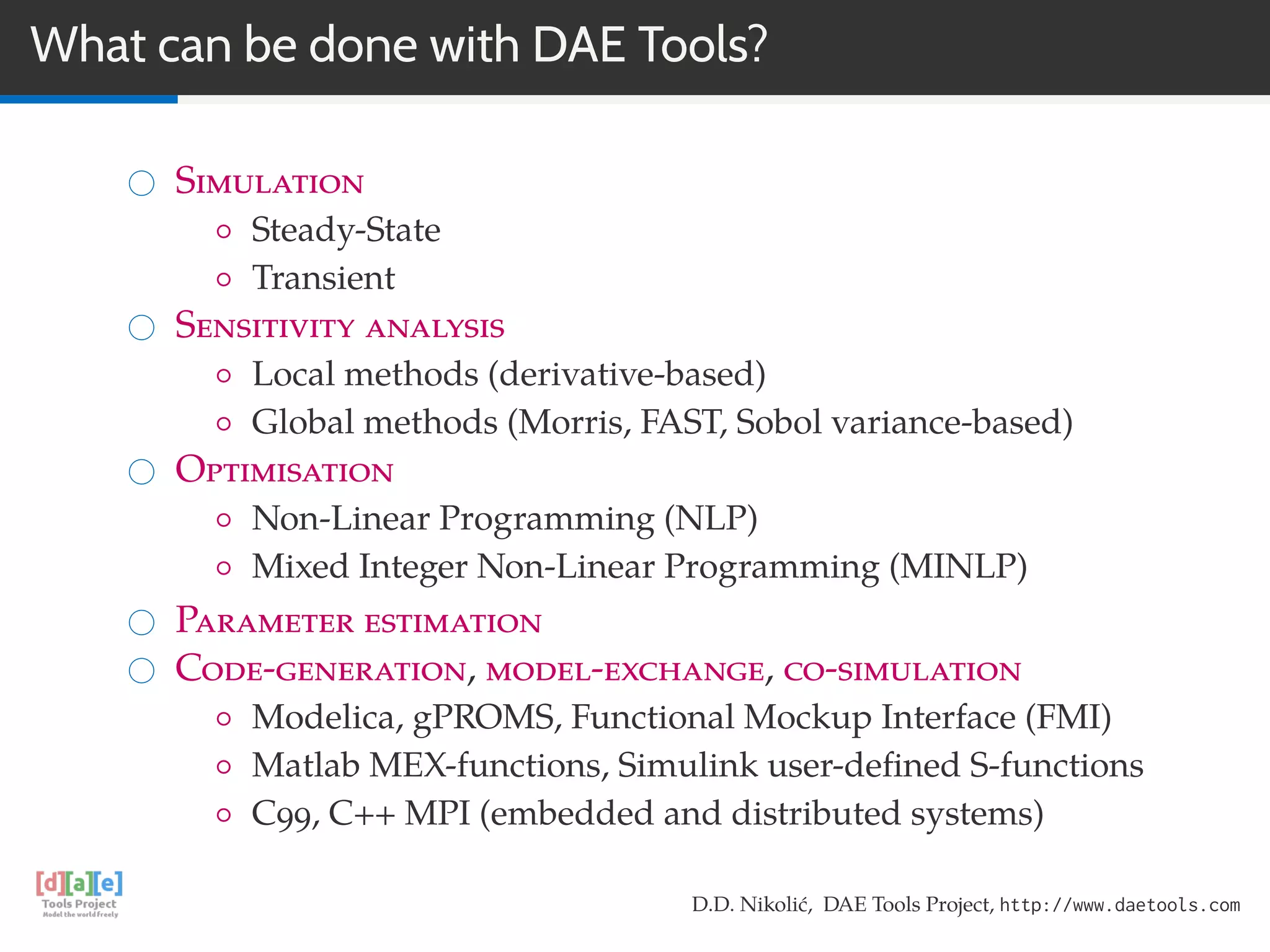
What can be done with DAE Tools?
Simulation
◦ Steady-State
◦ Transient
Sensitivity analysis
◦ Local methods (derivative-based)
◦ Global methods (Morris, FAST, Sobol variance-based)
Optimisation
◦ Non-Linear Programming (NLP)
◦ Mixed Integer Non-Linear Programming (MINLP)
Parameter estimation
Code-generation, model-exchange, co-simulation
◦ Modelica, gPROMS, Functional Mockup Interface (FMI)
◦ Matlab MEX-functions, Simulink user-defined S-functions
◦ C99, C++ MPI (embedded and distributed systems)
D.D. Nikolić, DAE Tools Project, http://www.daetools.com
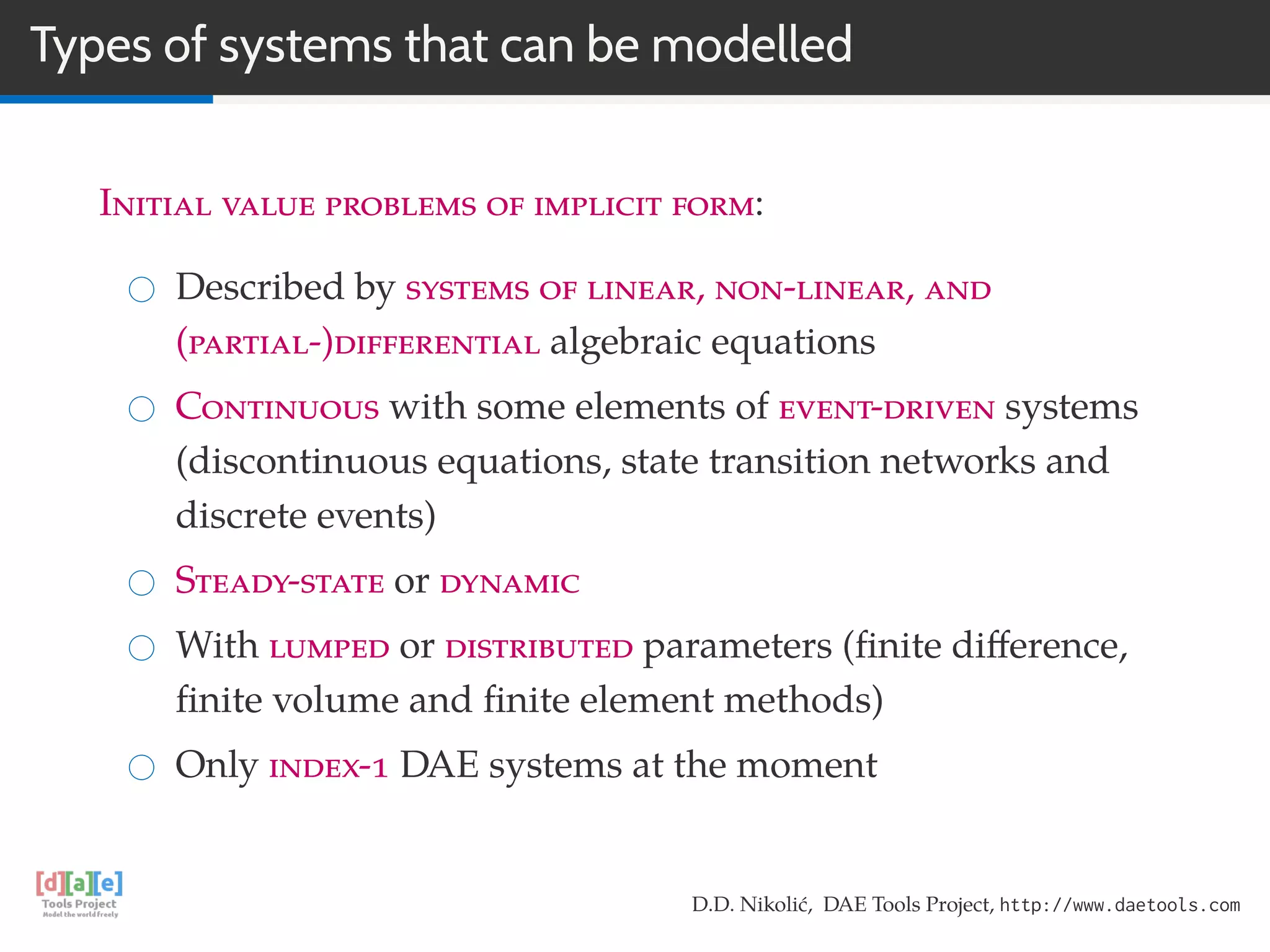
Types of systems that can be modelled
Initial value problems of implicit form:
Described by systems of linear, non-linear, and
(partial-)differential algebraic equations
Continuous with some elements of event-driven systems
(discontinuous equations, state transition networks and
discrete events)
Steady-state or dynamic
With lumped or distributed parameters (finite difference,
finite volume and finite element methods)
Only index-1 DAE systems at the moment
D.D. Nikolić, DAE Tools Project, http://www.daetools.com
MOTIVATION
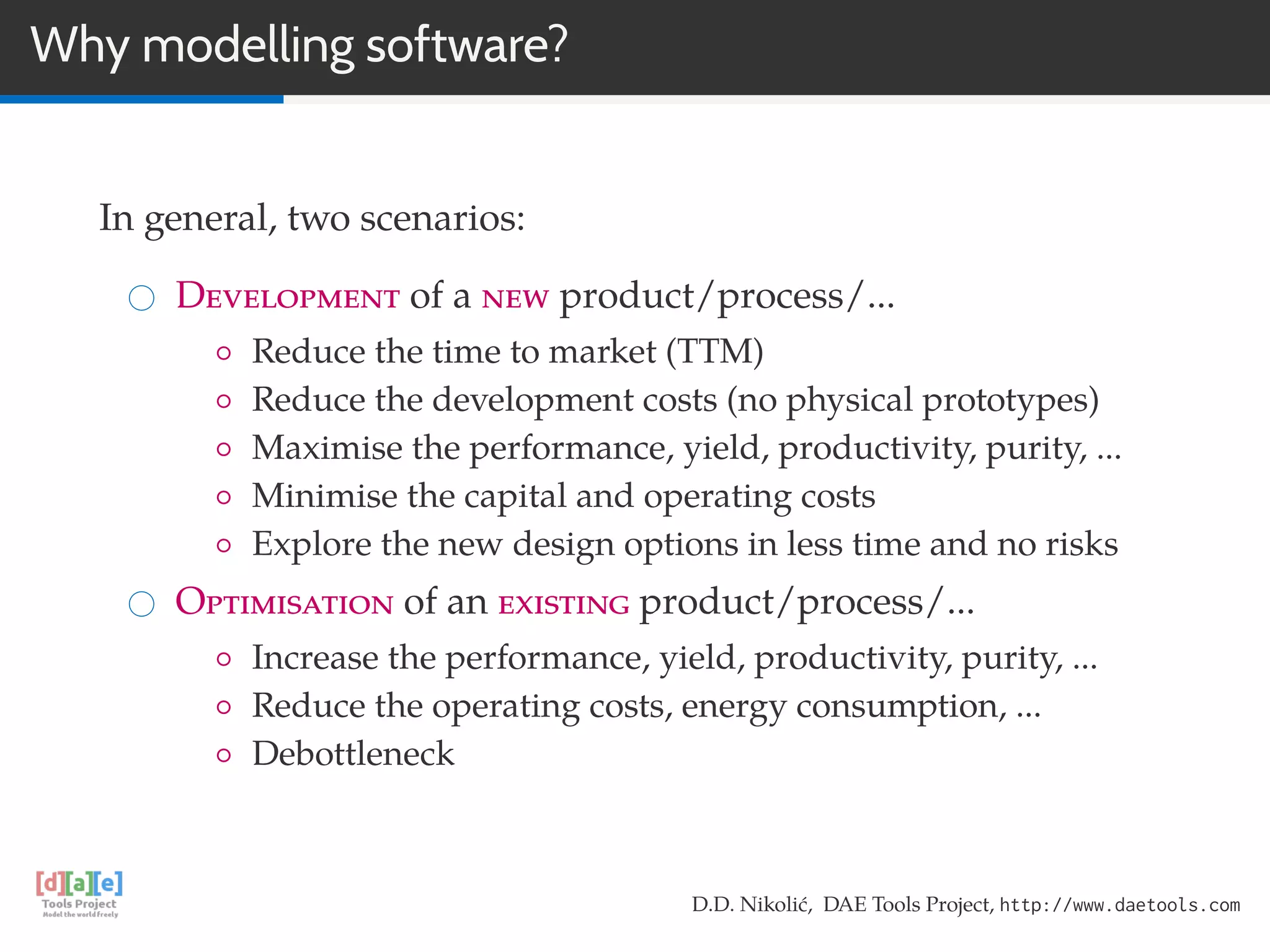
Why modelling software?
In general, two scenarios:
Development of a new product/process/...
◦ Reduce the time to market (TTM)
◦ Reduce the development costs (no physical prototypes)
◦ Maximise the performance, yield, productivity, purity, ...
◦ Minimise the capital and operating costs
◦ Explore the new design options in less time and no risks
Optimisation of an existing product/process/...
◦ Increase the performance, yield, productivity, purity, ...
◦ Reduce the operating costs, energy consumption, ...
◦ Debottleneck
D.D. Nikolić, DAE Tools Project, http://www.daetools.com
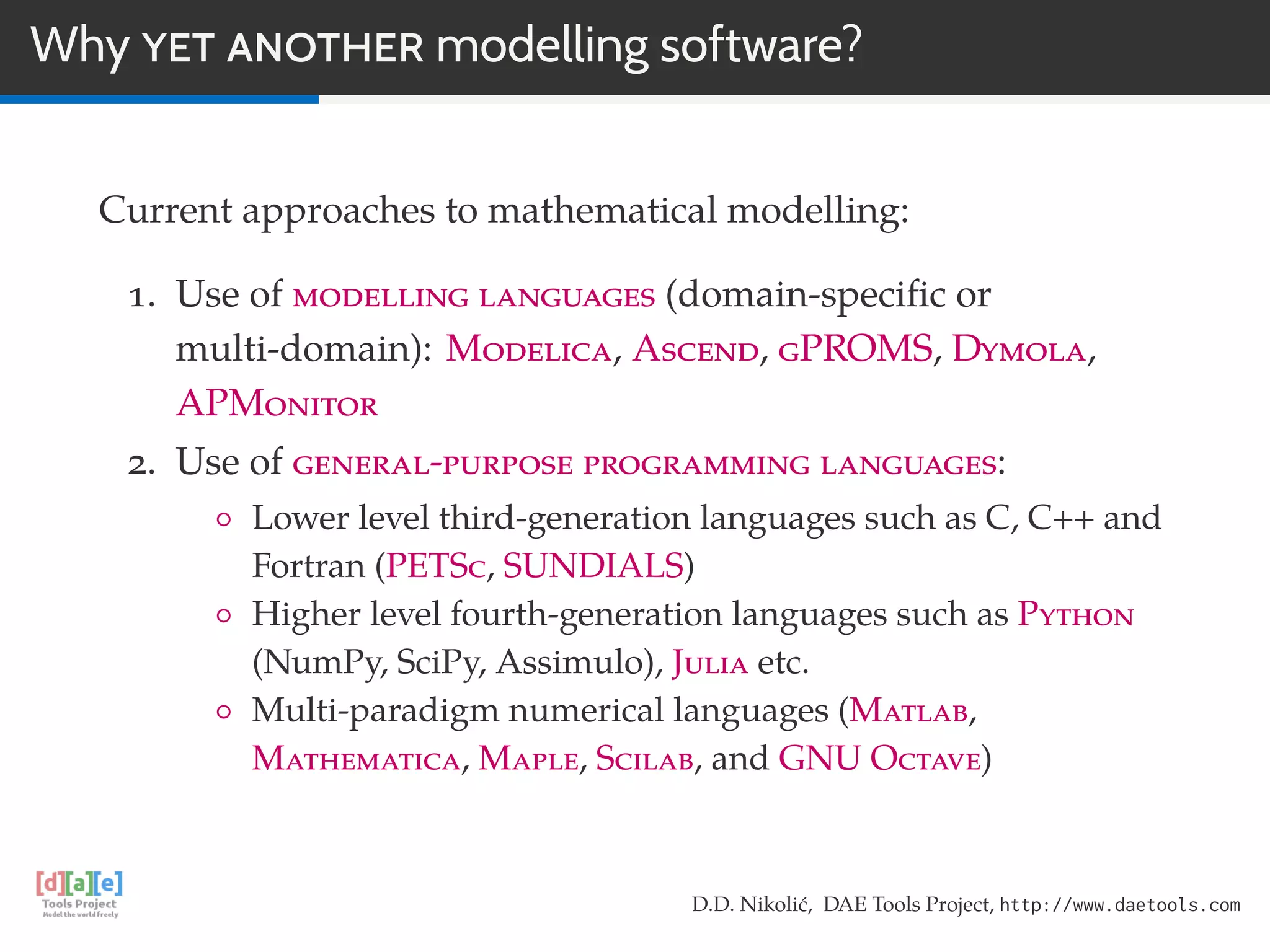
Why YET ANOTHER modelling software?
Current approaches to mathematical modelling:
1. Use of modelling languages (domain-specific or
multi-domain): Modelica, Ascend, gPROMS, Dymola,
APMonitor
2. Use of general-purpose programming languages:
◦ Lower level third-generation languages such as C, C++ and
Fortran (PETSc, SUNDIALS)
◦ Higher level fourth-generation languages such as Python
(NumPy, SciPy, Assimulo), Julia etc.
◦ Multi-paradigm numerical languages (Matlab,
Mathematica, Maple, Scilab, and GNU Octave)
D.D. Nikolić, DAE Tools Project, http://www.daetools.com
Why YET ANOTHER modelling software? (cont’d)
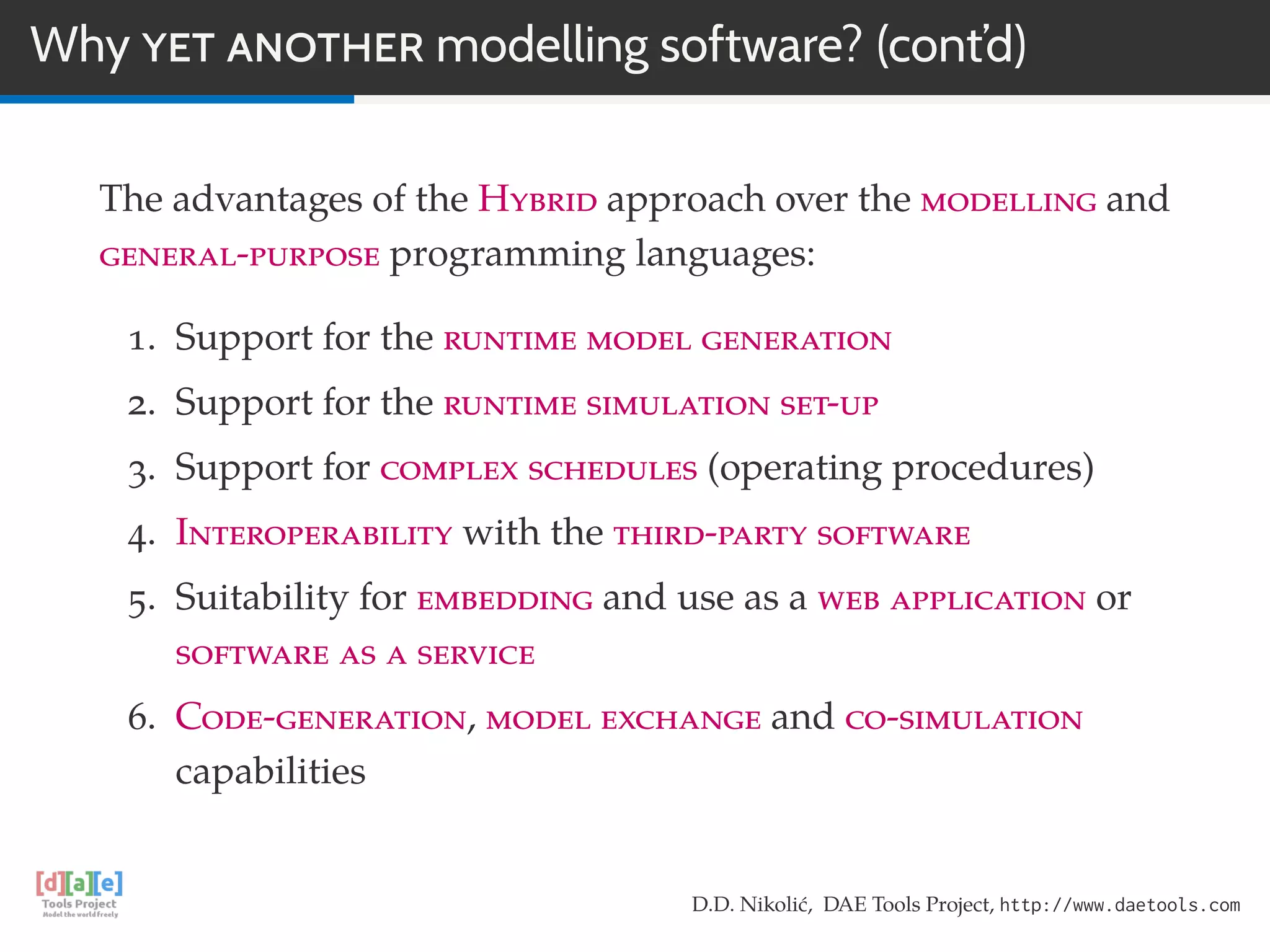
The advantages of the Hybrid approach over the modelling and
general-purpose programming languages:
1. Support for the runtime model generation
2. Support for the runtime simulation set-up
3. Support for complex schedules (operating procedures)
4. Interoperability with the third-party software
5. Suitability for embedding and use as a web application or
software as a service
6. Code-generation, model exchange and co-simulation
capabilities
D.D. Nikolić, DAE Tools Project, http://www.daetools.com
MAIN FEATURES
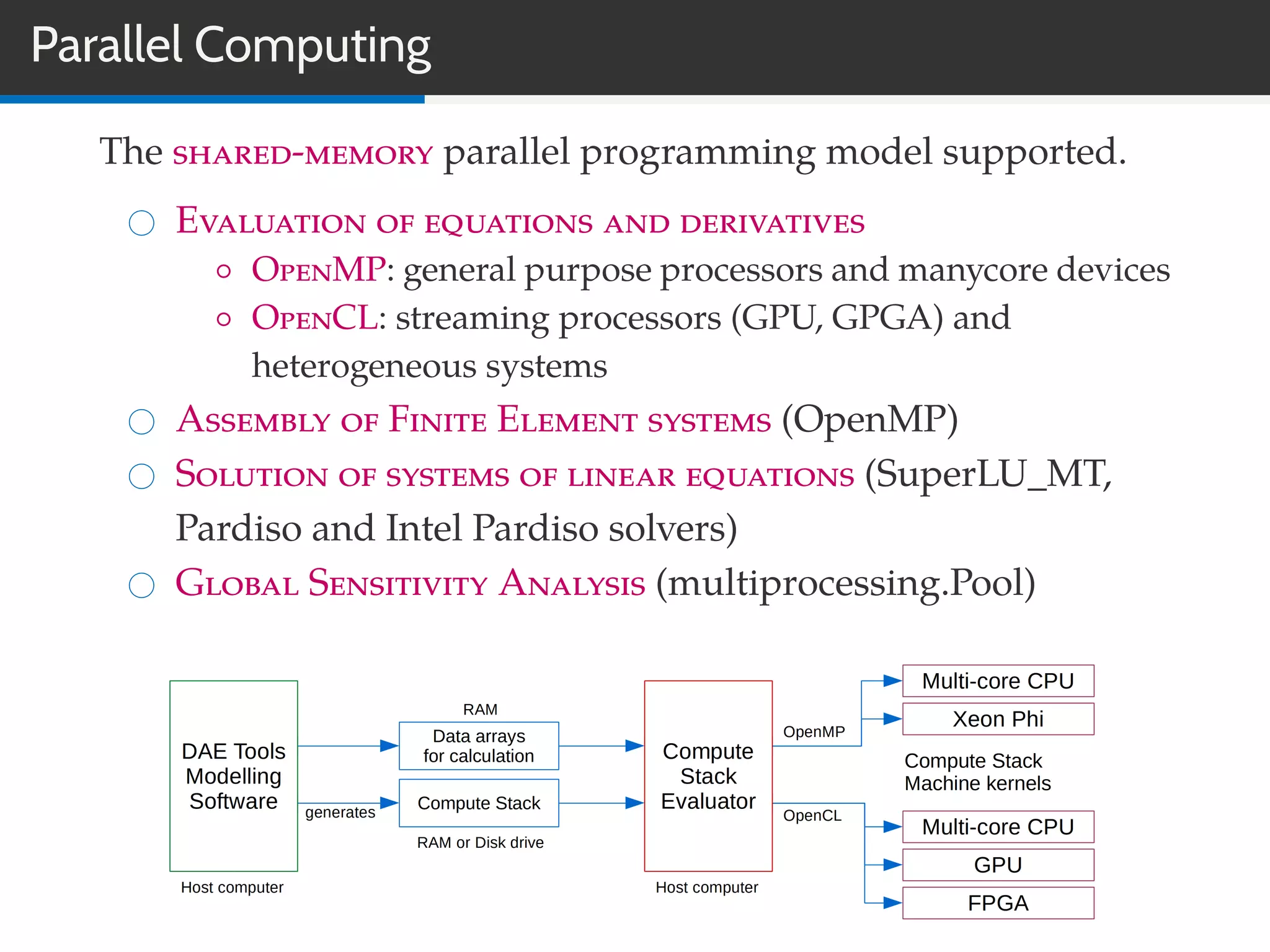
Parallel Computing
The shared-memory parallel programming model supported.
Evaluation of equations and derivatives
◦ OpenMP: general purpose processors and manycore devices
◦ OpenCL: streaming processors (GPU, GPGA) and
heterogeneous systems
Assembly of Finite Element systems (OpenMP)
Solution of systems of linear equations (SuperLU_MT,
Pardiso and Intel Pardiso solvers)
Global Sensitivity Analysis (multiprocessing.Pool)
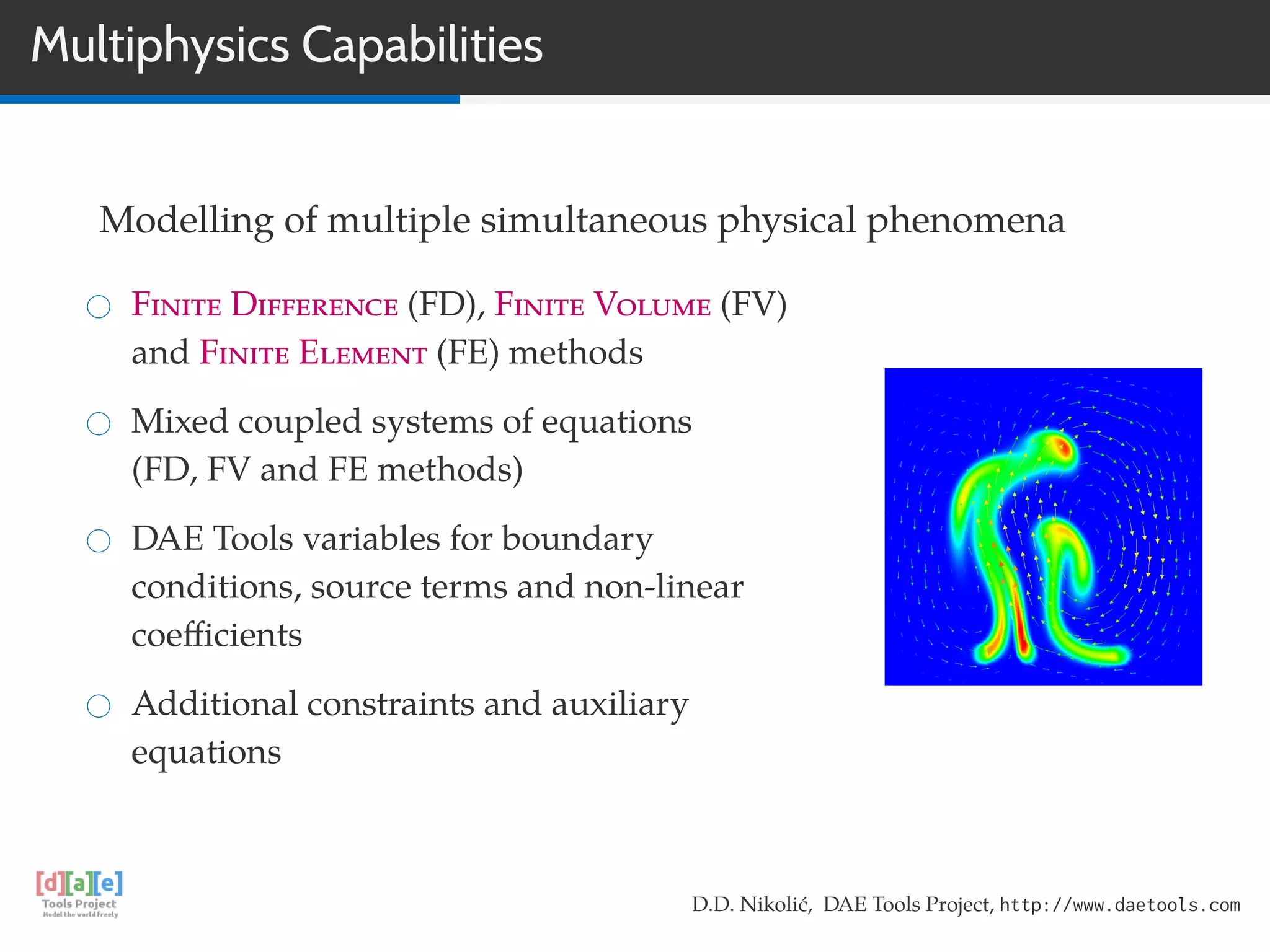
Multiphysics Capabilities
Modelling of multiple simultaneous physical phenomena
Finite Difference (FD), Finite Volume (FV)
and Finite Element (FE) methods
Mixed coupled systems of equations
(FD, FV and FE methods)
DAE Tools variables for boundary
conditions, source terms and non-linear
coefficients
Additional constraints and auxiliary
equations
D.D. Nikolić, DAE Tools Project, http://www.daetools.com
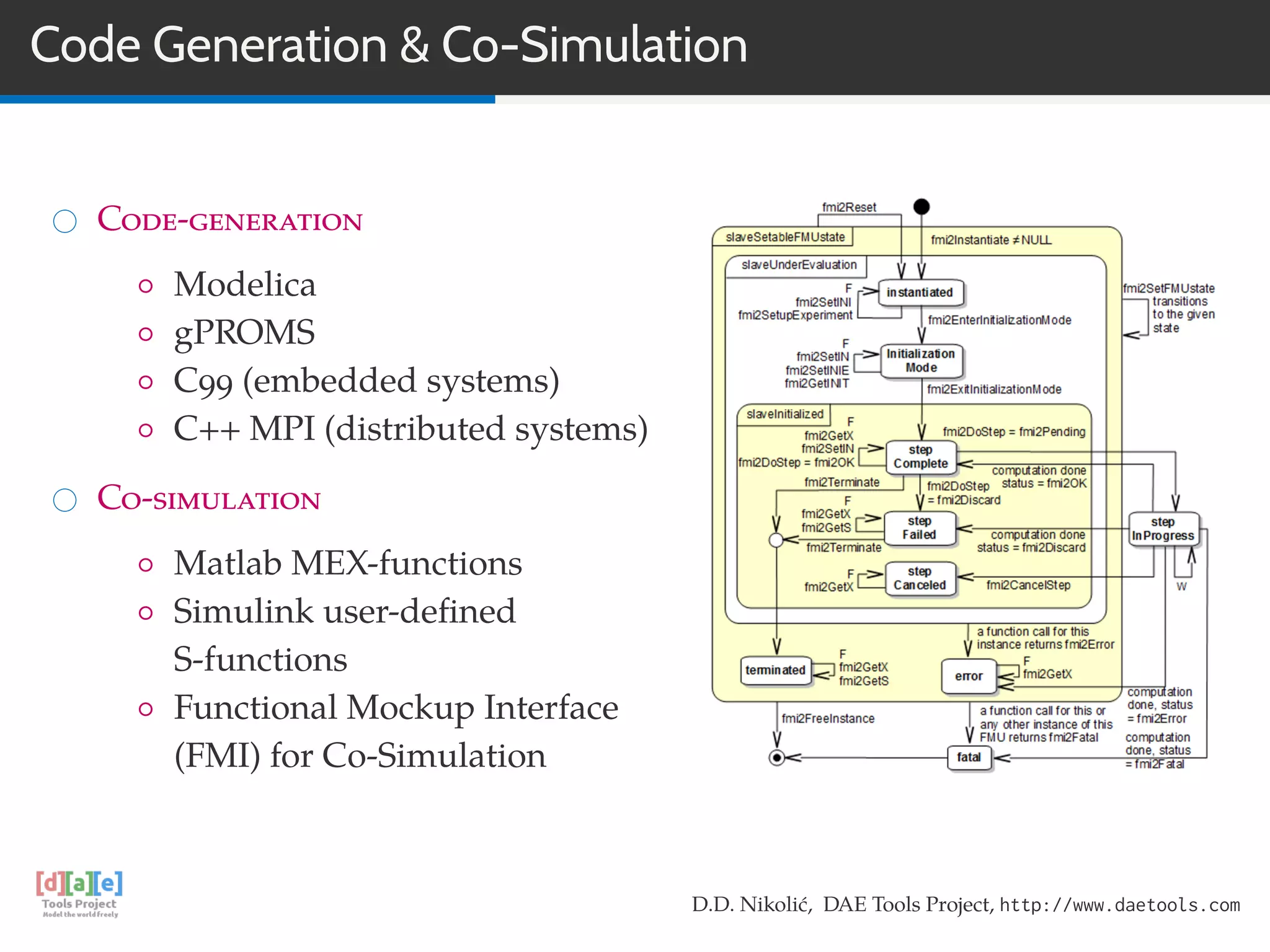
Code Generation & Co-Simulation
Code-generation
◦ Modelica
◦ gPROMS
◦ C99 (embedded systems)
◦ C++ MPI (distributed systems)
Co-simulation
◦ Matlab MEX-functions
◦ Simulink user-defined
S-functions
◦ Functional Mockup Interface
(FMI) for Co-Simulation
D.D. Nikolić, DAE Tools Project, http://www.daetools.com
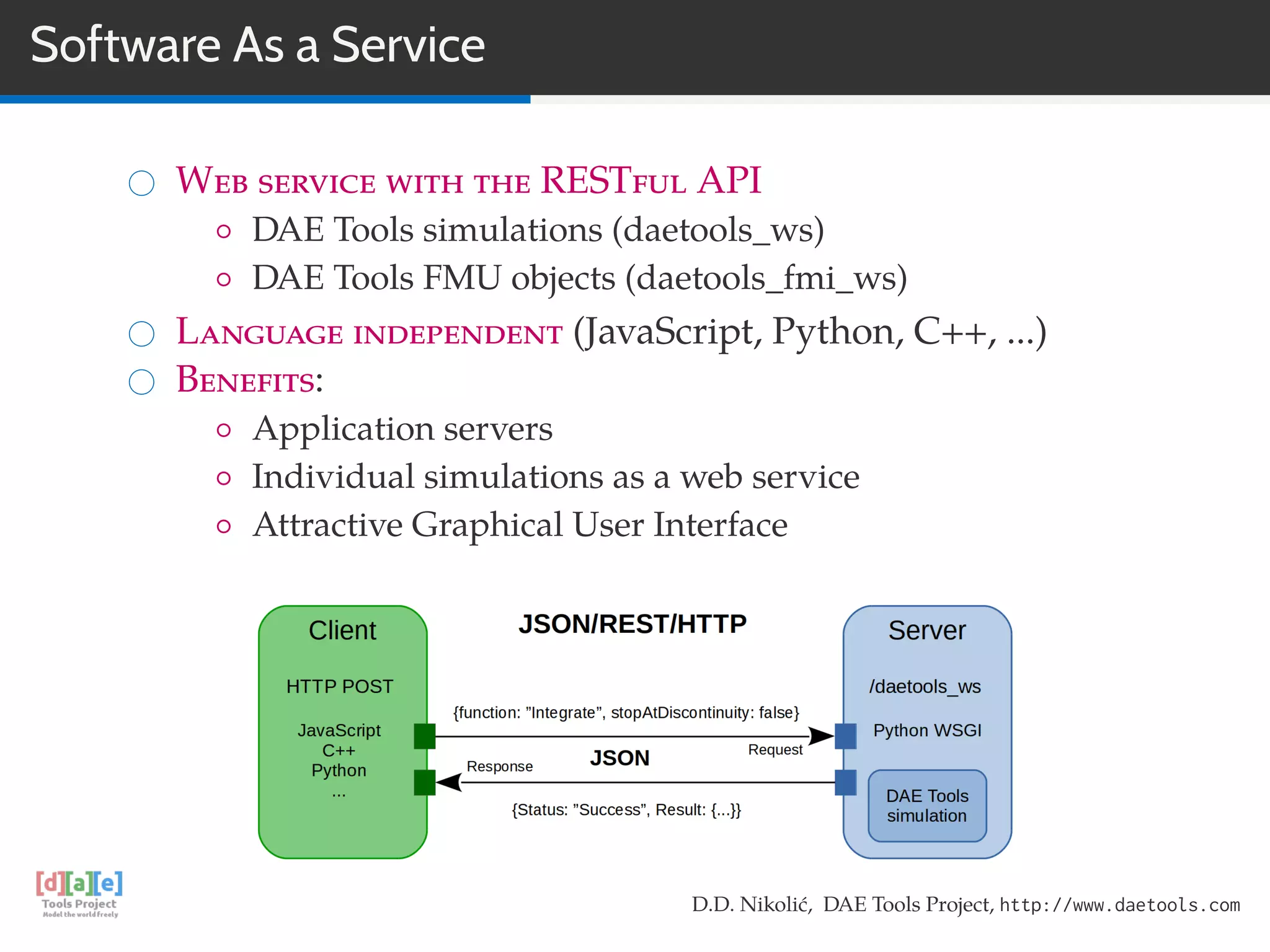
Software As a Service
Web service with the RESTful API
◦ DAE Tools simulations (daetools_ws)
◦ DAE Tools FMU objects (daetools_fmi_ws)
Language independent (JavaScript, Python, C++, ...)
Benefits:
◦ Application servers
◦ Individual simulations as a web service
◦ Attractive Graphical User Interface
D.D. Nikolić, DAE Tools Project, http://www.daetools.com
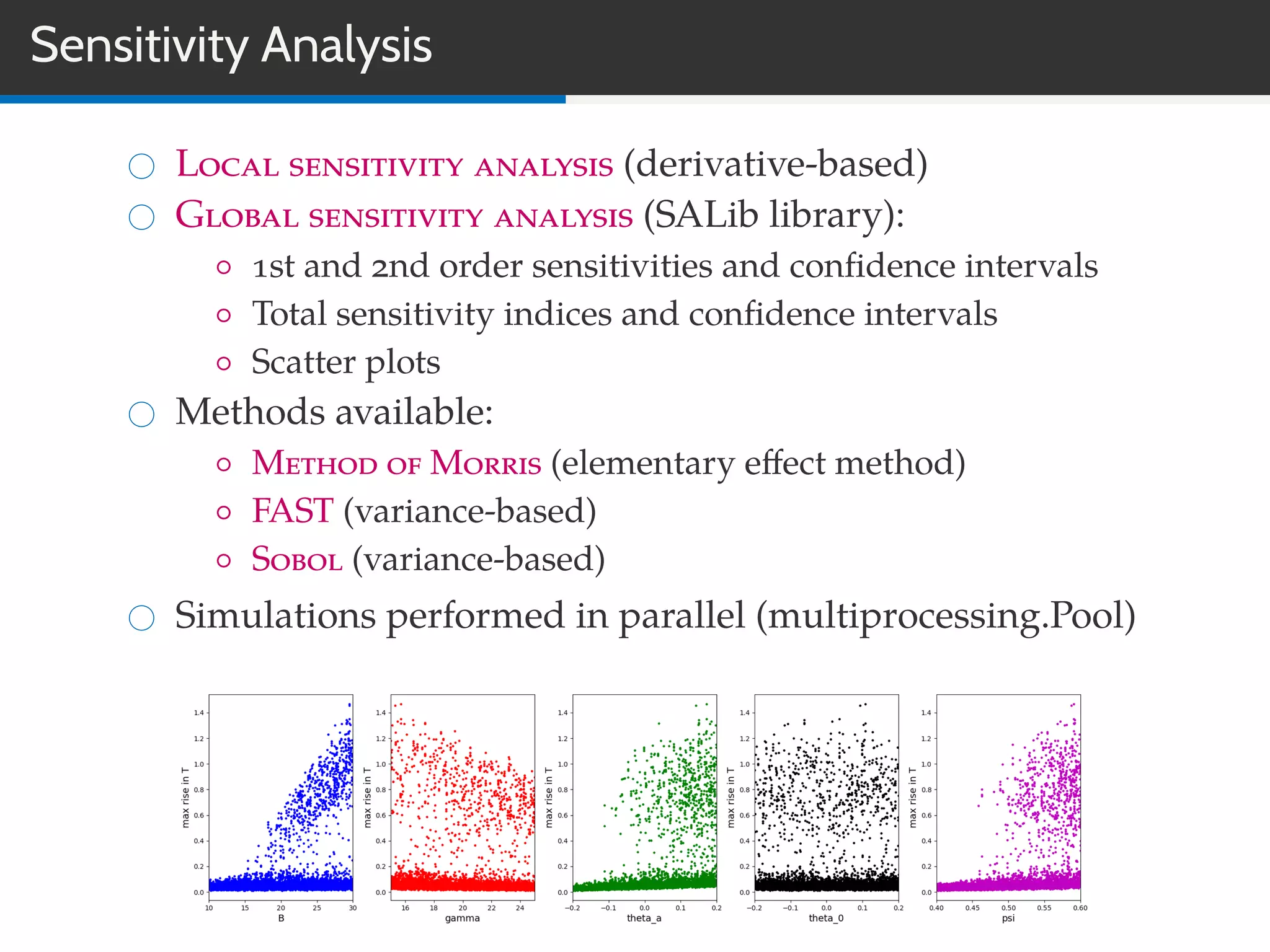
Sensitivity Analysis
Local sensitivity analysis (derivative-based)
Global sensitivity analysis (SALib library):
◦ 1st and 2nd order sensitivities and confidence intervals
◦ Total sensitivity indices and confidence intervals
◦ Scatter plots
Methods available:
◦ Method of Morris (elementary effect method)
◦ FAST (variance-based)
◦ Sobol (variance-based)
Simulations performed in parallel (multiprocessing.Pool)
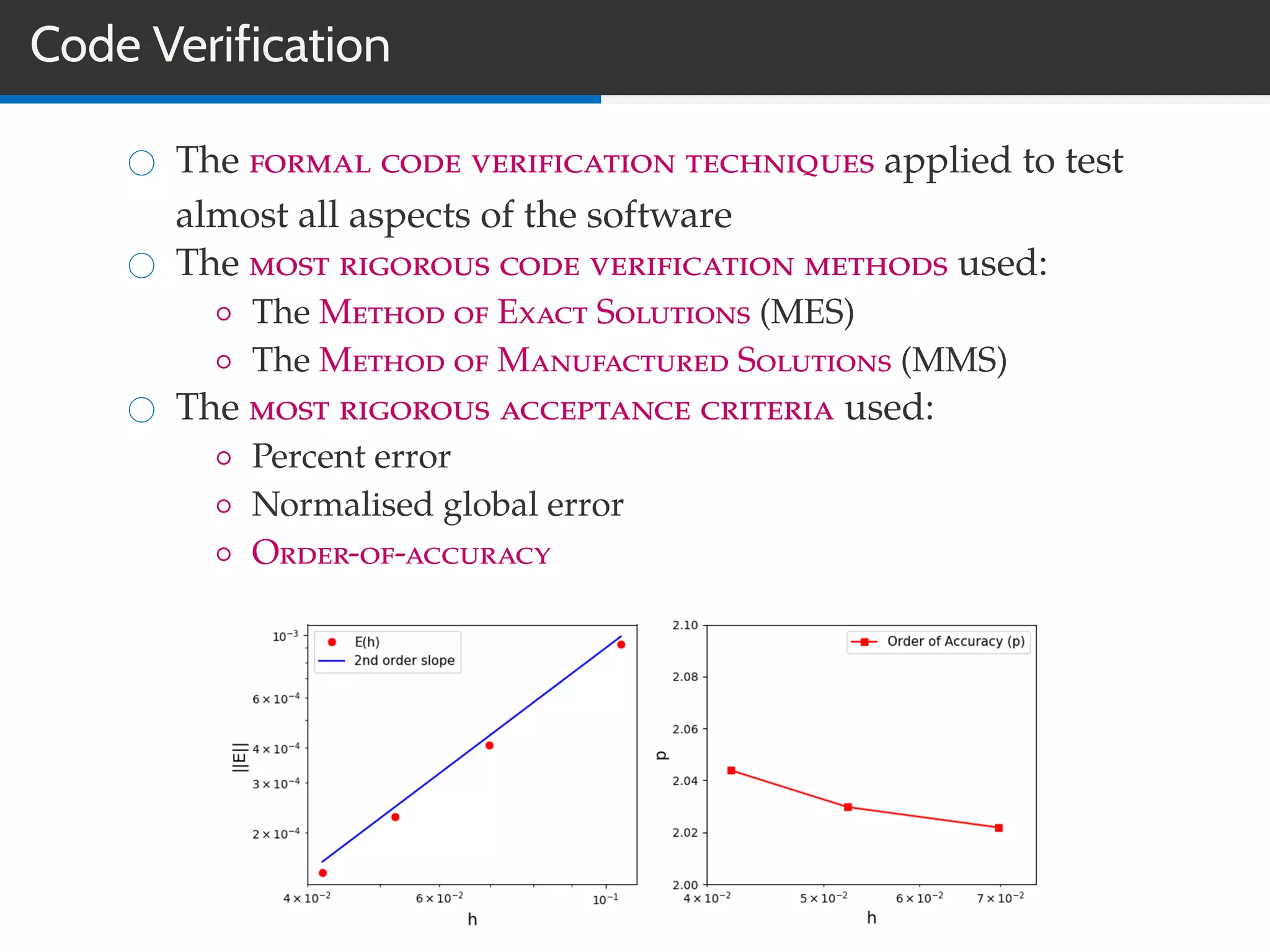
Code Verification
The formal code verification techniques applied to test
almost all aspects of the software
The most rigorous code verification methods used:
◦ The Method of Exact Solutions (MES)
◦ The Method of Manufactured Solutions (MMS)
The most rigorous acceptance criteria used:
◦ Percent error
◦ Normalised global error
◦ Order-of-accuracy
Additional DAE TOOLS features
Support for multiple platforms/architectures
Support for the automatic differentiation (ADOL-C)
Support for a large number of DAE, LA and NLP solvers
Support for the generation of model reports (XML +
MathML, Latex)
Export of the simulation results to various file formats
(Matlab, Excel, json, xml, HDF5, Pandas, VTK)
D.D. Nikolić, DAE Tools Project, http://www.daetools.com
PROGRAMMING PARADIGMS
The HYBRID approach
DAE Tools approach is a type of a hybrid approach
Combines strengths of modelling and general purpose
programming languages:
1. Developed in C++ with the Python bindings
2. Provides API (Application Programming Interface) that
resembles a syntax of modelling languages as much as
possible
3. Takes advantage of the higher level languages for:
◦ Model specification, simulation setup and schedules
◦ Access to the operating system
◦ Access to the standard/third-party libraries
D.D. Nikolić, DAE Tools Project, http://www.daetools.com
The HYBRID approach (cont’d)
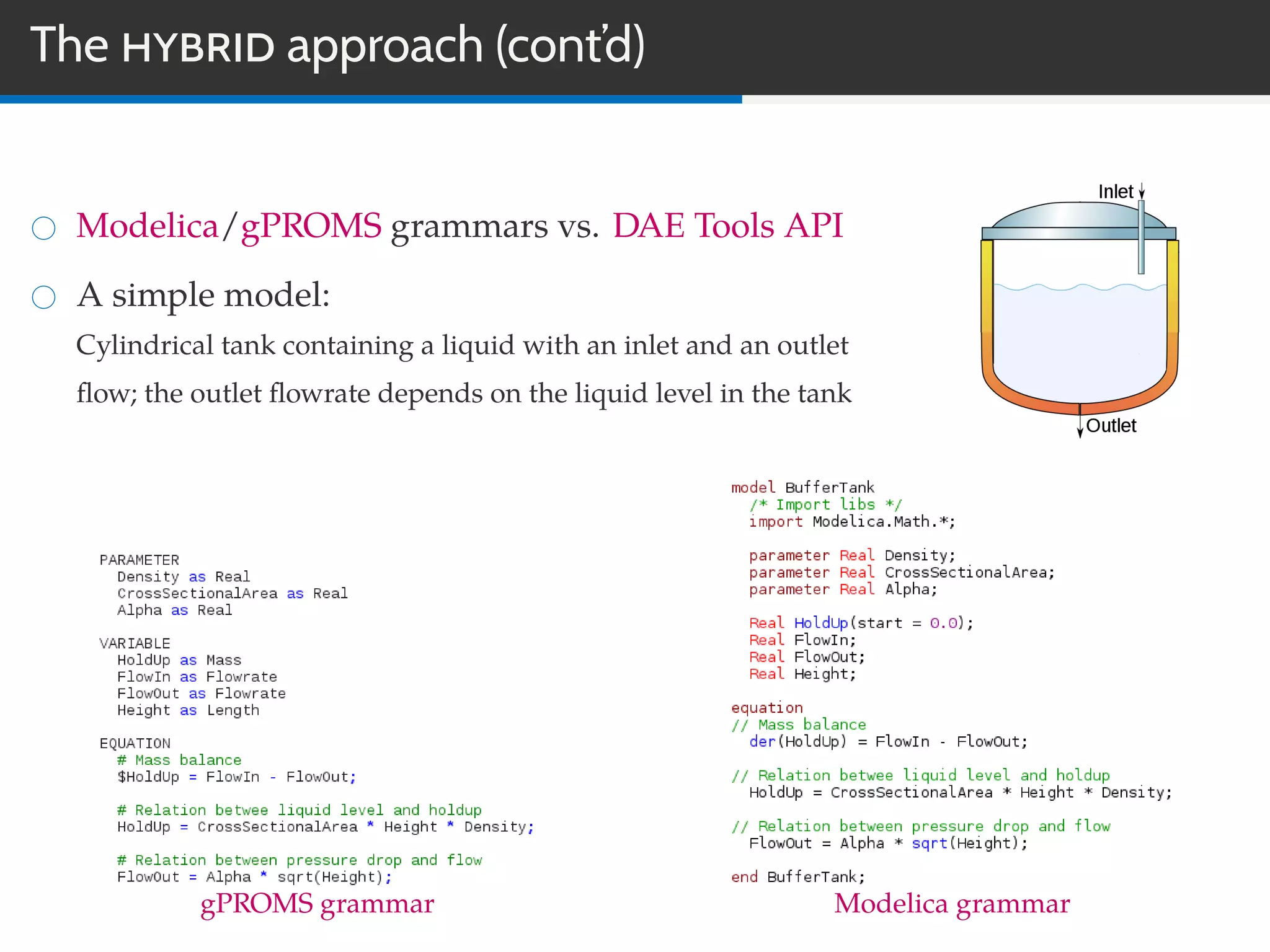
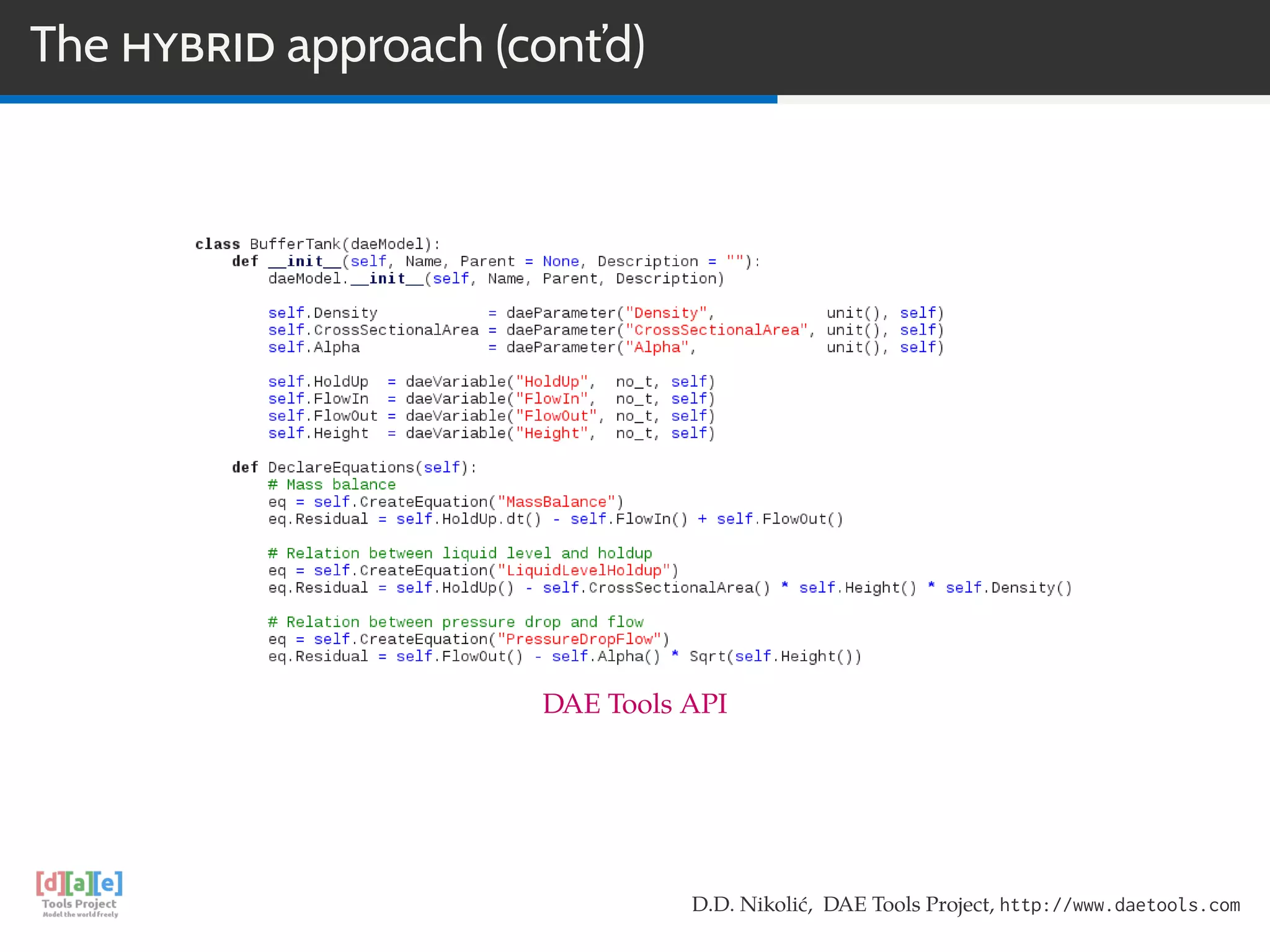
Modelica/gPROMS grammars vs. DAE Tools API
A simple model:
Cylindrical tank containing a liquid with an inlet and an outlet
flow; the outlet flowrate depends on the liquid level in the tank
gPROMS grammar Modelica grammar
The HYBRID approach (cont’d)
DAE Tools API
D.D. Nikolić, DAE Tools Project, http://www.daetools.com
The HYBRID approach (cont’d)
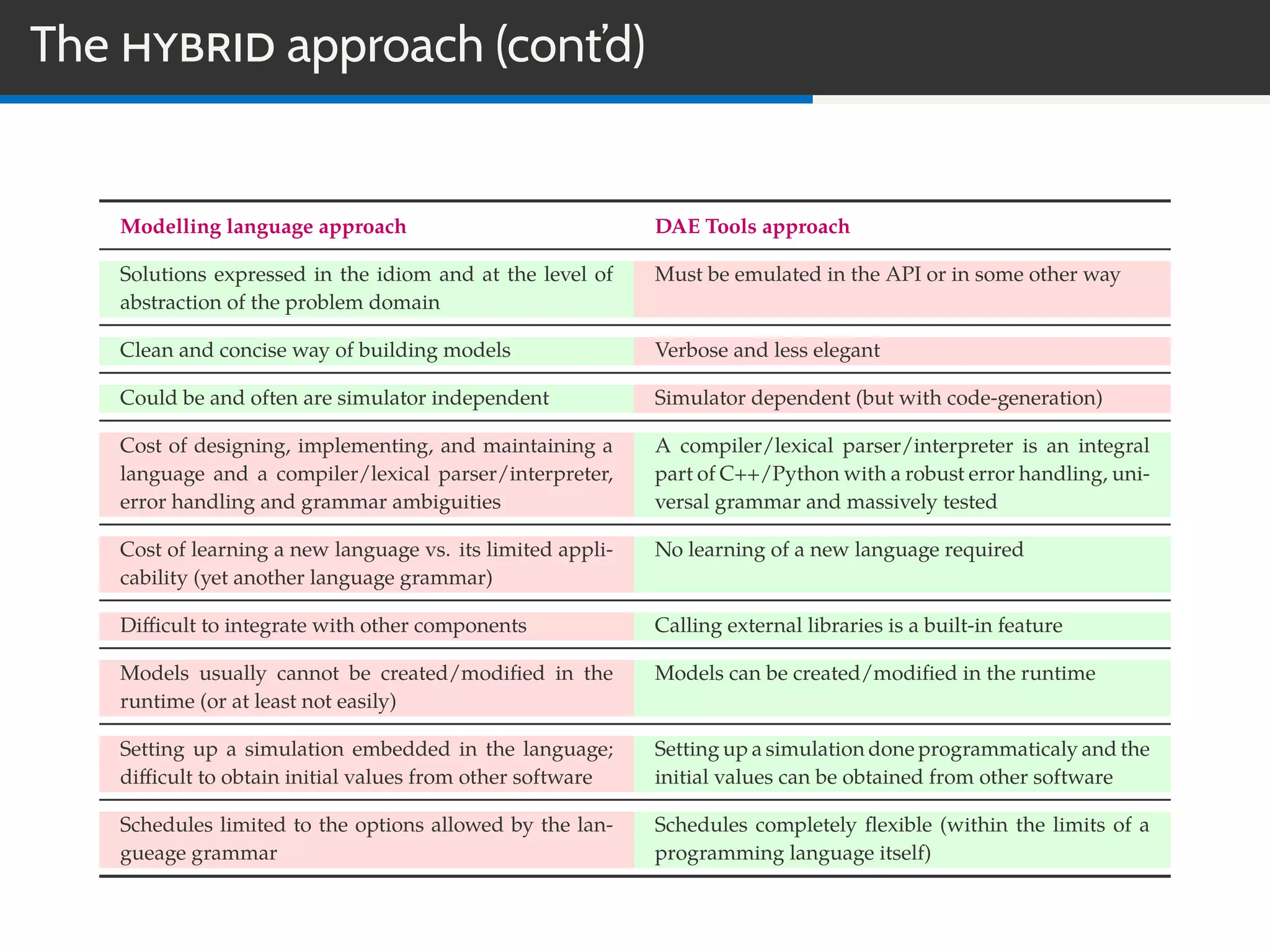
Modelling language approach DAE Tools approach
Solutions expressed in the idiom and at the level of
abstraction of the problem domain
Must be emulated in the API or in some other way
Clean and concise way of building models Verbose and less elegant
Could be and often are simulator independent Simulator dependent (but with code-generation)
Cost of designing, implementing, and maintaining a
language and a compiler/lexical parser/interpreter,
error handling and grammar ambiguities
A compiler/lexical parser/interpreter is an integral
part of C++/Python with a robust error handling, uni-
versal grammar and massively tested
Cost of learning a new language vs. its limited appli-
cability (yet another language grammar)
No learning of a new language required
Difficult to integrate with other components Calling external libraries is a built-in feature
Models usually cannot be created/modified in the
runtime (or at least not easily)
Models can be created/modified in the runtime
Setting up a simulation embedded in the language;
difficult to obtain initial values from other software
Setting up a simulation done programmaticaly and the
initial values can be obtained from other software
Schedules limited to the options allowed by the lan-
gueage grammar
Schedules completely flexible (within the limits of a
programming language itself)
The OBJECT-ORIENTED approach
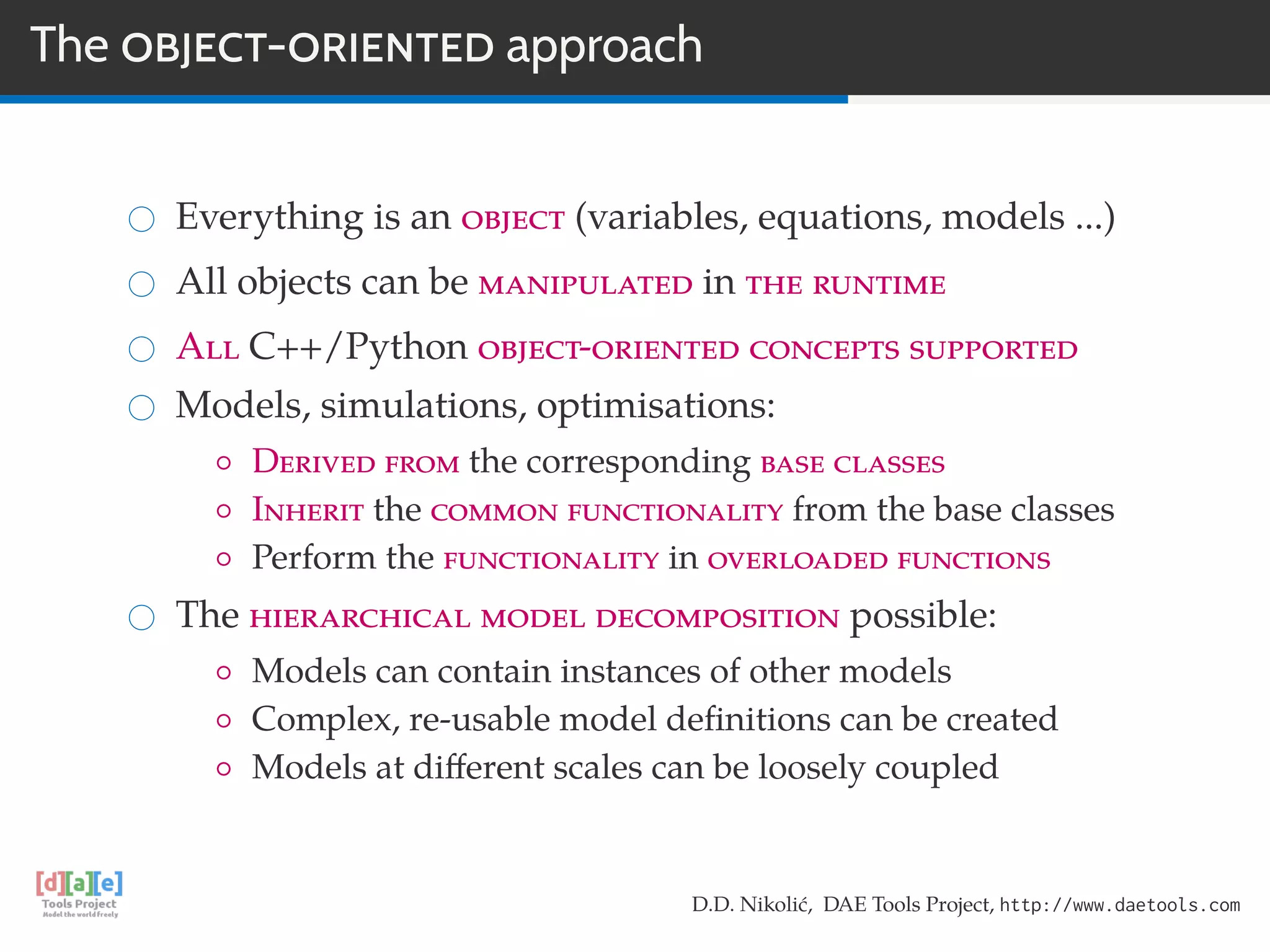
Everything is an object (variables, equations, models ...)
All objects can be manipulated in the runtime
All C++/Python object-oriented concepts supported
Models, simulations, optimisations:
◦ Derived from the corresponding base classes
◦ Inherit the common functionality from the base classes
◦ Perform the functionality in overloaded functions
The hierarchical model decomposition possible:
◦ Models can contain instances of other models
◦ Complex, re-usable model definitions can be created
◦ Models at different scales can be loosely coupled
D.D. Nikolić, DAE Tools Project, http://www.daetools.com
The EQUATION-ORIENTED (ACAUSAL) approach
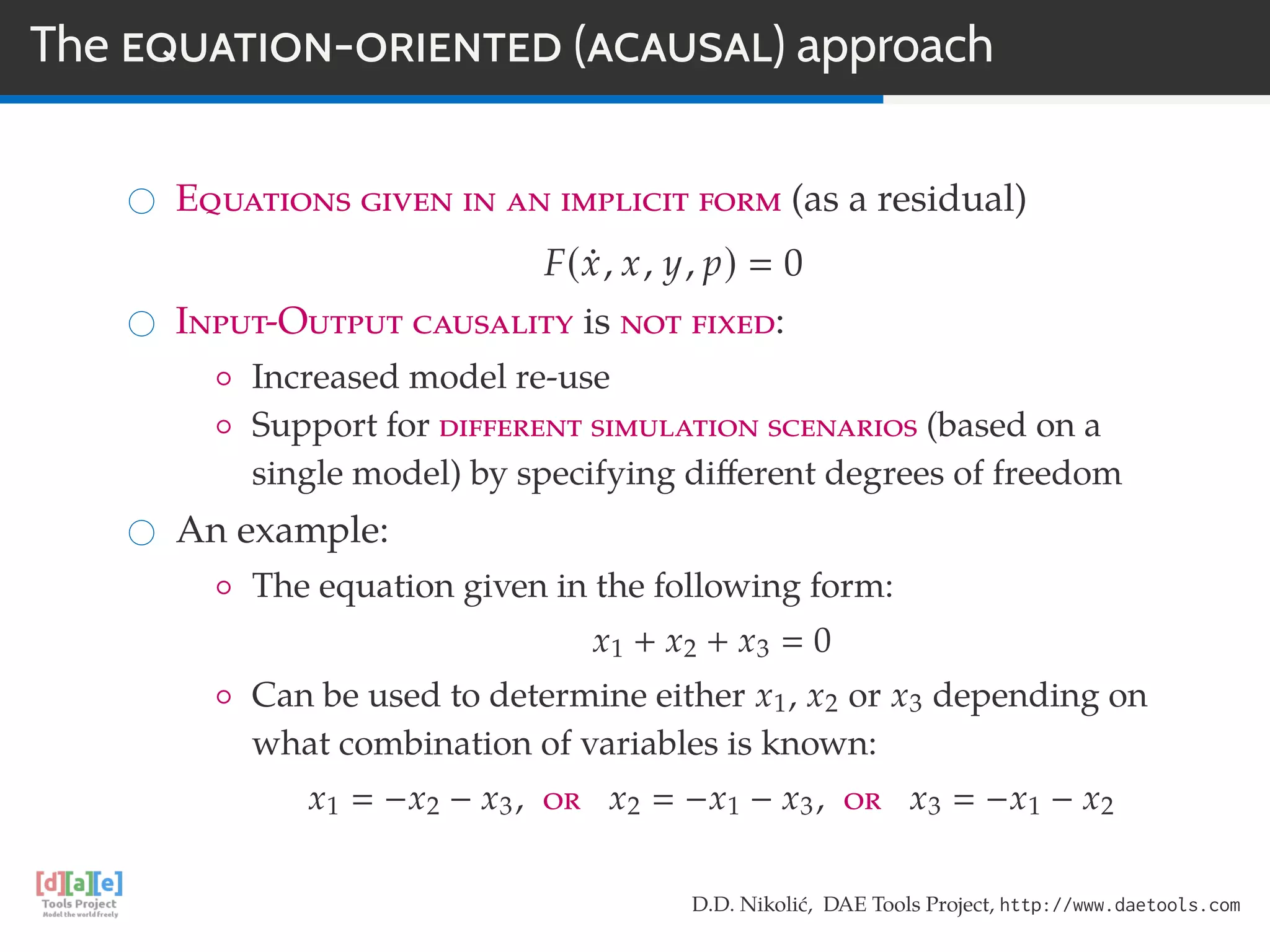
Equations given in an implicit form (as a residual)
F(x, x, y, p) 0
Input-Output causality is not fixed:
◦ Increased model re-use
◦ Support for different simulation scenarios (based on a
single model) by specifying different degrees of freedom
An example:
◦ The equation given in the following form:
x1 + x2 + x3 0
◦ Can be used to determine either x1, x2 or x3 depending on
what combination of variables is known:
x1 −x2 − x3, or x2 −x1 − x3, or x3 −x1 − x2
D.D. Nikolić, DAE Tools Project, http://www.daetools.com
Separation of MODEL DEFINITION from its APPLICATIONS
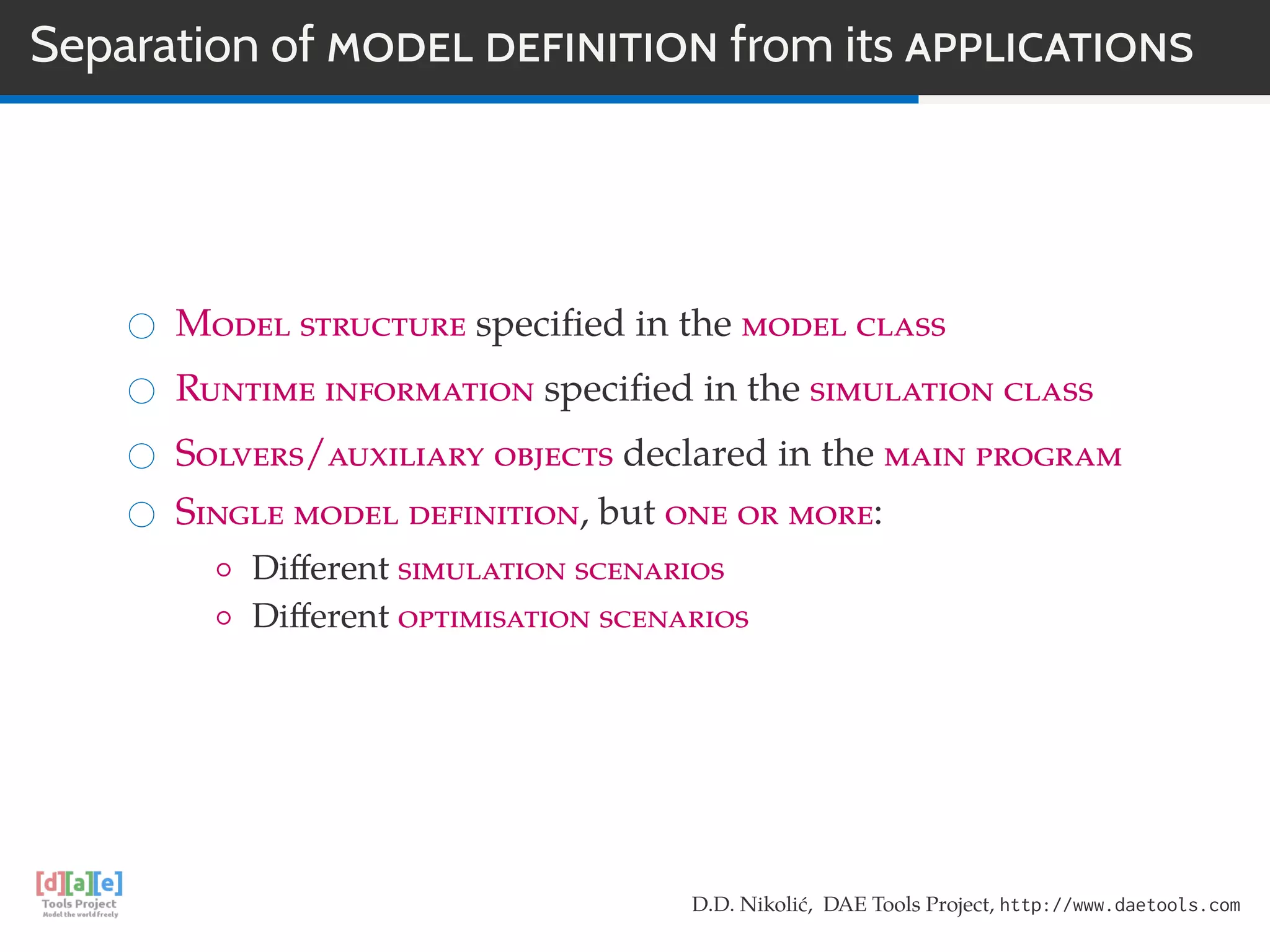
Model structure specified in the model class
Runtime information specified in the simulation class
Solvers/auxiliary objects declared in the main program
Single model definition, but one or more:
◦ Different simulation scenarios
◦ Different optimisation scenarios
D.D. Nikolić, DAE Tools Project, http://www.daetools.com
USE CASES
Use Case 1 - Chemical Engineering
Continuously Stirred Tank Reactor (Van de Vusse)
Plug Flow Reactor
Distillation column
Batch crystalliser
Discretised Population Balance equations
Newman Porous Electrode Theory (PET)
Multiphase Porous Electrode Theory (MPET)
Hydroxide Exchange Membrane Fuel Cells (HEMFCs)
Maxwell-Stefan equations (porous membranes)
Presssure Swing Adsorption
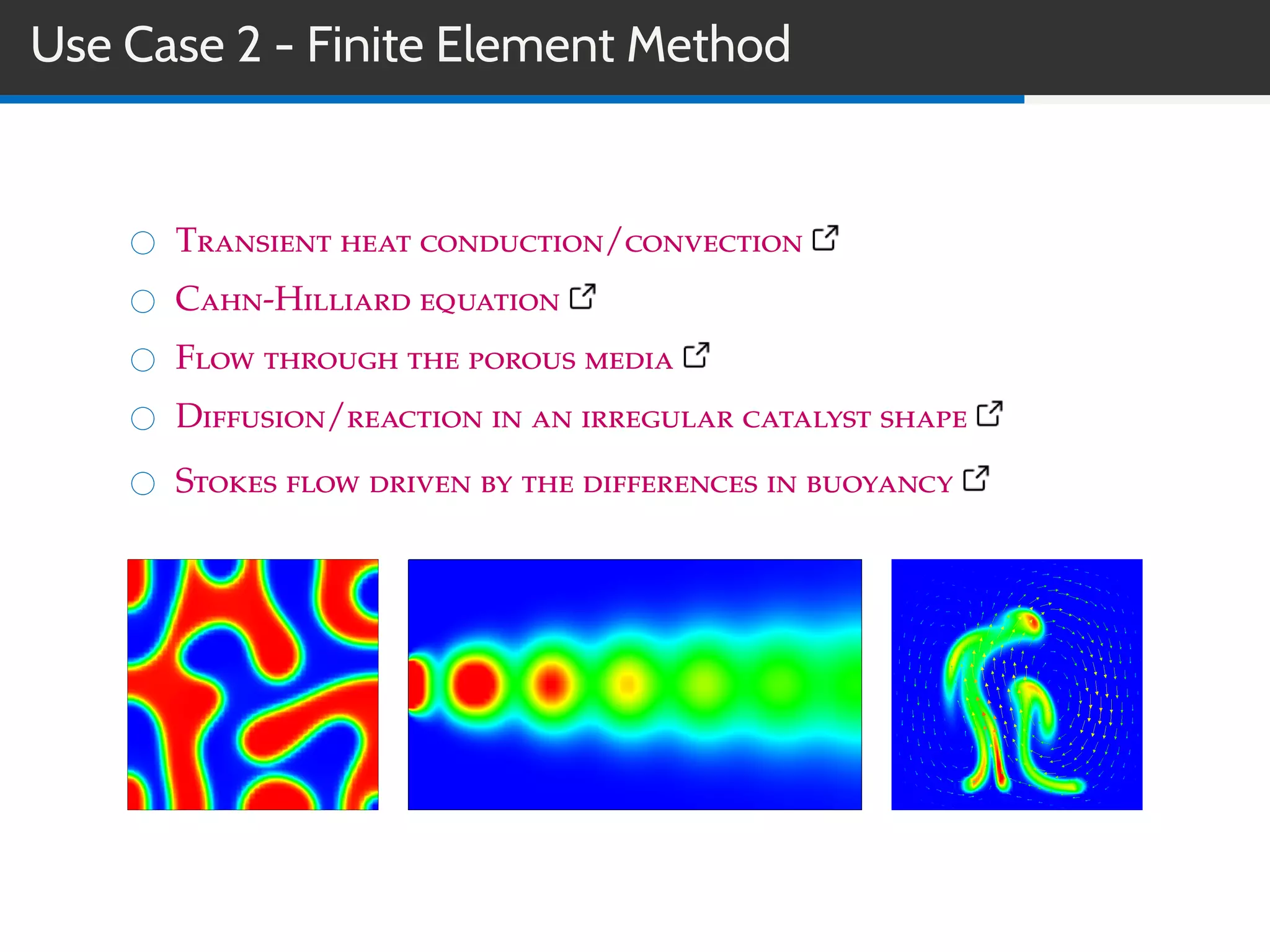
Use Case 2 - Finite Element Method
Transient heat conduction/convection
Cahn-Hilliard equation
Flow through the porous media
Diffusion/reaction in an irregular catalyst shape
Stokes flow driven by the differences in buoyancy
Use Case 3 - Parameter Estimation & Optimisation
Large-scale Constrained Optimisation Problem Set (COPS)
Determination of the reaction coefficients in the thermal
isomerization of α-pinene (COPS 5)
Determination of stage specific growth and mortality rates for
species at each stage as a function of time (COPS 6)
Determination of the reaction coefficients for the catalytic
cracking of gas oil and other byproducts (COPS 12)
Determination of the reaction coefficients for the conversion of
methanol into various hydrocarbons (COPS 13)
Catalyst mixing in a tubular plug flow reactor (COPS 14)
Use Case 4 - Multi-scale modelling
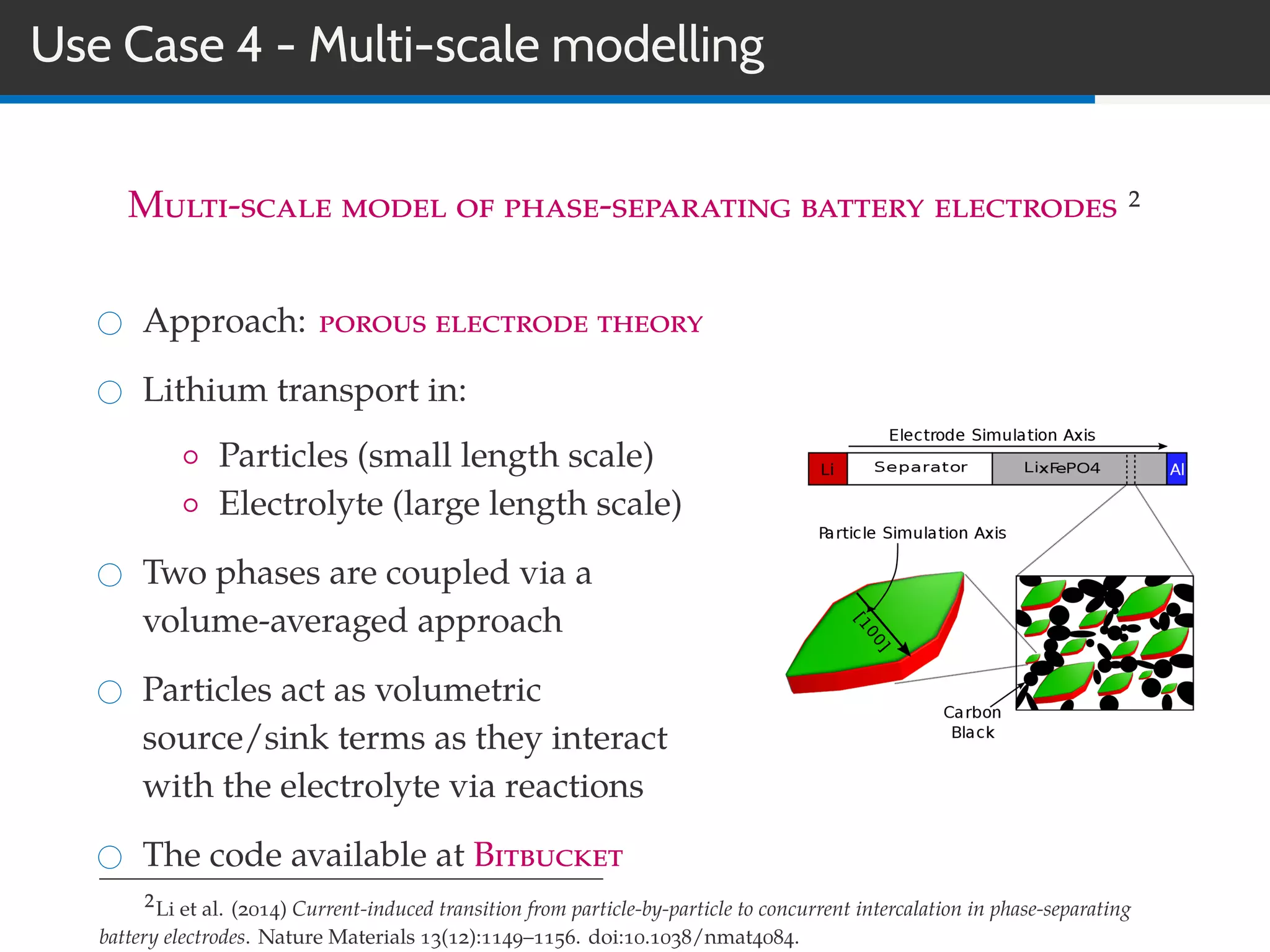
Multi-scale model of phase-separating battery electrodes 2
Approach: porous electrode theory
Lithium transport in:
◦ Particles (small length scale)
◦ Electrolyte (large length scale)
Two phases are coupled via a
volume-averaged approach
Particles act as volumetric
source/sink terms as they interact
with the electrolyte via reactions
The code available at Bitbucket
2Li et al. (2014) Current-induced transition from particle-by-particle to concurrent intercalation in phase-separating
battery electrodes. Nature Materials 13(12):1149–1156. doi:10.1038/nmat4084.
Use Case 4 - Multi-scale modelling (cont’d)
Spatial discretisation: finite-volume method
Large DAE system:
◦ Discretised transport eqns.
◦ Algebraic constraints (electrostatic eqns.)
◦ Constraints on the current
Implementations
◦ MATLAB (ode15s solver)
◦ DAE Tools (Sundials IDAS)
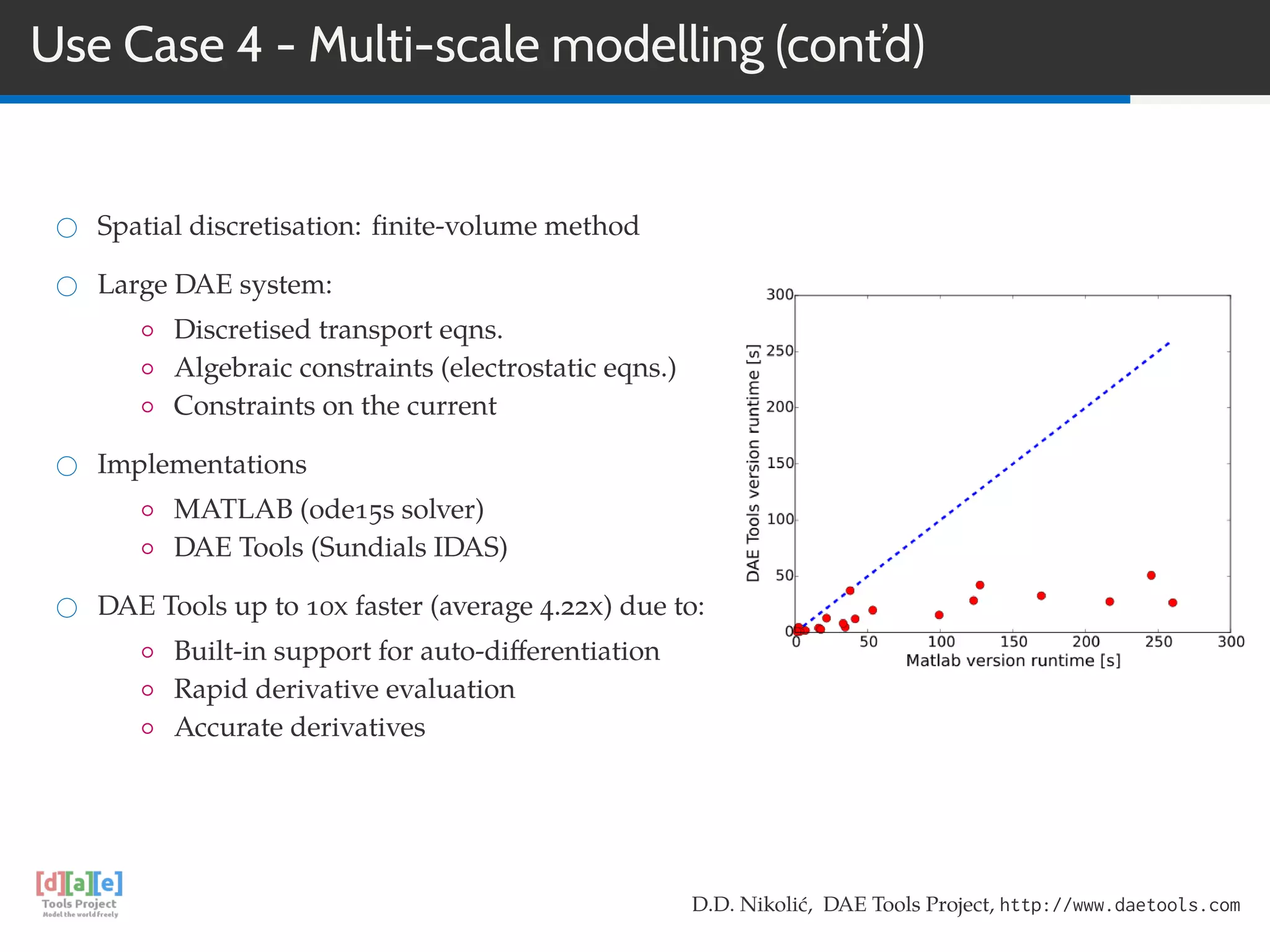
DAE Tools up to 10x faster (average 4.22x) due to:
◦ Built-in support for auto-differentiation
◦ Rapid derivative evaluation
◦ Accurate derivatives
D.D. Nikolić, DAE Tools Project, http://www.daetools.com
Use Case 5 - Sensitivity Analysis
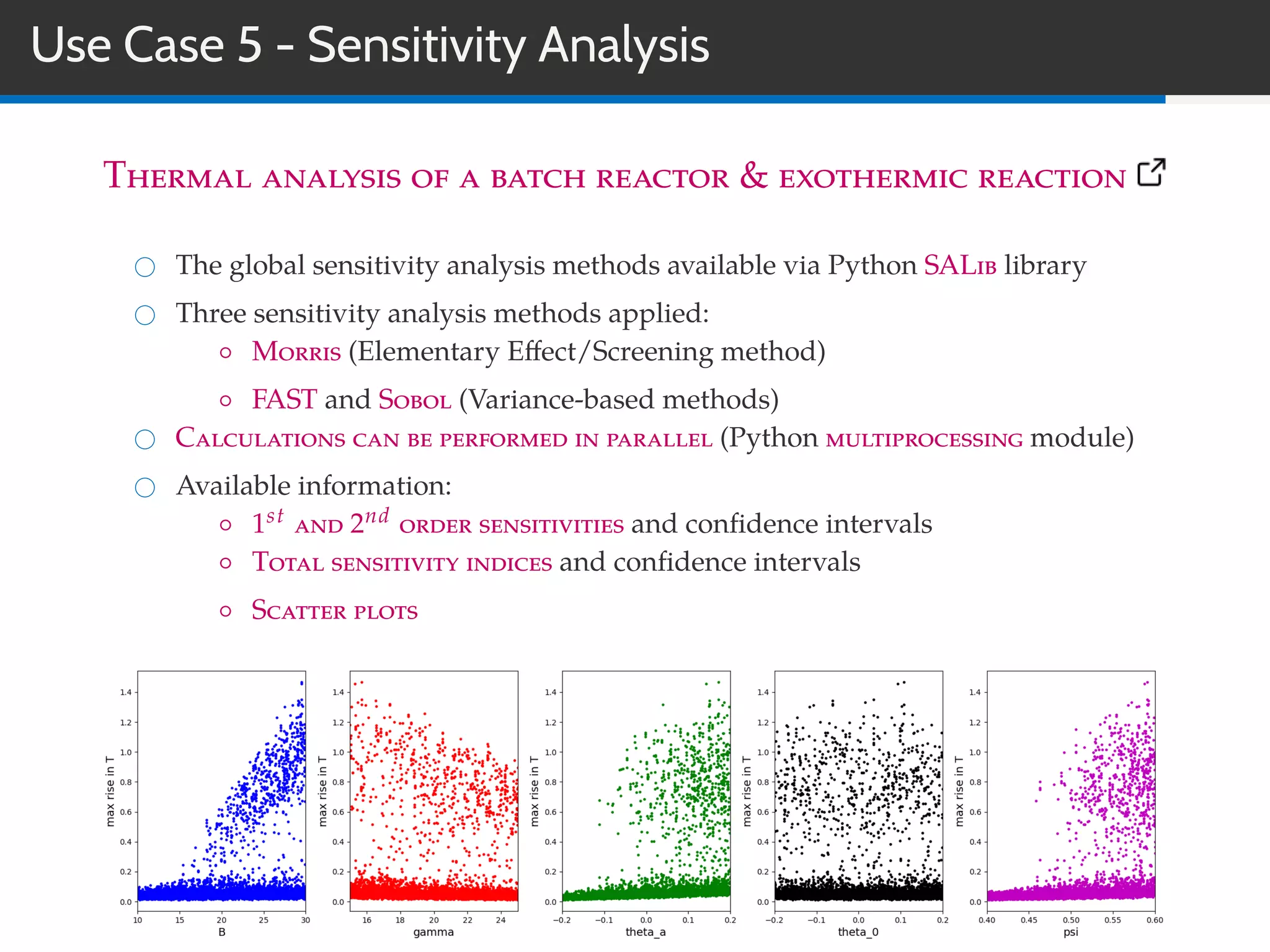
Thermal analysis of a batch reactor & exothermic reaction
The global sensitivity analysis methods available via Python SALib library
Three sensitivity analysis methods applied:
◦ Morris (Elementary Effect/Screening method)
◦ FAST and Sobol (Variance-based methods)
Calculations can be performed in parallel (Python multiprocessing module)
Available information:
◦ 1st and 2nd order sensitivities and confidence intervals
◦ Total sensitivity indices and confidence intervals
◦ Scatter plots
Use Case 6 - Embedded simulator (back end)
Network Interchange format for NEuroscience (NineML)
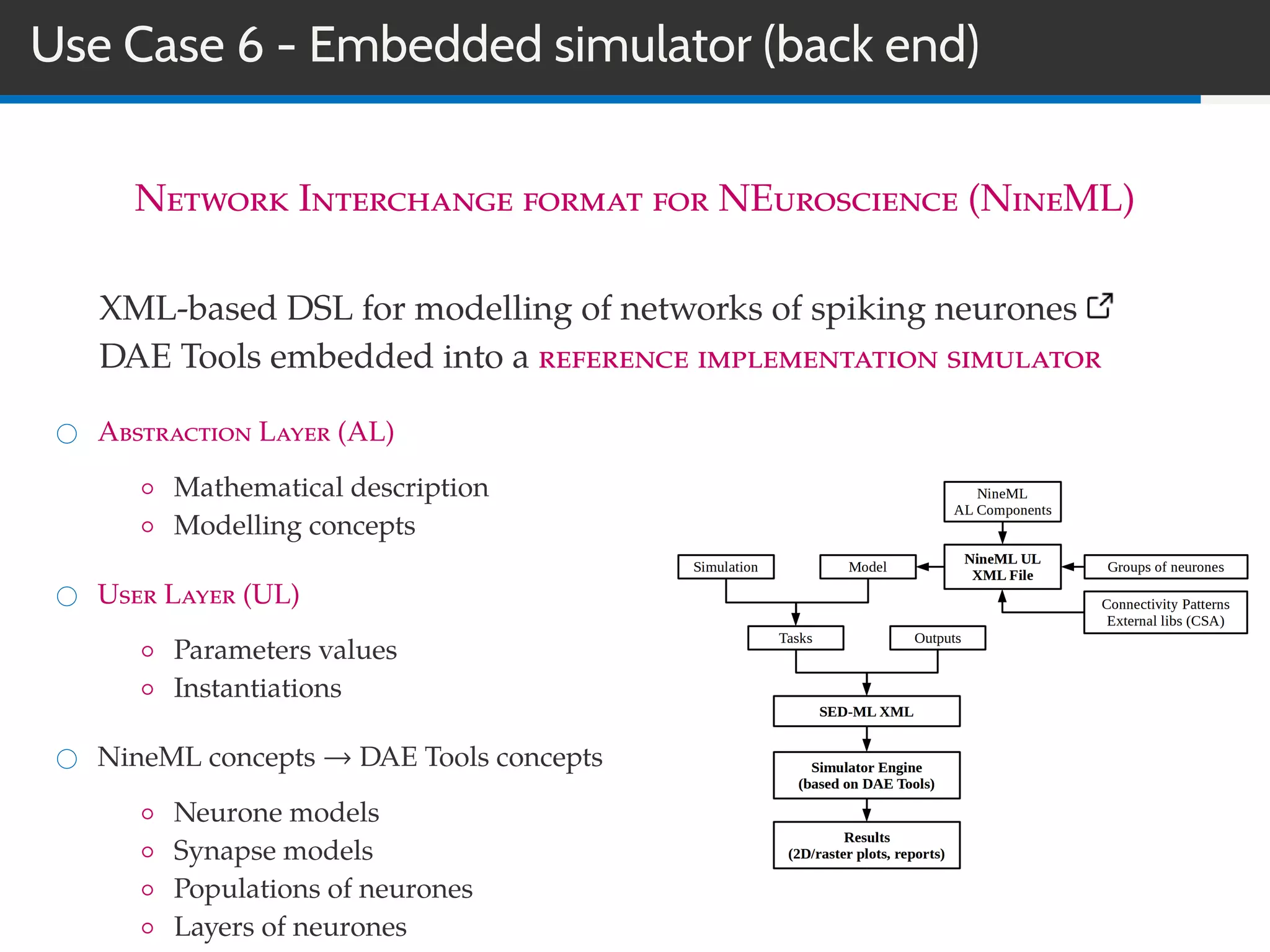
XML-based DSL for modelling of networks of spiking neurones
DAE Tools embedded into a reference implementation simulator
Abstraction Layer (AL)
◦ Mathematical description
◦ Modelling concepts
User Layer (UL)
◦ Parameters values
◦ Instantiations
NineML concepts → DAE Tools concepts
◦ Neurone models
◦ Synapse models
◦ Populations of neurones
◦ Layers of neurones
Use Case 7 - Software as a service
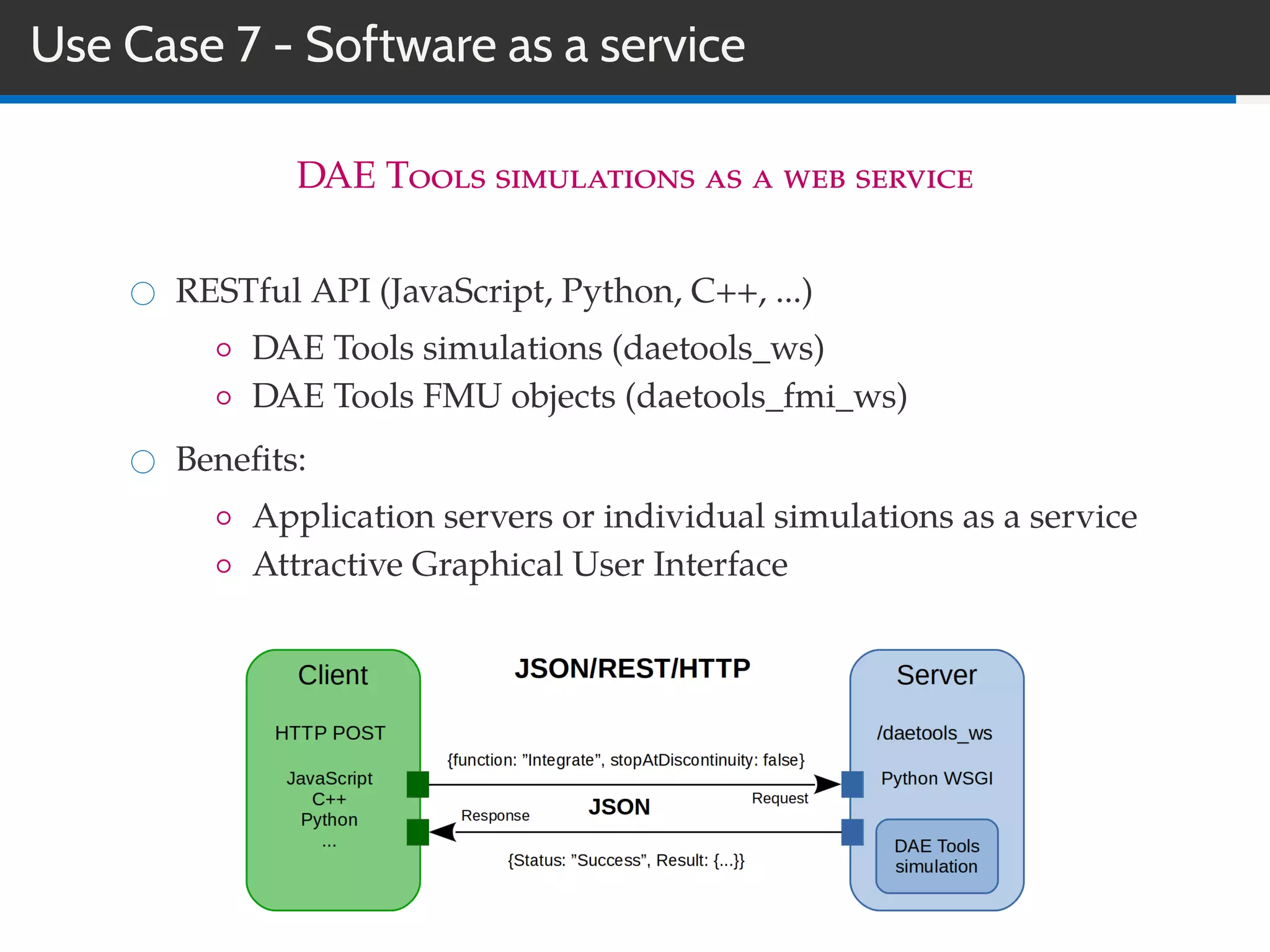
DAE Tools simulations as a web service
RESTful API (JavaScript, Python, C++, ...)
◦ DAE Tools simulations (daetools_ws)
◦ DAE Tools FMU objects (daetools_fmi_ws)
Benefits:
◦ Application servers or individual simulations as a service
◦ Attractive Graphical User Interface
Use Case 7 - Software as a service (cont’d)
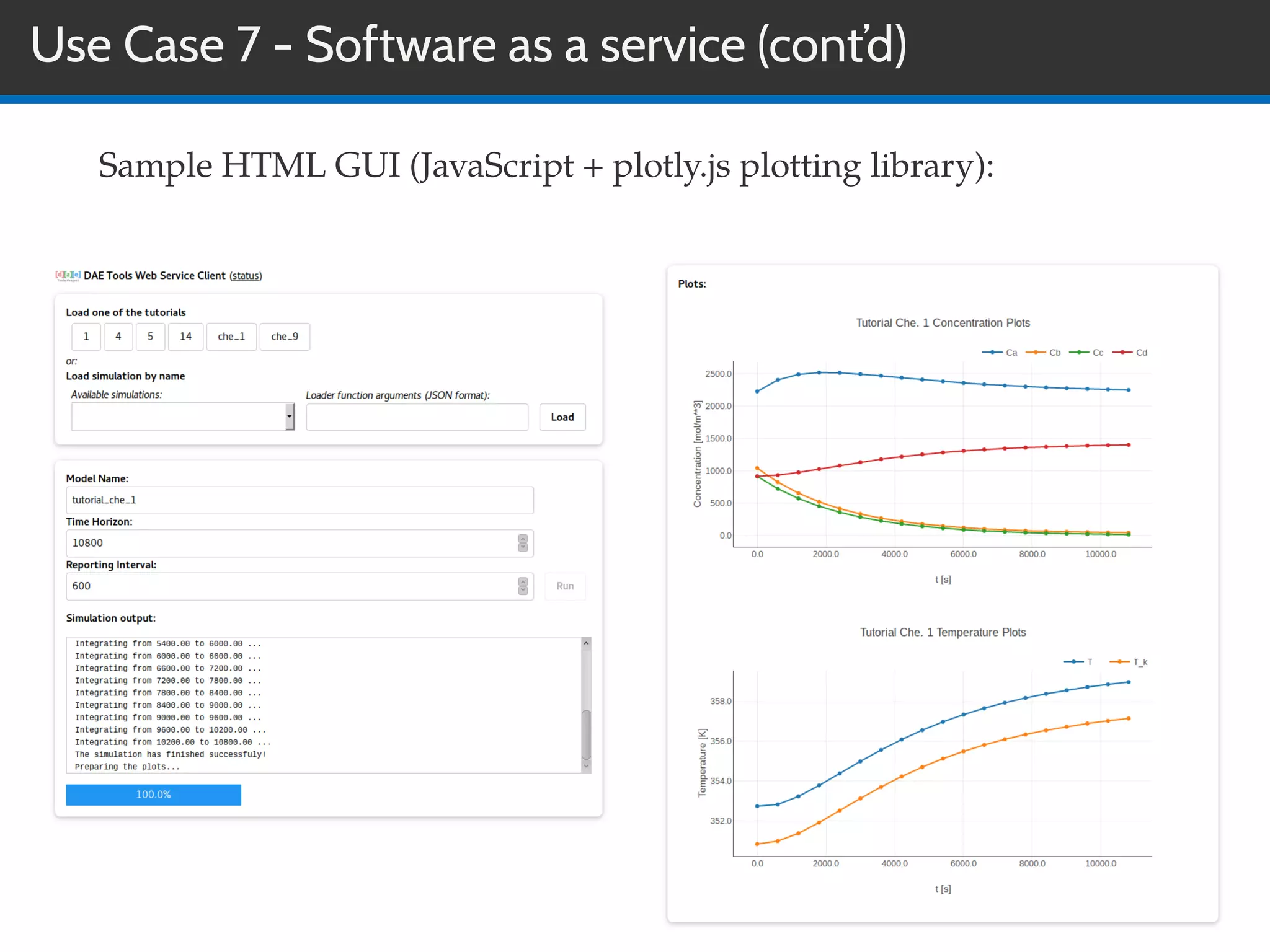
Sample HTML GUI (JavaScript + plotly.js plotting library):

DAE Tools 1.8.0 - Introduction

  • 1.
    DAE TOOLS SOFTWARE INTRODUCTION D.D.Nikolić Updated: 20 March 2018 DAE Tools Project, http://www.daetools.com
  • 2.
    Outline 1. General Information 2.Motivation 3. Main Features 4. Programming Paradigms 5. Use Cases D.D. Nikolić, DAE Tools Project, http://www.daetools.com
  • 3.
  • 4.
    What is DAETools? Modelling, simulation, optimisation & parameter estimation software 1 Areas of application: ◦ Initially: chemical process industry (mass, heat and momentum transfers, chemical reactions, separation processes, thermodynamics, electro-chemistry) ◦ Nowadays: multi-domain Free/Open source software (GNU GPL) Cross-platform Multiple architectures (32/64 bit x86, ARM, ...) 1Nikolić DD. (2016) DAE Tools: equation-based object-oriented modelling, simulation and optimisation software. PeerJ Computer Science 2:e54 D.D. Nikolić, DAE Tools Project, http://www.daetools.com
  • 5.
    What is DAETools? (cont’d) DAE Tools is not: ◦ A modelling language (such as Modelica) ◦ An integrated software suite of data structures and routines for scientific applications (such as PETSc, Sundials, ...) DAE Tools is: ◦ An architectural design of interdependent software components providing an API for: ◦ Model specification ◦ Activities on developed models (simulation, optimisation, ...) ◦ Processing of the results ◦ Report generation ◦ Code generation and model exchange DAE Tools apply a hybrid approach between modelling and general purpose programming languages, combining the strengths of both approaches into a single one D.D. Nikolić, DAE Tools Project, http://www.daetools.com
  • 6.
    What can bedone with DAE Tools? Simulation ◦ Steady-State ◦ Transient Sensitivity analysis ◦ Local methods (derivative-based) ◦ Global methods (Morris, FAST, Sobol variance-based) Optimisation ◦ Non-Linear Programming (NLP) ◦ Mixed Integer Non-Linear Programming (MINLP) Parameter estimation Code-generation, model-exchange, co-simulation ◦ Modelica, gPROMS, Functional Mockup Interface (FMI) ◦ Matlab MEX-functions, Simulink user-defined S-functions ◦ C99, C++ MPI (embedded and distributed systems) D.D. Nikolić, DAE Tools Project, http://www.daetools.com
  • 7.
    Types of systemsthat can be modelled Initial value problems of implicit form: Described by systems of linear, non-linear, and (partial-)differential algebraic equations Continuous with some elements of event-driven systems (discontinuous equations, state transition networks and discrete events) Steady-state or dynamic With lumped or distributed parameters (finite difference, finite volume and finite element methods) Only index-1 DAE systems at the moment D.D. Nikolić, DAE Tools Project, http://www.daetools.com
  • 8.
  • 9.
    Why modelling software? Ingeneral, two scenarios: Development of a new product/process/... ◦ Reduce the time to market (TTM) ◦ Reduce the development costs (no physical prototypes) ◦ Maximise the performance, yield, productivity, purity, ... ◦ Minimise the capital and operating costs ◦ Explore the new design options in less time and no risks Optimisation of an existing product/process/... ◦ Increase the performance, yield, productivity, purity, ... ◦ Reduce the operating costs, energy consumption, ... ◦ Debottleneck D.D. Nikolić, DAE Tools Project, http://www.daetools.com
  • 10.
    Why YET ANOTHERmodelling software? Current approaches to mathematical modelling: 1. Use of modelling languages (domain-specific or multi-domain): Modelica, Ascend, gPROMS, Dymola, APMonitor 2. Use of general-purpose programming languages: ◦ Lower level third-generation languages such as C, C++ and Fortran (PETSc, SUNDIALS) ◦ Higher level fourth-generation languages such as Python (NumPy, SciPy, Assimulo), Julia etc. ◦ Multi-paradigm numerical languages (Matlab, Mathematica, Maple, Scilab, and GNU Octave) D.D. Nikolić, DAE Tools Project, http://www.daetools.com
  • 11.
    Why YET ANOTHERmodelling software? (cont’d) The advantages of the Hybrid approach over the modelling and general-purpose programming languages: 1. Support for the runtime model generation 2. Support for the runtime simulation set-up 3. Support for complex schedules (operating procedures) 4. Interoperability with the third-party software 5. Suitability for embedding and use as a web application or software as a service 6. Code-generation, model exchange and co-simulation capabilities D.D. Nikolić, DAE Tools Project, http://www.daetools.com
  • 12.
  • 13.
    Parallel Computing The shared-memoryparallel programming model supported. Evaluation of equations and derivatives ◦ OpenMP: general purpose processors and manycore devices ◦ OpenCL: streaming processors (GPU, GPGA) and heterogeneous systems Assembly of Finite Element systems (OpenMP) Solution of systems of linear equations (SuperLU_MT, Pardiso and Intel Pardiso solvers) Global Sensitivity Analysis (multiprocessing.Pool)
  • 14.
    Multiphysics Capabilities Modelling ofmultiple simultaneous physical phenomena Finite Difference (FD), Finite Volume (FV) and Finite Element (FE) methods Mixed coupled systems of equations (FD, FV and FE methods) DAE Tools variables for boundary conditions, source terms and non-linear coefficients Additional constraints and auxiliary equations D.D. Nikolić, DAE Tools Project, http://www.daetools.com
  • 15.
    Code Generation &Co-Simulation Code-generation ◦ Modelica ◦ gPROMS ◦ C99 (embedded systems) ◦ C++ MPI (distributed systems) Co-simulation ◦ Matlab MEX-functions ◦ Simulink user-defined S-functions ◦ Functional Mockup Interface (FMI) for Co-Simulation D.D. Nikolić, DAE Tools Project, http://www.daetools.com
  • 16.
    Software As aService Web service with the RESTful API ◦ DAE Tools simulations (daetools_ws) ◦ DAE Tools FMU objects (daetools_fmi_ws) Language independent (JavaScript, Python, C++, ...) Benefits: ◦ Application servers ◦ Individual simulations as a web service ◦ Attractive Graphical User Interface D.D. Nikolić, DAE Tools Project, http://www.daetools.com
  • 17.
    Sensitivity Analysis Local sensitivityanalysis (derivative-based) Global sensitivity analysis (SALib library): ◦ 1st and 2nd order sensitivities and confidence intervals ◦ Total sensitivity indices and confidence intervals ◦ Scatter plots Methods available: ◦ Method of Morris (elementary effect method) ◦ FAST (variance-based) ◦ Sobol (variance-based) Simulations performed in parallel (multiprocessing.Pool)
  • 18.
    Code Verification The formalcode verification techniques applied to test almost all aspects of the software The most rigorous code verification methods used: ◦ The Method of Exact Solutions (MES) ◦ The Method of Manufactured Solutions (MMS) The most rigorous acceptance criteria used: ◦ Percent error ◦ Normalised global error ◦ Order-of-accuracy
  • 19.
    Additional DAE TOOLSfeatures Support for multiple platforms/architectures Support for the automatic differentiation (ADOL-C) Support for a large number of DAE, LA and NLP solvers Support for the generation of model reports (XML + MathML, Latex) Export of the simulation results to various file formats (Matlab, Excel, json, xml, HDF5, Pandas, VTK) D.D. Nikolić, DAE Tools Project, http://www.daetools.com
  • 20.
  • 21.
    The HYBRID approach DAETools approach is a type of a hybrid approach Combines strengths of modelling and general purpose programming languages: 1. Developed in C++ with the Python bindings 2. Provides API (Application Programming Interface) that resembles a syntax of modelling languages as much as possible 3. Takes advantage of the higher level languages for: ◦ Model specification, simulation setup and schedules ◦ Access to the operating system ◦ Access to the standard/third-party libraries D.D. Nikolić, DAE Tools Project, http://www.daetools.com
  • 22.
    The HYBRID approach(cont’d) Modelica/gPROMS grammars vs. DAE Tools API A simple model: Cylindrical tank containing a liquid with an inlet and an outlet flow; the outlet flowrate depends on the liquid level in the tank gPROMS grammar Modelica grammar
  • 23.
    The HYBRID approach(cont’d) DAE Tools API D.D. Nikolić, DAE Tools Project, http://www.daetools.com
  • 24.
    The HYBRID approach(cont’d) Modelling language approach DAE Tools approach Solutions expressed in the idiom and at the level of abstraction of the problem domain Must be emulated in the API or in some other way Clean and concise way of building models Verbose and less elegant Could be and often are simulator independent Simulator dependent (but with code-generation) Cost of designing, implementing, and maintaining a language and a compiler/lexical parser/interpreter, error handling and grammar ambiguities A compiler/lexical parser/interpreter is an integral part of C++/Python with a robust error handling, uni- versal grammar and massively tested Cost of learning a new language vs. its limited appli- cability (yet another language grammar) No learning of a new language required Difficult to integrate with other components Calling external libraries is a built-in feature Models usually cannot be created/modified in the runtime (or at least not easily) Models can be created/modified in the runtime Setting up a simulation embedded in the language; difficult to obtain initial values from other software Setting up a simulation done programmaticaly and the initial values can be obtained from other software Schedules limited to the options allowed by the lan- gueage grammar Schedules completely flexible (within the limits of a programming language itself)
  • 25.
    The OBJECT-ORIENTED approach Everythingis an object (variables, equations, models ...) All objects can be manipulated in the runtime All C++/Python object-oriented concepts supported Models, simulations, optimisations: ◦ Derived from the corresponding base classes ◦ Inherit the common functionality from the base classes ◦ Perform the functionality in overloaded functions The hierarchical model decomposition possible: ◦ Models can contain instances of other models ◦ Complex, re-usable model definitions can be created ◦ Models at different scales can be loosely coupled D.D. Nikolić, DAE Tools Project, http://www.daetools.com
  • 26.
    The EQUATION-ORIENTED (ACAUSAL)approach Equations given in an implicit form (as a residual) F(x, x, y, p) 0 Input-Output causality is not fixed: ◦ Increased model re-use ◦ Support for different simulation scenarios (based on a single model) by specifying different degrees of freedom An example: ◦ The equation given in the following form: x1 + x2 + x3 0 ◦ Can be used to determine either x1, x2 or x3 depending on what combination of variables is known: x1 −x2 − x3, or x2 −x1 − x3, or x3 −x1 − x2 D.D. Nikolić, DAE Tools Project, http://www.daetools.com
  • 27.
    Separation of MODELDEFINITION from its APPLICATIONS Model structure specified in the model class Runtime information specified in the simulation class Solvers/auxiliary objects declared in the main program Single model definition, but one or more: ◦ Different simulation scenarios ◦ Different optimisation scenarios D.D. Nikolić, DAE Tools Project, http://www.daetools.com
  • 28.
  • 29.
    Use Case 1- Chemical Engineering Continuously Stirred Tank Reactor (Van de Vusse) Plug Flow Reactor Distillation column Batch crystalliser Discretised Population Balance equations Newman Porous Electrode Theory (PET) Multiphase Porous Electrode Theory (MPET) Hydroxide Exchange Membrane Fuel Cells (HEMFCs) Maxwell-Stefan equations (porous membranes) Presssure Swing Adsorption
  • 30.
    Use Case 2- Finite Element Method Transient heat conduction/convection Cahn-Hilliard equation Flow through the porous media Diffusion/reaction in an irregular catalyst shape Stokes flow driven by the differences in buoyancy
  • 31.
    Use Case 3- Parameter Estimation & Optimisation Large-scale Constrained Optimisation Problem Set (COPS) Determination of the reaction coefficients in the thermal isomerization of α-pinene (COPS 5) Determination of stage specific growth and mortality rates for species at each stage as a function of time (COPS 6) Determination of the reaction coefficients for the catalytic cracking of gas oil and other byproducts (COPS 12) Determination of the reaction coefficients for the conversion of methanol into various hydrocarbons (COPS 13) Catalyst mixing in a tubular plug flow reactor (COPS 14)
  • 32.
    Use Case 4- Multi-scale modelling Multi-scale model of phase-separating battery electrodes 2 Approach: porous electrode theory Lithium transport in: ◦ Particles (small length scale) ◦ Electrolyte (large length scale) Two phases are coupled via a volume-averaged approach Particles act as volumetric source/sink terms as they interact with the electrolyte via reactions The code available at Bitbucket 2Li et al. (2014) Current-induced transition from particle-by-particle to concurrent intercalation in phase-separating battery electrodes. Nature Materials 13(12):1149–1156. doi:10.1038/nmat4084.
  • 33.
    Use Case 4- Multi-scale modelling (cont’d) Spatial discretisation: finite-volume method Large DAE system: ◦ Discretised transport eqns. ◦ Algebraic constraints (electrostatic eqns.) ◦ Constraints on the current Implementations ◦ MATLAB (ode15s solver) ◦ DAE Tools (Sundials IDAS) DAE Tools up to 10x faster (average 4.22x) due to: ◦ Built-in support for auto-differentiation ◦ Rapid derivative evaluation ◦ Accurate derivatives D.D. Nikolić, DAE Tools Project, http://www.daetools.com
  • 34.
    Use Case 5- Sensitivity Analysis Thermal analysis of a batch reactor & exothermic reaction The global sensitivity analysis methods available via Python SALib library Three sensitivity analysis methods applied: ◦ Morris (Elementary Effect/Screening method) ◦ FAST and Sobol (Variance-based methods) Calculations can be performed in parallel (Python multiprocessing module) Available information: ◦ 1st and 2nd order sensitivities and confidence intervals ◦ Total sensitivity indices and confidence intervals ◦ Scatter plots
  • 35.
    Use Case 6- Embedded simulator (back end) Network Interchange format for NEuroscience (NineML) XML-based DSL for modelling of networks of spiking neurones DAE Tools embedded into a reference implementation simulator Abstraction Layer (AL) ◦ Mathematical description ◦ Modelling concepts User Layer (UL) ◦ Parameters values ◦ Instantiations NineML concepts → DAE Tools concepts ◦ Neurone models ◦ Synapse models ◦ Populations of neurones ◦ Layers of neurones
  • 36.
    Use Case 7- Software as a service DAE Tools simulations as a web service RESTful API (JavaScript, Python, C++, ...) ◦ DAE Tools simulations (daetools_ws) ◦ DAE Tools FMU objects (daetools_fmi_ws) Benefits: ◦ Application servers or individual simulations as a service ◦ Attractive Graphical User Interface
  • 37.
    Use Case 7- Software as a service (cont’d) Sample HTML GUI (JavaScript + plotly.js plotting library):