DadaabNet
Project Report
March 2014
“The customer is always right”
1
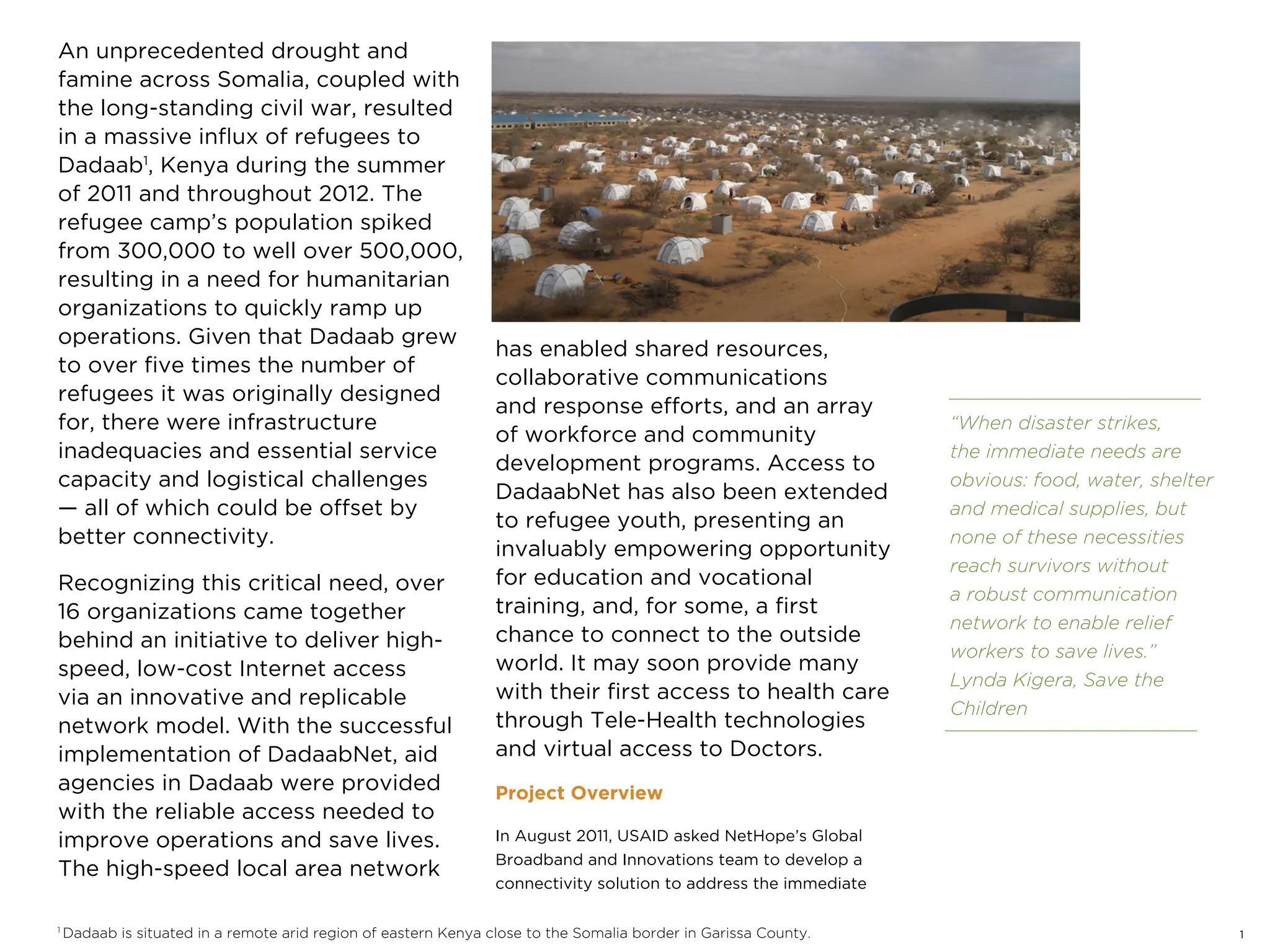
An unprecedented drought and
famine across Somalia, coupled with
the long-standing civil war, resulted
in a massive influx of refugees to
Dadaab1
, Kenya during the summer
of 2011 and throughout 2012. The
refugee camp’s population spiked
from 300,000 to well over 500,000,
resulting in a need for humanitarian
organizations to quickly ramp up
operations. Given that Dadaab grew
to over five times the number of
refugees it was originally designed
for, there were infrastructure
inadequacies and essential service
capacity and logistical challenges
— all of which could be offset by
better connectivity.
Recognizing this critical need, over
16 organizations came together
behind an initiative to deliver high-
speed, low-cost Internet access
via an innovative and replicable
network model. With the successful
implementation of DadaabNet, aid
agencies in Dadaab were provided
with the reliable access needed to
improve operations and save lives.
The high-speed local area network
has enabled shared resources,
collaborative communications
and response efforts, and an array
of workforce and community
development programs. Access to
DadaabNet has also been extended
to refugee youth, presenting an
invaluably empowering opportunity
for education and vocational
training, and, for some, a first
chance to connect to the outside
world. It may soon provide many
with their first access to health care
through Tele-Health technologies
and virtual access to Doctors.
Project Overview
In August 2011, USAID asked NetHope’s Global
Broadband and Innovations team to develop a
connectivity solution to address the immediate
1
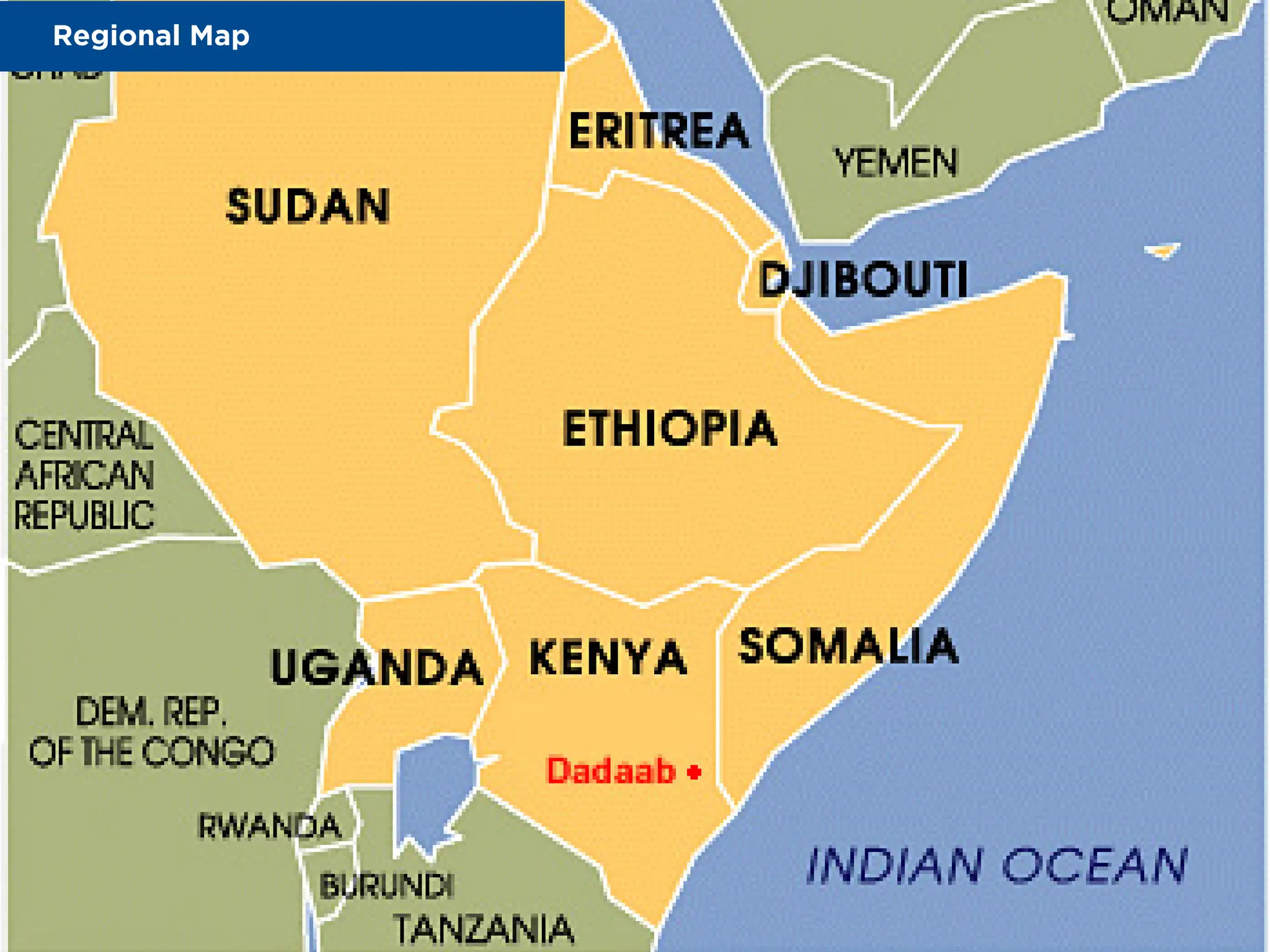
Dadaab is situated in a remote arid region of eastern Kenya close to the Somalia border in Garissa County.
“When disaster strikes,
the immediate needs are
obvious: food, water, shelter
and medical supplies, but
none of these necessities
reach survivors without
a robust communication
network to enable relief
workers to save lives.”
Lynda Kigera, Save the
Children
needs and attract local service providers to ensure
sustainability and scalability. Utilizing funding from
Cisco, USAID, Microsoft and others, NetHope and
networking partners Cisco Systems and Inveneo
were able to develop an innovative approach to
bring affordable and reliable Internet connectivity
to Dadaab and build an infrastructure network
throughout the refugee camp.
As thousands of refugees crossed the border
from Somalia, the number of response agencies
and humanitarian workers increased, expanding
inter-organizational information sharing and
scalability requirements. Bringing broadband
improvements to Dadaab started effectively
with early engagement of the local stakeholder
community to co-create an innovative network
architecture, business model and support plan.
Developing trusted relationships and delivering
solution-specific practical training and localized
engagements in the initial network implementation
were key elements to ensure successful service
introductions and ongoing operations. Kenyan
telecommunications companies Orange and
Safaricom, with support from local technology
experts Dimension Data and Setright, were enlisted
as full partners early in the process and invited
to participate in engineering and business peer
review. Preferred reduced pricing and additional
capacity based on demand aggregation and
projections were negotiated prior to the onset of
the project.
Critical Success Factor 1: Prior to solutions
development, requirements were gathered in
Dadaab from 17 NGO/UN agencies. A connectivity
assessment and proposal was documented and
shared. NetHope members and technology
partners were engaged up-front to conduct peer
review and recommendations. The following
impacts are the results of the implementation of
the findings.
Major Impacts of DadaabNet
1. A High-Speed Local Network to Support
Relief Operations. Established competitive and
reliable shared terrestrial connectivity for the
humanitarian organizations and community.
Connectivity savings will be measured in the
hundreds of thousands in the first two years
as agencies transfer their business operations
from VSAT to terrestrial.
2. Support for Refugee Community and
Youth. Connected five times the number
of locations for beneficiaries/refugees than
originally committed in addition to entire NGO
community for operations & joint collaborative
communications. Hundreds of youth have
gained access to Internet based training and
resources in the first few months; this number
is expected to increase into the tens of
thousands in the next 12 months and to exceed
a hundred thousand in year two.
3. Connectivity Savings. Twenty (20) times
reduction in recurring WAN connectivity
expense than previously available (VSAT vs.
terrestrial pricing), with greater reliability,
redundancy and resiliency.
4. A Sustainable Network with an Indefinite
Lifeline. Enabled local ownership, support and
2
Many view the
implementation of
DadaabNet as the first
bridge to creating a more
peaceful environment in
Dadaab.
“Without having this sort
of connectivity among the
NGOs, among the youth,
we could not make it where
we are today....I’d love my
children to have peace...
peace and a promising life.”
Abdikadir Farah, Dadaab
Resident
[photo left] Trainees
from Orange Kenya,
Inveneo ICIP, Setright,
and Dadaab-based
IT staffs assemble an
Ubiquiti Rocket Dish.
3
future development of the Dadaab services.
This capacity was developed by pre-qualifying
and training local agency ICT staff to provide
first-tier support and diagnostics; improving
response time to service needs; and increasing
the ICT talents of the local workforce.
5. A Reliable, Scalable Voice and Video Solution.
Established a reliable data voice and video
solution for the humanitarian agencies and
the community. NetHope worked with Cisco
and Inveneo to ensure the scalability and
replicability for other rural areas and refugee
camps.
6. Educational Opportunities to Refugees.
Through partnership with Norwegian Refugee
Council Youth Education Pack, five centers
were connected that offer high school and
college level diplomas through NRC online
programs. This was the first step in the
camps’ history to connect refugees to the
skills and knowledge needed for professional
development and growth.
Dadaab Phase 1
Humanitarian compounds and offices are clustered
within a 2km radius of each other in a secured
compound in Dadaab. An opportunity to establish
shared connectivity services and collaborative
support for the humanitarian community based
on proximity was realized very early in the
requirements gathering phase. The NGO and
UN agencies operating in Dadaab asserted that
the key to a well-coordinated response to the
massive influx of refugees was access to timely
and relevant information, supply line logistics
and situation/security reports. If connectivity is
limited, then information sharing is also limited and
collaboration and responsiveness are impeded.
The primary goals for Phase 1 were to:
1. Increase available reliable, affordable terrestrial
connectivity and choices of providers.
2. Establish a high-speed reliable local
collaboration network (DadaabNet).
With an existing local tower infrastructure and
the cluster of humanitarian organizations, it was
easy to understand how a shared high-speed
local network could be highly and quickly utilized
amongst the various agencies involved.
In March 2012, a high-speed local area network,
DadaabNet, along with integrated affordable
terrestrial Internet services and VSAT failover
configurations were designed and implemented as
4
DadaabNet Phase 1.
Critical Success Factor 2: DadaabNet became
a catalyst for interagency IT collaboration,
information sharing and problem solving in
Dadaab.
PHASE 1 RESULTS:
1. Provided Multiple Broadband Services to
Dadaab. Increased the reliability of service to
Dadaab by providing high-speed dual path,
multi-vendor terrestrial connectivity with
diversity and redundancy to enable mission
critical applications and improve camp
operations.
2. Reduced Internet Costs. Negotiated reductions
in the cost of terrestrial connectivity by
approximately $500 per month per Mb by
partnering with both Orange and Safaricom
to provide more diverse and reliable network
connectivity and increase bandwidth capacity
by 50Mb.
3. Introduced Back-Up Internet Connections.
Maintained VSAT as fail-over in the design and
configuration provided by Cisco and Inveneo in
order to ensure continuous up-time and have
third-tier redundancy to the mission critical
network while still reducing cost per Mb used.
4. Leveraged Resources and Donations from
Multiple Providers. During the implementation,
operations and optimization periods more
than $500k was invested in equipment and
value-added engineering services for network
design, training, local partner engagement
and technical support. The combination of
additional in-kind and direct donations enabled
the technical and program management
support needed to successfully complete,
expand and sustain the implementation.
5. Ensured Sustainability of Network. Enabled
scalable capacity to ensure a reliable network
and repeatable, innovative and cost-effective
last mile architecture. This was done through
the training of technically prequalified Orange
and Dadaab ICT staff in Inveneo technologies
(Ubiquiti) and Cisco routing and switching
configurations. Newly trained engineers were
also included on the installation team side-
by-side with Ubiquiti experts from Inveneo
& local partner Setright and Cisco’s certified
local technology partner Dimension Data (with
remote configuration support from Cisco).
6. Accelerated Migration from VSAT to
Terrestrial. It is expected that by 2014-2015,
90% of the aid agencies will be running mission
critical applications on terrestrial services
(vs. 99% being run on VSAT in 2011-2012).
[photo above] Trainees
are under Inveneo’s
CTO Andris Bjornson’s
guidance, to learn safe
climbing techniques on
50-meter towers.
5
Enhanced reliability and the resultant migration
from VSAT to terrestrial is in part a result
of Safaricom and Orange’s commitment to
maintain or exceed a 99.95 uptime and share
regular performance reports.
7. Installed DadaabNet High-Speed
Configurations for 10 Agencies. Enabled better
information and collaboration applications
amongst humanitarian organizations including
CARE, Catholic Relief Services, Kenya Red
Cross, Lutheran World Federation, Norwegian
Refugee Council, Oxfam, Save the Children,
UNHCR, UNICEF and WFP.
Critical Success Factor 3: This project established a
Dadaab based UN/NGO interagency collaboration
team that works in conjunction with the private
sector to sustain and expand DadaabNet service.
Dadaab Phase 2
Dadaab Phase 2 was a partnership between
NetHope, USAID, Cisco and Norwegian Refugee
Council, with local engineering support from
Dimension Data, Setright, International Rescue
Committee (Ubiquiti training) and the DadaabNet
team.
The primary goals for Phase 2 were to:
1. Expand DadaabNet to five local community
centers supporting education, medical
programs, Internet access and youth
related projects; this goal also included the
implementation of value-added applications
including VoIP, video conferencing and file
services to the target community center.
2. Optimize operations to improve network
reliability, sustainability and scalability by
transitioning management to the DadaabNet
team and ISPs and developing metrics to
evaluate the lasting impact and value of the
project.
Critical Success Factor 4: The USAID stated
objective was to connect one community
center. The DadaabNet team was successful in
connecting five centers. Other Dadaab agencies
are now planning to expand DadaabNet to other
community centers on their own in 2014 and
beyond.
PHASE 2 RESULTS:
1. Extended Connection to Refugee
Community and Provided Value-Added
Services. Established connections to five
Dadaab community centers and successfully
installed VoIP and value-added services in
six humanitarian agencies and two of the
community centers. This was accomplished by
engaging Cisco Tactical Operations for VoIP
[photo left] Dadaab
residents log on to
NRC YEP Center
computers -- many of
whom are accessing
the Internet and
setting up Skype and
email accounts for
the very first time.
video conferencing and network expansion
(community) design, local partner engagement
(Dimension Data) and technical support during
the implementation phases. The remaining
Dadaab community centers and additional
humanitarian agencies are quickly enabling
these services as well.
2. Focused on Delivery of Access to Dadaab
Youth. Many Dadaab youth accessed the
Internet and created email/Skype accounts for
the first time after DadaabNet and VoIP were
extended to the Norwegian Refugee Council
Youth Center (YEP) in Dadaabtown in May
2013. In November 2013, access to Dadaab
youth was expanded when the network was
extended to four more refugee community
centers in Dadaabtown, IFO, Hagadera &
Dagahaley.
3. Developed Expansion Planning and
Strengthened Security Protocols. Based
on current agency and community demand,
the team planned to expand DadaabNet by
procuring and distributing additional Ubiquiti
and Cisco equipment to Dadaab for distance
learning, security, online books, etc. with help
from International Procurement Agency (IPA)
and support from Cisco and UNHCR. The team
also utilized additional Cisco camera enabled
VoIP to expand the network and enhance
security; as a result, visiting staff could enter
the humanitarian compound without going to
the front gate (using video conferencing to
verify guests and credentials).
4. Increased Network Capacity and Ensured
Customer Satisfaction. Ensured capacity would
keep pace with network support and expansion
by training additional technically prequalified
Dadaab ICT staff in Inveneo technologies
(Ubiquiti) via a NetHope/International Rescue
Committee developed Setright reviewed
training course in Nairobi. The team also
supported operations and a positive customer
experience by encouraging the assignment of
an Orange customer service representative.
5. Supported Education Initiatives. Enabled the
launch of NRC distance learning programs in
2014 by deploying video controller equipment
to three YEP centers (November 2013) in order
to promote education through the Dadaab
Refugee Camp and offer hope to its residents.
6. Leveraged Resources and Donations from
Multiple Providers. The locally trained
DadaabNet engineering team collaborates
to enable new applications and network
installations and provide operations support
based on the overall value of the network; this
[photo left] Two
Dadaab residents
log on to NRC-YEP
Center computers to
communicate with
friends and family in
Somalia.
"We are communicating
many things with
relatives from Somalia...
if they are still fighting,
if there is peace... we are
communicating that."
Muktasri Marian, Student,
NRC YEP Center
6
ongoing work is accomplished without any
direct cost to the project. Local training and
engineering staff resources are leveraged to
utilize the network and applications benefits in
the Youth Education Pact Dadaab community
programs.
7. Established Indefinite Lifeline for DadaabNet.
Enabled increased service demand, ongoing
network expansion and capacity building
without ongoing funding and project support
from NetHope by negotiating an agreement
that Orange will sponsor training and
equipment replenishment. Also negotiated a
reduction in 2014 bandwidth prices from 260
per Mb to 190 per Mb (November 2013).
Critical Success Factor 5: The DadaabNet team
took ownership of the project, defining and
implementing new applications, composing
joint service provider requests/complaints and
managing the equipment and education of the
program staff.
Critical Success Factor 6: Orange is interested in
repeating the DadaabNet architecture in other
locations based on their experience with the
technology and business model. Repeatability may
be realized with little to no additional interventions.
“It gives us a sense of
pride and joy when we
look at where we have
come from, where we are
now, and realizing this is
something we can even
take to Kakuma to help the
Sudanese refugees who
are there.” Sally Michelle
Ochaka, Orange
7
annex
Regional Map
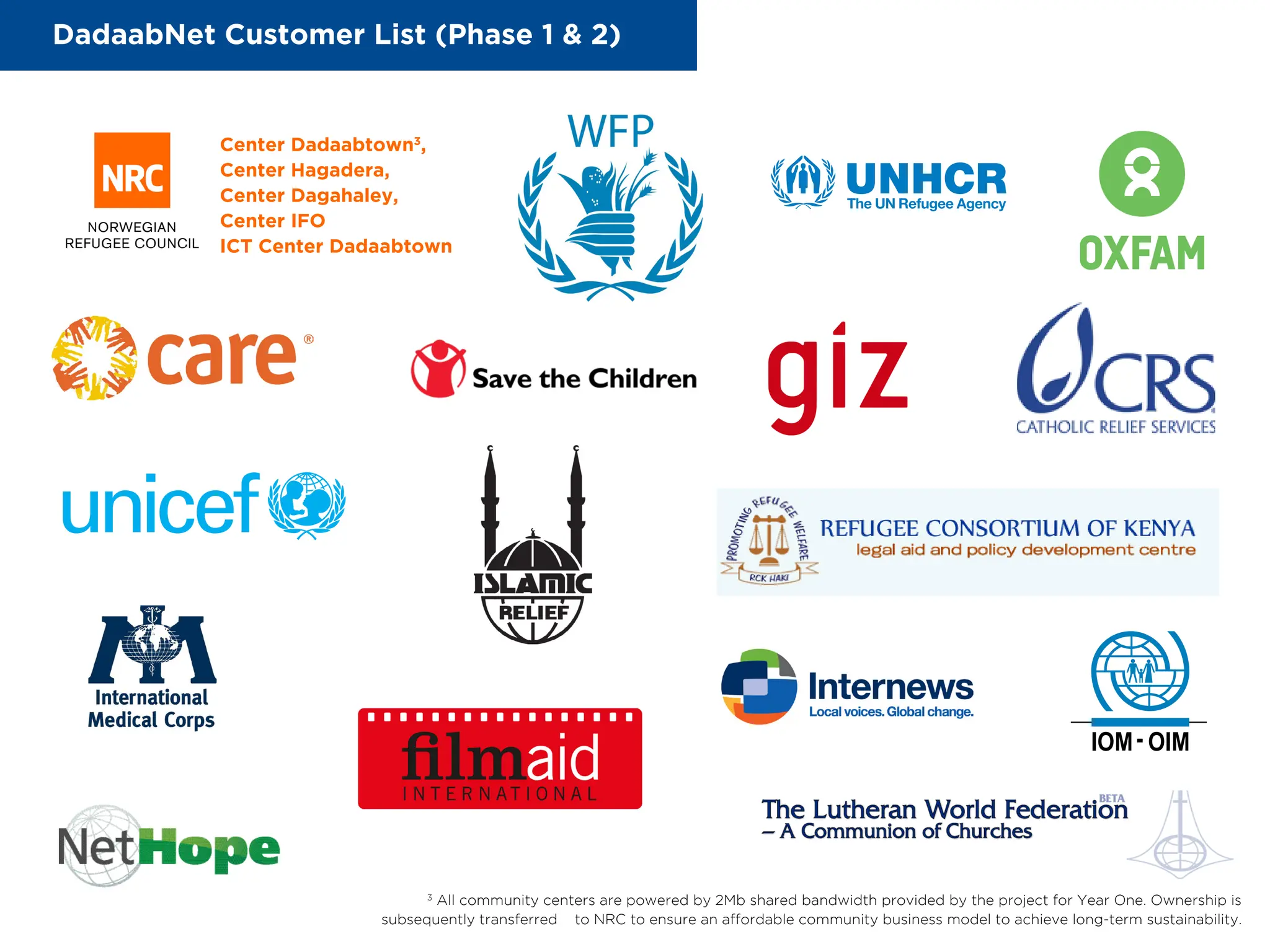
DadaabNet Customer List (Phase 1 & 2)
3
All community centers are powered by 2Mb shared bandwidth provided by the project for Year One. Ownership is
subsequently transferred to NRC to ensure an affordable community business model to achieve long-term sustainability.
Center Dadaabtown3
,
Center Hagadera,
Center Dagahaley,
Center IFO
ICT Center Dadaabtown
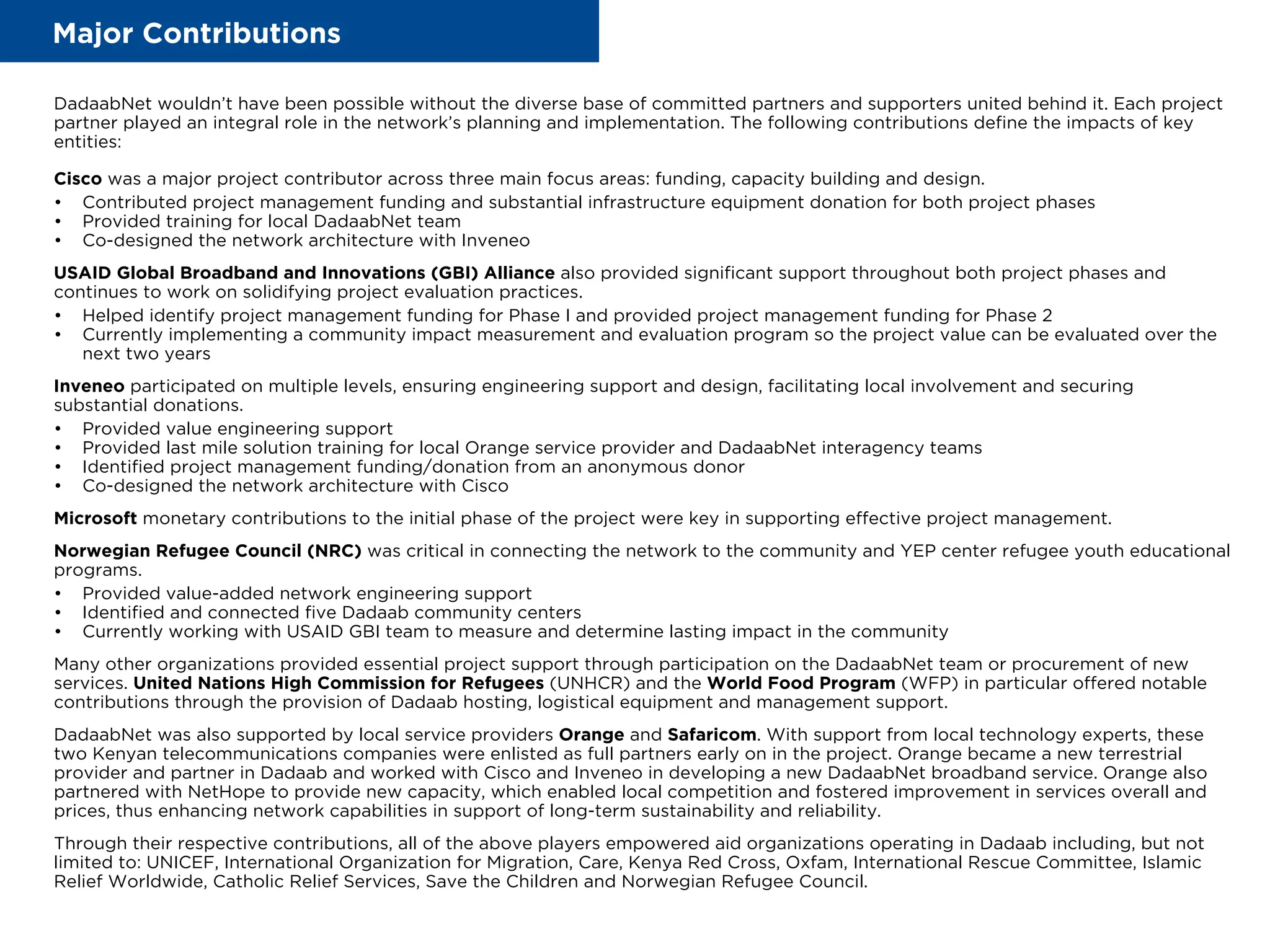
Major Contributions
DadaabNet wouldn’t have been possible without the diverse base of committed partners and supporters united behind it. Each project
partner played an integral role in the network’s planning and implementation. The following contributions define the impacts of key
entities:
Cisco was a major project contributor across three main focus areas: funding, capacity building and design.
• Contributed project management funding and substantial infrastructure equipment donation for both project phases
• Provided training for local DadaabNet team
• Co-designed the network architecture with Inveneo
USAID Global Broadband and Innovations (GBI) Alliance also provided significant support throughout both project phases and
continues to work on solidifying project evaluation practices.
• Helped identify project management funding for Phase I and provided project management funding for Phase 2
• Currently implementing a community impact measurement and evaluation program so the project value can be evaluated over the
next two years
Inveneo participated on multiple levels, ensuring engineering support and design, facilitating local involvement and securing
substantial donations.
• Provided value engineering support
• Provided last mile solution training for local Orange service provider and DadaabNet interagency teams
• Identified project management funding/donation from an anonymous donor
• Co-designed the network architecture with Cisco
Microsoft monetary contributions to the initial phase of the project were key in supporting effective project management.
Norwegian Refugee Council (NRC) was critical in connecting the network to the community and YEP center refugee youth educational
programs.
• Provided value-added network engineering support
• Identified and connected five Dadaab community centers
• Currently working with USAID GBI team to measure and determine lasting impact in the community
Many other organizations provided essential project support through participation on the DadaabNet team or procurement of new
services. United Nations High Commission for Refugees (UNHCR) and the World Food Program (WFP) in particular offered notable
contributions through the provision of Dadaab hosting, logistical equipment and management support.
DadaabNet was also supported by local service providers Orange and Safaricom. With support from local technology experts, these
two Kenyan telecommunications companies were enlisted as full partners early on in the project. Orange became a new terrestrial
provider and partner in Dadaab and worked with Cisco and Inveneo in developing a new DadaabNet broadband service. Orange also
partnered with NetHope to provide new capacity, which enabled local competition and fostered improvement in services overall and
prices, thus enhancing network capabilities in support of long-term sustainability and reliability.
Through their respective contributions, all of the above players empowered aid organizations operating in Dadaab including, but not
limited to: UNICEF, International Organization for Migration, Care, Kenya Red Cross, Oxfam, International Rescue Committee, Islamic
Relief Worldwide, Catholic Relief Services, Save the Children and Norwegian Refugee Council.
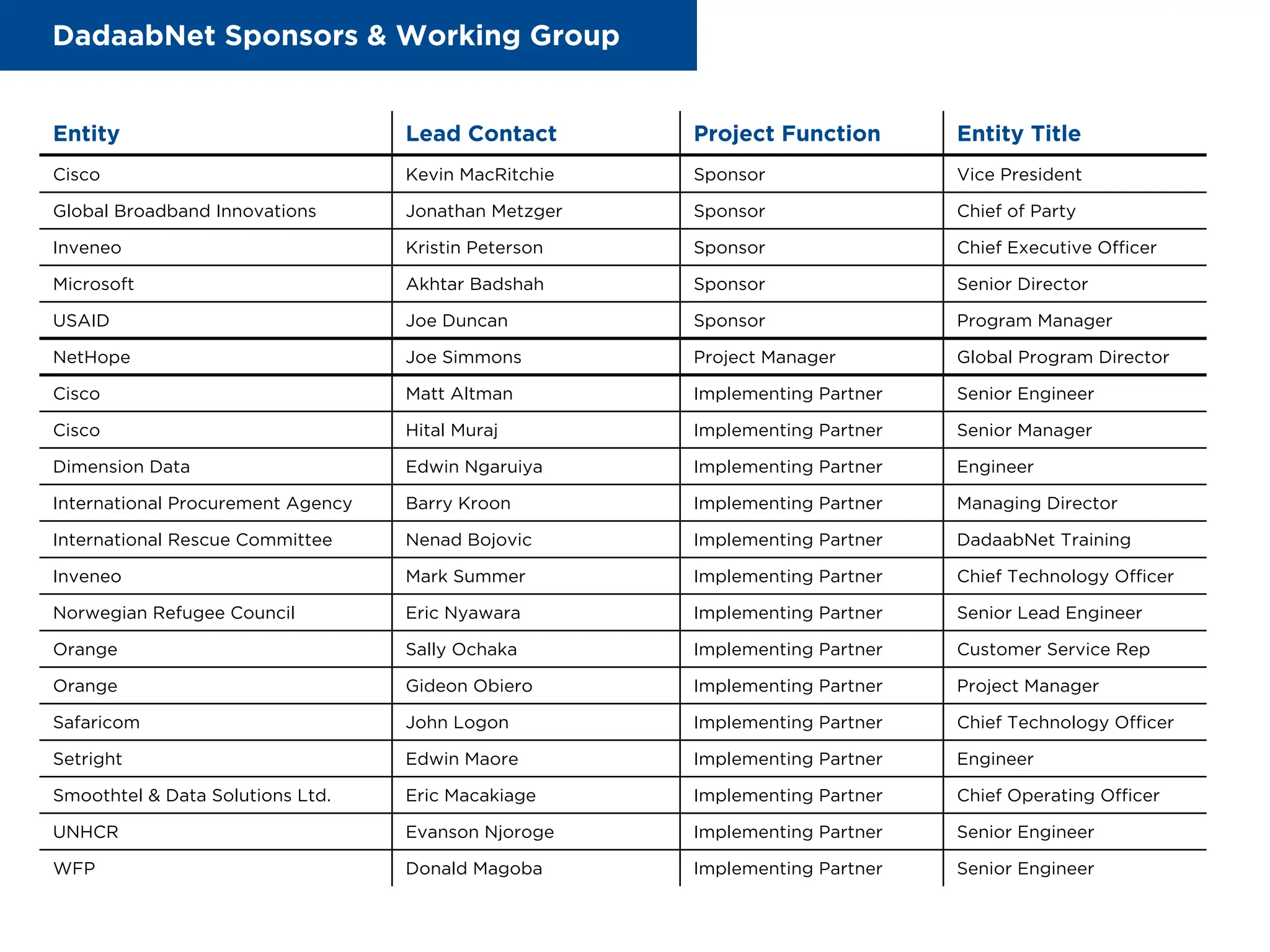
DadaabNet Sponsors & Working Group
Entity Lead Contact Project Function Entity Title
Cisco Kevin MacRitchie Sponsor Vice President
Global Broadband Innovations Jonathan Metzger Sponsor Chief of Party
Inveneo Kristin Peterson Sponsor Chief Executive Officer
Microsoft Akhtar Badshah Sponsor Senior Director
USAID Joe Duncan Sponsor Program Manager
NetHope Joe Simmons Project Manager Global Program Director
Cisco Matt Altman Implementing Partner Senior Engineer
Cisco Hital Muraj Implementing Partner Senior Manager
Dimension Data Edwin Ngaruiya Implementing Partner Engineer
International Procurement Agency Barry Kroon Implementing Partner Managing Director
International Rescue Committee Nenad Bojovic Implementing Partner DadaabNet Training
Inveneo Mark Summer Implementing Partner Chief Technology Officer
Norwegian Refugee Council Eric Nyawara Implementing Partner Senior Lead Engineer
Orange Sally Ochaka Implementing Partner Customer Service Rep
Orange Gideon Obiero Implementing Partner Project Manager
Safaricom John Logon Implementing Partner Chief Technology Officer
Setright Edwin Maore Implementing Partner Engineer
Smoothtel & Data Solutions Ltd. Eric Macakiage Implementing Partner Chief Operating Officer
UNHCR Evanson Njoroge Implementing Partner Senior Engineer
WFP Donald Magoba Implementing Partner Senior Engineer
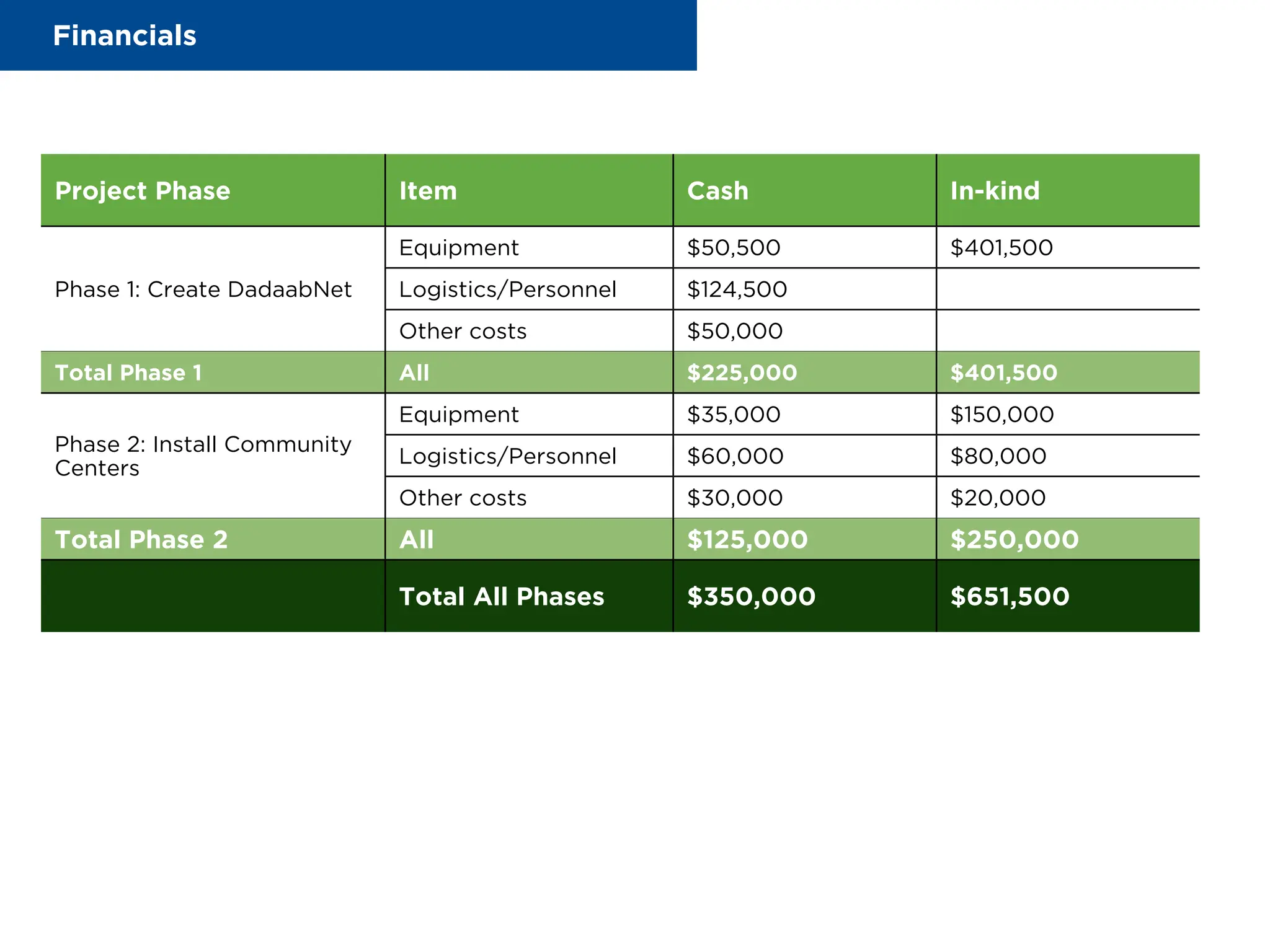
Project Phase Item Cash In-kind
Phase 1: Create DadaabNet
Equipment $50,500 $401,500
Logistics/Personnel $124,500
Other costs $50,000
Total Phase 1 All $225,000 $401,500
Phase 2: Install Community
Centers
Equipment $35,000 $150,000
Logistics/Personnel $60,000 $80,000
Other costs $30,000 $20,000
Total Phase 2 All $125,000 $250,000
Total All Phases $350,000 $651,500
Financials
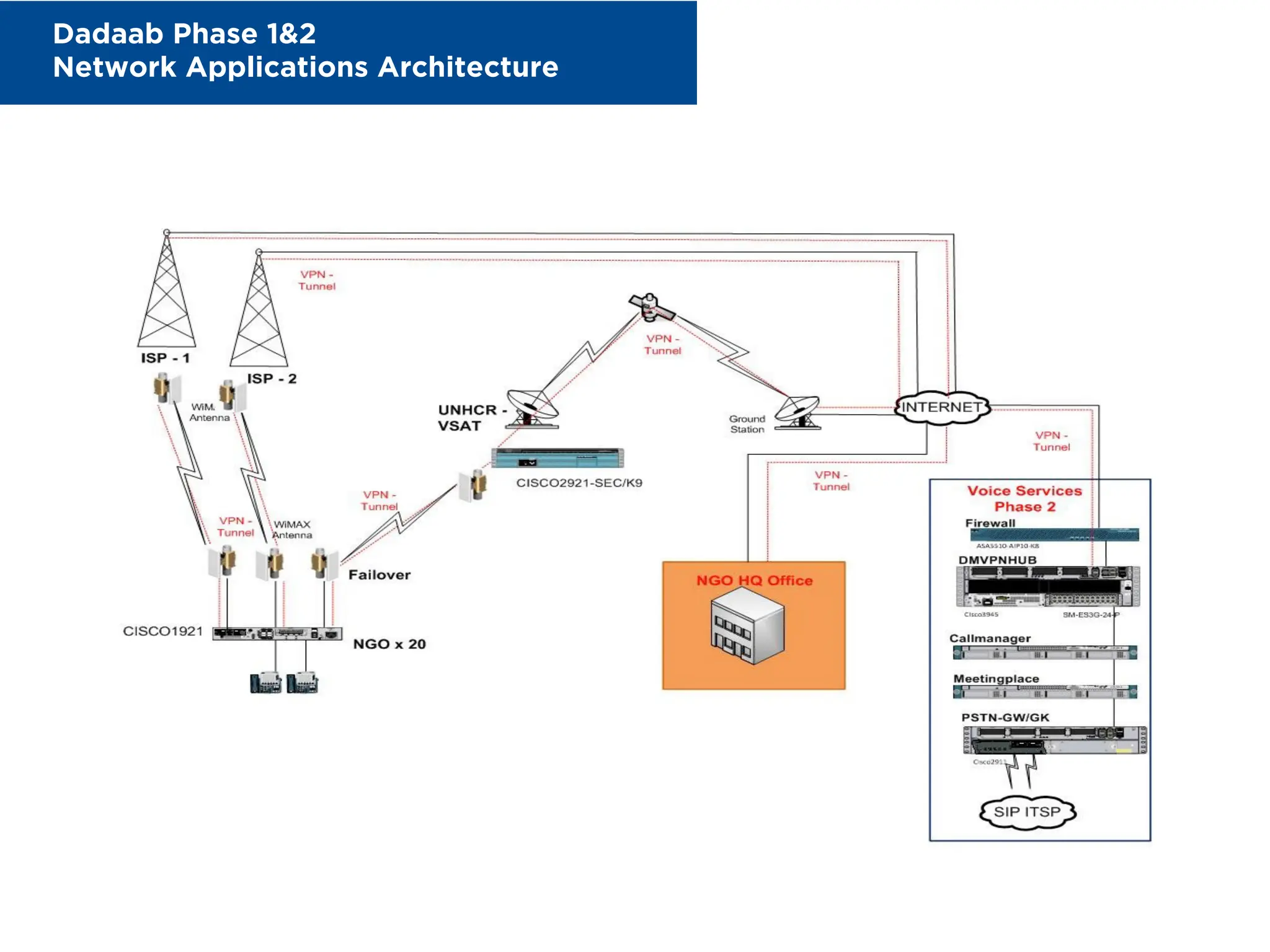
Dadaab Phase 1&2
Network Applications Architecture
Dadaab	
  Target	
  Network	
  Architecture	
  
Dadaab	
  Phase	
  1&	
  2	
  Network	
  Applica;ons	
  Architecture	
  
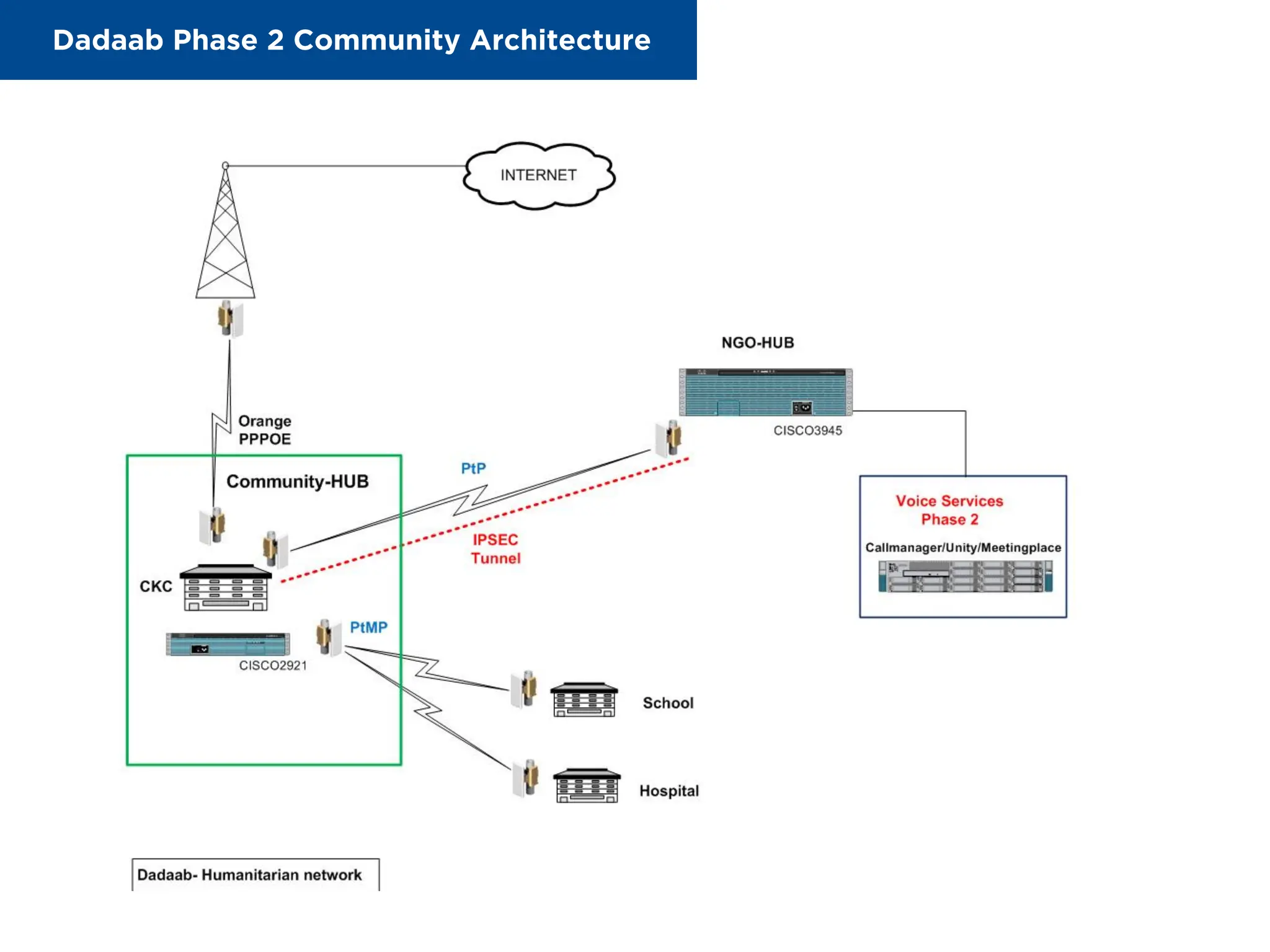
Dadaab Phase 2 Community Architecture
Dadaab	
  Target	
  Network	
  Architecture	
  
Dadaab	
  Phase	
  2	
  Community	
  Architecture	
  
For more information, visit www.NetHope.org, or contact us at
dadaabprogram@nethope.org
View a short video on the impact of DadaabNet: http://bit.ly/1fdIMmR
Follow us on Twitter @GBI_Net or NetHope_Org
& find us on Facebook at /NetHopeOrg

Dadaab bharath Project and Reports in.pdf

  • 1.
    DadaabNet Project Report March 2014 “Thecustomer is always right”
  • 2.
    1 An unprecedented droughtand famine across Somalia, coupled with the long-standing civil war, resulted in a massive influx of refugees to Dadaab1 , Kenya during the summer of 2011 and throughout 2012. The refugee camp’s population spiked from 300,000 to well over 500,000, resulting in a need for humanitarian organizations to quickly ramp up operations. Given that Dadaab grew to over five times the number of refugees it was originally designed for, there were infrastructure inadequacies and essential service capacity and logistical challenges — all of which could be offset by better connectivity. Recognizing this critical need, over 16 organizations came together behind an initiative to deliver high- speed, low-cost Internet access via an innovative and replicable network model. With the successful implementation of DadaabNet, aid agencies in Dadaab were provided with the reliable access needed to improve operations and save lives. The high-speed local area network has enabled shared resources, collaborative communications and response efforts, and an array of workforce and community development programs. Access to DadaabNet has also been extended to refugee youth, presenting an invaluably empowering opportunity for education and vocational training, and, for some, a first chance to connect to the outside world. It may soon provide many with their first access to health care through Tele-Health technologies and virtual access to Doctors. Project Overview In August 2011, USAID asked NetHope’s Global Broadband and Innovations team to develop a connectivity solution to address the immediate 1 Dadaab is situated in a remote arid region of eastern Kenya close to the Somalia border in Garissa County. “When disaster strikes, the immediate needs are obvious: food, water, shelter and medical supplies, but none of these necessities reach survivors without a robust communication network to enable relief workers to save lives.” Lynda Kigera, Save the Children
  • 3.
    needs and attractlocal service providers to ensure sustainability and scalability. Utilizing funding from Cisco, USAID, Microsoft and others, NetHope and networking partners Cisco Systems and Inveneo were able to develop an innovative approach to bring affordable and reliable Internet connectivity to Dadaab and build an infrastructure network throughout the refugee camp. As thousands of refugees crossed the border from Somalia, the number of response agencies and humanitarian workers increased, expanding inter-organizational information sharing and scalability requirements. Bringing broadband improvements to Dadaab started effectively with early engagement of the local stakeholder community to co-create an innovative network architecture, business model and support plan. Developing trusted relationships and delivering solution-specific practical training and localized engagements in the initial network implementation were key elements to ensure successful service introductions and ongoing operations. Kenyan telecommunications companies Orange and Safaricom, with support from local technology experts Dimension Data and Setright, were enlisted as full partners early in the process and invited to participate in engineering and business peer review. Preferred reduced pricing and additional capacity based on demand aggregation and projections were negotiated prior to the onset of the project. Critical Success Factor 1: Prior to solutions development, requirements were gathered in Dadaab from 17 NGO/UN agencies. A connectivity assessment and proposal was documented and shared. NetHope members and technology partners were engaged up-front to conduct peer review and recommendations. The following impacts are the results of the implementation of the findings. Major Impacts of DadaabNet 1. A High-Speed Local Network to Support Relief Operations. Established competitive and reliable shared terrestrial connectivity for the humanitarian organizations and community. Connectivity savings will be measured in the hundreds of thousands in the first two years as agencies transfer their business operations from VSAT to terrestrial. 2. Support for Refugee Community and Youth. Connected five times the number of locations for beneficiaries/refugees than originally committed in addition to entire NGO community for operations & joint collaborative communications. Hundreds of youth have gained access to Internet based training and resources in the first few months; this number is expected to increase into the tens of thousands in the next 12 months and to exceed a hundred thousand in year two. 3. Connectivity Savings. Twenty (20) times reduction in recurring WAN connectivity expense than previously available (VSAT vs. terrestrial pricing), with greater reliability, redundancy and resiliency. 4. A Sustainable Network with an Indefinite Lifeline. Enabled local ownership, support and 2 Many view the implementation of DadaabNet as the first bridge to creating a more peaceful environment in Dadaab. “Without having this sort of connectivity among the NGOs, among the youth, we could not make it where we are today....I’d love my children to have peace... peace and a promising life.” Abdikadir Farah, Dadaab Resident
  • 4.
    [photo left] Trainees fromOrange Kenya, Inveneo ICIP, Setright, and Dadaab-based IT staffs assemble an Ubiquiti Rocket Dish. 3 future development of the Dadaab services. This capacity was developed by pre-qualifying and training local agency ICT staff to provide first-tier support and diagnostics; improving response time to service needs; and increasing the ICT talents of the local workforce. 5. A Reliable, Scalable Voice and Video Solution. Established a reliable data voice and video solution for the humanitarian agencies and the community. NetHope worked with Cisco and Inveneo to ensure the scalability and replicability for other rural areas and refugee camps. 6. Educational Opportunities to Refugees. Through partnership with Norwegian Refugee Council Youth Education Pack, five centers were connected that offer high school and college level diplomas through NRC online programs. This was the first step in the camps’ history to connect refugees to the skills and knowledge needed for professional development and growth. Dadaab Phase 1 Humanitarian compounds and offices are clustered within a 2km radius of each other in a secured compound in Dadaab. An opportunity to establish shared connectivity services and collaborative support for the humanitarian community based on proximity was realized very early in the requirements gathering phase. The NGO and UN agencies operating in Dadaab asserted that the key to a well-coordinated response to the massive influx of refugees was access to timely and relevant information, supply line logistics and situation/security reports. If connectivity is limited, then information sharing is also limited and collaboration and responsiveness are impeded. The primary goals for Phase 1 were to: 1. Increase available reliable, affordable terrestrial connectivity and choices of providers. 2. Establish a high-speed reliable local collaboration network (DadaabNet). With an existing local tower infrastructure and the cluster of humanitarian organizations, it was easy to understand how a shared high-speed local network could be highly and quickly utilized amongst the various agencies involved. In March 2012, a high-speed local area network, DadaabNet, along with integrated affordable terrestrial Internet services and VSAT failover configurations were designed and implemented as
  • 5.
    4 DadaabNet Phase 1. CriticalSuccess Factor 2: DadaabNet became a catalyst for interagency IT collaboration, information sharing and problem solving in Dadaab. PHASE 1 RESULTS: 1. Provided Multiple Broadband Services to Dadaab. Increased the reliability of service to Dadaab by providing high-speed dual path, multi-vendor terrestrial connectivity with diversity and redundancy to enable mission critical applications and improve camp operations. 2. Reduced Internet Costs. Negotiated reductions in the cost of terrestrial connectivity by approximately $500 per month per Mb by partnering with both Orange and Safaricom to provide more diverse and reliable network connectivity and increase bandwidth capacity by 50Mb. 3. Introduced Back-Up Internet Connections. Maintained VSAT as fail-over in the design and configuration provided by Cisco and Inveneo in order to ensure continuous up-time and have third-tier redundancy to the mission critical network while still reducing cost per Mb used. 4. Leveraged Resources and Donations from Multiple Providers. During the implementation, operations and optimization periods more than $500k was invested in equipment and value-added engineering services for network design, training, local partner engagement and technical support. The combination of additional in-kind and direct donations enabled the technical and program management support needed to successfully complete, expand and sustain the implementation. 5. Ensured Sustainability of Network. Enabled scalable capacity to ensure a reliable network and repeatable, innovative and cost-effective last mile architecture. This was done through the training of technically prequalified Orange and Dadaab ICT staff in Inveneo technologies (Ubiquiti) and Cisco routing and switching configurations. Newly trained engineers were also included on the installation team side- by-side with Ubiquiti experts from Inveneo & local partner Setright and Cisco’s certified local technology partner Dimension Data (with remote configuration support from Cisco). 6. Accelerated Migration from VSAT to Terrestrial. It is expected that by 2014-2015, 90% of the aid agencies will be running mission critical applications on terrestrial services (vs. 99% being run on VSAT in 2011-2012). [photo above] Trainees are under Inveneo’s CTO Andris Bjornson’s guidance, to learn safe climbing techniques on 50-meter towers.
  • 6.
    5 Enhanced reliability andthe resultant migration from VSAT to terrestrial is in part a result of Safaricom and Orange’s commitment to maintain or exceed a 99.95 uptime and share regular performance reports. 7. Installed DadaabNet High-Speed Configurations for 10 Agencies. Enabled better information and collaboration applications amongst humanitarian organizations including CARE, Catholic Relief Services, Kenya Red Cross, Lutheran World Federation, Norwegian Refugee Council, Oxfam, Save the Children, UNHCR, UNICEF and WFP. Critical Success Factor 3: This project established a Dadaab based UN/NGO interagency collaboration team that works in conjunction with the private sector to sustain and expand DadaabNet service. Dadaab Phase 2 Dadaab Phase 2 was a partnership between NetHope, USAID, Cisco and Norwegian Refugee Council, with local engineering support from Dimension Data, Setright, International Rescue Committee (Ubiquiti training) and the DadaabNet team. The primary goals for Phase 2 were to: 1. Expand DadaabNet to five local community centers supporting education, medical programs, Internet access and youth related projects; this goal also included the implementation of value-added applications including VoIP, video conferencing and file services to the target community center. 2. Optimize operations to improve network reliability, sustainability and scalability by transitioning management to the DadaabNet team and ISPs and developing metrics to evaluate the lasting impact and value of the project. Critical Success Factor 4: The USAID stated objective was to connect one community center. The DadaabNet team was successful in connecting five centers. Other Dadaab agencies are now planning to expand DadaabNet to other community centers on their own in 2014 and beyond. PHASE 2 RESULTS: 1. Extended Connection to Refugee Community and Provided Value-Added Services. Established connections to five Dadaab community centers and successfully installed VoIP and value-added services in six humanitarian agencies and two of the community centers. This was accomplished by engaging Cisco Tactical Operations for VoIP [photo left] Dadaab residents log on to NRC YEP Center computers -- many of whom are accessing the Internet and setting up Skype and email accounts for the very first time.
  • 7.
    video conferencing andnetwork expansion (community) design, local partner engagement (Dimension Data) and technical support during the implementation phases. The remaining Dadaab community centers and additional humanitarian agencies are quickly enabling these services as well. 2. Focused on Delivery of Access to Dadaab Youth. Many Dadaab youth accessed the Internet and created email/Skype accounts for the first time after DadaabNet and VoIP were extended to the Norwegian Refugee Council Youth Center (YEP) in Dadaabtown in May 2013. In November 2013, access to Dadaab youth was expanded when the network was extended to four more refugee community centers in Dadaabtown, IFO, Hagadera & Dagahaley. 3. Developed Expansion Planning and Strengthened Security Protocols. Based on current agency and community demand, the team planned to expand DadaabNet by procuring and distributing additional Ubiquiti and Cisco equipment to Dadaab for distance learning, security, online books, etc. with help from International Procurement Agency (IPA) and support from Cisco and UNHCR. The team also utilized additional Cisco camera enabled VoIP to expand the network and enhance security; as a result, visiting staff could enter the humanitarian compound without going to the front gate (using video conferencing to verify guests and credentials). 4. Increased Network Capacity and Ensured Customer Satisfaction. Ensured capacity would keep pace with network support and expansion by training additional technically prequalified Dadaab ICT staff in Inveneo technologies (Ubiquiti) via a NetHope/International Rescue Committee developed Setright reviewed training course in Nairobi. The team also supported operations and a positive customer experience by encouraging the assignment of an Orange customer service representative. 5. Supported Education Initiatives. Enabled the launch of NRC distance learning programs in 2014 by deploying video controller equipment to three YEP centers (November 2013) in order to promote education through the Dadaab Refugee Camp and offer hope to its residents. 6. Leveraged Resources and Donations from Multiple Providers. The locally trained DadaabNet engineering team collaborates to enable new applications and network installations and provide operations support based on the overall value of the network; this [photo left] Two Dadaab residents log on to NRC-YEP Center computers to communicate with friends and family in Somalia. "We are communicating many things with relatives from Somalia... if they are still fighting, if there is peace... we are communicating that." Muktasri Marian, Student, NRC YEP Center 6
  • 8.
    ongoing work isaccomplished without any direct cost to the project. Local training and engineering staff resources are leveraged to utilize the network and applications benefits in the Youth Education Pact Dadaab community programs. 7. Established Indefinite Lifeline for DadaabNet. Enabled increased service demand, ongoing network expansion and capacity building without ongoing funding and project support from NetHope by negotiating an agreement that Orange will sponsor training and equipment replenishment. Also negotiated a reduction in 2014 bandwidth prices from 260 per Mb to 190 per Mb (November 2013). Critical Success Factor 5: The DadaabNet team took ownership of the project, defining and implementing new applications, composing joint service provider requests/complaints and managing the equipment and education of the program staff. Critical Success Factor 6: Orange is interested in repeating the DadaabNet architecture in other locations based on their experience with the technology and business model. Repeatability may be realized with little to no additional interventions. “It gives us a sense of pride and joy when we look at where we have come from, where we are now, and realizing this is something we can even take to Kakuma to help the Sudanese refugees who are there.” Sally Michelle Ochaka, Orange 7
  • 9.
  • 10.
  • 11.
    DadaabNet Customer List(Phase 1 & 2) 3 All community centers are powered by 2Mb shared bandwidth provided by the project for Year One. Ownership is subsequently transferred to NRC to ensure an affordable community business model to achieve long-term sustainability. Center Dadaabtown3 , Center Hagadera, Center Dagahaley, Center IFO ICT Center Dadaabtown
  • 12.
    Major Contributions DadaabNet wouldn’thave been possible without the diverse base of committed partners and supporters united behind it. Each project partner played an integral role in the network’s planning and implementation. The following contributions define the impacts of key entities: Cisco was a major project contributor across three main focus areas: funding, capacity building and design. • Contributed project management funding and substantial infrastructure equipment donation for both project phases • Provided training for local DadaabNet team • Co-designed the network architecture with Inveneo USAID Global Broadband and Innovations (GBI) Alliance also provided significant support throughout both project phases and continues to work on solidifying project evaluation practices. • Helped identify project management funding for Phase I and provided project management funding for Phase 2 • Currently implementing a community impact measurement and evaluation program so the project value can be evaluated over the next two years Inveneo participated on multiple levels, ensuring engineering support and design, facilitating local involvement and securing substantial donations. • Provided value engineering support • Provided last mile solution training for local Orange service provider and DadaabNet interagency teams • Identified project management funding/donation from an anonymous donor • Co-designed the network architecture with Cisco Microsoft monetary contributions to the initial phase of the project were key in supporting effective project management. Norwegian Refugee Council (NRC) was critical in connecting the network to the community and YEP center refugee youth educational programs. • Provided value-added network engineering support • Identified and connected five Dadaab community centers • Currently working with USAID GBI team to measure and determine lasting impact in the community Many other organizations provided essential project support through participation on the DadaabNet team or procurement of new services. United Nations High Commission for Refugees (UNHCR) and the World Food Program (WFP) in particular offered notable contributions through the provision of Dadaab hosting, logistical equipment and management support. DadaabNet was also supported by local service providers Orange and Safaricom. With support from local technology experts, these two Kenyan telecommunications companies were enlisted as full partners early on in the project. Orange became a new terrestrial provider and partner in Dadaab and worked with Cisco and Inveneo in developing a new DadaabNet broadband service. Orange also partnered with NetHope to provide new capacity, which enabled local competition and fostered improvement in services overall and prices, thus enhancing network capabilities in support of long-term sustainability and reliability. Through their respective contributions, all of the above players empowered aid organizations operating in Dadaab including, but not limited to: UNICEF, International Organization for Migration, Care, Kenya Red Cross, Oxfam, International Rescue Committee, Islamic Relief Worldwide, Catholic Relief Services, Save the Children and Norwegian Refugee Council.
  • 13.
    DadaabNet Sponsors &Working Group Entity Lead Contact Project Function Entity Title Cisco Kevin MacRitchie Sponsor Vice President Global Broadband Innovations Jonathan Metzger Sponsor Chief of Party Inveneo Kristin Peterson Sponsor Chief Executive Officer Microsoft Akhtar Badshah Sponsor Senior Director USAID Joe Duncan Sponsor Program Manager NetHope Joe Simmons Project Manager Global Program Director Cisco Matt Altman Implementing Partner Senior Engineer Cisco Hital Muraj Implementing Partner Senior Manager Dimension Data Edwin Ngaruiya Implementing Partner Engineer International Procurement Agency Barry Kroon Implementing Partner Managing Director International Rescue Committee Nenad Bojovic Implementing Partner DadaabNet Training Inveneo Mark Summer Implementing Partner Chief Technology Officer Norwegian Refugee Council Eric Nyawara Implementing Partner Senior Lead Engineer Orange Sally Ochaka Implementing Partner Customer Service Rep Orange Gideon Obiero Implementing Partner Project Manager Safaricom John Logon Implementing Partner Chief Technology Officer Setright Edwin Maore Implementing Partner Engineer Smoothtel & Data Solutions Ltd. Eric Macakiage Implementing Partner Chief Operating Officer UNHCR Evanson Njoroge Implementing Partner Senior Engineer WFP Donald Magoba Implementing Partner Senior Engineer
  • 14.
    Project Phase ItemCash In-kind Phase 1: Create DadaabNet Equipment $50,500 $401,500 Logistics/Personnel $124,500 Other costs $50,000 Total Phase 1 All $225,000 $401,500 Phase 2: Install Community Centers Equipment $35,000 $150,000 Logistics/Personnel $60,000 $80,000 Other costs $30,000 $20,000 Total Phase 2 All $125,000 $250,000 Total All Phases $350,000 $651,500 Financials
  • 15.
    Dadaab Phase 1&2 NetworkApplications Architecture Dadaab  Target  Network  Architecture   Dadaab  Phase  1&  2  Network  Applica;ons  Architecture  
  • 16.
    Dadaab Phase 2Community Architecture Dadaab  Target  Network  Architecture   Dadaab  Phase  2  Community  Architecture  
  • 17.
    For more information,visit www.NetHope.org, or contact us at dadaabprogram@nethope.org View a short video on the impact of DadaabNet: http://bit.ly/1fdIMmR Follow us on Twitter @GBI_Net or NetHope_Org & find us on Facebook at /NetHopeOrg