M602.17 1
CYCLEGRAPH AND CHRONOCYCLEGRAPH
M602.17 2
INTRODUCTION
• Is it possible to record all sorts of complex movements in flow
or string diagrams and Process charts?
• Is it possible to record fast motions by above diagrams?
M602.17 3
• Yes, the method study recording techniques we have known so
far do not record all sorts of complex motions and cannot record
fast motions
• Here, cyclegraph and chronocyclegraph are the techniques to
serve the purpose
• Cyclegraph and chronocyclegraph were introduced by Gilbreth
INTRODUCTION (contd..)
M602.17 4
• They are photographic methods and are very accurate
• They are used to trace especially those movements which are too
fast and complex for the human eye to pursue
INTRODUCTION (contd..)
M602.17 5
CYCLEGRAPH
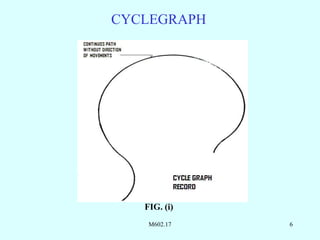
• It records the path of movements of, say, the hands or any other body
part of an operator while performing an operation
• Little pea light bulbs attached to the hands or fingers of the operator
trace continuous lines of movements on the photographic plate
• Another exposure to view on the same photographic plate can show
all three aspects simultaneously, i.e. worker, workplace layout and
the path of movements
• Wherever possible, it is better to go for three dimensional pictures
M602.17 6
CYCLEGRAPH
FIG. (i)
M602.17 7
CHRONOCYCLEGRAPH
• What is the limitation of Cyclegraph?
• Cyclegraph neither indicates the direction nor the speed of the
movements
M602.17 8
• Chronocyclegraph incorporates in it, a system of interrupting
the light source (from 10 to 30 times per second)
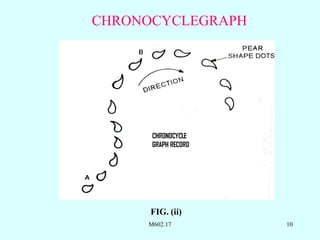
• Instead of recording the path of movements as continuous lines, it
records the same in the form of pear shaped spot on the
photographic plate
• The pointed end of the pear shaped spot shows the direction of
movement
• The shape and spacing of these spots indicate whether the speed
of working is increasing or decreasing
CHRONOCYCLEGRAPH (contd..)
M602.17 9
• More elongated spots with longer gaps between them mark higher
working speed
• Knowing the rate at which the light source is being interrupted, the
speed of movement can be easily determined
CHRONOCYCLEGRAPH (contd..)
M602.17 10
CHRONOCYCLEGRAPH
FIG. (ii)
M602.17 11
THANK YOU

cyclegraphs.ppt

  • 1.
    M602.17 1 CYCLEGRAPH ANDCHRONOCYCLEGRAPH
  • 2.
    M602.17 2 INTRODUCTION • Isit possible to record all sorts of complex movements in flow or string diagrams and Process charts? • Is it possible to record fast motions by above diagrams?
  • 3.
    M602.17 3 • Yes,the method study recording techniques we have known so far do not record all sorts of complex motions and cannot record fast motions • Here, cyclegraph and chronocyclegraph are the techniques to serve the purpose • Cyclegraph and chronocyclegraph were introduced by Gilbreth INTRODUCTION (contd..)
  • 4.
    M602.17 4 • Theyare photographic methods and are very accurate • They are used to trace especially those movements which are too fast and complex for the human eye to pursue INTRODUCTION (contd..)
  • 5.
    M602.17 5 CYCLEGRAPH • Itrecords the path of movements of, say, the hands or any other body part of an operator while performing an operation • Little pea light bulbs attached to the hands or fingers of the operator trace continuous lines of movements on the photographic plate • Another exposure to view on the same photographic plate can show all three aspects simultaneously, i.e. worker, workplace layout and the path of movements • Wherever possible, it is better to go for three dimensional pictures
  • 6.
  • 7.
    M602.17 7 CHRONOCYCLEGRAPH • Whatis the limitation of Cyclegraph? • Cyclegraph neither indicates the direction nor the speed of the movements
  • 8.
    M602.17 8 • Chronocyclegraphincorporates in it, a system of interrupting the light source (from 10 to 30 times per second) • Instead of recording the path of movements as continuous lines, it records the same in the form of pear shaped spot on the photographic plate • The pointed end of the pear shaped spot shows the direction of movement • The shape and spacing of these spots indicate whether the speed of working is increasing or decreasing CHRONOCYCLEGRAPH (contd..)
  • 9.
    M602.17 9 • Moreelongated spots with longer gaps between them mark higher working speed • Knowing the rate at which the light source is being interrupted, the speed of movement can be easily determined CHRONOCYCLEGRAPH (contd..)
  • 10.
  • 11.