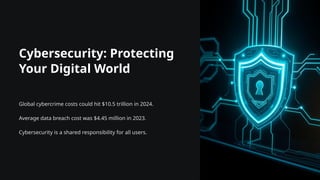
Cybersecurity: Protecting
Your DigitalWorld
Global cybercrime costs could hit $10.5 trillion in 2024.
Average data breach cost was $4.45 million in 2023.
Cybersecurity is a shared responsibility for all users.
2.
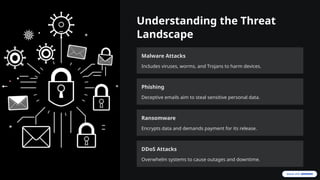
Understanding the Threat
Landscape
MalwareAttacks
Includes viruses, worms, and Trojans to harm devices.
Phishing
Deceptive emails aim to steal sensitive personal data.
Ransomware
Encrypts data and demands payment for its release.
DDoS Attacks
Overwhelm systems to cause outages and downtime.
3.
Common Attack Vectors
WeakPasswords
Easily guessed or
cracked passwords
expose vulnerabilities.
Unpatched
Software
Missing updates create
openings for exploits
and attacks.
Social Engineering
Manipulation tactics to
gain unauthorized
access.
Insider Threats
Malicious or careless
employees risking
security breaches.
4.
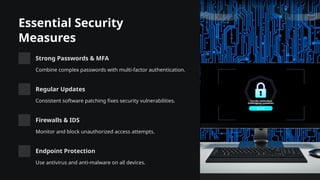
Essential Security
Measures
Strong Passwords& MFA
Combine complex passwords with multi-factor authentication.
Regular Updates
Consistent software patching fixes security vulnerabilities.
Firewalls & IDS
Monitor and block unauthorized access attempts.
Endpoint Protection
Use antivirus and anti-malware on all devices.
5.
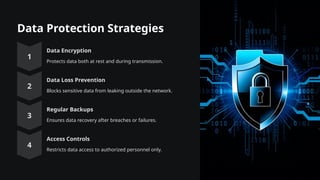
Data Protection Strategies
DataEncryption
Protects data both at rest and during transmission.
Data Loss Prevention
Blocks sensitive data from leaking outside the network.
Regular Backups
Ensures data recovery after breaches or failures.
Access Controls
Restricts data access to authorized personnel only.
6.
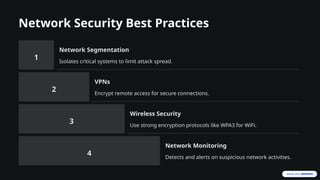
Network Security BestPractices
1
Network Segmentation
Isolates critical systems to limit attack spread.
2
VPNs
Encrypt remote access for secure connections.
3
Wireless Security
Use strong encryption protocols like WPA3 for WiFi.
4
Network Monitoring
Detects and alerts on suspicious network activities.
7.
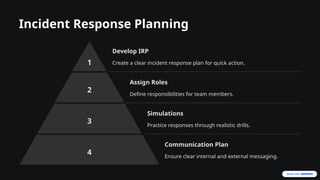
Incident Response Planning
1
DevelopIRP
Create a clear incident response plan for quick action.
2
Assign Roles
Define responsibilities for team members.
3
Simulations
Practice responses through realistic drills.
4
Communication Plan
Ensure clear internal and external messaging.
8.
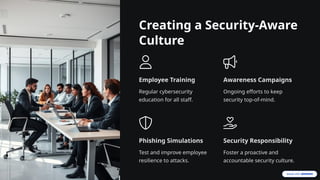
Creating a Security-Aware
Culture
EmployeeTraining
Regular cybersecurity
education for all staff.
Awareness Campaigns
Ongoing efforts to keep
security top-of-mind.
Phishing Simulations
Test and improve employee
resilience to attacks.
Security Responsibility
Foster a proactive and
accountable security culture.


![CYBERSECURITYcoll[1].pptx](https://cdn.slidesharecdn.com/ss_thumbnails/cybersecuritycoll1-231207002815-f4e5387d-thumbnail.jpg?width=640&height=640&fit=bounds)


![5G Explained! A High Level Overview [Introduction]](https://cdn.slidesharecdn.com/ss_thumbnails/5gexplainedahighleveloverview-260119165306-cc137a3e-thumbnail.jpg?width=640&height=640&fit=bounds)


