©2009 Rahul Patil


EETS 7302: Cyberlaw   1
©2009 Rahul Patil


EETS 7302: Cyberlaw   2
©2009 Rahul Patil


EETS 7302: Cyberlaw   3
©2009 Rahul Patil


EETS 7302: Cyberlaw   4
©2009 Rahul Patil


EETS 7302: Cyberlaw   5
©2009 Rahul Patil


EETS 7302: Cyberlaw   6
©2009 Rahul Patil


EETS 7302: Cyberlaw   7
©2009 Rahul Patil


EETS 7302: Cyberlaw   8
©2009 Rahul Patil


EETS 7302: Cyberlaw   9
©2009 Rahul Patil


EETS 7302: Cyberlaw   10
©2009 Rahul Patil


EETS 7302: Cyberlaw   11
©2009 Rahul Patil


EETS 7302: Cyberlaw   12
©2009 Rahul Patil


EETS 7302: Cyberlaw   13
©2009 Rahul Patil


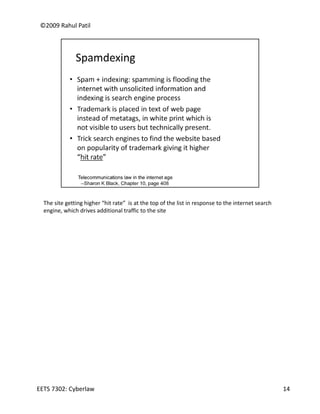
  The site getting higher “hit rate”  is at the top of the list in response to the internet search 
  engine, which drives additional traffic to the site


EETS 7302: Cyberlaw                                                                                   14
©2009 Rahul Patil


EETS 7302: Cyberlaw   15
©2009 Rahul Patil


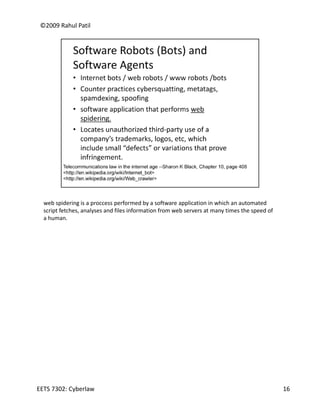
  web spidering is a proccess performed by a software application in which an automated 
  script fetches, analyses and files information from web servers at many times the speed of 
  a human.


EETS 7302: Cyberlaw                                                                             16
©2009 Rahul Patil


EETS 7302: Cyberlaw   17
©2009 Rahul Patil


EETS 7302: Cyberlaw   18
©2009 Rahul Patil


EETS 7302: Cyberlaw   19
©2009 Rahul Patil


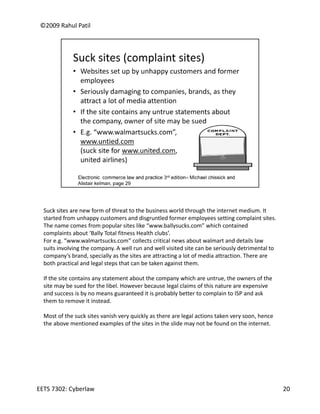
  Suck sites are new form of threat to the business world through the internet medium. It 
  started from unhappy customers and disgruntled former employees setting complaint sites. 
  The name comes from popular sites like “www.ballysucks.com” which contained 
  complaints about ‘Bally Total fitness Health clubs’.
  For e.g. “www.walmartsucks.com” collects critical news about walmart and details law 
  suits involving the company. A well run and well visited site can be seriously detrimental to 
  company s brand, specially as the sites are attracting a lot of media attraction. There are 
  company’s brand specially as the sites are attracting a lot of media attraction There are
  both practical and legal steps that can be taken against them.

  If the site contains any statement about the company which are untrue, the owners of the 
  site may be sued for the libel. However because legal claims of this nature are expensive 
  and success is by no means guaranteed it is probably better to complain to ISP and ask 
  them to remove it instead.

  Most of the suck sites vanish very quickly as there are legal actions taken very soon, hence 
  the above mentioned examples of the sites in the slide may not be found on the internet. 


EETS 7302: Cyberlaw                                                                                20
©2009 Rahul Patil


EETS 7302: Cyberlaw   21
©2009 Rahul Patil


EETS 7302: Cyberlaw   22
©2009 Rahul Patil


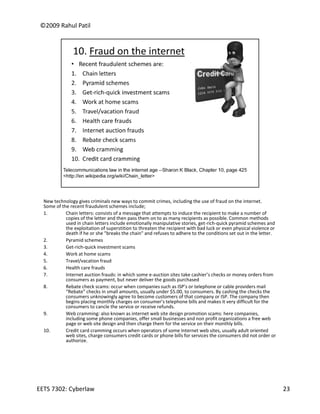
  New technology gives criminals new ways to commit crimes, including the use of fraud on the internet. 
  Some of the recent fraudulent schemes include;
  Some of the recent fraudulent schemes include;
  1.        Chain letters: consists of a message that attempts to induce the recipient to make a number of 
            copies of the letter and then pass them on to as many recipients as possible. Common methods 
            used in chain letters include emotionally manipulative stories, get‐rich‐quick pyramid schemes and 
            the exploitation of superstition to threaten the recipient with bad luck or even physical violence or 
            death if he or she "breaks the chain" and refuses to adhere to the conditions set out in the letter.
  2.        Pyramid schemes
  3.        Get‐rich‐quick investment scams
  4.        Work at home scams
  5.        Travel/vacation fraud
  6.        Health care frauds
  7.        Internet auction frauds: in which some e‐auction sites take cashier’s checks or money orders from 
            consumers as payment, but never deliver the goods purchased
  8.        Rebate check scams: occur when companies such as ISP’s or telephone or cable providers mail 
            “Rebate” checks in small amounts, usually under $5.00, to consumers. By cashing the checks the 
            consumers unknowingly agree to become customers of that company or ISP. The company then 
            begins placing monthly charges on consumer’s telephone bills and makes it very difficult for the 
            consumers to cancle the service or receive refunds.
            cons mers to cancle the ser ice or recei e ref nds
  9.        Web cramming: also known as internet web site design promotion scams: here companies, 
            including some phone companies, offer small businesses and non profit organizations a free web 
            page or web site design and then charge them for the service on their monthly bills.
  10.       Credit card cramming occurs when operators of some Internet web sites, usually adult oriented 
            web sites, charge consumers credit cards or phone bills for services the consumers did not order or 
            authorize.


EETS 7302: Cyberlaw                                                                                                  23
©2009 Rahul Patil


EETS 7302: Cyberlaw   24
©2009 Rahul Patil


EETS 7302: Cyberlaw   25

Cyberlaw