List in Writer’s Notebook

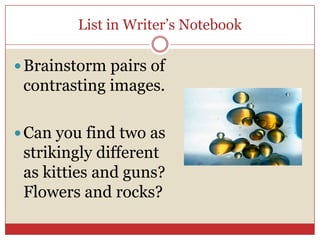
 Brainstorm pairs of
 contrasting images.

 Can you find two as
 strikingly different
 as kitties and guns?
 Flowers and rocks?
Class List…
Quick write (WNB)

 Pick your favorite pair.
 Develop each image with specific details, arranging
 the two images in alternating lines or sentences in a
 poem/paragraph.
Share/Discuss…

 What effects do you achieve?
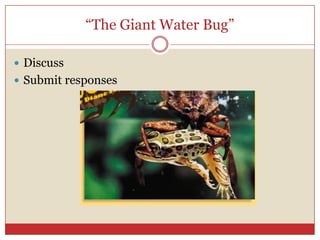
“The Giant Water Bug”

 Discuss
 Submit responses
Open Mic Model Session

 Mrs. Mundy
More with Sensory Imagery

Show & Tell/ Childhood Images – see
 worksheet.

Use the object you brought in or a childhood
 object to complete the handout.
More with Imagery

I’LL COLLECT THESE NEXT EXERCISES.
Sound - Paper

 Choose a place or time of day you know well and
 write about how it sounds.

 You might find yourself using words that start with
 the same letter (alliteration) and words that sound
 like what they’re describing (onomatopoeia).
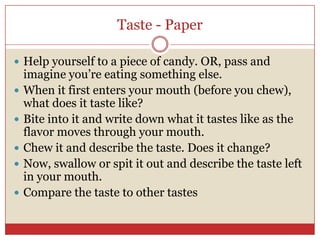
Taste - Paper

 Help yourself to a piece of candy. OR, pass and
    imagine you’re eating something else.
   When it first enters your mouth (before you chew),
    what does it taste like?
   Bite into it and write down what it tastes like as the
    flavor moves through your mouth.
   Chew it and describe the taste. Does it change?
   Now, swallow or spit it out and describe the taste left
    in your mouth.
   Compare the taste to other tastes
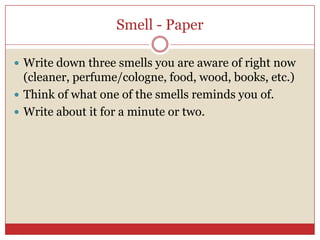
Smell - Paper

 Write down three smells you are aware of right now
  (cleaner, perfume/cologne, food, wood, books, etc.)
 Think of what one of the smells reminds you of.
 Write about it for a minute or two.
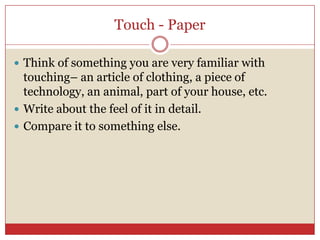
Touch - Paper

 Think of something you are very familiar with
  touching– an article of clothing, a piece of
  technology, an animal, part of your house, etc.
 Write about the feel of it in detail.
 Compare it to something else.
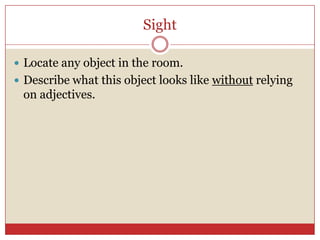
Sight

 Locate any object in the room.
 Describe what this object looks like without relying
 on adjectives.
Homework

 Write in your WNB.

Cw imagery11 day2_spring2012

  • 1.
    List in Writer’sNotebook  Brainstorm pairs of contrasting images.  Can you find two as strikingly different as kitties and guns? Flowers and rocks?
  • 2.
  • 3.
    Quick write (WNB) Pick your favorite pair.  Develop each image with specific details, arranging the two images in alternating lines or sentences in a poem/paragraph.
  • 4.
  • 5.
    “The Giant WaterBug”  Discuss  Submit responses
  • 6.
    Open Mic ModelSession  Mrs. Mundy
  • 7.
    More with SensoryImagery Show & Tell/ Childhood Images – see worksheet. Use the object you brought in or a childhood object to complete the handout.
  • 8.
    More with Imagery I’LLCOLLECT THESE NEXT EXERCISES.
  • 9.
    Sound - Paper Choose a place or time of day you know well and write about how it sounds.  You might find yourself using words that start with the same letter (alliteration) and words that sound like what they’re describing (onomatopoeia).
  • 10.
    Taste - Paper Help yourself to a piece of candy. OR, pass and imagine you’re eating something else.  When it first enters your mouth (before you chew), what does it taste like?  Bite into it and write down what it tastes like as the flavor moves through your mouth.  Chew it and describe the taste. Does it change?  Now, swallow or spit it out and describe the taste left in your mouth.  Compare the taste to other tastes
  • 11.
    Smell - Paper Write down three smells you are aware of right now (cleaner, perfume/cologne, food, wood, books, etc.)  Think of what one of the smells reminds you of.  Write about it for a minute or two.
  • 12.
    Touch - Paper Think of something you are very familiar with touching– an article of clothing, a piece of technology, an animal, part of your house, etc.  Write about the feel of it in detail.  Compare it to something else.
  • 13.
    Sight  Locate anyobject in the room.  Describe what this object looks like without relying on adjectives.
  • 14.