curriculum theory and practice
The organization of schooling and further education has long been associated with the idea of
a curriculum. But what actually is curriculum, and how might it be conceptualized? We
explore curriculum theory and practice and its relation to informal education.
contents: introduction · curriculum as transmission · curriculum as product · curriculum as
process · curriculum as praxis · curriculum and context · curriculum and informal education ·
further reading · links · how to cite this article
The idea of curriculum is hardly new - but the way we understand and theorize it has altered
over the years - and there remains considerable dispute as to meaning. It has its origins in the
running/chariot tracks of Greece. It was, literally, a course. In Latin curriculum was a racing
chariot; currere was to run. A useful starting point for us here might be the definition offered
by John Kerr and taken up by Vic Kelly in his standard work on the subject. Kerr defines
curriculum as, 'All the learning which is planned and guided by the school, whether it is
carried on in groups or individually, inside or outside the school. (quoted in Kelly 1983: 10;
see also, Kelly 1999). This gives us some basis to move on - and for the moment all we need
to do is highlight two of the key features:
Learning is planned and guided. We have to specify in advance what we are seeking to
achieve and how we are to go about it.
The definition refers to schooling. We should recognize that our current appreciation of
curriculum theory and practice emerged in the school and in relation to other schooling ideas
such as subject and lesson.
In what follows we are going to look at four ways of approaching curriculum theory and
practice:
1. Curriculum as a body of knowledge to be transmitted.
2. Curriculum as an attempt to achieve certain ends in students - product.
3. Curriculum as process.
1
4. Curriculum as praxis.
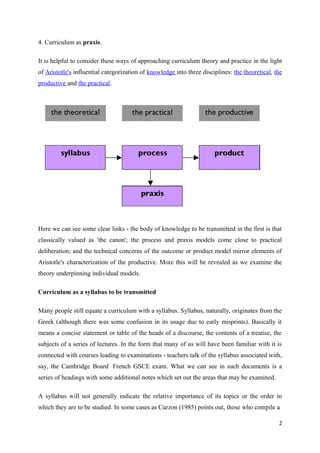
It is helpful to consider these ways of approaching curriculum theory and practice in the light
of Aristotle's influential categorization of knowledge into three disciplines: the theoretical, the
productive and the practical.
Here we can see some clear links - the body of knowledge to be transmitted in the first is that
classically valued as 'the canon'; the process and praxis models come close to practical
deliberation; and the technical concerns of the outcome or product model mirror elements of
Aristotle's characterization of the productive. More this will be revealed as we examine the
theory underpinning individual models.
Curriculum as a syllabus to be transmitted
Many people still equate a curriculum with a syllabus. Syllabus, naturally, originates from the
Greek (although there was some confusion in its usage due to early misprints). Basically it
means a concise statement or table of the heads of a discourse, the contents of a treatise, the
subjects of a series of lectures. In the form that many of us will have been familiar with it is
connected with courses leading to examinations - teachers talk of the syllabus associated with,
say, the Cambridge Board French GSCE exam. What we can see in such documents is a
series of headings with some additional notes which set out the areas that may be examined.
A syllabus will not generally indicate the relative importance of its topics or the order in
which they are to be studied. In some cases as Curzon (1985) points out, those who compile a
2
Besplatni Seminarski, Diplomski, Maturski Tekstovi i Pomoćna
Literatura.
RADOVI IZ SVIH OBLASTI, POWERPOINT PREZENTACIJE I DRUGI
EDUKATIVNI MATERIJALI.
www.diplomski-radovi.com
www.seminarskirad.org
www.magistarski.com
www.maturskiradovi.net
www.maturski.net
www.seminarskirad.info
www.maturski.org
www.essaysx.com
NA NAŠIM SAJTOVIMA MOŽETE PRONAĆI SVE, BILO DA JE TO SEMINARSKI,
DIPLOMSKI ILI MATURSKI TEKST, POWERPOINT PREZENTACIJA I DRUGI EDUKATIVNI
MATERIJAL.
ZA RAZLIKU OD OSTALIH MI VAM PRUŽAMO DA POGLEDATE SVAKI RAD, NJEGOV
SADRŽAJ I PRVE TRI STRANE TAKO DA MOŽETE TAČNO DA ODABERETE ONO ŠTO VAM U
POTPUNOSTI ODGOVARA. U BAZI SE NALAZE SEMINARSKI, DIPLOMSKI I
MATURSKI TEKSTOVI KOJE MOŽETE SKINUTI I UZ NJIHOVU POMOĆ NAPRAVITI
3
JEDINSTVEN I UNIKATAN RAD. AKO U BAZI NE NAĐETE RAD KOJI VAM JE POTREBAN, U
SVAKOM MOMENTU MOŽETE NARUČITI TEKST NA LINKU POMOĆ PRI IZRADI
TEKSTOVA I POMOĆNE LITERATURE.
4

Curriculum theory and practice.

  • 1.
    curriculum theory andpractice The organization of schooling and further education has long been associated with the idea of a curriculum. But what actually is curriculum, and how might it be conceptualized? We explore curriculum theory and practice and its relation to informal education. contents: introduction · curriculum as transmission · curriculum as product · curriculum as process · curriculum as praxis · curriculum and context · curriculum and informal education · further reading · links · how to cite this article The idea of curriculum is hardly new - but the way we understand and theorize it has altered over the years - and there remains considerable dispute as to meaning. It has its origins in the running/chariot tracks of Greece. It was, literally, a course. In Latin curriculum was a racing chariot; currere was to run. A useful starting point for us here might be the definition offered by John Kerr and taken up by Vic Kelly in his standard work on the subject. Kerr defines curriculum as, 'All the learning which is planned and guided by the school, whether it is carried on in groups or individually, inside or outside the school. (quoted in Kelly 1983: 10; see also, Kelly 1999). This gives us some basis to move on - and for the moment all we need to do is highlight two of the key features: Learning is planned and guided. We have to specify in advance what we are seeking to achieve and how we are to go about it. The definition refers to schooling. We should recognize that our current appreciation of curriculum theory and practice emerged in the school and in relation to other schooling ideas such as subject and lesson. In what follows we are going to look at four ways of approaching curriculum theory and practice: 1. Curriculum as a body of knowledge to be transmitted. 2. Curriculum as an attempt to achieve certain ends in students - product. 3. Curriculum as process. 1
  • 2.
    4. Curriculum aspraxis. It is helpful to consider these ways of approaching curriculum theory and practice in the light of Aristotle's influential categorization of knowledge into three disciplines: the theoretical, the productive and the practical. Here we can see some clear links - the body of knowledge to be transmitted in the first is that classically valued as 'the canon'; the process and praxis models come close to practical deliberation; and the technical concerns of the outcome or product model mirror elements of Aristotle's characterization of the productive. More this will be revealed as we examine the theory underpinning individual models. Curriculum as a syllabus to be transmitted Many people still equate a curriculum with a syllabus. Syllabus, naturally, originates from the Greek (although there was some confusion in its usage due to early misprints). Basically it means a concise statement or table of the heads of a discourse, the contents of a treatise, the subjects of a series of lectures. In the form that many of us will have been familiar with it is connected with courses leading to examinations - teachers talk of the syllabus associated with, say, the Cambridge Board French GSCE exam. What we can see in such documents is a series of headings with some additional notes which set out the areas that may be examined. A syllabus will not generally indicate the relative importance of its topics or the order in which they are to be studied. In some cases as Curzon (1985) points out, those who compile a 2
  • 3.
    Besplatni Seminarski, Diplomski,Maturski Tekstovi i Pomoćna Literatura. RADOVI IZ SVIH OBLASTI, POWERPOINT PREZENTACIJE I DRUGI EDUKATIVNI MATERIJALI. www.diplomski-radovi.com www.seminarskirad.org www.magistarski.com www.maturskiradovi.net www.maturski.net www.seminarskirad.info www.maturski.org www.essaysx.com NA NAŠIM SAJTOVIMA MOŽETE PRONAĆI SVE, BILO DA JE TO SEMINARSKI, DIPLOMSKI ILI MATURSKI TEKST, POWERPOINT PREZENTACIJA I DRUGI EDUKATIVNI MATERIJAL. ZA RAZLIKU OD OSTALIH MI VAM PRUŽAMO DA POGLEDATE SVAKI RAD, NJEGOV SADRŽAJ I PRVE TRI STRANE TAKO DA MOŽETE TAČNO DA ODABERETE ONO ŠTO VAM U POTPUNOSTI ODGOVARA. U BAZI SE NALAZE SEMINARSKI, DIPLOMSKI I MATURSKI TEKSTOVI KOJE MOŽETE SKINUTI I UZ NJIHOVU POMOĆ NAPRAVITI 3
  • 4.
    JEDINSTVEN I UNIKATANRAD. AKO U BAZI NE NAĐETE RAD KOJI VAM JE POTREBAN, U SVAKOM MOMENTU MOŽETE NARUČITI TEKST NA LINKU POMOĆ PRI IZRADI TEKSTOVA I POMOĆNE LITERATURE. 4