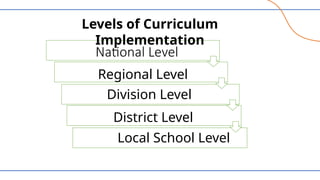
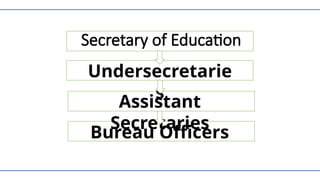
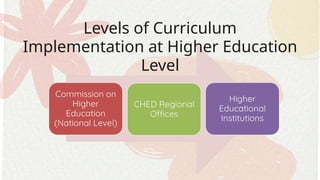
• Curriculum Implementationfocuses on the actual
application of the curriculum from the national
level down to the local school level.
Curriculum
Implementation
• It describes how various curriculum workers
perform their roles to achieve educational goals
set by the country, region, division, district, and
local schools.
• The implementation of the curriculum is
influenced by government policies and educational
philosophy.
3.
• The processis highly influenced by curriculum
workers.
Curriculum
Implementation
• People influence how the curriculum is applied.
• Not all curricula are implemented exactly as
planned due to challenges.
• Problems always arise during curriculum
implementation.
4.
• Curriculum workersare individuals responsible
for ensuring the successful implementation of
the curriculum.
WHO ARE THE CURRICULUM
WORKERS?
• According to Oliva (2005), these workers use their
expertise, creativity, and dedication to ensure
the curriculum is applied as planned.
5.
CURRICULUM WORKERS
1. Teachers
•Teachersare the most visible curriculum workers.
•Their expertise, creativity, and commitment are crucial to the
success of the curriculum.
•Teachers develop lesson plans, unit plans, yearly plans, and syllabi.
•They select teaching methods and strategies and assess students'
progress.
•Their educational background, philosophy, and teaching styles
affect curriculum implementation.
6.
CURRICULUM WORKERS
2. Principals
•Principalsare the chief academic and administrative officers of
the school.
•They provide curricular and instructional leadership and
supervision.
•They ensure that teachers follow educational goals set by the
Department of Education.
•They check lesson plans, prepare school calendars, supervise
instruction, and prepare school reports.
•They work with parents and community leaders to support school
Division Superintendents
•Chief academicofficer of each division.
•Supervise the implementation of the DepEd
curriculum, programs, and projects in the division
level for both public and private schools.
•Usually, each province or a city is considered a
division for DepEd.
Education Program Specialists
•Workat the national level or at the central offices
of the Commission on Higher Education and the
Department of Education.
•Assists the two government agencies in the
development of curriculum policies that will help
teachers and other curriculum leaders in the
implementation of the curriculum.
15.
Technical Panels andTechnical Committees
Professors and individual experts from
different disciplines and fields that assist the
Commission on Higher Education in
developing curriculum, formulating
curriculum policies, and evaluating the
compliance of higher education institutions to
CHED program standards.
National Level
• formulatingnational educational
policies;
• formulating a national basic
education plan;
• promulgating national educational
standards;
• monitoring and assessing national
22.
National Level
• undertakingnational educational research
and studies;
• enhancing the employment status,
professional competence, welfare, and
working conditions of all personnel of the
Department; and
• enhancing the total development of
learners through local and national
programs and/or projects.
Regional Level
• defininga regional educational
policy framework which reflects the
values, needs, and expectations of
the communities they serve;
• developing a regional basic
education plan;
25.
Regional Level
• developingregional educational
standards with a view toward
benchmarking for international
competitiveness;
• monitoring, evaluating, and
assessing regional learning
outcomes;
26.
Regional Level
• undertakingresearch projects and
developing and managing region-
wide projects which may be funded
through official development
assistance or other funding
agencies;
27.
Regional Level
• ensuringstrict compliance with prescribed
national criteria for the recruitment,
selection, and training of all staff in the
region and divisions;
• formulating, in coordination with the
regional development council, the budget to
support the regional educational plan which
shall take into account the educational plans of
28.
Regional Level
• determiningthe organization component
of the divisions and districts and approving
the proposed staffing pattern of all
employees in the divisions and districts.
• hiring, placing, and evaluating all
employees in the regional office, except for
the position of assistant director;
29.
Regional Level
• evaluatingall school division
superintendents and assistant division
superintendents in the region;
• planning and managing the effective and
efficient use of all personnel, physical and
fiscal resources of the regional office,
including professional staff and
development;
• managing the database and management
30.
Regional Level
• approvingthe establishment of
public and private elementary
and high schools and learning
centers.
31.
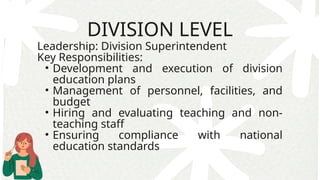
DIVISION LEVEL
Leadership: DivisionSuperintendent
Key Responsibilities:
• Development and execution of division
education plans
• Management of personnel, facilities, and
budget
• Hiring and evaluating teaching and non-
teaching staff
• Ensuring compliance with national
education standards
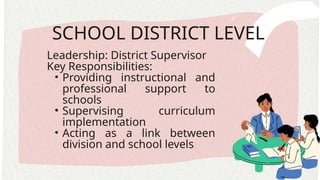
SCHOOL DISTRICT LEVEL
Leadership:District Supervisor
Key Responsibilities:
• Providing instructional and
professional support to
schools
• Supervising curriculum
implementation
• Acting as a link between
division and school levels
34.
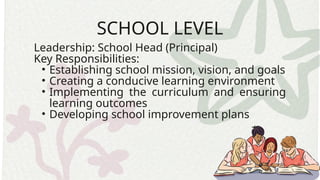
SCHOOL LEVEL
Leadership: SchoolHead (Principal)
Key Responsibilities:
• Establishing school mission, vision, and goals
• Creating a conducive learning environment
• Implementing the curriculum and ensuring
learning outcomes
• Developing school improvement plans
35.
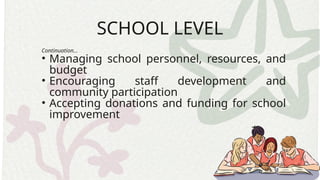
SCHOOL LEVEL
Continuation…
• Managingschool personnel, resources, and
budget
• Encouraging staff development and
community participation
• Accepting donations and funding for school
improvement
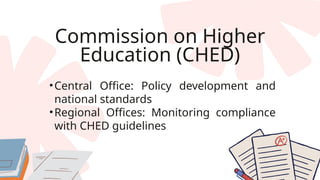
Commission on Higher
Education(CHED)
•Central Office: Policy development and
national standards
•Regional Offices: Monitoring compliance
with CHED guidelines
#8 c. Curriculum Consultant
Role:
Curriculum Consultants are experts in curriculum development, implementation, and evaluation. They provide specialized guidance and support to schools, teachers, and administrators to improve the quality of education.
* They often possess deep knowledge of specific subject areas or educational methodologies.
Responsibilities:
Curriculum Development: Assisting in the design and revision of curriculum materials to align with educational standards and best practices.
* **Teacher Training: Providing professional development for teachers on effective instructional strategies, assessment techniques, and the use of curriculum resources.
* **Curriculum Implementation:** Supporting schools in the implementation of new curriculum programs, including providing guidance on lesson planning, classroom management, and resource allocation.
* **Curriculum Evaluation:** Conducting evaluations of curriculum effectiveness and recommending improvements based on data analysis and research findings.
* **Resource Development:** Creating or recommending instructional resources, such as lesson plans, teaching guides, and assessment tools.
* **Staying Current:** Remaining up-to-date on educational research, trends, and best practices.
* **Advising:** Advising school administrators on curriculum-related matters.
#9 **d. District Supervisors**
* **Role:**
* District Supervisors are administrative leaders who oversee the operations of schools within a specific geographic district.
* They act as a liaison between the district office and the schools, ensuring that policies and procedures are followed.
* They are responsible for the overall educational performance of the schools in their district.
* **Responsibilities:**
* **School Oversight:** Monitoring the performance of schools and ensuring compliance with district and state regulations.
* **Administrative Support:** Providing administrative support to school principals and teachers, including guidance on budgeting, staffing, and facilities management.
* **Teacher Evaluation:** Conducting or overseeing teacher evaluations and providing feedback for professional growth.
* **Policy Implementation:** Implementing and enforcing district policies and procedures.
* **Communication:** Communicating with school administrators, teachers, parents, and community members.
* **Resource Allocation:** Managing and allocating district resources to support school needs.
* **Problem Solving:** Addressing and resolving issues that arise in schools, such as student discipline, teacher conflicts, or resource shortages.
#10 **e. Education Supervisors**
* **Role:**
* Education Supervisors have a broad role that can vary depending on the specific educational system.
* Generally, they are responsible for overseeing and improving the quality of education within a specific area, which could be a subject area, a grade level, or a group of schools.
* Their role often overlaps with both curriculum consultants and district supervisors.
* **Responsibilities:**
* **Instructional Leadership:** Providing leadership and guidance to teachers and administrators on effective instructional practices.
* **Curriculum Oversight:** Monitoring the implementation of curriculum and ensuring alignment with educational standards.
* **Teacher Development:** Providing professional development and support to teachers to improve their instructional skills.
* **Program Evaluation:** Evaluating the effectiveness of educational programs and recommending improvements.
* **Data Analysis:** Analyzing student performance data to identify areas for improvement.
* **School Improvement:** Supporting schools in developing and implementing school improvement plans.
* **Monitoring educational standards:** Ensuring that educational standards are being met throughout their area of supervision.
* **Often education supervisors are also responsible for the monitoring of special programs.**