Kindergarten 2
Curriculum Guide
2020-2021
T: +65 6955 1430 | www.nlcssingapore.sg
@nlcssg
CPE Registration Number 201621489R | Period of Registration 2019-07-25 to 2023-07-24
@NLCS_Singapore @nlcs.sing
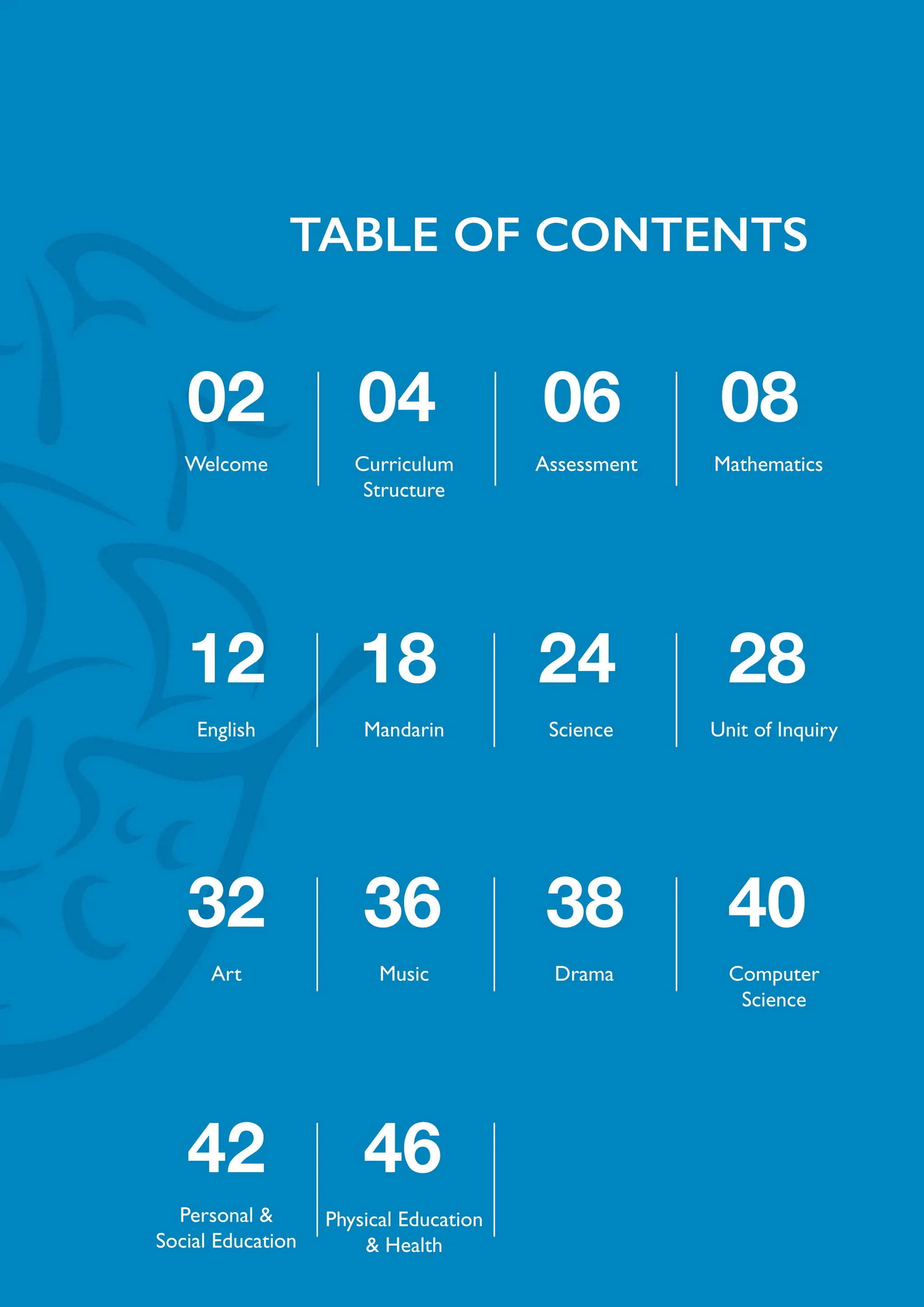
02
Welcome Curriculum
Structure
Assessment Mathematics
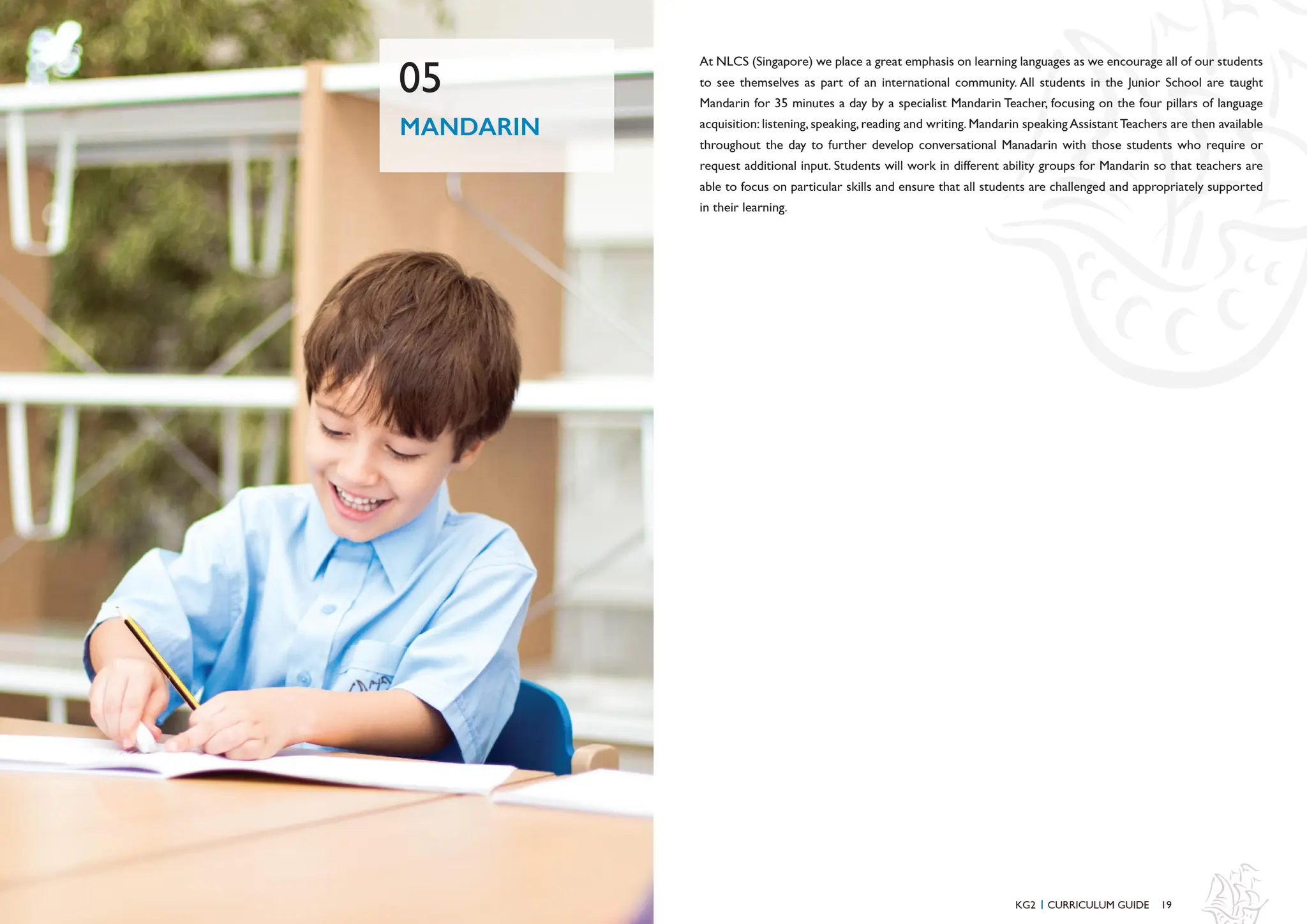
04 06 08
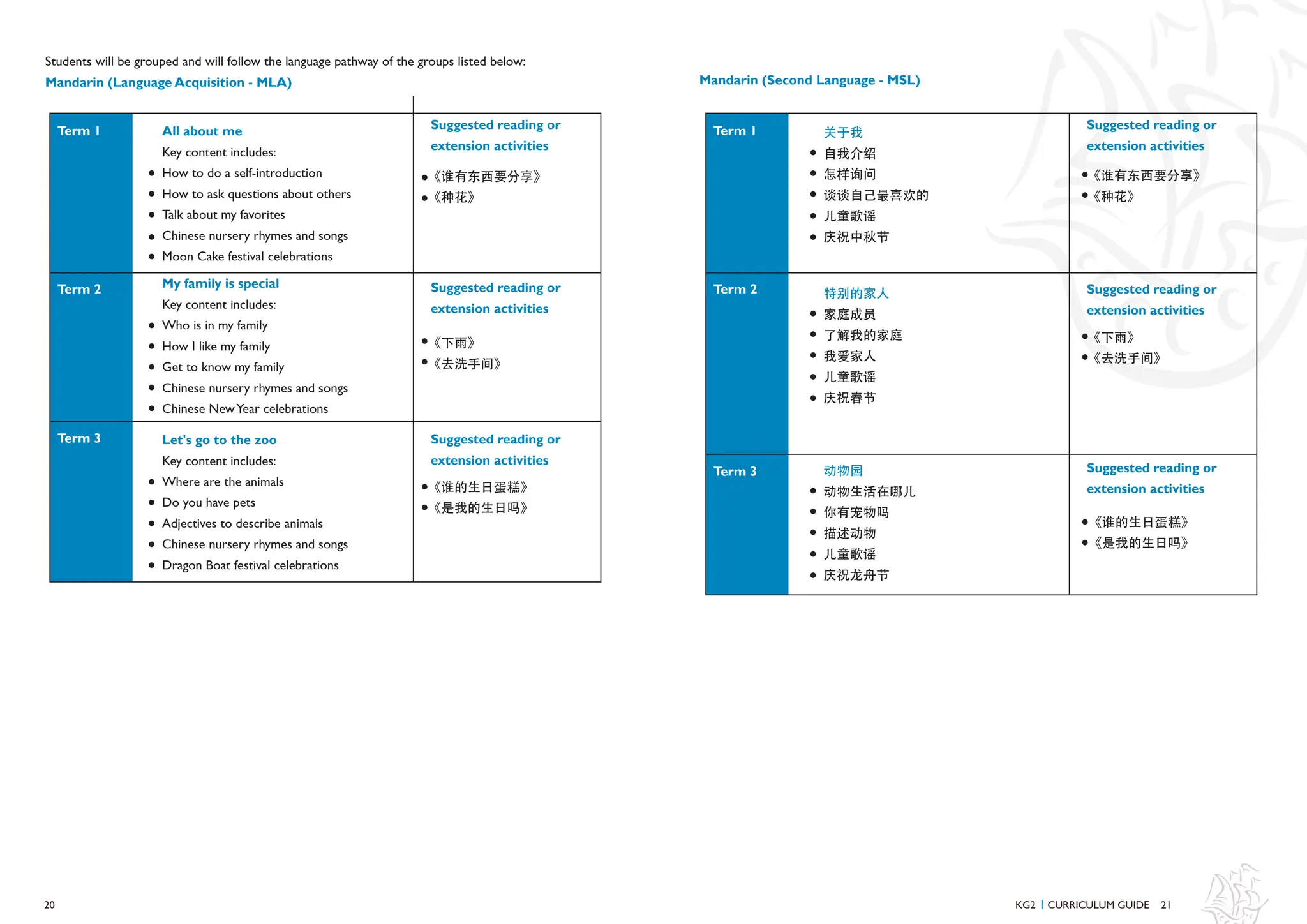
18
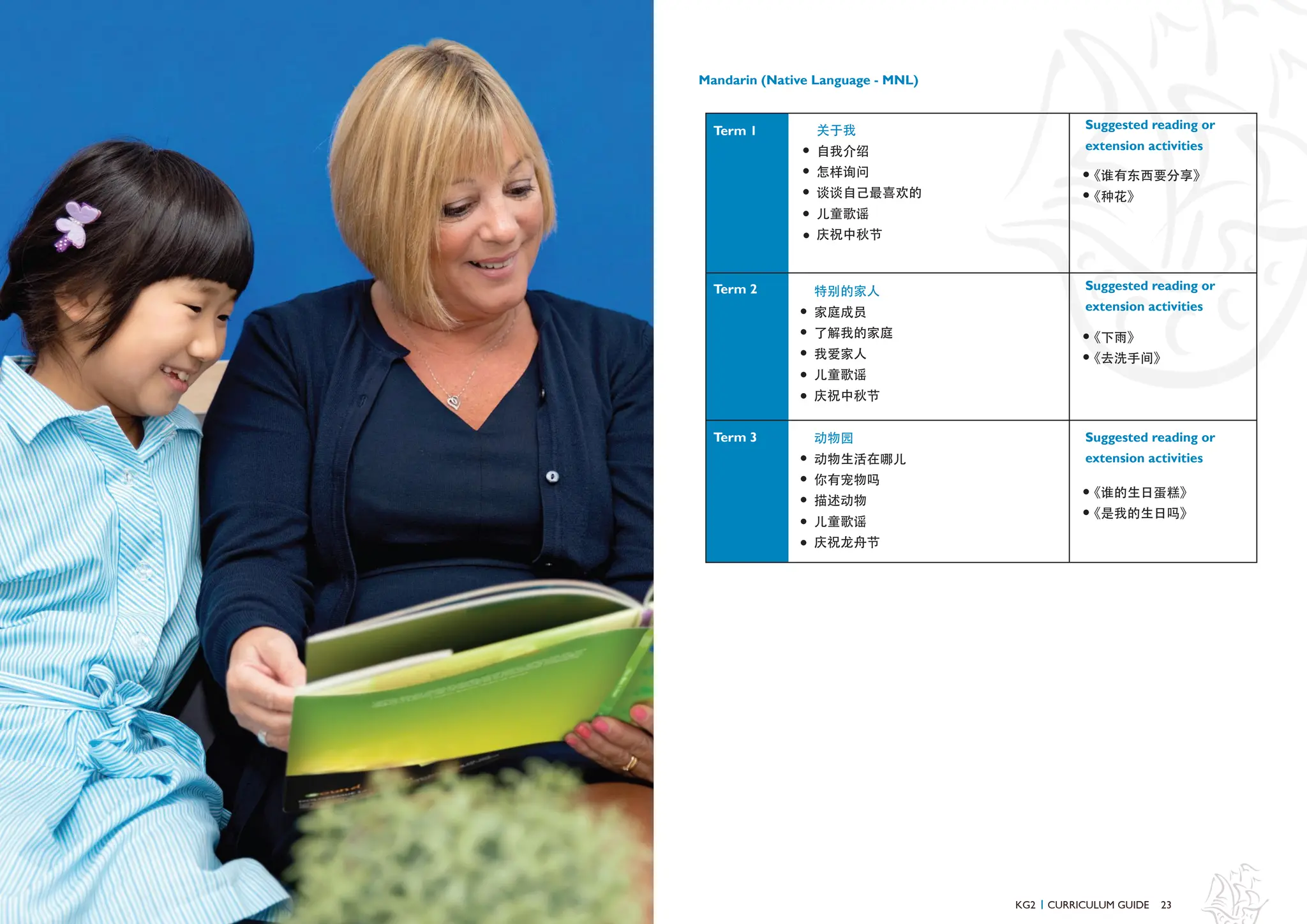
Mandarin Science
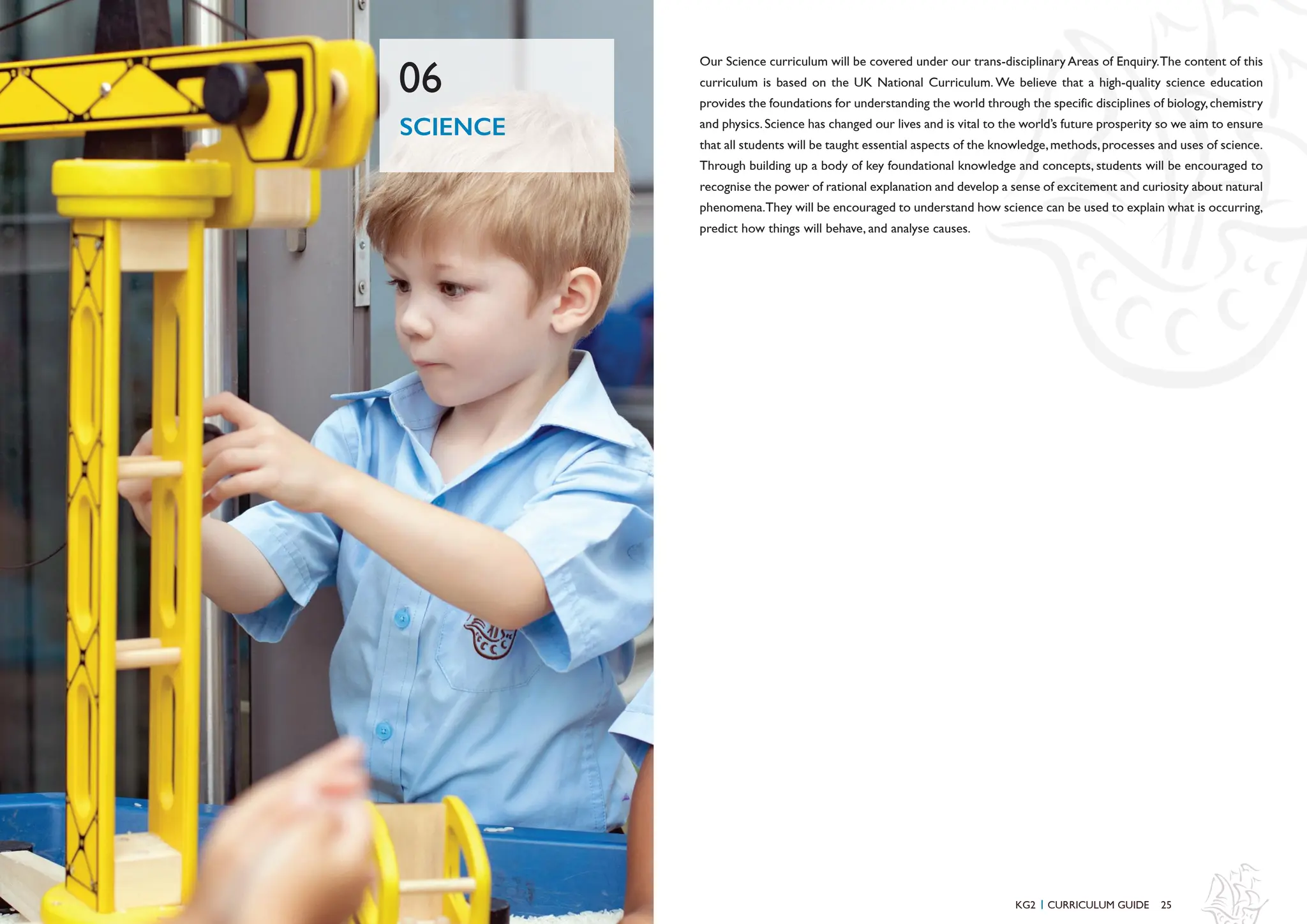
24
Unit of Inquiry
28
Computer
Science
40
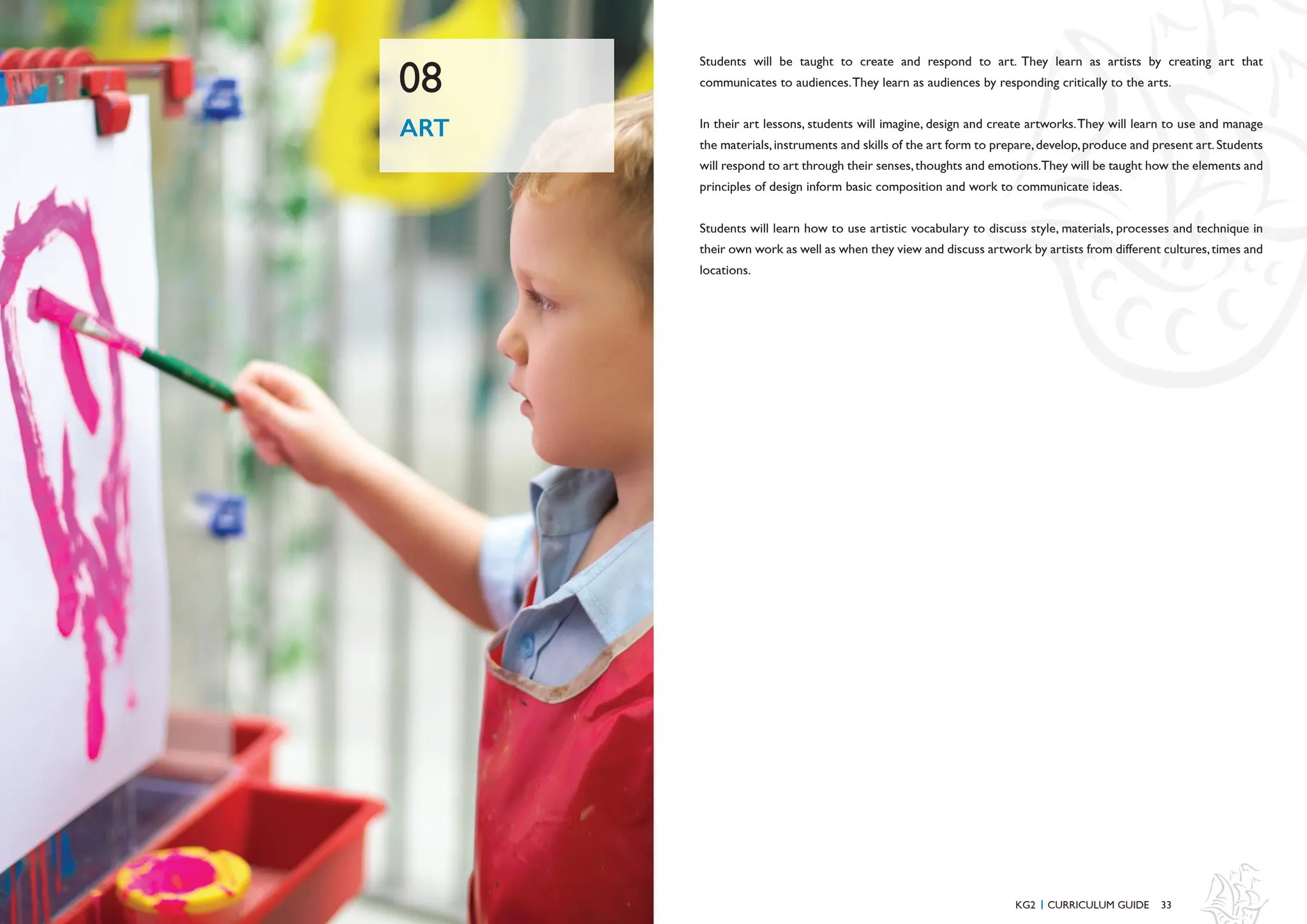
12
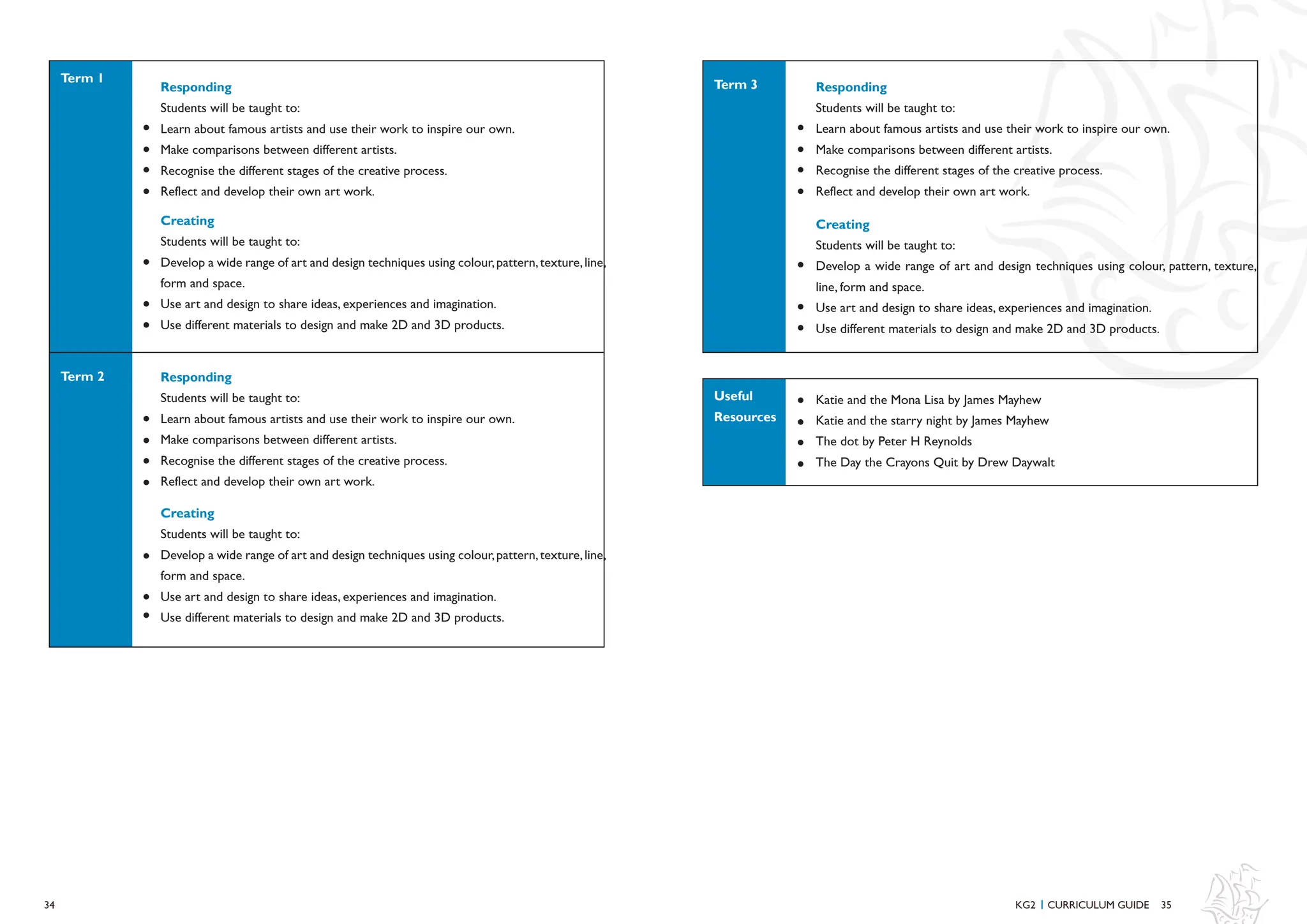
English
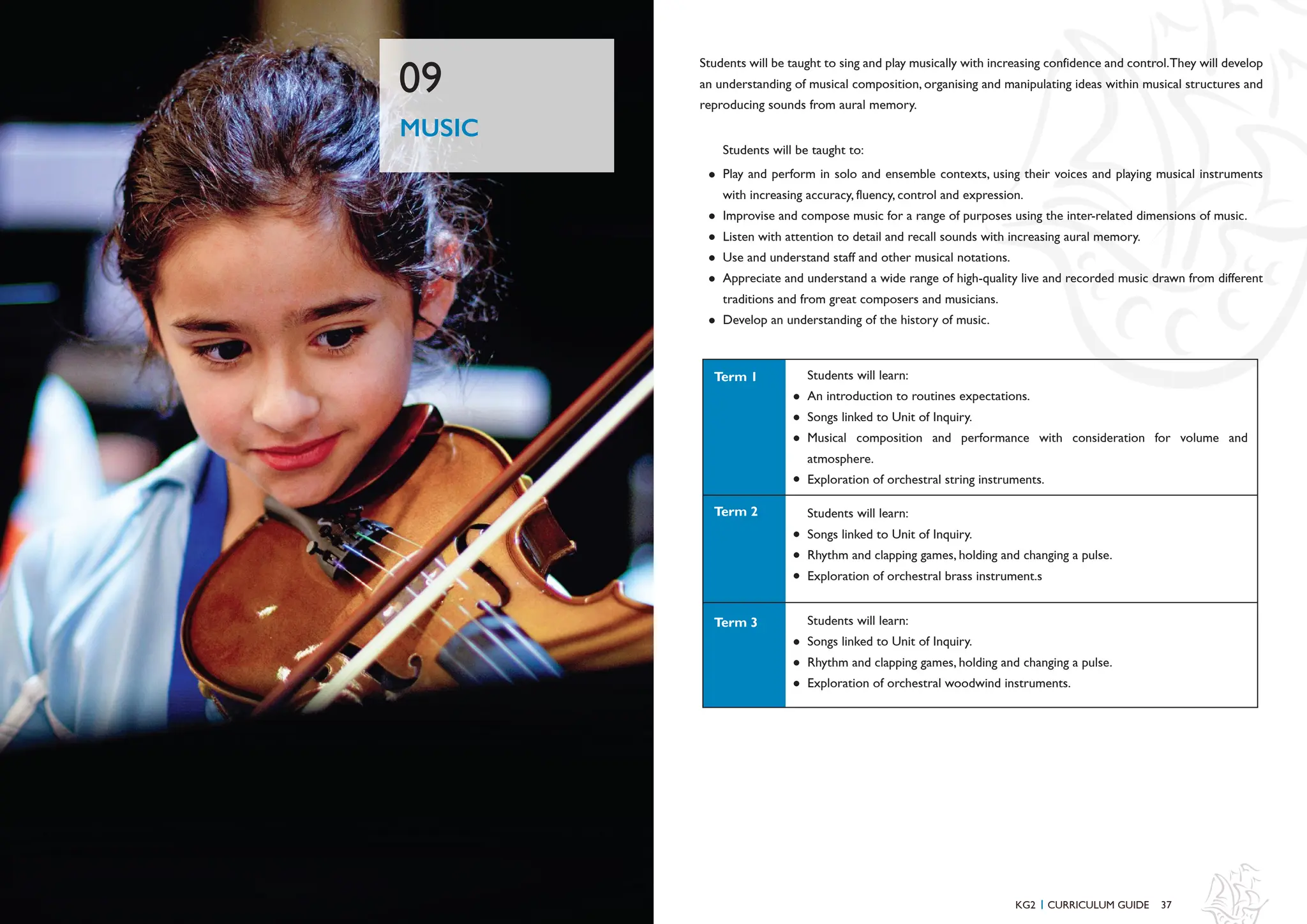
36
Music Drama
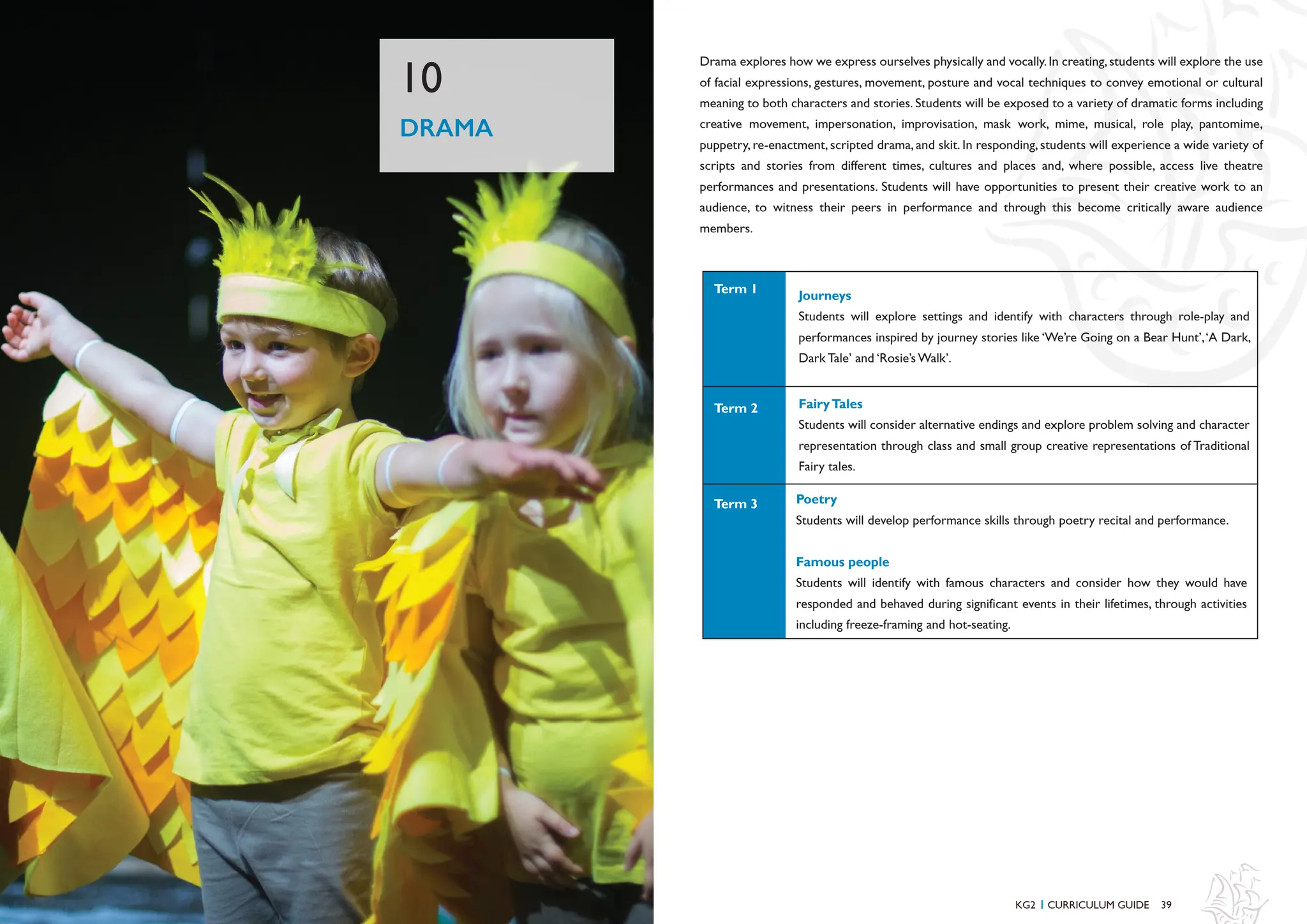
38
32
Art
46
Physical Education
& Health
42
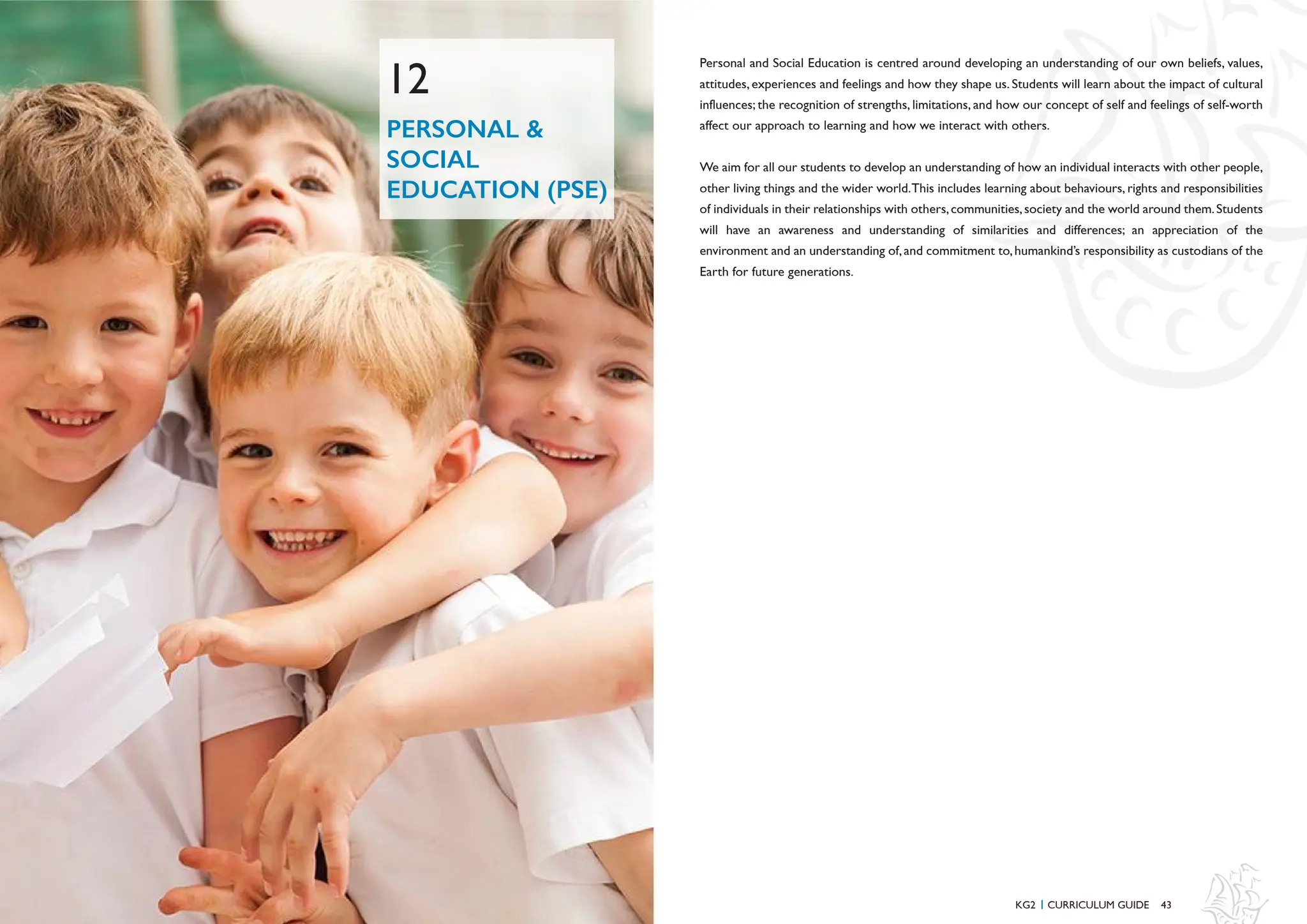
Personal &
Social Education
TABLE OF CONTENTS
Welcome to the Kindergarten 2 Curriculum Guide.The purpose of this booklet is to expand upon the content of
its counterpart, Junior School Curriculum Fundamentals, with detailed information on the curriculum structure,
content and assessment criteria for Kindergarten 2.
Students in Kindergarten 2 will receive subject specific teaching in Music, Physical Education & Health and Science
in order that they benefit from, and are inspired by, experts in these areas of the curriculum.They will also receive
a lesson a day of Mandarin teaching, taught by our Mandarin Assistant Teachers. A scholarly approach is modelled
in all subjects, where students are encouraged to be curious and to ask questions in order to further develop their
knowledge and understanding and to take their learning above and beyond the curriculum.
While every member of staff has the duty and responsibility of pastoral care for all of our students, it is your child’s
class teacher who is your first point of contact in the school. Good communication between school and home is
vital if we are to provide any additional support that students may require academically or pastorally.We seek to
ensure that every student receives the care and support needed in order to grow and learn to their full potential
both emotionally and intellectually. Communication between school and home therefore continues to be of the
utmost importance so that we can work together to ensure the best outcomes for our students and so we would
encourage you to liaise closely with your child’s class teacher through the Communication book.
In Kindergarten 2,students are still learning their phonics and developing their sight vocabulary.We will be teaching
phonics using ‘Read,Write, Inc’ and sending home books which are part of that scheme. It is important at this age
that parents hear their child read every day.It is also important that students enjoy listening to stories beyond their
reading capabilities and so we would encourage you to read to your child in order to discuss character, language,
themes and plot development to develop imagination, comprehension skills and to explore new vocabulary.
In Kindergarten 2 the students will enjoy a longer day which incorporates our extensive CCA programme. One of
the pillars of the NLCS ethos is the provision of a wide range of activities which will encourage students to discover
new interests, develop their talents and further embed ‘soft skills.We consider this to be a vital element in each
student’s education and will, with you, seek to widen their opportunities and experiences.
We are very much looking forward to welcoming your child to Kindergarten 2 at NLCS (Singapore) and are excited
about the academic journey which they are about to begin.We will be working closely with you in sharing successes
and discussing next steps in order to ensure that your child benefits from an exceptional educational experience
with us and not only runs their own race, but exceeds their own expectations of their capabilities and develops a
life-long passion for learning.
WELCOME
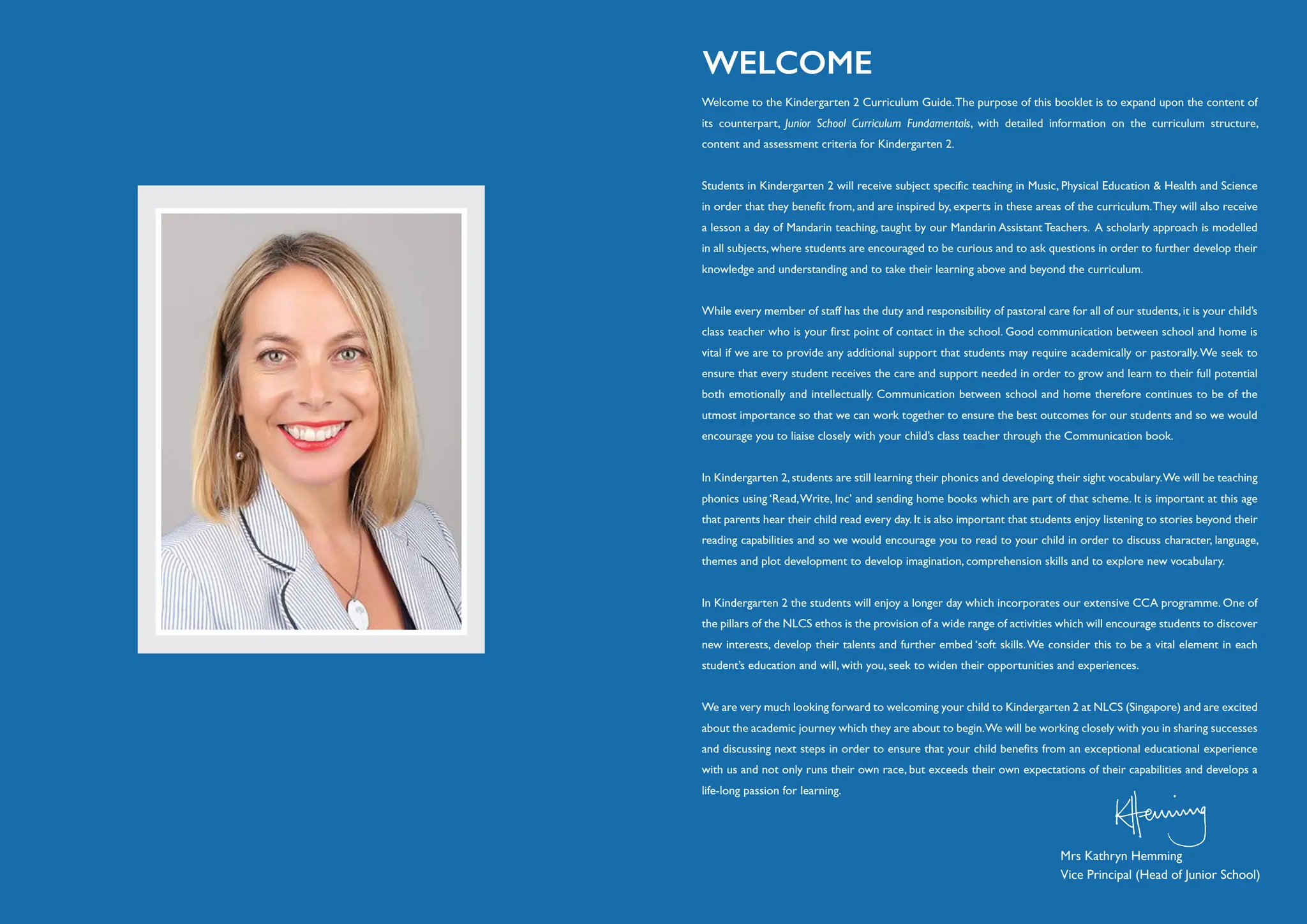
Mrs Kathryn Hemming
Vice Principal (Head of Junior School)
CURRICULUM
STRUCTURE
01
05
At NLCS (Singapore), teachers work collaboratively when planning in order to ensure that each class is
following the same curriculum in their Grade, while allowing for interests and personalised learning
specific to each class.An NLCS (Singapore) education is broad, balanced and academically rigorous.The
number and range of subjects,as well as the amount of time dedicated to each,has been carefully designed
to promote outstanding progress for every child, in every area.
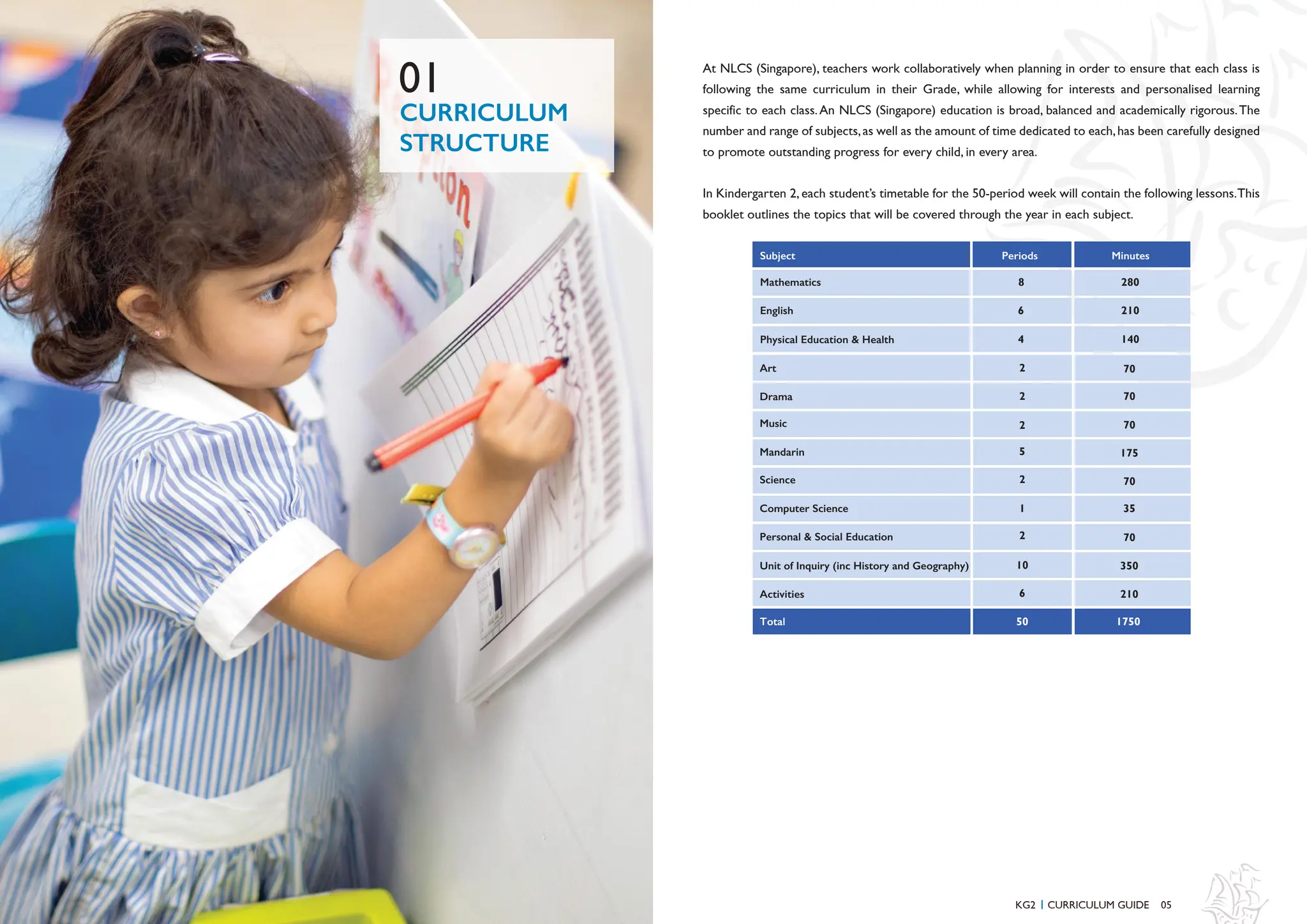
In Kindergarten 2, each student’s timetable for the 50-period week will contain the following lessons.This
booklet outlines the topics that will be covered through the year in each subject.
Subject
Mathematics
English
Physical Education & Health
Art
Drama
Music
Mandarin
Science
Computer Science
Personal & Social Education
Unit of Inquiry (inc History and Geography)
Total
Periods Minutes
8
6
4
280
210
140
2
2
2
5
2
1
2
10
50 1750
70
70
70
175
70
70
350
Activities 6 210
35
KG2 CURRICULUM GUIDE
I
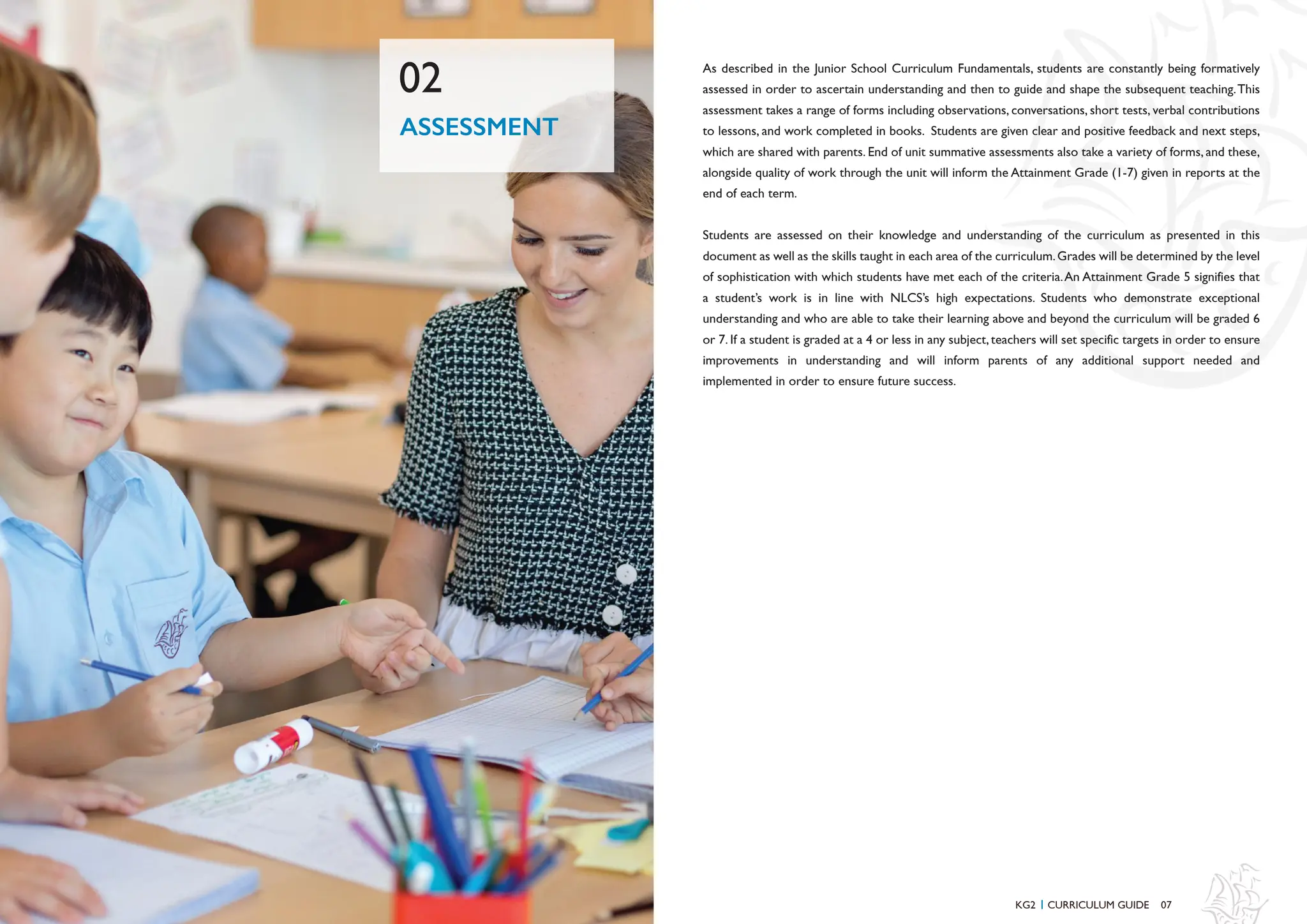
As described in the Junior School Curriculum Fundamentals, students are constantly being formatively
assessed in order to ascertain understanding and then to guide and shape the subsequent teaching.This
assessment takes a range of forms including observations, conversations, short tests, verbal contributions
to lessons, and work completed in books. Students are given clear and positive feedback and next steps,
which are shared with parents. End of unit summative assessments also take a variety of forms, and these,
alongside quality of work through the unit will inform the Attainment Grade (1-7) given in reports at the
end of each term.
Students are assessed on their knowledge and understanding of the curriculum as presented in this
document as well as the skills taught in each area of the curriculum.Grades will be determined by the level
of sophistication with which students have met each of the criteria.An Attainment Grade 5 signifies that
a student’s work is in line with NLCS’s high expectations. Students who demonstrate exceptional
understanding and who are able to take their learning above and beyond the curriculum will be graded 6
or 7. If a student is graded at a 4 or less in any subject, teachers will set specific targets in order to ensure
improvements in understanding and will inform parents of any additional support needed and
implemented in order to ensure future success.
ASSESSMENT
02
07
KG2 CURRICULUM GUIDE
I
The study of mathematics is a fundamental part of a balanced education and also provides the foundational
knowledge and skills for many other subjects including science and computer science. As mathematics
progresses through the school,we require our students to be critical thinkers,using their grasp of the first
principles of the discipline to find new and inventive ways of solving authentic problems. Our Junior
School curriculum is centred around developing the foundational skills and knowledge needed for future
success and we organise our content into five broad areas:
Number
Pattern and function
Shape and space
Measurement
Data handling
1.
2.
3.
4.
5.
09
MATHEMATICS
02
KG2 CURRICULUM GUIDE
I
The skills associated with using and applying mathematics are embedded throughout the curriculum.
Number
Students will be confident with recognising and using number bonds within 20
Students will apply this when completing addition and subtraction within 20.
Students will learn to partition numbers beyond 20 into tens and one.
Students will recognise numbers to 100 and be able to count then in sequence and
be able to read and write them in numbers and words.
Shape and space
Students will develop confidence in describing and contrasting the properties of
basic 2D and 3D shapes using mathematical vocabulary.
Ongoing
Mental Maths, Problem-Solving, Extension Tasks.
Measurement
Students will use ordinal numbers and time vocabulary to sequence events.
Data handling
Students will understand data representation through picture graphs.
Students will read and interpret data.
Number
Students will be introduced to fractions, starting with halves and quarters and
recognising them as equal parts of a whole object.
Students will use a variety of representations to solve one-step multiplication and
division problems including concrete objects, pictorial representations and arrays.
Shape and space
Students will describe the position, direction and movement in relation to quarter,
half and whole turns.
Ongoing
Mental Maths, Problem-Solving, Extension Tasks.
Measurement
Students will develop confidence in using seconds, minutes and hours to tell the
time.
Data handling
Students will be confident in completing and creating picture graphs.
Ongoing
Mental Maths, Problem-Solving, Extension Tasks.
Data handling
Students will build on skills developed in the previous term to interpret picture
graphs in order to solve problems.
Number
Students will be writing and solving multiplication and division number sentences.
Shape and space
Students will develop confidence in describing and contrasting the properties of
less common 2D and 3D shapes using mathematical vocabulary.
Measurement
Students will solve problems involving length, mass and capacity using mathematical
vocabulary and symbols.
Students will use number skills to count money to $1 and be able to solve problems
involving money.
Students will recognise and use language related to dates.
www.topmarks.co.uk
https://www.bbc.co.uk/bitesize/primary
www.prodigygames.com
https://www.j2e.com
www.whiterosemaths.co.uk
11
10 KG2 CURRICULUM GUIDE
I
Term 2
Term 1 Term 3
Useful
Websites
13
12
In our English curriculum we seek to excite and engage students through exposure to and exploration of
a wide range of both well-known and modern texts.We aim to foster a life-long love of reading amongst
our student community so that they can develop their vocabulary; understand how to use punctuation,
structure and language effectively; develop empathy; and learn about real and fictional worlds.This starts
with by using Read Write Inc. phonics to teach children to read accurately and fluently with good
comprehension.They learn to form each letter, spell correctly, and compose their ideas step-by-step.
Language is a transdisciplinary element throughout the curriculum and the skills developed throughout
the Junior School will allow for discussion, information processing, problem solving, researching and
presenting across all subjects. We seek to nurture an appreciation of the richness of language, by
encouraging familiarity with world classic texts, traditional tales and multi-cultural materials through a
literature-based approach to learning language.
The four areas in which students’ achievement in English is assessed are:
Listening and speaking
Viewing and presenting
Reading
Writing
A.
B.
C.
D.
ENGLISH
04
KG2 CURRICULUM GUIDE
I
Students will be assessed in all of these areas and the sophistication they display in these areas in both
English lessons and across the curriculum will determine their grading to be reported to parents.
15
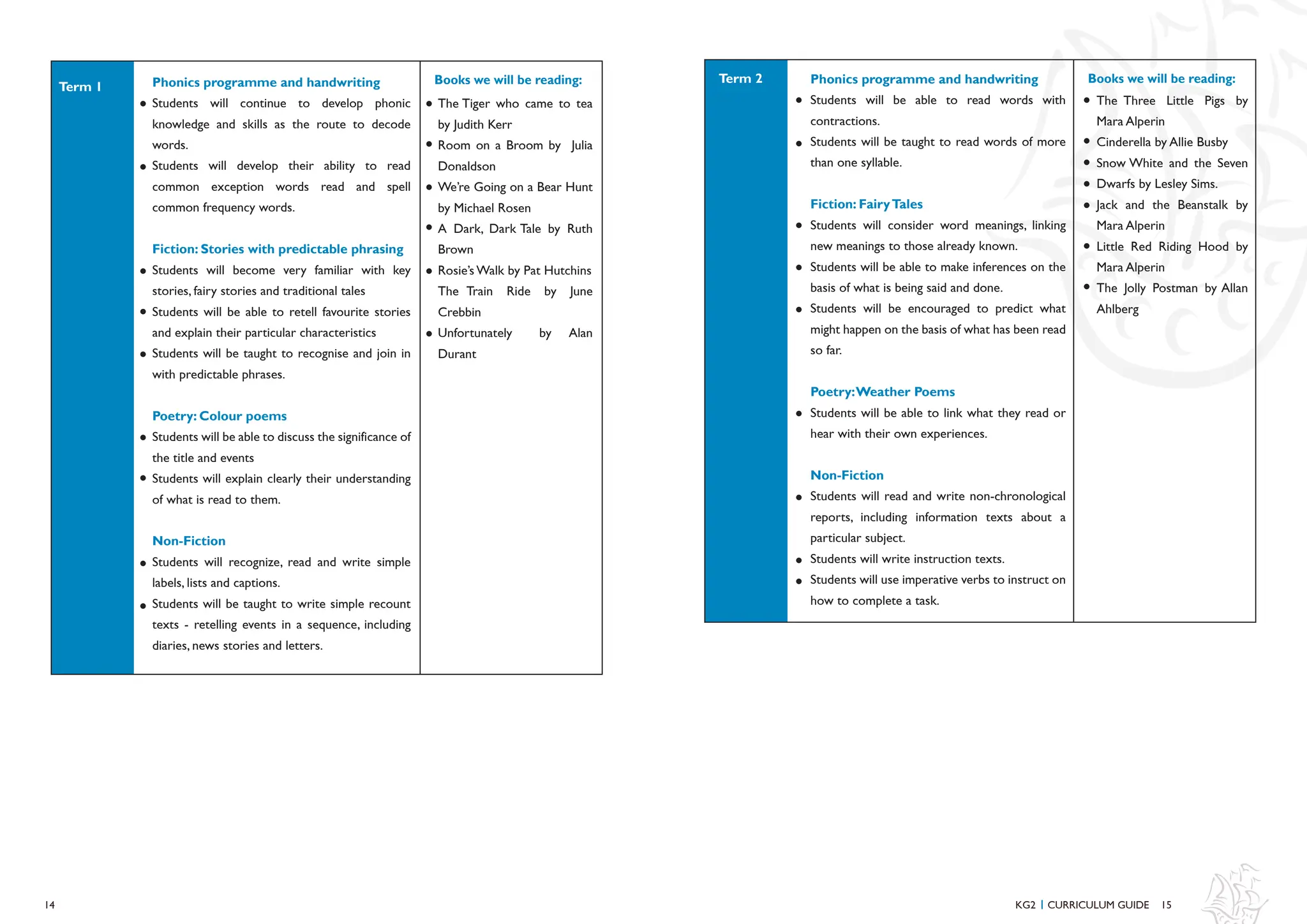
Phonics programme and handwriting
Students will continue to develop phonic
knowledge and skills as the route to decode
words.
Students will develop their ability to read
common exception words read and spell
common frequency words.
Fiction: Stories with predictable phrasing
Students will become very familiar with key
stories, fairy stories and traditional tales
Students will be able to retell favourite stories
and explain their particular characteristics
Students will be taught to recognise and join in
with predictable phrases.
Poetry: Colour poems
Students will be able to discuss the significance of
the title and events
Students will explain clearly their understanding
of what is read to them.
Non-Fiction
Students will recognize, read and write simple
labels, lists and captions.
Students will be taught to write simple recount
texts - retelling events in a sequence, including
diaries, news stories and letters.
The Tiger who came to tea
by Judith Kerr
Room on a Broom by Julia
Donaldson
We’re Going on a Bear Hunt
by Michael Rosen
A Dark, Dark Tale by Ruth
Brown
Rosie’s Walk by Pat Hutchins
The Train Ride by June
Crebbin
Unfortunately by Alan
Durant
Phonics programme and handwriting
Students will be able to read words with
contractions.
Students will be taught to read words of more
than one syllable.
Fiction: FairyTales
Students will consider word meanings, linking
new meanings to those already known.
Students will be able to make inferences on the
basis of what is being said and done.
Students will be encouraged to predict what
might happen on the basis of what has been read
so far.
Poetry:Weather Poems
Students will be able to link what they read or
hear with their own experiences.
Non-Fiction
Students will read and write non-chronological
reports, including information texts about a
particular subject.
Students will write instruction texts.
Students will use imperative verbs to instruct on
how to complete a task.
The Three Little Pigs by
Mara Alperin
Cinderella by Allie Busby
Snow White and the Seven
Dwarfs by Lesley Sims.
Jack and the Beanstalk by
Mara Alperin
Little Red Riding Hood by
Mara Alperin
The Jolly Postman by Allan
Ahlberg
14 KG2 CURRICULUM GUIDE
I
Term 1
Books we will be reading: Term 2 Books we will be reading:
17
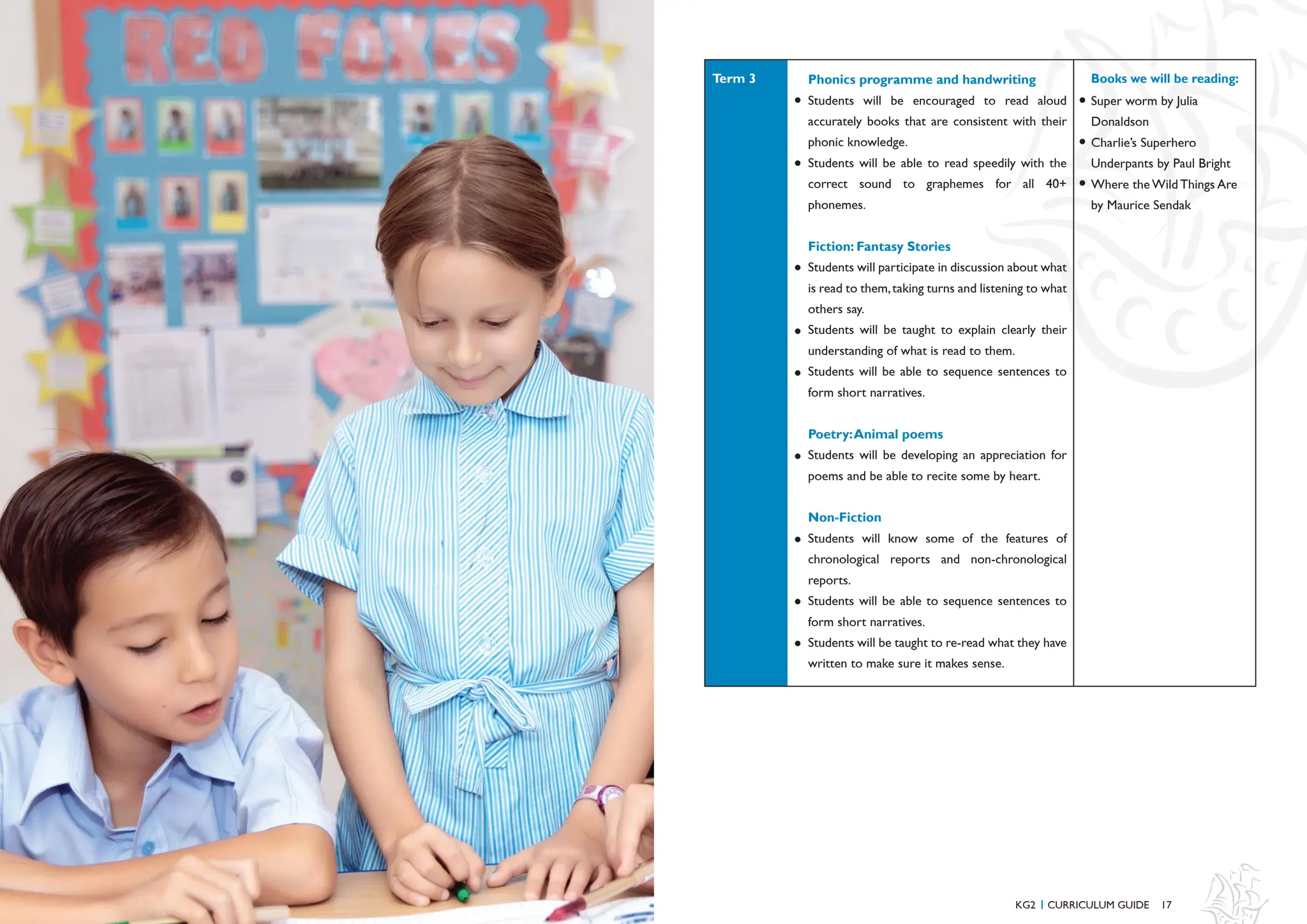
Phonics programme and handwriting
Students will be encouraged to read aloud
accurately books that are consistent with their
phonic knowledge.
Students will be able to read speedily with the
correct sound to graphemes for all 40+
phonemes.
Fiction: Fantasy Stories
Students will participate in discussion about what
is read to them,taking turns and listening to what
others say.
Students will be taught to explain clearly their
understanding of what is read to them.
Students will be able to sequence sentences to
form short narratives.
Poetry:Animal poems
Students will be developing an appreciation for
poems and be able to recite some by heart.
Non-Fiction
Students will know some of the features of
chronological reports and non-chronological
reports.
Students will be able to sequence sentences to
form short narratives.
Students will be taught to re-read what they have
written to make sure it makes sense.
Super worm by Julia
Donaldson
Charlie’s Superhero
Underpants by Paul Bright
Where the Wild Things Are
by Maurice Sendak
KG2 CURRICULUM GUIDE
I
Books we will be reading:
Term 3
19
At NLCS (Singapore) we place a great emphasis on learning languages as we encourage all of our students
to see themselves as part of an international community. All students in the Junior School are taught
Mandarin for 35 minutes a day by a specialist Mandarin Teacher, focusing on the four pillars of language
acquisition: listening, speaking, reading and writing. Mandarin speaking AssistantTeachers are then available
throughout the day to further develop conversational Manadarin with those students who require or
request additional input. Students will work in different ability groups for Mandarin so that teachers are
able to focus on particular skills and ensure that all students are challenged and appropriately supported
in their learning.
MANDARIN
05
KG2 CURRICULUM GUIDE
I
21
Students will be grouped and will follow the language pathway of the groups listed below:
Mandarin (Language Acquisition - MLA)
All about me
Key content includes:
How to do a self-introduction
How to ask questions about others
Talk about my favorites
Chinese nursery rhymes and songs
Moon Cake festival celebrations
《谁有东西要分享》
《种花》
My family is special
Key content includes:
Who is in my family
How I like my family
Get to know my family
Chinese nursery rhymes and songs
Chinese NewYear celebrations
《下雨》
《去洗手间》
Let's go to the zoo
Key content includes:
Where are the animals
Do you have pets
Adjectives to describe animals
Chinese nursery rhymes and songs
Dragon Boat festival celebrations
《谁的生日蛋糕》
《是我的生日吗》
Mandarin (Second Language - MSL)
关于我
自我介绍
怎样询问
谈谈自己最喜欢的
儿童歌谣
庆祝中秋节
《谁有东西要分享》
《种花》
特别的家人
家庭成员
了解我的家庭
我爱家人
儿童歌谣
庆祝春节
动物园
动物生活在哪儿
你有宠物吗
描述动物
儿童歌谣
庆祝龙舟节
《下雨》
《去洗手间》
《谁的生日蛋糕》
《是我的生日吗》
KG2 CURRICULUM GUIDE
I
20
Term 1
Term 3
Term 2
Suggested reading or
extension activities
Suggested reading or
extension activities
Suggested reading or
extension activities
Term 1
Term 3
Term 2
Suggested reading or
extension activities
Suggested reading or
extension activities
Suggested reading or
extension activities
23
22
Mandarin (Native Language - MNL)
关于我
自我介绍
怎样询问
谈谈自己最喜欢的
儿童歌谣
庆祝中秋节
《谁有东西要分享》
《种花》
特别的家人
家庭成员
了解我的家庭
我爱家人
儿童歌谣
庆祝中秋节
动物园
动物生活在哪儿
你有宠物吗
描述动物
儿童歌谣
庆祝龙舟节
《下雨》
《去洗手间》
《谁的生日蛋糕》
《是我的生日吗》
KG2 CURRICULUM GUIDE
I
Term 1
Term 3
Term 2
Suggested reading or
extension activities
Suggested reading or
extension activities
Suggested reading or
extension activities
25
Our Science curriculum will be covered under our trans-disciplinary Areas of Enquiry.The content of this
curriculum is based on the UK National Curriculum. We believe that a high-quality science education
provides the foundations for understanding the world through the specific disciplines of biology,chemistry
and physics.Science has changed our lives and is vital to the world’s future prosperity so we aim to ensure
that all students will be taught essential aspects of the knowledge,methods,processes and uses of science.
Through building up a body of key foundational knowledge and concepts, students will be encouraged to
recognise the power of rational explanation and develop a sense of excitement and curiosity about natural
phenomena.They will be encouraged to understand how science can be used to explain what is occurring,
predict how things will behave, and analyse causes.
SCIENCE
06
KG2 CURRICULUM GUIDE
I
27
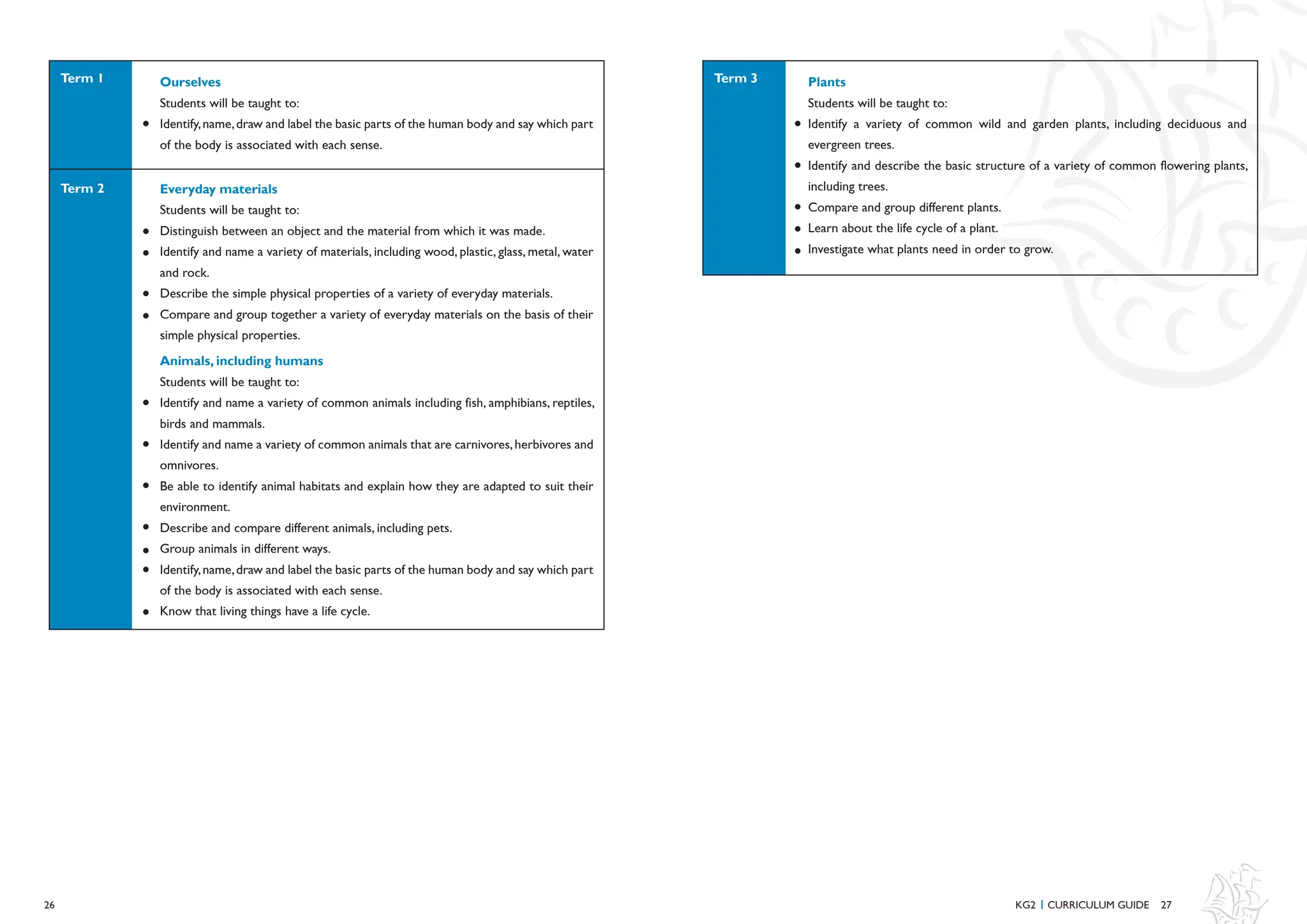
Ourselves
Students will be taught to:
Identify,name,draw and label the basic parts of the human body and say which part
of the body is associated with each sense.
Plants
Students will be taught to:
Identify a variety of common wild and garden plants, including deciduous and
evergreen trees.
Identify and describe the basic structure of a variety of common flowering plants,
including trees.
Compare and group different plants.
Learn about the life cycle of a plant.
Investigate what plants need in order to grow.
Everyday materials
Students will be taught to:
Distinguish between an object and the material from which it was made.
Identify and name a variety of materials, including wood, plastic, glass, metal, water
and rock.
Describe the simple physical properties of a variety of everyday materials.
Compare and group together a variety of everyday materials on the basis of their
simple physical properties.
Animals, including humans
Students will be taught to:
Identify and name a variety of common animals including fish, amphibians, reptiles,
birds and mammals.
Identify and name a variety of common animals that are carnivores,herbivores and
omnivores.
Be able to identify animal habitats and explain how they are adapted to suit their
environment.
Describe and compare different animals, including pets.
Group animals in different ways.
Identify,name,draw and label the basic parts of the human body and say which part
of the body is associated with each sense.
Know that living things have a life cycle.
26 KG2 CURRICULUM GUIDE
I
Term 1 Term 3
Term 2
29
28
The unit of inquiry encourages students to understand and respect the world around them by providing
the opportunity for in-depth study across a variety of diverse topics. Content is focused on the traditional
disciplines of history and geography, but also incorporates aspects of the social sciences to ensure that
students develop a broadening perspective on how they view the world. Unit of inquiry topics will often
draw links with other curriculum areas as we draw attention to the disciplinary connections that are so
important in appreciating the human story.
Students will be assessed on how confidently and accurately they demonstrate knowledge and
understanding of the curriculum covered in their oral contributions,questions and written work.They will
be developing the following skills:
Whilst covering these skills and gaining knowledge about the world around them, students will consider
and explore the following statements:
Formulate and ask questions about the past, the future, places and society
Use and analyse evidence from a variety of historical, geographical and societal sources
Orientate in relation to place and time
Identify roles, rights and responsibilities in society
Assess the accuracy, validity and possible bias of sources
Awareness of our characteristics, abilities and interests informs our learning and development
Homes reflect cultural influences and local conditions
Celebration and traditions are expressions of shared beliefs and values
All living things adapt to their environment
Physical and virtual public spaces provide people with opportunities to make connections and establish
a sense of community
People interact with, use and value local environments in different ways
A.
B.
C.
D.
E.
UNIT OF
INQUIRY
07
KG2 CURRICULUM GUIDE
I
31
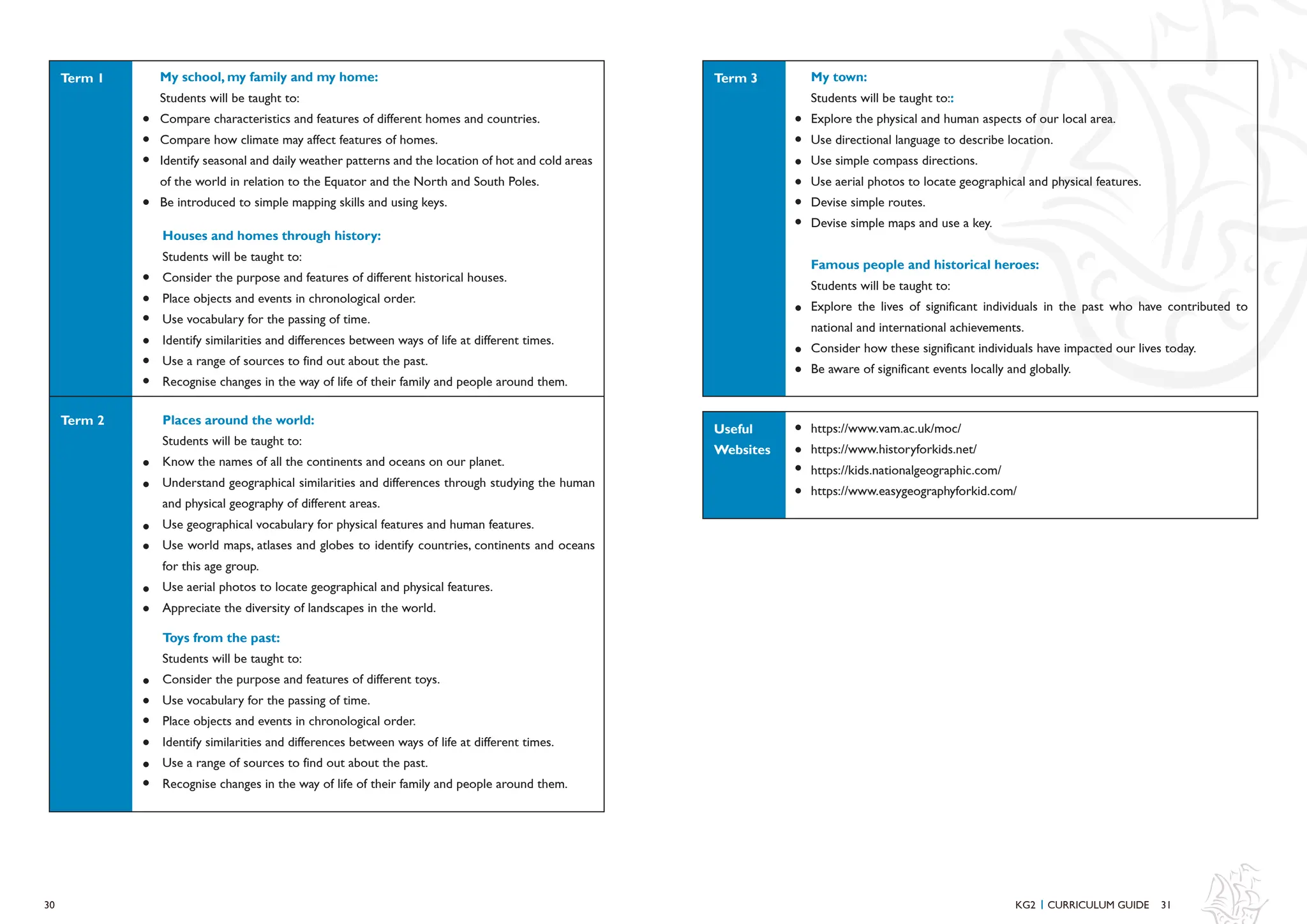
My school, my family and my home:
Students will be taught to:
Compare characteristics and features of different homes and countries.
Compare how climate may affect features of homes.
Identify seasonal and daily weather patterns and the location of hot and cold areas
of the world in relation to the Equator and the North and South Poles.
Be introduced to simple mapping skills and using keys.
Houses and homes through history:
Students will be taught to:
Consider the purpose and features of different historical houses.
Place objects and events in chronological order.
Use vocabulary for the passing of time.
Identify similarities and differences between ways of life at different times.
Use a range of sources to find out about the past.
Recognise changes in the way of life of their family and people around them.
Places around the world:
Students will be taught to:
Know the names of all the continents and oceans on our planet.
Understand geographical similarities and differences through studying the human
and physical geography of different areas.
Use geographical vocabulary for physical features and human features.
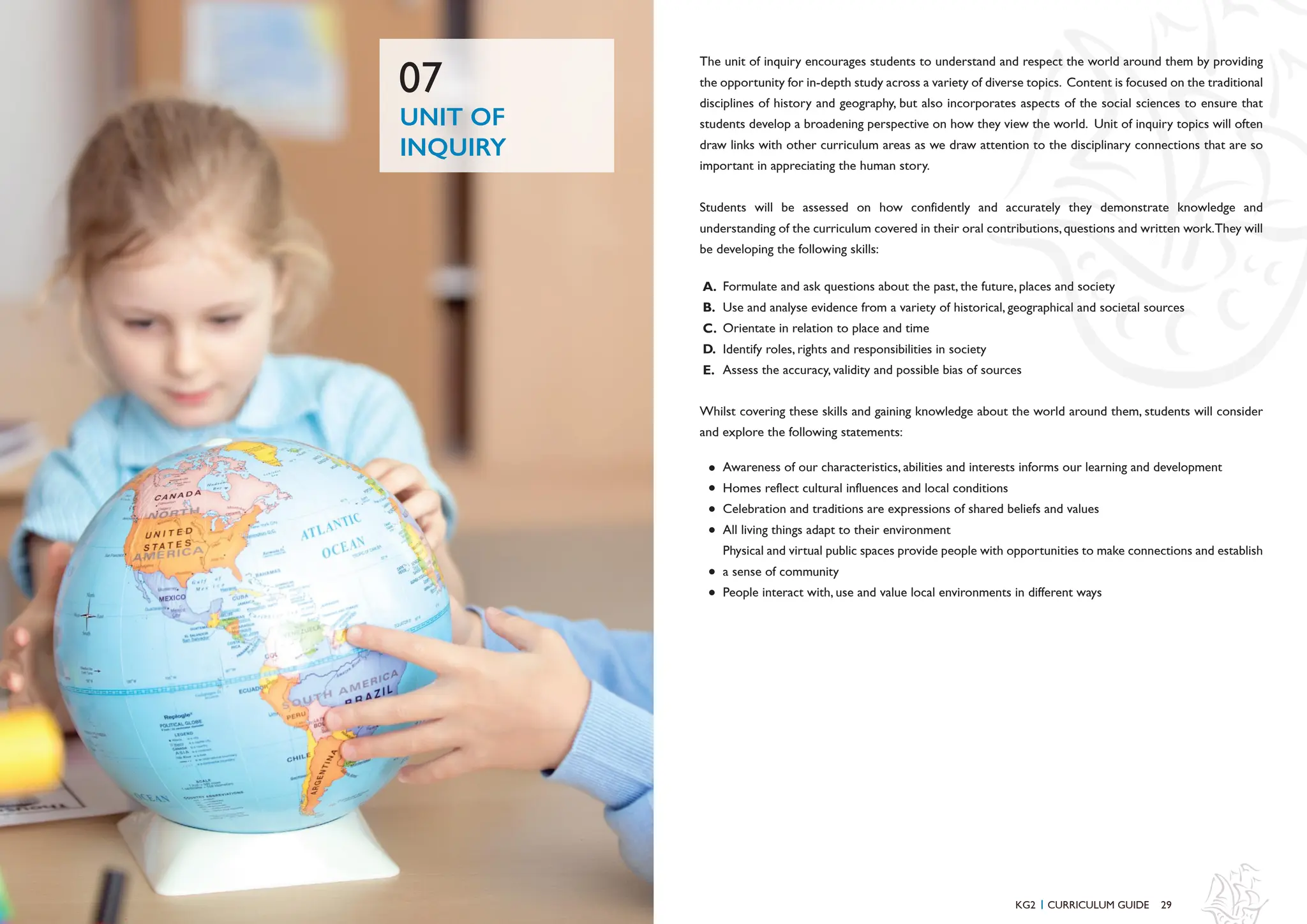
Use world maps, atlases and globes to identify countries, continents and oceans
for this age group.
Use aerial photos to locate geographical and physical features.
Appreciate the diversity of landscapes in the world.
Toys from the past:
Students will be taught to:
Consider the purpose and features of different toys.
Use vocabulary for the passing of time.
Place objects and events in chronological order.
Identify similarities and differences between ways of life at different times.
Use a range of sources to find out about the past.
Recognise changes in the way of life of their family and people around them.
My town:
Students will be taught to::
Explore the physical and human aspects of our local area.
Use directional language to describe location.
Use simple compass directions.
Use aerial photos to locate geographical and physical features.
Devise simple routes.
Devise simple maps and use a key.
Famous people and historical heroes:
Students will be taught to:
Explore the lives of significant individuals in the past who have contributed to
national and international achievements.
Consider how these significant individuals have impacted our lives today.
Be aware of significant events locally and globally.
https://www.vam.ac.uk/moc/
https://www.historyforkids.net/
https://kids.nationalgeographic.com/
https://www.easygeographyforkid.com/
KG2 CURRICULUM GUIDE
I
30
Term 2
Term 1 Term 3
Useful
Websites
33
32
Students will be taught to create and respond to art. They learn as artists by creating art that
communicates to audiences.They learn as audiences by responding critically to the arts.
In their art lessons, students will imagine, design and create artworks.They will learn to use and manage
the materials,instruments and skills of the art form to prepare,develop,produce and present art.Students
will respond to art through their senses,thoughts and emotions.They will be taught how the elements and
principles of design inform basic composition and work to communicate ideas.
Students will learn how to use artistic vocabulary to discuss style, materials, processes and technique in
their own work as well as when they view and discuss artwork by artists from different cultures,times and
locations.
ART
08
KG2 CURRICULUM GUIDE
I
35
34
Responding
Students will be taught to:
Learn about famous artists and use their work to inspire our own.
Make comparisons between different artists.
Recognise the different stages of the creative process.
Reflect and develop their own art work.
Creating
Students will be taught to:
Develop a wide range of art and design techniques using colour,pattern,texture,line,
form and space.
Use art and design to share ideas, experiences and imagination.
Use different materials to design and make 2D and 3D products.
Responding
Students will be taught to:
Learn about famous artists and use their work to inspire our own.
Make comparisons between different artists.
Recognise the different stages of the creative process.
Reflect and develop their own art work.
Creating
Students will be taught to:
Develop a wide range of art and design techniques using colour, pattern, texture,
line, form and space.
Use art and design to share ideas, experiences and imagination.
Use different materials to design and make 2D and 3D products.
Creating
Students will be taught to:
Develop a wide range of art and design techniques using colour,pattern,texture,line,
form and space.
Use art and design to share ideas, experiences and imagination.
Use different materials to design and make 2D and 3D products.
Responding
Students will be taught to:
Learn about famous artists and use their work to inspire our own.
Make comparisons between different artists.
Recognise the different stages of the creative process.
Reflect and develop their own art work.
Katie and the Mona Lisa by James Mayhew
Katie and the starry night by James Mayhew
The dot by Peter H Reynolds
The Day the Crayons Quit by Drew Daywalt
KG2 CURRICULUM GUIDE
I
Term 2
Term 1 Term 3
Useful
Resources
37
MUSIC
09
Students will be taught to sing and play musically with increasing confidence and control.They will develop
an understanding of musical composition, organising and manipulating ideas within musical structures and
reproducing sounds from aural memory.
Play and perform in solo and ensemble contexts, using their voices and playing musical instruments
with increasing accuracy, fluency, control and expression.
Improvise and compose music for a range of purposes using the inter-related dimensions of music.
Listen with attention to detail and recall sounds with increasing aural memory.
Use and understand staff and other musical notations.
Appreciate and understand a wide range of high-quality live and recorded music drawn from different
traditions and from great composers and musicians.
Develop an understanding of the history of music.
Students will be taught to:
KG2 CURRICULUM GUIDE
I
Students will learn:
An introduction to routines expectations.
Songs linked to Unit of Inquiry.
Musical composition and performance with consideration for volume and
atmosphere.
Exploration of orchestral string instruments.
Students will learn:
Songs linked to Unit of Inquiry.
Rhythm and clapping games, holding and changing a pulse.
Exploration of orchestral brass instrument.s
Students will learn:
Songs linked to Unit of Inquiry.
Rhythm and clapping games, holding and changing a pulse.
Exploration of orchestral woodwind instruments.
Term 2
Term 1
Term 3
39
Drama explores how we express ourselves physically and vocally.In creating,students will explore the use
of facial expressions, gestures, movement, posture and vocal techniques to convey emotional or cultural
meaning to both characters and stories. Students will be exposed to a variety of dramatic forms including
creative movement, impersonation, improvisation, mask work, mime, musical, role play, pantomime,
puppetry, re-enactment, scripted drama, and skit. In responding, students will experience a wide variety of
scripts and stories from different times, cultures and places and, where possible, access live theatre
performances and presentations. Students will have opportunities to present their creative work to an
audience, to witness their peers in performance and through this become critically aware audience
members.
DRAMA
10
KG2 CURRICULUM GUIDE
I
Poetry
Students will develop performance skills through poetry recital and performance.
Famous people
Students will identify with famous characters and consider how they would have
responded and behaved during significant events in their lifetimes, through activities
including freeze-framing and hot-seating.
Journeys
Students will explore settings and identify with characters through role-play and
performances inspired by journey stories like ‘We’re Going on a Bear Hunt’,‘A Dark,
Dark Tale’ and ‘Rosie’s Walk’.
FairyTales
Students will consider alternative endings and explore problem solving and character
representation through class and small group creative representations of Traditional
Fairy tales.
Term 2
Term 1
Term 3
41
COMPUTER
SCIENCE
11
NLCS (Singapore) seeks to ensure that students develop computational thinking and creativity to
understand and change the world. Computing has deep links with mathematics, science and design and
technology,and provides insights into both natural and artificial systems.Students are taught the principles
of information and computation, how digital systems work and how to put this knowledge to use through
basic programming.
Students will then later be able to build on these foundations to use information technology to create
programs, systems and a range of content. Computer Science also ensures that pupils become digitally
literate – able to use, and express themselves and develop their ideas through, information and
communication technology
KG2 CURRICULUM GUIDE
I
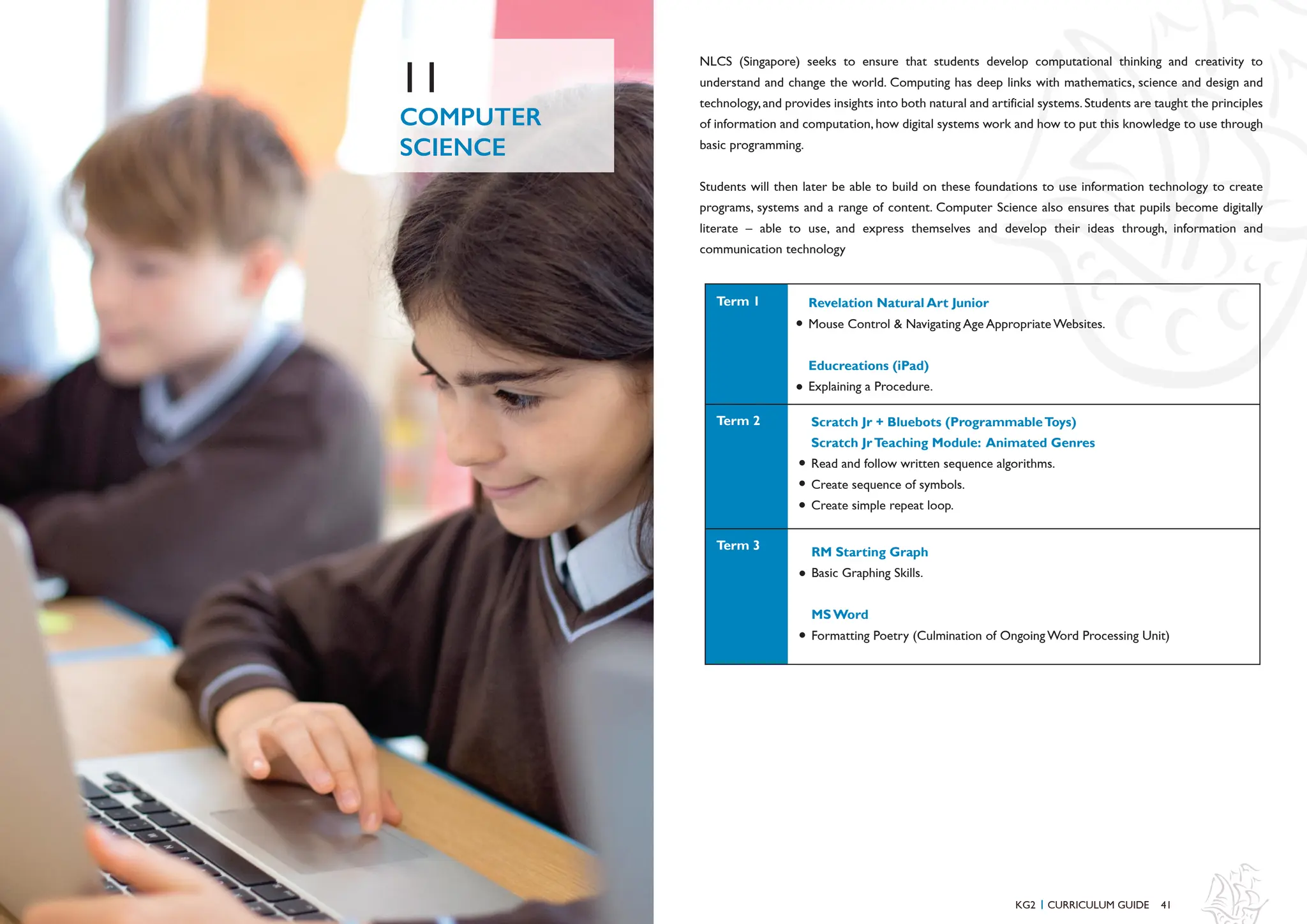
Revelation Natural Art Junior
Mouse Control & Navigating Age Appropriate Websites.
Educreations (iPad)
Explaining a Procedure.
Scratch Jr + Bluebots (ProgrammableToys)
Scratch JrTeaching Module: Animated Genres
Read and follow written sequence algorithms.
Create sequence of symbols.
Create simple repeat loop.
RM Starting Graph
Basic Graphing Skills.
MS Word
Formatting Poetry (Culmination of Ongoing Word Processing Unit)
Term 2
Term 1
Term 3
43
48 KG2 CURRICULUM GUIDE
I
PERSONAL &
SOCIAL
EDUCATION (PSE)
12
Personal and Social Education is centred around developing an understanding of our own beliefs, values,
attitudes, experiences and feelings and how they shape us. Students will learn about the impact of cultural
influences; the recognition of strengths, limitations, and how our concept of self and feelings of self-worth
affect our approach to learning and how we interact with others.
We aim for all our students to develop an understanding of how an individual interacts with other people,
other living things and the wider world.This includes learning about behaviours, rights and responsibilities
of individuals in their relationships with others,communities,society and the world around them.Students
will have an awareness and understanding of similarities and differences; an appreciation of the
environment and an understanding of,and commitment to,humankind’s responsibility as custodians of the
Earth for future generations.
45
KG2 CURRICULUM GUIDE
I
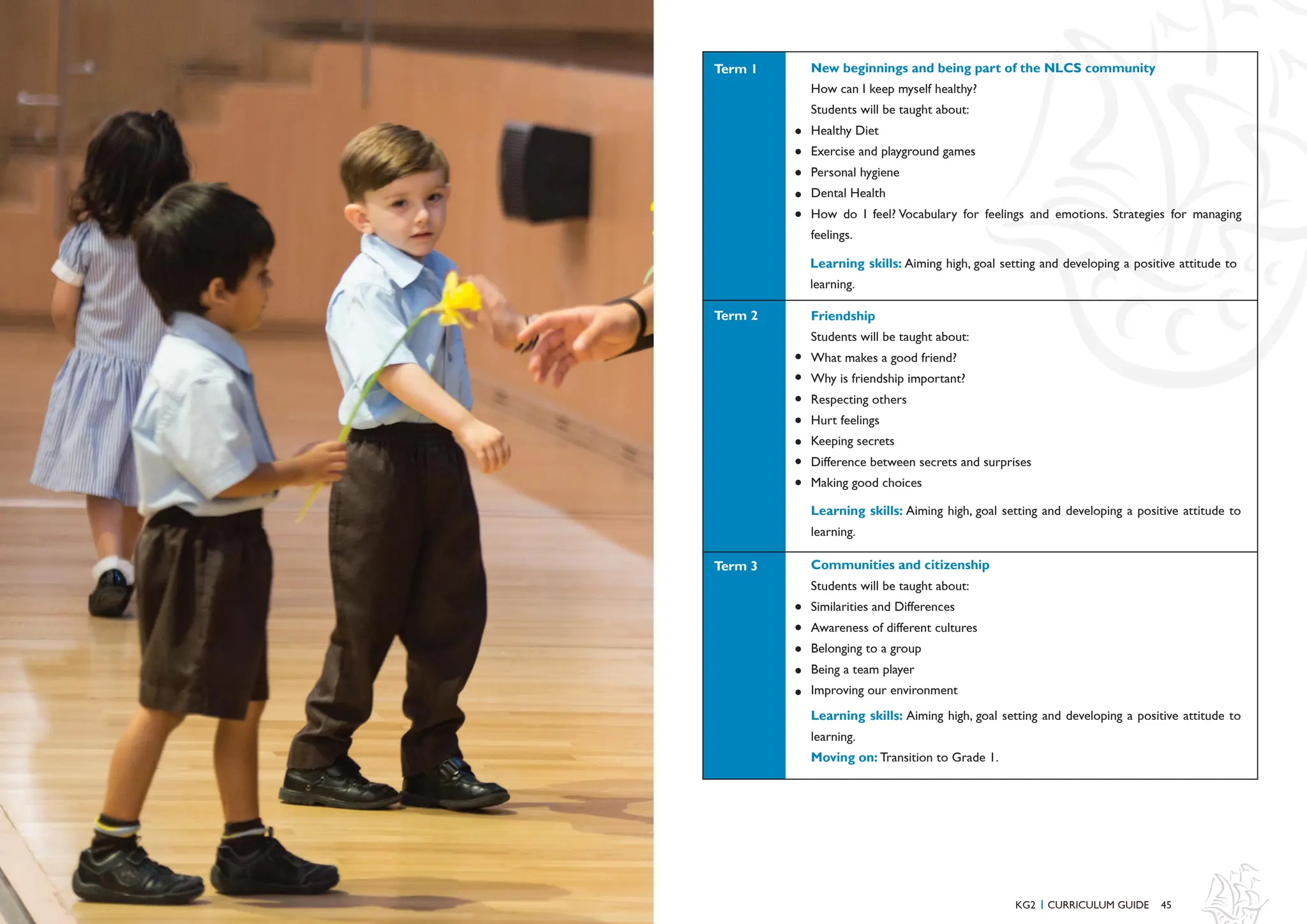
New beginnings and being part of the NLCS community
How can I keep myself healthy?
Students will be taught about:
Healthy Diet
Exercise and playground games
Personal hygiene
Dental Health
How do I feel? Vocabulary for feelings and emotions. Strategies for managing
feelings.
Friendship
Students will be taught about:
What makes a good friend?
Why is friendship important?
Respecting others
Hurt feelings
Keeping secrets
Difference between secrets and surprises
Making good choices
Communities and citizenship
Students will be taught about:
Similarities and Differences
Awareness of different cultures
Belonging to a group
Being a team player
Improving our environment
Term 2
Term 1
Term 3
Learning skills: Aiming high, goal setting and developing a positive attitude to
learning.
Learning skills: Aiming high, goal setting and developing a positive attitude to
learning.
Learning skills: Aiming high, goal setting and developing a positive attitude to
learning.
Moving on: Transition to Grade 1.
47
KG2 CURRICULUM GUIDE
I
PHYSICAL
EDUCATION &
HEALTH
13
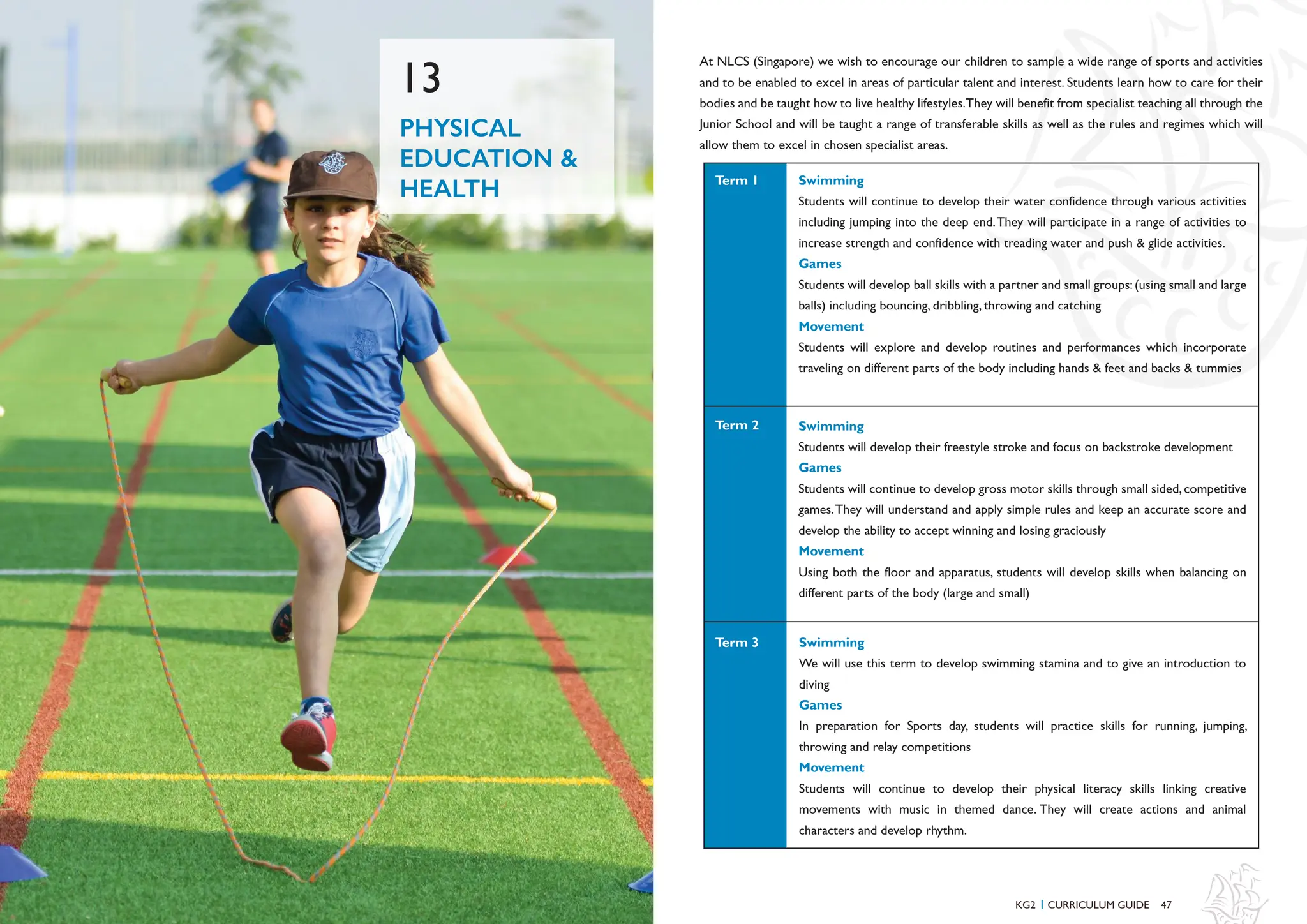
At NLCS (Singapore) we wish to encourage our children to sample a wide range of sports and activities
and to be enabled to excel in areas of particular talent and interest. Students learn how to care for their
bodies and be taught how to live healthy lifestyles.They will benefit from specialist teaching all through the
Junior School and will be taught a range of transferable skills as well as the rules and regimes which will
allow them to excel in chosen specialist areas.
Swimming
Students will continue to develop their water confidence through various activities
including jumping into the deep end.They will participate in a range of activities to
increase strength and confidence with treading water and push & glide activities.
Games
Students will develop ball skills with a partner and small groups:(using small and large
balls) including bouncing, dribbling, throwing and catching
Movement
Students will explore and develop routines and performances which incorporate
traveling on different parts of the body including hands & feet and backs & tummies
Swimming
Students will develop their freestyle stroke and focus on backstroke development
Games
Students will continue to develop gross motor skills through small sided, competitive
games.They will understand and apply simple rules and keep an accurate score and
develop the ability to accept winning and losing graciously
Movement
Using both the floor and apparatus, students will develop skills when balancing on
different parts of the body (large and small)
Swimming
We will use this term to develop swimming stamina and to give an introduction to
diving
Games
In preparation for Sports day, students will practice skills for running, jumping,
throwing and relay competitions
Movement
Students will continue to develop their physical literacy skills linking creative
movements with music in themed dance. They will create actions and animal
characters and develop rhythm.
Term 2
Term 1
Term 3
Curriculum-Guide-KG2_opt-CurriculumGuide

Curriculum-Guide-KG2_opt-CurriculumGuide

  • 1.
    Kindergarten 2 Curriculum Guide 2020-2021 T:+65 6955 1430 | www.nlcssingapore.sg @nlcssg CPE Registration Number 201621489R | Period of Registration 2019-07-25 to 2023-07-24 @NLCS_Singapore @nlcs.sing
  • 2.
    02 Welcome Curriculum Structure Assessment Mathematics 0406 08 18 Mandarin Science 24 Unit of Inquiry 28 Computer Science 40 12 English 36 Music Drama 38 32 Art 46 Physical Education & Health 42 Personal & Social Education TABLE OF CONTENTS
  • 3.
    Welcome to theKindergarten 2 Curriculum Guide.The purpose of this booklet is to expand upon the content of its counterpart, Junior School Curriculum Fundamentals, with detailed information on the curriculum structure, content and assessment criteria for Kindergarten 2. Students in Kindergarten 2 will receive subject specific teaching in Music, Physical Education & Health and Science in order that they benefit from, and are inspired by, experts in these areas of the curriculum.They will also receive a lesson a day of Mandarin teaching, taught by our Mandarin Assistant Teachers. A scholarly approach is modelled in all subjects, where students are encouraged to be curious and to ask questions in order to further develop their knowledge and understanding and to take their learning above and beyond the curriculum. While every member of staff has the duty and responsibility of pastoral care for all of our students, it is your child’s class teacher who is your first point of contact in the school. Good communication between school and home is vital if we are to provide any additional support that students may require academically or pastorally.We seek to ensure that every student receives the care and support needed in order to grow and learn to their full potential both emotionally and intellectually. Communication between school and home therefore continues to be of the utmost importance so that we can work together to ensure the best outcomes for our students and so we would encourage you to liaise closely with your child’s class teacher through the Communication book. In Kindergarten 2,students are still learning their phonics and developing their sight vocabulary.We will be teaching phonics using ‘Read,Write, Inc’ and sending home books which are part of that scheme. It is important at this age that parents hear their child read every day.It is also important that students enjoy listening to stories beyond their reading capabilities and so we would encourage you to read to your child in order to discuss character, language, themes and plot development to develop imagination, comprehension skills and to explore new vocabulary. In Kindergarten 2 the students will enjoy a longer day which incorporates our extensive CCA programme. One of the pillars of the NLCS ethos is the provision of a wide range of activities which will encourage students to discover new interests, develop their talents and further embed ‘soft skills.We consider this to be a vital element in each student’s education and will, with you, seek to widen their opportunities and experiences. We are very much looking forward to welcoming your child to Kindergarten 2 at NLCS (Singapore) and are excited about the academic journey which they are about to begin.We will be working closely with you in sharing successes and discussing next steps in order to ensure that your child benefits from an exceptional educational experience with us and not only runs their own race, but exceeds their own expectations of their capabilities and develops a life-long passion for learning. WELCOME Mrs Kathryn Hemming Vice Principal (Head of Junior School)
  • 4.
    CURRICULUM STRUCTURE 01 05 At NLCS (Singapore),teachers work collaboratively when planning in order to ensure that each class is following the same curriculum in their Grade, while allowing for interests and personalised learning specific to each class.An NLCS (Singapore) education is broad, balanced and academically rigorous.The number and range of subjects,as well as the amount of time dedicated to each,has been carefully designed to promote outstanding progress for every child, in every area. In Kindergarten 2, each student’s timetable for the 50-period week will contain the following lessons.This booklet outlines the topics that will be covered through the year in each subject. Subject Mathematics English Physical Education & Health Art Drama Music Mandarin Science Computer Science Personal & Social Education Unit of Inquiry (inc History and Geography) Total Periods Minutes 8 6 4 280 210 140 2 2 2 5 2 1 2 10 50 1750 70 70 70 175 70 70 350 Activities 6 210 35 KG2 CURRICULUM GUIDE I
  • 5.
    As described inthe Junior School Curriculum Fundamentals, students are constantly being formatively assessed in order to ascertain understanding and then to guide and shape the subsequent teaching.This assessment takes a range of forms including observations, conversations, short tests, verbal contributions to lessons, and work completed in books. Students are given clear and positive feedback and next steps, which are shared with parents. End of unit summative assessments also take a variety of forms, and these, alongside quality of work through the unit will inform the Attainment Grade (1-7) given in reports at the end of each term. Students are assessed on their knowledge and understanding of the curriculum as presented in this document as well as the skills taught in each area of the curriculum.Grades will be determined by the level of sophistication with which students have met each of the criteria.An Attainment Grade 5 signifies that a student’s work is in line with NLCS’s high expectations. Students who demonstrate exceptional understanding and who are able to take their learning above and beyond the curriculum will be graded 6 or 7. If a student is graded at a 4 or less in any subject, teachers will set specific targets in order to ensure improvements in understanding and will inform parents of any additional support needed and implemented in order to ensure future success. ASSESSMENT 02 07 KG2 CURRICULUM GUIDE I
  • 6.
    The study ofmathematics is a fundamental part of a balanced education and also provides the foundational knowledge and skills for many other subjects including science and computer science. As mathematics progresses through the school,we require our students to be critical thinkers,using their grasp of the first principles of the discipline to find new and inventive ways of solving authentic problems. Our Junior School curriculum is centred around developing the foundational skills and knowledge needed for future success and we organise our content into five broad areas: Number Pattern and function Shape and space Measurement Data handling 1. 2. 3. 4. 5. 09 MATHEMATICS 02 KG2 CURRICULUM GUIDE I The skills associated with using and applying mathematics are embedded throughout the curriculum.
  • 7.
    Number Students will beconfident with recognising and using number bonds within 20 Students will apply this when completing addition and subtraction within 20. Students will learn to partition numbers beyond 20 into tens and one. Students will recognise numbers to 100 and be able to count then in sequence and be able to read and write them in numbers and words. Shape and space Students will develop confidence in describing and contrasting the properties of basic 2D and 3D shapes using mathematical vocabulary. Ongoing Mental Maths, Problem-Solving, Extension Tasks. Measurement Students will use ordinal numbers and time vocabulary to sequence events. Data handling Students will understand data representation through picture graphs. Students will read and interpret data. Number Students will be introduced to fractions, starting with halves and quarters and recognising them as equal parts of a whole object. Students will use a variety of representations to solve one-step multiplication and division problems including concrete objects, pictorial representations and arrays. Shape and space Students will describe the position, direction and movement in relation to quarter, half and whole turns. Ongoing Mental Maths, Problem-Solving, Extension Tasks. Measurement Students will develop confidence in using seconds, minutes and hours to tell the time. Data handling Students will be confident in completing and creating picture graphs. Ongoing Mental Maths, Problem-Solving, Extension Tasks. Data handling Students will build on skills developed in the previous term to interpret picture graphs in order to solve problems. Number Students will be writing and solving multiplication and division number sentences. Shape and space Students will develop confidence in describing and contrasting the properties of less common 2D and 3D shapes using mathematical vocabulary. Measurement Students will solve problems involving length, mass and capacity using mathematical vocabulary and symbols. Students will use number skills to count money to $1 and be able to solve problems involving money. Students will recognise and use language related to dates. www.topmarks.co.uk https://www.bbc.co.uk/bitesize/primary www.prodigygames.com https://www.j2e.com www.whiterosemaths.co.uk 11 10 KG2 CURRICULUM GUIDE I Term 2 Term 1 Term 3 Useful Websites
  • 8.
    13 12 In our Englishcurriculum we seek to excite and engage students through exposure to and exploration of a wide range of both well-known and modern texts.We aim to foster a life-long love of reading amongst our student community so that they can develop their vocabulary; understand how to use punctuation, structure and language effectively; develop empathy; and learn about real and fictional worlds.This starts with by using Read Write Inc. phonics to teach children to read accurately and fluently with good comprehension.They learn to form each letter, spell correctly, and compose their ideas step-by-step. Language is a transdisciplinary element throughout the curriculum and the skills developed throughout the Junior School will allow for discussion, information processing, problem solving, researching and presenting across all subjects. We seek to nurture an appreciation of the richness of language, by encouraging familiarity with world classic texts, traditional tales and multi-cultural materials through a literature-based approach to learning language. The four areas in which students’ achievement in English is assessed are: Listening and speaking Viewing and presenting Reading Writing A. B. C. D. ENGLISH 04 KG2 CURRICULUM GUIDE I Students will be assessed in all of these areas and the sophistication they display in these areas in both English lessons and across the curriculum will determine their grading to be reported to parents.
  • 9.
    15 Phonics programme andhandwriting Students will continue to develop phonic knowledge and skills as the route to decode words. Students will develop their ability to read common exception words read and spell common frequency words. Fiction: Stories with predictable phrasing Students will become very familiar with key stories, fairy stories and traditional tales Students will be able to retell favourite stories and explain their particular characteristics Students will be taught to recognise and join in with predictable phrases. Poetry: Colour poems Students will be able to discuss the significance of the title and events Students will explain clearly their understanding of what is read to them. Non-Fiction Students will recognize, read and write simple labels, lists and captions. Students will be taught to write simple recount texts - retelling events in a sequence, including diaries, news stories and letters. The Tiger who came to tea by Judith Kerr Room on a Broom by Julia Donaldson We’re Going on a Bear Hunt by Michael Rosen A Dark, Dark Tale by Ruth Brown Rosie’s Walk by Pat Hutchins The Train Ride by June Crebbin Unfortunately by Alan Durant Phonics programme and handwriting Students will be able to read words with contractions. Students will be taught to read words of more than one syllable. Fiction: FairyTales Students will consider word meanings, linking new meanings to those already known. Students will be able to make inferences on the basis of what is being said and done. Students will be encouraged to predict what might happen on the basis of what has been read so far. Poetry:Weather Poems Students will be able to link what they read or hear with their own experiences. Non-Fiction Students will read and write non-chronological reports, including information texts about a particular subject. Students will write instruction texts. Students will use imperative verbs to instruct on how to complete a task. The Three Little Pigs by Mara Alperin Cinderella by Allie Busby Snow White and the Seven Dwarfs by Lesley Sims. Jack and the Beanstalk by Mara Alperin Little Red Riding Hood by Mara Alperin The Jolly Postman by Allan Ahlberg 14 KG2 CURRICULUM GUIDE I Term 1 Books we will be reading: Term 2 Books we will be reading:
  • 10.
    17 Phonics programme andhandwriting Students will be encouraged to read aloud accurately books that are consistent with their phonic knowledge. Students will be able to read speedily with the correct sound to graphemes for all 40+ phonemes. Fiction: Fantasy Stories Students will participate in discussion about what is read to them,taking turns and listening to what others say. Students will be taught to explain clearly their understanding of what is read to them. Students will be able to sequence sentences to form short narratives. Poetry:Animal poems Students will be developing an appreciation for poems and be able to recite some by heart. Non-Fiction Students will know some of the features of chronological reports and non-chronological reports. Students will be able to sequence sentences to form short narratives. Students will be taught to re-read what they have written to make sure it makes sense. Super worm by Julia Donaldson Charlie’s Superhero Underpants by Paul Bright Where the Wild Things Are by Maurice Sendak KG2 CURRICULUM GUIDE I Books we will be reading: Term 3
  • 11.
    19 At NLCS (Singapore)we place a great emphasis on learning languages as we encourage all of our students to see themselves as part of an international community. All students in the Junior School are taught Mandarin for 35 minutes a day by a specialist Mandarin Teacher, focusing on the four pillars of language acquisition: listening, speaking, reading and writing. Mandarin speaking AssistantTeachers are then available throughout the day to further develop conversational Manadarin with those students who require or request additional input. Students will work in different ability groups for Mandarin so that teachers are able to focus on particular skills and ensure that all students are challenged and appropriately supported in their learning. MANDARIN 05 KG2 CURRICULUM GUIDE I
  • 12.
    21 Students will begrouped and will follow the language pathway of the groups listed below: Mandarin (Language Acquisition - MLA) All about me Key content includes: How to do a self-introduction How to ask questions about others Talk about my favorites Chinese nursery rhymes and songs Moon Cake festival celebrations 《谁有东西要分享》 《种花》 My family is special Key content includes: Who is in my family How I like my family Get to know my family Chinese nursery rhymes and songs Chinese NewYear celebrations 《下雨》 《去洗手间》 Let's go to the zoo Key content includes: Where are the animals Do you have pets Adjectives to describe animals Chinese nursery rhymes and songs Dragon Boat festival celebrations 《谁的生日蛋糕》 《是我的生日吗》 Mandarin (Second Language - MSL) 关于我 自我介绍 怎样询问 谈谈自己最喜欢的 儿童歌谣 庆祝中秋节 《谁有东西要分享》 《种花》 特别的家人 家庭成员 了解我的家庭 我爱家人 儿童歌谣 庆祝春节 动物园 动物生活在哪儿 你有宠物吗 描述动物 儿童歌谣 庆祝龙舟节 《下雨》 《去洗手间》 《谁的生日蛋糕》 《是我的生日吗》 KG2 CURRICULUM GUIDE I 20 Term 1 Term 3 Term 2 Suggested reading or extension activities Suggested reading or extension activities Suggested reading or extension activities Term 1 Term 3 Term 2 Suggested reading or extension activities Suggested reading or extension activities Suggested reading or extension activities
  • 13.
    23 22 Mandarin (Native Language- MNL) 关于我 自我介绍 怎样询问 谈谈自己最喜欢的 儿童歌谣 庆祝中秋节 《谁有东西要分享》 《种花》 特别的家人 家庭成员 了解我的家庭 我爱家人 儿童歌谣 庆祝中秋节 动物园 动物生活在哪儿 你有宠物吗 描述动物 儿童歌谣 庆祝龙舟节 《下雨》 《去洗手间》 《谁的生日蛋糕》 《是我的生日吗》 KG2 CURRICULUM GUIDE I Term 1 Term 3 Term 2 Suggested reading or extension activities Suggested reading or extension activities Suggested reading or extension activities
  • 14.
    25 Our Science curriculumwill be covered under our trans-disciplinary Areas of Enquiry.The content of this curriculum is based on the UK National Curriculum. We believe that a high-quality science education provides the foundations for understanding the world through the specific disciplines of biology,chemistry and physics.Science has changed our lives and is vital to the world’s future prosperity so we aim to ensure that all students will be taught essential aspects of the knowledge,methods,processes and uses of science. Through building up a body of key foundational knowledge and concepts, students will be encouraged to recognise the power of rational explanation and develop a sense of excitement and curiosity about natural phenomena.They will be encouraged to understand how science can be used to explain what is occurring, predict how things will behave, and analyse causes. SCIENCE 06 KG2 CURRICULUM GUIDE I
  • 15.
    27 Ourselves Students will betaught to: Identify,name,draw and label the basic parts of the human body and say which part of the body is associated with each sense. Plants Students will be taught to: Identify a variety of common wild and garden plants, including deciduous and evergreen trees. Identify and describe the basic structure of a variety of common flowering plants, including trees. Compare and group different plants. Learn about the life cycle of a plant. Investigate what plants need in order to grow. Everyday materials Students will be taught to: Distinguish between an object and the material from which it was made. Identify and name a variety of materials, including wood, plastic, glass, metal, water and rock. Describe the simple physical properties of a variety of everyday materials. Compare and group together a variety of everyday materials on the basis of their simple physical properties. Animals, including humans Students will be taught to: Identify and name a variety of common animals including fish, amphibians, reptiles, birds and mammals. Identify and name a variety of common animals that are carnivores,herbivores and omnivores. Be able to identify animal habitats and explain how they are adapted to suit their environment. Describe and compare different animals, including pets. Group animals in different ways. Identify,name,draw and label the basic parts of the human body and say which part of the body is associated with each sense. Know that living things have a life cycle. 26 KG2 CURRICULUM GUIDE I Term 1 Term 3 Term 2
  • 16.
    29 28 The unit ofinquiry encourages students to understand and respect the world around them by providing the opportunity for in-depth study across a variety of diverse topics. Content is focused on the traditional disciplines of history and geography, but also incorporates aspects of the social sciences to ensure that students develop a broadening perspective on how they view the world. Unit of inquiry topics will often draw links with other curriculum areas as we draw attention to the disciplinary connections that are so important in appreciating the human story. Students will be assessed on how confidently and accurately they demonstrate knowledge and understanding of the curriculum covered in their oral contributions,questions and written work.They will be developing the following skills: Whilst covering these skills and gaining knowledge about the world around them, students will consider and explore the following statements: Formulate and ask questions about the past, the future, places and society Use and analyse evidence from a variety of historical, geographical and societal sources Orientate in relation to place and time Identify roles, rights and responsibilities in society Assess the accuracy, validity and possible bias of sources Awareness of our characteristics, abilities and interests informs our learning and development Homes reflect cultural influences and local conditions Celebration and traditions are expressions of shared beliefs and values All living things adapt to their environment Physical and virtual public spaces provide people with opportunities to make connections and establish a sense of community People interact with, use and value local environments in different ways A. B. C. D. E. UNIT OF INQUIRY 07 KG2 CURRICULUM GUIDE I
  • 17.
    31 My school, myfamily and my home: Students will be taught to: Compare characteristics and features of different homes and countries. Compare how climate may affect features of homes. Identify seasonal and daily weather patterns and the location of hot and cold areas of the world in relation to the Equator and the North and South Poles. Be introduced to simple mapping skills and using keys. Houses and homes through history: Students will be taught to: Consider the purpose and features of different historical houses. Place objects and events in chronological order. Use vocabulary for the passing of time. Identify similarities and differences between ways of life at different times. Use a range of sources to find out about the past. Recognise changes in the way of life of their family and people around them. Places around the world: Students will be taught to: Know the names of all the continents and oceans on our planet. Understand geographical similarities and differences through studying the human and physical geography of different areas. Use geographical vocabulary for physical features and human features. Use world maps, atlases and globes to identify countries, continents and oceans for this age group. Use aerial photos to locate geographical and physical features. Appreciate the diversity of landscapes in the world. Toys from the past: Students will be taught to: Consider the purpose and features of different toys. Use vocabulary for the passing of time. Place objects and events in chronological order. Identify similarities and differences between ways of life at different times. Use a range of sources to find out about the past. Recognise changes in the way of life of their family and people around them. My town: Students will be taught to:: Explore the physical and human aspects of our local area. Use directional language to describe location. Use simple compass directions. Use aerial photos to locate geographical and physical features. Devise simple routes. Devise simple maps and use a key. Famous people and historical heroes: Students will be taught to: Explore the lives of significant individuals in the past who have contributed to national and international achievements. Consider how these significant individuals have impacted our lives today. Be aware of significant events locally and globally. https://www.vam.ac.uk/moc/ https://www.historyforkids.net/ https://kids.nationalgeographic.com/ https://www.easygeographyforkid.com/ KG2 CURRICULUM GUIDE I 30 Term 2 Term 1 Term 3 Useful Websites
  • 18.
    33 32 Students will betaught to create and respond to art. They learn as artists by creating art that communicates to audiences.They learn as audiences by responding critically to the arts. In their art lessons, students will imagine, design and create artworks.They will learn to use and manage the materials,instruments and skills of the art form to prepare,develop,produce and present art.Students will respond to art through their senses,thoughts and emotions.They will be taught how the elements and principles of design inform basic composition and work to communicate ideas. Students will learn how to use artistic vocabulary to discuss style, materials, processes and technique in their own work as well as when they view and discuss artwork by artists from different cultures,times and locations. ART 08 KG2 CURRICULUM GUIDE I
  • 19.
    35 34 Responding Students will betaught to: Learn about famous artists and use their work to inspire our own. Make comparisons between different artists. Recognise the different stages of the creative process. Reflect and develop their own art work. Creating Students will be taught to: Develop a wide range of art and design techniques using colour,pattern,texture,line, form and space. Use art and design to share ideas, experiences and imagination. Use different materials to design and make 2D and 3D products. Responding Students will be taught to: Learn about famous artists and use their work to inspire our own. Make comparisons between different artists. Recognise the different stages of the creative process. Reflect and develop their own art work. Creating Students will be taught to: Develop a wide range of art and design techniques using colour, pattern, texture, line, form and space. Use art and design to share ideas, experiences and imagination. Use different materials to design and make 2D and 3D products. Creating Students will be taught to: Develop a wide range of art and design techniques using colour,pattern,texture,line, form and space. Use art and design to share ideas, experiences and imagination. Use different materials to design and make 2D and 3D products. Responding Students will be taught to: Learn about famous artists and use their work to inspire our own. Make comparisons between different artists. Recognise the different stages of the creative process. Reflect and develop their own art work. Katie and the Mona Lisa by James Mayhew Katie and the starry night by James Mayhew The dot by Peter H Reynolds The Day the Crayons Quit by Drew Daywalt KG2 CURRICULUM GUIDE I Term 2 Term 1 Term 3 Useful Resources
  • 20.
    37 MUSIC 09 Students will betaught to sing and play musically with increasing confidence and control.They will develop an understanding of musical composition, organising and manipulating ideas within musical structures and reproducing sounds from aural memory. Play and perform in solo and ensemble contexts, using their voices and playing musical instruments with increasing accuracy, fluency, control and expression. Improvise and compose music for a range of purposes using the inter-related dimensions of music. Listen with attention to detail and recall sounds with increasing aural memory. Use and understand staff and other musical notations. Appreciate and understand a wide range of high-quality live and recorded music drawn from different traditions and from great composers and musicians. Develop an understanding of the history of music. Students will be taught to: KG2 CURRICULUM GUIDE I Students will learn: An introduction to routines expectations. Songs linked to Unit of Inquiry. Musical composition and performance with consideration for volume and atmosphere. Exploration of orchestral string instruments. Students will learn: Songs linked to Unit of Inquiry. Rhythm and clapping games, holding and changing a pulse. Exploration of orchestral brass instrument.s Students will learn: Songs linked to Unit of Inquiry. Rhythm and clapping games, holding and changing a pulse. Exploration of orchestral woodwind instruments. Term 2 Term 1 Term 3
  • 21.
    39 Drama explores howwe express ourselves physically and vocally.In creating,students will explore the use of facial expressions, gestures, movement, posture and vocal techniques to convey emotional or cultural meaning to both characters and stories. Students will be exposed to a variety of dramatic forms including creative movement, impersonation, improvisation, mask work, mime, musical, role play, pantomime, puppetry, re-enactment, scripted drama, and skit. In responding, students will experience a wide variety of scripts and stories from different times, cultures and places and, where possible, access live theatre performances and presentations. Students will have opportunities to present their creative work to an audience, to witness their peers in performance and through this become critically aware audience members. DRAMA 10 KG2 CURRICULUM GUIDE I Poetry Students will develop performance skills through poetry recital and performance. Famous people Students will identify with famous characters and consider how they would have responded and behaved during significant events in their lifetimes, through activities including freeze-framing and hot-seating. Journeys Students will explore settings and identify with characters through role-play and performances inspired by journey stories like ‘We’re Going on a Bear Hunt’,‘A Dark, Dark Tale’ and ‘Rosie’s Walk’. FairyTales Students will consider alternative endings and explore problem solving and character representation through class and small group creative representations of Traditional Fairy tales. Term 2 Term 1 Term 3
  • 22.
    41 COMPUTER SCIENCE 11 NLCS (Singapore) seeksto ensure that students develop computational thinking and creativity to understand and change the world. Computing has deep links with mathematics, science and design and technology,and provides insights into both natural and artificial systems.Students are taught the principles of information and computation, how digital systems work and how to put this knowledge to use through basic programming. Students will then later be able to build on these foundations to use information technology to create programs, systems and a range of content. Computer Science also ensures that pupils become digitally literate – able to use, and express themselves and develop their ideas through, information and communication technology KG2 CURRICULUM GUIDE I Revelation Natural Art Junior Mouse Control & Navigating Age Appropriate Websites. Educreations (iPad) Explaining a Procedure. Scratch Jr + Bluebots (ProgrammableToys) Scratch JrTeaching Module: Animated Genres Read and follow written sequence algorithms. Create sequence of symbols. Create simple repeat loop. RM Starting Graph Basic Graphing Skills. MS Word Formatting Poetry (Culmination of Ongoing Word Processing Unit) Term 2 Term 1 Term 3
  • 23.
    43 48 KG2 CURRICULUMGUIDE I PERSONAL & SOCIAL EDUCATION (PSE) 12 Personal and Social Education is centred around developing an understanding of our own beliefs, values, attitudes, experiences and feelings and how they shape us. Students will learn about the impact of cultural influences; the recognition of strengths, limitations, and how our concept of self and feelings of self-worth affect our approach to learning and how we interact with others. We aim for all our students to develop an understanding of how an individual interacts with other people, other living things and the wider world.This includes learning about behaviours, rights and responsibilities of individuals in their relationships with others,communities,society and the world around them.Students will have an awareness and understanding of similarities and differences; an appreciation of the environment and an understanding of,and commitment to,humankind’s responsibility as custodians of the Earth for future generations.
  • 24.
    45 KG2 CURRICULUM GUIDE I Newbeginnings and being part of the NLCS community How can I keep myself healthy? Students will be taught about: Healthy Diet Exercise and playground games Personal hygiene Dental Health How do I feel? Vocabulary for feelings and emotions. Strategies for managing feelings. Friendship Students will be taught about: What makes a good friend? Why is friendship important? Respecting others Hurt feelings Keeping secrets Difference between secrets and surprises Making good choices Communities and citizenship Students will be taught about: Similarities and Differences Awareness of different cultures Belonging to a group Being a team player Improving our environment Term 2 Term 1 Term 3 Learning skills: Aiming high, goal setting and developing a positive attitude to learning. Learning skills: Aiming high, goal setting and developing a positive attitude to learning. Learning skills: Aiming high, goal setting and developing a positive attitude to learning. Moving on: Transition to Grade 1.
  • 25.
    47 KG2 CURRICULUM GUIDE I PHYSICAL EDUCATION& HEALTH 13 At NLCS (Singapore) we wish to encourage our children to sample a wide range of sports and activities and to be enabled to excel in areas of particular talent and interest. Students learn how to care for their bodies and be taught how to live healthy lifestyles.They will benefit from specialist teaching all through the Junior School and will be taught a range of transferable skills as well as the rules and regimes which will allow them to excel in chosen specialist areas. Swimming Students will continue to develop their water confidence through various activities including jumping into the deep end.They will participate in a range of activities to increase strength and confidence with treading water and push & glide activities. Games Students will develop ball skills with a partner and small groups:(using small and large balls) including bouncing, dribbling, throwing and catching Movement Students will explore and develop routines and performances which incorporate traveling on different parts of the body including hands & feet and backs & tummies Swimming Students will develop their freestyle stroke and focus on backstroke development Games Students will continue to develop gross motor skills through small sided, competitive games.They will understand and apply simple rules and keep an accurate score and develop the ability to accept winning and losing graciously Movement Using both the floor and apparatus, students will develop skills when balancing on different parts of the body (large and small) Swimming We will use this term to develop swimming stamina and to give an introduction to diving Games In preparation for Sports day, students will practice skills for running, jumping, throwing and relay competitions Movement Students will continue to develop their physical literacy skills linking creative movements with music in themed dance. They will create actions and animal characters and develop rhythm. Term 2 Term 1 Term 3