Current Issues slide_ Teachers Digital Literacy.pptx
1.
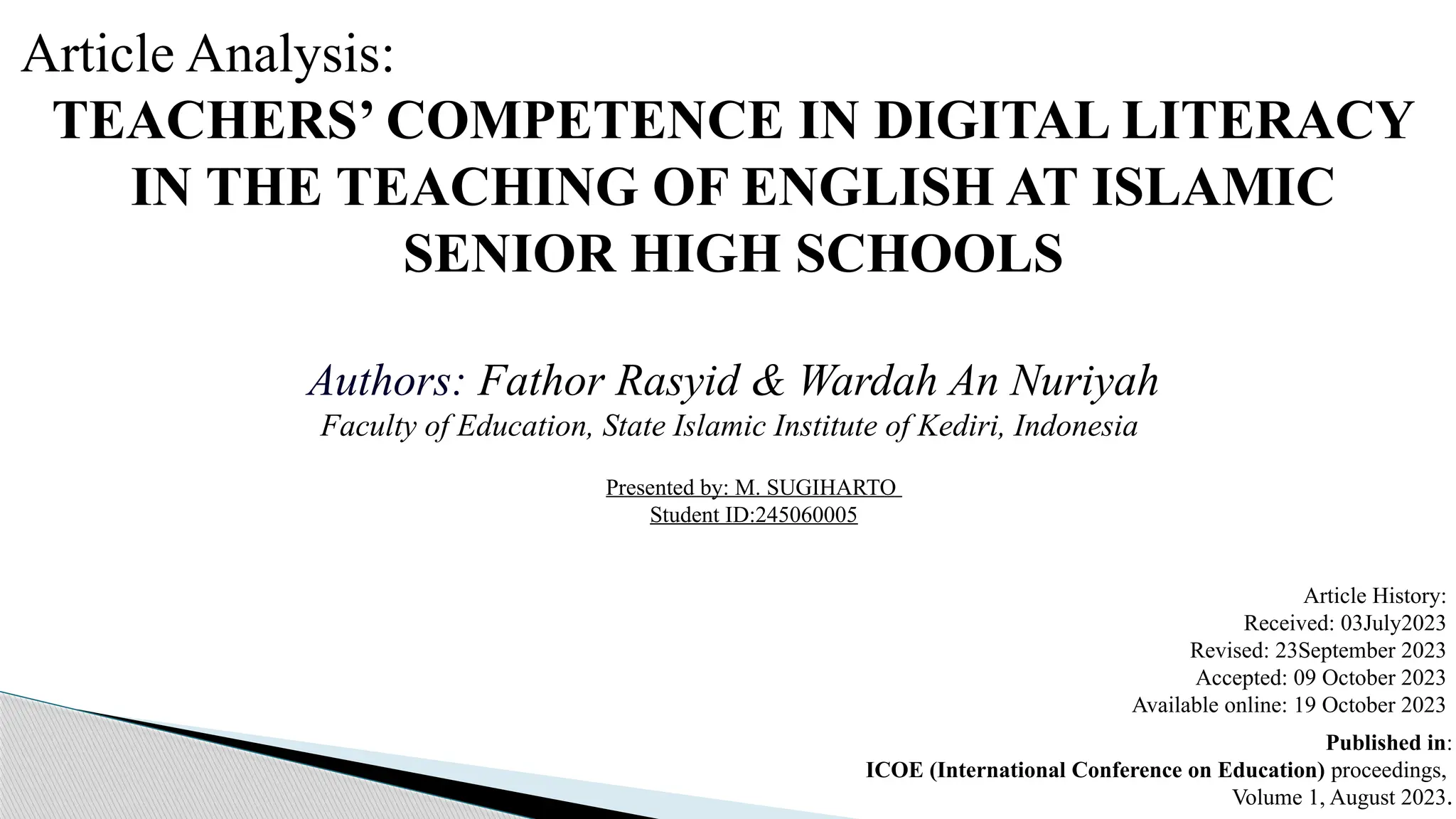
Article Analysis:
TEACHERS’ COMPETENCEIN DIGITAL LITERACY
IN THE TEACHING OF ENGLISH AT ISLAMIC
SENIOR HIGH SCHOOLS
Authors: Fathor Rasyid & Wardah An Nuriyah
Faculty of Education, State Islamic Institute of Kediri, Indonesia
Published in:
ICOE (International Conference on Education) proceedings,
Volume 1, August 2023.
Article History:
Received: 03July2023
Revised: 23September 2023
Accepted: 09 October 2023
Available online: 19 October 2023
Presented by: M. SUGIHARTO
Student ID:245060005
2.
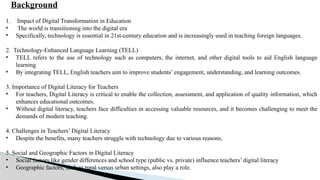
Background
1. Impact ofDigital Transformation in Education
• The world is transitioning into the digital era
• Specifically, technology is essential in 21st-century education and is increasingly used in teaching foreign languages.
2. Technology-Enhanced Language Learning (TELL)
• TELL refers to the use of technology such as computers, the internet, and other digital tools to aid English language
learning
• By integrating TELL, English teachers aim to improve students’ engagement, understanding, and learning outcomes.
3. Importance of Digital Literacy for Teachers
• For teachers, Digital Literacy is critical to enable the collection, assessment, and application of quality information, which
enhances educational outcomes.
• Without digital literacy, teachers face difficulties in accessing valuable resources, and it becomes challenging to meet the
demands of modern teaching.
4. Challenges in Teachers’ Digital Literacy
• Despite the benefits, many teachers struggle with technology due to various reasons,
5. Social and Geographic Factors in Digital Literacy
• Social factors like gender differences and school type (public vs. private) influence teachers’ digital literacy
• Geographic factors, such as rural versus urban settings, also play a role.
3.
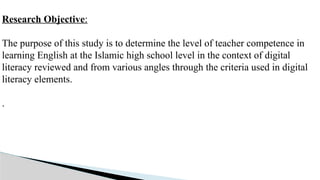
Research Objective:
The purposeof this study is to determine the level of teacher competence in
learning English at the Islamic high school level in the context of digital
literacy reviewed and from various angles through the criteria used in digital
literacy elements.
.
4.
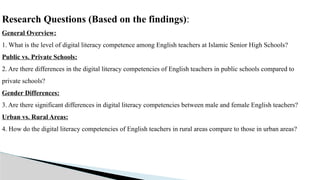
Research Questions (Basedon the findings):
General Overview:
1. What is the level of digital literacy competence among English teachers at Islamic Senior High Schools?
Public vs. Private Schools:
2. Are there differences in the digital literacy competencies of English teachers in public schools compared to
private schools?
Gender Differences:
3. Are there significant differences in digital literacy competencies between male and female English teachers?
Urban vs. Rural Areas:
4. How do the digital literacy competencies of English teachers in rural areas compare to those in urban areas?
5.
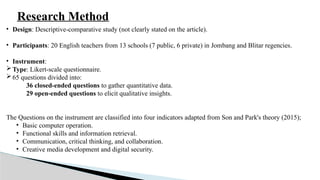
Research Method
• Design:Descriptive-comparative study (not clearly stated on the article).
• Participants: 20 English teachers from 13 schools (7 public, 6 private) in Jombang and Blitar regencies.
• Instrument:
Type: Likert-scale questionnaire.
65 questions divided into:
36 closed-ended questions to gather quantitative data.
29 open-ended questions to elicit qualitative insights.
The Questions on the instrument are classified into four indicators adapted from Son and Park's theory (2015);
• Basic computer operation.
• Functional skills and information retrieval.
• Communication, critical thinking, and collaboration.
• Creative media development and digital security.
6.
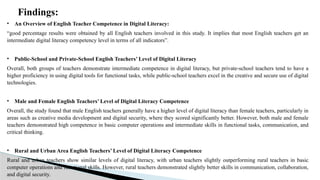
Findings:
• An Overviewof English Teacher Competence in Digital Literacy:
“good percentage results were obtained by all English teachers involved in this study. It implies that most English teachers get an
intermediate digital literacy competency level in terms of all indicators”.
• Public-School and Private-School English Teachers’ Level of Digital Literacy
Overall, both groups of teachers demonstrate intermediate competence in digital literacy, but private-school teachers tend to have a
higher proficiency in using digital tools for functional tasks, while public-school teachers excel in the creative and secure use of digital
technologies.
• Male and Female English Teachers’ Level of Digital Literacy Competence
Overall, the study found that male English teachers generally have a higher level of digital literacy than female teachers, particularly in
areas such as creative media development and digital security, where they scored significantly better. However, both male and female
teachers demonstrated high competence in basic computer operations and intermediate skills in functional tasks, communication, and
critical thinking.
• Rural and Urban Area English Teachers’ Level of Digital Literacy Competence
Rural and urban teachers show similar levels of digital literacy, with urban teachers slightly outperforming rural teachers in basic
computer operations and functional skills. However, rural teachers demonstrated slightly better skills in communication, collaboration,
and digital security.
7.
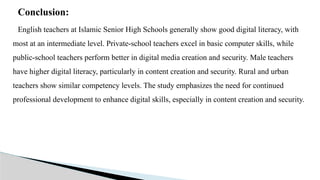
Conclusion:
English teachers atIslamic Senior High Schools generally show good digital literacy, with
most at an intermediate level. Private-school teachers excel in basic computer skills, while
public-school teachers perform better in digital media creation and security. Male teachers
have higher digital literacy, particularly in content creation and security. Rural and urban
teachers show similar competency levels. The study emphasizes the need for continued
professional development to enhance digital skills, especially in content creation and security.