The Problem ofCultural Bias in Traditional IQ Tests
• Many early intelligence tests relied heavily on verbal abilities, knowledge, and
experiences common to specific Western cultures.
• Example: Questions referencing Shakespeare or U.S. presidents.
• This raised concerns about whether these tests fairly assessed the intelligence of
individuals from diverse cultural backgrounds.
• Examples of potential bias:
• - Vocabulary: e.g., 'raining cats and dogs'
• - Cultural References: e.g., Thanksgiving or baseball
• - Problem-solving strategies favored in one culture
3.
Introducing Culture-Fair Tests
•Designed to minimize the influence of cultural knowledge and language.
• Aim to assess fluid intelligence – the ability to reason and solve novel problems.
• Often rely on non-verbal tasks such as visual patterns, matrices, and spatial
reasoning.
4.
Characteristics of Culture-FairAssessments
• Non-Verbal Emphasis: Reduced reliance on language.
• Example: Using shapes and abstract designs instead of written questions.
• Abstract Reasoning: Identifying patterns and logical rules.
• Example: Completing a sequence of geometric shapes.
• Novel Problems: Unfamiliar tasks to reduce cultural influence.
• Examples: Raven's Progressive Matrices, Cattell Culture Fair Intelligence Test.
5.
Illustrative Task Types
•Matrix Reasoning: Identify the missing item in a 3×3 pattern.
• Example: Choose the correct shape to complete the visual logic grid.
• Classification: Select the image that doesn’t belong.
• Example: One shape differs by number of sides or shading.
• Series Completion: Predict the next figure.
• Example: Images rotating 90° per step.
• Conditions: Apply visual rules to solve problems.
• Example: 'If circle = red, then square = blue.'
6.
Why Strive forCulture-Fairness?
• More equitable assessment across diverse populations.
• Example: Fairer testing for immigrant or ESL students.
• Reduces underestimation of potential in minority groups.
• Useful in cross-cultural research and education.
• Example: Comparing students from different cultures without language bias.
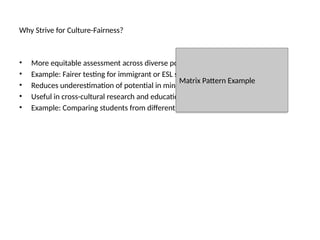
Matrix Pattern Example
7.
Challenges and Debates
•True 'culture-free' tests may not exist.
• Example: Visual familiarity can differ across cultures.
• Cultural loading in administration and interpretation.
• Example: Timed tests may affect performance differently.
• Predictive validity concerns in real-world environments.
• Example: May not predict success in language-heavy contexts.
8.
Moving Toward MoreEquitable Assessment
• Culture-fair tests aim to reduce bias in intelligence testing.
• They offer a useful supplement or alternative to traditional IQ tests.
• Ongoing development of culturally sensitive assessments is crucial.
9.
Questions & Discussion
•Feel free to ask questions about culture-fair testing, its uses, and its challenges.



![How Big Brands are Taking Your Traffic in Alberta [Data Inside].pptx](https://cdn.slidesharecdn.com/ss_thumbnails/howbigbrandsaretakingyourtrafficinalbertadatainside-260123180142-42d276f3-thumbnail.jpg?width=640&height=640&fit=bounds)


