Introduction to
Anticancer Chemotherapy
Topics
 Cell cycle
 Classification of cancer chemotherapy
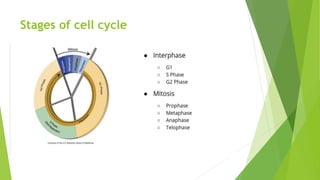
Stages of cell cycle
Interphase
 Interphase is the part of the cell cycle in which the cell
grows, replicates its
DNA and synthesizes new proteins in preparation for
mitosis.
 Cells which are constantly dividing have a relatively short
interphase period, while cells that do not divide, are
permanently stuck in interphase (quiescence).
 Cells which do not divide are permanently stuck in a special
stage of interphase called GO.
Interphase
 G1 (Growth Phase 1) - Cell grows and synthesizes proteins
required for
DNA replication.
 S (Synthesis Phase) - DNA is replicated.
 G2 (Growth Phase 2) - Cell synthesizes proteins required
for mitosis.
 GO - (Resting Phase) - Cell is not preparing for replication.
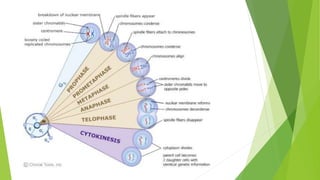
Mitosis
 Mitosis is the part of the cell cycle in which the nucleus and
cytoplasm of a parent cell split into two genetically identical
cells (daughter cells).
 Mitosis always produces cells which are genetically
identical to the parent cell.
 Errors in mitosis can lead to inhibition of cell division and
therefore the cell cycle, cell death and genetic mutations
(aneuploidy).
Mitosis
Significance of Mitosis
 Once mitosis has occurred, any DNA changes or mutations
which were not corrected prior to mitosis become
permanent.
 For this reason, mitosis can be thought as an endpoint in
the steps of the cell cycle.
 Throughout the steps of the cell cycle, there are various
quality control checkpoints which ensure that mitosis only
occurs once the cell is free of DNA mutations.
Regulation of cell cycle
Promoters (oncogenes)
 Cyclins ( E,D,A,B).
 Cyclin dependent kinases.
 Together forming
(cyclin+CDKS complex.
Inhibitors (tumour
suppressor genes)
 Retinoblastoma gene
 P53 gene
Classification of cancer chemtherapy
Cell cycle specificty
 Cell cycle specific
(actively dividing cells).
 Cell cycle non specific
(resting & actively
dividing cells).
Mechanism of action
 Alkylating agents.
 Antimetabolites.
 Antibiotics.
 Etc…….
Cell cycle phase specific
 G1- L asparagenase
 S - Methotrexate
6-Mercaptopurine
5-Fluorouracil
 G2 -Bleomycin Etoposide,
Topotecan Daunorubicin
 M - Vincristine
Vinblastine,Paclitaxel,
Docetaxel
Cell cycle phase non specific
 Cyclophosphamide
 Chlorambucil
 Cisplatin
 Actinomvcin-D
 L-Asparaginase
Classification of cancer chemotherapy
Thank you

CTH lecture .pptx

  • 1.
  • 2.
    Topics  Cell cycle Classification of cancer chemotherapy
  • 3.
  • 4.
    Interphase  Interphase isthe part of the cell cycle in which the cell grows, replicates its DNA and synthesizes new proteins in preparation for mitosis.  Cells which are constantly dividing have a relatively short interphase period, while cells that do not divide, are permanently stuck in interphase (quiescence).  Cells which do not divide are permanently stuck in a special stage of interphase called GO.
  • 5.
    Interphase  G1 (GrowthPhase 1) - Cell grows and synthesizes proteins required for DNA replication.  S (Synthesis Phase) - DNA is replicated.  G2 (Growth Phase 2) - Cell synthesizes proteins required for mitosis.  GO - (Resting Phase) - Cell is not preparing for replication.
  • 6.
    Mitosis  Mitosis isthe part of the cell cycle in which the nucleus and cytoplasm of a parent cell split into two genetically identical cells (daughter cells).  Mitosis always produces cells which are genetically identical to the parent cell.  Errors in mitosis can lead to inhibition of cell division and therefore the cell cycle, cell death and genetic mutations (aneuploidy).
  • 7.
  • 8.
    Significance of Mitosis Once mitosis has occurred, any DNA changes or mutations which were not corrected prior to mitosis become permanent.  For this reason, mitosis can be thought as an endpoint in the steps of the cell cycle.  Throughout the steps of the cell cycle, there are various quality control checkpoints which ensure that mitosis only occurs once the cell is free of DNA mutations.
  • 12.
    Regulation of cellcycle Promoters (oncogenes)  Cyclins ( E,D,A,B).  Cyclin dependent kinases.  Together forming (cyclin+CDKS complex. Inhibitors (tumour suppressor genes)  Retinoblastoma gene  P53 gene
  • 14.
    Classification of cancerchemtherapy Cell cycle specificty  Cell cycle specific (actively dividing cells).  Cell cycle non specific (resting & actively dividing cells). Mechanism of action  Alkylating agents.  Antimetabolites.  Antibiotics.  Etc…….
  • 15.
    Cell cycle phasespecific  G1- L asparagenase  S - Methotrexate 6-Mercaptopurine 5-Fluorouracil  G2 -Bleomycin Etoposide, Topotecan Daunorubicin  M - Vincristine Vinblastine,Paclitaxel, Docetaxel Cell cycle phase non specific  Cyclophosphamide  Chlorambucil  Cisplatin  Actinomvcin-D  L-Asparaginase Classification of cancer chemotherapy
  • 18.