Amity Business School
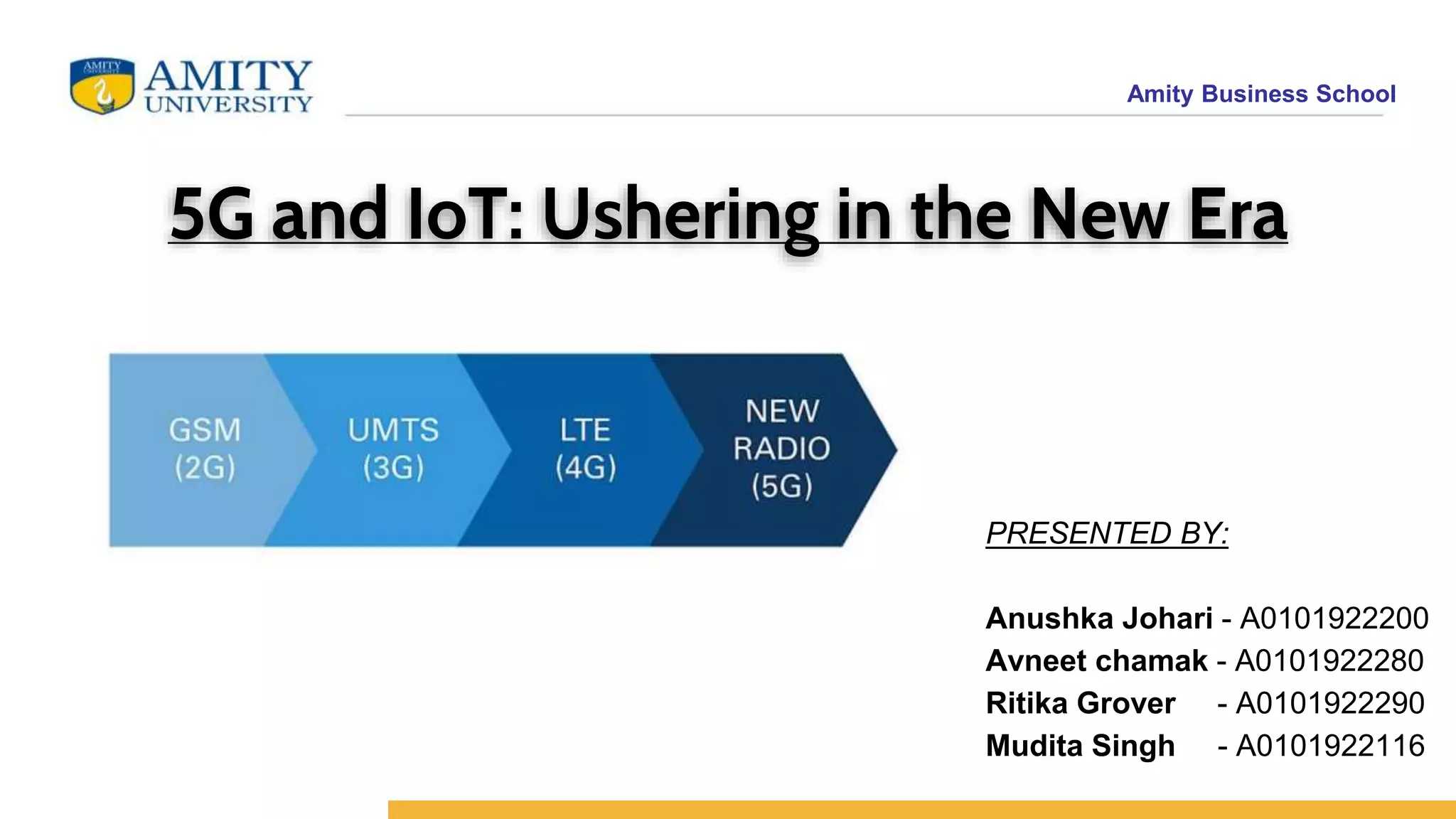
5G and IoT: Ushering in the New Era
PRESENTED BY:
Anushka Johari - A0101922200
Avneet chamak - A0101922280
Ritika Grover - A0101922290
Mudita Singh - A0101922116
Amity Business School
INTRODUCTION
• 5G stands for 5th generation mobile networks.
After 1G, 2G, 3G, and 4G networks, this is a new
global wireless standard. In 5G, virtually everything
and everyone is connected, including machines,
objects, and devices.
• A 5G network offers a unified, more capable air
interface. This platform is designed with the
capability to provide next-generation user
experiences, empower new deployment models,
and deliver new services.
• It will effortlessly connect a vast number of
embedded sensors in nearly everything for
exceptionally lean and low-cost connectivity by
scaling down data rates, power, and mobility
Amity Business School
CONTEXT
• 5G technology will be increasing the data transmitted speed because we will be using
advanced antenna technology.This functionality allows our mobile devices to make several
network connections on a single network.
• A self-driving car, for example, will use numerous networks at each different area, therefore
we will have many antennas at each different position so that we can use or connect with
that antenna, and 5G technology is beneficial to provide a stronger connection for these
types of objectives.
• IoT has numerous real-world applications, it can be utilized by companies, manufacturing,
and industrial purposes.
• IoT can also be used in healthcare,it offers numerous advantages, including the ability to
implant sensors inside patients' bodies to monitor their health. Hospitals have already begun
to deploy IoT devices to improve patient health.
Amity Business School
Impact and Importance of 5G on IoT
• A disconnected system makes a major challenge for IoT technologies.
• The ability of 5G to transmit data more quickly and support further links can benefit at once to
address the present challenge and simplify the connected device control.
• Now, we discuss the impact and importance of 5G on IoT with its applications. As IoT is
more established and essential due to the rapid growth of 5G, we discuss the establishment
and necessity of IoT over 5G. Lastly, we focus on the aspect of IoT on updated 5G
technology.
HOW 5G WORKS?
• Fourth-generation (4G) Long-Term Evolution (LTE) wireless technology provides the
foundation for 5G.
• Unlike 4G, which requires large, high-power cell towers to radiate signals over longer
distances, 5G wireless signals are transmitted through large numbers of small cell stations
located in places like light poles or building roofs.
Amity Business School
What does 5G mean for the IoT?
• The 5G wireless networks will produce the ideal telecom environment for IoT devices to
operate at their peak efficiency and provide the most benefits.
• More real-time connections will be made possible, in particular, because of the high 5G
speeds and omnipresence.
• Another benefit of 5G for IoT is its low latency. Requests will be handled more quickly by
machines. They will be able to “communicate” with one another more successfully as a
result, and there will be almost no delays.
What advantage will 5G bring with IoT?
• The main advantages of the 5G are a greater speed in the transmissions, lower latency and
therefore greater capacity of remote execution, a greater number of connected devices, and
the possibility of implementing virtual networks (network slicing), providing more adjusted
connectivity to concrete needs.
Amity Business School
The Internet of Things (IoT) has many uses in 5G,
including:
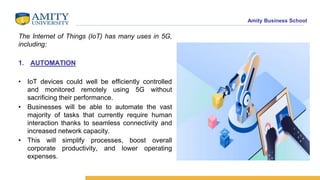
1. AUTOMATION
• IoT devices could well be efficiently controlled
and monitored remotely using 5G without
sacrificing their performance.
• Businesses will be able to automate the vast
majority of tasks that currently require human
interaction thanks to seamless connectivity and
increased network capacity.
• This will simplify processes, boost overall
corporate productivity, and lower operating
expenses.
Amity Business School
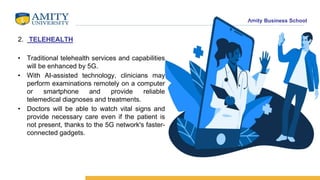
2. TELEHEALTH
• Traditional telehealth services and capabilities
will be enhanced by 5G.
• With AI-assisted technology, clinicians may
perform examinations remotely on a computer
or smartphone and provide reliable
telemedical diagnoses and treatments.
• Doctors will be able to watch vital signs and
provide necessary care even if the patient is
not present, thanks to the 5G network's faster-
connected gadgets.
Amity Business School
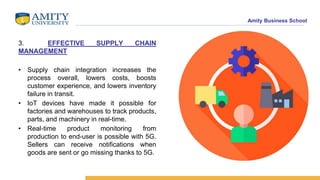
3. EFFECTIVE SUPPLY CHAIN
MANAGEMENT
• Supply chain integration increases the
process overall, lowers costs, boosts
customer experience, and lowers inventory
failure in transit.
• IoT devices have made it possible for
factories and warehouses to track products,
parts, and machinery in real-time.
• Real-time product monitoring from
production to end-user is possible with 5G.
Sellers can receive notifications when
goods are sent or go missing thanks to 5G.
Amity Business School
Impact of 5G and IoT on Industry 4.0
• The role of 5G and the opportunities for better ROI with Industry 4.0 are tremendous
because of the benefits offered by the technology. Industry 4.0 technologies enhance
automation, decision-making, machine-to-machine communication, and manufacturing
oversight.
• Manufacturing has evolved over the course of centuries from the days of handmade goods to
the adoption of water- and steam-powered machines, the invention of mass production, the
introduction of electronic automation, and now beyond. Today, the benchmark for companies
to keep up with, is Industry 4.0. Here, Manufacturing systems go beyond simple connection,
to also communicate, analyse and use collected information to drive further intelligent
actions.
• The proposed features of 5G technologies are listed and described how these features
impact the Industries of the future, leading to Industries 4.0. 5G promises to be a key enabler
for Factories of the Future, providing unified communication platform needed to disrupt with
new business models and to overcome the shortcomings of current communication
technologies.
Amity Business School
FUTURE OUTLOOK
Three ways 5G is more likely to impact the future of work
1. More Jobs
• Currently, machines in factories send and receive data via slow, low-bandwidth, high latency
disparate networks. 5G will likely replace technologies like Ethernet, WiFi, and 4G LTE,
making it more cost-effective to buy and set up robots. The end result is likely smarter
factories with more automation.
• For example, 5G has transformed a new Ericsson factory in Lewisville, Texas. There, remote
support personnel assist on-site workers via augmented reality and remote pilots guide
automated guided vehicles (AGVs) and drones around the facility, all using 5G.
2. Better Jobs
• People also expects the jobs created by 5G to be higher paying than the ones we’ll likely
lose to automation.
• Engineers and software developers are going to be in especially high demand to make 5G a
reality.
Amity Business School
3. Reduce Inequality
• Economic inequality in
America is growing and is the
highest of all the G7 nations.
Meanwhile, economic
mobility in the US has
been flat (or declining) for
decades and is lower than
similar countries.
• The vast majority of new high-
paying jobs go to high-skill
workers like software
developers.
Amity Business School
CONCLUSION
• 5G provides a range of benefits which are not available with other technologies. These
include 5G’s flexibility to support a massive number of static and mobile IoT devices, which
have a diverse range of speed, bandwidth and quality of service requirements.
• 5G will support critical communications with even more rigorous performance requirements.
• 5G’s ultra-reliability and low latency could help make self-driving cars, smart energy grids,
enhanced factory automation and other advanced applications a reality.
• Cloud computing, artificial intelligence and edge computing will also help to handle the data
volumes generated by the IoT.
• A global technology, 5G is being implemented consistently using 3GPP international
standards. It has been developed to ensure support for the IoT and it continues to evolve
with ongoing enhancements to agreed standards
Amity Business School
THANK YOU ALL!

CSIT PSDA - 3.pptx

  • 1.
    Amity Business School 5Gand IoT: Ushering in the New Era PRESENTED BY: Anushka Johari - A0101922200 Avneet chamak - A0101922280 Ritika Grover - A0101922290 Mudita Singh - A0101922116
  • 2.
    Amity Business School INTRODUCTION •5G stands for 5th generation mobile networks. After 1G, 2G, 3G, and 4G networks, this is a new global wireless standard. In 5G, virtually everything and everyone is connected, including machines, objects, and devices. • A 5G network offers a unified, more capable air interface. This platform is designed with the capability to provide next-generation user experiences, empower new deployment models, and deliver new services. • It will effortlessly connect a vast number of embedded sensors in nearly everything for exceptionally lean and low-cost connectivity by scaling down data rates, power, and mobility
  • 3.
    Amity Business School CONTEXT •5G technology will be increasing the data transmitted speed because we will be using advanced antenna technology.This functionality allows our mobile devices to make several network connections on a single network. • A self-driving car, for example, will use numerous networks at each different area, therefore we will have many antennas at each different position so that we can use or connect with that antenna, and 5G technology is beneficial to provide a stronger connection for these types of objectives. • IoT has numerous real-world applications, it can be utilized by companies, manufacturing, and industrial purposes. • IoT can also be used in healthcare,it offers numerous advantages, including the ability to implant sensors inside patients' bodies to monitor their health. Hospitals have already begun to deploy IoT devices to improve patient health.
  • 4.
    Amity Business School Impactand Importance of 5G on IoT • A disconnected system makes a major challenge for IoT technologies. • The ability of 5G to transmit data more quickly and support further links can benefit at once to address the present challenge and simplify the connected device control. • Now, we discuss the impact and importance of 5G on IoT with its applications. As IoT is more established and essential due to the rapid growth of 5G, we discuss the establishment and necessity of IoT over 5G. Lastly, we focus on the aspect of IoT on updated 5G technology. HOW 5G WORKS? • Fourth-generation (4G) Long-Term Evolution (LTE) wireless technology provides the foundation for 5G. • Unlike 4G, which requires large, high-power cell towers to radiate signals over longer distances, 5G wireless signals are transmitted through large numbers of small cell stations located in places like light poles or building roofs.
  • 5.
  • 6.
    Amity Business School Whatdoes 5G mean for the IoT? • The 5G wireless networks will produce the ideal telecom environment for IoT devices to operate at their peak efficiency and provide the most benefits. • More real-time connections will be made possible, in particular, because of the high 5G speeds and omnipresence. • Another benefit of 5G for IoT is its low latency. Requests will be handled more quickly by machines. They will be able to “communicate” with one another more successfully as a result, and there will be almost no delays. What advantage will 5G bring with IoT? • The main advantages of the 5G are a greater speed in the transmissions, lower latency and therefore greater capacity of remote execution, a greater number of connected devices, and the possibility of implementing virtual networks (network slicing), providing more adjusted connectivity to concrete needs.
  • 7.
    Amity Business School TheInternet of Things (IoT) has many uses in 5G, including: 1. AUTOMATION • IoT devices could well be efficiently controlled and monitored remotely using 5G without sacrificing their performance. • Businesses will be able to automate the vast majority of tasks that currently require human interaction thanks to seamless connectivity and increased network capacity. • This will simplify processes, boost overall corporate productivity, and lower operating expenses.
  • 8.
    Amity Business School 2.TELEHEALTH • Traditional telehealth services and capabilities will be enhanced by 5G. • With AI-assisted technology, clinicians may perform examinations remotely on a computer or smartphone and provide reliable telemedical diagnoses and treatments. • Doctors will be able to watch vital signs and provide necessary care even if the patient is not present, thanks to the 5G network's faster- connected gadgets.
  • 9.
    Amity Business School 3.EFFECTIVE SUPPLY CHAIN MANAGEMENT • Supply chain integration increases the process overall, lowers costs, boosts customer experience, and lowers inventory failure in transit. • IoT devices have made it possible for factories and warehouses to track products, parts, and machinery in real-time. • Real-time product monitoring from production to end-user is possible with 5G. Sellers can receive notifications when goods are sent or go missing thanks to 5G.
  • 10.
    Amity Business School Impactof 5G and IoT on Industry 4.0 • The role of 5G and the opportunities for better ROI with Industry 4.0 are tremendous because of the benefits offered by the technology. Industry 4.0 technologies enhance automation, decision-making, machine-to-machine communication, and manufacturing oversight. • Manufacturing has evolved over the course of centuries from the days of handmade goods to the adoption of water- and steam-powered machines, the invention of mass production, the introduction of electronic automation, and now beyond. Today, the benchmark for companies to keep up with, is Industry 4.0. Here, Manufacturing systems go beyond simple connection, to also communicate, analyse and use collected information to drive further intelligent actions. • The proposed features of 5G technologies are listed and described how these features impact the Industries of the future, leading to Industries 4.0. 5G promises to be a key enabler for Factories of the Future, providing unified communication platform needed to disrupt with new business models and to overcome the shortcomings of current communication technologies.
  • 11.
    Amity Business School FUTUREOUTLOOK Three ways 5G is more likely to impact the future of work 1. More Jobs • Currently, machines in factories send and receive data via slow, low-bandwidth, high latency disparate networks. 5G will likely replace technologies like Ethernet, WiFi, and 4G LTE, making it more cost-effective to buy and set up robots. The end result is likely smarter factories with more automation. • For example, 5G has transformed a new Ericsson factory in Lewisville, Texas. There, remote support personnel assist on-site workers via augmented reality and remote pilots guide automated guided vehicles (AGVs) and drones around the facility, all using 5G. 2. Better Jobs • People also expects the jobs created by 5G to be higher paying than the ones we’ll likely lose to automation. • Engineers and software developers are going to be in especially high demand to make 5G a reality.
  • 12.
    Amity Business School 3.Reduce Inequality • Economic inequality in America is growing and is the highest of all the G7 nations. Meanwhile, economic mobility in the US has been flat (or declining) for decades and is lower than similar countries. • The vast majority of new high- paying jobs go to high-skill workers like software developers.
  • 13.
    Amity Business School CONCLUSION •5G provides a range of benefits which are not available with other technologies. These include 5G’s flexibility to support a massive number of static and mobile IoT devices, which have a diverse range of speed, bandwidth and quality of service requirements. • 5G will support critical communications with even more rigorous performance requirements. • 5G’s ultra-reliability and low latency could help make self-driving cars, smart energy grids, enhanced factory automation and other advanced applications a reality. • Cloud computing, artificial intelligence and edge computing will also help to handle the data volumes generated by the IoT. • A global technology, 5G is being implemented consistently using 3GPP international standards. It has been developed to ensure support for the IoT and it continues to evolve with ongoing enhancements to agreed standards
  • 14.