Module 5
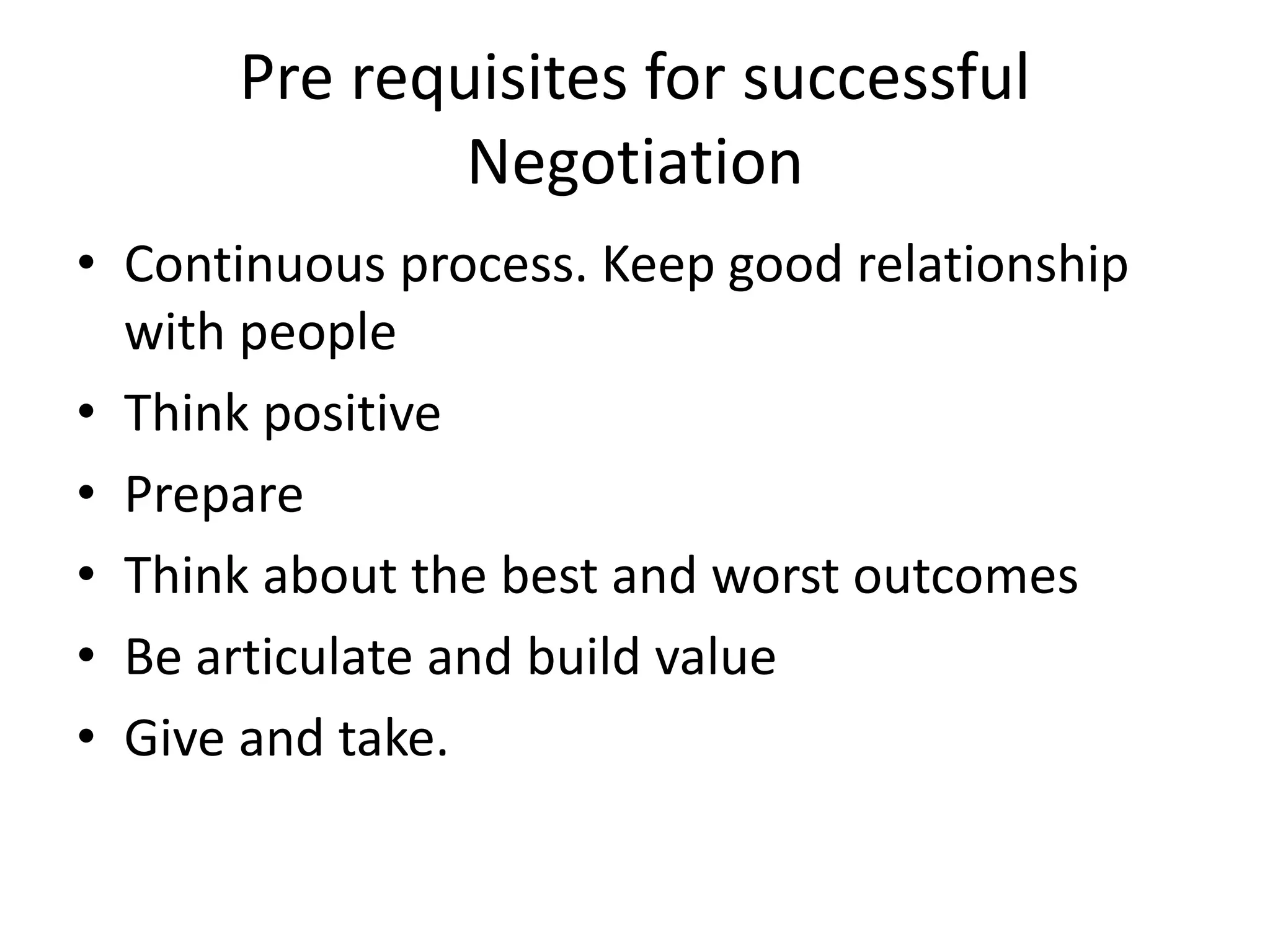
Pre requisites for successful
Negotiation
• Continuous process. Keep good relationship
with people
• Think positive
• Prepare
• Think about the best and worst outcomes
• Be articulate and build value
• Give and take.
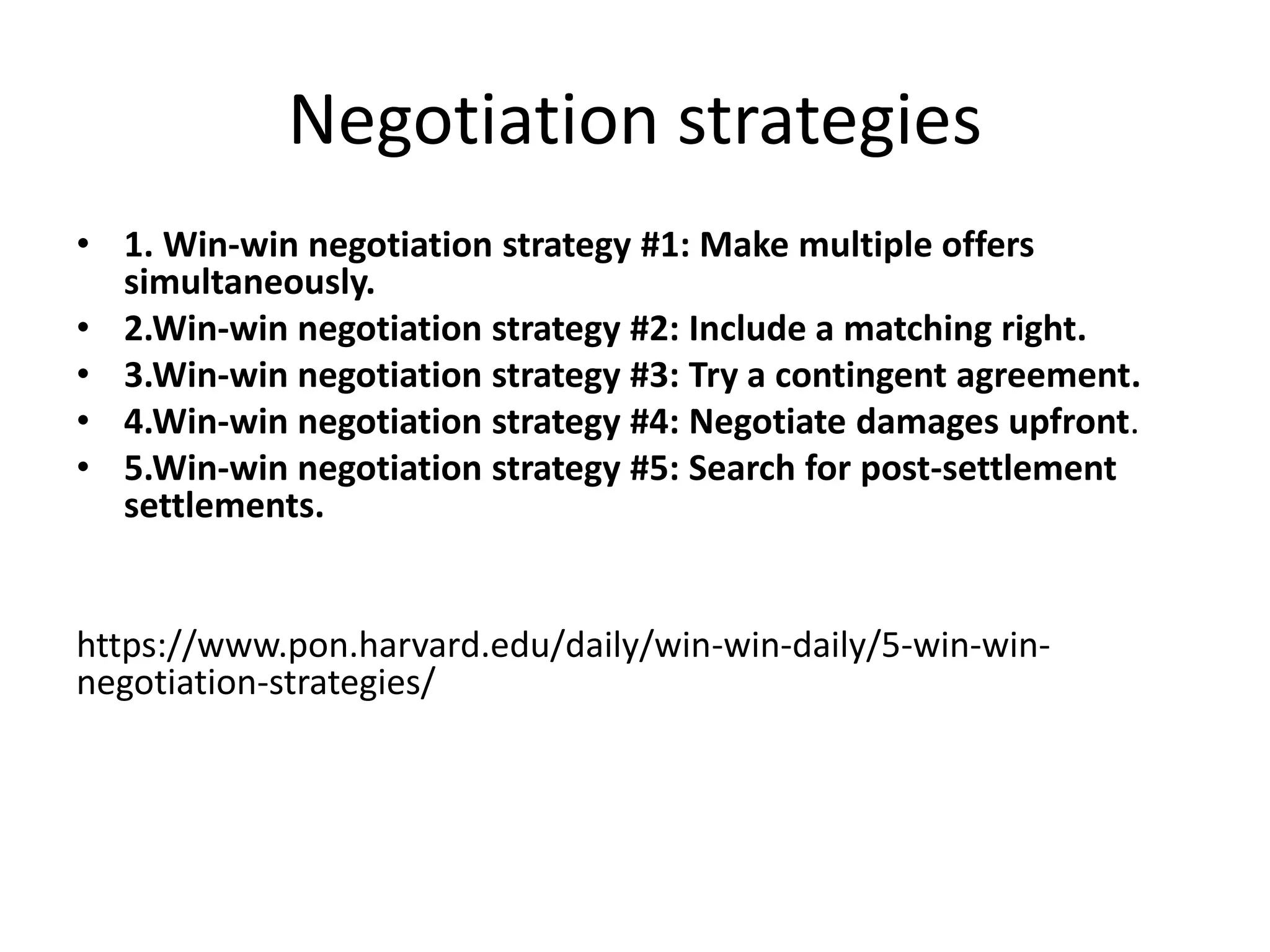
Negotiation strategies
• 1. Win-win negotiation strategy #1: Make multiple offers
simultaneously.
• 2.Win-win negotiation strategy #2: Include a matching right.
• 3.Win-win negotiation strategy #3: Try a contingent agreement.
• 4.Win-win negotiation strategy #4: Negotiate damages upfront.
• 5.Win-win negotiation strategy #5: Search for post-settlement
settlements.
https://www.pon.harvard.edu/daily/win-win-daily/5-win-win-
negotiation-strategies/
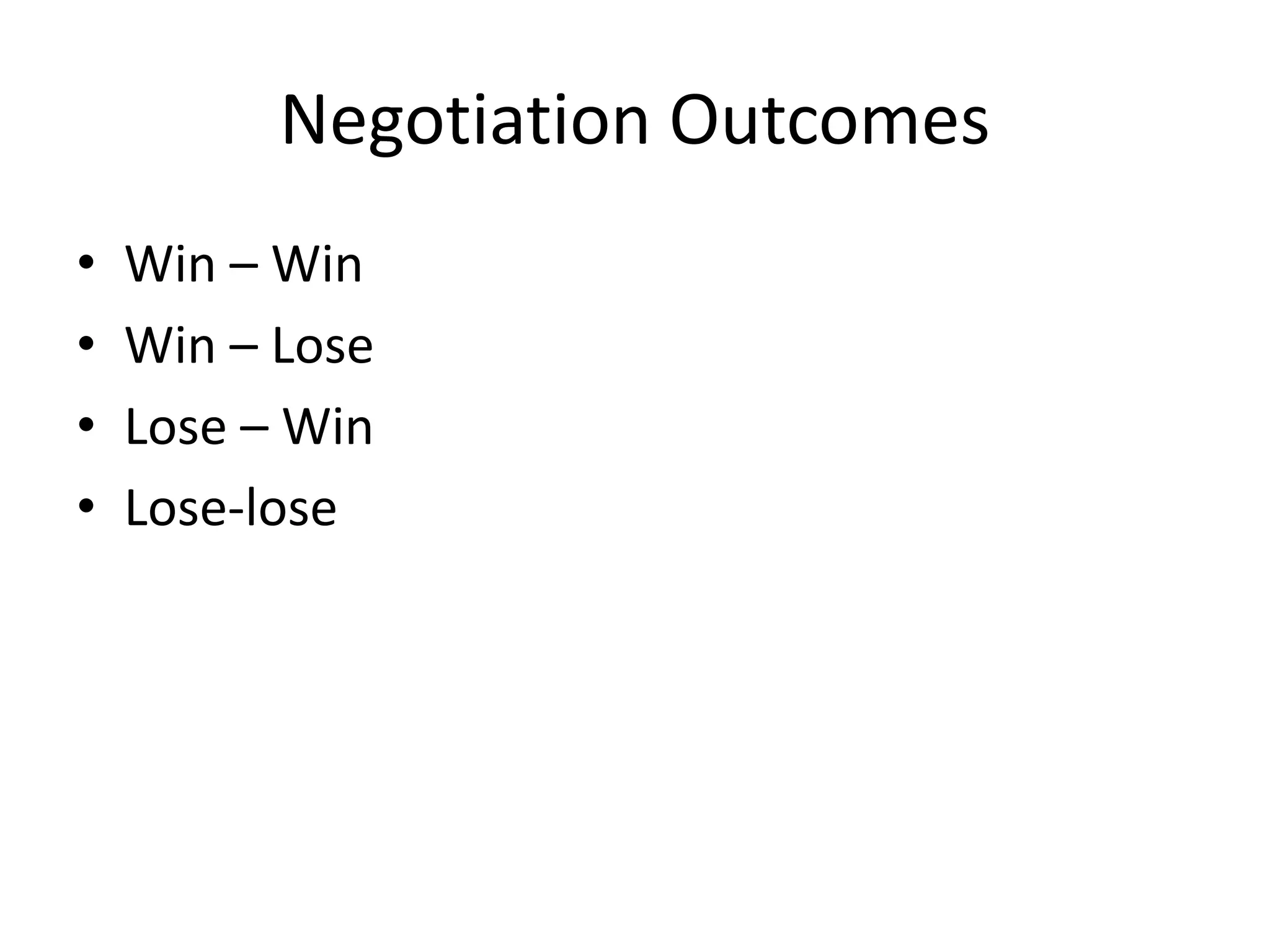
Negotiation Outcomes
• Win – Win
• Win – Lose
• Lose – Win
• Lose-lose
Negotiation Process
• Preparation Before negotiation
• During the negotiation
• Post negotiation
Role of communication in conflict
management
• Be very clear and straightforward what you expect from the
other person
• Don’t merely depend on verbal communication, instead
prefer communication through email keeping each and every
member in the loop
• Communication must not be done with members separately
but must be on a common platform so that every one gets the
same picture
• Never be loud and always be very careful about your pitch
and tone
• An individual must not assume things on his own and
overreact on petty issues
Communication for employment
• CV guidelines
• Application letter
Bio data, Resume, and CV
• Bio Data (“biographical” data)
• Resume:- A resume (or résumé, from French “to
sum up”) is a short, concise document used for
job applications in the US and Canada. The
purpose of a resume is to provide recruiters with
a brief overview of the candidate’s work history.
A good resume should be targeted at a specific
job and one to two pages long.
• Curriculum Vitae :- A CV (full form Curriculum
Vitae which is Latin for “course of life”) is an in-
depth document which describes the whole
course of your career in full detail.
Guidelines for CV
• Simple, readable and formatted properly
• Structured logically with good sequence
• Recruiter should be able to understand the contents
very simple.
• Use normal type of fonts and readable font size
• Use proper tense and avoid first person pronouns, ( I,
Me, My etc.)
• Avoid spelling and grammar errors
• Visually appealing
• Think about the person who read
• And tell what makes you different.
A standard format of a CV for a job
should include the following sections:
• Contact Information.
• Personal Statement.
• Professional Experience.
• Academic History.
• Key Skills and Qualifications.
• Industry Awards.
• Professional Certifications.
• Publications.
Social media
• Nature and types
• Choosing the right social medium
Discussion
• Types :- Twitter, Facebook, Instagram, Linkdin
Youtube, whats groups, snap chat, Telegram,
Botim, Youtube Channel
End of Module 5
All the best

CSD Module 5.pptx

  • 1.
  • 2.
    Pre requisites forsuccessful Negotiation • Continuous process. Keep good relationship with people • Think positive • Prepare • Think about the best and worst outcomes • Be articulate and build value • Give and take.
  • 3.
    Negotiation strategies • 1.Win-win negotiation strategy #1: Make multiple offers simultaneously. • 2.Win-win negotiation strategy #2: Include a matching right. • 3.Win-win negotiation strategy #3: Try a contingent agreement. • 4.Win-win negotiation strategy #4: Negotiate damages upfront. • 5.Win-win negotiation strategy #5: Search for post-settlement settlements. https://www.pon.harvard.edu/daily/win-win-daily/5-win-win- negotiation-strategies/
  • 4.
    Negotiation Outcomes • Win– Win • Win – Lose • Lose – Win • Lose-lose
  • 5.
    Negotiation Process • PreparationBefore negotiation • During the negotiation • Post negotiation
  • 6.
    Role of communicationin conflict management • Be very clear and straightforward what you expect from the other person • Don’t merely depend on verbal communication, instead prefer communication through email keeping each and every member in the loop • Communication must not be done with members separately but must be on a common platform so that every one gets the same picture • Never be loud and always be very careful about your pitch and tone • An individual must not assume things on his own and overreact on petty issues
  • 7.
    Communication for employment •CV guidelines • Application letter
  • 8.
    Bio data, Resume,and CV • Bio Data (“biographical” data) • Resume:- A resume (or résumé, from French “to sum up”) is a short, concise document used for job applications in the US and Canada. The purpose of a resume is to provide recruiters with a brief overview of the candidate’s work history. A good resume should be targeted at a specific job and one to two pages long. • Curriculum Vitae :- A CV (full form Curriculum Vitae which is Latin for “course of life”) is an in- depth document which describes the whole course of your career in full detail.
  • 9.
    Guidelines for CV •Simple, readable and formatted properly • Structured logically with good sequence • Recruiter should be able to understand the contents very simple. • Use normal type of fonts and readable font size • Use proper tense and avoid first person pronouns, ( I, Me, My etc.) • Avoid spelling and grammar errors • Visually appealing • Think about the person who read • And tell what makes you different.
  • 10.
    A standard formatof a CV for a job should include the following sections: • Contact Information. • Personal Statement. • Professional Experience. • Academic History. • Key Skills and Qualifications. • Industry Awards. • Professional Certifications. • Publications.
  • 11.
    Social media • Natureand types • Choosing the right social medium
  • 12.
    Discussion • Types :-Twitter, Facebook, Instagram, Linkdin Youtube, whats groups, snap chat, Telegram, Botim, Youtube Channel
  • 13.
    End of Module5 All the best