CS 134
Web Site
Design & Development
Class Overview & Introduction
Spring 2016; John Knox
About Me
• John Knox
• Staff member & Instructor at
University of Pittsburgh
• In addition to teaching, I develop and maintain
databases and web applications at the School of Arts
& Sciences
• First time teaching this course, but I’ve taught both
earlier and later web design courses.
How about you?
• Introduce yourself
▫ Name & Major
▫ Why did you pick this class?
About the Class
• CS 134 is an intro web-design course.
• We will learn:
▫ HTML5 & CSS3
▫ Basic web design (methods, and how things work)
▫ Basics of client-side scripting with JavaScript &
jQuery
About the Class
• Class Website:
http://www.pitt.edu/~jknoxiii/cs134
▫ Schedule, Notes, Labs will be updated
and posted as we go
▫ Useful resources and links
▫ Check it regularly
▫ Syllabus
Class Structure:
• SENSQ 5505, Mon & Wed, 6:00 – 7:15 PM
• We’ll start with lecture and end with labs when we
have them.
• Office hours will be right after class each day in the
classroom
▫ This will also allow us to extend labs if we want to.
▫ If you need me outside this period, please feel free to
contact me. We might be able to meet in SENSQ 6148.
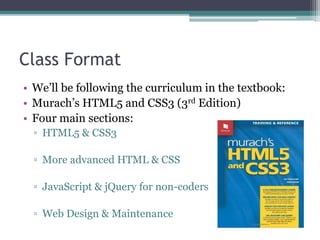
Class Format
• We’ll be following the curriculum in the textbook:
• Murach’s HTML5 and CSS3 (3rd Edition)
• Four main sections:
▫ HTML5 & CSS3
▫ More advanced HTML & CSS
▫ JavaScript & jQuery for non-coders
▫ Web Design & Maintenance
What the class does:
• Provides basic, marketable skills enough to be able
to create a simple, static website at a professional
level by hand.
▫ Company informational homepage
▫ Personal website / resume / portfolio
• Allow you to make sites look good on various screen
sizes and on mobile devices.
• Teaches you some basic coding skills to make sites
that are interactive on the client-side (in the
browser).
What this class doesn’t do:
• Simply have you create a website with a drag-and-
drop WYSIWYG editor or content management
system (Dreamweaver, MS Word, or Wordpress)
• Teach you to make web applications that interact on
the server-side or databases. (e.g. eCommerce sites,
forums, etc.)
▫ For a more code-centric course try CS 334.
• Journalism, graphic design, or particularly content
focused. We will learn the structure and patterns,
you can fill that structure with what interests you.
Class Topics
• The first section on HTML & CSS basics (ch 1-8),
we’ll do in its entirety before the mid-term
• The chapters in the final three sections are meant to
go in any order and we may not get to all of them.
• We can prioritize and focus on the topics that
interest you most.
• I’ll update the schedule based on feedback from you.
Topics we can focus on:
• Working with embedded media (audio & video)
• Working with fonts & printing
• Adding transitions & animations
• Working with JavaScript & interactive forms
• Working with jQuery libraries for fancy UI
• Focusing more on design, user experience, & web maintenance
mechanics
• Look at the book’s table of contents, and let me know what interests
you in the questionnaire.
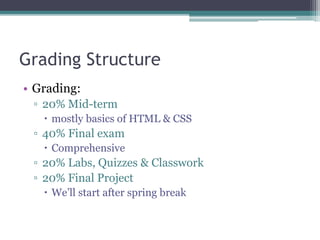
Grading Structure
• Grading:
▫ 20% Mid-term
 mostly basics of HTML & CSS
▫ 40% Final exam
 Comprehensive
▫ 20% Labs, Quizzes & Classwork
▫ 20% Final Project
 We’ll start after spring break
Labs & Assignments
• After lecture we will sometimes have lab assignments
that you can work on in class.
• They will likely be similar to, but not the same as the
exercises in the book (which have solutions you can
study).
• We will plan to use Box for collecting assignments, but
may need to use USB drives in a pinch.
• Assignments are due at the beginning of class on their
due dates. Any extensions need to have a very good
reason and be agreed to before the due date.
Quizzes
• We will have three small quizzes to reinforce
material and let you know what you need to study.
• When we have them I will announce them at least a
week ahead of time in class, and on the website. I’ll
also send out an e-mail.
• Your lowest quiz score will be dropped, and you’ll be
graded on your better two. If you miss a quiz, that
will be the one dropped.
Exams
• We’ll have two exams:
▫ Mid Term (before spring break)
 This will definitely cover the core first section of the
book, and may include topics we hit afterward.
▫ Final Exam
 This will be comprehensive (covering the whole
class), but the core we learned is essential for later
topics anyway. We’ll focus mostly on the newer
material.
Attendance
• Attendance won’t be graded in this class, but is
highly recommended.
• You are responsible for knowing what we go over
in class and encouraged to make use of lab time.
Academic Integrity
• Students must adhere to the university guidelines on
academic integrity.
• Don’t cheat. Don’t copy-paste large swathes of code in
projects. Doing so, will result in a 0 score.
• In this class we do encourage the use of templates and
collaboration, but clearly indicate when you use external
resources, and be sure the bulk of the work is your own.
• You’ll be responsible for knowing the theory in any case.
Any Questions?
• From here, we will start with the basics of how
the web works, and move on to HTML & CSS.
• I look forward to a great year together in this
class!

CS134 - 1 - Overview for CS Student.pptx

  • 1.
    CS 134 Web Site Design& Development Class Overview & Introduction Spring 2016; John Knox
  • 2.
    About Me • JohnKnox • Staff member & Instructor at University of Pittsburgh • In addition to teaching, I develop and maintain databases and web applications at the School of Arts & Sciences • First time teaching this course, but I’ve taught both earlier and later web design courses.
  • 3.
    How about you? •Introduce yourself ▫ Name & Major ▫ Why did you pick this class?
  • 4.
    About the Class •CS 134 is an intro web-design course. • We will learn: ▫ HTML5 & CSS3 ▫ Basic web design (methods, and how things work) ▫ Basics of client-side scripting with JavaScript & jQuery
  • 5.
    About the Class •Class Website: http://www.pitt.edu/~jknoxiii/cs134 ▫ Schedule, Notes, Labs will be updated and posted as we go ▫ Useful resources and links ▫ Check it regularly ▫ Syllabus
  • 6.
    Class Structure: • SENSQ5505, Mon & Wed, 6:00 – 7:15 PM • We’ll start with lecture and end with labs when we have them. • Office hours will be right after class each day in the classroom ▫ This will also allow us to extend labs if we want to. ▫ If you need me outside this period, please feel free to contact me. We might be able to meet in SENSQ 6148.
  • 7.
    Class Format • We’llbe following the curriculum in the textbook: • Murach’s HTML5 and CSS3 (3rd Edition) • Four main sections: ▫ HTML5 & CSS3 ▫ More advanced HTML & CSS ▫ JavaScript & jQuery for non-coders ▫ Web Design & Maintenance
  • 8.
    What the classdoes: • Provides basic, marketable skills enough to be able to create a simple, static website at a professional level by hand. ▫ Company informational homepage ▫ Personal website / resume / portfolio • Allow you to make sites look good on various screen sizes and on mobile devices. • Teaches you some basic coding skills to make sites that are interactive on the client-side (in the browser).
  • 9.
    What this classdoesn’t do: • Simply have you create a website with a drag-and- drop WYSIWYG editor or content management system (Dreamweaver, MS Word, or Wordpress) • Teach you to make web applications that interact on the server-side or databases. (e.g. eCommerce sites, forums, etc.) ▫ For a more code-centric course try CS 334. • Journalism, graphic design, or particularly content focused. We will learn the structure and patterns, you can fill that structure with what interests you.
  • 10.
    Class Topics • Thefirst section on HTML & CSS basics (ch 1-8), we’ll do in its entirety before the mid-term • The chapters in the final three sections are meant to go in any order and we may not get to all of them. • We can prioritize and focus on the topics that interest you most. • I’ll update the schedule based on feedback from you.
  • 11.
    Topics we canfocus on: • Working with embedded media (audio & video) • Working with fonts & printing • Adding transitions & animations • Working with JavaScript & interactive forms • Working with jQuery libraries for fancy UI • Focusing more on design, user experience, & web maintenance mechanics • Look at the book’s table of contents, and let me know what interests you in the questionnaire.
  • 12.
    Grading Structure • Grading: ▫20% Mid-term  mostly basics of HTML & CSS ▫ 40% Final exam  Comprehensive ▫ 20% Labs, Quizzes & Classwork ▫ 20% Final Project  We’ll start after spring break
  • 13.
    Labs & Assignments •After lecture we will sometimes have lab assignments that you can work on in class. • They will likely be similar to, but not the same as the exercises in the book (which have solutions you can study). • We will plan to use Box for collecting assignments, but may need to use USB drives in a pinch. • Assignments are due at the beginning of class on their due dates. Any extensions need to have a very good reason and be agreed to before the due date.
  • 14.
    Quizzes • We willhave three small quizzes to reinforce material and let you know what you need to study. • When we have them I will announce them at least a week ahead of time in class, and on the website. I’ll also send out an e-mail. • Your lowest quiz score will be dropped, and you’ll be graded on your better two. If you miss a quiz, that will be the one dropped.
  • 15.
    Exams • We’ll havetwo exams: ▫ Mid Term (before spring break)  This will definitely cover the core first section of the book, and may include topics we hit afterward. ▫ Final Exam  This will be comprehensive (covering the whole class), but the core we learned is essential for later topics anyway. We’ll focus mostly on the newer material.
  • 16.
    Attendance • Attendance won’tbe graded in this class, but is highly recommended. • You are responsible for knowing what we go over in class and encouraged to make use of lab time.
  • 17.
    Academic Integrity • Studentsmust adhere to the university guidelines on academic integrity. • Don’t cheat. Don’t copy-paste large swathes of code in projects. Doing so, will result in a 0 score. • In this class we do encourage the use of templates and collaboration, but clearly indicate when you use external resources, and be sure the bulk of the work is your own. • You’ll be responsible for knowing the theory in any case.
  • 18.
    Any Questions? • Fromhere, we will start with the basics of how the web works, and move on to HTML & CSS. • I look forward to a great year together in this class!