SMART CONTRACT AUDIT REPORT
For
Crypto Miner Token (Order #FO711C99)
Prepared By: Yogesh Padsala Prepared For: CryptoCloud solutions
Prepared on: 04/10/2018 https://minertoken.cloud
audit@etherauthority.io
Ether Authority Limited (www.EtherAuthority.io)
Table of Content
1. Disclaimer
2. Overview of the audit
3. Attacks made to the contract
4. Good things in smart contract
5. Critical vulnerabilities found in the contract
6. Medium vulnerabilities found in the contract
7. Low severity vulnerabilities found in the contract
8. Discussions and improvements
9. Summary of the audit
Ether Authority Limited (www.EtherAuthority.io)
1. Disclaimer
The audit makes no statements or warranties about utility of the code, safety
of the code, suitability of the business model, regulatory regime for the
business model, or any other statements about fitness of the contracts to
purpose, or their bug free status. The audit documentation is for discussion
purposes only.
2. Overview of the audit
The project has following file:
• CryptoMinerToken.sol
It contains approx 343 lines of Solidity code. All the functions and state
variables are not well commented using the natspec documentation. However,
that does not raise any vulnerability. It just increases the readability.
The audit was performed by Yogesh Padsala, from Ether Authority Limited.
Yogesh has extensive work experience of developing and auditing the smart
contracts.
The audit was based on the solidity compiler 0.4.25+commit.59dbf8f1 with
optimization enabled compiler in remix.ethereum.org
This audit was also performed the verification of the details exit in the main
website: https://minertoken.cloud
Ether Authority Limited (www.EtherAuthority.io)
3. Attacks tested on the contract
In order to check for the security of the contract, we tested several attacks in
order to make sure that the contract is secure and follows best practices.
3.1: Over and under flows
This contract does check for overflows and underflows by using
OpenZeppelin's SafeMath to mitigate this attack, and all the functions have
strong validations, which prevented this attack.
3.2: Short address attack
Although this contract is not vulnerable to this attack, It is highly
recommended to call functions after checking validity of the address from the
outside client.
3.3: Visibility & Delegatecall
No such issues found in this smart contract and visibility also properly
addressed.
3.4: Reentrancy / TheDAO hack
Use of “require” function and Checks-Effects-Interactions pattern in this smart
contract mitigated this vulnerability.
3.5: Forcing ether to a contract
Here, the Smart Contract’s balance has never been used as guard, which
mitigated this vulnerability
3.6: Denial Of Service (DOS)
There is no process consuming loops in the contracts which can be used for
DoS attacks. Also, there is no progressing state based on external calls, and
thus this contract is not prone to DoS.
Ether Authority Limited (www.EtherAuthority.io)
4. Good things in the smart contract
4.1 Checks-Effects-Interactions pattern
While transferring ether, this contract does all the process first and then
transfers the ether. This is very good practice which prevents reentrancy
possibility. The functions are: exit() and withdraw().
4.2 Declaring the variable as constant
If the state variables are not supposed to be changed, then it is good
practice to declare them as constant. It saves less gas compared to
the variables which are not declared as constant.
4.3 Minimum data stored in the contract
This contract stores very minimum amount of data in the smart contract,
which is really good thing as that minimize the gas cost to users of the contract
down the road.
4.4 Good validations
This contract processes loop with good validations as well as functions are
having good require conditions.
4.4 Good things in the code
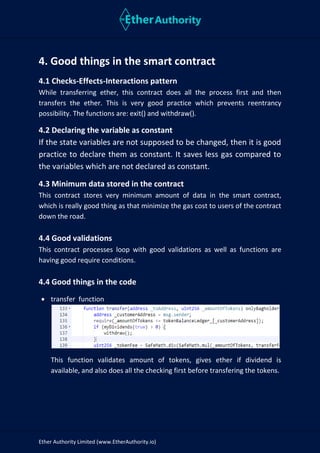
• transfer function
This function validates amount of tokens, gives ether if dividend is
available, and also does all the checking first before transfering the tokens.
Ether Authority Limited (www.EtherAuthority.io)
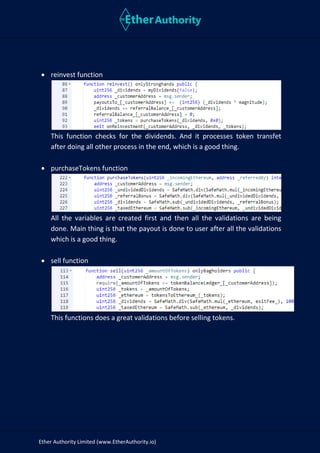
• reinvest function
This function checks for the dividends. And it processes token transfet
after doing all other process in the end, which is a good thing.
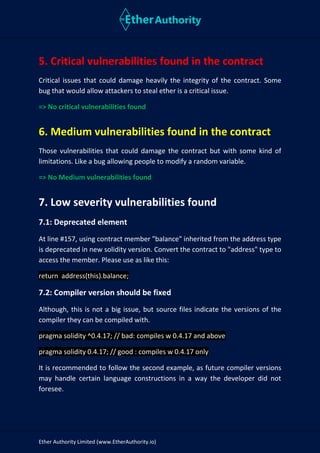
• purchaseTokens function
All the variables are created first and then all the validations are being
done. Main thing is that the payout is done to user after all the validations
which is a good thing.
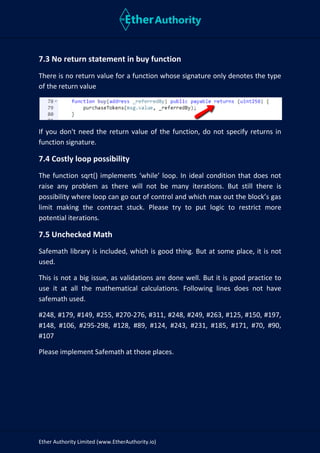
• sell function
This functions does a great validations before selling tokens.
Ether Authority Limited (www.EtherAuthority.io)
5. Critical vulnerabilities found in the contract
Critical issues that could damage heavily the integrity of the contract. Some
bug that would allow attackers to steal ether is a critical issue.
=> No critical vulnerabilities found
6. Medium vulnerabilities found in the contract
Those vulnerabilities that could damage the contract but with some kind of
limitations. Like a bug allowing people to modify a random variable.
=> No Medium vulnerabilities found
7. Low severity vulnerabilities found
7.1: Deprecated element
At line #157, using contract member "balance" inherited from the address type
is deprecated in new solidity version. Convert the contract to "address" type to
access the member. Please use as like this:
return address(this).balance;
7.2: Compiler version should be fixed
Although, this is not a big issue, but source files indicate the versions of the
compiler they can be compiled with.
pragma solidity ^0.4.17; // bad: compiles w 0.4.17 and above
pragma solidity 0.4.17; // good : compiles w 0.4.17 only
It is recommended to follow the second example, as future compiler versions
may handle certain language constructions in a way the developer did not
foresee.
Ether Authority Limited (www.EtherAuthority.io)
7.3 No return statement in buy function
There is no return value for a function whose signature only denotes the type
of the return value
If you don't need the return value of the function, do not specify returns in
function signature.
7.4 Costly loop possibility
The function sqrt() implements ‘while’ loop. In ideal condition that does not
raise any problem as there will not be many iterations. But still there is
possibility where loop can go out of control and which max out the block’s gas
limit making the contract stuck. Please try to put logic to restrict more
potential iterations.
7.5 Unchecked Math
Safemath library is included, which is good thing. But at some place, it is not
used.
This is not a big issue, as validations are done well. But it is good practice to
use it at all the mathematical calculations. Following lines does not have
safemath used.
#248, #179, #149, #255, #270-276, #311, #248, #249, #263, #125, #150, #197,
#148, #106, #295-298, #128, #89, #124, #243, #231, #185, #171, #70, #90,
#107
Please implement Safemath at those places.
Ether Authority Limited (www.EtherAuthority.io)
8. Discussions and improvements
8.1 Putting higher degree of control
It is good idea to put ability for owner to put safeguard in the code. So, let’s say
for example, there would be any un-intended event occurred in the future,
then owner can put a safeguard and which prevents all the process from
happening until the issue is resolved.
This can be easily achieved by declaring a variable for that, which can be used
in all the functions. Admin can make this variable true or false. Another way is
to create modifier for that and use it in every function.
8.2 Declaring custom function for require () validation
It is good idea to create a custom function for the require condition, and make
an Event to fire in case of failed “required” validation. It helps client to better
understand why any possible error occurred.
bool internal dorequireRevert; // <=== IMPORTANT DEBUG/REVERT SWITCH
// false => keep going but emit RequireFailed
// true => do the revert
function dorequire(bool testresult, string message) internal {
if (!testresult) {
emit RequireFailed(message);
if (dorequireRevert) {
require(false, message);
}
}
}
dorequire (1 != 0, "one is not equal zero!");
Ether Authority Limited (www.EtherAuthority.io)
8.3 Timestamp dependence awareness
This contract depends on the timestamp as places like #130 and #257. There is
nothing wrong in that but please be aware that the timestamp of the block can
be slightly manipulated by the miner.
8.4 Style guide violation
In Solidity, function and event names usually start with a lower- and uppercase
letter respectively:
function foo(); // good
event LogFoo(); // good
Violating the style guide decreases readability and may lead to confusion.
Thus, please follow the style guide at these lines: #27, #36, #44, #50
Ether Authority Limited (www.EtherAuthority.io)
9. Summary of the Audit
Overall the code performs good data validations as well as meets the
calculations according to the information presented in the website:
https://minertoken.cloud
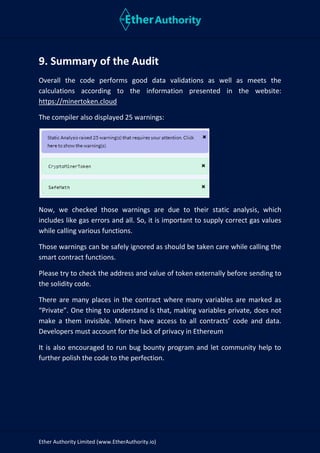
The compiler also displayed 25 warnings:
Now, we checked those warnings are due to their static analysis, which
includes like gas errors and all. So, it is important to supply correct gas values
while calling various functions.
Those warnings can be safely ignored as should be taken care while calling the
smart contract functions.
Please try to check the address and value of token externally before sending to
the solidity code.
There are many places in the contract where many variables are marked as
“Private”. One thing to understand is that, making variables private, does not
make a them invisible. Miners have access to all contracts’ code and data.
Developers must account for the lack of privacy in Ethereum
It is also encouraged to run bug bounty program and let community help to
further polish the code to the perfection.

Crypto Miner Token – Smart Contract Security Audit Report by EtherAuthority

  • 1.
    SMART CONTRACT AUDITREPORT For Crypto Miner Token (Order #FO711C99) Prepared By: Yogesh Padsala Prepared For: CryptoCloud solutions Prepared on: 04/10/2018 https://minertoken.cloud audit@etherauthority.io
  • 2.
    Ether Authority Limited(www.EtherAuthority.io) Table of Content 1. Disclaimer 2. Overview of the audit 3. Attacks made to the contract 4. Good things in smart contract 5. Critical vulnerabilities found in the contract 6. Medium vulnerabilities found in the contract 7. Low severity vulnerabilities found in the contract 8. Discussions and improvements 9. Summary of the audit
  • 3.
    Ether Authority Limited(www.EtherAuthority.io) 1. Disclaimer The audit makes no statements or warranties about utility of the code, safety of the code, suitability of the business model, regulatory regime for the business model, or any other statements about fitness of the contracts to purpose, or their bug free status. The audit documentation is for discussion purposes only. 2. Overview of the audit The project has following file: • CryptoMinerToken.sol It contains approx 343 lines of Solidity code. All the functions and state variables are not well commented using the natspec documentation. However, that does not raise any vulnerability. It just increases the readability. The audit was performed by Yogesh Padsala, from Ether Authority Limited. Yogesh has extensive work experience of developing and auditing the smart contracts. The audit was based on the solidity compiler 0.4.25+commit.59dbf8f1 with optimization enabled compiler in remix.ethereum.org This audit was also performed the verification of the details exit in the main website: https://minertoken.cloud
  • 4.
    Ether Authority Limited(www.EtherAuthority.io) 3. Attacks tested on the contract In order to check for the security of the contract, we tested several attacks in order to make sure that the contract is secure and follows best practices. 3.1: Over and under flows This contract does check for overflows and underflows by using OpenZeppelin's SafeMath to mitigate this attack, and all the functions have strong validations, which prevented this attack. 3.2: Short address attack Although this contract is not vulnerable to this attack, It is highly recommended to call functions after checking validity of the address from the outside client. 3.3: Visibility & Delegatecall No such issues found in this smart contract and visibility also properly addressed. 3.4: Reentrancy / TheDAO hack Use of “require” function and Checks-Effects-Interactions pattern in this smart contract mitigated this vulnerability. 3.5: Forcing ether to a contract Here, the Smart Contract’s balance has never been used as guard, which mitigated this vulnerability 3.6: Denial Of Service (DOS) There is no process consuming loops in the contracts which can be used for DoS attacks. Also, there is no progressing state based on external calls, and thus this contract is not prone to DoS.
  • 5.
    Ether Authority Limited(www.EtherAuthority.io) 4. Good things in the smart contract 4.1 Checks-Effects-Interactions pattern While transferring ether, this contract does all the process first and then transfers the ether. This is very good practice which prevents reentrancy possibility. The functions are: exit() and withdraw(). 4.2 Declaring the variable as constant If the state variables are not supposed to be changed, then it is good practice to declare them as constant. It saves less gas compared to the variables which are not declared as constant. 4.3 Minimum data stored in the contract This contract stores very minimum amount of data in the smart contract, which is really good thing as that minimize the gas cost to users of the contract down the road. 4.4 Good validations This contract processes loop with good validations as well as functions are having good require conditions. 4.4 Good things in the code • transfer function This function validates amount of tokens, gives ether if dividend is available, and also does all the checking first before transfering the tokens.
  • 6.
    Ether Authority Limited(www.EtherAuthority.io) • reinvest function This function checks for the dividends. And it processes token transfet after doing all other process in the end, which is a good thing. • purchaseTokens function All the variables are created first and then all the validations are being done. Main thing is that the payout is done to user after all the validations which is a good thing. • sell function This functions does a great validations before selling tokens.
  • 7.
    Ether Authority Limited(www.EtherAuthority.io) 5. Critical vulnerabilities found in the contract Critical issues that could damage heavily the integrity of the contract. Some bug that would allow attackers to steal ether is a critical issue. => No critical vulnerabilities found 6. Medium vulnerabilities found in the contract Those vulnerabilities that could damage the contract but with some kind of limitations. Like a bug allowing people to modify a random variable. => No Medium vulnerabilities found 7. Low severity vulnerabilities found 7.1: Deprecated element At line #157, using contract member "balance" inherited from the address type is deprecated in new solidity version. Convert the contract to "address" type to access the member. Please use as like this: return address(this).balance; 7.2: Compiler version should be fixed Although, this is not a big issue, but source files indicate the versions of the compiler they can be compiled with. pragma solidity ^0.4.17; // bad: compiles w 0.4.17 and above pragma solidity 0.4.17; // good : compiles w 0.4.17 only It is recommended to follow the second example, as future compiler versions may handle certain language constructions in a way the developer did not foresee.
  • 8.
    Ether Authority Limited(www.EtherAuthority.io) 7.3 No return statement in buy function There is no return value for a function whose signature only denotes the type of the return value If you don't need the return value of the function, do not specify returns in function signature. 7.4 Costly loop possibility The function sqrt() implements ‘while’ loop. In ideal condition that does not raise any problem as there will not be many iterations. But still there is possibility where loop can go out of control and which max out the block’s gas limit making the contract stuck. Please try to put logic to restrict more potential iterations. 7.5 Unchecked Math Safemath library is included, which is good thing. But at some place, it is not used. This is not a big issue, as validations are done well. But it is good practice to use it at all the mathematical calculations. Following lines does not have safemath used. #248, #179, #149, #255, #270-276, #311, #248, #249, #263, #125, #150, #197, #148, #106, #295-298, #128, #89, #124, #243, #231, #185, #171, #70, #90, #107 Please implement Safemath at those places.
  • 9.
    Ether Authority Limited(www.EtherAuthority.io) 8. Discussions and improvements 8.1 Putting higher degree of control It is good idea to put ability for owner to put safeguard in the code. So, let’s say for example, there would be any un-intended event occurred in the future, then owner can put a safeguard and which prevents all the process from happening until the issue is resolved. This can be easily achieved by declaring a variable for that, which can be used in all the functions. Admin can make this variable true or false. Another way is to create modifier for that and use it in every function. 8.2 Declaring custom function for require () validation It is good idea to create a custom function for the require condition, and make an Event to fire in case of failed “required” validation. It helps client to better understand why any possible error occurred. bool internal dorequireRevert; // <=== IMPORTANT DEBUG/REVERT SWITCH // false => keep going but emit RequireFailed // true => do the revert function dorequire(bool testresult, string message) internal { if (!testresult) { emit RequireFailed(message); if (dorequireRevert) { require(false, message); } } } dorequire (1 != 0, "one is not equal zero!");
  • 10.
    Ether Authority Limited(www.EtherAuthority.io) 8.3 Timestamp dependence awareness This contract depends on the timestamp as places like #130 and #257. There is nothing wrong in that but please be aware that the timestamp of the block can be slightly manipulated by the miner. 8.4 Style guide violation In Solidity, function and event names usually start with a lower- and uppercase letter respectively: function foo(); // good event LogFoo(); // good Violating the style guide decreases readability and may lead to confusion. Thus, please follow the style guide at these lines: #27, #36, #44, #50
  • 11.
    Ether Authority Limited(www.EtherAuthority.io) 9. Summary of the Audit Overall the code performs good data validations as well as meets the calculations according to the information presented in the website: https://minertoken.cloud The compiler also displayed 25 warnings: Now, we checked those warnings are due to their static analysis, which includes like gas errors and all. So, it is important to supply correct gas values while calling various functions. Those warnings can be safely ignored as should be taken care while calling the smart contract functions. Please try to check the address and value of token externally before sending to the solidity code. There are many places in the contract where many variables are marked as “Private”. One thing to understand is that, making variables private, does not make a them invisible. Miners have access to all contracts’ code and data. Developers must account for the lack of privacy in Ethereum It is also encouraged to run bug bounty program and let community help to further polish the code to the perfection.