Project: Extra Finance (EXTRA)
Website: app.extrafi.io/lend
Platform: Base Chain Network
Language: Solidity
Date: June 24th, 2024
Table of contents
Introduction ………………………………………………………………………………………..4
Project Background ……………………………………………………………………………….4
Audit Scope ………………………………………………………………………………………..6
Code Audit History ………………………………………………………………………………..7
Severity Definitions ……………………………………………………………………………....7
Claimed Smart Contract Features …………………………………………………………….. .8
Audit Summary ……………....………………………………………………………………….10
Technical Quick Stats …..……………………………………………………………………… 11
Business Risk Analysis …..…………………………………………………………………. 12
Code Quality ……………………………………………………………………………………. 13
Documentation ………………………………………………………………………………….. 13
Use of Dependencies …………………………………………………………………………… 13
AS-IS overview ………………………………………………………………………………….. 14
Audit Findings …………………………………………………………………………………… 16
Conclusion ………………………………………………………………………………………. 19
Our Methodology ………………………………………………………………………………... 20
Disclaimers ………………………………………………………………………………………. 22
Appendix
● Code Flow Diagram ……………………………………………………………………... 23
● Slither Results Log ………………………………………………………………………. 24
● Solidity static analysis ….……………………………………………………………….. 26
● Solhint Linter …………………………………………………………………….……….. 27
THIS IS SECURITY AUDIT REPORT DOCUMENT AND WHICH MAY
CONTAIN INFORMATION WHICH IS CONFIDENTIAL. WHICH
INCLUDES ANY POTENTIAL VULNERABILITIES AND MALICIOUS
CODES WHICH CAN BE USED TO EXPLOIT THE SOFTWARE. THIS
MUST BE REFERRED INTERNALLY AND ONLY SHOULD BE MADE
AVAILABLE TO THE PUBLIC AFTER ISSUES ARE RESOLVED.
Introduction
As part of EtherAuthority’s community smart contracts audit initiatives, the Extra Finance
smart contract from app.extrafi.io/lend was audited extensively. The audit has been
performed using manual analysis as well as using automated software tools. This report
presents all the findings regarding the audit performed on June 24th, 2024.
The purpose of this audit was to address the following:
- Ensure that all claimed functions exist and function correctly.
- Identify any security vulnerabilities that may be present in the smart contract.
Project Background
Website Details
● Extra Finance is a leveraged yield strategy & lending protocol built on
Optimism/Base.
● Extra Finance offers leveraged yield farming, allowing users to maximize earnings
by leveraging stable pools like $ETH/$USDC for attractive yield rates and
depositing assets in the Lending Pool for steady passive income. However, careful
risk assessment and active management are crucial to mitigate potential drawbacks
and ensure a successful farming experience.
Code Details
● The provided code implements a cross-chain token called `EXTRAoft` that
leverages the LayerZero protocol to facilitate sending tokens between different
blockchain networks. This functionality is achieved through several abstract and
base contracts that define essential methods and events for handling cross-chain
messaging and token operations. Here's a detailed breakdown of the key
components and their roles:
● Contract Components:
○ EXTRAoft Contract:
■ Inherits `OFT`.
■ Initializes the token with the name "Extra Finance" and symbol
"EXTRA".
■ Configures the contract to use a specified LayerZero endpoint for
crosschain operations.
○ OFT Contract:
■ Inherits `OFTCore`, `ERC20`, and `IOFT`.
■ Implements the ERC20 token standard alongside the crosschain
functionalities provided by `OFTCore`.
■ Defines `_debitFrom` and `_creditTo` methods to handle burning and
minting tokens during crosschain transfers.
■ Provides additional methods to support ERC165 interface checks and
tokenspecific details like total supply.
○ OFTCore Contract:
■ Inherits `NonblockingLzApp`, `ERC165`, and `IOFTCore`.
■ Provides core functionalities for an Omnichain Fungible Token (OFT),
including support for estimating send fees and sending tokens across
chains.
■ Implements the `_send` and `_sendAck` methods to handle token
transfers and acknowledgments.
■ Includes abstract methods `_debitFrom` and `_creditTo` for debiting
and crediting tokens, to be defined in derived contracts.
○ NonblockingLzApp Contract:
■ Inherits `LzApp`.
■ Adds functionality for handling message failures and retries.
■ Stores failed messages and emits events when messages fail or
succeed on retry.
■ Implements `_blockingLzReceive` to safely call the nonblocking
receive method and store failed messages if necessary.
○ LzApp Contract:
■ Inherits `Ownable`, `ILayerZeroReceiver`, and
`ILayerZeroUserApplicationConfig`.
■ Manages the configuration and communication with the LayerZero
endpoint.
■ Contains mappings to store trusted remote addresses, minimum
destination gas requirements, and payload size limits.
■ Defines methods to receive messages (`lzReceive`), send messages
(`_lzSend`), and configure various settings such as trusted remotes
and gas limits.
● The `EXTRAoft` contract extends a sophisticated framework for creating a
cross-chain token that can be sent and received across different blockchain
networks using the LayerZero protocol. The modular design allows for easy
customization and extension while providing robust mechanisms for handling
cross-chain messaging and token management.
Audit scope
Name Code Review and Security Analysis Report for Extra
Finance Smart Contract
Platform Base Chain Network
Language Solidity
File EXTRAoft.sol
Smart Contract Code 0x2dad3a13ef0c6366220f989157009e501e7938f8
Audit Date June 24th,2024
Audit Result Passed
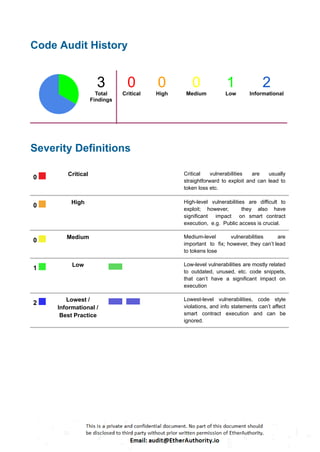
Code Audit History
Severity Definitions
0
Critical Critical vulnerabilities are usually
straightforward to exploit and can lead to
token loss etc.
0
High High-level vulnerabilities are difficult to
exploit; however, they also have
significant impact on smart contract
execution, e.g. Public access is crucial.
0
Medium Medium-level vulnerabilities are
important to fix; however, they can’t lead
to tokens lose
1
Low Low-level vulnerabilities are mostly related
to outdated, unused, etc. code snippets,
that can’t have a significant impact on
execution
2
Lowest /
Informational /
Best Practice
Lowest-level vulnerabilities, code style
violations, and info statements can’t affect
smart contract execution and can be
ignored.
3
Total
Findings
0
Critical
0
High
0
Medium
1
Low
2
Informational
Claimed Smart Contract Features
Claimed Feature Detail Our Observation
Tokenomics:
● Name: Extra Finance
● Symbol: EXTRA
● Decimals: 18
YES, This is valid.
Owner Specifications:
● Allows the current owner to transfer control of the
contract to a new owner.
● The current owner Leaves the contract without
the owner.
● Set configurations.
● Set the send/receive version.
● Set the trusted path for cross-chain
communication.
● Set a trusted remote address
● Set precrime.
● Set min dst gas.
● Set the payload size limit.
YES, This is valid.
We advise renouncing
ownership once the
ownership functions are
not needed. This is to make
the smart contract 100%
decentralized.
Key Functionalities:
● CrossChain Messaging: The `LzApp` and
`NonblockingLzApp` contracts manage
crosschain message sending and receiving,
ensuring messages are only accepted from
trusted sources and handling potential message
failures with retries.
● Token Transfers: The `OFTCore` and `OFT`
contracts implement methods to transfer tokens
between chains by encoding the transfer details
in the payload and ensuring the tokens are
correctly debited from the sender and credited to
YES, This is valid.
the receiver on the destination chain.
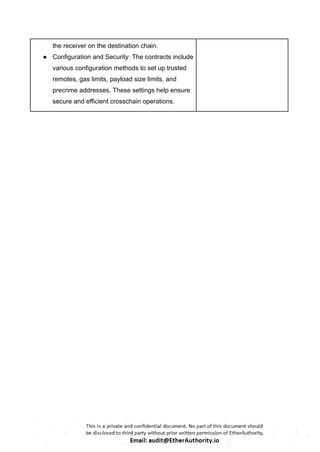
● Configuration and Security: The contracts include
various configuration methods to set up trusted
remotes, gas limits, payload size limits, and
precrime addresses. These settings help ensure
secure and efficient crosschain operations.
Audit Summary
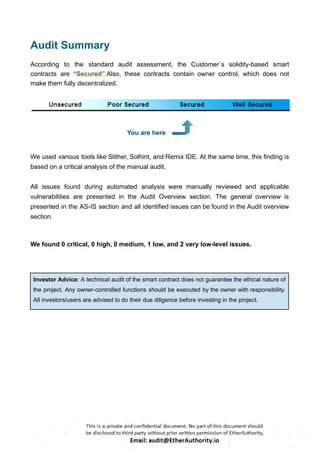
According to the standard audit assessment, the Customer`s solidity-based smart
contracts are “Secured”.Also, these contracts contain owner control, which does not
make them fully decentralized.
You are here
We used various tools like Slither, Solhint, and Remix IDE. At the same time, this finding is
based on a critical analysis of the manual audit.
All issues found during automated analysis were manually reviewed and applicable
vulnerabilities are presented in the Audit Overview section. The general overview is
presented in the AS-IS section and all identified issues can be found in the Audit overview
section.
We found 0 critical, 0 high, 0 medium, 1 low, and 2 very low-level issues.
Investor Advice: A technical audit of the smart contract does not guarantee the ethical nature of
the project. Any owner-controlled functions should be executed by the owner with responsibility.
All investors/users are advised to do their due diligence before investing in the project.
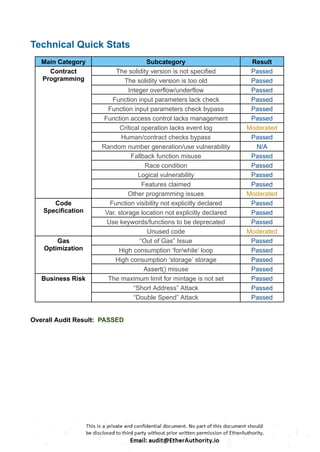
Technical Quick Stats
Main Category Subcategory Result
Contract
Programming
The solidity version is not specified Passed
The solidity version is too old Passed
Integer overflow/underflow Passed
Function input parameters lack check Passed
Function input parameters check bypass Passed
Function access control lacks management Passed
Critical operation lacks event log Moderated
Human/contract checks bypass Passed
Random number generation/use vulnerability N/A
Fallback function misuse Passed
Race condition Passed
Logical vulnerability Passed
Features claimed Passed
Other programming issues Moderated
Code
Specification
Function visibility not explicitly declared Passed
Var. storage location not explicitly declared Passed
Use keywords/functions to be deprecated Passed
Unused code Moderated
Gas
Optimization
“Out of Gas” Issue Passed
High consumption ‘for/while’ loop Passed
High consumption ‘storage’ storage Passed
Assert() misuse Passed
Business Risk The maximum limit for mintage is not set Passed
“Short Address” Attack Passed
“Double Spend” Attack Passed
Overall Audit Result: PASSED
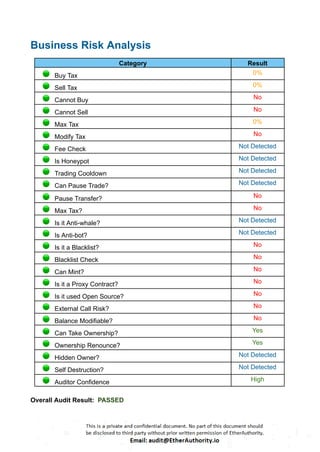
Business Risk Analysis
Category Result
Buy Tax 0%
Sell Tax 0%
Cannot Buy No
Cannot Sell No
Max Tax 0%
Modify Tax No
Fee Check Not Detected
Is Honeypot Not Detected
Trading Cooldown Not Detected
Can Pause Trade? Not Detected
Pause Transfer? No
Max Tax? No
Is it Anti-whale? Not Detected
Is Anti-bot? Not Detected
Is it a Blacklist? No
Blacklist Check No
Can Mint? No
Is it a Proxy Contract? No
Is it used Open Source? No
External Call Risk? No
Balance Modifiable? No
Can Take Ownership? Yes
Ownership Renounce? Yes
Hidden Owner? Not Detected
Self Destruction? Not Detected
Auditor Confidence High
Overall Audit Result: PASSED
Code Quality
This audit scope has 1 smart contract. Smart contracts contain Libraries, Smart contracts,
inherits, and Interfaces. This is a compact and well-written smart contract.
The libraries in Extra Finance are part of its logical algorithm. A library is a different type of
smart contract that contains reusable code. Once deployed on the blockchain (only once),
it is assigned a specific address and its properties/methods can be reused many times by
other contracts in the Extra Finance.
The EtherAuthority team has not provided scenario and unit test scripts, which would have
helped to determine the integrity of the code in an automated way.
Code parts are well commented on in the smart contracts. Ethereum’s NatSpec
commenting style is recommended.
Documentation
We were given a Extra Finance smart contract code in the form of a basescan web link.
As mentioned above, code parts are well commented on. And the logic is straightforward.
So it is easy to quickly understand the programming flow as well as complex code logic.
Comments are very helpful in understanding the overall architecture of the protocol.
Use of Dependencies
As per our observation, the libraries used in this smart contract infrastructure are based on
well-known industry standard open-source projects.
Apart from libraries, its functions are not used in external smart contract calls.
AS-IS overview
EXTRAoft.sol
Functions
Sl. Functions Type Observation Conclusion
1 constructor write Empty Blocks
in Code
Refer Audit
Findings
2 supportsInterface read Passed No Issue
3 token read Passed No Issue
4 circulatingSupply read Passed No Issue
5 _debitFrom internal Passed No Issue
6 _creditTo internal Passed No Issue
7 supportsInterface read Passed No Issue
8 estimateSendFee read Passed No Issue
9 sendFrom write Passed No Issue
10 setUseCustomAdapterParams write access only
Owner
No Issue
11 _nonblockingLzReceive internal Passed No Issue
12 _send internal Passed No Issue
13 _sendAck internal Passed No Issue
14 _checkAdapterParams internal Passed No Issue
15 _debitFrom internal Passed No Issue
16 _creditTo internal Passed No Issue
17 _blockingLzReceive internal Passed No Issue
18 _storeFailedMessage internal Passed No Issue
19 nonblockingLzReceive write Passed No Issue
20 _nonblockingLzReceive internal Passed No Issue
21 retryMessage write Passed No Issue
22 lzReceive write Passed No Issue
23 _blockingLzReceive internal Unused
function
Refer Audit
Findings
24 _lzSend internal Passed No Issue
25 _checkGasLimit internal Passed No Issue
26 _getGasLimit internal Passed No Issue
27 _checkPayloadSize internal Passed No Issue
28 getConfig external Passed No Issue
29 setConfig external Passed No Issue
30 setSendVersion external access only
Owner
No Issue
31 setReceiveVersion external access only
Owner
No Issue
32 forceResumeReceive external access only
Owner
No Issue
33 setTrustedRemote external access only
Owner
No Issue
34 setTrustedRemoteAddress external access only
Owner
No Issue
35 getTrustedRemoteAddress external Passed No Issue
36 setPrecrime external access only
Owner
No Issue
37 setMinDstGas external access only
Owner
No Issue
38 setPayloadSizeLimit external Critical
operation
lacks event log
Refer Audit
Findings
39 isTrustedRemote external Passed No Issue
Audit Findings
Critical Severity
No Critical severity vulnerabilities were found.
High Severity
No High severity vulnerabilities were found.
Medium
No Medium-severity vulnerabilities were found.
Low
[L-01] Critical operation lacks event log:
Description:
IMissing event log for setPayloadSizeLimit() in LzApp contract.
Recommendation: We suggest writing an event log for the listed event.
Very Low / Informational / Best practices:
[I-01] Unused function:
// overriding the virtual function in LzReceiver
function _blockingLzReceive(uint16 _srcChainId, bytes memory
_srcAddress, uint64 _nonce, bytes memory _payload) internal virtual
override {
(bool success, bytes memory reason) =
address(this).excessivelySafeCall(gasleft(), 150,
abi.encodeWithSelector(this.nonblockingLzReceive.selector,
_srcChainId, _srcAddress, _nonce, _payload));
// try-catch all errors/exceptions
if (!success) {
_storeFailedMessage(_srcChainId, _srcAddress, _nonce,
_payload, reason);
}
}
Description:
The _blockingLzReceive() is an internal function defined in the NonblockingLzApp contract
but never used in code.
Recommendation: We suggest removing unused functions.
[I-02] Empty Blocks in Code:
constructor(address _lzEndpoint) NonblockingLzApp(_lzEndpoint) {}
Description:
During the code review, it was identified that the constructor in the smart contract contains
an empty block. Empty blocks serve no functional purpose and can lead to confusion for
developers reviewing the code. Code readability and maintainability are essential for smart
contracts, and empty blocks should be avoided.
Recommendation: We recommend removing the empty block to improve code clarity
and maintainability.
Centralization
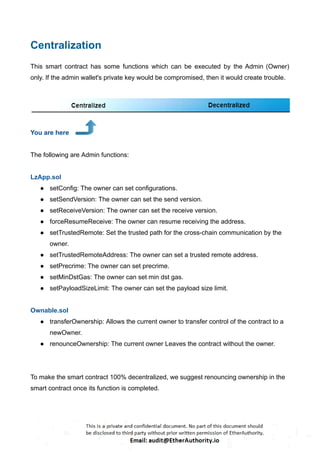
This smart contract has some functions which can be executed by the Admin (Owner)
only. If the admin wallet's private key would be compromised, then it would create trouble.
You are here
The following are Admin functions:
LzApp.sol
● setConfig: The owner can set configurations.
● setSendVersion: The owner can set the send version.
● setReceiveVersion: The owner can set the receive version.
● forceResumeReceive: The owner can resume receiving the address.
● setTrustedRemote: Set the trusted path for the cross-chain communication by the
owner.
● setTrustedRemoteAddress: The owner can set a trusted remote address.
● setPrecrime: The owner can set precrime.
● setMinDstGas: The owner can set min dst gas.
● setPayloadSizeLimit: The owner can set the payload size limit.
Ownable.sol
● transferOwnership: Allows the current owner to transfer control of the contract to a
newOwner.
● renounceOwnership: The current owner Leaves the contract without the owner.
To make the smart contract 100% decentralized, we suggest renouncing ownership in the
smart contract once its function is completed.
Conclusion
We were given a contract code in the form of a basescan web link. We have used all
possible tests based on given objects as files. We observed 1 low and 2 Informational
issues in the smart contracts. but those are not critical. So, it’s good to go for the
production.
Since possible test cases can be unlimited for such smart contracts protocol, we provide
no such guarantee of future outcomes. We have used all the latest static tools and manual
observations to cover the maximum possible test cases to scan everything.
Smart contracts within the scope were manually reviewed and analyzed with static
analysis tools. Smart Contract’s high-level description of functionality was presented in the
As-is overview section of the report.
The audit report contains all found security vulnerabilities and other issues in the reviewed
code.
The security state of the reviewed smart contract, based on standard audit procedure
scope, is “Secured”.
Our Methodology
We like to work with a transparent process and make our reviews a collaborative effort.
The goals of our security audits are to improve the quality of the systems we review and
aim for sufficient remediation to help protect users. The following is the methodology we
use in our security audit process.
Manual Code Review:
In manually reviewing all of the code, we look for any potential issues with code logic, error
handling, protocol and header parsing, cryptographic errors, and random number
generators. We also watch for areas where more defensive programming could reduce the
risk of future mistakes and speed up future audits. Although our primary focus is on the
in-scope code, we examine dependency code and behavior when it is relevant to a
particular line of investigation.
Vulnerability Analysis:
Our audit techniques included manual code analysis, user interface interaction, and white
box penetration testing. We look at the project's website to get a high-level understanding
of what functionality the software under review provides. We then meet with the
developers to gain an appreciation of their vision of the software. We install and use the
relevant software, exploring the user interactions and roles. While we do this, we
brainstorm threat models and attack surfaces. We read design documentation, review
other audit results, search for similar projects, examine source code dependencies, skim
open issue tickets, and generally investigate details other than the implementation.
Documenting Results:
We follow a conservative, transparent process for analyzing potential security
vulnerabilities and seeing them through successful remediation. Whenever a potential
issue is discovered, we immediately create an Issue entry for it in this document, even
though we have not yet verified the feasibility and impact of the issue. This process is
conservative because we document our suspicions early even if they are later shown to
not represent exploitable vulnerabilities. We generally follow a process of first documenting
the suspicion with unresolved questions, and then confirming the issue through code
analysis, live experimentation, or automated tests. Code analysis is the most tentative, and
we strive to provide test code, log captures, or screenshots demonstrating our
confirmation. After this we analyze the feasibility of an attack in a live system.
Suggested Solutions:
We search for immediate mitigations that live deployments can take, and finally, we
suggest the requirements for remediation engineering for future releases. The mitigation
and remediation recommendations should be scrutinized by the developers and
deployment engineers, and successful mitigation and remediation is an ongoing
collaborative process after we deliver our report, and before the details are made public.
Disclaimers
EtherAuthority.io Disclaimer
EtherAuthority team has analyzed this smart contract in accordance with the best industry
practices at the date of this report, in relation to: cybersecurity vulnerabilities and issues in
smart contract source code, the details of which are disclosed in this report, (Source
Code); the Source Code compilation, deployment and functionality (performing the
intended functions).
Due to the fact that the total number of test cases is unlimited, the audit makes no
statements or warranties on the security of the code. It also cannot be considered a
sufficient assessment regarding the utility and safety of the code, bug-free status, or any
other statements of the contract. While we have done our best in conducting the analysis
and producing this report, it is important to note that you should not rely on this report only.
We also suggest conducting a bug bounty program to confirm the high level of security of
this smart contract.
Technical Disclaimer
Smart contracts are deployed and executed on the blockchain platform. The platform, its
programming language, and other software related to the smart contract can have their
own vulnerabilities that can lead to hacks. Thus, the audit can’t guarantee the explicit
security of the audited smart contracts.
Appendix
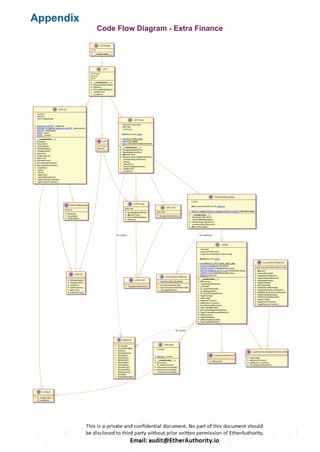
Code Flow Diagram - Extra Finance
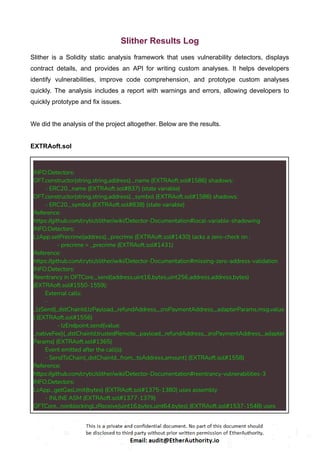
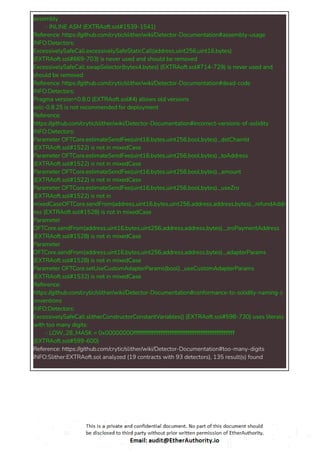
Slither Results Log
Slither is a Solidity static analysis framework that uses vulnerability detectors, displays
contract details, and provides an API for writing custom analyses. It helps developers
identify vulnerabilities, improve code comprehension, and prototype custom analyses
quickly. The analysis includes a report with warnings and errors, allowing developers to
quickly prototype and fix issues.
We did the analysis of the project altogether. Below are the results.
EXTRAoft.sol
INFO:Detectors:
OFT.constructor(string,string,address)._name (EXTRAoft.sol#1586) shadows:
- ERC20._name (EXTRAoft.sol#837) (state variable)
OFT.constructor(string,string,address)._symbol (EXTRAoft.sol#1586) shadows:
- ERC20._symbol (EXTRAoft.sol#838) (state variable)
Reference:
https://github.com/crytic/slither/wiki/Detector-Documentation#local-variable-shadowing
INFO:Detectors:
LzApp.setPrecrime(address)._precrime (EXTRAoft.sol#1430) lacks a zero-check on :
- precrime = _precrime (EXTRAoft.sol#1431)
Reference:
https://github.com/crytic/slither/wiki/Detector-Documentation#missing-zero-address-validation
INFO:Detectors:
Reentrancy in OFTCore._send(address,uint16,bytes,uint256,address,address,bytes)
(EXTRAoft.sol#1550-1559):
External calls:
-
_lzSend(_dstChainId,lzPayload,_refundAddress,_zroPaymentAddress,_adapterParams,msg.value
) (EXTRAoft.sol#1556)
- lzEndpoint.send{value:
_nativeFee}(_dstChainId,trustedRemote,_payload,_refundAddress,_zroPaymentAddress,_adapter
Params) (EXTRAoft.sol#1365)
Event emitted after the call(s):
- SendToChain(_dstChainId,_from,_toAddress,amount) (EXTRAoft.sol#1558)
Reference:
https://github.com/crytic/slither/wiki/Detector-Documentation#reentrancy-vulnerabilities-3
INFO:Detectors:
LzApp._getGasLimit(bytes) (EXTRAoft.sol#1375-1380) uses assembly
- INLINE ASM (EXTRAoft.sol#1377-1379)
OFTCore._nonblockingLzReceive(uint16,bytes,uint64,bytes) (EXTRAoft.sol#1537-1548) uses
assembly
- INLINE ASM (EXTRAoft.sol#1539-1541)
Reference: https://github.com/crytic/slither/wiki/Detector-Documentation#assembly-usage
INFO:Detectors:
ExcessivelySafeCall.excessivelySafeStaticCall(address,uint256,uint16,bytes)
(EXTRAoft.sol#669-703) is never used and should be removed
ExcessivelySafeCall.swapSelector(bytes4,bytes) (EXTRAoft.sol#714-729) is never used and
should be removed
Reference: https://github.com/crytic/slither/wiki/Detector-Documentation#dead-code
INFO:Detectors:
Pragma version^0.8.0 (EXTRAoft.sol#4) allows old versions
solc-0.8.25 is not recommended for deployment
Reference:
https://github.com/crytic/slither/wiki/Detector-Documentation#incorrect-versions-of-solidity
INFO:Detectors:
Parameter OFTCore.estimateSendFee(uint16,bytes,uint256,bool,bytes)._dstChainId
(EXTRAoft.sol#1522) is not in mixedCase
Parameter OFTCore.estimateSendFee(uint16,bytes,uint256,bool,bytes)._toAddress
(EXTRAoft.sol#1522) is not in mixedCase
Parameter OFTCore.estimateSendFee(uint16,bytes,uint256,bool,bytes)._amount
(EXTRAoft.sol#1522) is not in mixedCase
Parameter OFTCore.estimateSendFee(uint16,bytes,uint256,bool,bytes)._useZro
(EXTRAoft.sol#1522) is not in
mixedCaseOFTCore.sendFrom(address,uint16,bytes,uint256,address,address,bytes)._refundAddr
ess (EXTRAoft.sol#1528) is not in mixedCase
Parameter
OFTCore.sendFrom(address,uint16,bytes,uint256,address,address,bytes)._zroPaymentAddress
(EXTRAoft.sol#1528) is not in mixedCase
Parameter
OFTCore.sendFrom(address,uint16,bytes,uint256,address,address,bytes)._adapterParams
(EXTRAoft.sol#1528) is not in mixedCase
Parameter OFTCore.setUseCustomAdapterParams(bool)._useCustomAdapterParams
(EXTRAoft.sol#1532) is not in mixedCase
Reference:
https://github.com/crytic/slither/wiki/Detector-Documentation#conformance-to-solidity-naming-c
onventions
INFO:Detectors:
ExcessivelySafeCall.slitherConstructorConstantVariables() (EXTRAoft.sol#598-730) uses literals
with too many digits:
- LOW_28_MASK = 0x00000000ffffffffffffffffffffffffffffffffffffffffffffffffffffffff
(EXTRAoft.sol#599-600)
Reference: https://github.com/crytic/slither/wiki/Detector-Documentation#too-many-digits
INFO:Slither:EXTRAoft.sol analyzed (19 contracts with 93 detectors), 135 result(s) found
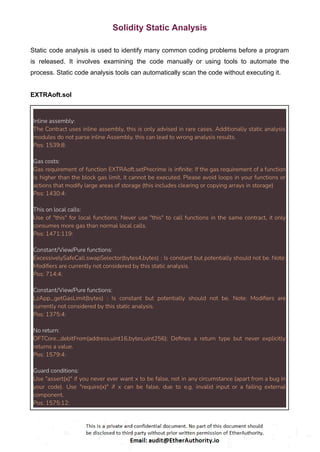
Solidity Static Analysis
Static code analysis is used to identify many common coding problems before a program
is released. It involves examining the code manually or using tools to automate the
process. Static code analysis tools can automatically scan the code without executing it.
EXTRAoft.sol
Inline assembly:
The Contract uses inline assembly, this is only advised in rare cases. Additionally static analysis
modules do not parse inline Assembly, this can lead to wrong analysis results.
Pos: 1539:8:
Gas costs:
Gas requirement of function EXTRAoft.setPrecrime is infinite: If the gas requirement of a function
is higher than the block gas limit, it cannot be executed. Please avoid loops in your functions or
actions that modify large areas of storage (this includes clearing or copying arrays in storage)
Pos: 1430:4:
This on local calls:
Use of "this" for local functions: Never use "this" to call functions in the same contract, it only
consumes more gas than normal local calls.
Pos: 1471:119:
Constant/View/Pure functions:
ExcessivelySafeCall.swapSelector(bytes4,bytes) : Is constant but potentially should not be. Note:
Modifiers are currently not considered by this static analysis.
Pos: 714:4:
Constant/View/Pure functions:
LzApp._getGasLimit(bytes) : Is constant but potentially should not be. Note: Modifiers are
currently not considered by this static analysis.
Pos: 1375:4:
No return:
OFTCore._debitFrom(address,uint16,bytes,uint256): Defines a return type but never explicitly
returns a value.
Pos: 1579:4:
Guard conditions:
Use "assert(x)" if you never ever want x to be false, not in any circumstance (apart from a bug in
your code). Use "require(x)" if x can be false, due to e.g. invalid input or a failing external
component.
Pos: 1575:12:
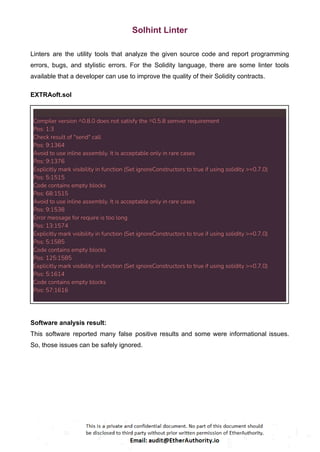
Solhint Linter
Linters are the utility tools that analyze the given source code and report programming
errors, bugs, and stylistic errors. For the Solidity language, there are some linter tools
available that a developer can use to improve the quality of their Solidity contracts.
EXTRAoft.sol
Compiler version ^0.8.0 does not satisfy the ^0.5.8 semver requirement
Pos: 1:3
Check result of "send" call
Pos: 9:1364
Avoid to use inline assembly. It is acceptable only in rare cases
Pos: 9:1376
Explicitly mark visibility in function (Set ignoreConstructors to true if using solidity >=0.7.0)
Pos: 5:1515
Code contains empty blocks
Pos: 68:1515
Avoid to use inline assembly. It is acceptable only in rare cases
Pos: 9:1538
Error message for require is too long
Pos: 13:1574
Explicitly mark visibility in function (Set ignoreConstructors to true if using solidity >=0.7.0)
Pos: 5:1585
Code contains empty blocks
Pos: 125:1585
Explicitly mark visibility in function (Set ignoreConstructors to true if using solidity >=0.7.0)
Pos: 5:1614
Code contains empty blocks
Pos: 57:1616
Software analysis result:
This software reported many false positive results and some were informational issues.
So, those issues can be safely ignored.
Extra Finance (EXTRA) Token – Smart Contract Security Audit Report by EtherAuthority

Extra Finance (EXTRA) Token – Smart Contract Security Audit Report by EtherAuthority

  • 1.
    Project: Extra Finance(EXTRA) Website: app.extrafi.io/lend Platform: Base Chain Network Language: Solidity Date: June 24th, 2024
  • 2.
    Table of contents Introduction………………………………………………………………………………………..4 Project Background ……………………………………………………………………………….4 Audit Scope ………………………………………………………………………………………..6 Code Audit History ………………………………………………………………………………..7 Severity Definitions ……………………………………………………………………………....7 Claimed Smart Contract Features …………………………………………………………….. .8 Audit Summary ……………....………………………………………………………………….10 Technical Quick Stats …..……………………………………………………………………… 11 Business Risk Analysis …..…………………………………………………………………. 12 Code Quality ……………………………………………………………………………………. 13 Documentation ………………………………………………………………………………….. 13 Use of Dependencies …………………………………………………………………………… 13 AS-IS overview ………………………………………………………………………………….. 14 Audit Findings …………………………………………………………………………………… 16 Conclusion ………………………………………………………………………………………. 19 Our Methodology ………………………………………………………………………………... 20 Disclaimers ………………………………………………………………………………………. 22 Appendix ● Code Flow Diagram ……………………………………………………………………... 23 ● Slither Results Log ………………………………………………………………………. 24 ● Solidity static analysis ….……………………………………………………………….. 26 ● Solhint Linter …………………………………………………………………….……….. 27
  • 3.
    THIS IS SECURITYAUDIT REPORT DOCUMENT AND WHICH MAY CONTAIN INFORMATION WHICH IS CONFIDENTIAL. WHICH INCLUDES ANY POTENTIAL VULNERABILITIES AND MALICIOUS CODES WHICH CAN BE USED TO EXPLOIT THE SOFTWARE. THIS MUST BE REFERRED INTERNALLY AND ONLY SHOULD BE MADE AVAILABLE TO THE PUBLIC AFTER ISSUES ARE RESOLVED.
  • 4.
    Introduction As part ofEtherAuthority’s community smart contracts audit initiatives, the Extra Finance smart contract from app.extrafi.io/lend was audited extensively. The audit has been performed using manual analysis as well as using automated software tools. This report presents all the findings regarding the audit performed on June 24th, 2024. The purpose of this audit was to address the following: - Ensure that all claimed functions exist and function correctly. - Identify any security vulnerabilities that may be present in the smart contract. Project Background Website Details ● Extra Finance is a leveraged yield strategy & lending protocol built on Optimism/Base. ● Extra Finance offers leveraged yield farming, allowing users to maximize earnings by leveraging stable pools like $ETH/$USDC for attractive yield rates and depositing assets in the Lending Pool for steady passive income. However, careful risk assessment and active management are crucial to mitigate potential drawbacks and ensure a successful farming experience.
  • 5.
    Code Details ● Theprovided code implements a cross-chain token called `EXTRAoft` that leverages the LayerZero protocol to facilitate sending tokens between different blockchain networks. This functionality is achieved through several abstract and base contracts that define essential methods and events for handling cross-chain messaging and token operations. Here's a detailed breakdown of the key components and their roles: ● Contract Components: ○ EXTRAoft Contract: ■ Inherits `OFT`. ■ Initializes the token with the name "Extra Finance" and symbol "EXTRA". ■ Configures the contract to use a specified LayerZero endpoint for crosschain operations. ○ OFT Contract: ■ Inherits `OFTCore`, `ERC20`, and `IOFT`. ■ Implements the ERC20 token standard alongside the crosschain functionalities provided by `OFTCore`. ■ Defines `_debitFrom` and `_creditTo` methods to handle burning and minting tokens during crosschain transfers. ■ Provides additional methods to support ERC165 interface checks and tokenspecific details like total supply. ○ OFTCore Contract: ■ Inherits `NonblockingLzApp`, `ERC165`, and `IOFTCore`. ■ Provides core functionalities for an Omnichain Fungible Token (OFT), including support for estimating send fees and sending tokens across chains. ■ Implements the `_send` and `_sendAck` methods to handle token transfers and acknowledgments. ■ Includes abstract methods `_debitFrom` and `_creditTo` for debiting and crediting tokens, to be defined in derived contracts. ○ NonblockingLzApp Contract: ■ Inherits `LzApp`.
  • 6.
    ■ Adds functionalityfor handling message failures and retries. ■ Stores failed messages and emits events when messages fail or succeed on retry. ■ Implements `_blockingLzReceive` to safely call the nonblocking receive method and store failed messages if necessary. ○ LzApp Contract: ■ Inherits `Ownable`, `ILayerZeroReceiver`, and `ILayerZeroUserApplicationConfig`. ■ Manages the configuration and communication with the LayerZero endpoint. ■ Contains mappings to store trusted remote addresses, minimum destination gas requirements, and payload size limits. ■ Defines methods to receive messages (`lzReceive`), send messages (`_lzSend`), and configure various settings such as trusted remotes and gas limits. ● The `EXTRAoft` contract extends a sophisticated framework for creating a cross-chain token that can be sent and received across different blockchain networks using the LayerZero protocol. The modular design allows for easy customization and extension while providing robust mechanisms for handling cross-chain messaging and token management. Audit scope Name Code Review and Security Analysis Report for Extra Finance Smart Contract Platform Base Chain Network Language Solidity File EXTRAoft.sol Smart Contract Code 0x2dad3a13ef0c6366220f989157009e501e7938f8 Audit Date June 24th,2024 Audit Result Passed
  • 7.
    Code Audit History SeverityDefinitions 0 Critical Critical vulnerabilities are usually straightforward to exploit and can lead to token loss etc. 0 High High-level vulnerabilities are difficult to exploit; however, they also have significant impact on smart contract execution, e.g. Public access is crucial. 0 Medium Medium-level vulnerabilities are important to fix; however, they can’t lead to tokens lose 1 Low Low-level vulnerabilities are mostly related to outdated, unused, etc. code snippets, that can’t have a significant impact on execution 2 Lowest / Informational / Best Practice Lowest-level vulnerabilities, code style violations, and info statements can’t affect smart contract execution and can be ignored. 3 Total Findings 0 Critical 0 High 0 Medium 1 Low 2 Informational
  • 8.
    Claimed Smart ContractFeatures Claimed Feature Detail Our Observation Tokenomics: ● Name: Extra Finance ● Symbol: EXTRA ● Decimals: 18 YES, This is valid. Owner Specifications: ● Allows the current owner to transfer control of the contract to a new owner. ● The current owner Leaves the contract without the owner. ● Set configurations. ● Set the send/receive version. ● Set the trusted path for cross-chain communication. ● Set a trusted remote address ● Set precrime. ● Set min dst gas. ● Set the payload size limit. YES, This is valid. We advise renouncing ownership once the ownership functions are not needed. This is to make the smart contract 100% decentralized. Key Functionalities: ● CrossChain Messaging: The `LzApp` and `NonblockingLzApp` contracts manage crosschain message sending and receiving, ensuring messages are only accepted from trusted sources and handling potential message failures with retries. ● Token Transfers: The `OFTCore` and `OFT` contracts implement methods to transfer tokens between chains by encoding the transfer details in the payload and ensuring the tokens are correctly debited from the sender and credited to YES, This is valid.
  • 9.
    the receiver onthe destination chain. ● Configuration and Security: The contracts include various configuration methods to set up trusted remotes, gas limits, payload size limits, and precrime addresses. These settings help ensure secure and efficient crosschain operations.
  • 10.
    Audit Summary According tothe standard audit assessment, the Customer`s solidity-based smart contracts are “Secured”.Also, these contracts contain owner control, which does not make them fully decentralized. You are here We used various tools like Slither, Solhint, and Remix IDE. At the same time, this finding is based on a critical analysis of the manual audit. All issues found during automated analysis were manually reviewed and applicable vulnerabilities are presented in the Audit Overview section. The general overview is presented in the AS-IS section and all identified issues can be found in the Audit overview section. We found 0 critical, 0 high, 0 medium, 1 low, and 2 very low-level issues. Investor Advice: A technical audit of the smart contract does not guarantee the ethical nature of the project. Any owner-controlled functions should be executed by the owner with responsibility. All investors/users are advised to do their due diligence before investing in the project.
  • 11.
    Technical Quick Stats MainCategory Subcategory Result Contract Programming The solidity version is not specified Passed The solidity version is too old Passed Integer overflow/underflow Passed Function input parameters lack check Passed Function input parameters check bypass Passed Function access control lacks management Passed Critical operation lacks event log Moderated Human/contract checks bypass Passed Random number generation/use vulnerability N/A Fallback function misuse Passed Race condition Passed Logical vulnerability Passed Features claimed Passed Other programming issues Moderated Code Specification Function visibility not explicitly declared Passed Var. storage location not explicitly declared Passed Use keywords/functions to be deprecated Passed Unused code Moderated Gas Optimization “Out of Gas” Issue Passed High consumption ‘for/while’ loop Passed High consumption ‘storage’ storage Passed Assert() misuse Passed Business Risk The maximum limit for mintage is not set Passed “Short Address” Attack Passed “Double Spend” Attack Passed Overall Audit Result: PASSED
  • 12.
    Business Risk Analysis CategoryResult Buy Tax 0% Sell Tax 0% Cannot Buy No Cannot Sell No Max Tax 0% Modify Tax No Fee Check Not Detected Is Honeypot Not Detected Trading Cooldown Not Detected Can Pause Trade? Not Detected Pause Transfer? No Max Tax? No Is it Anti-whale? Not Detected Is Anti-bot? Not Detected Is it a Blacklist? No Blacklist Check No Can Mint? No Is it a Proxy Contract? No Is it used Open Source? No External Call Risk? No Balance Modifiable? No Can Take Ownership? Yes Ownership Renounce? Yes Hidden Owner? Not Detected Self Destruction? Not Detected Auditor Confidence High Overall Audit Result: PASSED
  • 13.
    Code Quality This auditscope has 1 smart contract. Smart contracts contain Libraries, Smart contracts, inherits, and Interfaces. This is a compact and well-written smart contract. The libraries in Extra Finance are part of its logical algorithm. A library is a different type of smart contract that contains reusable code. Once deployed on the blockchain (only once), it is assigned a specific address and its properties/methods can be reused many times by other contracts in the Extra Finance. The EtherAuthority team has not provided scenario and unit test scripts, which would have helped to determine the integrity of the code in an automated way. Code parts are well commented on in the smart contracts. Ethereum’s NatSpec commenting style is recommended. Documentation We were given a Extra Finance smart contract code in the form of a basescan web link. As mentioned above, code parts are well commented on. And the logic is straightforward. So it is easy to quickly understand the programming flow as well as complex code logic. Comments are very helpful in understanding the overall architecture of the protocol. Use of Dependencies As per our observation, the libraries used in this smart contract infrastructure are based on well-known industry standard open-source projects. Apart from libraries, its functions are not used in external smart contract calls.
  • 14.
    AS-IS overview EXTRAoft.sol Functions Sl. FunctionsType Observation Conclusion 1 constructor write Empty Blocks in Code Refer Audit Findings 2 supportsInterface read Passed No Issue 3 token read Passed No Issue 4 circulatingSupply read Passed No Issue 5 _debitFrom internal Passed No Issue 6 _creditTo internal Passed No Issue 7 supportsInterface read Passed No Issue 8 estimateSendFee read Passed No Issue 9 sendFrom write Passed No Issue 10 setUseCustomAdapterParams write access only Owner No Issue 11 _nonblockingLzReceive internal Passed No Issue 12 _send internal Passed No Issue 13 _sendAck internal Passed No Issue 14 _checkAdapterParams internal Passed No Issue 15 _debitFrom internal Passed No Issue 16 _creditTo internal Passed No Issue 17 _blockingLzReceive internal Passed No Issue 18 _storeFailedMessage internal Passed No Issue 19 nonblockingLzReceive write Passed No Issue 20 _nonblockingLzReceive internal Passed No Issue 21 retryMessage write Passed No Issue 22 lzReceive write Passed No Issue 23 _blockingLzReceive internal Unused function Refer Audit Findings 24 _lzSend internal Passed No Issue 25 _checkGasLimit internal Passed No Issue 26 _getGasLimit internal Passed No Issue 27 _checkPayloadSize internal Passed No Issue 28 getConfig external Passed No Issue 29 setConfig external Passed No Issue 30 setSendVersion external access only Owner No Issue 31 setReceiveVersion external access only Owner No Issue 32 forceResumeReceive external access only Owner No Issue 33 setTrustedRemote external access only Owner No Issue
  • 15.
    34 setTrustedRemoteAddress externalaccess only Owner No Issue 35 getTrustedRemoteAddress external Passed No Issue 36 setPrecrime external access only Owner No Issue 37 setMinDstGas external access only Owner No Issue 38 setPayloadSizeLimit external Critical operation lacks event log Refer Audit Findings 39 isTrustedRemote external Passed No Issue
  • 16.
    Audit Findings Critical Severity NoCritical severity vulnerabilities were found. High Severity No High severity vulnerabilities were found. Medium No Medium-severity vulnerabilities were found. Low [L-01] Critical operation lacks event log: Description: IMissing event log for setPayloadSizeLimit() in LzApp contract. Recommendation: We suggest writing an event log for the listed event. Very Low / Informational / Best practices: [I-01] Unused function: // overriding the virtual function in LzReceiver function _blockingLzReceive(uint16 _srcChainId, bytes memory _srcAddress, uint64 _nonce, bytes memory _payload) internal virtual override { (bool success, bytes memory reason) = address(this).excessivelySafeCall(gasleft(), 150, abi.encodeWithSelector(this.nonblockingLzReceive.selector, _srcChainId, _srcAddress, _nonce, _payload)); // try-catch all errors/exceptions
  • 17.
    if (!success) { _storeFailedMessage(_srcChainId,_srcAddress, _nonce, _payload, reason); } } Description: The _blockingLzReceive() is an internal function defined in the NonblockingLzApp contract but never used in code. Recommendation: We suggest removing unused functions. [I-02] Empty Blocks in Code: constructor(address _lzEndpoint) NonblockingLzApp(_lzEndpoint) {} Description: During the code review, it was identified that the constructor in the smart contract contains an empty block. Empty blocks serve no functional purpose and can lead to confusion for developers reviewing the code. Code readability and maintainability are essential for smart contracts, and empty blocks should be avoided. Recommendation: We recommend removing the empty block to improve code clarity and maintainability.
  • 18.
    Centralization This smart contracthas some functions which can be executed by the Admin (Owner) only. If the admin wallet's private key would be compromised, then it would create trouble. You are here The following are Admin functions: LzApp.sol ● setConfig: The owner can set configurations. ● setSendVersion: The owner can set the send version. ● setReceiveVersion: The owner can set the receive version. ● forceResumeReceive: The owner can resume receiving the address. ● setTrustedRemote: Set the trusted path for the cross-chain communication by the owner. ● setTrustedRemoteAddress: The owner can set a trusted remote address. ● setPrecrime: The owner can set precrime. ● setMinDstGas: The owner can set min dst gas. ● setPayloadSizeLimit: The owner can set the payload size limit. Ownable.sol ● transferOwnership: Allows the current owner to transfer control of the contract to a newOwner. ● renounceOwnership: The current owner Leaves the contract without the owner. To make the smart contract 100% decentralized, we suggest renouncing ownership in the smart contract once its function is completed.
  • 19.
    Conclusion We were givena contract code in the form of a basescan web link. We have used all possible tests based on given objects as files. We observed 1 low and 2 Informational issues in the smart contracts. but those are not critical. So, it’s good to go for the production. Since possible test cases can be unlimited for such smart contracts protocol, we provide no such guarantee of future outcomes. We have used all the latest static tools and manual observations to cover the maximum possible test cases to scan everything. Smart contracts within the scope were manually reviewed and analyzed with static analysis tools. Smart Contract’s high-level description of functionality was presented in the As-is overview section of the report. The audit report contains all found security vulnerabilities and other issues in the reviewed code. The security state of the reviewed smart contract, based on standard audit procedure scope, is “Secured”.
  • 20.
    Our Methodology We liketo work with a transparent process and make our reviews a collaborative effort. The goals of our security audits are to improve the quality of the systems we review and aim for sufficient remediation to help protect users. The following is the methodology we use in our security audit process. Manual Code Review: In manually reviewing all of the code, we look for any potential issues with code logic, error handling, protocol and header parsing, cryptographic errors, and random number generators. We also watch for areas where more defensive programming could reduce the risk of future mistakes and speed up future audits. Although our primary focus is on the in-scope code, we examine dependency code and behavior when it is relevant to a particular line of investigation. Vulnerability Analysis: Our audit techniques included manual code analysis, user interface interaction, and white box penetration testing. We look at the project's website to get a high-level understanding of what functionality the software under review provides. We then meet with the developers to gain an appreciation of their vision of the software. We install and use the relevant software, exploring the user interactions and roles. While we do this, we brainstorm threat models and attack surfaces. We read design documentation, review other audit results, search for similar projects, examine source code dependencies, skim open issue tickets, and generally investigate details other than the implementation.
  • 21.
    Documenting Results: We followa conservative, transparent process for analyzing potential security vulnerabilities and seeing them through successful remediation. Whenever a potential issue is discovered, we immediately create an Issue entry for it in this document, even though we have not yet verified the feasibility and impact of the issue. This process is conservative because we document our suspicions early even if they are later shown to not represent exploitable vulnerabilities. We generally follow a process of first documenting the suspicion with unresolved questions, and then confirming the issue through code analysis, live experimentation, or automated tests. Code analysis is the most tentative, and we strive to provide test code, log captures, or screenshots demonstrating our confirmation. After this we analyze the feasibility of an attack in a live system. Suggested Solutions: We search for immediate mitigations that live deployments can take, and finally, we suggest the requirements for remediation engineering for future releases. The mitigation and remediation recommendations should be scrutinized by the developers and deployment engineers, and successful mitigation and remediation is an ongoing collaborative process after we deliver our report, and before the details are made public.
  • 22.
    Disclaimers EtherAuthority.io Disclaimer EtherAuthority teamhas analyzed this smart contract in accordance with the best industry practices at the date of this report, in relation to: cybersecurity vulnerabilities and issues in smart contract source code, the details of which are disclosed in this report, (Source Code); the Source Code compilation, deployment and functionality (performing the intended functions). Due to the fact that the total number of test cases is unlimited, the audit makes no statements or warranties on the security of the code. It also cannot be considered a sufficient assessment regarding the utility and safety of the code, bug-free status, or any other statements of the contract. While we have done our best in conducting the analysis and producing this report, it is important to note that you should not rely on this report only. We also suggest conducting a bug bounty program to confirm the high level of security of this smart contract. Technical Disclaimer Smart contracts are deployed and executed on the blockchain platform. The platform, its programming language, and other software related to the smart contract can have their own vulnerabilities that can lead to hacks. Thus, the audit can’t guarantee the explicit security of the audited smart contracts.
  • 23.
  • 24.
    Slither Results Log Slitheris a Solidity static analysis framework that uses vulnerability detectors, displays contract details, and provides an API for writing custom analyses. It helps developers identify vulnerabilities, improve code comprehension, and prototype custom analyses quickly. The analysis includes a report with warnings and errors, allowing developers to quickly prototype and fix issues. We did the analysis of the project altogether. Below are the results. EXTRAoft.sol INFO:Detectors: OFT.constructor(string,string,address)._name (EXTRAoft.sol#1586) shadows: - ERC20._name (EXTRAoft.sol#837) (state variable) OFT.constructor(string,string,address)._symbol (EXTRAoft.sol#1586) shadows: - ERC20._symbol (EXTRAoft.sol#838) (state variable) Reference: https://github.com/crytic/slither/wiki/Detector-Documentation#local-variable-shadowing INFO:Detectors: LzApp.setPrecrime(address)._precrime (EXTRAoft.sol#1430) lacks a zero-check on : - precrime = _precrime (EXTRAoft.sol#1431) Reference: https://github.com/crytic/slither/wiki/Detector-Documentation#missing-zero-address-validation INFO:Detectors: Reentrancy in OFTCore._send(address,uint16,bytes,uint256,address,address,bytes) (EXTRAoft.sol#1550-1559): External calls: - _lzSend(_dstChainId,lzPayload,_refundAddress,_zroPaymentAddress,_adapterParams,msg.value ) (EXTRAoft.sol#1556) - lzEndpoint.send{value: _nativeFee}(_dstChainId,trustedRemote,_payload,_refundAddress,_zroPaymentAddress,_adapter Params) (EXTRAoft.sol#1365) Event emitted after the call(s): - SendToChain(_dstChainId,_from,_toAddress,amount) (EXTRAoft.sol#1558) Reference: https://github.com/crytic/slither/wiki/Detector-Documentation#reentrancy-vulnerabilities-3 INFO:Detectors: LzApp._getGasLimit(bytes) (EXTRAoft.sol#1375-1380) uses assembly - INLINE ASM (EXTRAoft.sol#1377-1379) OFTCore._nonblockingLzReceive(uint16,bytes,uint64,bytes) (EXTRAoft.sol#1537-1548) uses
  • 25.
    assembly - INLINE ASM(EXTRAoft.sol#1539-1541) Reference: https://github.com/crytic/slither/wiki/Detector-Documentation#assembly-usage INFO:Detectors: ExcessivelySafeCall.excessivelySafeStaticCall(address,uint256,uint16,bytes) (EXTRAoft.sol#669-703) is never used and should be removed ExcessivelySafeCall.swapSelector(bytes4,bytes) (EXTRAoft.sol#714-729) is never used and should be removed Reference: https://github.com/crytic/slither/wiki/Detector-Documentation#dead-code INFO:Detectors: Pragma version^0.8.0 (EXTRAoft.sol#4) allows old versions solc-0.8.25 is not recommended for deployment Reference: https://github.com/crytic/slither/wiki/Detector-Documentation#incorrect-versions-of-solidity INFO:Detectors: Parameter OFTCore.estimateSendFee(uint16,bytes,uint256,bool,bytes)._dstChainId (EXTRAoft.sol#1522) is not in mixedCase Parameter OFTCore.estimateSendFee(uint16,bytes,uint256,bool,bytes)._toAddress (EXTRAoft.sol#1522) is not in mixedCase Parameter OFTCore.estimateSendFee(uint16,bytes,uint256,bool,bytes)._amount (EXTRAoft.sol#1522) is not in mixedCase Parameter OFTCore.estimateSendFee(uint16,bytes,uint256,bool,bytes)._useZro (EXTRAoft.sol#1522) is not in mixedCaseOFTCore.sendFrom(address,uint16,bytes,uint256,address,address,bytes)._refundAddr ess (EXTRAoft.sol#1528) is not in mixedCase Parameter OFTCore.sendFrom(address,uint16,bytes,uint256,address,address,bytes)._zroPaymentAddress (EXTRAoft.sol#1528) is not in mixedCase Parameter OFTCore.sendFrom(address,uint16,bytes,uint256,address,address,bytes)._adapterParams (EXTRAoft.sol#1528) is not in mixedCase Parameter OFTCore.setUseCustomAdapterParams(bool)._useCustomAdapterParams (EXTRAoft.sol#1532) is not in mixedCase Reference: https://github.com/crytic/slither/wiki/Detector-Documentation#conformance-to-solidity-naming-c onventions INFO:Detectors: ExcessivelySafeCall.slitherConstructorConstantVariables() (EXTRAoft.sol#598-730) uses literals with too many digits: - LOW_28_MASK = 0x00000000ffffffffffffffffffffffffffffffffffffffffffffffffffffffff (EXTRAoft.sol#599-600) Reference: https://github.com/crytic/slither/wiki/Detector-Documentation#too-many-digits INFO:Slither:EXTRAoft.sol analyzed (19 contracts with 93 detectors), 135 result(s) found
  • 26.
    Solidity Static Analysis Staticcode analysis is used to identify many common coding problems before a program is released. It involves examining the code manually or using tools to automate the process. Static code analysis tools can automatically scan the code without executing it. EXTRAoft.sol Inline assembly: The Contract uses inline assembly, this is only advised in rare cases. Additionally static analysis modules do not parse inline Assembly, this can lead to wrong analysis results. Pos: 1539:8: Gas costs: Gas requirement of function EXTRAoft.setPrecrime is infinite: If the gas requirement of a function is higher than the block gas limit, it cannot be executed. Please avoid loops in your functions or actions that modify large areas of storage (this includes clearing or copying arrays in storage) Pos: 1430:4: This on local calls: Use of "this" for local functions: Never use "this" to call functions in the same contract, it only consumes more gas than normal local calls. Pos: 1471:119: Constant/View/Pure functions: ExcessivelySafeCall.swapSelector(bytes4,bytes) : Is constant but potentially should not be. Note: Modifiers are currently not considered by this static analysis. Pos: 714:4: Constant/View/Pure functions: LzApp._getGasLimit(bytes) : Is constant but potentially should not be. Note: Modifiers are currently not considered by this static analysis. Pos: 1375:4: No return: OFTCore._debitFrom(address,uint16,bytes,uint256): Defines a return type but never explicitly returns a value. Pos: 1579:4: Guard conditions: Use "assert(x)" if you never ever want x to be false, not in any circumstance (apart from a bug in your code). Use "require(x)" if x can be false, due to e.g. invalid input or a failing external component. Pos: 1575:12:
  • 27.
    Solhint Linter Linters arethe utility tools that analyze the given source code and report programming errors, bugs, and stylistic errors. For the Solidity language, there are some linter tools available that a developer can use to improve the quality of their Solidity contracts. EXTRAoft.sol Compiler version ^0.8.0 does not satisfy the ^0.5.8 semver requirement Pos: 1:3 Check result of "send" call Pos: 9:1364 Avoid to use inline assembly. It is acceptable only in rare cases Pos: 9:1376 Explicitly mark visibility in function (Set ignoreConstructors to true if using solidity >=0.7.0) Pos: 5:1515 Code contains empty blocks Pos: 68:1515 Avoid to use inline assembly. It is acceptable only in rare cases Pos: 9:1538 Error message for require is too long Pos: 13:1574 Explicitly mark visibility in function (Set ignoreConstructors to true if using solidity >=0.7.0) Pos: 5:1585 Code contains empty blocks Pos: 125:1585 Explicitly mark visibility in function (Set ignoreConstructors to true if using solidity >=0.7.0) Pos: 5:1614 Code contains empty blocks Pos: 57:1616 Software analysis result: This software reported many false positive results and some were informational issues. So, those issues can be safely ignored.