CRY OF
PUGADLAWIN
G R O U P 4 : M M - 1 A
| M A C A L I N A O | C A L M A | M A L L A R I | H E R N A N D E Z | | M AT I C |
T O R N A D O | VA L B U E N A | VA L E N Z U E L A |
THE CRY OF PUGAD LAWIN
The start of the revolution against Spain has been officially commemorated in recent
years as “The Cry of Pugad Lawin.”
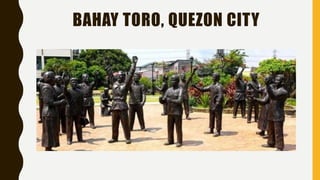
The supposed site of “Pugad Lawin” is situated in Brgy. Bahay Toro, Quezon
City,
and is memorialized with a
tableau of life-sized, oddly rigid Katipuneros tearing their cedulas.
BAHAY TORO, QUEZON CITY
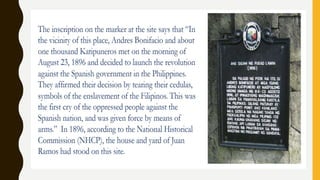
•“Cry” took place on August 23, 1896; at a site
known as Pugad Lawin, situated in what today is
Bahay Toro, Quezon City; which in 1896 had
been the house and yard of Juan Ramos.
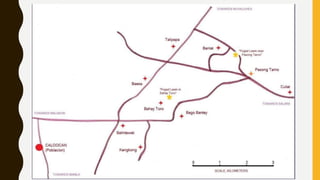
• the name “Pugad Lawin” came to be used in the twentieth
century to refer not just to one of the contending “Cry” sites,
but to two. First one site, and then another. Today, the Pugad
Lawin marker is in Bahay Toro, where Juan Ramos had
supposedly lived. But in previous decades, as will be discussed
later, Pugad Lawin was said to have been three kilometers or
so to the northeast, where Ramos’s mother Melchora Aquino
(“Tandang Sora”) had lived near Pasong Tamo in barrio
Banlat.
DEFINITIONS OF “CRY”
• Pasya, Pagpupunit and Unang Labanan
•
The debate has long been clouded by a lack of consensus on exactly
what is meant by the “Cry”. The term has been applied to three related
but distinct events –
• the “pasya” – the decision to revolt;
• the “pagpupunit” – the tearing of cedulas; and
• the “unang labanan” – the first encounter with Spanish forces.
• These three events, to state the obvious, did not all happen at the
time and place. When and where the “Cry” should be commemorated
thus depends on how it is defined.
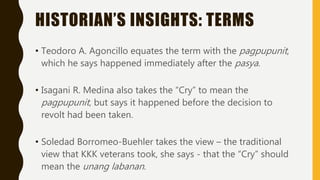
HISTORIAN’S INSIGHTS: TERMS
• Teodoro A. Agoncillo equates the term with the pagpupunit,
which he says happened immediately after the pasya.
• Isagani R. Medina also takes the “Cry” to mean the
pagpupunit, but says it happened before the decision to
revolt had been taken.
• Soledad Borromeo-Buehler takes the view – the traditional
view that KKK veterans took, she says - that the “Cry” should
mean the unang labanan.
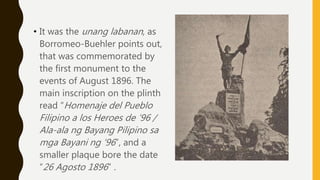
• It was the unang labanan, as
Borromeo-Buehler points out,
that was commemorated by
the first monument to the
events of August 1896. The
main inscription on the plinth
read “Homenaje del Pueblo
Filipino a los Heroes de ’96 /
Ala-ala ng Bayang Pilipino sa
mga Bayani ng ‘96”, and a
smaller plaque bore the date
“26 Agosto 1896” .
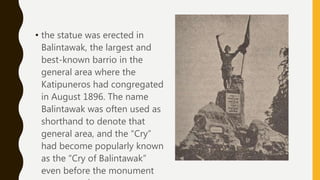
• the statue was erected in
Balintawak, the largest and
best-known barrio in the
general area where the
Katipuneros had congregated
in August 1896. The name
Balintawak was often used as
shorthand to denote that
general area, and the “Cry”
had become popularly known
as the “Cry of Balintawak”
even before the monument
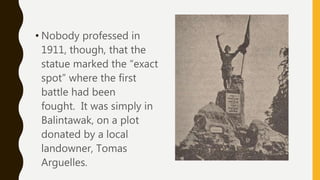
• Nobody professed in
1911, though, that the
statue marked the “exact
spot” where the first
battle had been
fought. It was simply in
Balintawak, on a plot
donated by a local
landowner, Tomas
Arguelles.
EVIDENCES
• The first battle, an encounter with a detachment of
the Guardia Civil, was fought on the date inscribed on
the Balintawak monument - August 26 – at a place
about five kilometers north-east of Balintawak,
between the settlements of Banlat and Pasong
Tamo. A few sources give the date as August 25 but,
as both Borromeo-Buehler and Encarnacion have
shown, the most solid, contemporary sources confirm
August 26 to be correct.
• The Balintawak monument continued to be the focus of the
yearly “Cry” celebrations, held on August 26, for decades. In
the 1960s, however, the official definition of the “Cry”
changed. Officially, the “Cry” ceased to mean the unang
labanan and was defined instead as “that part of the
Revolution when the Katipunan decided to launch a
revolution against Spain. This event culminated with the
tearing of the cedula”. This definition, which is more or less in
line with Agoncillo’s, thus embraces both the pasya and
pagpupunit, but excludes the unang labanan.
• A number of sources, however, indicate that cedulas were
torn on more than one occasion, in different places,
presumably because Katipuneros were arriving to join their
embryonic army over the course of a number of days, and
many wanted to proclaim their rebellion, their commitment to
fight Spanish rule, in the same way. It is even possible (as
Medina believes) that the main pagpupunit preceded the
pasya. But then it would have been premature, because the
revolt might have been deferred. It seems more likely, as the
official definition of the “Cry” assumes, that the largest, best
remembered act of defiant cedula-tearing happened soon
after the pasya had been taken, and in the same vicinity.
DECISION TO REVOLT: WHEN?
• It is almost certain that the decision to revolt was
taken on Monday, August 24, 1896, after a lengthy
meeting (or series of meetings) that had begun on
Sunday, August 23. Many veterans later recalled
August 23 as the historic day (see the Appendix to
these notes), but others specifically remembered the
decision had not been taken until the early hours of
August 24, and this latter date is given by at least four
important sources, namely:
• The Biak-na-Bato constitution of November 1897,
which mentions “the current war, initiated on August
24, 1896.” The constitution’s signatories included at
least one participant in the “Cry” (Cipriano Pacheco)
and several others who would have read circulars and
messages from the revolutionists in Caloocan in
August 1896.
•Carlos Ronquillo, in the first chronicle of the
revolt against Spain by a Filipino, written in
1898. His work begins with the words “Sa isang
araw ng pagpupulong sa Balintawak (24 Agosto
1896) kaarawan nang pasimulan ang
Revolucion….”
•
The Liga Filipina memorial erected in Tondo in 1903
by the Samahan ng May pag-asa, a patriotic society
named in Bonifacio’s honor whose members included
several KKK veterans. The inscription on the memorial
lists many of those who attended the famous meeting
addressed by Rizal on July 3, 1892, and alongside
Bonifacio’s name it records that he was “Supremo del
‘Katipunan’ que dió el 1er grito de Guerra contra la
tiranía el 24 de Agosto de 1896.”
•Santiago Alvarez, in his memoirs Ang Katipunan
at Paghihimagsik, written in 1927 but based, he
said, on records entrusted to him by the
Katipunan’s first leaders and fighters. Internal
evidence suggests that Alvarez’s account of the
meeting on August 24 is based on information
he obtained from Ramon Bernardo, a Katipunan
leader from Pandacan who was a participant in
the “Cry.”
CONCLUSION: WHEN?
• August 24 has now been confirmed as the date of the formal
decision by the discovery of a contemporary document - a
page from what Medina calls the “borador ng pulong ng
Kataastaasang Sangunian,” or rough copy book of the
Katipunan Supreme Council. Since a proper borador was not
to hand in Caloocan at this tumultuous moment, the Supreme
Council’s communications were drafted in some kind of farm
ledger, used under normal circumstances to record crop yields
or sales. The text is therefore written across printed columns
that are headed “Maiz,” “Mani,” “Camote” and so on.
• The document is dated “Kalookan, Maynila ika
26 ng Agosto ng taong 1896,” and it begins as
follows:-
“Ayon sa pinagkaisahan sa ginanap […?]
pulong ng Kataastaasang Kapisanan […?]
ikadalawang puo’t apat nitong umiiral na buan
tungkol sa paghihimagsik (revolucion) at sa
pagkakailangang […?] maghalal ng
magsisipamahala ng bayan at mag aakay ng
Hukbo…….” [In accordance with the decision
taken by the meeting of the Supreme Assembly
held on the twenty-fourth of the present month
regarding the revolution, and given the necessity
to elect leaders of the people and directors of the
Army…..”]
•
WHO DECIDED TO TAKE REVOLT?
• The decision to revolt, says the “borador” document,
was taken by the KKK’s Supreme Assembly. First
constituted in December 1895, the Assembly was
described by Emilio Jacinto as the primary and
paramount body within the Katipunan (“ang una at
lubos na kapangyarihang ay hahawakan ng
Kataastaasang Kapisanan”
WHO DECIDED TO TAKE REVOLT?
• Milagros Guerrero has suggested that the Supreme
Assembly’s decision needed to be confirmed or
ratified by the KKK Supreme Council. Such a “two-
stage pasya,” however, is not corroborated by the
“borador” document, which indicates the Supreme
Assembly’s decision was final.
REVOLT: WHERE?
• Bonifacio and the members of the Katipunan Supreme Assembly were
on August 25 or 26. We only need to establish where the Assembly met
on August 23 and 24. Unfortunately, this is not a great help. The
sources are still conflicting. They broadly agree that the leading
revolutionists went first to Caloocan (población) after leaving Manila,
and then headed eastwards via Kangkong towards Pasong Tamo and
eventually Balara. The sources still offer no accord, however, as to the
whereabouts of the leading revolutionists on the critical dates of August
23 and 24. Some sources say they left Kangkong as early as August 23,
whereas others say they were still in Kangkong as late as August 26
POSSIBLY, WHERE?
• Apolonio Samson’s place in bo. Kangkong, Caloocan
• Melchora Aquino’s place near Pasong Tamo in bo. Banlat,
Caloocan
• Juan Ramos’s place in bo. Bahay Toro, Caloocan
CALOOCAN OR BALINTAWAK?
• They referred in vaguer terms to “Caloocan,” meaning
“somewhere in the municipality of Caloocan,” or to
“Balintawak,” meaning “some distance to the east of Caloocan
población, in the general area where Balintawak is the best-
known place.” For the present purpose, these vaguer sources
must be put to one side in favor of those that are more
specific.
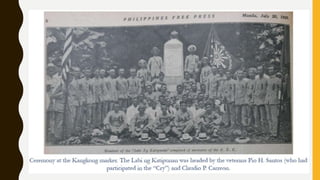
KANGKONG – APOLONIO SAMSON
In 1917 a Katipunan veterans’ association, the Labi ng
Katipunan, erected a memorial on the site where they
remembered the decision to revolt had been taken, at
Apolonio Samson’s house on the Kaingin Road in barrio
Kangkong.
“Sa pook na ito,” the inscription stated, plainly and simply,
“...ipinasya ng KKKNMANB ang paghihimagsik noong ika-
23 ng Agosto 1896”
WHY KANGKONG: EVIDENCES
• The writer Nick Joaquin described the spot in the early 1960s,
a time when it was still:
“lonely, obscure, isolated, and very hard to find. It’s in an
‘interior’ reached by no street; you have to use a footpath. And
the place itself is pure provincial countryside: giant thick-
boughed mango and tamarind and santol trees keep guard
over the marker, which is always in shadow, and one guesses
that this was deep woods in those days.”
VETERAN TESTIMONIES: KANGKONG
• Kangkong, Pasong Tamo (in bo. Banlat), and Bahay Toro.
• 8 out of the 10 individuals who mentioned either Kangkong, Pasong
Tamo, or Bahay Toro - recalled the decisive meeting and/or the “grito”
as having taken place in Kangkong.
• This was the location specified by Tomas Remigio, Julio Nakpil,
Sinforoso San Pedro, Guillermo Masangkay, Cipriano Pacheco, Briccio
Pantas, Francisco Carreon and Vicente Samson
VETERAN TESTIMONIES:
MELCHORA AQUINO’S (P. TAMO)
• Only one veteran – Pio Valenzuela – ever maintained that the
decisive meeting took place at Melchora Aquino’s place near
Pasong Tamo.
• He also once recalled (in 1911) that the pasya had been taken
in Kangkong. If his testimony on that occasion is counted, the
tally for Kangkong would be 9 out of 10.
VETERAN TESTIMONIES:
JUAN RAMOS’S (BAHAY TORO)
• One other veteran – probably Ramon Bernardo – remembered
the decision as having been taken in Bahay Toro, but he did
not say “Juan Ramos’s place in Bahay Toro.” He said it had
been taken at Melchora Aquino’s place, “sa pook ng
Sampalukan, Bahay Toro.” It therefore seems his recollection
was simply mistaken, because Melchora Aquino’s place was
near Pasong Tamo, in bo. Banlat
CONCLUSION:
WHERE ‘PASYA’ TOOK PLACE?
• Unless and until any solid evidence is found to the contrary,
therefore, the only possible conclusion to be drawn from the
veterans’ testimony is that “pasya” was taken by the Supreme
Assembly at the house of Apolonio Samson in Kangkong.
VETERAN TESTIMONIES:
PAGPUPUNIT SA KANGKONG
• veteran Cipriano Pacheco later recalled.
• Whilst the Supreme Assembly was meeting at Samson’s
house (crowd ~ 2,000)
• Bonifacio wanted to announce the momentous decision
somewhere everyone could gather around and hear him. He
led the crowd from Samson’s house to a place nearby
(“malapit pa doon”) where there was an open field (“malaking
kaparangan”)
PAGPUPUNIT SA KANGKONG:
HOW DID IT HAPPEN?
• He told them the momentous news: “Brothers,” he shouted, “The
decision is to go ahead with the revolution.” (“Mga kapatid, ang
pinagkaisahan ay ipagpatuloy ang paghihimagsik.”)
• It was the decision the crowd wanted, and they cheered. “Do you swear,”
Bonifacio asked them, “to reject the government that oppresses
us?” “Yes!” the crowd roared. “In that case,” Bonifacio urged them,
“bring out your cedulas and rip them up, as a symbol of defiance!”
(“Kung gayon, ilabas ninyo ang inyong mga sedula personal at punitin,
tanda ng pagtalikod sa kapangyarihan!”)
• The Katipuneros fervently heeded his call, weeping with emotion as they
ripped their cedulas to shreds. Bonifacio raised the cry “Mabuhay ang
Katagalugan!, and the crowd responded as one, “Mabuhay!”
• Two decades after the revolution, the celebration of
the “Cry” was not a contentious issue. Ceremonies
were held both in Kangkong, where KKK veterans
agreed the pasya had been taken, and in
Balintawak, where the famous statue of a bolo-
waving, flag-holding Katipunero stood to
commemorate the unang labanan, fought a few
kilometers to the north-east.
WHY PUGAD LAWIN, BALINTAWAK?
• Balintawak, they insisted, in the strict, narrow sense – a
particular barrio to the east of Caloocan, with delineated
boundaries – was not where the “Cry” had occurred. The
“Cry” had occurred, they said, at a place known as Pugad
Lawin.
• In contemporary records, alas, and on contemporary maps,
the name Pugad Lawin cannot be found anywhere. “Isa[ng] ...
pagkakamali... ang sabihing mayroong Pugad Lawin sa
Kalookan,” the scholar Sofronio G. Calderon decided after a
fruitless search way back in the 1920s.
DR PIO VALENZUELA – NOT VALID?
• The foremost proponent of this argument was Dr Pio Valenzuela, who
had been the Vice-President of the Katipunan at the outbreak of the
revolution and who had latterly, in the early 1920s, been the provincial
governor of Bulacan. He was a prestigious figure, but not a good
witness to history. He changed his story, more than once. In 1911, as we
noted, he had said the decision to revolt had been taken at Apolonio
Samson’s house in Kangkong. In 1917, he had testified in court that it
had been taken at Melchora Aquino’s house on the road known as Daan
Malalim, in Pasong Tamo, “also known as Pacpac-lawin.” But in his
“Memoirs,” which Agoncillo says date from the early 1920s, he said it
had been taken at the place of Melchora Aquino’s son, Juan Ramos, in
“Pugad Lawin”.
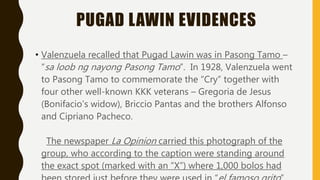
PUGAD LAWIN EVIDENCES
• Valenzuela recalled that Pugad Lawin was in Pasong Tamo –
“sa loob ng nayong Pasong Tamo”. In 1928, Valenzuela went
to Pasong Tamo to commemorate the “Cry” together with
four other well-known KKK veterans – Gregoria de Jesus
(Bonifacio’s widow), Briccio Pantas and the brothers Alfonso
and Cipriano Pacheco.
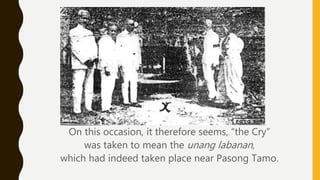
The newspaper La Opinion carried this photograph of the
group, who according to the caption were standing around
the exact spot (marked with an “X”) where 1,000 bolos had
•
On this occasion, it therefore seems, “the Cry”
was taken to mean the unang labanan,
which had indeed taken place near Pasong Tamo.
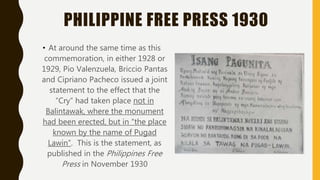
PHILIPPINE FREE PRESS 1930
• At around the same time as this
commemoration, in either 1928 or
1929, Pio Valenzuela, Briccio Pantas
and Cipriano Pacheco issued a joint
statement to the effect that the
“Cry” had taken place not in
Balintawak, where the monument
had been erected, but in “the place
known by the name of Pugad
Lawin”. This is the statement, as
published in the Philippines Free
Press in November 1930
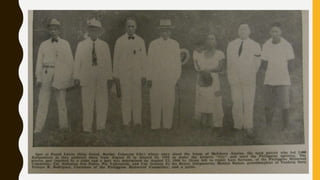
MELCHORA AQUINO’S ??
• But it was. Any doubt that Pio Valenzuela identified Pugad
Lawin with Pasong Tamo, and specifically with Melchora
Aquino’s place, was dispelled in August 1940, when together
with two other Katipunan veterans (Genaro de los Reyes and
Sinforoso San Pedro) he returned there with Eulogio B.
Rodriguez and Luis Serrano of the Philippine Historical
Committee (a forerunner of the NHCP) to verify the location.
Before posing for photographs, the party marked the site of
Melchora Aquino’s house with a thin wooden stake on which
somebody placed their hat.
• The photograph’s caption is not contemporaneous, because
Caloocan did not attain the status of a city until 1963. It is
possible the description of the site – “Sitio Gulod, Banlat,
Caloocan City” – reflects how the location was known in the
1960s rather than in 1940. Fortunately, though, Luis Serrano
wrote a detailed account of the 1940 expedition which makes
it absolutely clear not only that Valenzuela and his
companions believed the “Cry” took place at or near Melchora
Aquino’s place, a spot they remembered as Pugad Lawin, but
also that their geographical point of reference, their starting
point for locating the exact spot, was Pasong Tamo.
• The trip to Pugad Lawin in 1940, Serrano recalls, was
organized by Eulogio B. Rodriguez in his capacity as chairman
of the Philippine Historical Committee “for the purpose of
first, verifying the date of the ‘Cry,’ second, ascertaining the
truth of a report that Bonifacio and some members of the
Katipunan had buried certain important documents of the
Katipunan there, and third, locating the exact spot where the
house of Tandang Sora stood.” After picking up the three
veterans, Serrano relates, the party “negotiated the distance
by car up to Pasong-tamo and hiked about an hour to Pugad-
lawin.”
• “We found that Pugad-lawin was a knoll of about 30
or 40 feet higher than the surrounding territory. As
the remaining vegetation indicated, it must have been
well covered with trees during the revolution. It was a
good observation point from a military point of view
because it commanded an excellent view of the whole
country to the south and west, the only directions
from where the Spanish forces could be expected to
come. Some of the big trees which formed landmarks
of the place were still recognized by Dr. Valenzuela.”
• Two local men, Serrano continues, aided the party in digging around an
ancient tree stump in an attempt to find the buried Katipunan records,
but their efforts were in vain. Otherwise, though, the expedition had
been highly successful, because it confirmed:
•
“first, the so-called First Cry took place at Pugad-lawin on August
23, and second, it was from the house of Tandang Sora that Katipunan
members sallied forth to challenge the might of Spain... [Bonifacio and
his followers arrived] at the house of Tandang Sora in Pugad-lawin in
the afternoon of August 22. Tandang Sora’s son, Juan A. Ramos, was a
member of the secret organization; hence it was natural for the
Katipuneros to seek refuge there.” [Note: The dates given here are
wrong – as Valenzuela had correctly remembered in 1911, the
Katipuneros arrived at Tandang Sora’s house on August 24, not August
• Serrano’s account does not mention Bahay Toro,
where the site of Pugad Lawin is now officially
marked. If Valenzuela had directed the expedition in
1940 to Bahay Toro, they would not have started their
hike at Pasong Tamo. They would have parked
somewhere much closer.
• In his “Memoirs,” as already mentioned, in a single line that has muddied the whole
issue, Valenzuela relates that the decision to revolt was taken at the “house,
storehouse and yard of Juan Ramos, son of Melchora Aquino, in Pugad Lawin”.
•
In recent decades, as we shall see shortly, Teodoro Agoncillo and Isagani Medina have
argued that this means the pasya site was not at Melchora Aquino’s place, but at a
completely different location, in Bahay Toro, three kilometers to the south west of
Pasong Tamo. And yet Luis Serrano, who personally went with Valenzuela to Pasong
Tamo in 1940, and who later translated the veteran’s “Memoirs,” did not draw such an
inference. The crux of the matter, Serrano doubtless believed, was that Valenzuela
specified in his “Memoirs,” as elsewhere, that the pasya site was at Pugad Lawin,
meaning the wooded knoll (a likely place for a hawk’s nest) to which they had hiked
together from Pasong Tamo.
PUGAD LAWIN, IT IS.
• Official recognition of “Pugad Lawin, wherever it was”
• Agoncillo was the pre-eminent historian of the day, and the 1896
revolution was among his special fields. It was mainly upon his advice,
is commonly said, that the Philippine government ruled that the term
“Cry of Balintawak” should be discarded in favor of “Cry of Pugad
Lawin.” This change was signaled formally in 1963 by President
Macapagal, whose Proclamation 149 declared that the 67th anniversary
of the “Cry of Pugad Lawin” on August 23 would be a special public
holiday in Quezon City, “where the event took place.”
• By “the event” of August 23, Proclamation 149 meant the pasya, not
unang labanan. Agoncillo’s definition of the “Cry” had become the
BALINTAWAK TO PUGAD LAWIN
• The “Cry,” therefore, was officially redefined, and the “Cry” site
was officially removed from Balintawak, but it was reassigned
to “Pugad Lawin, wherever it was,” not to a particular
designated spot. The problem this presented to the
organizers of the annual “Cry” commemorations was solved
by the simple expedient of sticking to what was familiar. The
crowds gathered, rites were observed, and politicos delivered
their speeches at Balintawak, as before, as if nothing had
happened
RECOGNITION TO PUGAD LAWIN
• The Committee, that is to say, accepted his position that Pugad Lawin was a considerable distance
from Pasong Tamo, and that the yard where cedulas were shredded had belonged to Juan Ramos, not
to his mother, Melchora Aquino. The search for Pugad Lawin thus boiled down to a search for where
Juan Ramos had lived.
• The Pugad Lawin Historical Committee did not discover any fresh documentary evidence in its 1983
investigation, but claimed to have identified the former site of Ramos’s place (then amidst a squatter
settlement) on the basis, it seems, of oral testimony from one of Juan Ramos’s grandsons, Escolastico
Ramos.
• The Committee relayed its findings to the government’s historical agency (then called the National
Historical Institute), which despatched someone to visit the site, deliberated on the matter, and
declared the Committee to be right. On the occasion of the next commemoration of the “Cry,” on
August 23, 1984, the NHI placed its marker at the site in Seminary Road, Bahay Toro where it has since
remained.
ISAGANI’S
• The foremost proponent of “Pugad Lawin in Bahay Toro” in this renewed debate was
Isagani R. Medina. He presented the case for Bahay Toro more fully, and with more
documentation, than anybody else has before or since, first in a paper he delivered at a
conference in 1993 and then in his annotations to Ronquillo’s memoirs. He patently
wished to make his case as forceful and persuasive as he could, and it seems unlikely
he omitted any evidence he felt to be significant. We now need to examine the case
he makes.
•
Medina found official documents from 1896, the vecindarios or lists of residents for the
municipality of Caloocan, which show that Melchora Aquino and Juan Ramos, mother
and son, were listed under different cabecerías. This strongly suggests they resided
(officially at least, in terms of registration) in different places. Melchora Aquino lived
with her youngest daughter, Juana Ramos. Another of her daughters, Estefania Ramos,
was living with her family nearby. Her son Juan Ramos, however, was registered in
another cabecería, of which he was himself the cabeza de barangay, and was living
• Today, the “Cry” continues to be officially marked in
Bahay Toro almost by default, by the force of
inertia. “Pugad Lawin in Bahay Toro” retains its official
status not because there is any supporting evidence
for that site, but because nobody has pushed the case
for the actual site, the site that Katipunan veterans
marked a century ago, the site of Apolonio Samson’s
house in Kangkong.
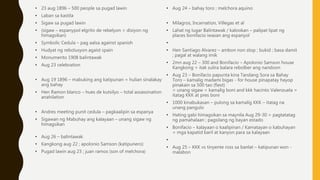
• 23 aug 1896 – 500 people sa pugad lawin
• Laban sa kastila
• Sigaw sa pugad lawin
• (sigaw – espanypol elgrito de rebelyon = disiyon ng
himagsikan)
• Symbolic Cedula – pag aalsa against spanish
• Hudyat ng rebolusyon agaist spain
• Monumento 1908 balintawak
• Aug 23 celebration
• Aug 19 1896 – mabuking ang katipunan = hulian sinalakay
ang bahay
• Hen Ramon blanco – hues de kutsilyo – total assassination
anahilation
• Andres meeting punit cedula – pagkaalipin sa espanya
• Sigawan ng Mabuhay ang kalayaan – unang sigaw ng
himagsikan
• Aug 26 – balintawak
• Kangkong aug 22 ; apolonio Samson (katipunero)
• Pugad lawin aug 23 ; juan ramos (son of melchora)
• Aug 24 – bahay toro ; melchora aquino
• Milagros, Incarnation, Villegas et al
• Lahat ng lugar Balintawak / kalookan – palipat lipat ng
places bonifacio iwasan ang espanyol
•
• Hen Santiago Alvarez – ambon non stop ; bukid ; basa damit
; pagal at walang imik
• 2mn aug 22 – 300 and Bonifacio – Apolonio Samson house
Kangkong = itak sulira balara rebolber ang nandoon
• Aug 23 – Bonifacio papunta kina Tandang Sora sa Bahay
Toro – kamalig madami bigas - for house pinapatay hayop
pinakain sa 500 tao (fiest)
= unang sigaw = kamalig boni and kkk hacinto Valenzuela =
itatag KKK at pres boni
• 1000 kinabukasan – pulong sa kamalig KKK – itatag na
unang pangulo
• Hating gabi himagsikan sa maynila Aug 29-30 = pagtatatag
ng pamahalaan ; pagsilang ng bayan estado
• Bonifacio – kalayaan o kaalipinan / Kamatayan o kabuhayan
= mga kapatid baril at kanyon para sa kalayaan
•
• Aug 25 – KKK vs tinyente ross sa banlat – katipunan won -
malabon

Cry-of-pugadlawin-pptx[1].pptx

  • 1.
    CRY OF PUGADLAWIN G RO U P 4 : M M - 1 A | M A C A L I N A O | C A L M A | M A L L A R I | H E R N A N D E Z | | M AT I C | T O R N A D O | VA L B U E N A | VA L E N Z U E L A |
  • 2.
    THE CRY OFPUGAD LAWIN The start of the revolution against Spain has been officially commemorated in recent years as “The Cry of Pugad Lawin.” The supposed site of “Pugad Lawin” is situated in Brgy. Bahay Toro, Quezon City, and is memorialized with a tableau of life-sized, oddly rigid Katipuneros tearing their cedulas.
  • 3.
  • 5.
    •“Cry” took placeon August 23, 1896; at a site known as Pugad Lawin, situated in what today is Bahay Toro, Quezon City; which in 1896 had been the house and yard of Juan Ramos.
  • 6.
    • the name“Pugad Lawin” came to be used in the twentieth century to refer not just to one of the contending “Cry” sites, but to two. First one site, and then another. Today, the Pugad Lawin marker is in Bahay Toro, where Juan Ramos had supposedly lived. But in previous decades, as will be discussed later, Pugad Lawin was said to have been three kilometers or so to the northeast, where Ramos’s mother Melchora Aquino (“Tandang Sora”) had lived near Pasong Tamo in barrio Banlat.
  • 8.
    DEFINITIONS OF “CRY” •Pasya, Pagpupunit and Unang Labanan • The debate has long been clouded by a lack of consensus on exactly what is meant by the “Cry”. The term has been applied to three related but distinct events – • the “pasya” – the decision to revolt; • the “pagpupunit” – the tearing of cedulas; and • the “unang labanan” – the first encounter with Spanish forces. • These three events, to state the obvious, did not all happen at the time and place. When and where the “Cry” should be commemorated thus depends on how it is defined.
  • 9.
    HISTORIAN’S INSIGHTS: TERMS •Teodoro A. Agoncillo equates the term with the pagpupunit, which he says happened immediately after the pasya. • Isagani R. Medina also takes the “Cry” to mean the pagpupunit, but says it happened before the decision to revolt had been taken. • Soledad Borromeo-Buehler takes the view – the traditional view that KKK veterans took, she says - that the “Cry” should mean the unang labanan.
  • 10.
    • It wasthe unang labanan, as Borromeo-Buehler points out, that was commemorated by the first monument to the events of August 1896. The main inscription on the plinth read “Homenaje del Pueblo Filipino a los Heroes de ’96 / Ala-ala ng Bayang Pilipino sa mga Bayani ng ‘96”, and a smaller plaque bore the date “26 Agosto 1896” .
  • 11.
    • the statuewas erected in Balintawak, the largest and best-known barrio in the general area where the Katipuneros had congregated in August 1896. The name Balintawak was often used as shorthand to denote that general area, and the “Cry” had become popularly known as the “Cry of Balintawak” even before the monument
  • 12.
    • Nobody professedin 1911, though, that the statue marked the “exact spot” where the first battle had been fought. It was simply in Balintawak, on a plot donated by a local landowner, Tomas Arguelles.
  • 13.
    EVIDENCES • The firstbattle, an encounter with a detachment of the Guardia Civil, was fought on the date inscribed on the Balintawak monument - August 26 – at a place about five kilometers north-east of Balintawak, between the settlements of Banlat and Pasong Tamo. A few sources give the date as August 25 but, as both Borromeo-Buehler and Encarnacion have shown, the most solid, contemporary sources confirm August 26 to be correct.
  • 14.
    • The Balintawakmonument continued to be the focus of the yearly “Cry” celebrations, held on August 26, for decades. In the 1960s, however, the official definition of the “Cry” changed. Officially, the “Cry” ceased to mean the unang labanan and was defined instead as “that part of the Revolution when the Katipunan decided to launch a revolution against Spain. This event culminated with the tearing of the cedula”. This definition, which is more or less in line with Agoncillo’s, thus embraces both the pasya and pagpupunit, but excludes the unang labanan.
  • 15.
    • A numberof sources, however, indicate that cedulas were torn on more than one occasion, in different places, presumably because Katipuneros were arriving to join their embryonic army over the course of a number of days, and many wanted to proclaim their rebellion, their commitment to fight Spanish rule, in the same way. It is even possible (as Medina believes) that the main pagpupunit preceded the pasya. But then it would have been premature, because the revolt might have been deferred. It seems more likely, as the official definition of the “Cry” assumes, that the largest, best remembered act of defiant cedula-tearing happened soon after the pasya had been taken, and in the same vicinity.
  • 16.
    DECISION TO REVOLT:WHEN? • It is almost certain that the decision to revolt was taken on Monday, August 24, 1896, after a lengthy meeting (or series of meetings) that had begun on Sunday, August 23. Many veterans later recalled August 23 as the historic day (see the Appendix to these notes), but others specifically remembered the decision had not been taken until the early hours of August 24, and this latter date is given by at least four important sources, namely:
  • 17.
    • The Biak-na-Batoconstitution of November 1897, which mentions “the current war, initiated on August 24, 1896.” The constitution’s signatories included at least one participant in the “Cry” (Cipriano Pacheco) and several others who would have read circulars and messages from the revolutionists in Caloocan in August 1896.
  • 18.
    •Carlos Ronquillo, inthe first chronicle of the revolt against Spain by a Filipino, written in 1898. His work begins with the words “Sa isang araw ng pagpupulong sa Balintawak (24 Agosto 1896) kaarawan nang pasimulan ang Revolucion….”
  • 19.
    • The Liga Filipinamemorial erected in Tondo in 1903 by the Samahan ng May pag-asa, a patriotic society named in Bonifacio’s honor whose members included several KKK veterans. The inscription on the memorial lists many of those who attended the famous meeting addressed by Rizal on July 3, 1892, and alongside Bonifacio’s name it records that he was “Supremo del ‘Katipunan’ que dió el 1er grito de Guerra contra la tiranía el 24 de Agosto de 1896.”
  • 20.
    •Santiago Alvarez, inhis memoirs Ang Katipunan at Paghihimagsik, written in 1927 but based, he said, on records entrusted to him by the Katipunan’s first leaders and fighters. Internal evidence suggests that Alvarez’s account of the meeting on August 24 is based on information he obtained from Ramon Bernardo, a Katipunan leader from Pandacan who was a participant in the “Cry.”
  • 21.
    CONCLUSION: WHEN? • August24 has now been confirmed as the date of the formal decision by the discovery of a contemporary document - a page from what Medina calls the “borador ng pulong ng Kataastaasang Sangunian,” or rough copy book of the Katipunan Supreme Council. Since a proper borador was not to hand in Caloocan at this tumultuous moment, the Supreme Council’s communications were drafted in some kind of farm ledger, used under normal circumstances to record crop yields or sales. The text is therefore written across printed columns that are headed “Maiz,” “Mani,” “Camote” and so on.
  • 22.
    • The documentis dated “Kalookan, Maynila ika 26 ng Agosto ng taong 1896,” and it begins as follows:- “Ayon sa pinagkaisahan sa ginanap […?] pulong ng Kataastaasang Kapisanan […?] ikadalawang puo’t apat nitong umiiral na buan tungkol sa paghihimagsik (revolucion) at sa pagkakailangang […?] maghalal ng magsisipamahala ng bayan at mag aakay ng Hukbo…….” [In accordance with the decision taken by the meeting of the Supreme Assembly held on the twenty-fourth of the present month regarding the revolution, and given the necessity to elect leaders of the people and directors of the Army…..”] •
  • 23.
    WHO DECIDED TOTAKE REVOLT? • The decision to revolt, says the “borador” document, was taken by the KKK’s Supreme Assembly. First constituted in December 1895, the Assembly was described by Emilio Jacinto as the primary and paramount body within the Katipunan (“ang una at lubos na kapangyarihang ay hahawakan ng Kataastaasang Kapisanan”
  • 24.
    WHO DECIDED TOTAKE REVOLT? • Milagros Guerrero has suggested that the Supreme Assembly’s decision needed to be confirmed or ratified by the KKK Supreme Council. Such a “two- stage pasya,” however, is not corroborated by the “borador” document, which indicates the Supreme Assembly’s decision was final.
  • 25.
    REVOLT: WHERE? • Bonifacioand the members of the Katipunan Supreme Assembly were on August 25 or 26. We only need to establish where the Assembly met on August 23 and 24. Unfortunately, this is not a great help. The sources are still conflicting. They broadly agree that the leading revolutionists went first to Caloocan (población) after leaving Manila, and then headed eastwards via Kangkong towards Pasong Tamo and eventually Balara. The sources still offer no accord, however, as to the whereabouts of the leading revolutionists on the critical dates of August 23 and 24. Some sources say they left Kangkong as early as August 23, whereas others say they were still in Kangkong as late as August 26
  • 26.
    POSSIBLY, WHERE? • ApolonioSamson’s place in bo. Kangkong, Caloocan • Melchora Aquino’s place near Pasong Tamo in bo. Banlat, Caloocan • Juan Ramos’s place in bo. Bahay Toro, Caloocan
  • 27.
    CALOOCAN OR BALINTAWAK? •They referred in vaguer terms to “Caloocan,” meaning “somewhere in the municipality of Caloocan,” or to “Balintawak,” meaning “some distance to the east of Caloocan población, in the general area where Balintawak is the best- known place.” For the present purpose, these vaguer sources must be put to one side in favor of those that are more specific.
  • 28.
    KANGKONG – APOLONIOSAMSON In 1917 a Katipunan veterans’ association, the Labi ng Katipunan, erected a memorial on the site where they remembered the decision to revolt had been taken, at Apolonio Samson’s house on the Kaingin Road in barrio Kangkong. “Sa pook na ito,” the inscription stated, plainly and simply, “...ipinasya ng KKKNMANB ang paghihimagsik noong ika- 23 ng Agosto 1896”
  • 30.
    WHY KANGKONG: EVIDENCES •The writer Nick Joaquin described the spot in the early 1960s, a time when it was still: “lonely, obscure, isolated, and very hard to find. It’s in an ‘interior’ reached by no street; you have to use a footpath. And the place itself is pure provincial countryside: giant thick- boughed mango and tamarind and santol trees keep guard over the marker, which is always in shadow, and one guesses that this was deep woods in those days.”
  • 31.
    VETERAN TESTIMONIES: KANGKONG •Kangkong, Pasong Tamo (in bo. Banlat), and Bahay Toro. • 8 out of the 10 individuals who mentioned either Kangkong, Pasong Tamo, or Bahay Toro - recalled the decisive meeting and/or the “grito” as having taken place in Kangkong. • This was the location specified by Tomas Remigio, Julio Nakpil, Sinforoso San Pedro, Guillermo Masangkay, Cipriano Pacheco, Briccio Pantas, Francisco Carreon and Vicente Samson
  • 32.
    VETERAN TESTIMONIES: MELCHORA AQUINO’S(P. TAMO) • Only one veteran – Pio Valenzuela – ever maintained that the decisive meeting took place at Melchora Aquino’s place near Pasong Tamo. • He also once recalled (in 1911) that the pasya had been taken in Kangkong. If his testimony on that occasion is counted, the tally for Kangkong would be 9 out of 10.
  • 33.
    VETERAN TESTIMONIES: JUAN RAMOS’S(BAHAY TORO) • One other veteran – probably Ramon Bernardo – remembered the decision as having been taken in Bahay Toro, but he did not say “Juan Ramos’s place in Bahay Toro.” He said it had been taken at Melchora Aquino’s place, “sa pook ng Sampalukan, Bahay Toro.” It therefore seems his recollection was simply mistaken, because Melchora Aquino’s place was near Pasong Tamo, in bo. Banlat
  • 34.
    CONCLUSION: WHERE ‘PASYA’ TOOKPLACE? • Unless and until any solid evidence is found to the contrary, therefore, the only possible conclusion to be drawn from the veterans’ testimony is that “pasya” was taken by the Supreme Assembly at the house of Apolonio Samson in Kangkong.
  • 35.
    VETERAN TESTIMONIES: PAGPUPUNIT SAKANGKONG • veteran Cipriano Pacheco later recalled. • Whilst the Supreme Assembly was meeting at Samson’s house (crowd ~ 2,000) • Bonifacio wanted to announce the momentous decision somewhere everyone could gather around and hear him. He led the crowd from Samson’s house to a place nearby (“malapit pa doon”) where there was an open field (“malaking kaparangan”)
  • 36.
    PAGPUPUNIT SA KANGKONG: HOWDID IT HAPPEN? • He told them the momentous news: “Brothers,” he shouted, “The decision is to go ahead with the revolution.” (“Mga kapatid, ang pinagkaisahan ay ipagpatuloy ang paghihimagsik.”) • It was the decision the crowd wanted, and they cheered. “Do you swear,” Bonifacio asked them, “to reject the government that oppresses us?” “Yes!” the crowd roared. “In that case,” Bonifacio urged them, “bring out your cedulas and rip them up, as a symbol of defiance!” (“Kung gayon, ilabas ninyo ang inyong mga sedula personal at punitin, tanda ng pagtalikod sa kapangyarihan!”) • The Katipuneros fervently heeded his call, weeping with emotion as they ripped their cedulas to shreds. Bonifacio raised the cry “Mabuhay ang Katagalugan!, and the crowd responded as one, “Mabuhay!”
  • 37.
    • Two decadesafter the revolution, the celebration of the “Cry” was not a contentious issue. Ceremonies were held both in Kangkong, where KKK veterans agreed the pasya had been taken, and in Balintawak, where the famous statue of a bolo- waving, flag-holding Katipunero stood to commemorate the unang labanan, fought a few kilometers to the north-east.
  • 38.
    WHY PUGAD LAWIN,BALINTAWAK? • Balintawak, they insisted, in the strict, narrow sense – a particular barrio to the east of Caloocan, with delineated boundaries – was not where the “Cry” had occurred. The “Cry” had occurred, they said, at a place known as Pugad Lawin. • In contemporary records, alas, and on contemporary maps, the name Pugad Lawin cannot be found anywhere. “Isa[ng] ... pagkakamali... ang sabihing mayroong Pugad Lawin sa Kalookan,” the scholar Sofronio G. Calderon decided after a fruitless search way back in the 1920s.
  • 39.
    DR PIO VALENZUELA– NOT VALID? • The foremost proponent of this argument was Dr Pio Valenzuela, who had been the Vice-President of the Katipunan at the outbreak of the revolution and who had latterly, in the early 1920s, been the provincial governor of Bulacan. He was a prestigious figure, but not a good witness to history. He changed his story, more than once. In 1911, as we noted, he had said the decision to revolt had been taken at Apolonio Samson’s house in Kangkong. In 1917, he had testified in court that it had been taken at Melchora Aquino’s house on the road known as Daan Malalim, in Pasong Tamo, “also known as Pacpac-lawin.” But in his “Memoirs,” which Agoncillo says date from the early 1920s, he said it had been taken at the place of Melchora Aquino’s son, Juan Ramos, in “Pugad Lawin”.
  • 40.
    PUGAD LAWIN EVIDENCES •Valenzuela recalled that Pugad Lawin was in Pasong Tamo – “sa loob ng nayong Pasong Tamo”. In 1928, Valenzuela went to Pasong Tamo to commemorate the “Cry” together with four other well-known KKK veterans – Gregoria de Jesus (Bonifacio’s widow), Briccio Pantas and the brothers Alfonso and Cipriano Pacheco. The newspaper La Opinion carried this photograph of the group, who according to the caption were standing around the exact spot (marked with an “X”) where 1,000 bolos had
  • 41.
    • On this occasion,it therefore seems, “the Cry” was taken to mean the unang labanan, which had indeed taken place near Pasong Tamo.
  • 42.
    PHILIPPINE FREE PRESS1930 • At around the same time as this commemoration, in either 1928 or 1929, Pio Valenzuela, Briccio Pantas and Cipriano Pacheco issued a joint statement to the effect that the “Cry” had taken place not in Balintawak, where the monument had been erected, but in “the place known by the name of Pugad Lawin”. This is the statement, as published in the Philippines Free Press in November 1930
  • 43.
    MELCHORA AQUINO’S ?? •But it was. Any doubt that Pio Valenzuela identified Pugad Lawin with Pasong Tamo, and specifically with Melchora Aquino’s place, was dispelled in August 1940, when together with two other Katipunan veterans (Genaro de los Reyes and Sinforoso San Pedro) he returned there with Eulogio B. Rodriguez and Luis Serrano of the Philippine Historical Committee (a forerunner of the NHCP) to verify the location. Before posing for photographs, the party marked the site of Melchora Aquino’s house with a thin wooden stake on which somebody placed their hat.
  • 45.
    • The photograph’scaption is not contemporaneous, because Caloocan did not attain the status of a city until 1963. It is possible the description of the site – “Sitio Gulod, Banlat, Caloocan City” – reflects how the location was known in the 1960s rather than in 1940. Fortunately, though, Luis Serrano wrote a detailed account of the 1940 expedition which makes it absolutely clear not only that Valenzuela and his companions believed the “Cry” took place at or near Melchora Aquino’s place, a spot they remembered as Pugad Lawin, but also that their geographical point of reference, their starting point for locating the exact spot, was Pasong Tamo.
  • 46.
    • The tripto Pugad Lawin in 1940, Serrano recalls, was organized by Eulogio B. Rodriguez in his capacity as chairman of the Philippine Historical Committee “for the purpose of first, verifying the date of the ‘Cry,’ second, ascertaining the truth of a report that Bonifacio and some members of the Katipunan had buried certain important documents of the Katipunan there, and third, locating the exact spot where the house of Tandang Sora stood.” After picking up the three veterans, Serrano relates, the party “negotiated the distance by car up to Pasong-tamo and hiked about an hour to Pugad- lawin.”
  • 47.
    • “We foundthat Pugad-lawin was a knoll of about 30 or 40 feet higher than the surrounding territory. As the remaining vegetation indicated, it must have been well covered with trees during the revolution. It was a good observation point from a military point of view because it commanded an excellent view of the whole country to the south and west, the only directions from where the Spanish forces could be expected to come. Some of the big trees which formed landmarks of the place were still recognized by Dr. Valenzuela.”
  • 48.
    • Two localmen, Serrano continues, aided the party in digging around an ancient tree stump in an attempt to find the buried Katipunan records, but their efforts were in vain. Otherwise, though, the expedition had been highly successful, because it confirmed: • “first, the so-called First Cry took place at Pugad-lawin on August 23, and second, it was from the house of Tandang Sora that Katipunan members sallied forth to challenge the might of Spain... [Bonifacio and his followers arrived] at the house of Tandang Sora in Pugad-lawin in the afternoon of August 22. Tandang Sora’s son, Juan A. Ramos, was a member of the secret organization; hence it was natural for the Katipuneros to seek refuge there.” [Note: The dates given here are wrong – as Valenzuela had correctly remembered in 1911, the Katipuneros arrived at Tandang Sora’s house on August 24, not August
  • 49.
    • Serrano’s accountdoes not mention Bahay Toro, where the site of Pugad Lawin is now officially marked. If Valenzuela had directed the expedition in 1940 to Bahay Toro, they would not have started their hike at Pasong Tamo. They would have parked somewhere much closer.
  • 50.
    • In his“Memoirs,” as already mentioned, in a single line that has muddied the whole issue, Valenzuela relates that the decision to revolt was taken at the “house, storehouse and yard of Juan Ramos, son of Melchora Aquino, in Pugad Lawin”. • In recent decades, as we shall see shortly, Teodoro Agoncillo and Isagani Medina have argued that this means the pasya site was not at Melchora Aquino’s place, but at a completely different location, in Bahay Toro, three kilometers to the south west of Pasong Tamo. And yet Luis Serrano, who personally went with Valenzuela to Pasong Tamo in 1940, and who later translated the veteran’s “Memoirs,” did not draw such an inference. The crux of the matter, Serrano doubtless believed, was that Valenzuela specified in his “Memoirs,” as elsewhere, that the pasya site was at Pugad Lawin, meaning the wooded knoll (a likely place for a hawk’s nest) to which they had hiked together from Pasong Tamo.
  • 51.
    PUGAD LAWIN, ITIS. • Official recognition of “Pugad Lawin, wherever it was” • Agoncillo was the pre-eminent historian of the day, and the 1896 revolution was among his special fields. It was mainly upon his advice, is commonly said, that the Philippine government ruled that the term “Cry of Balintawak” should be discarded in favor of “Cry of Pugad Lawin.” This change was signaled formally in 1963 by President Macapagal, whose Proclamation 149 declared that the 67th anniversary of the “Cry of Pugad Lawin” on August 23 would be a special public holiday in Quezon City, “where the event took place.” • By “the event” of August 23, Proclamation 149 meant the pasya, not unang labanan. Agoncillo’s definition of the “Cry” had become the
  • 52.
    BALINTAWAK TO PUGADLAWIN • The “Cry,” therefore, was officially redefined, and the “Cry” site was officially removed from Balintawak, but it was reassigned to “Pugad Lawin, wherever it was,” not to a particular designated spot. The problem this presented to the organizers of the annual “Cry” commemorations was solved by the simple expedient of sticking to what was familiar. The crowds gathered, rites were observed, and politicos delivered their speeches at Balintawak, as before, as if nothing had happened
  • 53.
    RECOGNITION TO PUGADLAWIN • The Committee, that is to say, accepted his position that Pugad Lawin was a considerable distance from Pasong Tamo, and that the yard where cedulas were shredded had belonged to Juan Ramos, not to his mother, Melchora Aquino. The search for Pugad Lawin thus boiled down to a search for where Juan Ramos had lived. • The Pugad Lawin Historical Committee did not discover any fresh documentary evidence in its 1983 investigation, but claimed to have identified the former site of Ramos’s place (then amidst a squatter settlement) on the basis, it seems, of oral testimony from one of Juan Ramos’s grandsons, Escolastico Ramos. • The Committee relayed its findings to the government’s historical agency (then called the National Historical Institute), which despatched someone to visit the site, deliberated on the matter, and declared the Committee to be right. On the occasion of the next commemoration of the “Cry,” on August 23, 1984, the NHI placed its marker at the site in Seminary Road, Bahay Toro where it has since remained.
  • 54.
    ISAGANI’S • The foremostproponent of “Pugad Lawin in Bahay Toro” in this renewed debate was Isagani R. Medina. He presented the case for Bahay Toro more fully, and with more documentation, than anybody else has before or since, first in a paper he delivered at a conference in 1993 and then in his annotations to Ronquillo’s memoirs. He patently wished to make his case as forceful and persuasive as he could, and it seems unlikely he omitted any evidence he felt to be significant. We now need to examine the case he makes. • Medina found official documents from 1896, the vecindarios or lists of residents for the municipality of Caloocan, which show that Melchora Aquino and Juan Ramos, mother and son, were listed under different cabecerías. This strongly suggests they resided (officially at least, in terms of registration) in different places. Melchora Aquino lived with her youngest daughter, Juana Ramos. Another of her daughters, Estefania Ramos, was living with her family nearby. Her son Juan Ramos, however, was registered in another cabecería, of which he was himself the cabeza de barangay, and was living
  • 55.
    • Today, the“Cry” continues to be officially marked in Bahay Toro almost by default, by the force of inertia. “Pugad Lawin in Bahay Toro” retains its official status not because there is any supporting evidence for that site, but because nobody has pushed the case for the actual site, the site that Katipunan veterans marked a century ago, the site of Apolonio Samson’s house in Kangkong.
  • 56.
    • 23 aug1896 – 500 people sa pugad lawin • Laban sa kastila • Sigaw sa pugad lawin • (sigaw – espanypol elgrito de rebelyon = disiyon ng himagsikan) • Symbolic Cedula – pag aalsa against spanish • Hudyat ng rebolusyon agaist spain • Monumento 1908 balintawak • Aug 23 celebration • Aug 19 1896 – mabuking ang katipunan = hulian sinalakay ang bahay • Hen Ramon blanco – hues de kutsilyo – total assassination anahilation • Andres meeting punit cedula – pagkaalipin sa espanya • Sigawan ng Mabuhay ang kalayaan – unang sigaw ng himagsikan • Aug 26 – balintawak • Kangkong aug 22 ; apolonio Samson (katipunero) • Pugad lawin aug 23 ; juan ramos (son of melchora) • Aug 24 – bahay toro ; melchora aquino • Milagros, Incarnation, Villegas et al • Lahat ng lugar Balintawak / kalookan – palipat lipat ng places bonifacio iwasan ang espanyol • • Hen Santiago Alvarez – ambon non stop ; bukid ; basa damit ; pagal at walang imik • 2mn aug 22 – 300 and Bonifacio – Apolonio Samson house Kangkong = itak sulira balara rebolber ang nandoon • Aug 23 – Bonifacio papunta kina Tandang Sora sa Bahay Toro – kamalig madami bigas - for house pinapatay hayop pinakain sa 500 tao (fiest) = unang sigaw = kamalig boni and kkk hacinto Valenzuela = itatag KKK at pres boni • 1000 kinabukasan – pulong sa kamalig KKK – itatag na unang pangulo • Hating gabi himagsikan sa maynila Aug 29-30 = pagtatatag ng pamahalaan ; pagsilang ng bayan estado • Bonifacio – kalayaan o kaalipinan / Kamatayan o kabuhayan = mga kapatid baril at kanyon para sa kalayaan • • Aug 25 – KKK vs tinyente ross sa banlat – katipunan won - malabon