THEWEEK •JUNE4,2017 41
The trial would proceed as ifhe had asserted 'not
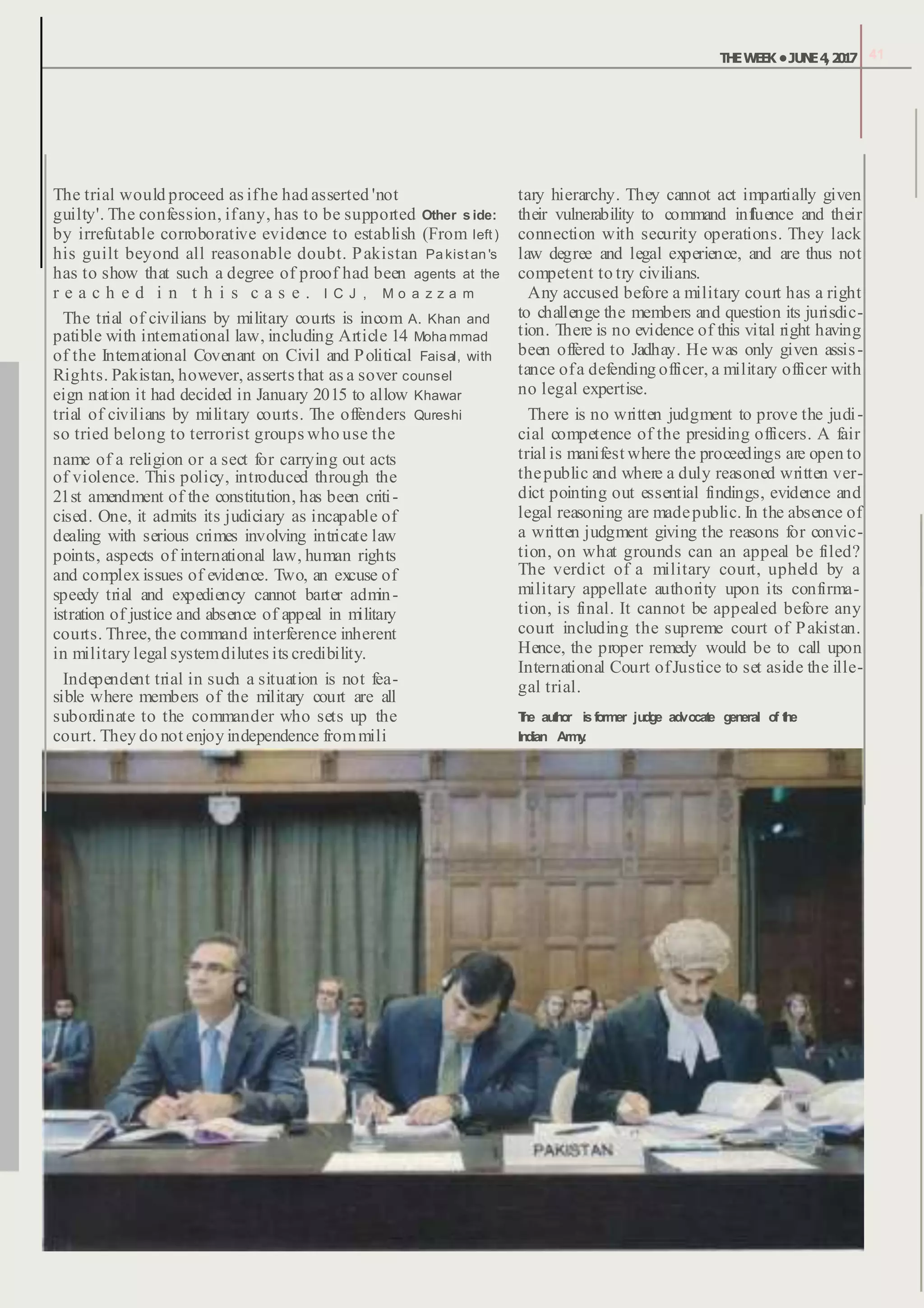
guilty'. The confession, ifany, has to be supported Other s ide:
by irrefutable corroborative evidence to establish (From left)
his guilt beyond all reasonable doubt. Pakistan Pa kistan 's
has to show that such a degree of proof had been agents at the
r e a c h e d i n t h i s c a s e . I C J , M o a z z a m
The trial of civilians by military courts is incom A. Khan and
patible with international law, including Article 14 Moha mmad
of the International Covenant on Civil and Political Faisal, with
Rights. Pakistan, however, asserts that as a sover counsel
eign nation it had decided in January 2015 to allow Khawar
trial of civilians by military courts. The offenders Qureshi
so tried belong to terrorist groups who use the
name of a religion or a sect for carrying out acts
of violence. This policy, introduced through the
21st amendment of the constitution, has been criti-
cised. One, it admits its judiciary as incapable of
dealing with serious crimes involving intricate law
points, aspects of international law, human rights
and complex issues of evidence. Two, an excuse of
speedy trial and expediency cannot barter admin-
istration of justice and absence of appeal in military
courts. Three, the command interference inherent
in military legal systemdilutes its credibility.
Independent trial in such a situation is not fea-
sible where members of the military court are all
subordinate to the commander who sets up the
court. They do not enjoy independence frommili
tary hierarchy. They cannot act impartially given
their vulnerability to command influence and their
connection with security operations. They lack
law degree and legal experience, and are thus not
competent to try civilians.
Any accused before a military court has a right
to challenge the members and question its jurisdic-
tion. There is no evidence of this vital right having
been offered to Jadhay. He was only given assis-
tance ofa defending officer, a military officer with
no legal expertise.
There is no written judgment to prove the judi-
cial competence of the presiding officers. A fair
trial is manifest where the proceedings are open to
thepublic and where a duly reasoned written ver-
dict pointing out essential findings, evidence and
legal reasoning are madepublic. In the absence of
a written judgment giving the reasons for convic-
tion, on what grounds can an appeal be filed?
The verdict of a military court, upheld by a
military appellate authority upon its confirma-
tion, is final. It cannot be appealed before any
court including the supreme court of Pakistan.
Hence, the proper remedy would be to call upon
International Court ofJustice to set aside the ille-
gal trial.
The author is former judge advocate general of the
Indian Army.

Crude Effort to Crucify- page 2

  • 1.
    THEWEEK •JUNE4,2017 41 Thetrial would proceed as ifhe had asserted 'not guilty'. The confession, ifany, has to be supported Other s ide: by irrefutable corroborative evidence to establish (From left) his guilt beyond all reasonable doubt. Pakistan Pa kistan 's has to show that such a degree of proof had been agents at the r e a c h e d i n t h i s c a s e . I C J , M o a z z a m The trial of civilians by military courts is incom A. Khan and patible with international law, including Article 14 Moha mmad of the International Covenant on Civil and Political Faisal, with Rights. Pakistan, however, asserts that as a sover counsel eign nation it had decided in January 2015 to allow Khawar trial of civilians by military courts. The offenders Qureshi so tried belong to terrorist groups who use the name of a religion or a sect for carrying out acts of violence. This policy, introduced through the 21st amendment of the constitution, has been criti- cised. One, it admits its judiciary as incapable of dealing with serious crimes involving intricate law points, aspects of international law, human rights and complex issues of evidence. Two, an excuse of speedy trial and expediency cannot barter admin- istration of justice and absence of appeal in military courts. Three, the command interference inherent in military legal systemdilutes its credibility. Independent trial in such a situation is not fea- sible where members of the military court are all subordinate to the commander who sets up the court. They do not enjoy independence frommili tary hierarchy. They cannot act impartially given their vulnerability to command influence and their connection with security operations. They lack law degree and legal experience, and are thus not competent to try civilians. Any accused before a military court has a right to challenge the members and question its jurisdic- tion. There is no evidence of this vital right having been offered to Jadhay. He was only given assis- tance ofa defending officer, a military officer with no legal expertise. There is no written judgment to prove the judi- cial competence of the presiding officers. A fair trial is manifest where the proceedings are open to thepublic and where a duly reasoned written ver- dict pointing out essential findings, evidence and legal reasoning are madepublic. In the absence of a written judgment giving the reasons for convic- tion, on what grounds can an appeal be filed? The verdict of a military court, upheld by a military appellate authority upon its confirma- tion, is final. It cannot be appealed before any court including the supreme court of Pakistan. Hence, the proper remedy would be to call upon International Court ofJustice to set aside the ille- gal trial. The author is former judge advocate general of the Indian Army.