Crossborder Tertiary Education A Way Towards Capacity Development Oecd
Crossborder Tertiary Education A Way Towards Capacity Development Oecd
Crossborder Tertiary Education A Way Towards Capacity Development Oecd
Crossborder Tertiary Education A Way Towards Capacity Development Oecd
Crossborder Tertiary Education A Way Towards Capacity Development Oecd
1.
Crossborder Tertiary EducationA Way Towards
Capacity Development Oecd download
https://ebookbell.com/product/crossborder-tertiary-education-a-
way-towards-capacity-development-oecd-6781438
Explore and download more ebooks at ebookbell.com
2.
Here are somerecommended products that we believe you will be
interested in. You can click the link to download.
Cross Border James N Conway
https://ebookbell.com/product/cross-border-james-n-conway-46138966
Crossborder Eu Employment And Its Enforcement An Analysis Of The
Labour And Social Security Law Aspects And A Quest For Solutions Yves
Jorens
https://ebookbell.com/product/crossborder-eu-employment-and-its-
enforcement-an-analysis-of-the-labour-and-social-security-law-aspects-
and-a-quest-for-solutions-yves-jorens-48711260
Crossborder Mergers And Acquisitions 1st Edition Scott C Whitaker
https://ebookbell.com/product/crossborder-mergers-and-
acquisitions-1st-edition-scott-c-whitaker-49050392
Crossborder Cosmopolitans The Making Of A Panafrican North America
Wendell Nii Laryea Adjetey
https://ebookbell.com/product/crossborder-cosmopolitans-the-making-of-
a-panafrican-north-america-wendell-nii-laryea-adjetey-49140676
3.
Crossborder Transfer AndCollateralisation Of Receivables A
Comparative Analysis Of Multiple Legal Systems Woojung Jon
https://ebookbell.com/product/crossborder-transfer-and-
collateralisation-of-receivables-a-comparative-analysis-of-multiple-
legal-systems-woojung-jon-50225882
Crossborder Litigation In Europe Paul Beaumont Mihail Danov Katarina
Trimmings Burcu Yksel Editors
https://ebookbell.com/product/crossborder-litigation-in-europe-paul-
beaumont-mihail-danov-katarina-trimmings-burcu-yksel-editors-50234380
Crossborder Investment Withholding Tax A Practical Guide For Investors
And Intermediaries 2nd Edition Ross K Mcgill
https://ebookbell.com/product/crossborder-investment-withholding-tax-
a-practical-guide-for-investors-and-intermediaries-2nd-edition-ross-k-
mcgill-50509676
Crossborder Eu Competition Law Actions Mihail Danov Florian Becker
Paul Beaumont Editors
https://ebookbell.com/product/crossborder-eu-competition-law-actions-
mihail-danov-florian-becker-paul-beaumont-editors-50667210
Crossborder Class Actions The European Way Arnaud Nuyts Nikitas E
Hatzimihail
https://ebookbell.com/product/crossborder-class-actions-the-european-
way-arnaud-nuyts-nikitas-e-hatzimihail-51287494
5.
www.oecd.org/publishing
-:HSTCQE=UXX[XY:
The full textof this book is available on line via these links:
www.sourceoecd.org/education/9789264033634
www.sourceoecd.org/industrytrade/9789264033634
Those with access to all OECD books on line should use this link:
www.sourceoecd.org/9789264033634
SourceOECD is the OECD’s online library of books, periodicals and statistical databases.
For more information about this award-winning service and free trials, ask your librarian,
or write to us at SourceOECD@oecd.org.
ISBN 978-92-64-03363-4
96 2007 07 1 P
Cross-border Tertiary Education
A WAY TOWARDS CAPACITY DEVELOPMENT
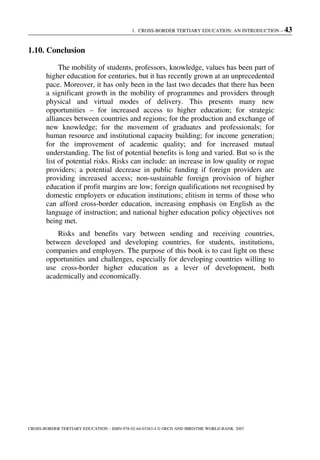
Cross-border higher education is emerging to become a fascinating but very
complex phenomenon. The mobility of students, professors, knowledge and even
values has been part of higher education for centuries, but it has recently grown at
an unprecedented pace. The last two decades have seen a significant growth in the
mobility of higher education programmes and providers through physical and virtual
modes of delivery. This presents many new opportunities among which are increased
access to higher education, strategic alliances between countries and regions, as
well as the expansion of human resource and institutional capacity. Parallel to these
opportunities are an equal number of challenges: a potential increase in low quality or
rogue providers, a lack of recognition of foreign qualifications by domestic employers
or education institutions, along with elitism and the tensions it creates. In many
cases, these new trends lead countries to revisit different aspects of their tertiary
education policy, especially regulatory frameworks for quality assurance and private
higher education.
The purpose of this book is to cast light on these opportunities and challenges,
especially for developing countries willing to leverage cross-border higher education
as a tool for development. This book discusses the concept of capacity-building
through cross-border education, emphasising the critical role of quality assurance
and trade negotiations. This volume should be of particular interest to both
education policy makers and the myriad stakeholders in higher education from
developing countries.
Cross-border
Tertiary
Education
A
WAY
TOWARDS
CAPACITY
DEVELOPMENT
Cross-border Tertiary
Education
A WAY TOWARDS CAPACITY
DEVELOPMENT
vast quantities ofthese things and others which were purchased
from manufacturers and in quantities which not only compelled
these very manufacturers to turn over the entire output of their
plants for many months but also compelled them to add to their
factory capacity. And, of course, there were many things which the
wives and mothers and sisters and sweethearts of America, with all
their loving desires and keen capabilities, could not produce. Which
meant that our Red Cross in France must have purchasing and
warehousing functions—like big business of almost every other sort.
It would have been foolish and worse than foolish to have even
attempted the problem without organization. That was the difficulty
of the well-meaning American relief work which was launched upon
French soil before the coming of our Red Cross. In the early days of
the war the French ports were littered with boxes of relief supplies
addressed "The American Embassy," "American Chamber of
Commerce," "French Army," and just "France." People did so want to
help, and so, in our impulsive American way, sent along things
without sending any notice whatsoever as to whom they were to go.
One of the big reasons for the foundation of the American Relief
Clearing House was to combat this very tendency. As far back as
October, 1914, it began by organizing French and American
committees, obtaining freedom of customs for relief goods, free sea
and rail freights, and finally, by organizing the War Relief Clearing
House in New York, as a complementary committee for systematic
collection and forwarding.
Eventually the Clearing House brought American donors to the point
where they would actually mark the contents of boxes, but there
was always great waste in not passing upon the serviceability of
shipments until they had reached Paris and great delay in having to
pack and re-sort them there. The secondhand material which came
was of fair quality, but not sufficient in quantity. And while people
here in the United States were always willing to contribute money
generously they seemed disinclined to have goods bought outside
this country. The result was that the American Relief Clearing House
57.
in Paris neverhad a sufficient accumulation against emergency. At
the time of the first great offensive against Verdun, in the spring of
1916, it was compelled to send out all of the supplies which it held
and to appeal to the United States for more clothes, food, and the
like, which meant all of a six weeks' delay.
Such a state of things could not exist in our Red Cross work there.
And yet the problem in this very phase that confronted Major
Murphy and his party was tremendous. The Compagnie Générale
Transatlantique had just notified the Clearing House that it could no
longer afford to supply free space; and in view of the subsequent
shipping situation, the heavy torpedoing, and the army demand for
tonnage, it is considered not improbable that had the Clearing House
continued it would have had to give up handling anything except
money. Yet in spite of obstacles, the Red Cross would have to
purchase and store supplies—not in the quantities that the Clearing
House had purchased and stored them, but in far, far greater
number.
Major Murphy met the problem squarely, as was his way. He cabled
to America, and seven men were sent to him late in September,
1917. They were men taken from various corners of the country, but
all of them expert in the task allotted to them. At once they began
the work of coördinating the vast problem of American Red Cross
purchase and supply. There was large need for them; for, while at
the very beginning of our Red Cross work over there, while its
problem, because of its vastness and its novelty, was still quite
largely a question of guesswork, purchases were made for each
department as it requisitioned material or was stored for them
individually. Such a method was quickly outgrown, and was bound to
be succeeded by a far better one, which, as we shall see presently,
finally did come to pass.
From the beginning the main warehouses, like the main garages, of
the American Red Cross in France have been located in the
headquarters city of Paris. Providing these facilities was one of the
first tasks that confronted Major Murphy. And to understand the
58.
promptitude with whichhe met this task understand, if you will, that
by the following September he already had six warehouses in Paris,
organized with a capacity to handle 10,000 tons of supplies a month,
which might quickly be increased to 60,000 tons a month. As a
matter of fact, before Armistice Day was reached there were
fourteen of these warehouses and they actually were handling some
10,000,000 tons a month.
The nucleus of this warehouse organization was again the American
Relief Clearing House. It gave the first three of the store buildings.
The next three were obtained by Major Murphy's organization, with
the typical keenness of American business men who, having donated
their services and their abilities to our great adventure overseas,
purposed to make those services and abilities work to their highest
possibilities.
Warehouses to be effective and efficient must have not only good
locations, but appropriate railroad connections and modern
equipment for handling their supplies; this is primary. The French,
themselves, long since have recognized it as such. And because the
freight terminal tracks at Paris are so abundant and so generally well
planned there were plenty of warehouses there, if one could but find
them. To find them was not so hard a task, even during the war, if
one but had the time. There was the rub. The Red Cross did not
have the time; there was not a day, not an hour, to be wasted. It
needed storage space at once—ships with hundreds and thousands
of tons of Red Cross relief supplies already were at the docks of
French ports. More were on their way across the Atlantic. Space to
store these cargoes must be found—and found immediately. By
October 1, 1917, our Red Cross had twenty-one storage centers in
France, giving it 5,000,000 cubic feet of space as against but 50,000
three months earlier. The largest unit was a sugar warehouse in the
wholesale center of Paris, a five-story stone structure with twelve
hoists, two railroad tracks on the outside, and two within.
These facilities cost money, of course. And that in some instances
they cost more money because time was a large factor in the
59.
question can hardlybe denied. Yet economy was practiced as well as
speed. This is record fact. Our Red Cross in France did not permit
itself to become a waster; even in emergencies which called for a
saving of time—no matter at what expense—it carefully watched the
outgoing of dollars.
When, for instance, it sought to obtain one of the largest of its
needed Parisian warehouses—a really huge structure with 2,500,000
cubic feet of storage space and served by two railroad tracks thrust
into its very heart—it tried to drive a good Yankee bargain. The place
had been found after a day of seemingly hopeless and heartless
search. Its owner was located and the rental cost discussed briefly.
The owner wanted ninety centimes (approximately seventeen cents)
a square meter. The Red Cross agents demurred. They counter-
offered with eighty centimes. The owner accepted.
"Shake!" said the chief of the party. They clasped hands.
"Never mind the formal papers now," laughed our Yankee Red Cross
bargainer, "we'll take each other's word. I haven't a minute to lose,
as we must have the place ready for supplies within forty-eight
hours."
"Impossible!" cried the French landlord. He knew the real condition
of the place, which had been unused and unrepaired for months.
Yet within forty-eight hours the Red Cross supplies from overseas
actually were being moved in. Immediately upon closing the deal,
the Americans had sought labor. It was not to be found, they were
told; all the surplus labor of Paris being in the trenches or else
engaged in some work vital to the war's operations.
"Why not use permissionnaires?" some one suggested.
The hint was a good one. It so happened that the French
Government already had consented to the employment of this very
sort of labor by the American Red Cross. So down to the larger
railroad stations of Paris hurried our Red Cross agents. Soldiers back
60.
from the trencheswere given the opportunity to earn a few francs—
and gladly accepted it. Within a few hours a crew of more than a
hundred men had been gathered and the work of making the newly
acquired property ready to receive supplies begun. And under
American supervision it was completed—within the allotted two
days.
This experience was repeated a few weeks later when the American
Red Cross took over the old stables of the Compagnie Générale des
Petites Voitures in the Rue Chemin du Vert as still another
warehouse and had to clean and make them fit for supplies—all
within a mere ten days. The Compagnie Générale des Petites
Voitures was an ancient Parisian institution. It operated—of all the
vehicles perhaps the most distinctive upon the streets of the great
French capital—the little victoria-like fiacre, drawn by a wise and
ancient horse with a bell about its neck. The war had drained the
city of most of its horses—they were in the French artillery—and for
a long time before the coming of our Red Cross the great stables in
the Rue Chemin du Vert had been idle; in fact for the first time in
more than half a century.
In taking over the place the officers of the American Red Cross were
not blind to the fact that they were getting nothing more than a
great, rambling, two-story stable and its yards, which were just as
they had been left when a thousand horses had been led forth from
their stalls. The place was a fearful litter of confusion, while crowded
together at one end of the courtyard were the old fiacres—ancient,
weather-beaten, decrepit, abandoned. They made a pathetic picture.
Rumor told the neighborhood, and told it quickly, that the Croix
Rouge Américaine—as the French know our organization over there
—had taken over the old stables and were to use them for
warehousing purposes, but rumor was not smart enough to tell how
the trick was to be done. It did not know; the Red Cross workers
did. They had found after making a careful inventory of the place,
that they had on their hands about 8,000 square yards of ground,
covered for the greater part with more or less dilapidated buildings a
61.
hundred years oldor even older. More than that, there were five
hundred tons of manure in the structures which must be completely
removed and the premises thoroughly disinfected before there could
be even a thought of using them for goods storage. Cleaning the
Augean stables was something of the same sort of a job.
Various Parisian contractors who specialize in that sort of work were
asked what they would charge for the task of getting the big stables
clean once again. One said seven thousand francs. Another allowed
that it would cost five thousand. He was the lowest bidder. The Red
Cross turned from all of them and went to the market gardeners of
the great central Halles. Would they help? Of course they would—
the name of the Croix Rouge Américaine has some real potency in
France. In four days the stables were cleaned—perfectly and at an
entire cost of less than two hundred francs!
Then, with the aid of a hundred workmen, the work of rehabilitating
them was begun. At that time in Paris carpenters were not to be had
for love or for money, so every available Red Cross man who knew
how to saw a piece of wood or who could drive a nail without hitting
his thumb—and at that, there were many thumbs jammed before
the job was entirely done—was pressed into service. From the
famous Latin Quarter of Paris came many volunteers, some of them
American painters and sculptors more familiar with working tools of
other sorts, but all fired with a zeal and a determination to help.
Such a prodigious din of work the neighborhood could not easily
remember!
Lumber was scarce, almost unobtainable in fact. That did not
discourage our Red Cross. One of the lesser buildings in the
compound was quickly marked for destruction and actually was torn
down in order to supply the lumber needed for the repair of the
others. Windows were put in and glazed, doors were hung, wall
derricks and hoistways rigged, roofs made water-tight, and the
ancient cobbles of the courtyard scrubbed until they were almost
blue in their faces. All the stables, the vehicle rooms, and the office
quarters were disinfected, electric lights were installed in every
62.
corner, fire extinguishershung throughout the buildings, telephones
placed in each department, racks and bins for supplies constructed,
lettered, and numbered, smooth cement walks laid to connect each
building with its fellows—and not until all of this was done did the
Red Cross men who had volunteered for the long hours of hard
manual labor really dare stop for a deep breath.
"Talk about Hercules," laughed one of them when it was all done.
"He had better look to his old laurels. He never did a job like this—in
ten days."
It took the folk of the neighborhood a long time to realize what had
happened in ten days.
Yet there it was—if so you were pleased to call it—one of the largest
"retail-wholesale" stores in all Paris, with some 15,000 tons of
supplies in place in the racks within a fortnight after the herculean
and record-breaking cleansing task had been finished; and fresh
stuff arriving daily to meet the needs of the hard-pressed peasantry
and soldiers of France. And in a little time to perform similar service
for the men of our own army and navy over there. Yet, unlike any
other general store in the world—wholesale or retail—this Red Cross
one was open for business every hour of the day or the night.
Comfortable quarters were prepared and furnished for six workers,
who volunteered to live in the warehouse and so be prepared at any
hour of the night to receive and execute an emergency call for
supplies.
One huge task of this particular warehouse was the re-sorting of
volunteer or donated shipments. From a period in the early progress
of the war the Red Cross accepted only supplies shipped to its
general stores—in no case whatsoever to individual organizations—
and ordered that all goods should be sorted and re-packed in France
for distribution there. So one big room in the Rue Chemin du Vert
was turned over to this work. It never lacked variety. In one actual
instance a big box sent from some city in the Middle West burst
open and the first thing that met the gaze of the Red Cross
63.
warehouse workers wasa white satin high-heeled party slipper
poking its head out for a look at "gay Paree." And it was by no
means the only tribute of this sort that thoughtless America gave to
starving France. There sometimes were real opportunities for
censorship in the re-sorting room.
A man who went to this great warehouse in the early days of its
existence brought back a vivid picture of its activities.
"As one entered the long, wide courtyard through the great arch
from the street—an arch, by the way, which reminded me
wonderfully of the Washington Arch at the foot of Fifth Avenue, New
York," said he, "and caught a glimpse of the flags of France and
America—and the Red Cross—floating over it, he became
immediately impressed with the militarylike activity of the entire
place. This was heightened by the presence of a number of French
soldiers and some fifty Algerians in their red fezzes, who were at
work on crates and boxes. Three or four big gray camions were
waiting at the upper end of the yard while the workmen loaded
them. Opposite were what had once been the extensive stable
structures, now clean and only reminiscent of their former tenants in
the long line of chain halters hanging motionless against the walls.
Here the bulkier, non-perishable goods were stored.
"Halfway up the entrance yard began the series of rooms whose
shelves, fashioned ingeniously from packing cases, contained the
great supplies of condensed milk, tobacco, sugar, soap, pork, canned
beef, and rice. Overhead, on what was once the great hayloft of the
stables, were the cubicles where were stacked the paper-wrapped
bundles of new clothing for men, women, and children, every
package marked with the size, and the sabots with thick wooden
soles and the sturdy leathern uppers—enough to outfit a whole
townful of people.
64.
"Across a 'Bridgeof Sighs'—the opportunity to call it that is quite too
good to be lost—to another building, one came upon stores of
chairs, bucksaws, farm implements, boxes of window glass, bedside
tables, wicker reclining chairs, iron beds, mattresses, pillows,
bolsters, blankets, sheets, pillowcases, and comforters. Through a
wide doorway whose lintel was a rough hand-hewn beam as thick as
a man's body and a century old, were the dormitory and the
messroom of the red-fezzed Algerians who, by the way, were under
the command of two French officers. Next came the lofts, with their
bins of crutches, surgical dressings, rubber sheeting, absorbent
cotton, enamel ware, bright copper sterilizers, and boxes of rubber
gloves for hospital use. Still another building housed the immense
supplies of wool gloves and socks, pajamas, sweaters, and women's
and children's underwear and high stacks of brown corduroy jackets
and trousers, for the Red Cross sought to furnish to the peasant just
the same sort of clothing that he and his father's grandfather were
accustomed to wear; even to the beloved béret.
"Throughout the storage building one came across evidences of the
manner in which every available bit of old wood was utilized for
reconstruction in order to avoid further expenditure. Bins and racks
were made of ancient doors and window frames and crates had
been carefully fashioned into delivery counters. In fact small 'branch
stores' for the distribution of goods in less than box or crate lots
were established in every corner of the Rue Chemin du Vert
warehouse, with clerks always in attendance upon them. In this way
it was as easy to fit out an individual with what he or she needed as
to fit out an entire community, and the reverse.
"On the right side of the main courtyard, running back from the
administration offices, were the long, narrow shipping rooms where
the bundles called for were made up from the stock which lined the
walls and were tagged and addressed by a corps of young women;
the crate lots being attended to by the men in the courtyard below.
Still farther on was the department which received the packages of
used clothing, of knitted goods, or the other things sent by humane
65.
persons in countlesscities of America and France to the needy ones
in the fighting lines, or back of them. Below and beyond this room
were the coal bins, the carpenter's shop, in which tables and bedside
stands constantly were being turned out from new lumber, and the
'calaboose,' for the benefit of an occasionally recalcitrant Algerian.
And adjoining the main courtyard was still another room almost as
large; and this last was the place of receipt of all supplies. Here they
were inspected, counted, and assigned to their proper buildings and
compartments. The entire place was a great hive, literally a hive of
industry. And the people of the neighborhood never passed its
arched entrance without first stopping to look in, it all was so
amazing to them. They wondered if there ever could have been a
time when a thousand horses were stabled there."
Upon the day of the signing of the armistice and for many months
thereafter Warehouse No. 1 in the Rue Chemin du Vert remained a
busy hive of industry. It still handled almost every conceivable sort
of commodity, and perhaps the only difference in its appearance
from the day that the graphic New Yorker saw it was that German
prisoners—each with a doggedly complacent look upon his face and
a large "P. G." upon his back,—had replaced the Algerians for the
hard manual labor. It continued to employ fifteen men and women in
its office and from thirty-five to forty Red Cross workers, American or
French, while the value of the stock constantly kept on hand was
roughly estimated at close to $2,000,000. From thirty-five to forty
tons were daily being sent out. Yet how was a stock valuation of
$2,000,000 really to be compared with one of $2,500,000 in
warehouse No. 6 in the Rue Cambrai or $3,000,000 at No. 24 in the
Rue Curial? And these were but three of eleven Red Cross
warehouses in Paris at the time of the armistice. And a report issued
very soon after showed twenty-nine other warehouses of the
American Red Cross in France, eight of them in the city of Dijon,
which, because of its strategic railroad location, was a store center
of greatest importance for our army over there.
Perhaps you like facts with your picture.
66.
Well, then, returningfrom the picture of the thing to the fact, we
find at the time of the first definite general organization of our Red
Cross in France—in September, 1917—a Bureau of Transportation
and Supplies was formed under the direction of Mr. R. H. Sherman. A
little later a slightly more comprehensive organization was charted,
and a separate Bureau of Supplies created, with Mr. Joseph R. Swan
as its immediate director. This was subdivided into four main
sections: Paris Warehouses, Outside Warehouses, Receiving, and
Shipping. This organization remained practically unchanged until the
general reorganization plan of August, 1918, which we have already
seen, when the bureau became the Section of Stores and, as such, a
factor, and a mighty important factor, of the Division of
Requirements.
From that time forward the problem was one of growth, great
growth, rather than that of organization. It was a problem of finding
warehouses to accommodate our supplies over there; of finding
competent men to oversee and operate the warehouses, and then,
in due order, of keeping the supplies moving through the
warehouses and out to the men at the front. In due course we shall
see how these supplies functioned. For the moment consider the fact
that in an initiatory six weeks, from October 11 to November 30,
1917, Mr. Swan submitted a detailed account showing how he had
invested nearly $8,000,000 in the purchase of general stores for our
Red Cross. In the press of emergency work—there hardly was a
month or a day from our arrival in France until after the signing of
the armistice when the situation could not have been fairly described
as emergency—it was possible to take but one general inventory.
That was made, for accounting purposes, as of February 24, 1918,
and showed the value of the American Red Cross stores then on
hand in its warehouses in France to be 33,960,999.49 francs, well
over $6,000,000. At the first of the following November—eleven days
before the signing of the armistice—another inventory was taken.
The stocks had grown. There were in the principal warehouses of
the Red Cross alone and including its stock of coal upon the Quai de
la Loire supplies valued at 46,452,018.80 francs, or close to
67.
$9,000,000. Figures arevaluable when they mount to sizes such as
these.
Yet figures cannot tell the way in which the warehousing
organization of the American Red Cross met the constant
emergencies which confronted it. Like the Transportation
Department, it was forever and at all times on the job. For instance,
from the beginning of that last German advance, in the Ides of
March, 1918, until it was reaching its final fearful thrusts—late in
June and early in July—there was on hand, night and day, a crew at
the warehouse, which had been fashioned from a former taxicab
stables in the Rue Chemin du Vert, a complete crew to load camions
by the dozens, by the hundreds, if necessary. In such a super-
emergency no six men housed in the plant would do; for there were
nights on which twenty, thirty, and even forty of the big camions
went rolling out through that great archway with their supplies for
our boys at the front—the very boys who so soon were to play their
great part in the supreme victories of the war. On those summer
nights warehouse work was speeded up, to put it very mildly indeed.
Men worked long hours without rest and with but a single thought—
the accomplishment of real endeavor while there yet remained time
to save Paris and all the rest of France. And in such spirit is victory
born.
Do not, I pray you, conceive the idea that all the warehouse work
was done in Paris. I have hinted at the importance of Dijon, the
great army store center, as a Red Cross stores center, and have,
myself, stood in the great American Red Cross warehouse upon the
lining of the inner harbor of St. Nazaire and have with mine own
eyes seen 8,000 cases stacked under their capacious roofs—
foodstuffs and clothing and comforts and hospital supplies which
came forever and in a steady stream from the transports docking at
that important American receiving point, and have known of
68.
warehouses to beestablished in strange quarters, stranger
sometimes than the abandoned stables of the horse-drawn taxicabs
of Paris, here in an ancient exposition building upon the outskirts of
a sizable French city, there in a convent, and again in a church or a
school, or even again in a stable.
Here was a little town, not many miles back from the northern front.
The Red Cross determined to set up a warehouse there, both for
military and civilian relief supplies. An agent from the Paris
headquarters went up there to confer with the local representative in
regard to the proper location for the plant. The local man favored
one building, the Paris representative another which was nearer to
the railroad station. While they argued as to the merits of the two
buildings German airmen flew over the town and destroyed one of
them. And before they could compromise on the other, the French
Government requisitioned it as a barracks.
Now was a time for deep thought rather than compromise. And deep
thought won—it always does. Deep thought moved the American
Red Cross warehouse into the ancient seminary there, even though
that sturdy structure had been pretty well peppered by the boche.
When the Red Cross moved in, you still could count fifty-one distinct
shell holes in it; another and a final one came while it still was in the
process of adaptation to warehouse uses. In this badly battered
structure lived the Red Cross warehouse man and his three
assistants—all of them camion chauffeurs—after they had put forty-
five panes of glass in with their own hands. Then the supply of glass
ran out. In the former chapel of the seminary fourteen great window
frames had to be covered with muslin, which served, after a fashion,
to keep out the stress of weather. Twenty-seven of the precious
panes of glass went into the office—where daylight was of the
greatest necessity. The rest were used, in alternation with the
muslin, for the living quarters, where the Red Cross men cooked
their own meals, in the intervals between dealing out warehouse
supplies. It was hard work, but the chauffeurs did not complain.
Indeed it so happened that their chief did most of the complaining.
69.
"What is theuse?" he sputtered one afternoon while the war still
was a day-by-day uncertainty. "Those boys will put in a big day's
work, every one of them, come home and not know enough to go to
bed. Like as not they will take a couple of hours and climb up some
round knoll to watch the artillery fire. When the town was in the
actual line of fire—not more than a fortnight ago—one of them
turned up missing. He had been with us only a moment before, so
we began hunting through the warehouse for him. Where do you
suppose we found him? Let me tell you: he was up in the belfry, the
biggest and the best target in the town. Said he wanted to see
where the shells were striking. I told him to come down, the Red
Cross wasn't paying him for damn foolishness. But you couldn't help
liking the nerve of the boy, could you?"
Courage!
How it did run hand in hand with endeavor all through the progress
of this war. And it was not limited to the men of the actual fighting
forces. The Red Cross had more than its even share of it. The great,
appealing roll of honor in the Hotel Regina headquarters—the list of
the American Red Cross men and women who gave their lives in the
service of their country—was mute evidence of this. Courage in full
measure, and yet never with false heroics. Full of the sturdy
everyday courage, the courage of the casual things, exemplified, for
instance, in this letter from the files of the Stores Section, written by
the agent in charge of another of its warehouses in northern France:
"A shipment of four rolls of oiled cloth arrived most opportunely a
few days ago and one roll is being employed locally to repair the
many panes of window glass destroyed in last night's air raid. In
connection with this raid it may be added that one of our chauffeurs
nearly figured as a victim of this raid, the window in his lodging
being blown in and a large hole knocked in the roof of his house.
70.
"I presume thatit is violating no military secret to add that another
raid from the boches is looked for to-night and in case it does come
the other rolls of window cloth may come into play...."
It was in these very days of the great spring offensive of 1918, that
the Supplies Department, like the Transportation Department of our
Red Cross overseas, began to have its hardest tests. For in addition
to the regular routine of its great warehousing function, there came,
with the rapidly increasing number of troops, hospitals and refugees,
rapidly increasing special duties for it to perform; greatly increased
quantities of goods to be shipped. And I think it but fair to state that
without the vision of one man, Major Field, there might not have
been many supplies to ship. Immediately after his appointment as
Chief of the Bureau of Supplies, Major Field began to purchase
goods, in great quantities and an almost inconceivable variety. He
bought in the French market, in the English market, in the Spanish
market, from the commissary stores of the United States Army—in
fact from every conceivable corner and source of supply; as well as
from some which apparently were so remote as hardly to be even
conceivable. He stored away beds, tents, sheets, clothing, toilet
articles, and cases of groceries by the thousands, and still continued
to buy. The Red Cross gasped. The A. E. F. protested. The vast
warehouses were filled almost to the bursting point. Major Field
listened to the protestations, then smiled, and went out, buying still
more supplies. His smile was cryptic, and yet was not; it was the
smile of confidence, the smile of serenity. And both confidence and
serenity were justified. For the days of the drive showed—and
showed conclusively—that if our American Red Cross had not been
so well stocked in supplies it would have failed in the great mission
overseas to which we had intrusted it.
"The ——th Regiment has moved up beyond its baggage train. Can
the Red Cross ship blankets and kits through to it?"
71.
This was atypical emergency request—from an organization of three
thousand men. It was answered in the typical fashion—with a full
carload of blankets and other bedding. The kits followed in a truck.
"A field hospital is needed behind the new American lines," was
another. It, too, was answered promptly; with several carloads of
hospital equipment, surgical dressings, and drugs. These things
sound simple, and were not. And the fact that they were many times
multiplied added nothing to the simplicity of the situation. In fact
there came a time when it was quite impossible to keep any exact
account of the tonnage shipped, because the calls came so thick and
fast and were so urgent that no one stopped for the usual
requisitions but answered any reasonable demands. The requisition
system could wait for a less critical time, and did.
One day a message came that a certain field hospital was out of
ether—that its surgeons were actually performing painful operations
upon conscious men—all because the army had run out of its stock
of anæsthetics. The men at the American Red Cross supply
headquarters sickened at the very thought; they moved heaven and
earth to start a camion load of the precious ether through to the
wounded men at the field hospital, and followed it up with twenty-
five truckloads of other surgical supplies.
Under the reorganization of the American Red Cross in France which
was effected under the Murnane plan, the entire work of purchase
and warehousing was brought under a single Bureau of Supplies,
which was ranked in turn as a Department of Supplies. This Bureau
was promptly subdivided into two sections: that of Stores and that
of Purchases. Taking them in the order set down in the official
organization plan, we find that the headquarters section of Stores—
situated in Paris—was charged with the operation of all central and
port warehouses and their contents and was to be in a position to
honor all properly approved requisitions from them, so far as was
72.
humanly possible. Itwas further charged to confer with the
comptroller of our French American Red Cross organization and so to
prepare a proper system and check upon these supplies. In each of
the nine zones there were to be subsections of stores, answerable
for operation to the Zone Manager and for policy to the Paris
headquarters, but so organized as to keep not only sufficient
supplies for all the ordinary needs of the zones, but in various well-
situated warehouses, enough for occasions of large emergency—and
all within comparatively short haul.
The Section of Purchases corresponded to the purchasing agent of a
large corporation. Remember that the purchasing opportunities in
France were extremely limited, so that by far the greater part of this
work must be performed by the parent organization here in the
United States, and sent—as were the circus tents—in response to
requisitions, either by cable or by mail. Incidentally, however,
remember that no small amount of purchasing for the benefit of our
army and navy in France was done both in England and in Spain,
which, in turn, was a relief to the overseas transport problem. For it
must ever be remembered that the famous "bridge across the
Atlantic" was at all times, until after the signing of the armistice at
least, fearfully overcrowded. It was only the urgent necessities of the
Red Cross and its supplies that made it successful in gaining the
previous tonnage space east from New York, or Boston, or Newport
News. And even then the tonnage was held to essentials; essentials
whose absoluteness was almost a matter of affidavit.
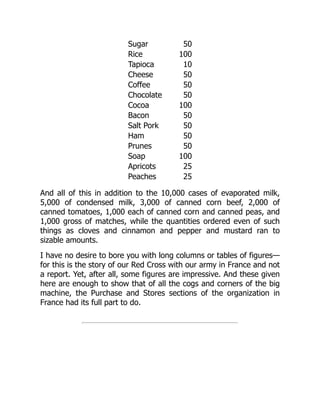
Yet even the essentials ofttimes mounted high. Before me lies a copy
of a cablegram sent from Paris to Washington early in January, 1919.
It outlines in some detail the foodstuff needs of the American Red
Cross in France for the next three months. Some of the larger items,
in tons, follow:
73.
Sugar 50
Rice 100
Tapioca10
Cheese 50
Coffee 50
Chocolate 50
Cocoa 100
Bacon 50
Salt Pork 50
Ham 50
Prunes 50
Soap 100
Apricots 25
Peaches 25
And all of this in addition to the 10,000 cases of evaporated milk,
5,000 of condensed milk, 3,000 of canned corn beef, 2,000 of
canned tomatoes, 1,000 each of canned corn and canned peas, and
1,000 gross of matches, while the quantities ordered even of such
things as cloves and cinnamon and pepper and mustard ran to
sizable amounts.
I have no desire to bore you with long columns or tables of figures—
for this is the story of our Red Cross with our army in France and not
a report. Yet, after all, some figures are impressive. And these given
here are enough to show that of all the cogs and corners of the big
machine, the Purchase and Stores sections of the organization in
France had its full part to do.
74.
CHAPTER VI
THE DOUGHBOYMOVES TOWARD THE FRONT
By July, 1917, the first Divisions of our amazing army began to seep
into the battle countries of Europe. It had not been the intention of
either our War Department or its general staff to send the army
overseas until the first of 1918; the entire plan of organization and
preparation here in the United States had been predicated upon
such a program. Yet the situation overseas was dire indeed. Three
years of warfare—and such warfare—had begun to fag even the
indomitable spirits of England and of France. The debacle of Russia
was ever before the eyes of these nations. In the words of their own
leaders, their morale was at its lowest point. France, in one glorious
moment in 1917, had seemed, under the leadership of Nivelle, to be
close to the turning point toward victory. But she had seen herself
miss the point, and was forced again in rugged doggedness to stand
stoutly with England and hold the line for the democracy of the
world.
In such an hour there was no opportunity for delay; not even for the
slight delay incidental to raising an American Army of a mere half
million, training it in the simplest possible fashion, and then
dispatching it overseas. Such a method would have been more
gratifying to our military pride. We sacrificed that pride, and shall
never regret the hour of that decision. We first sent hospital
detachments from our army medical service to be brigaded with the
British, who seemed to have suffered their most severe losses in
their hospital staffs, and sent engineer regiments not only to build
the United States Military Railroad, of which you have already read,
but also to aid the weakened land transport sections of the French
and British armies. And General John J. Pershing, with adequate
75.
staff assistance, crossedto Paris to prepare for the first and all-
glorious American campaign in Europe.
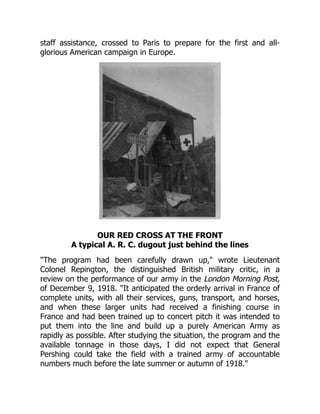
OUR RED CROSS AT THE FRONT
A typical A. R. C. dugout just behind the lines
"The program had been carefully drawn up," wrote Lieutenant
Colonel Repington, the distinguished British military critic, in a
review on the performance of our army in the London Morning Post,
of December 9, 1918. "It anticipated the orderly arrival in France of
complete units, with all their services, guns, transport, and horses,
and when these larger units had received a finishing course in
France and had been trained up to concert pitch it was intended to
put them into the line and build up a purely American Army as
rapidly as possible. After studying the situation, the program and the
available tonnage in those days, I did not expect that General
Pershing could take the field with a trained army of accountable
numbers much before the late summer or autumn of 1918."
76.
Yet by thefirst day of January, 1918, there were already in France
four American Divisions, each with an approximate strength of
28,153 men, by February there were six Divisions, and by March,
eight. It is fair to say, however, that even by March only two of the
Divisions were fit to be in the line, and none in the other active
sectors. Training for modern warfare is indeed an arduous task. Yet
our amazing army did not shirk it, and even in the dispiriting and
terrifying days of the spring of 1918 kept to its task of preparing
itself for the great ordeal just ahead, and, almost at the very hour
that the last great German drive began to assume really serious
proportions, was finishing those preparations. Ten Divisions were
ready, before the spring was well advanced, to stand shoulder to
shoulder with British Divisions should such an unusual course have
been found indispensable. In fact, anticipating this very emergency,
brigading with the British had already been begun. But as the British
reinforcements began pouring into Northern France the possibilities
of the emergency arising diminished. And five of our Divisions were
returned south into the training camps of the United States Army.
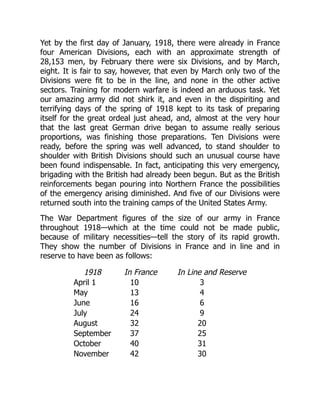
The War Department figures of the size of our army in France
throughout 1918—which at the time could not be made public,
because of military necessities—tell the story of its rapid growth.
They show the number of Divisions in France and in line and in
reserve to have been as follows:
1918 In France In Line and Reserve
April 1 10 3
May 13 4
June 16 6
July 24 9
August 32 20
September 37 25
October 40 31
November 42 30
77.
This tabulation takesno count whatsoever of the noncombatants of
the S. O. S.—as the army man knows the Service of Supplies—or the
other great numbers of men employed in the rearward service of the
United States Army. It is perhaps enough to say that the largest
number of our troops employed in France was on September 26, the
day that General Pershing began his Meuse-Argonne offensive. On
that day our army consisted of 1,224,720 combatants and 493,764
noncombatants, a total of 1,718,484 men in its actual forces.
It is known now that if the war had continued we should probably
have doubled those figures within a comparatively few months and
should have had eighty Divisions in France by April, 1919, which
would have made the United States Army by all odds the most
considerable of any of the single belligerent nations fighting in
France.
We have told elsewhere a little of the romance of the transport of
our men; here in cold figures—statistics which scorn romance in
their composition—is their result. We shall see through our Red
Cross spectacles again and again the performances of that army, as
the men and the women of the American Red Cross saw them.
In the meantime let us turn again, therefore, to Lieutenant Colonel
Repington, whose reputation in this regard is well established, and
find him saying of the commanding general of our army:
"To my mind, there is nothing finer in the war than the splendid
good comradeship which General Pershing displayed throughout,
and nothing more striking than the determined way in which he
pursued the original American plan of making the American arms
both respected and feared. The program of arrivals, speeded up and
varied in response to the appeal of the Allies, involved him in
appalling difficulties, from which the American army suffered to the
last. His generous answer to cries for help in other sectors left him
for long stretches almost, if not quite, without an army. He played
the game like a man by his friends, but all the time with a singleness
of purpose and a strength of character which history will applaud; he
78.
kept his eyesfixed on the great objective which he ultimately
attained and silenced his detractors in attaining it. To his calm and
steadfast spirit we owe much. To his staff, cool amidst the most
disturbing events, impervious to panic, rapid in decision, and quick
to act, the allied world owes a tribute. To his troops, what can we
say? They were crusaders. They came to beat the Germans and they
beat them soundly. They worthily maintained the tradition of their
race. They fought and won for an idea."
Truer words have not been written. To one who has made even a
superficial study of our army in France, the figure of the doughboy—
the boy from the little home in Connecticut or Kansas or Oregon—
looms large indeed. I did not, myself, see him in action. Other and
abler pens have told and are still telling of his unselfishness, his
audacity, his seemingly unbounded heroism both in the trenches and
upon the open field of battle. The little rows of crosses in the
shattered forest of the Argonne or upon the roads leading from Paris
into Château-Thierry, elsewhere over the face of lovely France, tell
the story of his sacrifice more graphically than any pen may ever tell
it.
Frequently I have seen the doughboy in Paris as well as in the other
cities and towns and in our military camps in France. He is an
amusing fellow. One can hardly fail to like him. I have talked with
him—by the dozens and by the hundreds. I have argued with him,
for sometimes we have failed to agree. But I have never failed to
sympathize, or to understand. Nor, as for that matter, to appreciate.
No one who has seen the performance of our amazing army in
France, or the immediate results of that performance, can fail to
appreciate. If you are a finicky person you may easily see the
defects that haste brought into the making of our expeditionary
army—waste in material and in personnel here and there; but, after
all, these very defects are almost inherent in any organization raised
to meet a supreme emergency, and they appear picayune indeed
when one places them alongside the marvel of its performance—
when one thinks of Château-Thierry or Saint Mihiel or the Argonne.
79.
It is notthe province of this book to describe the operations of our
army in France except in so far as they were touched directly by the
operations of our Red Cross over there. So, back to our text. You will
recall that Major Grayson M.-P. Murphy, our first Red Cross
Commissioner to France, and his staff arrived in Paris coincidently
with General Pershing on the thirteenth of June, 1917. They went
right to work, despite terrific odds, in the building of a working
organization. At about the hour of their coming there was developing
here in the United States a rather distinct feeling in certain
widespread religious and philanthropic organizations that they
should be distinctly represented in our war enterprise in Europe. The
patriotism that stirred these great organizations was admirable; it
was unmistakable, and finally resulted in certain of the larger ones—
the Young Men's Christian Association, the Knights of Columbus, the
Young Women's Christian Association and the Salvation Army—being
given definite status in the war work overseas. In the case of the Y.
M. C. A.—by far the largest of all these organizations—it was allotted
the major problem of providing entertainment for the enlisted men
and the officers at the camps in France, in England, in Italy and, in
due time, in the German valley of the Rhine. At a later hour the very
difficult problem of providing canteens, that would be, in effect,
nothing more nor less than huge post exchanges, was thrust upon
the Y. M. C. A. It accepted the problem—not gladly, but in patriotic
spirit—and even though the experiment brought upon its shoulders
much thoughtless and bitter criticism, saw it bravely through.
The Y. M. C. A. therefore, was to undertake, speaking by and large,
the canteen problem of the camps, while that of the hospitals, the
docks at the ports of debarkation and embarkation, the railroad
junctions, and the cities of France was handed to the American Red
Cross. The Red Cross began its preparations for this particular part
of its task by establishing stations for the French Army, which,
pending the arrival of the American forces, would serve admirably as
experiment stations. Major Murphy at once conferred with the
80.
French military authoritiesand, after finding from them where their
greatest need lay, proceeded without delay to the establishment of
model canteens on the French lines of communication; in the
metropolitan zone of Paris and at the front. And before our army
came, and the great bulk of the work of our Red Cross naturally
shifted to it, these early canteens supplied rations to literally millions
of French soldiers.
"In view of keeping up the good spirits of troops it is indispensable
that soldiers on leave be able to find, while waiting at railroad
stations in the course of their journeys, canteens which will allow
them to have comfortable rest and refreshment. Good results have
already been obtained in this direction, but it is necessary to improve
the canteens already existing and to create new ones in stations that
do not already have them."
The above is a translation of a quotation from a note written by the
French Minister of War to a general of his army, at about the time of
our first Red Cross Commission over there. If one were to attempt to
translate between the lines he would be certain to find that the
soldiers going home on leave or discharge, obliged to wait long
hours in railroad stations, sometimes without food or other comforts,
and ofttimes, too, forced to sleep upon a cold, stone-flagged floor,
had often a greatly lowered morale as the result of such an
experience. And if their mental state was not lowered, their physical
condition was almost sure to be.
So it was that the American Red Cross jumped into the immediate
assistance of its rather badly burdened French brothers—the various
organizations of Croix Rouge Française. It seized as its most
immediate opportunity, Paris, and particularly the junction points of
the Grande Ceinture, the belt-line railroad which completely encircles
the outer environs of the city, and provides track-interchange
facilities for the various trunk-line railroads which enter her walls
81.
from every direction.For lack of funds and a lack of personnel the
French Red Cross authorities were about to close some of the
canteens which they already had established upon the Grande
Ceinture, while the real necessity was that more should be opened.
Such a disaster our American Red Cross prevented. On July 18,
1917, Colonel Payot, Director of the French Army Transports, wrote
to H. H. Harjes—at that time representative of the American Red
Cross at the general headquarters of the French Army—giving a list
of railroad stations where canteens were needed, and in the order of
their urgency. In the correspondence which followed between the
French authorities and the American Red Cross, various agreements
were reached.
It was agreed that the French administration would furnish the
necessary buildings and provide electric light, running water, and
coal for heating. On the other hand, the American Red Cross
undertook to furnish all other supplies—cooking appliances, coal for
cooking, equipment, stores, medical supplies, and personnel. As
early as July 31, Major Perkins wrote that our American Red Cross
was now ready to serve a full meal at seventy-five centimes
(fourteen or fifteen cents) a person, and other drinks and dishes at
small cost to the poilu. Men without funds on receiving a voucher
from the Commissaire de la Gare (railroad-station agent) could
obtain meals and hot drinks without charge. The sale of wine, beer,
and spirits was prohibited in our canteens. And because of the
French coöperation in their establishment, they were named Les
Cantines des Deux Drapeaux and bore signs showing both the
Tricolor of France and our own Stars and Stripes, with their
designating name beneath.
The original list of outside stations suggested by the French
authorities were five in number: Pont d'Oye, Châlons, Épernay,
Belfort, and Bar-le-Duc. Finally it was decided to reduce this list—the
hour of the arrival of the American forces in number steadily drawing
nearer—and Châlons and Épernay were definitely chosen for
American Red Cross canteen work. At that time both of these cities
82.
of the Champagnedistrict were well behind the lines; afterwards the
Germans came too close for comfort and shelled them badly, which
meant the withdrawal of the French troops and a closing of the neat
canteens for a time; but they were reopened. When I visited
Épernay in January 1919, the Red Cross canteen there was again
open and in charge of two young ladies from Watertown, N. Y.—the
Misses Emma and Kate Lansing, sisters of the then Secretary of
State. You could not keep down the buoyant spirit of our Red Cross.
Before the American Red Cross undertook to establish fully equipped
canteens—on the scale of those at Châlons and at Épernay—the
London Committee of the French Red Cross had been operating at
many railroad stations small canteens known as the Gouttes de Café,
where coffee and bouillon were served free to the soldiers in passing
trains. In several cases agreements were made with the French
society by which certain individual Gouttes de Café passed to the
control of the American Red Cross and were, in other cases,
absorbed in the larger installation which it was prepared to support.
This, however, took place only when the demands of the situation
really called for a larger canteen, prepared to serve full meals and
operate dormitories and a recreation room. Occasionally it was found
advisable for our Red Cross to inaugurate a canteen of its very own,
while the Goutte de Café continued to carry on its own work on the
station platform or in the immediate vicinity.
I remember particularly the situation in the great central station of
the Midi Railroad in Bordeaux. This huge structure is a real focal
point of passenger traffic. From beneath its expansive train shed
trains come and go; to and from Paris and Boulogne and Biarritz and
Marseilles and many other points—over the busy lines, not only of
the Midi, but of the Paris-Orléans and the Etat. A great proportion of
this traffic is military, and long ago the French Red Cross sought to
accommodate this with a huge Goutte de Café in a barnlike sort of
room in the main station structure and opening direct upon its
platforms. I glanced at this place. It was gloomy and ill-lighted by
the uncertain, even though dazzling, glow of one or two electric arc
83.
lights. It wasfearfully overcrowded. Poilus occupied each of the
many seats in the room and flowed over to the floor, where they sat
or reclined as best they might on the benches or on their luggage.
The place was ill-ventilated, too. It was not one that offered large
appeal.
How different the appearance of the canteen of our own Red Cross.
It had a far less advantageous location; well outside the station train
shed and only to be found by one who was definitely directed to it.
Two buildings had been erected and another adapted for the
canteen. They were plain enough outside, but inside they were
typically American—which meant that light and color and warmth
had been combined effectively to produce the effect of a home that
might have been in Maine, or Ohio, or Colorado, or California, or any
other nice corner of the old U. S. A. There was homelike
atmosphere, too, in the long, low buildings enhanced by the
unforgetable aroma of coffee being made—being made American
style, if you please. That building boasted a long counter, and upon
the counter miniature mountains of ham sandwiches and big brown
doughnuts—sandwiches and doughnuts which actually had been
fabricated from white flour—and ham sandwiches with a genuine
flavor to them. And all in great quantity—2,000 meals in a single day
was no unusual order—and for a price that was nominal, to put it
lightly.
In another building there were more of the lights and the warm
yellows and greens of good taste in decoration; a big piano with a
doughboy at it some twenty-three hours out of the twenty-four—
whole companies of divans and regiments of easy-chairs: American
newspapers, many weekly publications, a lot of magazines, and
books in profusion. The room was completely filled, but somehow
one did not gain the sensation of its being crowded. The feeling that
one carried from the place was that a bit of the U. S. A. had been
set right down there at the corner of the great and busy chief
railway terminal of the French city of Bordeaux. Only one forgot
Bordeaux.
84.
What was doneat Bordeaux—and also at St. Nazaire and Nantes
and Brest and Tours and Toul and many, many other points—by our
Red Cross in the provision of canteen facilities was repeated in Paris,
only on a far larger scale than at any other point. The A. R. C. L. O.
C. canteens in Paris—there seems to be no holding in check that
army passion for initialization—soon after the signing of the
armistice had reached fourteen in number, of which about half were
located in or close to the great railroad passenger terminals of the
city. The others were hotels, large or small, devoted in particular to
the housing of the doughboy and his officers on the occasions of
their leaves to the capital—for no other point in France, not even the
attractions of Biarritz or the sunny Riviera, can ever quite fill the
place in the heart of the man in khaki that Paris, with all her
refinements and her infinite variety of amusements, long since
attained. These last canteens we shall consider in greater detail
when we come to find our doughboy on leave. For the present we
are seeing him still bound for the front, the war still in action, the
great adventure still ahead.
A single glance at the records of the organization of the Army and
Navy Department under which the canteen work along the lines of
communication is grouped at the Paris headquarters of the American
Red Cross, shows that it was not until February, 1918, that the
inrush of the American Army in France had assumed proportions
ample enough to demand a segregation of canteen accommodations
for it from those offered to the poilus. As I have said, the canteens
for the poilus were in the general nature of training or experimental
stations for our really big canteen job over there, and as such more
than justified the trouble or the cost; which does not take into the
reckoning the valuable service which they rendered the blue-clad
soldiers of our great and loyal friend—the French Republic.
Take Châlons, for instance: Châlons set an American Red Cross
standard for canteens, particularly for such canteens as would have
85.
to take careof the physical needs and comforts of soldiers, perhaps
in great numbers. This early Red Cross station was set in a large
barracks some fifty yards distant from the chief railroad terminal of
that busy town. And, as it often happened that the leave permits of
the poilus did not permit them to go into the town, a fenced
passage, with a sentinel, was builded from the train platforms to the
canteen entrance. At that entrance, a coat room where the soldier
could check his bulky kit was established.
On going into the restaurant of the canteen one quickly discovered
that what might otherwise have been a dull and dreary barracks'
interior had been transformed by French artists—the French have a
marvelous knack for doing this very sort of thing—into a light,
cheerful, and amusing room. The effect on the poilus who visited it
for the first time was instantaneous; they had not been used to that
sort of thing.
At one end of the gay and happy room was the counter from which
the meals were served by the American women working in the
canteen. The soldier went first to the cashier and from her bought
either a ticket for a complete meal, or for any special dish that might
appeal to his fancy or to his jaded appetite. He then went to the
counter, was handed his food on a tray, and took it to one of the
clean, white-tiled tables that lined the room. Groups of friends might
gather at a table. But no one was long alone, unless he chose to be.
Friendships are made quickly in the spirit of such a place, and the
chatter and laughter that pervaded it reflected the gayety of its
decorations.
After eating, if it was still summer, the poilu might stroll in the
garden where there were seats, a pergola, even a Punch and Judy
Theater—for your Frenchman, be he Parisian or peasant, dearly
loves his guignol—or he might find his way to the recreation room,
where there were writing materials, games, magazines, lounging
chairs, a piano and a victrola. Here men might group around the
piano and sing to their hearts' content. And here the popularity of
Madelon was quite unquestioned.
86.
And after allof this was done, he might retire to the dormitories with
absolute assurance that he would be called in full time for his train—
whether that train left at one o'clock in the morning or at four. And if
he so chose, in the morning might refresh himself in the fully
equipped washrooms, shower baths, or the barber shop, have his
coffee and eggs, his fruit and his beloved confiture and go aboard
the train in the full spirit of a man at complete peace with the world.
The orders that came in February, 1918, calling for the segregation
of the accommodations for the A. E. F. from those given to the
French, did not result in withdrawing financial support from Châlons
and the other canteens which our Red Cross had established
particularly for the poilus, but did result in the establishment of rest
stations, or canteens, exclusively for our own men. This organization
of canteens extended particularly along the lines of communication
between the area of action and the Service of Supplies zone, and
was quite distinct from the canteen organizations at the ports and
the evacuation hospitals; these last we shall come to consider when
we see the part played by our Red Cross in the entire hospital
program of the A. E. F. The Lines of Communication task was a real
job in itself.
One could hardly rub the side of a magic lamp and have a
completely equipped canteen materialize as the fulfillment of a wish.
Magic lamps have not been particularly numerous in France these
last few years. If they had been France might have been spared at
least some of her great burden of sorrow. And so, even for our
resourceful Red Cross, buildings could not always be provided, nor
chairs, nor counters, nor even stoves. That is why at Vierzon, a little
but a very busy railroad junction near Nevers, there was, for many
months, only a tent. But for each dawn of all those months there
was the cheering aroma of fresh coffee steaming up into the air
from six marmites, as the French know our giant coffee containers.
87.
And the figuresof American girls could be seen silhouetted against
the glow of bonfires, while the line of soldiers, cups in hand, which
started at that early hour, would continue for at least another
eighteen, or until well after midnight.
Remember, if you will, that making coffee for a canteen is not
making it for a household dining room. One does not measure it by
teaspoonfuls. It is an affair of pounds and of gallons. The water—ten
gallons for each marmite—was procured from a well which had been
tested and adjudged pure. The sandwiches, with their fillings of
meat or of jelly, were not the dainty morsels which women crumble
between their fingers at bridge parties. They were sandwiches fit for
fighting men. They were the sort that hungry soldiers could grip with
their teeth.
Because of the necessary secrecy in reference to the exact numbers
of passing troops, in turn because of military necessities, the
American Red Cross was not permitted during the war to keep an
exact record of the number of men who visited its canteens. But
where hundreds were accommodated, even at as comparatively
small a place as Vierzon, thousands were fed at the larger places,
such as Dijon or Toul, for instance. And it is to be noted that in all
these canteens food was being served to regular detachments of the
A. E. F. as well as to casuals leaving or rejoining their commands.
In the great September drive of 1918 a canteen was set up by the
roadside at Souilly. Night and day and without intermission it was
maintained. It was there that stretcher bearers and ambulance
drivers were given hot drinks and warm food—all that they wanted
of both—and where sometimes they toppled over from sheer fatigue
and wearied nerves. From this one tent—and this is but one instance
typical of many, many others—three hundred gallons of chocolate
were served daily. And while bread was procured with the utmost
difficulty, no boy was turned away hungry. Many times the snacks of
food so offered were, according to the statements of the soldiers
themselves, the first food that they had received for three days.
88.
Welcome to ourwebsite – the perfect destination for book lovers and
knowledge seekers. We believe that every book holds a new world,
offering opportunities for learning, discovery, and personal growth.
That’s why we are dedicated to bringing you a diverse collection of
books, ranging from classic literature and specialized publications to
self-development guides and children's books.
More than just a book-buying platform, we strive to be a bridge
connecting you with timeless cultural and intellectual values. With an
elegant, user-friendly interface and a smart search system, you can
quickly find the books that best suit your interests. Additionally,
our special promotions and home delivery services help you save time
and fully enjoy the joy of reading.
Join us on a journey of knowledge exploration, passion nurturing, and
personal growth every day!
ebookbell.com