Cross-border Logistics Performance
in Sri Lanka: the way forward
LalithEdirisinghe
BACKGROUND
According to the Mahinda Chintanaya Idiri
Dekma the country has a clear and definite
objective of converting the country to a
Naval
Aviation
Commercial
Energy and
Knowledge hub in Asia
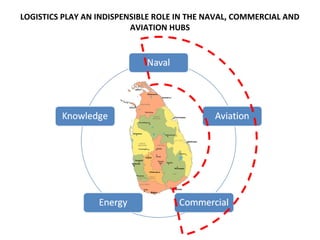
LOGISTICS PLAY AN INDISPENSIBLE ROLE IN THE NAVAL, COMMERCIAL AND
AVIATION HUBS
• Being an island, the sea creates a barrier for
certain modes of transport for movement of
incoming and outgoing cargo to Sri Lanka such
as land based transportation, while placing it
in a highly strategic position for Sea transport
• The north of the country faces one of the
economic tigers of the world today with an
increasing disposable income, India.
BACKGROUND contd.
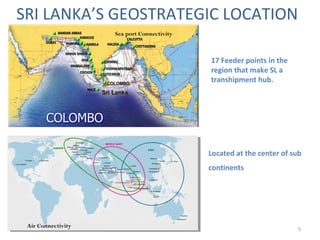
SRI LANKA’S GEOSTRATEGIC LOCATION
5
Located at the center of sub
continents
Air Connectivity
17 Feeder points in the
region that make SL a
transhipment hub.
Sea port Connectivity
THE LOGISTICS SCENARIO
• Logistics Performance Indicators (LPI) of Sri
Lanka (SL) is 81 out of 155 countries in 2012
• Investors essentially demand top level
performance in Logistics
• Competing countries like Singapore tops in
the ranking
• Rapid and consistent improvements in LPI is a
prerequisite for 3 Hubs
RESEARCH QUESTIONS
1. What are the reasons for moderate level of
Logistics performance despite country
specific advantages ?
2. What are the improvements required in
policy regulations in Sri Lanka (SL)?
HYPOTHESES
1. Modern systems, and infrastructure facilities
effect the Logistics industry in SL
2. The link between customs and other border
management agencies in SL impact the
effectiveness and efficiency in logistics
3. Appointing a separate statutory body to
administer the logistics industry influence
logistics perfrmance in SL
METHODOLOGY
• The research has utilized both qualitative and
quantitative data from primary and secondary
sources.
• Opinion Survey
• Primary data were collected through
unstructured interviews with officials of Sri
Lanka Ports Authority, Board of Investment of
SL, and SL Customs.
• To make clarifications and get opinion on
latest changes of policies, procedures
implementation of new projects etc.
• Secondary data by reviewing
• Doing Business Reports of the World Bank,
• Maritime Transport Reports of United Nations
Conference on Trade and Development,
• The Global Competitiveness Reports of World
Economic Forum
• The Connecting to Compete Reports of The World
Bank
• The annual publications of the Central Bank and
various logistics related trade associations in Sri
Lanka.
METHODOLOGY (Cont…)
Literature review
• The dominant maritime position of Sri Lanka was seen
gradually eroding over the years, particularly since the latter
half of the 20th
century. Colombo has gradually lost its
attraction for marine traffic (Ratnayake and Wijeratne, 2012)
• Improving logistics performance has become an important
development policy objective in recent years because logistics
have a major impact on economic activity.(World Bank, 2012)
• Indexes see the potential in Sri Lanka to establish itself as a
hub in the areas of naval, aviation and commercial activities.
(Edirisinghe & Muller, 2013)
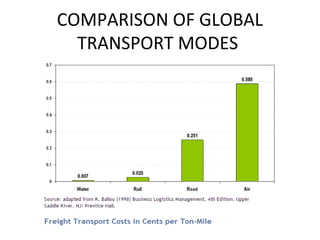
COMPARISON OF GLOBAL
TRANSPORT MODES
LOGISTICS PERFORMANCE INDEX
(LPI)
LPI is based on recent theoretical and empirical research and on the practical
experience of logistics professionals involved in international freight
forwarding.
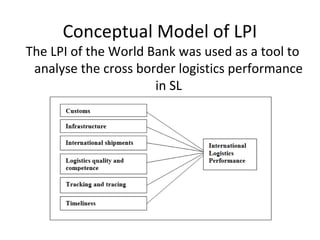
LPI analyzes countries in six components
1. The efficiency of customs and border management
clearance
2. The quality of trade and transport infrastructure
3. The ease of arranging competitively priced shipments
4. The competence and quality of logistics services
5. The ability to track and trace consignments
6. The frequency with which shipments reach
consignees within scheduled or expected delivery
times
Conceptual Model of LPI
The LPI of the World Bank was used as a tool to
analyse the cross border logistics performance
in SL
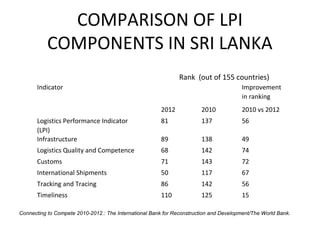
COMPARISON OF LPI
COMPONENTS IN SRI LANKA
Indicator Improvement
in ranking
2012 2010 2010 vs 2012
Logistics Performance Indicator
(LPI)
81 137 56
Infrastructure 89 138 49
Logistics Quality and Competence 68 142 74
Customs 71 143 72
International Shipments 50 117 67
Tracking and Tracing 86 142 56
Timeliness 110 125 15
Rank (out of 155 countries)
Connecting to Compete 2010-2012.: The International Bank for Reconstruction and Development/The World Bank.
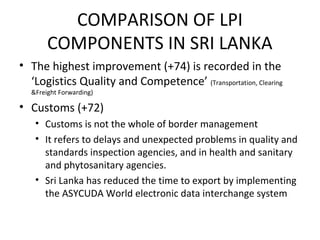
• The highest improvement (+74) is recorded in the
‘Logistics Quality and Competence’ (Transportation, Clearing
&Freight Forwarding)
• Customs (+72)
• Customs is not the whole of border management
• It refers to delays and unexpected problems in quality and
standards inspection agencies, and in health and sanitary
and phytosanitary agencies.
• Sri Lanka has reduced the time to export by implementing
the ASYCUDA World electronic data interchange system
COMPARISON OF LPI
COMPONENTS IN SRI LANKA
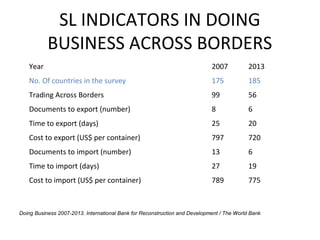
SL INDICATORS IN DOING
BUSINESS ACROSS BORDERS
Year 2007 2013
No. Of countries in the survey 175 185
Trading Across Borders 99 56
Documents to export (number) 8 6
Time to export (days) 25 20
Cost to export (US$ per container) 797 720
Documents to import (number) 13 6
Time to import (days) 27 19
Cost to import (US$ per container) 789 775
Doing Business 2007-2013. International Bank for Reconstruction and Development / The World Bank
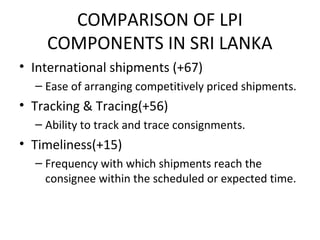
• International shipments (+67)
– Ease of arranging competitively priced shipments.
• Tracking & Tracing(+56)
– Ability to track and trace consignments.
• Timeliness(+15)
– Frequency with which shipments reach the
consignee within the scheduled or expected time.
COMPARISON OF LPI
COMPONENTS IN SRI LANKA
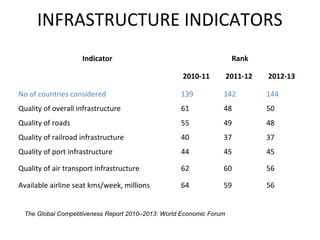
INFRASTRUCTURE INDICATORS
Indicator Rank
2010-11 2011-12 2012-13
No of countries considered 139 142 144
Quality of overall infrastructure 61 48 50
Quality of roads 55 49 48
Quality of railroad infrastructure 40 37 37
Quality of port infrastructure 44 45 45
Quality of air transport infrastructure 62 60 56
Available airline seat kms/week, millions 64 59 56
The Global Competitiveness Report 2010–2013: World Economic Forum
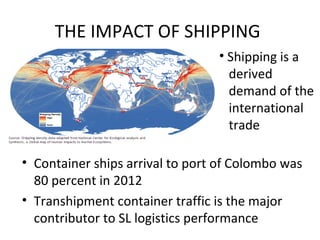
THE IMPACT OF SHIPPING
• Container ships arrival to port of Colombo was
80 percent in 2012
• Transhipment container traffic is the major
contributor to SL logistics performance
• Shipping is a
derived
demand of the
international
trade
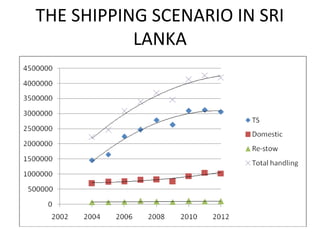
THE SHIPPING SCENARIO IN SRI
LANKA
CONCERNS IN SHIPPING
• SL’s export volume is only 35 percent of external
trade compared to 65 percent of imports against
the total laden movements
• 28 percent of domestic containers handled are
empty containers
• This does not generate any income to shipping
lines but creates a substantial cost.
• It is estimated that approximately USD 80 million
is spent every year on empty container
repositions.
CONCLUSIONS
• From a development perspective, converting the
country into naval, aviation and commercial hubs
is pertinent to the cross border movement of
goods, services and people.
• While using the advantages of the strategic
geographical location Sri Lanka can learn from
countries such as South Africa which has made
great progress in making trading across borders
easy, efficient and effective.
CONCLUSIONS (CONT…)
• Lower LPI is mainly attributed to
• The absence of dry port facility
• Port users are not innovative enough in reaping the
real potential of Hambantota port
• Usage of rail road for cargo movement is at negligible
level
• On-line booking systems are not utilized by all
stakeholders.
• Inconsistency in operational productivity in the supply
chain
• Issues related to feeder network availability to cover
all destinations/origins
THE WAY FORWARD
1. Although, policymaking is a responsibility
shared among respective government
agencies, SL should take a lead in
transforming a separate statuary body for
logistics
2. The present trend of investment in improving
the logistics infrastructure should be
continued but a close evaluation with respect
to return on investment is required.
3. Border management agencies should develop
a holistic approach with customs to reduce
the burden of multiple barriers at borders
4. Extensive us of electronic submission and
processing of documents
5. SL Customs should focus on to the Strategic
Risk Management, Compliance Management
and Change Management
THE WAY FORWARD (CONT..)
6. Congested road access to the Colombo Port and the
poor quality of trucking and rail services should be
eased
7. A collective Logistics framework that includes the
private sector is important for consistent
implementation
8. More research in Logistics and supply chain should
be carried out by universities that permeate and
proliferate to the power of decision making for the
betterment of the industry
THE WAY FORWARD (CONT..)
Thank you

Cross border logistics performance in sri lanka

  • 1.
    Cross-border Logistics Performance inSri Lanka: the way forward LalithEdirisinghe
  • 2.
    BACKGROUND According to theMahinda Chintanaya Idiri Dekma the country has a clear and definite objective of converting the country to a Naval Aviation Commercial Energy and Knowledge hub in Asia
  • 3.
    LOGISTICS PLAY ANINDISPENSIBLE ROLE IN THE NAVAL, COMMERCIAL AND AVIATION HUBS
  • 4.
    • Being anisland, the sea creates a barrier for certain modes of transport for movement of incoming and outgoing cargo to Sri Lanka such as land based transportation, while placing it in a highly strategic position for Sea transport • The north of the country faces one of the economic tigers of the world today with an increasing disposable income, India. BACKGROUND contd.
  • 5.
    SRI LANKA’S GEOSTRATEGICLOCATION 5 Located at the center of sub continents Air Connectivity 17 Feeder points in the region that make SL a transhipment hub. Sea port Connectivity
  • 6.
    THE LOGISTICS SCENARIO •Logistics Performance Indicators (LPI) of Sri Lanka (SL) is 81 out of 155 countries in 2012 • Investors essentially demand top level performance in Logistics • Competing countries like Singapore tops in the ranking • Rapid and consistent improvements in LPI is a prerequisite for 3 Hubs
  • 7.
    RESEARCH QUESTIONS 1. Whatare the reasons for moderate level of Logistics performance despite country specific advantages ? 2. What are the improvements required in policy regulations in Sri Lanka (SL)?
  • 8.
    HYPOTHESES 1. Modern systems,and infrastructure facilities effect the Logistics industry in SL 2. The link between customs and other border management agencies in SL impact the effectiveness and efficiency in logistics 3. Appointing a separate statutory body to administer the logistics industry influence logistics perfrmance in SL
  • 9.
    METHODOLOGY • The researchhas utilized both qualitative and quantitative data from primary and secondary sources. • Opinion Survey • Primary data were collected through unstructured interviews with officials of Sri Lanka Ports Authority, Board of Investment of SL, and SL Customs. • To make clarifications and get opinion on latest changes of policies, procedures implementation of new projects etc.
  • 10.
    • Secondary databy reviewing • Doing Business Reports of the World Bank, • Maritime Transport Reports of United Nations Conference on Trade and Development, • The Global Competitiveness Reports of World Economic Forum • The Connecting to Compete Reports of The World Bank • The annual publications of the Central Bank and various logistics related trade associations in Sri Lanka. METHODOLOGY (Cont…)
  • 11.
    Literature review • Thedominant maritime position of Sri Lanka was seen gradually eroding over the years, particularly since the latter half of the 20th century. Colombo has gradually lost its attraction for marine traffic (Ratnayake and Wijeratne, 2012) • Improving logistics performance has become an important development policy objective in recent years because logistics have a major impact on economic activity.(World Bank, 2012) • Indexes see the potential in Sri Lanka to establish itself as a hub in the areas of naval, aviation and commercial activities. (Edirisinghe & Muller, 2013)
  • 12.
  • 13.
    LOGISTICS PERFORMANCE INDEX (LPI) LPIis based on recent theoretical and empirical research and on the practical experience of logistics professionals involved in international freight forwarding. LPI analyzes countries in six components 1. The efficiency of customs and border management clearance 2. The quality of trade and transport infrastructure 3. The ease of arranging competitively priced shipments 4. The competence and quality of logistics services 5. The ability to track and trace consignments 6. The frequency with which shipments reach consignees within scheduled or expected delivery times
  • 14.
    Conceptual Model ofLPI The LPI of the World Bank was used as a tool to analyse the cross border logistics performance in SL
  • 15.
    COMPARISON OF LPI COMPONENTSIN SRI LANKA Indicator Improvement in ranking 2012 2010 2010 vs 2012 Logistics Performance Indicator (LPI) 81 137 56 Infrastructure 89 138 49 Logistics Quality and Competence 68 142 74 Customs 71 143 72 International Shipments 50 117 67 Tracking and Tracing 86 142 56 Timeliness 110 125 15 Rank (out of 155 countries) Connecting to Compete 2010-2012.: The International Bank for Reconstruction and Development/The World Bank.
  • 16.
    • The highestimprovement (+74) is recorded in the ‘Logistics Quality and Competence’ (Transportation, Clearing &Freight Forwarding) • Customs (+72) • Customs is not the whole of border management • It refers to delays and unexpected problems in quality and standards inspection agencies, and in health and sanitary and phytosanitary agencies. • Sri Lanka has reduced the time to export by implementing the ASYCUDA World electronic data interchange system COMPARISON OF LPI COMPONENTS IN SRI LANKA
  • 17.
    SL INDICATORS INDOING BUSINESS ACROSS BORDERS Year 2007 2013 No. Of countries in the survey 175 185 Trading Across Borders 99 56 Documents to export (number) 8 6 Time to export (days) 25 20 Cost to export (US$ per container) 797 720 Documents to import (number) 13 6 Time to import (days) 27 19 Cost to import (US$ per container) 789 775 Doing Business 2007-2013. International Bank for Reconstruction and Development / The World Bank
  • 18.
    • International shipments(+67) – Ease of arranging competitively priced shipments. • Tracking & Tracing(+56) – Ability to track and trace consignments. • Timeliness(+15) – Frequency with which shipments reach the consignee within the scheduled or expected time. COMPARISON OF LPI COMPONENTS IN SRI LANKA
  • 19.
    INFRASTRUCTURE INDICATORS Indicator Rank 2010-112011-12 2012-13 No of countries considered 139 142 144 Quality of overall infrastructure 61 48 50 Quality of roads 55 49 48 Quality of railroad infrastructure 40 37 37 Quality of port infrastructure 44 45 45 Quality of air transport infrastructure 62 60 56 Available airline seat kms/week, millions 64 59 56 The Global Competitiveness Report 2010–2013: World Economic Forum
  • 20.
    THE IMPACT OFSHIPPING • Container ships arrival to port of Colombo was 80 percent in 2012 • Transhipment container traffic is the major contributor to SL logistics performance • Shipping is a derived demand of the international trade
  • 21.
  • 22.
    CONCERNS IN SHIPPING •SL’s export volume is only 35 percent of external trade compared to 65 percent of imports against the total laden movements • 28 percent of domestic containers handled are empty containers • This does not generate any income to shipping lines but creates a substantial cost. • It is estimated that approximately USD 80 million is spent every year on empty container repositions.
  • 23.
    CONCLUSIONS • From adevelopment perspective, converting the country into naval, aviation and commercial hubs is pertinent to the cross border movement of goods, services and people. • While using the advantages of the strategic geographical location Sri Lanka can learn from countries such as South Africa which has made great progress in making trading across borders easy, efficient and effective.
  • 24.
    CONCLUSIONS (CONT…) • LowerLPI is mainly attributed to • The absence of dry port facility • Port users are not innovative enough in reaping the real potential of Hambantota port • Usage of rail road for cargo movement is at negligible level • On-line booking systems are not utilized by all stakeholders. • Inconsistency in operational productivity in the supply chain • Issues related to feeder network availability to cover all destinations/origins
  • 25.
    THE WAY FORWARD 1.Although, policymaking is a responsibility shared among respective government agencies, SL should take a lead in transforming a separate statuary body for logistics 2. The present trend of investment in improving the logistics infrastructure should be continued but a close evaluation with respect to return on investment is required.
  • 26.
    3. Border managementagencies should develop a holistic approach with customs to reduce the burden of multiple barriers at borders 4. Extensive us of electronic submission and processing of documents 5. SL Customs should focus on to the Strategic Risk Management, Compliance Management and Change Management THE WAY FORWARD (CONT..)
  • 27.
    6. Congested roadaccess to the Colombo Port and the poor quality of trucking and rail services should be eased 7. A collective Logistics framework that includes the private sector is important for consistent implementation 8. More research in Logistics and supply chain should be carried out by universities that permeate and proliferate to the power of decision making for the betterment of the industry THE WAY FORWARD (CONT..)
  • 28.