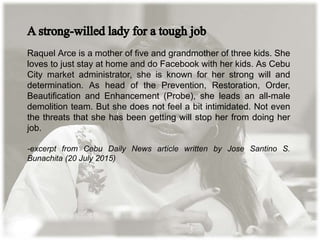
Raquel Arce is a mother of five and grandmother of three kids. She
loves to just stay at home and do Facebook with her kids. As Cebu
City market administrator, she is known for her strong will and
determination. As head of the Prevention, Restoration, Order,
Beautification and Enhancement (Probe), she leads an all-male
demolition team. But she does not feel a bit intimidated. Not even
the threats that she has been getting will stop her from doing her
job.
-excerpt from Cebu Daily News article written by Jose Santino S.
Bunachita (20 July 2015)
educating women from a young age that aiming
for excellence is not wrong
creating more opportunities for women in
industries
celebrating female success not as this unique
event that only a handful of women can
accomplish
James Felton Keith went back to his hometown of Detroit to help rebuild
the city after it went bankrupt. On his first day working in the new mayor’s
office, a colleague was giving him a tour of the office when two gay men
walked by and were introduced. After they left, James was shocked at
what he heard from his colleague: She nudges me and says, “You know,
these white gay guys are coming to take all our jobs.” Months later,
leading up to Pride week, James was interviewed in the mayor’s office by
the local LGBTQ magazine. During Pride weekend, James participated in
the Pride March, shared photos on Instagram, and had what felt like a
“regular weekend.” Unfortunately, Monday morning, he was told it’s not
working out and was fired. James recalls: And I thought, “What do you
mean it’s not working out? It’s working out. The strategy that I came there
to implement was working out. “And so he told me that my “associations”
weren’t aligned with the administration. And that’s specifically what he
said. I will never forget it.” Henceforth, he was fired.
-excerpt from HuffingtonPost.Com article written by Nathan Mansake
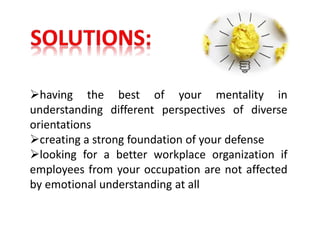
having the best of your mentality in
understanding different perspectives of diverse
orientations
creating a strong foundation of your defense
looking for a better workplace organization if
employees from your occupation are not affected
by emotional understanding at all
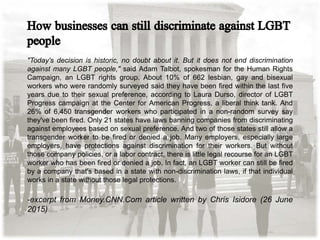
"Today's decision is historic, no doubt about it. But it does not end discrimination
against many LGBT people," said Adam Talbot, spokesman for the Human Rights
Campaign, an LGBT rights group. About 10% of 662 lesbian, gay and bisexual
workers who were randomly surveyed said they have been fired within the last five
years due to their sexual preference, according to Laura Durso, director of LGBT
Progress campaign at the Center for American Progress, a liberal think tank. And
26% of 6,450 transgender workers who participated in a non-random survey say
they've been fired. Only 21 states have laws banning companies from discriminating
against employees based on sexual preference. And two of those states still allow a
transgender worker to be fired or denied a job. Many employers, especially large
employers, have protections against discrimination for their workers. But without
those company policies, or a labor contract, there is little legal recourse for an LGBT
worker who has been fired or denied a job. In fact, an LGBT worker can still be fired
by a company that's based in a state with non-discrimination laws, if that individual
works in a state without those legal protections.
-excerpt from Money.CNN.Com article written by Chris Isidore (26 June
2015)
using rights to counter those companies
discriminating them
looking for companies who have LGBT rights
protection
striking the company with LGBT Rights Act to
disable them from their ability to dismiss
employees because of their orientation
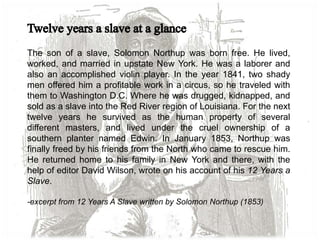
The son of a slave, Solomon Northup was born free. He lived,
worked, and married in upstate New York. He was a laborer and
also an accomplished violin player. In the year 1841, two shady
men offered him a profitable work in a circus, so he traveled with
them to Washington D.C. Where he was drugged, kidnapped, and
sold as a slave into the Red River region of Louisiana. For the next
twelve years he survived as the human property of several
different masters, and lived under the cruel ownership of a
southern planter named Edwin. In January 1853, Northup was
finally freed by his friends from the North who came to rescue him.
He returned home to his family in New York and there, with the
help of editor David Wilson, wrote on his account of his 12 Years a
Slave.
-excerpt from 12 Years A Slave written by Solomon Northup (1853)
removing the slavery system
African-American Civil Rights Movement
perception of equality
Capitalism hurts all working women. In the United States, sexism and patriarchy
are highly prevalent, and women are faced with income inequality, violence,
discrimination and harassment. But in Bangladesh, the women are fighting back. In
Dhaka, women make up the majority of the homeless population. Women walked
through the streets of Dhaka quickly and quietly with their eyes down, due to the
fact that they are often afraid of leaving their homes and walking around the city out
of fear of being raped, which is something that happens every single day in the city
of Dhaka. Poverty and suffering are commonplace for women in Bangladesh, but
women are not passive. Lucky Akter, general secretary of the Bangladesh Students
Union, explain that “In Bangladesh, women struggle everywhere. The fight against
patriarchy is in every sphere of life. Women are contributing to the economy but still
they are suppressed. In this neoliberal era, women are considered as a commodity.
Capitalism shows fake respect towards women.” Everyday, they endure
harassment and the threat of sexual violence, which is very common in the
factories. They live in extremely cramped living quarters and struggle with illness
and injuries as a result of their unsanitary and horrific working conditions.
-excerpt from Workers.Org article written by Colleen Davidson (6 March
2015)
educating women
giving economic empowerment to women
exercising the rights of women to speak out
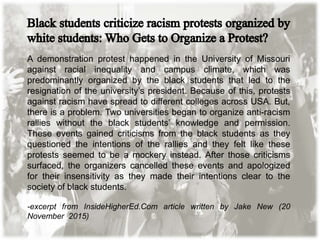
A demonstration protest happened in the University of Missouri
against racial inequality and campus climate, which was
predominantly organized by the black students that led to the
resignation of the university’s president. Because of this, protests
against racism have spread to different colleges across USA. But,
there is a problem. Two universities began to organize anti-racism
rallies without the black students’ knowledge and permission.
These events gained criticisms from the black students as they
questioned the intentions of the rallies and they felt like these
protests seemed to be a mockery instead. After those criticisms
surfaced, the organizers cancelled these events and apologized
for their insensitivity as they made their intentions clear to the
society of black students.
-excerpt from InsideHigherEd.Com article written by Jake New (20
November 2015)
consulting the people involved before organizing
an event
avoiding personal pride
respecting and accepting each other’s opinion
and culture
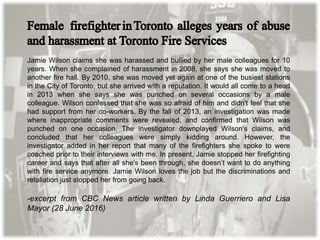
Jamie Wilson claims she was harassed and bullied by her male colleagues for 10
years. When she complained of harassment in 2008, she says she was moved to
another fire hall. By 2010, she was moved yet again at one of the busiest stations
in the City of Toronto, but she arrived with a reputation. It would all come to a head
in 2013 when she says she was punched on several occasions by a male
colleague. Wilson confessed that she was so afraid of him and didn't feel that she
had support from her co-workers. By the fall of 2013, an investigation was made
where inappropriate comments were revealed, and confirmed that Wilson was
punched on one occasion. The investigator downplayed Wilson's claims, and
concluded that her colleagues were simply kidding around. However, the
investigator added in her report that many of the firefighters she spoke to were
coached prior to their interviews with me. In present, Jamie stopped her firefighting
career and says that after all she’s been through, she doesn’t want to do anything
with fire service anymore. Jamie Wilson loves the job but the discriminations and
retaliation just stopped her from going back.
-excerpt from CBC News article written by Linda Guerriero and Lisa
Mayor (28 June 2016)
prohibiting gender discrimination in fire stations
creating associations for women firefighters
men’s acceptance to women’s capability
Beijing - China has deported a group 20 foreign tourists from
Britain, South Africa and India for watching videos in a hotel, that
allegedly advocated terrorism and religious extremism. Two of the
tourists, however, said they were actually just watching a
documentary about the 13th century Mongol leader Genghis Khan.
It cited the foreign affairs of Ordos city, China, where police had
stopped these tourists as they were going to fly to Xi’an, home of
the terracotta warriors on a 47-day tour of the country. Britain’s
Press Association reported that the documentary was a BBC
production on he 13th century Mongol leader Genghis Khan, citing
statement of British couples. Said that the video “may have
mistakenly been deemed as ‘propaganda’ material.”
-excerpt from Cebu Daily News WORLD article (20 July 2015)
investigating thoroughly before making
conclusions
giving more importance to human rights and
respect
be considerate
Critical Perspective in Organizational Communication

Critical Perspective in Organizational Communication

  • 3.
    Raquel Arce isa mother of five and grandmother of three kids. She loves to just stay at home and do Facebook with her kids. As Cebu City market administrator, she is known for her strong will and determination. As head of the Prevention, Restoration, Order, Beautification and Enhancement (Probe), she leads an all-male demolition team. But she does not feel a bit intimidated. Not even the threats that she has been getting will stop her from doing her job. -excerpt from Cebu Daily News article written by Jose Santino S. Bunachita (20 July 2015)
  • 4.
    educating women froma young age that aiming for excellence is not wrong creating more opportunities for women in industries celebrating female success not as this unique event that only a handful of women can accomplish
  • 5.
    James Felton Keithwent back to his hometown of Detroit to help rebuild the city after it went bankrupt. On his first day working in the new mayor’s office, a colleague was giving him a tour of the office when two gay men walked by and were introduced. After they left, James was shocked at what he heard from his colleague: She nudges me and says, “You know, these white gay guys are coming to take all our jobs.” Months later, leading up to Pride week, James was interviewed in the mayor’s office by the local LGBTQ magazine. During Pride weekend, James participated in the Pride March, shared photos on Instagram, and had what felt like a “regular weekend.” Unfortunately, Monday morning, he was told it’s not working out and was fired. James recalls: And I thought, “What do you mean it’s not working out? It’s working out. The strategy that I came there to implement was working out. “And so he told me that my “associations” weren’t aligned with the administration. And that’s specifically what he said. I will never forget it.” Henceforth, he was fired. -excerpt from HuffingtonPost.Com article written by Nathan Mansake
  • 6.
    having the bestof your mentality in understanding different perspectives of diverse orientations creating a strong foundation of your defense looking for a better workplace organization if employees from your occupation are not affected by emotional understanding at all
  • 7.
    "Today's decision ishistoric, no doubt about it. But it does not end discrimination against many LGBT people," said Adam Talbot, spokesman for the Human Rights Campaign, an LGBT rights group. About 10% of 662 lesbian, gay and bisexual workers who were randomly surveyed said they have been fired within the last five years due to their sexual preference, according to Laura Durso, director of LGBT Progress campaign at the Center for American Progress, a liberal think tank. And 26% of 6,450 transgender workers who participated in a non-random survey say they've been fired. Only 21 states have laws banning companies from discriminating against employees based on sexual preference. And two of those states still allow a transgender worker to be fired or denied a job. Many employers, especially large employers, have protections against discrimination for their workers. But without those company policies, or a labor contract, there is little legal recourse for an LGBT worker who has been fired or denied a job. In fact, an LGBT worker can still be fired by a company that's based in a state with non-discrimination laws, if that individual works in a state without those legal protections. -excerpt from Money.CNN.Com article written by Chris Isidore (26 June 2015)
  • 8.
    using rights tocounter those companies discriminating them looking for companies who have LGBT rights protection striking the company with LGBT Rights Act to disable them from their ability to dismiss employees because of their orientation
  • 9.
    The son ofa slave, Solomon Northup was born free. He lived, worked, and married in upstate New York. He was a laborer and also an accomplished violin player. In the year 1841, two shady men offered him a profitable work in a circus, so he traveled with them to Washington D.C. Where he was drugged, kidnapped, and sold as a slave into the Red River region of Louisiana. For the next twelve years he survived as the human property of several different masters, and lived under the cruel ownership of a southern planter named Edwin. In January 1853, Northup was finally freed by his friends from the North who came to rescue him. He returned home to his family in New York and there, with the help of editor David Wilson, wrote on his account of his 12 Years a Slave. -excerpt from 12 Years A Slave written by Solomon Northup (1853)
  • 10.
    removing the slaverysystem African-American Civil Rights Movement perception of equality
  • 11.
    Capitalism hurts allworking women. In the United States, sexism and patriarchy are highly prevalent, and women are faced with income inequality, violence, discrimination and harassment. But in Bangladesh, the women are fighting back. In Dhaka, women make up the majority of the homeless population. Women walked through the streets of Dhaka quickly and quietly with their eyes down, due to the fact that they are often afraid of leaving their homes and walking around the city out of fear of being raped, which is something that happens every single day in the city of Dhaka. Poverty and suffering are commonplace for women in Bangladesh, but women are not passive. Lucky Akter, general secretary of the Bangladesh Students Union, explain that “In Bangladesh, women struggle everywhere. The fight against patriarchy is in every sphere of life. Women are contributing to the economy but still they are suppressed. In this neoliberal era, women are considered as a commodity. Capitalism shows fake respect towards women.” Everyday, they endure harassment and the threat of sexual violence, which is very common in the factories. They live in extremely cramped living quarters and struggle with illness and injuries as a result of their unsanitary and horrific working conditions. -excerpt from Workers.Org article written by Colleen Davidson (6 March 2015)
  • 12.
    educating women giving economicempowerment to women exercising the rights of women to speak out
  • 13.
    A demonstration protesthappened in the University of Missouri against racial inequality and campus climate, which was predominantly organized by the black students that led to the resignation of the university’s president. Because of this, protests against racism have spread to different colleges across USA. But, there is a problem. Two universities began to organize anti-racism rallies without the black students’ knowledge and permission. These events gained criticisms from the black students as they questioned the intentions of the rallies and they felt like these protests seemed to be a mockery instead. After those criticisms surfaced, the organizers cancelled these events and apologized for their insensitivity as they made their intentions clear to the society of black students. -excerpt from InsideHigherEd.Com article written by Jake New (20 November 2015)
  • 14.
    consulting the peopleinvolved before organizing an event avoiding personal pride respecting and accepting each other’s opinion and culture
  • 15.
    Jamie Wilson claimsshe was harassed and bullied by her male colleagues for 10 years. When she complained of harassment in 2008, she says she was moved to another fire hall. By 2010, she was moved yet again at one of the busiest stations in the City of Toronto, but she arrived with a reputation. It would all come to a head in 2013 when she says she was punched on several occasions by a male colleague. Wilson confessed that she was so afraid of him and didn't feel that she had support from her co-workers. By the fall of 2013, an investigation was made where inappropriate comments were revealed, and confirmed that Wilson was punched on one occasion. The investigator downplayed Wilson's claims, and concluded that her colleagues were simply kidding around. However, the investigator added in her report that many of the firefighters she spoke to were coached prior to their interviews with me. In present, Jamie stopped her firefighting career and says that after all she’s been through, she doesn’t want to do anything with fire service anymore. Jamie Wilson loves the job but the discriminations and retaliation just stopped her from going back. -excerpt from CBC News article written by Linda Guerriero and Lisa Mayor (28 June 2016)
  • 16.
    prohibiting gender discriminationin fire stations creating associations for women firefighters men’s acceptance to women’s capability
  • 17.
    Beijing - Chinahas deported a group 20 foreign tourists from Britain, South Africa and India for watching videos in a hotel, that allegedly advocated terrorism and religious extremism. Two of the tourists, however, said they were actually just watching a documentary about the 13th century Mongol leader Genghis Khan. It cited the foreign affairs of Ordos city, China, where police had stopped these tourists as they were going to fly to Xi’an, home of the terracotta warriors on a 47-day tour of the country. Britain’s Press Association reported that the documentary was a BBC production on he 13th century Mongol leader Genghis Khan, citing statement of British couples. Said that the video “may have mistakenly been deemed as ‘propaganda’ material.” -excerpt from Cebu Daily News WORLD article (20 July 2015)
  • 18.
    investigating thoroughly beforemaking conclusions giving more importance to human rights and respect be considerate