CREATIVE CRITICAL REFLECTION TASK 1: HOW DOES
YOUR PRODUCT USE OR CHALLENGE CONVENTIONS
AND HOW DOES IT REPRESENT SOCIAL ISSUESby Hannah
Evaluation Question 1: In what ways does your
media product use, develop or challenge forms
and conventions of real media products?
ABOUT OUR PIECE
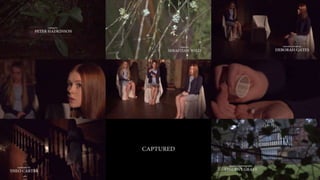
• My piece was called ‘Captured’ and was based within the thriller genre. However, more narrowly
into the psychological thriller genre. The main journey throughout the piece was to lead the
audience into the gradual enclosing of a property to a location which the audience has gathered to
be in an isolated location in the countryside, creating an eerie and obscure feeling very early on. My
product conformed and was very typical to several different aspects of the thriller genre.
• The usual aim of a thriller is to explore between the protagonist character and the antagonist, in our
case protagonists being the three girls during the disruption in the equilibrium who are leading the
story of their ‘capture’. Throughout a thriller the film would build to a climax whereby a series of bad
events creating suspense and tension leads to the downfall and/or result in the confrontation. The
aim of the protagonist is to seek justice in the event whilst the antagonist try’s to destroy it.
Obviously in our opening sequence it is unachievable, however we have given hints as to where the
story will lead to and the kinds of characters playing a significant influence.
WHAT ARE GENRE CONVENTIONS
• Conventions are what you would expect to see in a certain genre. They are the small elements that
separate one genre to another.
• Codes and conventions in media can be separated into 3 groups:
• Technical (e.g camera angles, movements & shots),
• Symbolic (e.g clothing, colours)
• Written and audio (music etc)
• Conventions in a thriller may include; violence, cliffhangers, conspiracy, action, suspense, hero,
villain. Nevertheless the genre may and probably will include several of these aspects. All to
create the intended impact of an audience to lead the audience more clearly into the genre your
film will follow.
ICONOGRAPHY
• Iconography is the mainly imagery. It can be symbolism, location, props, and techniques that appear
as conventional topes or reoccurring themes of a certain genre
• Important to connote to a person the kind of genre the film is intending to create and a possible
tone implemented
• Shadows are important parts of psychological thrillers movies as it is a reoccurring motif within the
thriller genre. Also, often combined with silhouettes working simultaneously with low key lighting
• The images that associate to a subgenre are mainly conveyed through the Mise-en-scene. Mise-en-
scene is made up of; lighting, setting, costume, props, colour and symbols a character can convey for
instance their body language, facial expressions, accents.
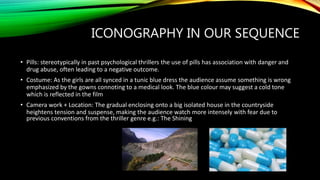
ICONOGRAPHY IN OUR SEQUENCE
• Pills: stereotypically in past psychological thrillers the use of pills has association with danger and
drug abuse, often leading to a negative outcome.
• Costume: As the girls are all synced in a tunic blue dress the audience assume something is wrong
emphasized by the gowns connoting to a medical look. The blue colour may suggest a cold tone
which is reflected in the film
• Camera work + Location: The gradual enclosing onto a big isolated house in the countryside
heightens tension and suspense, making the audience watch more intensely with fear due to
previous conventions from the thriller genre e.g.: The Shining
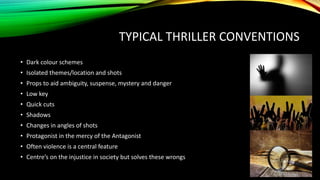
TYPICAL THRILLER CONVENTIONS
• Dark colour schemes
• Isolated themes/location and shots
• Props to aid ambiguity, suspense, mystery and danger
• Low key
• Quick cuts
• Shadows
• Changes in angles of shots
• Protagonist in the mercy of the Antagonist
• Often violence is a central feature
• Centre’s on the injustice in society but solves these wrongs
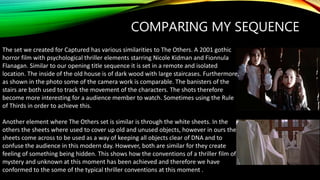
COMPARING MY SEQUENCE
The set we created for Captured has various similarities to The Others. A 2001 gothic
horror film with psychological thriller elements starring Nicole Kidman and Fionnula
Flanagan. Similar to our opening title sequence it is set in a remote and isolated
location. The inside of the old house is of dark wood with large staircases. Furthermore,
as shown in the photo some of the camera work is comparable. The banisters of the
stairs are both used to track the movement of the characters. The shots therefore
become more interesting for a audience member to watch. Sometimes using the Rule
of Thirds in order to achieve this.
Another element where The Others set is similar is through the white sheets. In the
others the sheets where used to cover up old and unused objects, however in ours the
sheets come across to be used as a way of keeping all objects clear of DNA and to
confuse the audience in this modern day. However, both are similar for they create
feeling of something being hidden. This shows how the conventions of a thriller film of
mystery and unknown at this moment has been achieved and therefore we have
conformed to the some of the typical thriller conventions at this moment .
COMPARING MY SEQUENCE
• My media product did use and develop forms and conventions of real media products was through the
camera work. We can compare the opening of the shining to support this. In the opening sequence of
Captured the tone sets the mood of the piece hinting the genre and possible conventions and feeding
information. The initial music has an eerie, already create a form of expectation. Furthermore, the
underscore of music is slow paced which matches the camera work
• Through editing and camera we specifically chose to have long duration shots to create suspense
and tension making audience wait although we haven’t shown them up. As an audience member,
they are expecting to see someone as we’ve kept them waiting too long which is a convention of
thriller and horror
• The first half of the sequence is soley establishing the location. Overall shots of countryside tells
isolation. Location is overcast
• When a house has been established at 1.09 the camera then uses focus pull, from out of focus too
focusing in on the property. This is a POV shot of the bushes through to look at the property.
HOW DOES YOUR PRODUCT
REPRESENT SOCIALS GROUPS
• Media products can relate to social groups in the format of C.R.A.G.S
• C – class
• R – race
• A – age
• G – gender
• S – sexuality
• Through a media product it is not always necessary, suitable or competent to contain all of
these features within a product. Therefore you may see a piece highlighting only a few of
these idea, however still connoting as powerful impact on the intended audience. My piece
mainly represented the idea of age and gender.
AGE
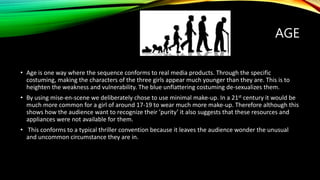
• Age is one way where the sequence conforms to real media products. Through the specific
costuming, making the characters of the three girls appear much younger than they are. This is to
heighten the weakness and vulnerability. The blue unflattering costuming de-sexualizes them.
• By using mise-en-scene we deliberately chose to use minimal make-up. In a 21st century it would be
much more common for a girl of around 17-19 to wear much more make-up. Therefore although this
shows how the audience want to recognize their ’purity’ it also suggests that these resources and
appliances were not available for them.
• This conforms to a typical thriller convention because it leaves the audience wonder the unusual
and uncommon circumstance they are in.
GENDER
• The sequence presents three young vulnerable females portraying
them as victims, this is stereotypically showing how my media
product does use and develop forms and conventions of real media
products.
• This idea has been presented in various others films. One of these
examples can be seen through Split. The American psychological
thriller follows a man with 23 different personalities who kidnaps
and imprisons three teenage girls in an isolated underground
facility.
• In both examples they are portrayed as helpless victims. This is
empathized by the camera techniques of a high angle. This makes
the female in both examples as vulnerable. Making the antagonist
have more status and power. This conforms to the way we would
typically expect a young girl. The mise on scene of the girls facial
expressions conveys them to not know how to react and have little
power in a situation which conforms to how society presents
women.
OTHER REPRESENTATION OF SOCIAL
GROUPS AND ISSUES
• During the development stage of our project, we researched into issues within society which could
link to our project. We came across the issue of the ‘Manson Family’.
• The Manson Family was a commune established by Charles Manson in the late 1960’s in California,
America. Manson was born in Cincinnati, Ohio in 1934. His mother was only 16 when she gave birth
to him. He lived a disturbed life with little security in his childhood years. Living with an alcoholic
mother who held a criminal record. As far as we are aware evidence suggests he never knew his
biological father either. Even as a child he showed occasions of violent and unusual behavior for a
boy of such young age. His ’family’ cult consisted of four members. The drifter attracted other
misfit’s drifters to form a cult who would break into people’s home and kill them.
• The most notable attack was the August 1969 two-day massacre, commanded by Manson but
committed by his four most loyal followers. The results were the murder of seven people, five were
killed on a single night at the home of Hollywood director Roman Polanski and his pregnant wife,
Sharon Tate.
HOW DOES THE MANSON FAMILY
ISSUE RELATE TO ‘CAPTURED’
• The costuming creates the idea of a cult and although unlike the girls in Captured who were portrayed to be in
some ‘cult’, unlike the Manson's they did not want to be involved. In the sequence though it is left unknown if
they are there by choice or force, however through the Mise-en scene of their facial expressions and body
language that they are tired and depressed. The costume intentionally creates the impact of vulnerability and
a strip of sexuality and personality, which is striking in this 21st modern society. Therefore, one might say that
they don’t necessarily represent a social group as a stereotypical representation doesn’t come across as the
characters are limited by the context.
• However, it can represent the similar but obscure social groups in the past like Manson girls. Although it is
more of an issue in America and is far less common for our intended British audience it still tap’s into
everyone’s fear and is relatable. Thus, this plays on the public’s conscious even generations later.
• Just like the Manson's where it was intentional for all the all the girls to be brunette. In Captured this is
similar. However, each girls portrayed a different look, one blonde, one brunette and one red-haired. This was
a intended choice by us, for we wanted the audience to recognise this deliberate and precise choice and think
about the intension and meaning behind it, so they can look deeper into the story and issue which enhances
the typical aims of a thriller film.

Critical Creative Reflection Task 2

  • 1.
    CREATIVE CRITICAL REFLECTIONTASK 1: HOW DOES YOUR PRODUCT USE OR CHALLENGE CONVENTIONS AND HOW DOES IT REPRESENT SOCIAL ISSUESby Hannah
  • 2.
    Evaluation Question 1:In what ways does your media product use, develop or challenge forms and conventions of real media products?
  • 3.
    ABOUT OUR PIECE •My piece was called ‘Captured’ and was based within the thriller genre. However, more narrowly into the psychological thriller genre. The main journey throughout the piece was to lead the audience into the gradual enclosing of a property to a location which the audience has gathered to be in an isolated location in the countryside, creating an eerie and obscure feeling very early on. My product conformed and was very typical to several different aspects of the thriller genre. • The usual aim of a thriller is to explore between the protagonist character and the antagonist, in our case protagonists being the three girls during the disruption in the equilibrium who are leading the story of their ‘capture’. Throughout a thriller the film would build to a climax whereby a series of bad events creating suspense and tension leads to the downfall and/or result in the confrontation. The aim of the protagonist is to seek justice in the event whilst the antagonist try’s to destroy it. Obviously in our opening sequence it is unachievable, however we have given hints as to where the story will lead to and the kinds of characters playing a significant influence.
  • 4.
    WHAT ARE GENRECONVENTIONS • Conventions are what you would expect to see in a certain genre. They are the small elements that separate one genre to another. • Codes and conventions in media can be separated into 3 groups: • Technical (e.g camera angles, movements & shots), • Symbolic (e.g clothing, colours) • Written and audio (music etc) • Conventions in a thriller may include; violence, cliffhangers, conspiracy, action, suspense, hero, villain. Nevertheless the genre may and probably will include several of these aspects. All to create the intended impact of an audience to lead the audience more clearly into the genre your film will follow.
  • 5.
    ICONOGRAPHY • Iconography isthe mainly imagery. It can be symbolism, location, props, and techniques that appear as conventional topes or reoccurring themes of a certain genre • Important to connote to a person the kind of genre the film is intending to create and a possible tone implemented • Shadows are important parts of psychological thrillers movies as it is a reoccurring motif within the thriller genre. Also, often combined with silhouettes working simultaneously with low key lighting • The images that associate to a subgenre are mainly conveyed through the Mise-en-scene. Mise-en- scene is made up of; lighting, setting, costume, props, colour and symbols a character can convey for instance their body language, facial expressions, accents.
  • 6.
    ICONOGRAPHY IN OURSEQUENCE • Pills: stereotypically in past psychological thrillers the use of pills has association with danger and drug abuse, often leading to a negative outcome. • Costume: As the girls are all synced in a tunic blue dress the audience assume something is wrong emphasized by the gowns connoting to a medical look. The blue colour may suggest a cold tone which is reflected in the film • Camera work + Location: The gradual enclosing onto a big isolated house in the countryside heightens tension and suspense, making the audience watch more intensely with fear due to previous conventions from the thriller genre e.g.: The Shining
  • 7.
    TYPICAL THRILLER CONVENTIONS •Dark colour schemes • Isolated themes/location and shots • Props to aid ambiguity, suspense, mystery and danger • Low key • Quick cuts • Shadows • Changes in angles of shots • Protagonist in the mercy of the Antagonist • Often violence is a central feature • Centre’s on the injustice in society but solves these wrongs
  • 8.
    COMPARING MY SEQUENCE Theset we created for Captured has various similarities to The Others. A 2001 gothic horror film with psychological thriller elements starring Nicole Kidman and Fionnula Flanagan. Similar to our opening title sequence it is set in a remote and isolated location. The inside of the old house is of dark wood with large staircases. Furthermore, as shown in the photo some of the camera work is comparable. The banisters of the stairs are both used to track the movement of the characters. The shots therefore become more interesting for a audience member to watch. Sometimes using the Rule of Thirds in order to achieve this. Another element where The Others set is similar is through the white sheets. In the others the sheets where used to cover up old and unused objects, however in ours the sheets come across to be used as a way of keeping all objects clear of DNA and to confuse the audience in this modern day. However, both are similar for they create feeling of something being hidden. This shows how the conventions of a thriller film of mystery and unknown at this moment has been achieved and therefore we have conformed to the some of the typical thriller conventions at this moment .
  • 9.
    COMPARING MY SEQUENCE •My media product did use and develop forms and conventions of real media products was through the camera work. We can compare the opening of the shining to support this. In the opening sequence of Captured the tone sets the mood of the piece hinting the genre and possible conventions and feeding information. The initial music has an eerie, already create a form of expectation. Furthermore, the underscore of music is slow paced which matches the camera work • Through editing and camera we specifically chose to have long duration shots to create suspense and tension making audience wait although we haven’t shown them up. As an audience member, they are expecting to see someone as we’ve kept them waiting too long which is a convention of thriller and horror • The first half of the sequence is soley establishing the location. Overall shots of countryside tells isolation. Location is overcast • When a house has been established at 1.09 the camera then uses focus pull, from out of focus too focusing in on the property. This is a POV shot of the bushes through to look at the property.
  • 10.
    HOW DOES YOURPRODUCT REPRESENT SOCIALS GROUPS • Media products can relate to social groups in the format of C.R.A.G.S • C – class • R – race • A – age • G – gender • S – sexuality • Through a media product it is not always necessary, suitable or competent to contain all of these features within a product. Therefore you may see a piece highlighting only a few of these idea, however still connoting as powerful impact on the intended audience. My piece mainly represented the idea of age and gender.
  • 11.
    AGE • Age isone way where the sequence conforms to real media products. Through the specific costuming, making the characters of the three girls appear much younger than they are. This is to heighten the weakness and vulnerability. The blue unflattering costuming de-sexualizes them. • By using mise-en-scene we deliberately chose to use minimal make-up. In a 21st century it would be much more common for a girl of around 17-19 to wear much more make-up. Therefore although this shows how the audience want to recognize their ’purity’ it also suggests that these resources and appliances were not available for them. • This conforms to a typical thriller convention because it leaves the audience wonder the unusual and uncommon circumstance they are in.
  • 12.
    GENDER • The sequencepresents three young vulnerable females portraying them as victims, this is stereotypically showing how my media product does use and develop forms and conventions of real media products. • This idea has been presented in various others films. One of these examples can be seen through Split. The American psychological thriller follows a man with 23 different personalities who kidnaps and imprisons three teenage girls in an isolated underground facility. • In both examples they are portrayed as helpless victims. This is empathized by the camera techniques of a high angle. This makes the female in both examples as vulnerable. Making the antagonist have more status and power. This conforms to the way we would typically expect a young girl. The mise on scene of the girls facial expressions conveys them to not know how to react and have little power in a situation which conforms to how society presents women.
  • 13.
    OTHER REPRESENTATION OFSOCIAL GROUPS AND ISSUES • During the development stage of our project, we researched into issues within society which could link to our project. We came across the issue of the ‘Manson Family’. • The Manson Family was a commune established by Charles Manson in the late 1960’s in California, America. Manson was born in Cincinnati, Ohio in 1934. His mother was only 16 when she gave birth to him. He lived a disturbed life with little security in his childhood years. Living with an alcoholic mother who held a criminal record. As far as we are aware evidence suggests he never knew his biological father either. Even as a child he showed occasions of violent and unusual behavior for a boy of such young age. His ’family’ cult consisted of four members. The drifter attracted other misfit’s drifters to form a cult who would break into people’s home and kill them. • The most notable attack was the August 1969 two-day massacre, commanded by Manson but committed by his four most loyal followers. The results were the murder of seven people, five were killed on a single night at the home of Hollywood director Roman Polanski and his pregnant wife, Sharon Tate.
  • 14.
    HOW DOES THEMANSON FAMILY ISSUE RELATE TO ‘CAPTURED’ • The costuming creates the idea of a cult and although unlike the girls in Captured who were portrayed to be in some ‘cult’, unlike the Manson's they did not want to be involved. In the sequence though it is left unknown if they are there by choice or force, however through the Mise-en scene of their facial expressions and body language that they are tired and depressed. The costume intentionally creates the impact of vulnerability and a strip of sexuality and personality, which is striking in this 21st modern society. Therefore, one might say that they don’t necessarily represent a social group as a stereotypical representation doesn’t come across as the characters are limited by the context. • However, it can represent the similar but obscure social groups in the past like Manson girls. Although it is more of an issue in America and is far less common for our intended British audience it still tap’s into everyone’s fear and is relatable. Thus, this plays on the public’s conscious even generations later. • Just like the Manson's where it was intentional for all the all the girls to be brunette. In Captured this is similar. However, each girls portrayed a different look, one blonde, one brunette and one red-haired. This was a intended choice by us, for we wanted the audience to recognise this deliberate and precise choice and think about the intension and meaning behind it, so they can look deeper into the story and issue which enhances the typical aims of a thriller film.