Question, No. 1 : THE MAJOR SCHOOLS OF THOUGHT IN CRIMINOLOGY,
ALONG WITH THEIR PROPONENTS, MAIN ASSUMPTIONS, AND CONCEPTS.
1. Supernatural Explanations
Proponents:
 Ancient civilizations (e.g., Mesopotamia, Egypt, Greece, Rome)
 Religious leaders and shamans
Main Assumptions and Concepts:
 Demonic Possession: Many ancient cultures believed that individuals could be
possessed by evil spirits or demons, leading to immoral or criminal behavior. This
idea was prevalent in various cultures and often justified extreme measures,
such as exorcisms.
 Divine Punishment: Crimes were often seen as acts against the divine order.
Societies believed that misdeeds could provoke the wrath of gods or spirits,
resulting in punishment not only for the wrongdoer but also for the community.
 Sacrificial Practices: To appease the gods or spirits believed to be angered by
crimes, ancient societies sometimes practiced sacrifices, believing that such acts
could restore balance and order.
2. Classical School
Proponents:
 Cesare Beccaria
 Jeremy Bentham
Main Assumptions and Concepts:
 Rational Choice: Individuals are rational actors who weigh the costs and
benefits of their actions. Crime occurs when the perceived benefits outweigh the
potential punishment.
 Free Will: People have the freedom to choose their behavior, including criminal
acts.
 Deterrence: Effective punishment can deter crime. Punishments should be
proportional to the crime and applied swiftly to be effective.
 Social Contract: Society exists based on an implicit agreement; laws are made
to protect the rights of individuals.
3. Positivist School
Proponents:
 Cesare Lombroso
 Enrico Ferri
 Raffaele Garofalo
Main Assumptions and Concepts:
 Determinism: Criminal behavior is determined by factors beyond individual
control, such as biological, psychological, and social influences.
 Lombroso's Theory of Atavism: Some individuals are born criminals, exhibiting
physical traits that distinguish them from non-criminals.
 Social Environment: Emphasizes the role of the environment and social
conditions in shaping behavior.
 Scientific Method: Advocates for the use of empirical research and scientific
methods to study crime.
4. Chicago School
Proponents:
 Robert E. Park
 Ernest W. Burgess
 Clifford Shaw and Henry D. McKay
Main Assumptions and Concepts:
 Social Ecology: Crime is a product of social structures and environmental
factors, particularly in urban settings.
 Zone of Transition: Areas of rapid social change experience higher crime rates
due to social disorganization.
 Cultural Transmission: Criminal behaviors and values are transmitted through
social groups, particularly in disorganized communities.
5. Critical Criminology
Proponents:
 Richard Quinney
 Jock Young
 Howard Becker
Main Assumptions and Concepts:
 Power Dynamics: Crime is linked to social inequality and power relations. Those
in power define laws that serve their interests.
 Labeling Theory: Criminal behavior is influenced by societal labels and
stigmatization; being labeled as a criminal can lead to a self-fulfilling prophecy.
 Marxist Perspective: Explores the connection between capitalism, class
struggle, and crime, arguing that laws protect the interests of the ruling class.
6. Feminist Criminology
Proponents:
 Meda Chesney-Lind
 Rita Simon
 Carol Smart
Main Assumptions and Concepts:
 Gender and Crime: Examines how gender roles and societal expectations
influence both criminal behavior and the justice system's response.
 Victimization: Focuses on the victimization of women and how traditional
criminological theories often overlook female perspectives.
 Intersectionality: Considers how race, class, and gender intersect to influence
experiences with crime and justice
Question No. 02: Certainly! Understanding the differences in behavior between
criminals and non-criminals involves examining various psychological, social, and
environmental factors. Below is a comprehensive exploration of these differences:
1. Psychological Differences
A. Personality Traits:
 Impulsivity: Criminals may display higher levels of impulsivity, making decisions
without considering the consequences.
 Aggressiveness: Some studies suggest that individuals who engage in criminal
behavior may have higher levels of aggression or hostility.
 Lack of Empathy: Many criminals show a reduced ability to empathize with
others, which can lead to a disregard for the harm their actions may cause.
B. Cognitive Patterns:
 Rationalization: Criminals often rationalize or justify their behavior to alleviate
feelings of guilt or responsibility.
 Perception of Risk: Criminals may underestimate the risks associated with their
actions or believe they can evade consequences more easily than non-criminals.
2. Social Factors
A. Socialization and Environment:
 Family Background: Criminal behavior is often linked to adverse childhood
experiences, such as abuse or neglect. Non-criminals generally come from more
stable backgrounds.
 Peer Influence: Association with delinquent peers can lead to criminal behavior.
Non-criminals typically have healthier social circles.
 Community Context: High-crime neighborhoods may foster criminal behavior
due to a lack of social cohesion, opportunities, and resources.
B. Socioeconomic Status:
 Poverty and Deprivation: Economic hardship can lead individuals to resort to
crime out of necessity or as a means of survival, whereas non-criminals may
have more stable economic conditions.
 Access to Education and Resources: Higher levels of education and access to
resources often correlate with lower crime rates, as individuals are more likely to
pursue legitimate opportunities.
3. Behavioral Patterns
A. Decision-Making:
 Risk Assessment: Non-criminals generally engage in more thorough risk
assessments before making decisions, weighing potential negative outcomes
more carefully than criminals.
 Long-Term vs. Short-Term Thinking: Criminals may prioritize immediate
gratification or short-term gains, while non-criminals often consider long-term
consequences.
B. Coping Mechanisms:
 Conflict Resolution: Non-criminals typically use constructive methods to resolve
conflicts, such as negotiation or seeking help, whereas criminals may resort to
aggression or illegal means.
 Stress Management: Criminals may have maladaptive coping strategies, turning
to crime as a means to cope with stress or trauma.
4. Emotional Responses
A. Guilt and Remorse:
 Emotional Responses: Non-criminals often experience guilt and remorse (deep
regret) for harmful actions, which can deter them from engaging in criminal
behavior. Criminals may lack these feelings or compartmentalize them.
B. Emotional Regulation:
 Impulse Control: Non-criminals generally exhibit better emotional regulation and
impulse control, allowing them to manage strong emotions without resorting to
harmful actions.
5. Cultural and Normative Influences
A. Norm Internalization:
 Adherence to Social Norms: Non-criminals are more likely to internalize
societal norms and laws, guiding their behavior to align with accepted standards.
Criminals may either reject these norms or feel disconnected from them.
B. Cultural Values:
 Value Systems: Cultural influences can shape behaviors; communities that
emphasize respect for the law and individual rights may produce fewer criminals
compared to those that normalize or condone deviant behaviors.
Conclusion
The differences between criminal and non-criminal behavior can be attributed to a
complex interplay of psychological, social, environmental, and cultural factors. While not
all individuals with similar backgrounds engage in criminal behavior, certain risk factors
and traits are more prevalent among those who do. Understanding these differences
can help in developing targeted interventions and prevention strategies aimed at
reducing criminal behavior and supporting at-risk populations.
Question No. 03: Edwin Sutherland’s Differential Association Theory ,1939
The differential association explanation of offending suggests that through interaction
with others, individuals learn the values, attitudes, techniques, and motivation for
criminal behavior. We often hear the phrase “Got in with a bad crowd”; our friendship
groups can profoundly affect criminality, especially during adolescence.
Differential associations (number of contacts with criminals over non-criminals) may
vary in frequency, duration, priority, and intensity.
The process of learning criminal behavior by association with criminal and anti-criminal
patterns involves all of the mechanisms that are involved in any other learning.
(behaviorism: classical conditioning, operant conditioning, social learning theory).
The principal part of the learning of criminal behavior occurs within intimate personal
groups. The differential association is a theory proposed by Sutherland in 1939. It
explains that people learn to become offenders from their environment. Through
interactions with others, individuals learn the values, attitudes, methods and motives for
criminal behavior.
NINE PROPOSITIONS
The first explicit statement of the theory of differential association appears in the 1939
edition of Principles of Criminology, and in the fourth edition of it, he presented his final
theory. His theory has nine basic postulates.
1. Criminal behavior is learned. This means that criminal behavior is not
inherited, as such; also, the person who is not already trained in crime
does not invent criminal behavior.
2. Criminal behavior is learned in interaction with other persons in a process
of communication. This communication is verbal in many cases but
includes gestures.
3. The principal part of the learning of criminal behavior occurs within
intimate personal groups. Negatively, this means that impersonal
communication, such as movies or newspaper, play a relatively
unimportant part in committing criminal behavior.
4. When criminal behavior is learned, the learning includes (a) techniques of
committing the crime, which are sometimes very simple; (b) the specific
direction of motives, drives, rationalizations, and attitudes.
5. The specific direction of the motives and drives is learned from definitions
of the legal codes as favorable or unfavorable. This different context of the
situation is usually found in the US, where cultural conflict in relation to the
legal code exists.
6. A person becomes delinquent because of an excess of definitions
favorable to violation of law over definitions unfavorable to violation of law.
This is the principle of differential association. When people become
criminals, they do so not only because of contact with criminal patterns but
also because of isolation from anti-criminal patterns. Negatively, this
means that associations that are neutral so far as crime is concerned have
little or no effect on the genesis of criminal behavior.
7. Differential associations may vary in frequency, duration, priority, and
intensity. Priority seems to be important principally through its selective
influence, and intensity has to do with such things as the prestige of the
source of a criminal or anticriminal pattern and with emotional reactions
related to the association. These modalities would be rated in quantitative
form and mathematical ratio, but the development of a formula in this
sense has not been developed and would be very difficult.
8. The process of learning criminal behavior by association with criminal and
anti-criminal patterns involve all of the mechanisms that are involved in
any other learning. Negatively, this means that the learning of criminal
behavior is not restricted to the process of imitation. A person who is
seduced, for instance, learns criminal behavior by association, but this
would not be ordinarily described as imitation.
9. While criminal behavior is an expression of general needs and values, it is
not explained by those general needs and values since non-criminal
behavior is an expression of the same needs and values.
Thieves generally steal in order to secure money, but honest laborers work in order to
money. The attempts to explain criminal behavior by general drives and values such as
the money motive have been, and must completely be, futile since they explain lawful
behavior as completely as they explain criminal behavior.
THE CAMBRIDGE STUDY
The differential association theory of offending is supported by the Cambridge Study in
delinquency development by Farrington et al., 2006. This study followed 411 males
who, at the beginning of the study, were all living in a working-class deprived inner-
city area of South London.
This was a prospective longitudinal study of the development of offending and antisocial
behavior in 411 males. The study started when they were 8 in 1961. At the beginning of
the study, they were all living in a working-class deprived inner-city area of South
London. The researchers looked at official records of conviction and self-report of
offending up to the age of 50. By the end of the study, 41% of the participants had at
least one conviction (someone is guilty of a criminal offence.). The most significant childhood
risk factors at age 8–10 for later offending were family criminality, daring or risk-taking,
low school attainment, poverty and poor parenting.
This theory predicts that offenders will come from families and groups who have pro-
criminal norms and that the criminal activities in which they are involved are similar to
the ones they have learned. This is shown to be the case by Osborne and West (1982)
as they found that 40% of the sons of convicted criminals also had convictions by the
age of 18, whereas only 13% of sons of non-criminal fathers had a conviction.
This is also supported by the Cambridge Study in delinquency development. However,
this pattern could also be explained by genetic factors. Furthermore, evidence suggests
that criminality is concentrated in a small number of families. For example, Walmsley
et al. (1992) found that 1/3 of the prison population in the UK also had relatives in
prison too. This, again, could be interpreted as support for the influence of
genetic factors.
EXAMPLES
White-collar Crimes
White-collar crimes generally require immense technical acumen, such as refined
accounting skills which can be generally learned only in close contact with educated
people in power (Sutherland, 1950). Thus, even when the larger culture of a corporation
upholds ethical norms such as honesty and transparency, close association with a
select group of people possessing questionable morals can gradually transform an
individual.
Seeing one’s close associates pilfering office supplies and appropriating company funds
can lead one to justify to oneself such transgressions. Subsequently, the same
individual may learn how to purloin without detection and may personally engage in
white collar crimes.
Organized Crime
People tend to join the mafia, often growing up inside its culture. Having family
members already involved in its structure functions as a potent invitation to potential
members. What bears noting, however, is that despite the influence of the surrounding
culture, not all members of mafia families necessarily join the organized crime network.
In fact, even during the peak of the American Mafia during the 1960/70s, the NYPD
comprised many Italian-Americans, some of whose close family members were part of
the Mafia.
The differential association theory would explain this situation by stating that individuals
who have closer and more associations with criminals than with non-criminals were
more likely to join the Mafia (Sutherland, 1950).
CRITICAL EVALUATION
1. Lack of origion of criminal
2. This theory doesn’t explain crimes by accidents and passion
3. This theory applies to any type of crime and to any socioeconomic
background. For example, individuals of middle-class backgrounds are
exposed to middle-class values and learn to commit middle-class crimes
such as fraud, whereas individuals from disadvantaged backgrounds
might learn burglary. However, the research has focused on relatively
petty crimes such as burglary (chori) and vandalism (action
involving deliberate destruction of or damage to public or private property.). This
does not show whether “white collar” crimes or more serious crimes such
as murder follow the same pattern. Also, the research done is usually
correlational, so other factors could be involved, such as people with
criminal tendencies who might associate more with people with the same
deviance.
4. This theory does not explain why criminality decreases with age. 40% of
offenses are committed by under 21 years old individuals. Many young
offenders do not carry on offending in their adult life.
5. The fact that criminality runs in families could also be explained by the
psychodynamic explanation of offending behavior whereby a child
internalizes a deviant superego from the same-sex parent during the
resolution of the Oedipus complex for boys and the Electra for girls.
6. It does not explain why some people who are exposed to criminality do not
go on to become criminals themselves. This suggests that other factors,
such as moral reasoning and free will, influence the choice of these
individuals.
7. Furthermore, it is socially sensitive as it could lead to the stereotyping of
individuals who come from criminal backgrounds as likely to commit
crimes themselves, and based on this prediction, opportunities could be
denied to them. This could also lead to a self-fulfilling prophecy.
QUESTION NO. 04: THEORY OF SOCIAL ALIENATION IN CRIME
Overview: The theory of social alienation posits that individuals who feel disconnected
or estranged from their society or community are more likely to engage in criminal
behavior. This sense of alienation can stem from various factors, including economic
disparity, social inequality, and lack of community cohesion. The theory suggests that
social bonds are crucial in regulating behavior, and when these bonds weaken,
individuals may resort to crime.
Proponents and Historical Context
Proponents:
 Émile Durkheim (1858–1917): A foundational figure in sociology, Durkheim's
work laid the groundwork for understanding social integration and its impact on
behavior.
 Albert Cohen (1955): Further developed ideas of alienation in his study of
delinquent subcultures.
 Howard Becker (1963): Explored labeling theory, which intersects with
alienation by discussing how societal reactions contribute to feelings of alienation
and subsequent criminal behavior.
Main Assumptions
1. Disconnection from Society: Individuals who experience social alienation feel
estranged from their community, leading to a lack of commitment to social norms
and values.
2. Weak Social Bonds: The theory emphasizes that strong social bonds and
integration act as deterrents to criminal behavior. When these bonds are weak or
absent, individuals are more prone to engage in crime.
3. Economic and Social Inequality: Factors such as poverty, lack of access to
education, and social exclusion contribute to feelings of alienation, increasing the
likelihood of criminal behavior.

4. Rebellion Against Society: Alienated individuals may engage in criminal acts as
a form of rebellion against a society that they feel does not recognize or value
them.
5. Marginalization: Individuals from marginalized groups often experience
heightened levels of alienation, leading to a greater propensity for crime.
6. Loss of Identity: Social alienation can lead to a loss of personal identity and
belonging, prompting individuals to seek alternative identities in deviant groups.
7. Coping Mechanisms: For some, criminal behavior may serve as a maladaptive
coping mechanism for dealing with feelings of isolation and hopelessness.
Famous Studies and Experiments
1. Émile Durkheim’s "Suicide" (1897):
o While focused on suicide, Durkheim's work demonstrated how social
alienation affects individual behavior. He identified that individuals in more
integrated communities have lower rates of suicide, suggesting that
alienation correlates with harmful behaviors.
2. Albert Cohen's "Delinquent Boys" (1955):
o Cohen examined how boys from lower socioeconomic backgrounds
formed delinquent subcultures as a response to their feelings of alienation
and status frustration. This study highlighted the connection between
social alienation and the development of deviant subcultures.
3. Howard Becker’s "Outsiders" (1963):
o Becker explored how societal labels contribute to alienation. Individuals
labeled as deviants may internalize these labels, leading to a greater
likelihood of engaging in criminal behavior.
Critical Evaluation
Strengths:
 Holistic Approach: The theory provides a comprehensive framework for
understanding crime by incorporating social, economic, and psychological
factors.
 Empirical Support: Numerous studies support the idea that social alienation is
linked to criminal behavior, particularly in marginalized communities.
Weaknesses:
 Overemphasis on Alienation: Critics argue that not all individuals who
experience alienation engage in criminal behavior, suggesting that other factors,
such as personality traits or situational influences, also play significant roles.
 Causality Issues: Establishing a direct causal link between alienation and crime
can be challenging, as many individuals experience alienation without resorting
to criminal acts.
 Neglect of Other Theories: Some critics point out that the theory may overlook
the contributions of other criminological theories, such as strain theory or routine
activity theory, which also explain criminal behavior.
Conclusion
The theory of social alienation in crime offers valuable insights into the relationship
between societal disconnection and criminal behavior. By highlighting the importance of
social bonds and community integration, it emphasizes the need for societal
interventions aimed at fostering inclusion and support for marginalized individuals.
While it has its limitations, the theory remains a relevant framework for understanding
the complexities of crime in contemporary society.
QUESTION NO. 05: LABELLING THEORY
Proponents
In 1963, the theory was first introduced by Howard Becker in his book "Outsiders", in
which he accentuated the interactions among people as one of the causes of deviance.
Labelling theory is based on the Symbolic Interactionism Perspective of Sociology in
which sociologists like Georg Herbert Mead and Charles Horton Cooley delineate
(explain as per law) that every phenomenon of society, including crime and deviance, is
due to the interaction between individuals. Edwin Lemert delineated prima deviance and
secondary deviance in "Social Pathology". To elaborate. primary deviance is an init
attempt to violate social norms or criminal law, which may or may not be labelled
subsequently Secondary deviance, on the other hand, is a criminal offence due to the
label imposed.
Labelling theory explained by Edwin Lemert
Besides, Howard S. Becker, in his book "Becoming a Marijuana User puts forth the role
of society and its reactions in promoting substance abuse. Furthermore, Erving Goffman
studied the association of labelling and stigma with perpetual negative identities of
individuals, thus leading to marginalization.
EXPLANATION OF THE THEORY
Society labels an individual based on his criminal act, lowering his self-image. As a
reaction, the individual adopts the labelled behaviour. Even though some criminological
initiatives aimed at mitigating crime-similar to rehabilitation programs-are intended to
assist offenders, they may compel them to adopt a life of crime because of the stigma
that society attaches to those who show such behavior. Hence, they start to accept the
labels for themselves as their society begins to treat them according to their labels.
On the other hand, when someone acts in a way that others find unacceptable, they
label them as deviant, which the person gradually internalizes and accepts. At the very
core of the labelling theory lies the idea of social reaction, the response or reaction of
others, to the individual's behaviour or the Individual himself.
DIFFERENT LABELS ARE Strange, weird, dangerous, perverted, a freak – these are all
terms used to create distance between groups of people, to create the ‘other’, and they
are all markers of stigma. Broadly defined, stigma is a discrediting attribute or mark of
disgrace that leads others to see us as untrustworthy, ‘tainted’, or incompetent. Stigma
is therefore a socially constructed notion of social acceptance based upon identity and
association.
Case examples:
 Edwin Lemert’s Case Studies: Edwin Lemert, a key figure in labeling theory, studied
individuals who were labeled as "deviant" and how this affected their self-identity. One of his
examples involved youth who, after being labeled as delinquents, engaged in more deviant
behavior as a means of fulfilling that label.
 The "War on Drugs": The criminalization of drug use in the U.S. has led to many
individuals, particularly young people of color, being labeled as criminals. This label often
results in a cycle of marginalization, leading to increased chances of recidivism and difficulty
reintegrating into society.
 The "Hippie" Movement: During the 1960s, individuals who identified with the
counterculture movement were often labeled as "hippies" and viewed negatively by mainstream
society. This label influenced their behavior and community, creating a distinct identity that both
resisted and embodied societal expectations.
Effects of Labelling on Youth in Pakistan
The reaction of society after a criminal act plays a crucial role in making an individual
deviant. Deviance refers to the violation of social norms. Primary deviance occurs when
the label is imposed on the attempt of crime whereas becoming a criminal due to the
imposed label is known as secondary deviance. The labels imposed by society differ
from time to time and in accordance with the cultures, however, they sway the people,
as indicated by David Rosenhan in his research titled 'On Being Sane in Insane Places'
Stigmatization
According to the sociologists B. G. Link and J. C. Phelan, stigma is defined as a set of
particular, negative opinions and prejudices associated with a label. These can be
seen in and spread through the media or regular interpersonal encounters. When
examining the consequences of labelling. theorists classify labels into two types formal
and informal. Formal labels are given to a person by someone authoritative or having a
formal status in order to recognize abnormal behaviour. For Instance, a person found
guilty or placed under arrest for committing a crime is formally called a criminal"
because he is believed to have participated in an action considered abnormal (such as
breaching the law)
Nonetheless, organizations not possessing formal power to label someone deviant can
also apply labels to individuals According to D. R. Kavish, C. W. Mullins and D. A. Soto,
such labels are informal For instance, teachers and other members of the school statt
may designate a youngster as a troublemaker and handle him according to that label by
making him face detention. For example, in Pakistan if a juvenile is arrested for petty
theft, He will be labelled as a criminal for life, which affects one's image as well as
opportunities.
Criminal Behavior.
The Symbolic Interactionism Perspective of Sociology explains that the creation of a
society is a result of regular and meaningful interactions between various individuals.
Furthermore, Charles Cooley delineates in his Looking Glass Self theory that the way
one perceives oneself depends on now others perceive him or her. The labelled person
is often viewed as deceitful by others, thus instilling criminal behaviour or deviance. For
example, in the 1990s, serial killer Javed Iqbal in Pakistan killed and raped more
than a hundred children in Lahore. Among several other reasons, one major
reason behind the instilling of his heinous crimes was the wide coverage by the
media, presenting him as monstrous.
Recidivism
Recidivism means the commission of crime of a habitual criminal. According to the
Black's Law Dictionary, recidivism can be defined as the tendency of a convicted
criminal to relapse into a habit of criminal activity
One of the major causes of recidivism is the unemployment of convicts (label ki waja sy
job milna muhskil as kisi pr FIR ho tou wo Govt mulazim nai Bank skta or na kisi bari
private firm me job kr skta) due to social labelling leading to poverty. The convicts are
deprived of employment opportunities after they are released from jail which not only
leads to their marginalization out also internalizes their criminal label.
Social Exclusion
The deviant people are rejected by society, leading to their social exclusion and criminal
activities. According to Travis Hirschi, people with strong social bonds are less likely
to indulge in criminal behaviours. On the other hand, as R. J. Sampson and J. H.
Laub delineate, stigmatized individuals are adversely affected and find it troublesome to
establish relations with the non-deviant people of society, resulting in weak social bonds
and instilling criminal behaviour. Furthermore, labelling minimizes employment as well
as education opportunities, leading to long-lasting criminal behaviours among
individuals. For instance, women in Pakistan are marginalized, particularly those who
assert independence, in the contemporary era, most of the terrorist organizations recruit
women to carry out attacks. Henry Thomas Buckle once said.
"Society prepares crimes, and criminals commit it."
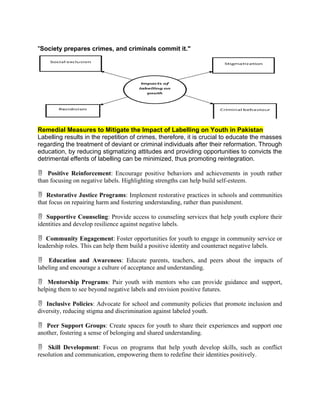
Remedial Measures to Mitigate the Impact of Labelling on Youth in Pakistan
Labelling results in the repetition of crimes, therefore, it is crucial to educate the masses
regarding the treatment of deviant or criminal individuals after their reformation. Through
education, by reducing stigmatizing attitudes and providing opportunities to convicts the
detrimental effents of labelling can be minimized, thus promoting reintegration.
 Positive Reinforcement: Encourage positive behaviors and achievements in youth rather
than focusing on negative labels. Highlighting strengths can help build self-esteem.
 Restorative Justice Programs: Implement restorative practices in schools and communities
that focus on repairing harm and fostering understanding, rather than punishment.
 Supportive Counseling: Provide access to counseling services that help youth explore their
identities and develop resilience against negative labels.
 Community Engagement: Foster opportunities for youth to engage in community service or
leadership roles. This can help them build a positive identity and counteract negative labels.
 Education and Awareness: Educate parents, teachers, and peers about the impacts of
labeling and encourage a culture of acceptance and understanding.
 Mentorship Programs: Pair youth with mentors who can provide guidance and support,
helping them to see beyond negative labels and envision positive futures.
 Inclusive Policies: Advocate for school and community policies that promote inclusion and
diversity, reducing stigma and discrimination against labeled youth.
 Peer Support Groups: Create spaces for youth to share their experiences and support one
another, fostering a sense of belonging and shared understanding.
 Skill Development: Focus on programs that help youth develop skills, such as conflict
resolution and communication, empowering them to redefine their identities positively.
 Media Literacy: Teach youth to critically evaluate media messages and societal expectations,
helping them to resist negative labeling and create their own narratives.
Educating the Masses
In order to mitigate the consequences of stigmatization and labelling, transforming
social institutions like family and education and people's mindsets from negative to
positive is paramount. Teachers and parents should be trained in order to prevent them
from labelling their children as troublemakers or deviants. Instead, they ought to be
encouraged by highlighting their strengths and talents, inculcating a positive identity.
Reintegration of Deviant Individuals or Criminals after their De-radicalization
When the ideas and mindsets of criminals are de-radicalized, inclusive behaviours
should be adopted by society's individuals. Individuals should not be labelled on the
basis of their past actions, rather, they should be reintegrated. Furthermore, the masses
ought to be made aware of the detrimental impact of labelling and be empathetic
towards each other.
Providing Employment Opportunities and Giving Access to Resources
According to the Human Needs Theory by John Burton, there are certain human
essentials like identity, economic security, political participation, etc. If individuals are
deprived of these essentials. they might indulge in criminal activities. Therefore, it is
crucial to ensure that all young people. irrespective of their labels or histories, have
equal access to resources and opportunities such as healthcare, work, education, etc.
Invest in initiatives related to community development and career education to give
young people a responsibility as well as give them opportunities for growth and
success.
Critical Analysis
Labelling theory explains the reaction of society to the criminal or deviant behaviour of
an individual. According to the Sociological School of Criminology, crime is learned by
interaction with other individuals. if society stigmatizes an individual, then one learns
and adopts that behaviour in the long term. Though negative labelling of individuals
causes crimes and adversely impacts them, individuals can be labelled positively so
that they adopt positive behaviours and self-confidence. Furthermore, labelling is not
the only cause of crime. Rather, there might be certain biological and psychological
causes of crime, as explained by Biological and Psychological Schools of Thought of
Criminology.
Conclusion
In a nutshell, a labelling theory proposed by Howard Becker is about the creation of
crime by labelling the behavior of individuals Most of the time, society reacts negatively
to the primary deviance, thus creating habitual criminals by instilling the label of
"criminals amongst those individuals, Stigmatization not only results in increased
criminal activities but also the alienation of such Individuals due to social exclusion.
Furthermore, they are also deprived of fundamental needs of identity, economic
belongingness, etc. In order to mitigate the negative impacts of labelling. educating the
masses is paramount.
Question No. 06: Measure to control Robberies and urban street criminality in
Pakistan
1. Increase police presence
2. Strengthen law enforcement
3. Community policing
4. Improved street lightening
5. Increase Public Awareness
6. Appointment of the national public prosecutor
7. Effective judiciary system
8. Apoliticization of institutes
9. Use of technology (CCTV, GPS system, geo fencing, QRF )
QUESTION NO. 07: ANOMIE THEORY / STRAIN THEORY BY ROBERT MERTON
Introduction:
Every society has some pact patterns of living. It follows a few rules and regulations to
keep things normal in society. However, people deviating from those standards fall into
the category of abnormality. Meanwhile, anomie is a deviation from the normal norms of
society. It is a condition when a person becomes normless. It is a state when there is
normlessness in the person. A person without norms breaks the social bond with
society and moves towards criminal activities. The reason behind those activities is that
they become alienated from society Similarly, Robert K Merton's theory of anomie
states the same idea. Society has a few sets of patterns to let people achieve their
desires and goals. Sometimes achievement of those goals becomes difficult with legal
means. Meanwhile, at this moment, that person goes against the standards of society to
achieve certain goals. Therefore, he develops a sense of normlessness. In a result of
those behaviours, deviance and crimes occur in society. However, few schools of
thought criticize anomie theory on the grounds that people with good financial and
social statuses never get any chance to develop a strain of not achieving their goals.
They always get what they prefer to have in their lives. So, at this moment, the theory
lacks to explain deviant behaviour in the upper strata of society
"One sank into the ancient sin of anomie when challenges failed"
-Carolyn Heilbrun
Understanding the meaning of Anomie
Society runs on some set of patterns and fix rules. To adjust to society person should
be following those conditions to live a normal life. However, there are few situations or
conditions that lead a person towards abnormality. Similarly, anomie is a condition in a
person that rises when he disconnects his social bond from society. Anomie is known
as normlessness in a person. People can be normless because of any sudden change
in their normal environment. It can even be because of society shifting towards
modernization.
 Anomie is a feeling of disconnection from the society
A person who feels that he is not valuable to society. Whatever he is doing among
people is meaning less, and it has no impact on society. He always feels away from
other people. This leads him towards deviance and crimes, It is a state of hopelessness
in a person.
 Anomie leads a person towards suicide
A person is in a state of normless and hopeless feels alienated from society. When his
social bond with others becomes weak, and he feels trouble adjusting to those people
always stays feeling chaos and distress. Those feelings in person keep him in inner
conflicts. Therefore to avoid those situations, ultimately person goes towards suicide
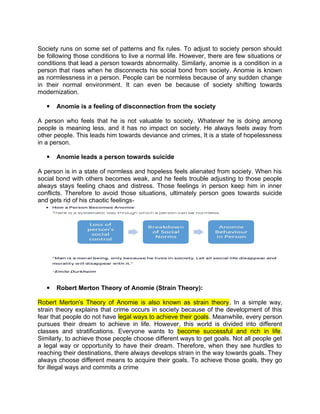
and gets rid of his chaotic feelings‫۔‬
 Robert Merton Theory of Anomie (Strain Theory):
Robert Merton's Theory of Anomie is also known as strain theory. In a simple way,
strain theory explains that crime occurs in society because of the development of this
fear that people do not have legal ways to achieve their goals. Meanwhile, every person
pursues their dream to achieve in life. However, this world is divided into different
classes and stratifications. Everyone wants to become successful and rich in life.
Similarly, to achieve those people choose different ways to get goals. Not all people get
a legal way or opportunity to have their dream. Therefore, when they see hurdles to
reaching their destinations, there always develops strain in the way towards goals. They
always choose different means to acquire their goals. To achieve those goals, they go
for illegal ways and commits a crime
 Conformity:
People in this phase, according to Merton, most of the time people accept legal ways to
achieve their goals. For example, if someone wants to earn money in his life, he will go
towards education and will have a good job or business to make money. He won't use
any illegal way to earn.
 Innovation:
In this phase person, according to Merton, has a socially accepted goal. However, to
achieve that goal, he will make a new way to achieve it. That way can be illegal, and it
can be a crime even. For example, to make money at this point person would not go for
a job or education. He will do robbery to make money.
 Ritualism:
According to Merton, in this phase person rejects social goals and accepts ways to
achieve those goals. For instance, a person can reject his goal to earn, but he will stick
to the legal means to acquire money to fulfil basic needs. From a broader perspective, if
a person has the instinct to earn, he will keep his traditional rules and dignity in his head
to make that money.
 Retreatism:
In this phase or it can be said that people reject social goals and also rejects ways to
fulfil those goals. Similarly, they are people with low social bonds. They have nothing
with the values and norms of society, Normally, they create their own virtual world, and
they live in those scenarios People on drugs or with other mental disorders fall in this
category.
 Rebellion:
They are people who reject their social goals and their ways of achieving those goals.
They are those innovative people who bring their own new ways to society. They create
their own goals and ways to acquire those goals. Meanwhile, pressure groups against
the government fall into this category. They come up against the ruling government and
make new rules and regulations.
How Robert Merton Theory of Anomie can reduce normlessness:
Through understanding Strain Theory, there can be made few assumptions to reduce
normiessness in the person. The major reason behind the development of strain in a
person is because lack of resources to achieve his desires. Similarly, due to the weak
connections between people and society. Those people who stay away from other or
show antisocial behaviour most of the time leads to normiessness. To keep people
intact and normal. There should be a fair mechanism for them to acquire their goals.
There should not be any nepotism or culture of corruption, So, people never go towards
deviant behaviour People should be intact and close to other people in society. Their
strong social bond can help them to stay normal and progressive
"People From lower social classes tend to resort such means because they have
fewer opportunities than higher classes to achieve cultural goals.
-Merton
Criticism on Robert Merton's Theory:
Strains theory lacks in explaining a few concepts in their true sense. According to
Merton, most of the time, crime occurs in society because of strain development. It can
be developed through any failure and rejection. It is easy to understand that normal
people from lower classes lack in having all opportunities to acquire goals. They stay
deprived and try other means to achieve their goals Meanwhile, the theory lacks to
explain that people from the upper classes also commit crimes. However, they have all
the ways and sources to achieve their goals. Similarly, there are few crimes that happen
without the development of strains. People commit murders and commit crimes in anger
that comes from sugden reactions: Therefore, strains theory lacks to describe all these
practical scenarios.
"Strain theory best applies only to the lower class as they struggle with limited
resources to obtain their goals,
-Core Theory
Conclusion:
In a nutshell, anomie is being normless. In practical scenarios. Every society has
particular sets of rules and regulations to follow. There are few fixed norms and values
that keep society as a standard of living. Because of any circumstances when people
become less connected to society. Their social bond becomes weak. They lose their
connection. They become normless and deviate from their main course of living. Most of
the time, these people choose their way towards crime. Similarly, Robert Merton's
theory of anomie tells about the reason and how people go towards crimes. According
to him, in every society, there are certain socially accepted goals and ways to achieve
those goals. When people lack to achieve those goals, they seek illegal ways to acquire
those positions. Though. those ways are way towards their criminal behaviours
However, the strong, social construction of a person with society and increasing his
social bond can overcome anomie behaviour. Similarly, the limitation, in theory, is that it
can only be applied to the lower class because they lack in resources to achieve their
goals.
"They always go to achieve only what seems realistically possible for them to
achieve."
-Emile Durkheim
Question No. 08: LOMBROSIAN THEORY OF DEVIANCE
* Cesare Lambroso was the first criminologist who made an attempt to understand the
personality of offenders in physical terms. Lombroso employed scientific methods in
explaining criminal behaviour and shifted the emphasis from crime to criminal.
Lombroso developed the 'Theory of Deviance' and according to this theory, a person's
bodily constitution indicates whether or not an individual is a born criminal or not.
In developing this theory, Lambroso observed the physical characteristics of Italian
prisoners and compared them to those of Italian soldiers. Lombroso also maintained
that criminals had less sensitivity to pain and touch; more acute sight; a lack of moral
sense, including an absence of remorse; more vanity, impulsiveness, vindictiveness,
and cruelty and also other manifestations.
Theory of Atavism
The word 'Atavistic' comes from the Latin word "avatus", which means 'ancestor' in
Latin.
In his view, criminals reflect a reversion to an early and more primitive being that was
both mentally and physically inferior. Lombroso's theory used physical characteristics as
indicators of criminality and suggest that criminals are distinguished from non-criminals
by multiple physical anomalies. Lombroso moderated his theory of physical anomaly in
later years but his emphasis throughout his work was on human physical traits which
also included biology, psychology and environment.
'The Criminal Man',
In 'The Criminal Man', first published in 1876, he suggested that there was distinct
biological class of people that were prone to criminality. The 'atavistic' characteristics,
he argued, denoted the fact that the offenders were at a more primitive stage of
evolution than non-offenders and they were called "genetic throwbacks" This implies
that criminality is inherited and that it can be identified by physical defects. The theory
was that criminals were physically different from normal persons and possessed a few
physical characteristics of inferior animal world. This made them, according to
Lombroso, wilder, untamed and unable to fit in the 1870's society and therefore they
would inevitably turn to crime.
Revision of Atavism:
The Theory of Atavism was revised in 1906 and held that only one-third of criminals
were born criminals and not all the criminals. Finally, he conceded that his theory of
atavism was ill-founded and held that there were in fact occasional criminals
Insane Criminals:
The second category of criminals according to Lombroso consisted of insane criminals
who resorted to criminality on account of certain mental depravity or disorder.
Criminoids:
The third category of criminals was those of criminoids who were physical criminal type
and had a tendency to commit crime in order to overcome their inferiority in order to
meet the needs of survival. Besides describing the term "born criminal," Lombroso also
described "criminaloids", or occasional criminals, criminals by passion, moral imbeciles,
and criminal epileptics.
LOMBROSIAN VIEW REGARDING FEMALE
CRIMINALITY
Lombroso used his theory of atavism to explain women's criminal offending. Lombroso
viewed female criminals as having an excess of male characteristics. He argued that,
biologically, criminal females more closely resembled males than females. According to
this theory, Lombroso outlines a comparative analysis of "normal women" as opposed
to "criminal women" such as "the prostitute." However, Lombroso's "obdurate beliefs"
about women presented an "intractable problem" for this theory: "Because he was
convinced that women are inferior to men Lombroso was unable to argue, based on his
theory of the born criminal, that women's lesser involvement in crime reflected their
comparatively lower levels of atavism."
LOMBROSO AND DARWIN'S THEORY OF EVOLUTION
Lombroso was heavily influenced by a misunderstood Darwin: criminals were
"throwbacks" in the phylogenetic tree to early phases of evolution. If a criminal man is
an ancestral form of human being, obviously his anthropological features and
physiological reactions would be different from those of the "normal nineteenth century
man". For this reason Lombroso quickly applied anthropometry to the criminal man and
woman. Lombroso argued that criminals were not to blame for their criminal activities as
their behaviour was determined by their physiology. From this anatomical observation,
Lombroso also quickly extended the theory of deviance as a form of evolutionary
blockage to insanity. Lombroso considered insanity a milder form of regression in the
evolutionary tree, less dramatic than criminality, and genius a sort of mental mosaic in
which the evolution of positive qualities was mixed with degeneration of some somatic
organs
CHARACTERISTICS OF CRIMINALS
Cesare Lombroso concluded that the criminals were physically different. The physical
characteristics that he used to identify criminals included:
i. An asymmetry of the face or head.
ii. Large monkey-like ears.
iii. Large lips.
iv. Long arms
v. A twisted nose.
vi. Excessive cheekbones.
vii. Excessive wrinkles on the skin.
viii. Large jaw.
ix. Large chin.
Lombroso declared that Males with five or more of these characteristics could be
marked as born criminals. Females, on the other hand, only needed as few as three
of these characteristics to be born criminals.
CRITICAL VIEW REGARDING LOMBROSIAN THEORY
ENRICO FERRI
Enrico Ferri challenged Lombroso's theory of atavism and demonstrated that it was
erroneous to think that criminals were incorrigible. He believed that just as non-criminals
could commit crimes if placed in conducive circumstances as also the criminals could
refrain from criminality in healthy and crime-free surroundings. According to him, crime
is the synthetic product of three main factors:
i. Physical or geographical
ii. Anthropological; and
iii. Psychological or social.
Ferri emphasized that criminal behaviour is an outcome of a variety of factors having
their combined effect on the individual. According to him social change, which is
inevitable in a dynamic society, results in disharmony, conflict and cultural variations.
As a result of this, social disorganization takes place and a traditional pattern of social
control mechanism totally breaks down. In the wake of such rapid social changes, the
incidence of crime is bound to increase tremendously. The heterogeneity of social
conditions destroys the congenial social relationship, creating a social vacuum which
proves to be a fertile ground for criminality
GABRIEL DE TARDE
Gabriel de Tarde, the eminent French criminologist and social psychologist, criticized
Lombroso's theory of criminal behaviour, and offered a social explanation of crime.
Tarde asserted that criminal behaviour is the result of a learning process, therefore, any
speculation regarding direct relationship between physical appearance and criminal
propensities of criminals would mean overlooking the real cause of criminality. Tarde
further denounced the proposition of phrenologists who tried to establish a correlation
between the skull, the brain and the social behaviour of a person
RELEVANCE OF LOMBROSIAN THEORY IN PRESENT CONTEXT
The greatest contribution is the development of criminal science, which lies in the fact
that the attention of criminologists was drawn for the first time towards the individual,
that is, the personality of criminal rather than his act (crime) or punishment. This paved
the way for the modern penologists to formulate a criminal policy embodying the
principle of individualization as a method and reformation. Thus introduced the
methodology and logic of natural science in the field of criminology.
While analyzing causes of crime, Lombroso laid greater emphasis on the biological
nature of human behaviour and thus indirectly drew attention of criminologists to the
impact of environment on crime causation. The individualization of punishment, which
all humanitarian and scientific thinkers now agreed upon, is something which
Lombroso's work, more perhaps than that of any other man, has helped to bring about
and amounts to one of the greatest contribution to criminology. The emphasis was
shifted from penology to criminology and the objects of punishment were radically
changed in as much as retributory methods were abandoned. Criminals were now to be
treated rather than punished. Protection of society from criminals was to be the primary
object which could be achieved by utilizing reformatory methods for different classes of
criminals in varying degrees. It is in this context that Lombrosian theory is said to have
given birth to modern sociological or clinical school which regards criminal as a by-
product of his conditions and experience of life.
QUESTION NO. 09: SHELDON’S CONSTITUTIONAL THEORY: SOMATOTYPING
Somatotype is a discredited theory of personality that associates different body
compositions with various personality traits and behavioral characteristics. A
somatotype refers to the bodybuilder or physique of a person. There have been theories
surrounding body composition and personality since antiquity. However, William Herbert
Sheldon originated the Somatotype in the 1940s.
According to Sheldon, there are three somatotypes: slim ectomorphs, muscular
mesomorphs, and smooth endomorphs. Endomorphs, in his view, are relaxed and
sociable, mesomorphs active and assertive, and ectomorphs quiet and restrained.
Three somatotypes are ideal types: most people have a mixture of multiple
somatotypes.
Sheldon was heavily influenced by Ernst Kretschmer’s constitutional psychology. Ernst
Kretschmer, using a similar classification of body types, attempted to find correlations
between body type and psychiatric syndromes. Sheldon, in contrast, focused more on
personality. Somatotype studies from Sheldon to the present suffer from substantial
flaws such as confounding results, small sample sizes, and inconsistent findings.
Nonetheless, somatotype spread through the 1950s and was used in earnest attempts
to characterize personality as late as the 1980s.
Despite the discredited nature of somatotype, people unaware of the theory are still
influenced in their assessments of personality by body type. This can compromise
scientific data in cases where participants are rating the personalities of people with
different body types. A somatotype, also known as a constitutional type, refers to
the body build or physique of a person, particularly as it relates to their
temperament or behavioral characteristics.
Numerous theorizers since antiquity have proposed various categories of somatotypes.
The term somatotype is used in the system of classification of human physical types
developed by the American psychologist William Herbert Sheldon.
Early Somatotypology
Attempts to correlate body composition with certain personality traits have a legacy
dating to antiquity in many parts of the world. One early example of early somatic
typology is Hippocrates’ theory of the four humors. According to Hippocrates, choleric
temperaments were associated with yellow bile from the liver, melancholic temperament
with black bile from the kidneys, sanguine temperament with red blood from the heart,
and phlegmatic temperament with white phlegm from the lungs (Clark and Watson,
2008).
There are also traditional Eastern ways of classifying people for the purpose of medical
and psychological treatments. For example, the Indian physician R. D. Lele found a
correlation of somatotypes with Prakriti, which is a system of classifying personality.
W. H. Sheldon’s Three Somatotypes
In the 1940s, American psychologist William Herbert Sheldon developed a theory that
associated body types with human temperament types. Sheldon proposed that the
human physique could be classified according to how much they are composed of three
elements.
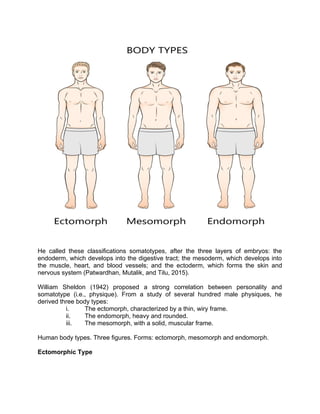
He called these classifications somatotypes, after the three layers of embryos: the
endoderm, which develops into the digestive tract; the mesoderm, which develops into
the muscle, heart, and blood vessels; and the ectoderm, which forms the skin and
nervous system (Patwardhan, Mutalik, and Tilu, 2015).
William Sheldon (1942) proposed a strong correlation between personality and
somatotype (i.e., physique). From a study of several hundred male physiques, he
derived three body types:
i. The ectomorph, characterized by a thin, wiry frame.
ii. The endomorph, heavy and rounded.
iii. The mesomorph, with a solid, muscular frame.
Human body types. Three figures. Forms: ectomorph, mesomorph and endomorph.
Ectomorphic Type
The ectomorph body type is characterized by long, thin muscles and limbs and low-fat
storage. In everyday terms, ectomorphs are slim. Ectomorphs are not predisposed to
store fat or build muscle (Patwardhan, Mutalik, and Tilu, 2015).
Mesomorphic Type
The mesomorph body type is predisposed to build muscle but not store fat. They tend to
be strong and solid, neither overweight nor underweight. Their bodies may be described
as rectangular in shape with an upright posture. Mesomorphs are typically thought of as
having an even weight distribution, muscular arms, legs, chest and shoulders, and a
large heart (Patwardhan, Mutalik, and Tilu, 2015).
Endomorphic Type
Endomorphs are characterized by increased fat storage, a wide waist, and a large bone
structure. Endomorphs, in everyday language, are fat. They have a smooth, round
body, small shoulders, and shorter limbs. They tend to carry weight in the lower
abdomen, hips, and thighs rather than evenly distributed throughout the body
(Patwardhan, Mutalik, and Tilu, 2015).
These body types could be modulated by body composition. Certain diets, exercises,
and training techniques can change body composition. For example, during starvation,
an endomorph may resemble an ectomorph, while an athletic mesomorph may look like
an endomorph as the result of muscle. Aging can also increase the amount of fat tissue
and its distribution, seemingly altering body type. However, there are certain
characteristics of the somatotype that cannot be changed. For instance, bone structure
— save for a few changes due to the reduction of distance between joints due to aging
or physical deformities — is a fixed characteristic. Sheldon noted that the vast majority
of criminal were mesomorphs. One explanation for this is that a solid muscular person
becomes involved in crime at an early age due to their intimidating appearance.
Cultural conditions can also play a role in changing temperaments in all body types
(Patwardhan, Mutalik, and Tilu, 2015).
The anthropologists Heath and Carter (1967) modified Sheldon’s original somatotyping
method in order to make it reproducible and validatable.
Personality Characteristics of the Somatotypes
Sheldon (1954), in Atlas of Men, ascribed distinct sets of personality traits to each
somatotype. He set these traits in three different dimensions.
i. Ectomorphs are quiet, restrained, noon-assertive, sensitive,
introverted, artistic, and self-conscious.
ii. Endomorphs (also known as viscerotonic) were seen as relaxed,
sociable, tolerant, comfort-loving, peaceful, good-humored, and in
need of affection.
iii. Mesomorphs are active, assertive, vigorous, adventurous, dominant,
and competitive.
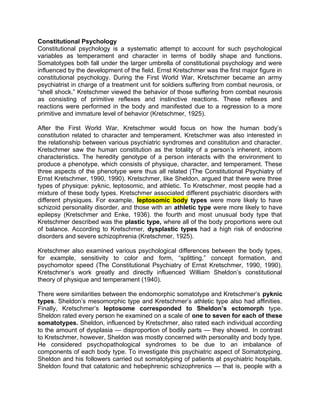
Constitutional Psychology
Constitutional psychology is a systematic attempt to account for such psychological
variables as temperament and character in terms of bodily shape and functions.
Somatotypes both fall under the larger umbrella of constitutional psychology and were
influenced by the development of the field. Ernst Kretschmer was the first major figure in
constitutional psychology. During the First World War, Kretschmer became an army
psychiatrist in charge of a treatment unit for soldiers suffering from combat neurosis, or
“shell shock.” Kretschmer viewed the behavior of those suffering from combat neurosis
as consisting of primitive reflexes and instinctive reactions. These reflexes and
reactions were performed in the body and manifested due to a regression to a more
primitive and immature level of behavior (Kretschmer, 1925).
After the First World War, Kretschmer would focus on how the human body’s
constitution related to character and temperament. Kretschmer was also interested in
the relationship between various psychiatric syndromes and constitution and character.
Kretschmer saw the human constitution as the totality of a person’s inherent, inborn
characteristics. The heredity genotype of a person interacts with the environment to
produce a phenotype, which consists of physique, character, and temperament. These
three aspects of the phenotype were thus all related (The Constitutional Psychiatry of
Ernst Kretschmer, 1990, 1990). Kretschmer, like Sheldon, argued that there were three
types of physique: pyknic, leptosomic, and athletic. To Kretschmer, most people had a
mixture of these body types. Kretschmer associated different psychiatric disorders with
different physiques. For example, leptosomic body types were more likely to have
schizoid personality disorder, and those with an athletic type were more likely to have
epilepsy (Kretschmer and Enke, 1936). the fourth and most unusual body type that
Kretschmer described was the plastic type, where all of the body proportions were out
of balance. According to Kretschmer, dysplastic types had a high risk of endocrine
disorders and severe schizophrenia (Kretschmer, 1925).
Kretschmer also examined various psychological differences between the body types,
for example, sensitivity to color and form, “splitting,” concept formation, and
psychomotor speed (The Constitutional Psychiatry of Ernst Kretschmer, 1990, 1990).
Kretschmer’s work greatly and directly influenced William Sheldon’s constitutional
theory of physique and temperament (1940).
There were similarities between the endomorphic somatotype and Kretschmer’s pyknic
types. Sheldon’s mesomorphic type and Kretschmer’s athletic type also had affinities.
Finally, Kretschmer’s leptosome corresponded to Sheldon’s ectomorph type.
Sheldon rated every person he examined on a scale of one to seven for each of these
somatotypes. Sheldon, influenced by Kretschmer, also rated each individual according
to the amount of dysplasia — disproportion of bodily parts — they showed. In contrast
to Kretschmer, however, Sheldon was mostly concerned with personality and body type.
He considered psychopathological syndromes to be due to an imbalance of
components of each body type. To investigate this psychiatric aspect of Somatotyping,
Sheldon and his followers carried out somatotyping of patients at psychiatric hospitals.
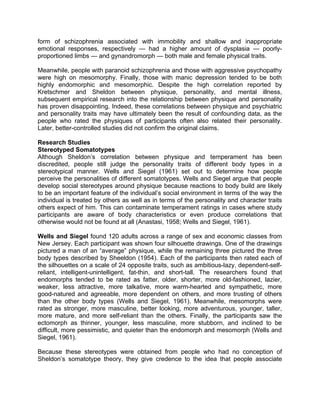
Sheldon found that catatonic and hebephrenic schizophrenics — that is, people with a
form of schizophrenia associated with immobility and shallow and inappropriate
emotional responses, respectively — had a higher amount of dysplasia — poorly-
proportioned limbs — and gynandromorph — both male and female physical traits.
Meanwhile, people with paranoid schizophrenia and those with aggressive psychopathy
were high on mesomorphy. Finally, those with manic depression tended to be both
highly endomorphic and mesomorphic. Despite the high correlation reported by
Kretschmer and Sheldon between physique, personality, and mental illness,
subsequent empirical research into the relationship between physique and personality
has proven disappointing. Indeed, these correlations between physique and psychiatric
and personality traits may have ultimately been the result of confounding data, as the
people who rated the physiques of participants often also related their personality.
Later, better-controlled studies did not confirm the original claims.
Research Studies
Stereotyped Somatotypes
Although Sheldon’s correlation between physique and temperament has been
discredited, people still judge the personality traits of different body types in a
stereotypical manner. Wells and Siegel (1961) set out to determine how people
perceive the personalities of different somatotypes. Wells and Siegel argue that people
develop social stereotypes around physique because reactions to body build are likely
to be an important feature of the individual’s social environment in terms of the way the
individual is treated by others as well as in terms of the personality and character traits
others expect of him. This can contaminate temperament ratings in cases where study
participants are aware of body characteristics or even produce correlations that
otherwise would not be found at all (Anastasi, 1958; Wells and Siegel, 1961).
Wells and Siegel found 120 adults across a range of sex and economic classes from
New Jersey. Each participant was shown four silhouette drawings. One of the drawings
pictured a man of an “average” physique, while the remaining three pictured the three
body types described by Sheeldon (1954). Each of the participants then rated each of
the silhouettes on a scale of 24 opposite traits, such as ambitious-lazy, dependent-self-
reliant, intelligent-unintelligent, fat-thin, and short-tall. The researchers found that
endomorphs tended to be rated as fatter, older, shorter, more old-fashioned, lazier,
weaker, less attractive, more talkative, more warm-hearted and sympathetic, more
good-natured and agreeable, more dependent on others, and more trusting of others
than the other body types (Wells and Siegel, 1961). Meanwhile, mesomorphs were
rated as stronger, more masculine, better looking, more adventurous, younger, taller,
more mature, and more self-reliant than the others. Finally, the participants saw the
ectomorph as thinner, younger, less masculine, more stubborn, and inclined to be
difficult, more pessimistic, and quieter than the endomorph and mesomorph (Wells and
Siegel, 1961).
Because these stereotypes were obtained from people who had no conception of
Sheldon’s somatotype theory, they give credence to the idea that people associate
different temperaments with different body builds, comprising an implicit personality
theory (Wells and Siegel, 1961).
Somatotype and Trainee Pilots
The 1950s saw a number of studies into how somatotype affects the personality traits of
different populations. These populations were as far-ranging as seven-year-old children
(Davidson et al., 1957), university women (Slaughter, 1968), and even top Croatian
female cadet handball players (Cavala et al., 2013). One typical study involved
characterizing the personality and somatotype of male trainee pilots (Adams, 1985). In
this study, Adams (1985) attempted to use the Heath-Carter (1967) somatotype method
on 21 aviation majors between 18 and 38 years of age who had earned their private
pilot’s licenses.
The researcher distributed the Sixteen Personality Factor Questionnaire
during a lecture, and eighteen of the participants were stereotyped using the Heath-
Carter technique. Like other studies into somatotyping, this study suffered from severe
methodological flaws. The non-participation of half of an already small sample size likely
biased results. Additionally, the ages were heavily weighted — there were 16
participants aged 20 and just one over 24. The researchers found that the somatotypes
of the trainee pilots were comparable to the average somatotype of college men
(Sheldon, Stevens, and Tucker, 1940); however, the participants were significantly less
ectomorph than those in the general college-aged population.
Adams (1985) also found correlations between individual personality traits and
somatotype components. Two of the correlations Adams found to be of interest were
the so-called “Factor L” — a measure of surgency, mistrust, and doubt — and
endomorphy.
More endomorphic pilots had higher levels of mistrust and doubt, and ectomorphic pilots
had lower levels of mistrust and doubt. Indeed, those with higher degrees of ectomorph
tended to be more trusting, adaptable, and likable. Meanwhile, mesomorphs tended to
be more outgoing, warmhearted, easing-going, and participants in group situations.
Question No. 10:
(A)Left realism vs right realism
Aspect Left Realism Right Realism
Roots of Crime
Crime as a product of social
inequality
Crime as a result of individual choices
Example
Poverty leading to higher
crime rates
Blaming poor discipline for burglaries
Solutions in
Focus
Rehabilitation and addressing
root causes
Punishment and deterrence
Example
Community programs for job
training
Harsher penalties for repeat offenders
Crime Victims
Empowering marginalized
victims
Protecting law-abiding citizens
Example
Support services for low-
income crime victims
Increased police presence in high-crime areas
Role of Society
Collective responsibility for
crime
Individual accountability for actions
Example
Social justice movements
addressing inequality
Education on consequences of crime
Perceptions of
Crime
Contextual understanding of
crime rates
Immediate impacts often sensationalized
Example
Researching unemployment’s
impact on youth crime
Highlighting violent crime stories for tougher
laws
(B) PHRENOLOGY AND PHYSIOGNOMY:
Aspect Phrenology Physiognomy
Definition
Study of skull shape to determine
character traits
Study of facial features to infer
personality
Key Focus Bumps and contours of the skull Features and expressions of the face
Origin
Developed in the early 19th century by
Franz Joseph Gall
Dates back to ancient Greece,
popularized in the 19th century
Scientific Basis
Lacks empirical support; considered
pseudoscience
Also lacks scientific validity; often
based on stereotypes
Applications
Used for assessing intelligence and
personality
Used for character judgment and social
interactions
Criticism
Criticized for oversimplification and
determinism
Criticized for ethical implications and
biases
Historical
Impact
Influenced early psychology and
criminal profiling
Influenced literature, art, and social
perceptions
Modern
Relevance
Generally dismissed in contemporary
science
Still exists in popular culture but is
controversial
Example
Claiming that a prominent forehead
indicates intelligence
Judging someone's character based on
a stern expression
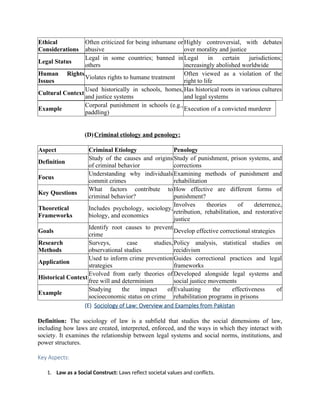
(C)CORPORAL PUNISHMENT AND CAPITAL PUNISHMENT
Aspect Corporal Punishment Capital Punishment
Definition
Physical punishment inflicted on a
person
The legally sanctioned execution of an
individual
Forms
Includes whipping, caning, or other
physical harm
Methods include lethal injection,
electrocution, firing squad, etc.
Purpose
Deterrence, discipline, or retribution
for minor offenses
Deterrence for serious crimes,
retribution for severe offenses
Scope
Typically used for minor crimes or
misconduct
Applied to serious crimes such as
murder or treason
Ethical
Considerations
Often criticized for being inhumane or
abusive
Highly controversial, with debates
over morality and justice
Legal Status
Legal in some countries; banned in
others
Legal in certain jurisdictions;
increasingly abolished worldwide
Human Rights
Issues
Violates rights to humane treatment
Often viewed as a violation of the
right to life
Cultural Context
Used historically in schools, homes,
and justice systems
Has historical roots in various cultures
and legal systems
Example
Corporal punishment in schools (e.g.,
paddling)
Execution of a convicted murderer
(D)Criminal etiology and penology:
Aspect Criminal Etiology Penology
Definition
Study of the causes and origins
of criminal behavior
Study of punishment, prison systems, and
corrections
Focus
Understanding why individuals
commit crimes
Examining methods of punishment and
rehabilitation
Key Questions
What factors contribute to
criminal behavior?
How effective are different forms of
punishment?
Theoretical
Frameworks
Includes psychology, sociology,
biology, and economics
Involves theories of deterrence,
retribution, rehabilitation, and restorative
justice
Goals
Identify root causes to prevent
crime
Develop effective correctional strategies
Research
Methods
Surveys, case studies,
observational studies
Policy analysis, statistical studies on
recidivism
Application
Used to inform crime prevention
strategies
Guides correctional practices and legal
frameworks
Historical Context
Evolved from early theories of
free will and determinism
Developed alongside legal systems and
social justice movements
Example
Studying the impact of
socioeconomic status on crime
Evaluating the effectiveness of
rehabilitation programs in prisons
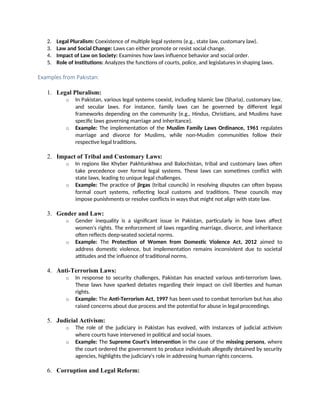
(E) Sociology of Law: Overview and Examples from Pakistan
Definition: The sociology of law is a subfield that studies the social dimensions of law,
including how laws are created, interpreted, enforced, and the ways in which they interact with
society. It examines the relationship between legal systems and social norms, institutions, and
power structures.
Key Aspects:
1. Law as a Social Construct: Laws reflect societal values and conflicts.
2. Legal Pluralism: Coexistence of multiple legal systems (e.g., state law, customary law).
3. Law and Social Change: Laws can either promote or resist social change.
4. Impact of Law on Society: Examines how laws influence behavior and social order.
5. Role of Institutions: Analyzes the functions of courts, police, and legislatures in shaping laws.
Examples from Pakistan:
1. Legal Pluralism:
o In Pakistan, various legal systems coexist, including Islamic law (Sharia), customary law,
and secular laws. For instance, family laws can be governed by different legal
frameworks depending on the community (e.g., Hindus, Christians, and Muslims have
specific laws governing marriage and inheritance).
o Example: The implementation of the Muslim Family Laws Ordinance, 1961 regulates
marriage and divorce for Muslims, while non-Muslim communities follow their
respective legal traditions.
2. Impact of Tribal and Customary Laws:
o In regions like Khyber Pakhtunkhwa and Balochistan, tribal and customary laws often
take precedence over formal legal systems. These laws can sometimes conflict with
state laws, leading to unique legal challenges.
o Example: The practice of jirgas (tribal councils) in resolving disputes can often bypass
formal court systems, reflecting local customs and traditions. These councils may
impose punishments or resolve conflicts in ways that might not align with state law.
3. Gender and Law:
o Gender inequality is a significant issue in Pakistan, particularly in how laws affect
women's rights. The enforcement of laws regarding marriage, divorce, and inheritance
often reflects deep-seated societal norms.
o Example: The Protection of Women from Domestic Violence Act, 2012 aimed to
address domestic violence, but implementation remains inconsistent due to societal
attitudes and the influence of traditional norms.
4. Anti-Terrorism Laws:
o In response to security challenges, Pakistan has enacted various anti-terrorism laws.
These laws have sparked debates regarding their impact on civil liberties and human
rights.
o Example: The Anti-Terrorism Act, 1997 has been used to combat terrorism but has also
raised concerns about due process and the potential for abuse in legal proceedings.
5. Judicial Activism:
o The role of the judiciary in Pakistan has evolved, with instances of judicial activism
where courts have intervened in political and social issues.
o Example: The Supreme Court's intervention in the case of the missing persons, where
the court ordered the government to produce individuals allegedly detained by security
agencies, highlights the judiciary's role in addressing human rights concerns.
6. Corruption and Legal Reform:
o Corruption within the legal and judicial systems is a significant concern in Pakistan.
Efforts to reform these systems often face resistance due to entrenched interests.
o Example: The establishment of the National Accountability Bureau (NAB) aims to
combat corruption, yet its effectiveness is often questioned due to allegations of
political manipulation and selective accountability.
Conclusion:
The sociology of law in Pakistan illustrates the complex interplay between legal systems and
societal dynamics. By examining the social context of laws, scholars and policymakers can better
understand the challenges and opportunities for legal reform and social justice in the country.
Through real-world examples, it becomes clear how laws both shape and are shaped by the social
fabric of Pakistani society.
Question No. 11;
NATURE VS NURTURE DEBATE IN CRIMNOLOGY :
1- Introduction
The terms masculinity and femininity refer to traits or characteristics typically associated
with being male or female, respectively. These terms are directly related to traditional
gender roles. Gender roles are social expectations for how men and women should
behave. Generally, most communities agree that the traditional gender roles definition
states that women are more nurturing and men are more dominant.
2- Definitions of masculinity and femininity
3- Different meanings of masculinity and femininity in society
 ✓Blunt versus shy
 ✓Rational versus irrational
 ✓Assertive versus emotional
 ✓Independent versus dependent
 ✓Dominant versus oppressive
4- What are different gender roles?
5- Nature versus Nurture Debate
6- Social construction of traditional gender roles
 ✓Structural Functionalism
 ✓Conflict Theory
 ✓Feminist Theory
 ✓Gender Performative Theory
 ✓Social Learning Theory
7- Conclusion
Introduction:
Femininity and masculinity are acquired social identities. As individuals become
socialized, they develop a gender identity. An understanding of what it means to be a
“man” or a “woman” gender identity is often naturalized. It relies on a notion of biological
difference, so natural femininity encompasses, for example, motherhood, being
nurturing, a desire for pretty clothes and the exhibition of emotions. “Natural”
masculinity, in contrast, encompasses fatherhood, acting “tough” a desire for sports and
competition, and hiding emotions. The nature vs nurture debate centres on the
contributions of genetics and environmental factors to human development. Some
philosophers, such as Plato and Descartes, suggested that certain factors are inborn or
occur naturally regardless of environmental influences. Other well-known thinkers, such
as John Locke, believed in what is known as a tabula rasa, which suggests that the
mind begins as a blank slate. According to this notion, everything is determined by our
experiences. The different social theorist has substantiated their nurture debate through
multiple theoretical perspectives. For instance, gender performative theory suggested
that gender roles are not fixed and are determined by repeated practices of those roles
performed by different genders.
Definition of masculinity and femininity
 Masculinity:
“Masculinity is defined as possession of attributes or features associated with men.”
This is a traditional perception of masculinity. There are many socially created
definitions of masculinity for being a man and these can change over time and from one
location to another. Masculinity is usually associated with:
1-Blunt
2-Rational
3-Assertive
4-Independents
5- Dominant
 Femininity:
“Femininity is a set of attributes, behaviors, and roles generally associated with women
and girls.”
Femininity is a force of energy that encompasses life with love, compassion, and the
inherent desire to nurture and protect what is precious, holy, and beautiful. Femininity is
associated with:
1-Shy
2-Irrational
3-Emotional
4-Dependent
5- Oppressive
What are different gender roles?
“Gender roles are stereotypes regarding attitudes, attributes, and actions imposed on
men and women based on gender. “
What Are Some Modern Examples of Gender Roles in Society?
Gender roles vary greatly depending on where you live, as stereotypes differ among
countries and cultures. These are some of the most common gender stereotypes.
1. Women in the kitchen
One of the most common and hurtful stereotypes is that women should be the ones
taking care of the cooking. For example, while men are expected to leave the house to
work a job, women are expected to welcome them back with prepared meals.
 Domestic chores
In the same vein, some societies also expect women to take care of most of the chores
related to the household. Because they should be the ones staying at home, things like
cleaning, taking care of the kids, and similar tasks fall to them.
 Masculinity
The idea of masculinity is a stereotype imposed on men, as they are expected to be
strong, muscular, and tall. Personality-wise, this stereotype dictates that men should be
dominant and aggressive, never leaving room for more measured or sensible thoughts.
 Work and aspirations
Men are often expected to occupy hard and public jobs, while women are thought of as
being more suited for nurturing jobs. For example, one might think of men as pilots or
doctors, while women may be expected to be nurses or teachers.
Nature versus Nurture debate
To better understand the nature vs. nurture argument, it is imperative to know what
each of these terms means.
Nature refers largely to our genetics. It includes the genes we are born with and other
hereditary factors that can impact how our personality is formed and influence the way
that we develop from childhood through adulthood.
1. Genetic factor
Biological sex is often confused with gender in our society. The two sexes are
differentiated as females, who have ovaries and produce eggs, and males, who have
testes and produce sperm. In mammals, females typically have XX chromosomes, and
males typically have XY chromosomes.
 Hormonal differences
Researchers have long known that the sex hormones, such as estrogen and
testosterone, drive certain differences in behavior between men and women. For
example, estrogen prompts maternal behavior, while testosterone drives aggressive,
territorial behavior in males.
 Brain differences between men and women:
On average, male brains are about 10% larger than female brains.
Nurture encompasses the environmental factors that impact who we are. This includes
our early childhood experiences, the way we were raised, our social relationships, and
the surrounding culture.
The social construction of traditional gender roles
“The meaning of the word ‘gender’ has evolved and differentiated from the word ‘sex’ to
express the reality that women’s and men’s roles and status are socially constructed
and subject to change.”
(Judith butler)
 Structural Functionalism
The functionalist perspective sees society as a complex system. This approach looks at
society through a macro-level orientation, which is a broad focus on the social
structures that shape society as a whole and looks at both social structure and social
functions. The functionalist perspective of gender inequality was most robustly
articulated in the 1940s and 1950s, and largely developed by Talcott Parsons’ model of
the nuclear family (husband, wife and their children). A structural functionalist view of
gender inequality applies the division of labor to view predefined gender roles: women
take care of the home while men provide for the family.
 Conflict Theory
According to conflict theory, society is defined by a struggle for dominance among
social groups that compete for scarce resources. In the context of gender, conflict
theory argues that gender is best understood as men attempting to maintain power and
privilege to the detriment of women. Therefore, men can be seen as the dominant group
ad women as the subordinate group. While certain gender roles may have been
appropriate in a hunter-gatherer society, conflict theorists argue that the only reason
these roles persist is that the dominant group naturally works to maintain their power
and status. According to conflict theory, social problems are created when dominant
groups exploit or oppress subordinate groups. The conflict between the two groups
caused things like the Women’s Suffrage Movement and was responsible for social
change.
 Feminist Theory
Feminist theory is the extension of feminism into theoretical or philosophical discourse.
It aims to understand the nature of gender inequality, and examines women’s social
roles, experiences, and interests. While generally providing a critique of social relations,
much of feminist theory also focuses on analyzing gender inequality and the promotion
of women’s interests. Radical feminism, in particular, evaluates the role of the patriarchy
in perpetuating male dominance. In patriarchal societies, the male’s perspective and
contributions are considered more valuable, resulting in the silencing and
marginalization of the woman. Feminism focuses on the theory of patriarchy as a
system of power that organizes society into a complex of relationships based on the
assertion of male supremacy.
 Gender Performative theory
Influenced by Austin, philosopher, and gender theorist Judith Butler argued that gender
is socially constructed. Gender performativity is a term first used by the feminist
philosopher Judith Butler in her 1990 book Gender Trouble. She argues that being born
male or female does not determine behaviour. Instead, people learn to behave in
particular ways to fit into society. The idea of gender is an act, or performance.
 Social learning theory
Social learning theory (SLT) explains behaviour through observation and copying. A
child may exhibit gender-specific behaviours due to copying role models of the same
sex, such as their older siblings.
Bandura went on and described five processes that took part when gender was
developed through social learning:
1- Observation: For social learning to occur, the behaviour must be observed.
2- Attention: Then, the individual needs to pay attention to his/her role model’s
behavior.
3- Retention: Then, the individual would need to encode and retain the gender-
appropriate behavior.
4- Reproduction: The individual would need to replicate gender-appropriate behavior.
5- Motivation: Lastly, some kind of reinforcement would need to take place for the
individual to be motivated to continue the behavior.
Conclusion:
Masculinity is seen to be the trait that emphasizes ambition, acquisition of wealth, and
differentiated gender roles. While femininity is seen to be the trait that stresses caring
and nurturing behaviors, sexuality equality, environmental awareness, and more fluid
gender roles. Both of these are socially acquired phenomena. Men are considered more
assertive in nature while women are assumed to be fragile. Masculinity and femininity
carry different meanings in society. As a result, different gender roles are associated
with each gender. Contemporarily, there is debate in gender studies that whether these
roles are the result of nature or culture. According to many cultural theorists, gender
construction begins at an early age through a process called socialization. Gender roles
are the result of this socialization. For instance, a father who disallows his son from
coddling dolls or, worse, berates him for it, will push the son toward the internalization of
masculinity from a young age. At the same time, the encouragement of a girl for playing
mother and pushing her doll around in a stroller demonstrates how girls from a very
young age are pushed toward idealizing a domestic and feminized lifestyle. Hence
these traditional roles are the outcome of socialization.

Crimnologyafasfafafaf Notes Section 01.docx

  • 1.
    Question, No. 1: THE MAJOR SCHOOLS OF THOUGHT IN CRIMINOLOGY, ALONG WITH THEIR PROPONENTS, MAIN ASSUMPTIONS, AND CONCEPTS. 1. Supernatural Explanations Proponents:  Ancient civilizations (e.g., Mesopotamia, Egypt, Greece, Rome)  Religious leaders and shamans Main Assumptions and Concepts:  Demonic Possession: Many ancient cultures believed that individuals could be possessed by evil spirits or demons, leading to immoral or criminal behavior. This idea was prevalent in various cultures and often justified extreme measures, such as exorcisms.  Divine Punishment: Crimes were often seen as acts against the divine order. Societies believed that misdeeds could provoke the wrath of gods or spirits, resulting in punishment not only for the wrongdoer but also for the community.  Sacrificial Practices: To appease the gods or spirits believed to be angered by crimes, ancient societies sometimes practiced sacrifices, believing that such acts could restore balance and order. 2. Classical School Proponents:  Cesare Beccaria  Jeremy Bentham Main Assumptions and Concepts:  Rational Choice: Individuals are rational actors who weigh the costs and benefits of their actions. Crime occurs when the perceived benefits outweigh the potential punishment.  Free Will: People have the freedom to choose their behavior, including criminal acts.  Deterrence: Effective punishment can deter crime. Punishments should be proportional to the crime and applied swiftly to be effective.  Social Contract: Society exists based on an implicit agreement; laws are made to protect the rights of individuals. 3. Positivist School Proponents:
  • 2.
     Cesare Lombroso Enrico Ferri  Raffaele Garofalo Main Assumptions and Concepts:  Determinism: Criminal behavior is determined by factors beyond individual control, such as biological, psychological, and social influences.  Lombroso's Theory of Atavism: Some individuals are born criminals, exhibiting physical traits that distinguish them from non-criminals.  Social Environment: Emphasizes the role of the environment and social conditions in shaping behavior.  Scientific Method: Advocates for the use of empirical research and scientific methods to study crime. 4. Chicago School Proponents:  Robert E. Park  Ernest W. Burgess  Clifford Shaw and Henry D. McKay Main Assumptions and Concepts:  Social Ecology: Crime is a product of social structures and environmental factors, particularly in urban settings.  Zone of Transition: Areas of rapid social change experience higher crime rates due to social disorganization.  Cultural Transmission: Criminal behaviors and values are transmitted through social groups, particularly in disorganized communities. 5. Critical Criminology Proponents:  Richard Quinney  Jock Young  Howard Becker Main Assumptions and Concepts:  Power Dynamics: Crime is linked to social inequality and power relations. Those in power define laws that serve their interests.  Labeling Theory: Criminal behavior is influenced by societal labels and stigmatization; being labeled as a criminal can lead to a self-fulfilling prophecy.
  • 3.
     Marxist Perspective:Explores the connection between capitalism, class struggle, and crime, arguing that laws protect the interests of the ruling class. 6. Feminist Criminology Proponents:  Meda Chesney-Lind  Rita Simon  Carol Smart Main Assumptions and Concepts:  Gender and Crime: Examines how gender roles and societal expectations influence both criminal behavior and the justice system's response.  Victimization: Focuses on the victimization of women and how traditional criminological theories often overlook female perspectives.  Intersectionality: Considers how race, class, and gender intersect to influence experiences with crime and justice Question No. 02: Certainly! Understanding the differences in behavior between criminals and non-criminals involves examining various psychological, social, and environmental factors. Below is a comprehensive exploration of these differences: 1. Psychological Differences A. Personality Traits:  Impulsivity: Criminals may display higher levels of impulsivity, making decisions without considering the consequences.  Aggressiveness: Some studies suggest that individuals who engage in criminal behavior may have higher levels of aggression or hostility.  Lack of Empathy: Many criminals show a reduced ability to empathize with others, which can lead to a disregard for the harm their actions may cause. B. Cognitive Patterns:  Rationalization: Criminals often rationalize or justify their behavior to alleviate feelings of guilt or responsibility.  Perception of Risk: Criminals may underestimate the risks associated with their actions or believe they can evade consequences more easily than non-criminals.
  • 4.
    2. Social Factors A.Socialization and Environment:  Family Background: Criminal behavior is often linked to adverse childhood experiences, such as abuse or neglect. Non-criminals generally come from more stable backgrounds.  Peer Influence: Association with delinquent peers can lead to criminal behavior. Non-criminals typically have healthier social circles.  Community Context: High-crime neighborhoods may foster criminal behavior due to a lack of social cohesion, opportunities, and resources. B. Socioeconomic Status:  Poverty and Deprivation: Economic hardship can lead individuals to resort to crime out of necessity or as a means of survival, whereas non-criminals may have more stable economic conditions.  Access to Education and Resources: Higher levels of education and access to resources often correlate with lower crime rates, as individuals are more likely to pursue legitimate opportunities. 3. Behavioral Patterns A. Decision-Making:  Risk Assessment: Non-criminals generally engage in more thorough risk assessments before making decisions, weighing potential negative outcomes more carefully than criminals.  Long-Term vs. Short-Term Thinking: Criminals may prioritize immediate gratification or short-term gains, while non-criminals often consider long-term consequences. B. Coping Mechanisms:  Conflict Resolution: Non-criminals typically use constructive methods to resolve conflicts, such as negotiation or seeking help, whereas criminals may resort to aggression or illegal means.  Stress Management: Criminals may have maladaptive coping strategies, turning to crime as a means to cope with stress or trauma. 4. Emotional Responses A. Guilt and Remorse:
  • 5.
     Emotional Responses:Non-criminals often experience guilt and remorse (deep regret) for harmful actions, which can deter them from engaging in criminal behavior. Criminals may lack these feelings or compartmentalize them. B. Emotional Regulation:  Impulse Control: Non-criminals generally exhibit better emotional regulation and impulse control, allowing them to manage strong emotions without resorting to harmful actions. 5. Cultural and Normative Influences A. Norm Internalization:  Adherence to Social Norms: Non-criminals are more likely to internalize societal norms and laws, guiding their behavior to align with accepted standards. Criminals may either reject these norms or feel disconnected from them. B. Cultural Values:  Value Systems: Cultural influences can shape behaviors; communities that emphasize respect for the law and individual rights may produce fewer criminals compared to those that normalize or condone deviant behaviors. Conclusion The differences between criminal and non-criminal behavior can be attributed to a complex interplay of psychological, social, environmental, and cultural factors. While not all individuals with similar backgrounds engage in criminal behavior, certain risk factors and traits are more prevalent among those who do. Understanding these differences can help in developing targeted interventions and prevention strategies aimed at reducing criminal behavior and supporting at-risk populations. Question No. 03: Edwin Sutherland’s Differential Association Theory ,1939 The differential association explanation of offending suggests that through interaction with others, individuals learn the values, attitudes, techniques, and motivation for criminal behavior. We often hear the phrase “Got in with a bad crowd”; our friendship groups can profoundly affect criminality, especially during adolescence. Differential associations (number of contacts with criminals over non-criminals) may vary in frequency, duration, priority, and intensity. The process of learning criminal behavior by association with criminal and anti-criminal patterns involves all of the mechanisms that are involved in any other learning. (behaviorism: classical conditioning, operant conditioning, social learning theory).
  • 6.
    The principal partof the learning of criminal behavior occurs within intimate personal groups. The differential association is a theory proposed by Sutherland in 1939. It explains that people learn to become offenders from their environment. Through interactions with others, individuals learn the values, attitudes, methods and motives for criminal behavior. NINE PROPOSITIONS The first explicit statement of the theory of differential association appears in the 1939 edition of Principles of Criminology, and in the fourth edition of it, he presented his final theory. His theory has nine basic postulates. 1. Criminal behavior is learned. This means that criminal behavior is not inherited, as such; also, the person who is not already trained in crime does not invent criminal behavior. 2. Criminal behavior is learned in interaction with other persons in a process of communication. This communication is verbal in many cases but includes gestures. 3. The principal part of the learning of criminal behavior occurs within intimate personal groups. Negatively, this means that impersonal communication, such as movies or newspaper, play a relatively unimportant part in committing criminal behavior. 4. When criminal behavior is learned, the learning includes (a) techniques of committing the crime, which are sometimes very simple; (b) the specific direction of motives, drives, rationalizations, and attitudes. 5. The specific direction of the motives and drives is learned from definitions of the legal codes as favorable or unfavorable. This different context of the situation is usually found in the US, where cultural conflict in relation to the legal code exists. 6. A person becomes delinquent because of an excess of definitions favorable to violation of law over definitions unfavorable to violation of law. This is the principle of differential association. When people become criminals, they do so not only because of contact with criminal patterns but also because of isolation from anti-criminal patterns. Negatively, this means that associations that are neutral so far as crime is concerned have little or no effect on the genesis of criminal behavior. 7. Differential associations may vary in frequency, duration, priority, and intensity. Priority seems to be important principally through its selective influence, and intensity has to do with such things as the prestige of the source of a criminal or anticriminal pattern and with emotional reactions related to the association. These modalities would be rated in quantitative form and mathematical ratio, but the development of a formula in this sense has not been developed and would be very difficult. 8. The process of learning criminal behavior by association with criminal and anti-criminal patterns involve all of the mechanisms that are involved in any other learning. Negatively, this means that the learning of criminal behavior is not restricted to the process of imitation. A person who is
  • 7.
    seduced, for instance,learns criminal behavior by association, but this would not be ordinarily described as imitation. 9. While criminal behavior is an expression of general needs and values, it is not explained by those general needs and values since non-criminal behavior is an expression of the same needs and values. Thieves generally steal in order to secure money, but honest laborers work in order to money. The attempts to explain criminal behavior by general drives and values such as the money motive have been, and must completely be, futile since they explain lawful behavior as completely as they explain criminal behavior. THE CAMBRIDGE STUDY The differential association theory of offending is supported by the Cambridge Study in delinquency development by Farrington et al., 2006. This study followed 411 males who, at the beginning of the study, were all living in a working-class deprived inner- city area of South London. This was a prospective longitudinal study of the development of offending and antisocial behavior in 411 males. The study started when they were 8 in 1961. At the beginning of the study, they were all living in a working-class deprived inner-city area of South London. The researchers looked at official records of conviction and self-report of offending up to the age of 50. By the end of the study, 41% of the participants had at least one conviction (someone is guilty of a criminal offence.). The most significant childhood risk factors at age 8–10 for later offending were family criminality, daring or risk-taking, low school attainment, poverty and poor parenting. This theory predicts that offenders will come from families and groups who have pro- criminal norms and that the criminal activities in which they are involved are similar to the ones they have learned. This is shown to be the case by Osborne and West (1982) as they found that 40% of the sons of convicted criminals also had convictions by the age of 18, whereas only 13% of sons of non-criminal fathers had a conviction. This is also supported by the Cambridge Study in delinquency development. However, this pattern could also be explained by genetic factors. Furthermore, evidence suggests that criminality is concentrated in a small number of families. For example, Walmsley et al. (1992) found that 1/3 of the prison population in the UK also had relatives in prison too. This, again, could be interpreted as support for the influence of genetic factors. EXAMPLES White-collar Crimes White-collar crimes generally require immense technical acumen, such as refined accounting skills which can be generally learned only in close contact with educated people in power (Sutherland, 1950). Thus, even when the larger culture of a corporation upholds ethical norms such as honesty and transparency, close association with a select group of people possessing questionable morals can gradually transform an individual.
  • 8.
    Seeing one’s closeassociates pilfering office supplies and appropriating company funds can lead one to justify to oneself such transgressions. Subsequently, the same individual may learn how to purloin without detection and may personally engage in white collar crimes. Organized Crime People tend to join the mafia, often growing up inside its culture. Having family members already involved in its structure functions as a potent invitation to potential members. What bears noting, however, is that despite the influence of the surrounding culture, not all members of mafia families necessarily join the organized crime network. In fact, even during the peak of the American Mafia during the 1960/70s, the NYPD comprised many Italian-Americans, some of whose close family members were part of the Mafia. The differential association theory would explain this situation by stating that individuals who have closer and more associations with criminals than with non-criminals were more likely to join the Mafia (Sutherland, 1950). CRITICAL EVALUATION 1. Lack of origion of criminal 2. This theory doesn’t explain crimes by accidents and passion 3. This theory applies to any type of crime and to any socioeconomic background. For example, individuals of middle-class backgrounds are exposed to middle-class values and learn to commit middle-class crimes such as fraud, whereas individuals from disadvantaged backgrounds might learn burglary. However, the research has focused on relatively petty crimes such as burglary (chori) and vandalism (action involving deliberate destruction of or damage to public or private property.). This does not show whether “white collar” crimes or more serious crimes such as murder follow the same pattern. Also, the research done is usually correlational, so other factors could be involved, such as people with criminal tendencies who might associate more with people with the same deviance. 4. This theory does not explain why criminality decreases with age. 40% of offenses are committed by under 21 years old individuals. Many young offenders do not carry on offending in their adult life. 5. The fact that criminality runs in families could also be explained by the psychodynamic explanation of offending behavior whereby a child internalizes a deviant superego from the same-sex parent during the resolution of the Oedipus complex for boys and the Electra for girls. 6. It does not explain why some people who are exposed to criminality do not go on to become criminals themselves. This suggests that other factors,
  • 9.
    such as moralreasoning and free will, influence the choice of these individuals. 7. Furthermore, it is socially sensitive as it could lead to the stereotyping of individuals who come from criminal backgrounds as likely to commit crimes themselves, and based on this prediction, opportunities could be denied to them. This could also lead to a self-fulfilling prophecy. QUESTION NO. 04: THEORY OF SOCIAL ALIENATION IN CRIME Overview: The theory of social alienation posits that individuals who feel disconnected or estranged from their society or community are more likely to engage in criminal behavior. This sense of alienation can stem from various factors, including economic disparity, social inequality, and lack of community cohesion. The theory suggests that social bonds are crucial in regulating behavior, and when these bonds weaken, individuals may resort to crime. Proponents and Historical Context Proponents:  Émile Durkheim (1858–1917): A foundational figure in sociology, Durkheim's work laid the groundwork for understanding social integration and its impact on behavior.  Albert Cohen (1955): Further developed ideas of alienation in his study of delinquent subcultures.  Howard Becker (1963): Explored labeling theory, which intersects with alienation by discussing how societal reactions contribute to feelings of alienation and subsequent criminal behavior. Main Assumptions 1. Disconnection from Society: Individuals who experience social alienation feel estranged from their community, leading to a lack of commitment to social norms and values. 2. Weak Social Bonds: The theory emphasizes that strong social bonds and integration act as deterrents to criminal behavior. When these bonds are weak or absent, individuals are more prone to engage in crime. 3. Economic and Social Inequality: Factors such as poverty, lack of access to education, and social exclusion contribute to feelings of alienation, increasing the likelihood of criminal behavior. 4. Rebellion Against Society: Alienated individuals may engage in criminal acts as a form of rebellion against a society that they feel does not recognize or value them. 5. Marginalization: Individuals from marginalized groups often experience heightened levels of alienation, leading to a greater propensity for crime.
  • 10.
    6. Loss ofIdentity: Social alienation can lead to a loss of personal identity and belonging, prompting individuals to seek alternative identities in deviant groups. 7. Coping Mechanisms: For some, criminal behavior may serve as a maladaptive coping mechanism for dealing with feelings of isolation and hopelessness. Famous Studies and Experiments 1. Émile Durkheim’s "Suicide" (1897): o While focused on suicide, Durkheim's work demonstrated how social alienation affects individual behavior. He identified that individuals in more integrated communities have lower rates of suicide, suggesting that alienation correlates with harmful behaviors. 2. Albert Cohen's "Delinquent Boys" (1955): o Cohen examined how boys from lower socioeconomic backgrounds formed delinquent subcultures as a response to their feelings of alienation and status frustration. This study highlighted the connection between social alienation and the development of deviant subcultures. 3. Howard Becker’s "Outsiders" (1963): o Becker explored how societal labels contribute to alienation. Individuals labeled as deviants may internalize these labels, leading to a greater likelihood of engaging in criminal behavior. Critical Evaluation Strengths:  Holistic Approach: The theory provides a comprehensive framework for understanding crime by incorporating social, economic, and psychological factors.  Empirical Support: Numerous studies support the idea that social alienation is linked to criminal behavior, particularly in marginalized communities. Weaknesses:  Overemphasis on Alienation: Critics argue that not all individuals who experience alienation engage in criminal behavior, suggesting that other factors, such as personality traits or situational influences, also play significant roles.  Causality Issues: Establishing a direct causal link between alienation and crime can be challenging, as many individuals experience alienation without resorting to criminal acts.  Neglect of Other Theories: Some critics point out that the theory may overlook the contributions of other criminological theories, such as strain theory or routine activity theory, which also explain criminal behavior.
  • 11.
    Conclusion The theory ofsocial alienation in crime offers valuable insights into the relationship between societal disconnection and criminal behavior. By highlighting the importance of social bonds and community integration, it emphasizes the need for societal interventions aimed at fostering inclusion and support for marginalized individuals. While it has its limitations, the theory remains a relevant framework for understanding the complexities of crime in contemporary society. QUESTION NO. 05: LABELLING THEORY Proponents In 1963, the theory was first introduced by Howard Becker in his book "Outsiders", in which he accentuated the interactions among people as one of the causes of deviance. Labelling theory is based on the Symbolic Interactionism Perspective of Sociology in which sociologists like Georg Herbert Mead and Charles Horton Cooley delineate (explain as per law) that every phenomenon of society, including crime and deviance, is due to the interaction between individuals. Edwin Lemert delineated prima deviance and secondary deviance in "Social Pathology". To elaborate. primary deviance is an init attempt to violate social norms or criminal law, which may or may not be labelled subsequently Secondary deviance, on the other hand, is a criminal offence due to the label imposed. Labelling theory explained by Edwin Lemert Besides, Howard S. Becker, in his book "Becoming a Marijuana User puts forth the role of society and its reactions in promoting substance abuse. Furthermore, Erving Goffman studied the association of labelling and stigma with perpetual negative identities of individuals, thus leading to marginalization. EXPLANATION OF THE THEORY Society labels an individual based on his criminal act, lowering his self-image. As a reaction, the individual adopts the labelled behaviour. Even though some criminological initiatives aimed at mitigating crime-similar to rehabilitation programs-are intended to assist offenders, they may compel them to adopt a life of crime because of the stigma that society attaches to those who show such behavior. Hence, they start to accept the labels for themselves as their society begins to treat them according to their labels. On the other hand, when someone acts in a way that others find unacceptable, they label them as deviant, which the person gradually internalizes and accepts. At the very core of the labelling theory lies the idea of social reaction, the response or reaction of others, to the individual's behaviour or the Individual himself. DIFFERENT LABELS ARE Strange, weird, dangerous, perverted, a freak – these are all terms used to create distance between groups of people, to create the ‘other’, and they are all markers of stigma. Broadly defined, stigma is a discrediting attribute or mark of disgrace that leads others to see us as untrustworthy, ‘tainted’, or incompetent. Stigma

  • 12.
    is therefore asocially constructed notion of social acceptance based upon identity and association. Case examples:  Edwin Lemert’s Case Studies: Edwin Lemert, a key figure in labeling theory, studied individuals who were labeled as "deviant" and how this affected their self-identity. One of his examples involved youth who, after being labeled as delinquents, engaged in more deviant behavior as a means of fulfilling that label.  The "War on Drugs": The criminalization of drug use in the U.S. has led to many individuals, particularly young people of color, being labeled as criminals. This label often results in a cycle of marginalization, leading to increased chances of recidivism and difficulty reintegrating into society.  The "Hippie" Movement: During the 1960s, individuals who identified with the counterculture movement were often labeled as "hippies" and viewed negatively by mainstream society. This label influenced their behavior and community, creating a distinct identity that both resisted and embodied societal expectations. Effects of Labelling on Youth in Pakistan The reaction of society after a criminal act plays a crucial role in making an individual deviant. Deviance refers to the violation of social norms. Primary deviance occurs when the label is imposed on the attempt of crime whereas becoming a criminal due to the imposed label is known as secondary deviance. The labels imposed by society differ from time to time and in accordance with the cultures, however, they sway the people, as indicated by David Rosenhan in his research titled 'On Being Sane in Insane Places' Stigmatization According to the sociologists B. G. Link and J. C. Phelan, stigma is defined as a set of particular, negative opinions and prejudices associated with a label. These can be seen in and spread through the media or regular interpersonal encounters. When examining the consequences of labelling. theorists classify labels into two types formal and informal. Formal labels are given to a person by someone authoritative or having a formal status in order to recognize abnormal behaviour. For Instance, a person found guilty or placed under arrest for committing a crime is formally called a criminal"
  • 13.
    because he isbelieved to have participated in an action considered abnormal (such as breaching the law) Nonetheless, organizations not possessing formal power to label someone deviant can also apply labels to individuals According to D. R. Kavish, C. W. Mullins and D. A. Soto, such labels are informal For instance, teachers and other members of the school statt may designate a youngster as a troublemaker and handle him according to that label by making him face detention. For example, in Pakistan if a juvenile is arrested for petty theft, He will be labelled as a criminal for life, which affects one's image as well as opportunities. Criminal Behavior. The Symbolic Interactionism Perspective of Sociology explains that the creation of a society is a result of regular and meaningful interactions between various individuals. Furthermore, Charles Cooley delineates in his Looking Glass Self theory that the way one perceives oneself depends on now others perceive him or her. The labelled person is often viewed as deceitful by others, thus instilling criminal behaviour or deviance. For example, in the 1990s, serial killer Javed Iqbal in Pakistan killed and raped more than a hundred children in Lahore. Among several other reasons, one major reason behind the instilling of his heinous crimes was the wide coverage by the media, presenting him as monstrous. Recidivism Recidivism means the commission of crime of a habitual criminal. According to the Black's Law Dictionary, recidivism can be defined as the tendency of a convicted criminal to relapse into a habit of criminal activity One of the major causes of recidivism is the unemployment of convicts (label ki waja sy job milna muhskil as kisi pr FIR ho tou wo Govt mulazim nai Bank skta or na kisi bari private firm me job kr skta) due to social labelling leading to poverty. The convicts are deprived of employment opportunities after they are released from jail which not only leads to their marginalization out also internalizes their criminal label. Social Exclusion The deviant people are rejected by society, leading to their social exclusion and criminal activities. According to Travis Hirschi, people with strong social bonds are less likely to indulge in criminal behaviours. On the other hand, as R. J. Sampson and J. H. Laub delineate, stigmatized individuals are adversely affected and find it troublesome to establish relations with the non-deviant people of society, resulting in weak social bonds and instilling criminal behaviour. Furthermore, labelling minimizes employment as well as education opportunities, leading to long-lasting criminal behaviours among individuals. For instance, women in Pakistan are marginalized, particularly those who assert independence, in the contemporary era, most of the terrorist organizations recruit women to carry out attacks. Henry Thomas Buckle once said.
  • 14.
    "Society prepares crimes,and criminals commit it." Remedial Measures to Mitigate the Impact of Labelling on Youth in Pakistan Labelling results in the repetition of crimes, therefore, it is crucial to educate the masses regarding the treatment of deviant or criminal individuals after their reformation. Through education, by reducing stigmatizing attitudes and providing opportunities to convicts the detrimental effents of labelling can be minimized, thus promoting reintegration.  Positive Reinforcement: Encourage positive behaviors and achievements in youth rather than focusing on negative labels. Highlighting strengths can help build self-esteem.  Restorative Justice Programs: Implement restorative practices in schools and communities that focus on repairing harm and fostering understanding, rather than punishment.  Supportive Counseling: Provide access to counseling services that help youth explore their identities and develop resilience against negative labels.  Community Engagement: Foster opportunities for youth to engage in community service or leadership roles. This can help them build a positive identity and counteract negative labels.  Education and Awareness: Educate parents, teachers, and peers about the impacts of labeling and encourage a culture of acceptance and understanding.  Mentorship Programs: Pair youth with mentors who can provide guidance and support, helping them to see beyond negative labels and envision positive futures.  Inclusive Policies: Advocate for school and community policies that promote inclusion and diversity, reducing stigma and discrimination against labeled youth.  Peer Support Groups: Create spaces for youth to share their experiences and support one another, fostering a sense of belonging and shared understanding.  Skill Development: Focus on programs that help youth develop skills, such as conflict resolution and communication, empowering them to redefine their identities positively.
  • 15.
     Media Literacy:Teach youth to critically evaluate media messages and societal expectations, helping them to resist negative labeling and create their own narratives. Educating the Masses In order to mitigate the consequences of stigmatization and labelling, transforming social institutions like family and education and people's mindsets from negative to positive is paramount. Teachers and parents should be trained in order to prevent them from labelling their children as troublemakers or deviants. Instead, they ought to be encouraged by highlighting their strengths and talents, inculcating a positive identity. Reintegration of Deviant Individuals or Criminals after their De-radicalization When the ideas and mindsets of criminals are de-radicalized, inclusive behaviours should be adopted by society's individuals. Individuals should not be labelled on the basis of their past actions, rather, they should be reintegrated. Furthermore, the masses ought to be made aware of the detrimental impact of labelling and be empathetic towards each other. Providing Employment Opportunities and Giving Access to Resources According to the Human Needs Theory by John Burton, there are certain human essentials like identity, economic security, political participation, etc. If individuals are deprived of these essentials. they might indulge in criminal activities. Therefore, it is crucial to ensure that all young people. irrespective of their labels or histories, have equal access to resources and opportunities such as healthcare, work, education, etc. Invest in initiatives related to community development and career education to give young people a responsibility as well as give them opportunities for growth and success. Critical Analysis Labelling theory explains the reaction of society to the criminal or deviant behaviour of an individual. According to the Sociological School of Criminology, crime is learned by interaction with other individuals. if society stigmatizes an individual, then one learns and adopts that behaviour in the long term. Though negative labelling of individuals causes crimes and adversely impacts them, individuals can be labelled positively so that they adopt positive behaviours and self-confidence. Furthermore, labelling is not the only cause of crime. Rather, there might be certain biological and psychological causes of crime, as explained by Biological and Psychological Schools of Thought of Criminology. Conclusion
  • 16.
    In a nutshell,a labelling theory proposed by Howard Becker is about the creation of crime by labelling the behavior of individuals Most of the time, society reacts negatively to the primary deviance, thus creating habitual criminals by instilling the label of "criminals amongst those individuals, Stigmatization not only results in increased criminal activities but also the alienation of such Individuals due to social exclusion. Furthermore, they are also deprived of fundamental needs of identity, economic belongingness, etc. In order to mitigate the negative impacts of labelling. educating the masses is paramount. Question No. 06: Measure to control Robberies and urban street criminality in Pakistan 1. Increase police presence 2. Strengthen law enforcement 3. Community policing 4. Improved street lightening 5. Increase Public Awareness 6. Appointment of the national public prosecutor 7. Effective judiciary system 8. Apoliticization of institutes 9. Use of technology (CCTV, GPS system, geo fencing, QRF ) QUESTION NO. 07: ANOMIE THEORY / STRAIN THEORY BY ROBERT MERTON Introduction: Every society has some pact patterns of living. It follows a few rules and regulations to keep things normal in society. However, people deviating from those standards fall into the category of abnormality. Meanwhile, anomie is a deviation from the normal norms of society. It is a condition when a person becomes normless. It is a state when there is normlessness in the person. A person without norms breaks the social bond with society and moves towards criminal activities. The reason behind those activities is that they become alienated from society Similarly, Robert K Merton's theory of anomie states the same idea. Society has a few sets of patterns to let people achieve their desires and goals. Sometimes achievement of those goals becomes difficult with legal means. Meanwhile, at this moment, that person goes against the standards of society to achieve certain goals. Therefore, he develops a sense of normlessness. In a result of those behaviours, deviance and crimes occur in society. However, few schools of thought criticize anomie theory on the grounds that people with good financial and social statuses never get any chance to develop a strain of not achieving their goals. They always get what they prefer to have in their lives. So, at this moment, the theory lacks to explain deviant behaviour in the upper strata of society "One sank into the ancient sin of anomie when challenges failed" -Carolyn Heilbrun Understanding the meaning of Anomie
  • 17.
    Society runs onsome set of patterns and fix rules. To adjust to society person should be following those conditions to live a normal life. However, there are few situations or conditions that lead a person towards abnormality. Similarly, anomie is a condition in a person that rises when he disconnects his social bond from society. Anomie is known as normlessness in a person. People can be normless because of any sudden change in their normal environment. It can even be because of society shifting towards modernization.  Anomie is a feeling of disconnection from the society A person who feels that he is not valuable to society. Whatever he is doing among people is meaning less, and it has no impact on society. He always feels away from other people. This leads him towards deviance and crimes, It is a state of hopelessness in a person.  Anomie leads a person towards suicide A person is in a state of normless and hopeless feels alienated from society. When his social bond with others becomes weak, and he feels trouble adjusting to those people always stays feeling chaos and distress. Those feelings in person keep him in inner conflicts. Therefore to avoid those situations, ultimately person goes towards suicide and gets rid of his chaotic feelings‫۔‬  Robert Merton Theory of Anomie (Strain Theory): Robert Merton's Theory of Anomie is also known as strain theory. In a simple way, strain theory explains that crime occurs in society because of the development of this fear that people do not have legal ways to achieve their goals. Meanwhile, every person pursues their dream to achieve in life. However, this world is divided into different classes and stratifications. Everyone wants to become successful and rich in life. Similarly, to achieve those people choose different ways to get goals. Not all people get a legal way or opportunity to have their dream. Therefore, when they see hurdles to reaching their destinations, there always develops strain in the way towards goals. They always choose different means to acquire their goals. To achieve those goals, they go for illegal ways and commits a crime
  • 18.
     Conformity: People inthis phase, according to Merton, most of the time people accept legal ways to achieve their goals. For example, if someone wants to earn money in his life, he will go towards education and will have a good job or business to make money. He won't use any illegal way to earn.  Innovation: In this phase person, according to Merton, has a socially accepted goal. However, to achieve that goal, he will make a new way to achieve it. That way can be illegal, and it can be a crime even. For example, to make money at this point person would not go for a job or education. He will do robbery to make money.  Ritualism: According to Merton, in this phase person rejects social goals and accepts ways to achieve those goals. For instance, a person can reject his goal to earn, but he will stick to the legal means to acquire money to fulfil basic needs. From a broader perspective, if a person has the instinct to earn, he will keep his traditional rules and dignity in his head to make that money.  Retreatism: In this phase or it can be said that people reject social goals and also rejects ways to fulfil those goals. Similarly, they are people with low social bonds. They have nothing with the values and norms of society, Normally, they create their own virtual world, and they live in those scenarios People on drugs or with other mental disorders fall in this category.  Rebellion: They are people who reject their social goals and their ways of achieving those goals. They are those innovative people who bring their own new ways to society. They create their own goals and ways to acquire those goals. Meanwhile, pressure groups against
  • 19.
    the government fallinto this category. They come up against the ruling government and make new rules and regulations. How Robert Merton Theory of Anomie can reduce normlessness: Through understanding Strain Theory, there can be made few assumptions to reduce normiessness in the person. The major reason behind the development of strain in a person is because lack of resources to achieve his desires. Similarly, due to the weak connections between people and society. Those people who stay away from other or show antisocial behaviour most of the time leads to normiessness. To keep people intact and normal. There should be a fair mechanism for them to acquire their goals. There should not be any nepotism or culture of corruption, So, people never go towards deviant behaviour People should be intact and close to other people in society. Their strong social bond can help them to stay normal and progressive "People From lower social classes tend to resort such means because they have fewer opportunities than higher classes to achieve cultural goals. -Merton Criticism on Robert Merton's Theory: Strains theory lacks in explaining a few concepts in their true sense. According to Merton, most of the time, crime occurs in society because of strain development. It can be developed through any failure and rejection. It is easy to understand that normal people from lower classes lack in having all opportunities to acquire goals. They stay deprived and try other means to achieve their goals Meanwhile, the theory lacks to explain that people from the upper classes also commit crimes. However, they have all the ways and sources to achieve their goals. Similarly, there are few crimes that happen without the development of strains. People commit murders and commit crimes in anger that comes from sugden reactions: Therefore, strains theory lacks to describe all these practical scenarios. "Strain theory best applies only to the lower class as they struggle with limited resources to obtain their goals, -Core Theory Conclusion:
  • 20.
    In a nutshell,anomie is being normless. In practical scenarios. Every society has particular sets of rules and regulations to follow. There are few fixed norms and values that keep society as a standard of living. Because of any circumstances when people become less connected to society. Their social bond becomes weak. They lose their connection. They become normless and deviate from their main course of living. Most of the time, these people choose their way towards crime. Similarly, Robert Merton's theory of anomie tells about the reason and how people go towards crimes. According to him, in every society, there are certain socially accepted goals and ways to achieve those goals. When people lack to achieve those goals, they seek illegal ways to acquire those positions. Though. those ways are way towards their criminal behaviours However, the strong, social construction of a person with society and increasing his social bond can overcome anomie behaviour. Similarly, the limitation, in theory, is that it can only be applied to the lower class because they lack in resources to achieve their goals. "They always go to achieve only what seems realistically possible for them to achieve." -Emile Durkheim Question No. 08: LOMBROSIAN THEORY OF DEVIANCE * Cesare Lambroso was the first criminologist who made an attempt to understand the personality of offenders in physical terms. Lombroso employed scientific methods in explaining criminal behaviour and shifted the emphasis from crime to criminal. Lombroso developed the 'Theory of Deviance' and according to this theory, a person's bodily constitution indicates whether or not an individual is a born criminal or not. In developing this theory, Lambroso observed the physical characteristics of Italian prisoners and compared them to those of Italian soldiers. Lombroso also maintained that criminals had less sensitivity to pain and touch; more acute sight; a lack of moral sense, including an absence of remorse; more vanity, impulsiveness, vindictiveness, and cruelty and also other manifestations. Theory of Atavism The word 'Atavistic' comes from the Latin word "avatus", which means 'ancestor' in Latin. In his view, criminals reflect a reversion to an early and more primitive being that was both mentally and physically inferior. Lombroso's theory used physical characteristics as indicators of criminality and suggest that criminals are distinguished from non-criminals by multiple physical anomalies. Lombroso moderated his theory of physical anomaly in later years but his emphasis throughout his work was on human physical traits which also included biology, psychology and environment. 'The Criminal Man',
  • 21.
    In 'The CriminalMan', first published in 1876, he suggested that there was distinct biological class of people that were prone to criminality. The 'atavistic' characteristics, he argued, denoted the fact that the offenders were at a more primitive stage of evolution than non-offenders and they were called "genetic throwbacks" This implies that criminality is inherited and that it can be identified by physical defects. The theory was that criminals were physically different from normal persons and possessed a few physical characteristics of inferior animal world. This made them, according to Lombroso, wilder, untamed and unable to fit in the 1870's society and therefore they would inevitably turn to crime. Revision of Atavism: The Theory of Atavism was revised in 1906 and held that only one-third of criminals were born criminals and not all the criminals. Finally, he conceded that his theory of atavism was ill-founded and held that there were in fact occasional criminals Insane Criminals: The second category of criminals according to Lombroso consisted of insane criminals who resorted to criminality on account of certain mental depravity or disorder. Criminoids: The third category of criminals was those of criminoids who were physical criminal type and had a tendency to commit crime in order to overcome their inferiority in order to meet the needs of survival. Besides describing the term "born criminal," Lombroso also described "criminaloids", or occasional criminals, criminals by passion, moral imbeciles, and criminal epileptics. LOMBROSIAN VIEW REGARDING FEMALE CRIMINALITY Lombroso used his theory of atavism to explain women's criminal offending. Lombroso viewed female criminals as having an excess of male characteristics. He argued that, biologically, criminal females more closely resembled males than females. According to this theory, Lombroso outlines a comparative analysis of "normal women" as opposed to "criminal women" such as "the prostitute." However, Lombroso's "obdurate beliefs" about women presented an "intractable problem" for this theory: "Because he was convinced that women are inferior to men Lombroso was unable to argue, based on his theory of the born criminal, that women's lesser involvement in crime reflected their comparatively lower levels of atavism." LOMBROSO AND DARWIN'S THEORY OF EVOLUTION Lombroso was heavily influenced by a misunderstood Darwin: criminals were "throwbacks" in the phylogenetic tree to early phases of evolution. If a criminal man is an ancestral form of human being, obviously his anthropological features and
  • 22.
    physiological reactions wouldbe different from those of the "normal nineteenth century man". For this reason Lombroso quickly applied anthropometry to the criminal man and woman. Lombroso argued that criminals were not to blame for their criminal activities as their behaviour was determined by their physiology. From this anatomical observation, Lombroso also quickly extended the theory of deviance as a form of evolutionary blockage to insanity. Lombroso considered insanity a milder form of regression in the evolutionary tree, less dramatic than criminality, and genius a sort of mental mosaic in which the evolution of positive qualities was mixed with degeneration of some somatic organs CHARACTERISTICS OF CRIMINALS Cesare Lombroso concluded that the criminals were physically different. The physical characteristics that he used to identify criminals included: i. An asymmetry of the face or head. ii. Large monkey-like ears. iii. Large lips. iv. Long arms v. A twisted nose. vi. Excessive cheekbones. vii. Excessive wrinkles on the skin. viii. Large jaw. ix. Large chin. Lombroso declared that Males with five or more of these characteristics could be marked as born criminals. Females, on the other hand, only needed as few as three of these characteristics to be born criminals. CRITICAL VIEW REGARDING LOMBROSIAN THEORY ENRICO FERRI Enrico Ferri challenged Lombroso's theory of atavism and demonstrated that it was erroneous to think that criminals were incorrigible. He believed that just as non-criminals could commit crimes if placed in conducive circumstances as also the criminals could refrain from criminality in healthy and crime-free surroundings. According to him, crime is the synthetic product of three main factors: i. Physical or geographical ii. Anthropological; and iii. Psychological or social. Ferri emphasized that criminal behaviour is an outcome of a variety of factors having their combined effect on the individual. According to him social change, which is inevitable in a dynamic society, results in disharmony, conflict and cultural variations. As a result of this, social disorganization takes place and a traditional pattern of social control mechanism totally breaks down. In the wake of such rapid social changes, the incidence of crime is bound to increase tremendously. The heterogeneity of social
  • 23.
    conditions destroys thecongenial social relationship, creating a social vacuum which proves to be a fertile ground for criminality GABRIEL DE TARDE Gabriel de Tarde, the eminent French criminologist and social psychologist, criticized Lombroso's theory of criminal behaviour, and offered a social explanation of crime. Tarde asserted that criminal behaviour is the result of a learning process, therefore, any speculation regarding direct relationship between physical appearance and criminal propensities of criminals would mean overlooking the real cause of criminality. Tarde further denounced the proposition of phrenologists who tried to establish a correlation between the skull, the brain and the social behaviour of a person RELEVANCE OF LOMBROSIAN THEORY IN PRESENT CONTEXT The greatest contribution is the development of criminal science, which lies in the fact that the attention of criminologists was drawn for the first time towards the individual, that is, the personality of criminal rather than his act (crime) or punishment. This paved the way for the modern penologists to formulate a criminal policy embodying the principle of individualization as a method and reformation. Thus introduced the methodology and logic of natural science in the field of criminology. While analyzing causes of crime, Lombroso laid greater emphasis on the biological nature of human behaviour and thus indirectly drew attention of criminologists to the impact of environment on crime causation. The individualization of punishment, which all humanitarian and scientific thinkers now agreed upon, is something which Lombroso's work, more perhaps than that of any other man, has helped to bring about and amounts to one of the greatest contribution to criminology. The emphasis was shifted from penology to criminology and the objects of punishment were radically changed in as much as retributory methods were abandoned. Criminals were now to be treated rather than punished. Protection of society from criminals was to be the primary object which could be achieved by utilizing reformatory methods for different classes of criminals in varying degrees. It is in this context that Lombrosian theory is said to have given birth to modern sociological or clinical school which regards criminal as a by- product of his conditions and experience of life. QUESTION NO. 09: SHELDON’S CONSTITUTIONAL THEORY: SOMATOTYPING Somatotype is a discredited theory of personality that associates different body compositions with various personality traits and behavioral characteristics. A somatotype refers to the bodybuilder or physique of a person. There have been theories surrounding body composition and personality since antiquity. However, William Herbert Sheldon originated the Somatotype in the 1940s. According to Sheldon, there are three somatotypes: slim ectomorphs, muscular mesomorphs, and smooth endomorphs. Endomorphs, in his view, are relaxed and
  • 24.
    sociable, mesomorphs activeand assertive, and ectomorphs quiet and restrained. Three somatotypes are ideal types: most people have a mixture of multiple somatotypes. Sheldon was heavily influenced by Ernst Kretschmer’s constitutional psychology. Ernst Kretschmer, using a similar classification of body types, attempted to find correlations between body type and psychiatric syndromes. Sheldon, in contrast, focused more on personality. Somatotype studies from Sheldon to the present suffer from substantial flaws such as confounding results, small sample sizes, and inconsistent findings. Nonetheless, somatotype spread through the 1950s and was used in earnest attempts to characterize personality as late as the 1980s. Despite the discredited nature of somatotype, people unaware of the theory are still influenced in their assessments of personality by body type. This can compromise scientific data in cases where participants are rating the personalities of people with different body types. A somatotype, also known as a constitutional type, refers to the body build or physique of a person, particularly as it relates to their temperament or behavioral characteristics. Numerous theorizers since antiquity have proposed various categories of somatotypes. The term somatotype is used in the system of classification of human physical types developed by the American psychologist William Herbert Sheldon. Early Somatotypology Attempts to correlate body composition with certain personality traits have a legacy dating to antiquity in many parts of the world. One early example of early somatic typology is Hippocrates’ theory of the four humors. According to Hippocrates, choleric temperaments were associated with yellow bile from the liver, melancholic temperament with black bile from the kidneys, sanguine temperament with red blood from the heart, and phlegmatic temperament with white phlegm from the lungs (Clark and Watson, 2008). There are also traditional Eastern ways of classifying people for the purpose of medical and psychological treatments. For example, the Indian physician R. D. Lele found a correlation of somatotypes with Prakriti, which is a system of classifying personality. W. H. Sheldon’s Three Somatotypes In the 1940s, American psychologist William Herbert Sheldon developed a theory that associated body types with human temperament types. Sheldon proposed that the human physique could be classified according to how much they are composed of three elements.
  • 25.
    He called theseclassifications somatotypes, after the three layers of embryos: the endoderm, which develops into the digestive tract; the mesoderm, which develops into the muscle, heart, and blood vessels; and the ectoderm, which forms the skin and nervous system (Patwardhan, Mutalik, and Tilu, 2015). William Sheldon (1942) proposed a strong correlation between personality and somatotype (i.e., physique). From a study of several hundred male physiques, he derived three body types: i. The ectomorph, characterized by a thin, wiry frame. ii. The endomorph, heavy and rounded. iii. The mesomorph, with a solid, muscular frame. Human body types. Three figures. Forms: ectomorph, mesomorph and endomorph. Ectomorphic Type
  • 26.
    The ectomorph bodytype is characterized by long, thin muscles and limbs and low-fat storage. In everyday terms, ectomorphs are slim. Ectomorphs are not predisposed to store fat or build muscle (Patwardhan, Mutalik, and Tilu, 2015). Mesomorphic Type The mesomorph body type is predisposed to build muscle but not store fat. They tend to be strong and solid, neither overweight nor underweight. Their bodies may be described as rectangular in shape with an upright posture. Mesomorphs are typically thought of as having an even weight distribution, muscular arms, legs, chest and shoulders, and a large heart (Patwardhan, Mutalik, and Tilu, 2015). Endomorphic Type Endomorphs are characterized by increased fat storage, a wide waist, and a large bone structure. Endomorphs, in everyday language, are fat. They have a smooth, round body, small shoulders, and shorter limbs. They tend to carry weight in the lower abdomen, hips, and thighs rather than evenly distributed throughout the body (Patwardhan, Mutalik, and Tilu, 2015). These body types could be modulated by body composition. Certain diets, exercises, and training techniques can change body composition. For example, during starvation, an endomorph may resemble an ectomorph, while an athletic mesomorph may look like an endomorph as the result of muscle. Aging can also increase the amount of fat tissue and its distribution, seemingly altering body type. However, there are certain characteristics of the somatotype that cannot be changed. For instance, bone structure — save for a few changes due to the reduction of distance between joints due to aging or physical deformities — is a fixed characteristic. Sheldon noted that the vast majority of criminal were mesomorphs. One explanation for this is that a solid muscular person becomes involved in crime at an early age due to their intimidating appearance. Cultural conditions can also play a role in changing temperaments in all body types (Patwardhan, Mutalik, and Tilu, 2015). The anthropologists Heath and Carter (1967) modified Sheldon’s original somatotyping method in order to make it reproducible and validatable. Personality Characteristics of the Somatotypes Sheldon (1954), in Atlas of Men, ascribed distinct sets of personality traits to each somatotype. He set these traits in three different dimensions. i. Ectomorphs are quiet, restrained, noon-assertive, sensitive, introverted, artistic, and self-conscious. ii. Endomorphs (also known as viscerotonic) were seen as relaxed, sociable, tolerant, comfort-loving, peaceful, good-humored, and in need of affection. iii. Mesomorphs are active, assertive, vigorous, adventurous, dominant, and competitive.
  • 27.
    Constitutional Psychology Constitutional psychologyis a systematic attempt to account for such psychological variables as temperament and character in terms of bodily shape and functions. Somatotypes both fall under the larger umbrella of constitutional psychology and were influenced by the development of the field. Ernst Kretschmer was the first major figure in constitutional psychology. During the First World War, Kretschmer became an army psychiatrist in charge of a treatment unit for soldiers suffering from combat neurosis, or “shell shock.” Kretschmer viewed the behavior of those suffering from combat neurosis as consisting of primitive reflexes and instinctive reactions. These reflexes and reactions were performed in the body and manifested due to a regression to a more primitive and immature level of behavior (Kretschmer, 1925). After the First World War, Kretschmer would focus on how the human body’s constitution related to character and temperament. Kretschmer was also interested in the relationship between various psychiatric syndromes and constitution and character. Kretschmer saw the human constitution as the totality of a person’s inherent, inborn characteristics. The heredity genotype of a person interacts with the environment to produce a phenotype, which consists of physique, character, and temperament. These three aspects of the phenotype were thus all related (The Constitutional Psychiatry of Ernst Kretschmer, 1990, 1990). Kretschmer, like Sheldon, argued that there were three types of physique: pyknic, leptosomic, and athletic. To Kretschmer, most people had a mixture of these body types. Kretschmer associated different psychiatric disorders with different physiques. For example, leptosomic body types were more likely to have schizoid personality disorder, and those with an athletic type were more likely to have epilepsy (Kretschmer and Enke, 1936). the fourth and most unusual body type that Kretschmer described was the plastic type, where all of the body proportions were out of balance. According to Kretschmer, dysplastic types had a high risk of endocrine disorders and severe schizophrenia (Kretschmer, 1925). Kretschmer also examined various psychological differences between the body types, for example, sensitivity to color and form, “splitting,” concept formation, and psychomotor speed (The Constitutional Psychiatry of Ernst Kretschmer, 1990, 1990). Kretschmer’s work greatly and directly influenced William Sheldon’s constitutional theory of physique and temperament (1940). There were similarities between the endomorphic somatotype and Kretschmer’s pyknic types. Sheldon’s mesomorphic type and Kretschmer’s athletic type also had affinities. Finally, Kretschmer’s leptosome corresponded to Sheldon’s ectomorph type. Sheldon rated every person he examined on a scale of one to seven for each of these somatotypes. Sheldon, influenced by Kretschmer, also rated each individual according to the amount of dysplasia — disproportion of bodily parts — they showed. In contrast to Kretschmer, however, Sheldon was mostly concerned with personality and body type. He considered psychopathological syndromes to be due to an imbalance of components of each body type. To investigate this psychiatric aspect of Somatotyping, Sheldon and his followers carried out somatotyping of patients at psychiatric hospitals. Sheldon found that catatonic and hebephrenic schizophrenics — that is, people with a
  • 28.
    form of schizophreniaassociated with immobility and shallow and inappropriate emotional responses, respectively — had a higher amount of dysplasia — poorly- proportioned limbs — and gynandromorph — both male and female physical traits. Meanwhile, people with paranoid schizophrenia and those with aggressive psychopathy were high on mesomorphy. Finally, those with manic depression tended to be both highly endomorphic and mesomorphic. Despite the high correlation reported by Kretschmer and Sheldon between physique, personality, and mental illness, subsequent empirical research into the relationship between physique and personality has proven disappointing. Indeed, these correlations between physique and psychiatric and personality traits may have ultimately been the result of confounding data, as the people who rated the physiques of participants often also related their personality. Later, better-controlled studies did not confirm the original claims. Research Studies Stereotyped Somatotypes Although Sheldon’s correlation between physique and temperament has been discredited, people still judge the personality traits of different body types in a stereotypical manner. Wells and Siegel (1961) set out to determine how people perceive the personalities of different somatotypes. Wells and Siegel argue that people develop social stereotypes around physique because reactions to body build are likely to be an important feature of the individual’s social environment in terms of the way the individual is treated by others as well as in terms of the personality and character traits others expect of him. This can contaminate temperament ratings in cases where study participants are aware of body characteristics or even produce correlations that otherwise would not be found at all (Anastasi, 1958; Wells and Siegel, 1961). Wells and Siegel found 120 adults across a range of sex and economic classes from New Jersey. Each participant was shown four silhouette drawings. One of the drawings pictured a man of an “average” physique, while the remaining three pictured the three body types described by Sheeldon (1954). Each of the participants then rated each of the silhouettes on a scale of 24 opposite traits, such as ambitious-lazy, dependent-self- reliant, intelligent-unintelligent, fat-thin, and short-tall. The researchers found that endomorphs tended to be rated as fatter, older, shorter, more old-fashioned, lazier, weaker, less attractive, more talkative, more warm-hearted and sympathetic, more good-natured and agreeable, more dependent on others, and more trusting of others than the other body types (Wells and Siegel, 1961). Meanwhile, mesomorphs were rated as stronger, more masculine, better looking, more adventurous, younger, taller, more mature, and more self-reliant than the others. Finally, the participants saw the ectomorph as thinner, younger, less masculine, more stubborn, and inclined to be difficult, more pessimistic, and quieter than the endomorph and mesomorph (Wells and Siegel, 1961). Because these stereotypes were obtained from people who had no conception of Sheldon’s somatotype theory, they give credence to the idea that people associate
  • 29.
    different temperaments withdifferent body builds, comprising an implicit personality theory (Wells and Siegel, 1961). Somatotype and Trainee Pilots The 1950s saw a number of studies into how somatotype affects the personality traits of different populations. These populations were as far-ranging as seven-year-old children (Davidson et al., 1957), university women (Slaughter, 1968), and even top Croatian female cadet handball players (Cavala et al., 2013). One typical study involved characterizing the personality and somatotype of male trainee pilots (Adams, 1985). In this study, Adams (1985) attempted to use the Heath-Carter (1967) somatotype method on 21 aviation majors between 18 and 38 years of age who had earned their private pilot’s licenses. The researcher distributed the Sixteen Personality Factor Questionnaire during a lecture, and eighteen of the participants were stereotyped using the Heath- Carter technique. Like other studies into somatotyping, this study suffered from severe methodological flaws. The non-participation of half of an already small sample size likely biased results. Additionally, the ages were heavily weighted — there were 16 participants aged 20 and just one over 24. The researchers found that the somatotypes of the trainee pilots were comparable to the average somatotype of college men (Sheldon, Stevens, and Tucker, 1940); however, the participants were significantly less ectomorph than those in the general college-aged population. Adams (1985) also found correlations between individual personality traits and somatotype components. Two of the correlations Adams found to be of interest were the so-called “Factor L” — a measure of surgency, mistrust, and doubt — and endomorphy. More endomorphic pilots had higher levels of mistrust and doubt, and ectomorphic pilots had lower levels of mistrust and doubt. Indeed, those with higher degrees of ectomorph tended to be more trusting, adaptable, and likable. Meanwhile, mesomorphs tended to be more outgoing, warmhearted, easing-going, and participants in group situations. Question No. 10: (A)Left realism vs right realism Aspect Left Realism Right Realism Roots of Crime Crime as a product of social inequality Crime as a result of individual choices Example Poverty leading to higher crime rates Blaming poor discipline for burglaries Solutions in Focus Rehabilitation and addressing root causes Punishment and deterrence Example Community programs for job training Harsher penalties for repeat offenders
  • 30.
    Crime Victims Empowering marginalized victims Protectinglaw-abiding citizens Example Support services for low- income crime victims Increased police presence in high-crime areas Role of Society Collective responsibility for crime Individual accountability for actions Example Social justice movements addressing inequality Education on consequences of crime Perceptions of Crime Contextual understanding of crime rates Immediate impacts often sensationalized Example Researching unemployment’s impact on youth crime Highlighting violent crime stories for tougher laws (B) PHRENOLOGY AND PHYSIOGNOMY: Aspect Phrenology Physiognomy Definition Study of skull shape to determine character traits Study of facial features to infer personality Key Focus Bumps and contours of the skull Features and expressions of the face Origin Developed in the early 19th century by Franz Joseph Gall Dates back to ancient Greece, popularized in the 19th century Scientific Basis Lacks empirical support; considered pseudoscience Also lacks scientific validity; often based on stereotypes Applications Used for assessing intelligence and personality Used for character judgment and social interactions Criticism Criticized for oversimplification and determinism Criticized for ethical implications and biases Historical Impact Influenced early psychology and criminal profiling Influenced literature, art, and social perceptions Modern Relevance Generally dismissed in contemporary science Still exists in popular culture but is controversial Example Claiming that a prominent forehead indicates intelligence Judging someone's character based on a stern expression (C)CORPORAL PUNISHMENT AND CAPITAL PUNISHMENT Aspect Corporal Punishment Capital Punishment Definition Physical punishment inflicted on a person The legally sanctioned execution of an individual Forms Includes whipping, caning, or other physical harm Methods include lethal injection, electrocution, firing squad, etc. Purpose Deterrence, discipline, or retribution for minor offenses Deterrence for serious crimes, retribution for severe offenses Scope Typically used for minor crimes or misconduct Applied to serious crimes such as murder or treason
  • 31.
    Ethical Considerations Often criticized forbeing inhumane or abusive Highly controversial, with debates over morality and justice Legal Status Legal in some countries; banned in others Legal in certain jurisdictions; increasingly abolished worldwide Human Rights Issues Violates rights to humane treatment Often viewed as a violation of the right to life Cultural Context Used historically in schools, homes, and justice systems Has historical roots in various cultures and legal systems Example Corporal punishment in schools (e.g., paddling) Execution of a convicted murderer (D)Criminal etiology and penology: Aspect Criminal Etiology Penology Definition Study of the causes and origins of criminal behavior Study of punishment, prison systems, and corrections Focus Understanding why individuals commit crimes Examining methods of punishment and rehabilitation Key Questions What factors contribute to criminal behavior? How effective are different forms of punishment? Theoretical Frameworks Includes psychology, sociology, biology, and economics Involves theories of deterrence, retribution, rehabilitation, and restorative justice Goals Identify root causes to prevent crime Develop effective correctional strategies Research Methods Surveys, case studies, observational studies Policy analysis, statistical studies on recidivism Application Used to inform crime prevention strategies Guides correctional practices and legal frameworks Historical Context Evolved from early theories of free will and determinism Developed alongside legal systems and social justice movements Example Studying the impact of socioeconomic status on crime Evaluating the effectiveness of rehabilitation programs in prisons (E) Sociology of Law: Overview and Examples from Pakistan Definition: The sociology of law is a subfield that studies the social dimensions of law, including how laws are created, interpreted, enforced, and the ways in which they interact with society. It examines the relationship between legal systems and social norms, institutions, and power structures. Key Aspects: 1. Law as a Social Construct: Laws reflect societal values and conflicts.
  • 32.
    2. Legal Pluralism:Coexistence of multiple legal systems (e.g., state law, customary law). 3. Law and Social Change: Laws can either promote or resist social change. 4. Impact of Law on Society: Examines how laws influence behavior and social order. 5. Role of Institutions: Analyzes the functions of courts, police, and legislatures in shaping laws. Examples from Pakistan: 1. Legal Pluralism: o In Pakistan, various legal systems coexist, including Islamic law (Sharia), customary law, and secular laws. For instance, family laws can be governed by different legal frameworks depending on the community (e.g., Hindus, Christians, and Muslims have specific laws governing marriage and inheritance). o Example: The implementation of the Muslim Family Laws Ordinance, 1961 regulates marriage and divorce for Muslims, while non-Muslim communities follow their respective legal traditions. 2. Impact of Tribal and Customary Laws: o In regions like Khyber Pakhtunkhwa and Balochistan, tribal and customary laws often take precedence over formal legal systems. These laws can sometimes conflict with state laws, leading to unique legal challenges. o Example: The practice of jirgas (tribal councils) in resolving disputes can often bypass formal court systems, reflecting local customs and traditions. These councils may impose punishments or resolve conflicts in ways that might not align with state law. 3. Gender and Law: o Gender inequality is a significant issue in Pakistan, particularly in how laws affect women's rights. The enforcement of laws regarding marriage, divorce, and inheritance often reflects deep-seated societal norms. o Example: The Protection of Women from Domestic Violence Act, 2012 aimed to address domestic violence, but implementation remains inconsistent due to societal attitudes and the influence of traditional norms. 4. Anti-Terrorism Laws: o In response to security challenges, Pakistan has enacted various anti-terrorism laws. These laws have sparked debates regarding their impact on civil liberties and human rights. o Example: The Anti-Terrorism Act, 1997 has been used to combat terrorism but has also raised concerns about due process and the potential for abuse in legal proceedings. 5. Judicial Activism: o The role of the judiciary in Pakistan has evolved, with instances of judicial activism where courts have intervened in political and social issues. o Example: The Supreme Court's intervention in the case of the missing persons, where the court ordered the government to produce individuals allegedly detained by security agencies, highlights the judiciary's role in addressing human rights concerns. 6. Corruption and Legal Reform:
  • 33.
    o Corruption withinthe legal and judicial systems is a significant concern in Pakistan. Efforts to reform these systems often face resistance due to entrenched interests. o Example: The establishment of the National Accountability Bureau (NAB) aims to combat corruption, yet its effectiveness is often questioned due to allegations of political manipulation and selective accountability. Conclusion: The sociology of law in Pakistan illustrates the complex interplay between legal systems and societal dynamics. By examining the social context of laws, scholars and policymakers can better understand the challenges and opportunities for legal reform and social justice in the country. Through real-world examples, it becomes clear how laws both shape and are shaped by the social fabric of Pakistani society. Question No. 11; NATURE VS NURTURE DEBATE IN CRIMNOLOGY : 1- Introduction The terms masculinity and femininity refer to traits or characteristics typically associated with being male or female, respectively. These terms are directly related to traditional gender roles. Gender roles are social expectations for how men and women should behave. Generally, most communities agree that the traditional gender roles definition states that women are more nurturing and men are more dominant. 2- Definitions of masculinity and femininity 3- Different meanings of masculinity and femininity in society  ✓Blunt versus shy  ✓Rational versus irrational  ✓Assertive versus emotional  ✓Independent versus dependent  ✓Dominant versus oppressive 4- What are different gender roles? 5- Nature versus Nurture Debate 6- Social construction of traditional gender roles  ✓Structural Functionalism
  • 34.
     ✓Conflict Theory ✓Feminist Theory  ✓Gender Performative Theory  ✓Social Learning Theory 7- Conclusion Introduction: Femininity and masculinity are acquired social identities. As individuals become socialized, they develop a gender identity. An understanding of what it means to be a “man” or a “woman” gender identity is often naturalized. It relies on a notion of biological difference, so natural femininity encompasses, for example, motherhood, being nurturing, a desire for pretty clothes and the exhibition of emotions. “Natural” masculinity, in contrast, encompasses fatherhood, acting “tough” a desire for sports and competition, and hiding emotions. The nature vs nurture debate centres on the contributions of genetics and environmental factors to human development. Some philosophers, such as Plato and Descartes, suggested that certain factors are inborn or occur naturally regardless of environmental influences. Other well-known thinkers, such as John Locke, believed in what is known as a tabula rasa, which suggests that the mind begins as a blank slate. According to this notion, everything is determined by our experiences. The different social theorist has substantiated their nurture debate through multiple theoretical perspectives. For instance, gender performative theory suggested that gender roles are not fixed and are determined by repeated practices of those roles performed by different genders. Definition of masculinity and femininity  Masculinity: “Masculinity is defined as possession of attributes or features associated with men.” This is a traditional perception of masculinity. There are many socially created definitions of masculinity for being a man and these can change over time and from one location to another. Masculinity is usually associated with: 1-Blunt 2-Rational 3-Assertive 4-Independents 5- Dominant  Femininity:
  • 35.
    “Femininity is aset of attributes, behaviors, and roles generally associated with women and girls.” Femininity is a force of energy that encompasses life with love, compassion, and the inherent desire to nurture and protect what is precious, holy, and beautiful. Femininity is associated with: 1-Shy 2-Irrational 3-Emotional 4-Dependent 5- Oppressive What are different gender roles? “Gender roles are stereotypes regarding attitudes, attributes, and actions imposed on men and women based on gender. “ What Are Some Modern Examples of Gender Roles in Society? Gender roles vary greatly depending on where you live, as stereotypes differ among countries and cultures. These are some of the most common gender stereotypes. 1. Women in the kitchen One of the most common and hurtful stereotypes is that women should be the ones taking care of the cooking. For example, while men are expected to leave the house to work a job, women are expected to welcome them back with prepared meals.  Domestic chores In the same vein, some societies also expect women to take care of most of the chores related to the household. Because they should be the ones staying at home, things like cleaning, taking care of the kids, and similar tasks fall to them.  Masculinity The idea of masculinity is a stereotype imposed on men, as they are expected to be strong, muscular, and tall. Personality-wise, this stereotype dictates that men should be dominant and aggressive, never leaving room for more measured or sensible thoughts.  Work and aspirations
  • 36.
    Men are oftenexpected to occupy hard and public jobs, while women are thought of as being more suited for nurturing jobs. For example, one might think of men as pilots or doctors, while women may be expected to be nurses or teachers. Nature versus Nurture debate To better understand the nature vs. nurture argument, it is imperative to know what each of these terms means. Nature refers largely to our genetics. It includes the genes we are born with and other hereditary factors that can impact how our personality is formed and influence the way that we develop from childhood through adulthood. 1. Genetic factor Biological sex is often confused with gender in our society. The two sexes are differentiated as females, who have ovaries and produce eggs, and males, who have testes and produce sperm. In mammals, females typically have XX chromosomes, and males typically have XY chromosomes.  Hormonal differences Researchers have long known that the sex hormones, such as estrogen and testosterone, drive certain differences in behavior between men and women. For example, estrogen prompts maternal behavior, while testosterone drives aggressive, territorial behavior in males.  Brain differences between men and women: On average, male brains are about 10% larger than female brains. Nurture encompasses the environmental factors that impact who we are. This includes our early childhood experiences, the way we were raised, our social relationships, and the surrounding culture. The social construction of traditional gender roles “The meaning of the word ‘gender’ has evolved and differentiated from the word ‘sex’ to express the reality that women’s and men’s roles and status are socially constructed and subject to change.” (Judith butler)  Structural Functionalism
  • 37.
    The functionalist perspectivesees society as a complex system. This approach looks at society through a macro-level orientation, which is a broad focus on the social structures that shape society as a whole and looks at both social structure and social functions. The functionalist perspective of gender inequality was most robustly articulated in the 1940s and 1950s, and largely developed by Talcott Parsons’ model of the nuclear family (husband, wife and their children). A structural functionalist view of gender inequality applies the division of labor to view predefined gender roles: women take care of the home while men provide for the family.  Conflict Theory According to conflict theory, society is defined by a struggle for dominance among social groups that compete for scarce resources. In the context of gender, conflict theory argues that gender is best understood as men attempting to maintain power and privilege to the detriment of women. Therefore, men can be seen as the dominant group ad women as the subordinate group. While certain gender roles may have been appropriate in a hunter-gatherer society, conflict theorists argue that the only reason these roles persist is that the dominant group naturally works to maintain their power and status. According to conflict theory, social problems are created when dominant groups exploit or oppress subordinate groups. The conflict between the two groups caused things like the Women’s Suffrage Movement and was responsible for social change.  Feminist Theory Feminist theory is the extension of feminism into theoretical or philosophical discourse. It aims to understand the nature of gender inequality, and examines women’s social roles, experiences, and interests. While generally providing a critique of social relations, much of feminist theory also focuses on analyzing gender inequality and the promotion of women’s interests. Radical feminism, in particular, evaluates the role of the patriarchy in perpetuating male dominance. In patriarchal societies, the male’s perspective and contributions are considered more valuable, resulting in the silencing and marginalization of the woman. Feminism focuses on the theory of patriarchy as a system of power that organizes society into a complex of relationships based on the assertion of male supremacy.  Gender Performative theory Influenced by Austin, philosopher, and gender theorist Judith Butler argued that gender is socially constructed. Gender performativity is a term first used by the feminist philosopher Judith Butler in her 1990 book Gender Trouble. She argues that being born male or female does not determine behaviour. Instead, people learn to behave in particular ways to fit into society. The idea of gender is an act, or performance.  Social learning theory
  • 38.
    Social learning theory(SLT) explains behaviour through observation and copying. A child may exhibit gender-specific behaviours due to copying role models of the same sex, such as their older siblings. Bandura went on and described five processes that took part when gender was developed through social learning: 1- Observation: For social learning to occur, the behaviour must be observed. 2- Attention: Then, the individual needs to pay attention to his/her role model’s behavior. 3- Retention: Then, the individual would need to encode and retain the gender- appropriate behavior. 4- Reproduction: The individual would need to replicate gender-appropriate behavior. 5- Motivation: Lastly, some kind of reinforcement would need to take place for the individual to be motivated to continue the behavior. Conclusion: Masculinity is seen to be the trait that emphasizes ambition, acquisition of wealth, and differentiated gender roles. While femininity is seen to be the trait that stresses caring and nurturing behaviors, sexuality equality, environmental awareness, and more fluid gender roles. Both of these are socially acquired phenomena. Men are considered more assertive in nature while women are assumed to be fragile. Masculinity and femininity carry different meanings in society. As a result, different gender roles are associated with each gender. Contemporarily, there is debate in gender studies that whether these roles are the result of nature or culture. According to many cultural theorists, gender construction begins at an early age through a process called socialization. Gender roles are the result of this socialization. For instance, a father who disallows his son from coddling dolls or, worse, berates him for it, will push the son toward the internalization of masculinity from a young age. At the same time, the encouragement of a girl for playing mother and pushing her doll around in a stroller demonstrates how girls from a very young age are pushed toward idealizing a domestic and feminized lifestyle. Hence these traditional roles are the outcome of socialization.