Creating Value Added Services and Applications
for Converged Communications Networks 1st
Edition Johan Zuidweg download
https://ebookultra.com/download/creating-value-added-services-
and-applications-for-converged-communications-networks-1st-
edition-johan-zuidweg/
Explore and download more ebooks or textbooks
at ebookultra.com
We have selected some products that you may be interested in
Click the link to download now or visit ebookultra.com
for more options!.
Value Added Services for Next Generation Networks Informa
Telecoms Media 1st Edition Thierry Van De Velde
https://ebookultra.com/download/value-added-services-for-next-
generation-networks-informa-telecoms-media-1st-edition-thierry-van-de-
velde/
Quality of experience engineering for customer added value
services from evaluation to monitoring 1st Edition Cuadra-
Sanchez
https://ebookultra.com/download/quality-of-experience-engineering-for-
customer-added-value-services-from-evaluation-to-monitoring-1st-
edition-cuadra-sanchez/
Bioprocessing for Value Added Products from Renewable
Resources New Technologies and Applications 1st Edition
Shang-Tian Yang
https://ebookultra.com/download/bioprocessing-for-value-added-
products-from-renewable-resources-new-technologies-and-
applications-1st-edition-shang-tian-yang/
Broadband Mobile Multimedia Techniques and Applications
Wireless Networks and Mobile Communications 1st Edition
Yan Zhang
https://ebookultra.com/download/broadband-mobile-multimedia-
techniques-and-applications-wireless-networks-and-mobile-
communications-1st-edition-yan-zhang/
Wireless Communications Systems and Networks 1st Edition
Mohsen Guizani
https://ebookultra.com/download/wireless-communications-systems-and-
networks-1st-edition-mohsen-guizani/
Handbook of Wireless Local Area Networks Applications
Technology Security and Standards Internet and
Communications 1st Edition Mohammad Ilyas
https://ebookultra.com/download/handbook-of-wireless-local-area-
networks-applications-technology-security-and-standards-internet-and-
communications-1st-edition-mohammad-ilyas/
Marketing and finance creating shareholder value 2nd
Edition Smith
https://ebookultra.com/download/marketing-and-finance-creating-
shareholder-value-2nd-edition-smith/
Value added selling how to sell more profitably
confidently and professionally by competing on value not
price 2nd Edition Thomas P. Reilly
https://ebookultra.com/download/value-added-selling-how-to-sell-more-
profitably-confidently-and-professionally-by-competing-on-value-not-
price-2nd-edition-thomas-p-reilly/
Convergence of Communications Navigation Sensing and
Services 1st Edition Leo Ligthart
https://ebookultra.com/download/convergence-of-communications-
navigation-sensing-and-services-1st-edition-leo-ligthart/
Creating Value Added Services and Applications for
Converged Communications Networks 1st Edition Johan
Zuidweg Digital Instant Download
Author(s): Johan Zuidweg
ISBN(s): 9781608077878, 160807787X
Edition: 1
File Details: PDF, 6.55 MB
Year: 2015
Language: english
Creating Value-Added Services
and Applications for Converged
Communications Networks
6525_Book.indb 1 1/23/15 7:55 AM
For a listing of recent titles in the
Artech House Communications and Network Engineering Library,
turn to the back of this book.
6525_Book.indb 2 1/23/15 7:55 AM
Creating Value-Added Services
and Applications for Converged
Communications Networks
Johan Zuidweg
artechhouse.com
6525_Book.indb 3 1/23/15 7:55 AM
Library of Congress Cataloging-in-Publication Data
A catalog record for this book is available from the U.S. Library of Congress
British Library Cataloguing in Publication Data
A catalog record for this book is available from the British Library.
ISBN-13: 978-1-60807-786-1
Cover design by John Gomes
© 2015 Artech House
685 Canton St.
Norwood, MA
All rights reserved. Printed and bound in the United States of America. No part of this
book may be reproduced or utilized in any form or by any means, electronic or mechanical,
including photocopying, recording, or by any information storage and retrieval system,
without permission in writing from the publisher.
All terms mentioned in this book that are known to be trademarks or service marks
have been appropriately capitalized. Artech House cannot attest to the accuracy of this
information. Use of a term in this book should not be regarded as affecting the validity
of any trademark or service mark.
10 9 8 7 6 5 4 3 2 1
6525_Book.indb 4 1/23/15 7:55 AM
To Ana, Daniel, and Hugo
6525_Book.indb 5 1/23/15 7:55 AM
6525_Book.indb 6 1/23/15 7:55 AM
vii
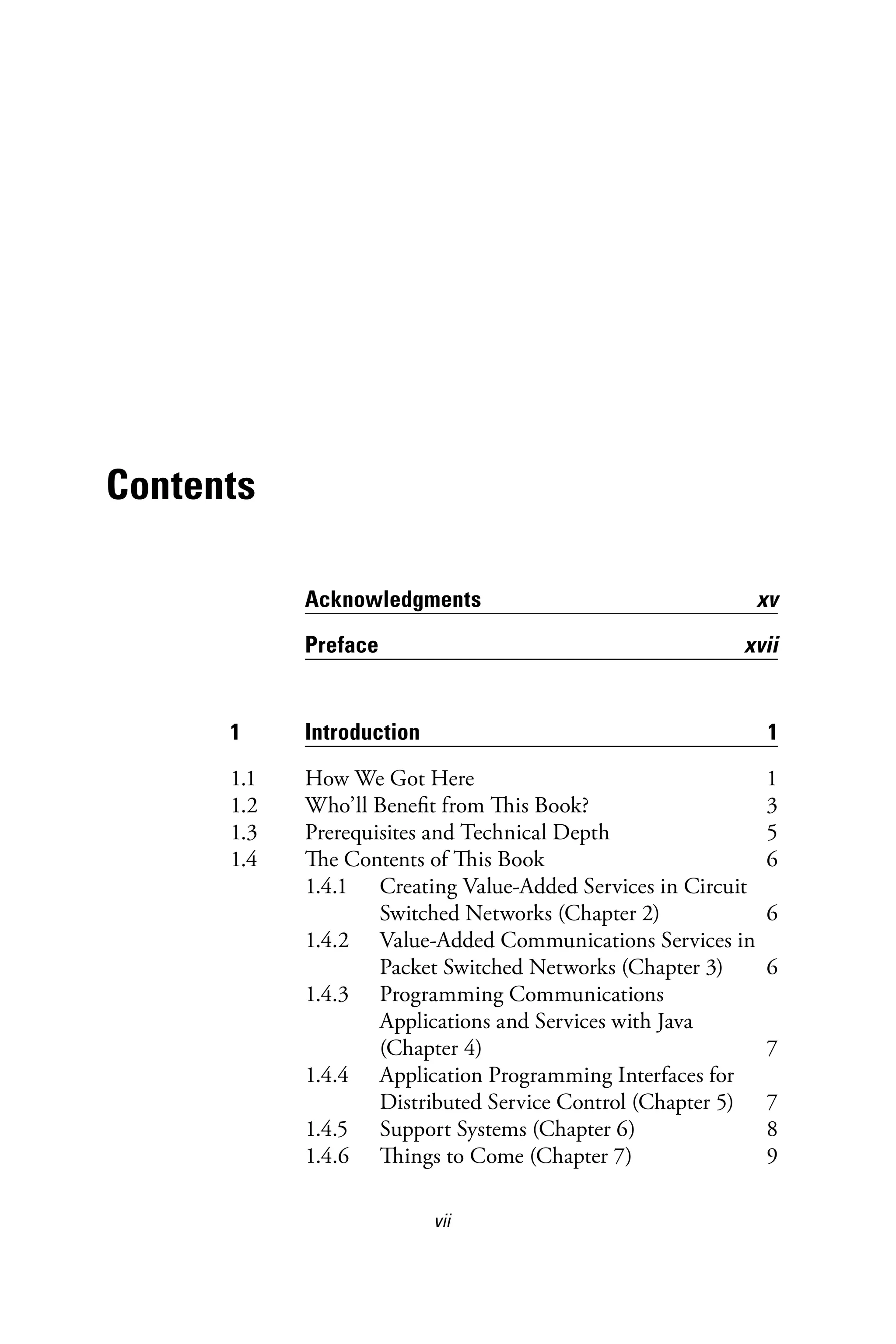
Contents
Acknowledgments xv
Preface xvii
1 Introduction 1
1.1 How We Got Here 1
1.2 Who’ll Benefit from This Book? 3
1.3 Prerequisites and Technical Depth 5
1.4 The Contents of This Book 6
1.4.1 Creating Value-Added Services in Circuit
Switched Networks (Chapter 2) 6
1.4.2 Value-Added Communications Services in
Packet Switched Networks (Chapter 3) 6
1.4.3 Programming Communications
Applications and Services with Java
(Chapter 4) 7
1.4.4 Application Programming Interfaces for
Distributed Service Control (Chapter 5) 7
1.4.5 Support Systems (Chapter 6) 8
1.4.6 Things to Come (Chapter 7) 9
6525_Book.indb 7 1/23/15 7:55 AM
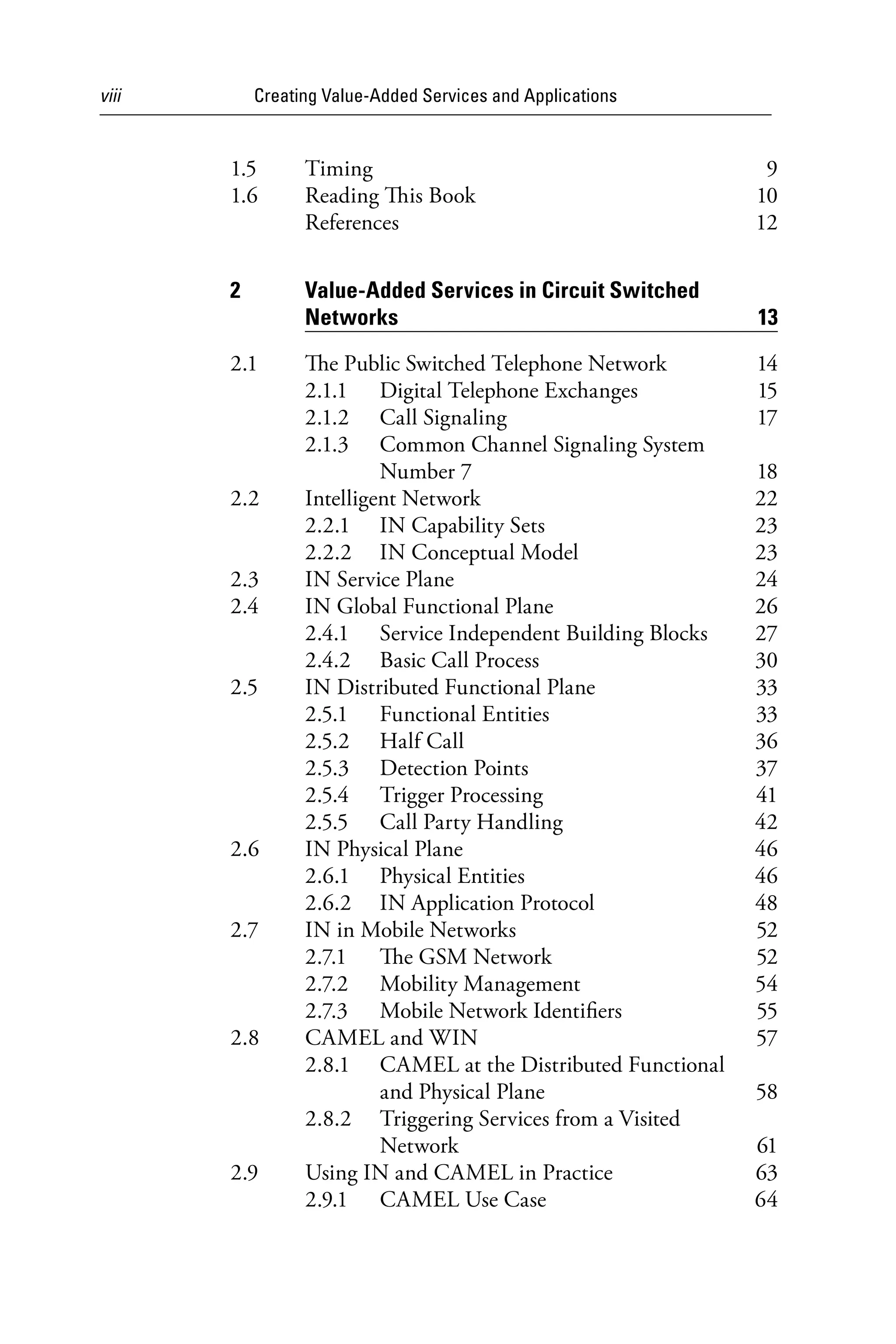
viii Creating Value-Added Services and Applications
1.5 Timing 9
1.6 Reading This Book 10
References 12
2 Value-Added Services in Circuit Switched
Networks 13
2.1 The Public Switched Telephone Network 14
2.1.1 Digital Telephone Exchanges 15
2.1.2 Call Signaling 17
2.1.3 Common Channel Signaling System
Number 7 18
2.2 Intelligent Network 22
2.2.1 IN Capability Sets 23
2.2.2 IN Conceptual Model 23
2.3 IN Service Plane 24
2.4 IN Global Functional Plane 26
2.4.1 Service Independent Building Blocks 27
2.4.2 Basic Call Process 30
2.5 IN Distributed Functional Plane 33
2.5.1 Functional Entities 33
2.5.2 Half Call 36
2.5.3 Detection Points 37
2.5.4 Trigger Processing 41
2.5.5 Call Party Handling 42
2.6 IN Physical Plane 46
2.6.1 Physical Entities 46
2.6.2 IN Application Protocol 48
2.7 IN in Mobile Networks 52
2.7.1 The GSM Network 52
2.7.2 Mobility Management 54
2.7.3 Mobile Network Identifiers 55
2.8 CAMEL and WIN 57
2.8.1 CAMEL at the Distributed Functional
and Physical Plane 58
2.8.2 Triggering Services from a Visited
Network 61
2.9 Using IN and CAMEL in Practice 63
2.9.1 CAMEL Use Case 64
6525_Book.indb 8 1/23/15 7:55 AM
Contents ix
2.9.2 Commercial IN and CAMEL Offering 65
References 66
3 Value-Added Communications Services in
Packet Switched Networks 67
3.1 IP Networks and the Internet 68
3.1.1 IP Packets and Routing 68
3.1.2 IP Protocols 70
3.1.3 HTTP and HTML 73
3.1.4 IPv6 74
3.2 Mobile Access to IP Networks 75
3.2.1 From 2G to 2.5G and 3G networks 76
3.2.2 Mobile Data Networks 77
3.2.3 The Packet Data Protocol Context 78
3.2.5 Mobility Management in Mobile Data
Networks 79
3.2.3 Long-Term Evolution 80
3.3 Real-Time Communications over IP 81
3.3.1 Coding Multimedia into IP Packets 81
3.3.2 Real-Time Protocol 83
3.3.3 Call Signaling for IP-Based Real-Time
Communications 84
3.3.4 Session Initiation Protocol 85
3.3.5 Session Description Protocol 86
3.3.6 SIP Dialogues 87
3.3.7 SIP Servers 90
3.3.8 SIP Servers: An Example 91
3.3.9 SIP Extensions 93
3.4 Internet Multimedia Subsystem 95
3.4.1 IMS Overview 96
3.4.2 IMS Core 97
3.4.3 Application Servers 100
3.4.4 CSCF and AS State Models 103
3.4.5 Service Triggering and Service Chaining 103
3.4.6 Programming IMS Application Servers 106
3.4.7 Call Processing Language 106
3.4.8 CPL Example 109
3.5 MMTEL 111
6525_Book.indb 9 1/23/15 7:55 AM
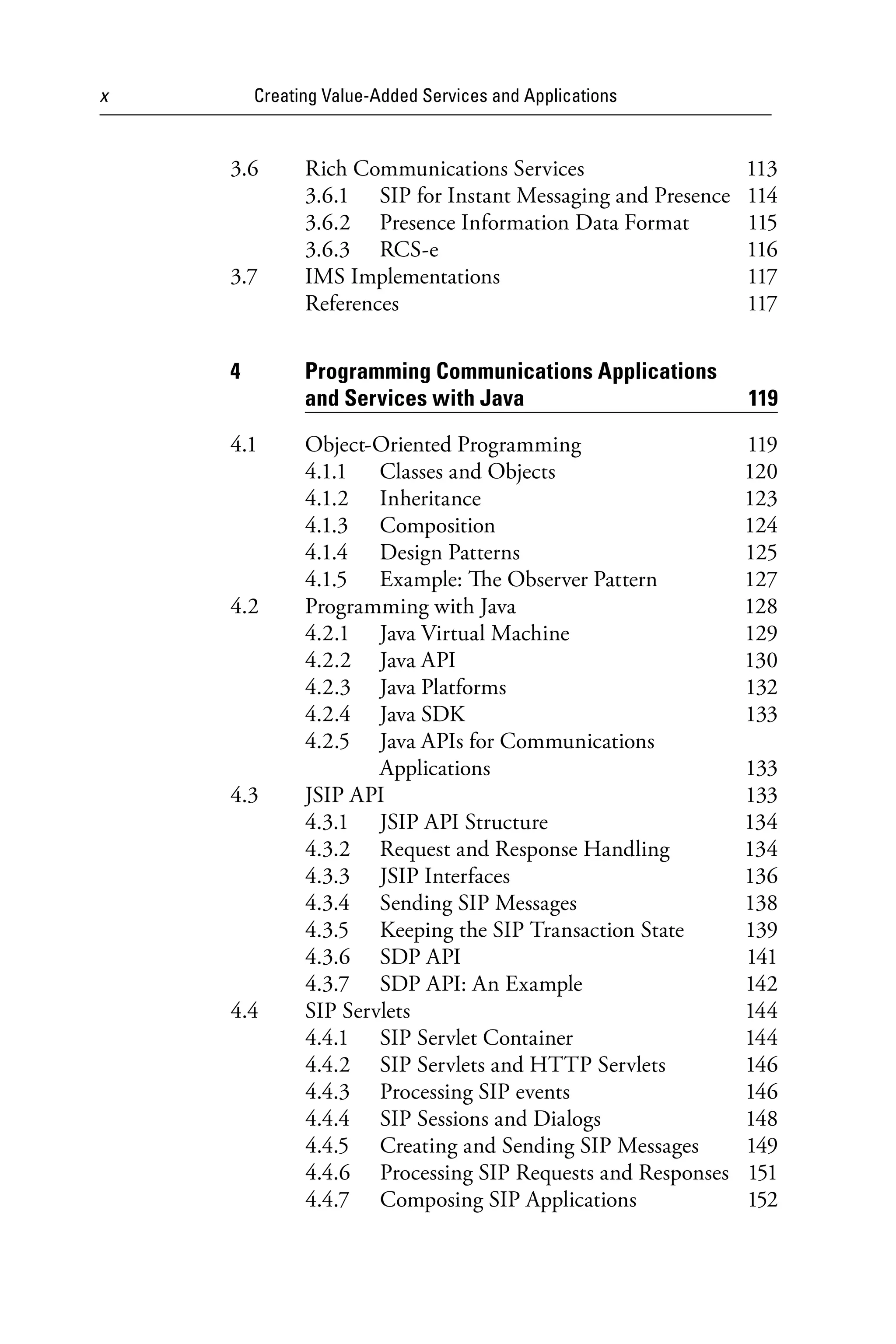
x Creating Value-Added Services and Applications
3.6 Rich Communications Services 113
3.6.1 SIP for Instant Messaging and Presence 114
3.6.2 Presence Information Data Format 115
3.6.3 RCS-e 116
3.7 IMS Implementations 117
References 117
4 Programming Communications Applications
and Services with Java 119
4.1 Object-Oriented Programming 119
4.1.1 Classes and Objects 120
4.1.2 Inheritance 123
4.1.3 Composition 124
4.1.4 Design Patterns 125
4.1.5 Example: The Observer Pattern 127
4.2 Programming with Java 128
4.2.1 Java Virtual Machine 129
4.2.2 Java API 130
4.2.3 Java Platforms 132
4.2.4 Java SDK 133
4.2.5 Java APIs for Communications
Applications 133
4.3 JSIP API 133
4.3.1 JSIP API Structure 134
4.3.2 Request and Response Handling 134
4.3.3 JSIP Interfaces 136
4.3.4 Sending SIP Messages 138
4.3.5 Keeping the SIP Transaction State 139
4.3.6 SDP API 141
4.3.7 SDP API: An Example 142
4.4 SIP Servlets 144
4.4.1 SIP Servlet Container 144
4.4.2 SIP Servlets and HTTP Servlets 146
4.4.3 Processing SIP events 146
4.4.4 SIP Sessions and Dialogs 148
4.4.5 Creating and Sending SIP Messages 149
4.4.6 Processing SIP Requests and Responses 151
4.4.7 Composing SIP Applications 152
6525_Book.indb 10 1/23/15 7:55 AM
Contents xi
4.4.8 Building JEE Applications with SIP
Servlets 154
4.5 JAIN SLEE 156
4.5.1 JAIN SLEE Overview 156
4.5.2 Service Building Blocks 157
4.5.3 Activities and Events 159
4.5.4 JCC Resource Adapter 159
4.5.5 Combining JAIN SLEE with JEE and
JEE 163
4.6 Java IMS API 164
4.6.1 Capabilities 165
4.6.2 Registry 166
4.6.3 IMS API Structure 167
4.6.4 Using the IMS API 168
References 170
5 Application Programming Interfaces for
Distributed Service Control 171
5.1 Distributed Object-oriented Systems 172
5.1.1 Communications Between Distributed
Objects 172
5.1.2 Remote Procedure Call 173
5.1.3 Java Remote Method Invocation 175
5.1.4 Common Object Request Broker
Architecture 177
5.1.5 Interface Definition Language 178
5.1.6 Remote Object References 179
5.2 Web Services 180
5.2.1 XML 181
5.2.2 XML Schemas 182
5.2.3 Simple Object Access Protocol 184
5.2.4 Web Services Definition Language 188
5.2.5 Representational State Transfer 190
5.2.6 A REST Example 193
5.3 The Emergence of Network APIs 194
5.3.1 The Parlay Group 195
5.3.2 Open Service Access 196
5.3.3 OSA Interface Structure 198
6525_Book.indb 11 1/23/15 7:55 AM
xii Creating Value-Added Services and Applications
5.3.4 Prepaid Calling: An Example 200
5.4 Parlay X and Open Mobile Alliance 205
5.4.1 Parlay X 205
5.4.2 OMA RESTful Network APIs 208
5.4.3 Prepaid Calling: An Example 211
5.5 GSMA OneAPI 215
5.5.1 OneAPI Interfaces 216
5.5.2 Prepaid Calling: An Example 218
5.6 Device APIs 222
5.6.1 SIM Application Toolkit 223
5.6.2 Mobile Execution Environment 225
5.6.3 Device Management Client API 227
5.6.4 Open Connection Manager API 228
References 231
6 Support Systems 233
6.1 OSS and BSS 233
6.2 Assurance 235
6.2.1 Network Management 236
6.2.2 The Agent-Manager Model 237
6.2.3 Managed Objects 239
6.2.4 Network Management Protocols 241
6.2.5 Frameworx 242
6.2.6 Multitechnology Operations System
Interface 244
6.2.7 Service Delivery Platforms 245
6.3 Charging and Billing 247
6.3.1 CDR and IPDR 248
6.3.2 Mediation and Rating 250
6.3.3 Charging in IMS 252
6.3.4 Correlating IMS Charging Data 253
6.3.5 Online Charging 254
References 256
7 Things to Come 257
7.1 Predictions from the Turn of the Millennium 258
7.2 Machine-to-Machine Communications 259
6525_Book.indb 12 1/23/15 7:55 AM
Contents xiii
7.2.1 M2M Opportunities and Challenges 259
7.2.2 oneM2M 260
7.2.3 oneM2M Common Services Layer 261
7.2.4 oneM2M Protocols 262
7.3 Cloud Computing and Virtualization 263
7.3.1 Cloud Computing-Enabled Services 264
7.3.2 Network Operators and Cloud
Computing 264
7.3.3 Communications Services Through the
Cloud 266
7.3.4 Cloud Computing Challenges 267
7.4 Network Centric Versus Over the Top Services 268
7.4.1 The Smart Phone Revolution 269
7.4.2 The Operators’ Answer: IMS and
WAC 270
7.5 The Future of the Network Operator 271
7.5.1 Bumps Ahead 271
7.5.2 After Rain Comes Sunshine 271
7.5.3 Regulation to the Rescue 273
7.5.4 Que Sera, Sera 273
References 273
Glossary 275
About the Author 287
Index 289
6525_Book.indb 13 1/23/15 7:55 AM
6525_Book.indb 14 1/23/15 7:55 AM
Random documents with unrelated
content Scribd suggests to you:
whilst others, already embarked, are going to a ship lying at anchor.
That ship is the Pensacola bound for Charleston, South Carolina. The
troops are the Thirty-first regiment, lately stationed at Mobile,
whence they have just arrived, after an overland march, for the
purpose of embarking in the Pensacola. Whether they shall remain
at Charleston in winter quarters will, according to a letter of General
Haldimand to Colonel Chisolm, “depend upon the conduct of the
Bostonians.”[11]
CHAPTER X.
Governor Peter Chester—Fort George of the British and St. Michael of the Spanish
—Tartar Point—Red Cliff.
Peter Chester, having been commissioned governor of West Florida
in 1772, came to Pensacola, the capital of the province, and entered
upon the administration of the office. He was recognized and
deferred to by General Haldimand as a man of capacity and
experience, a reputation which was not impaired by his nine years’
rule in Florida.
The first days of his administration were marked by a
determination to reform the public service, and to supersede the old
star fort by more stable and efficient defenses for the town and
harbor, and the spirit which animated him was at once
communicated to the military commander of the province.
Early in his administration, after much discussion by engineers of
several plans for the defense of the town, a fort was built, under
orders from General Gage, on Gage Hill, and named Fort George for
his majesty George III.[12]
In the centre of the fortress was the council chamber of the
province and the repository of its archives, where the office duties of
the governor and the military commander were performed, where
audience was given to Indian chiefs and delegations, and where
really centered the government of West Florida, according to its
English boundaries.
In that chamber on one occasion could have been seen a man in
the prime of life, partly in Indian dress, in earnest conversation with
Governor Chester and William Panton, the millionaire and merchant
prince of the Floridas. By the evident admixture of white and Indian
blood in his veins, his skin had lost several shades of the hue, his
hair the peculiar stiffness, and his cheek bones somewhat of the
prominence of those of his aboriginal ancestry. He was tall and
slender; his eyes, black and piercing, beamed with the light that
belongs to those of the cultured; the Indians said his high forehead
was arched like a horse-shoe; the fingers which hold the pen with
which he is writing, during a pause in the conversation, are long and
slender; he speaks and then reads what he has written; all is in the
purest English, to which he is capable of giving point by an apt
classical quotation. On a future occasion he will enter that chamber
with the commission of a British colonel. A few years later he will
hold a like commission from the King of Spain. A few years later still
will find him a brigadier-general of the United States. That man is
Alexander McGillivray, of whom much is to be written.
In that chamber three men were once seated at a table, attended
by two secretaries busily writing, one in English, the other in
Spanish. One of the three is Governor Chester, another is General
John Campbell, a distinguished English officer whom fortune has just
deserted. The third, a young-looking Spaniard, too young for his
insignia of a Spanish general, is Don Bernardo de Galvez, the
governor and military commander of Louisiana. Those three men are
closing a drama and writing the last paragraph of a chapter of
history. The two papers the secretaries are writing, when signed, will
separate, one going to London, the other to Madrid, to meet again
at Versailles. At Versailles they will be copied substantially into the
duplicates of the treaty of 1783 between Spain and Great Britain,
and constitute its V Article.
A pigeon-hole on the side of that chamber once contained an
order from Lord Dartmouth, dated January, 1774, to the
commander-in-chief of West Florida, to forward a regiment from
Pensacola to revolutionary Boston to quell the tea-riots. This book is
debtor to many documents which once rested in other pigeon-holes
of the chamber.
Fort George was a quadrangle with bastions at each corner. There
were within the fort a powder magazine and barracks for the
garrison, besides the chamber above mentioned. The woods north of
it, for an eighth of a mile, and within a curve bending around it to
the bay, were felled, in order to give play to its guns landward,
whilst they could bear upon an enemy in the bay by firing over the
town. By a system of signals, intercommunication was kept up with
Tartar Point and thence with Red Cliff.
Tartar Point, now the site of the Navy Yard, where a battery and
barracks were erected by the British, is the only existing name in this
part of West Florida which carries one’s thoughts back to the days of
British rule. The name of the point under the second Spanish
dominion, which lasted about forty years, was Punta de la Asta
Bandera—the Point of the Flagstaff. It seems strange that an English
name which had been superseded for that period by a Spanish
designation, should after that lapse of time be restored.
The locality of Red Cliff was for a time a puzzle. Such a name for a
locality at once induced a search for a suggestive aspect. No red
bluff, however, not too far eastward to serve as the site of a work for
the defense of the town or harbor, could be found, and yet, no bluff
westward of the former could be observed to suit the designation.
But at length, a letter in the Canadian archives fixed Barrancas as
the locality by stating that there was at about the distance of a half
to a quarter of a mile from Red Cliff a powder magazine, built by the
Spaniards, capable of holding 500 barrels of powder, which was then
being used as the powder depôt of the province, evidently the relic
of old San Carlos, destroyed by the French in 1719, and stood on the
site of the present Fort Redoubt.
The defenses of Red Cliff consisted of two batteries, “one on the
top and the other at the foot of the hill.” There were quarters for the
officers and barracks for the soldiers in one building, so constructed
as to be proof against musket balls and available as an ample
defense against an Indian attack.[13]
CHAPTER XI.
Representative Government.
When the governments of West and East Florida were established,
as before related, their governors were, severally, vested with
authority, their councils consenting and the condition of the
provinces being favorable, to call for the election of general
assemblies by the people.
In 1773, Governor Chester concluded that the time had arrived
when it would be expedient for him to exercise this power. He,
accordingly, issued writs authorizing an election, fixing the time it
was to be held, the voting precincts, the qualifications of voters, and
the number and qualifications of assemblymen to be chosen, as well
as the day of the sitting of the general assembly at Pensacola.
But the writs, unhappily, fixed the terms of assemblymen at three
years; a provision which proved fatal, not only to this first attempt,
but likewise to all future efforts to establish representative
government in West Florida. The election was held throughout the
province, and the members of a full general assembly elected. But
whilst the people went to the polls with alacrity, and hailed with
pleasure the advent of popular government, they were opposed to
the long tenure fixed by Governor Chester; and so determined was
that opposition that they resolved that it should not receive the
implied sanction of their votes. They accordingly cast ballots which
declared that they were subject to the condition that the
representative should hold for one year only. To that condition the
governor refused to consent. The people, on the other hand, were
equally unyielding in their opposition. Efforts were made, but in vain,
to induce a concession by one side or the other; consequently,
during the following years of English dominion, as before, the
province knew no other civil government than that of the governor
and his council.
It is difficult to understand the motives which prompted the
people to so stubborn an opposition. The tenure of three years
might, indeed, seem long to voters who had probably lived in
colonies, where it was a third or two-thirds less. But still, if there
was any value to a people in representative government, surely an
assembly holding for three years was better than none; especially as
it would have so concentrated the influence and power of the
community as to enable it at some auspicious conjuncture to remove
the one popular objection to the system.
On the other hand, we can better appreciate the conduct of
Governor Chester. An Englishman with the Tory conservatism of that
day, he would, naturally, fear the effect of short terms and frequent
elections, aside from economical considerations. All the northern
colonies were in a state of ferment bordering on revolution, and that
consideration, doubtless, intensified his opposition to anything that
savored of opposition to the wishes of the king or his
representatives. Indeed, from his stand-point, to yield to the popular
wishes in array against his own will and judgment, was to leaven the
province with a pestilent political heresy which was seeking to
substitute the power of the people for the authority of the crown.
Governor Chester seems to have possessed superior talents for
government, the best evidence of which is found in the prosperity of
the colony during his administration, the harmony that existed
between him and the military, and the high respect and deference
he received from General Haldimand.
Such a man, conscious of his rectitude and good intentions
towards the province, evinced by his readiness to afford it the
privilege of representative government, somewhat at the expense of
his own authority, would naturally feel that the condition attached to
the ballots, and adhered to with much insistance, manifested such a
want of confidence in him as to justify his distrust of the people.
But what Governor Chester’s zealous endeavors could not
accomplish in West Florida, the reluctant efforts of Governor Tonyn
achieved in the eastern province. In 1780, the latter, against his own
wishes, and solely at the suggestion of others, called for the election
of a general assembly. The call having been promptly obeyed, the
first popular representative body in Florida met at St. Augustine in
January, 1781.[14]
CHAPTER XII.
Growth of Pensacola—Panton, Leslie  Co.—A King and the Beaver—Governor
Chester’s Palace and Chariot—The White House of the British, and Casa
Blanca of the Spanish—General Gage—Commerce—Earthquake.
There is evidence of great improvement in the town within a few
years from Governor Chester’s advent; a progress which was
accelerated as the revolution in the Northern Colonies advanced.
That great movement, ever widening its area, extended at last from
the Gulf to Canada, leaving no repose or peace for those who, living
within it, were resolute to remain loyal to their king.
Some entered the royal military service; multitudes left America,
and others, to nurse their loyalty in quietude, removed to Florida.
Though most of that emigration went to East Florida, yet West
Florida, and especially Pensacola, received a large share. St.
Augustine, however, was the tory paradise of the revolutionary era.
She can, without question, supplement the glory of her antiquity
with the boast of having once seen her streets lighted up by the
blazing effigies of John Adams and John Hancock.[15]
The most important commercial acquisition of Pensacola by that
tory immigration was William Panton, the senior of the firm of
Panton, Leslie  Co., a Scotch house of great wealth and extensive
commercial relations. They had an establishment in London, with
branches in the West India Islands. During the English dominion in
Florida they established themselves in St. Augustine; later, during
Governor Chester’s administration, at Pensacola, and afterwards, at
Mobile. Other merchants also came to Pensacola about the same
time, attracted principally by the heavy disbursements of the
government. But these expenditures were not the attraction to the
Scotchmen. Their object was to grasp the Indian trade of West
Florida. A building which they erected with a wharf in front of it is
still standing, or at least, its solid brick walls are now those of the
hospital of Dr. James Herron, whose dwelling house stands on the
site of the Council Chamber of Fort George.
In that building was carried on a business which grew steadily
from year to year during the British dominion, and afterwards
attained great magnitude under Spanish rule, as we shall have
occasion to notice in a future page. In building up that business,
Panton had a most able and influential coadjutor in General
Alexander McGillivray, whom we lately saw in the Council Chamber
of Fort George. Through him their business comprehended not only
West Florida, but extended to and even beyond the Tennessee river.
In perfect security, their long lines of pack horses went to and fro in
that great stretch of country, carrying all the supplies the Indians
needed, and bringing back skins, peltry, bees-wax, honey, dried
venison, and whatever else their savage customers would provide
for barter. Furs were a large item of that traffic, for the beaver in
those days abounded throughout West Florida, and was found even
in the vicinity of Pensacola.
One of their ponds, still existing on Carpenter’s Creek, four miles
from the town, is suggestive of an instructive comparison between
the fruits of the life-work of its humble constructors, and those of
the twenty years rule, of a mighty monarch. Of the British dominion
of his Majesty George III., in this part of Florida, the millions of
treasure expended, and the thousands of lives sacrificed to establish
and maintain it, there exists no memorial, or result, except a fast
disappearing bank of sand on the site of Fort George. From that
barren outcome of such a vast expenditure of human life and
money, we turn with a blush for the vanity and folly of man, to
contemplate that little pool fringed with fairy candles,[16]
where the
water lilies bloom, and the trout and perch flash in the sunlight, as
the memento of a perished race, whose humble labors have
furnished pastime and food to successive generations of anglers.
An unsuccessful effort has been made to obtain reliable
information as to the number and description of the houses
Pensacola contained in its most thriving days during Governor
Chester’s administration. But the only account we have, is that of
William Bertram, who though reputed an eminent botanist is hardly
reliable, for he describes Governor Chester’s residence as a “stone
palace, with a cupola built by the Spaniards;”[17]
and yet, according
to the description of the town in Captain Will’s report, at the close of
Spanish rule, it consisted of “forty huts and barracks, surrounded by
a stockade;” and he witnessed at that time, the exodus of the entire
Spanish population. Besides, persons whose memories went back
within thirty years of Governor Chester’s alleged palatial residence,
neither saw, nor even heard, of the ruins of such a structure.
Upon the same authority rests the statement, that the Governor
had a farm to which he took morning rides in “his chariot.”[18]
But a
traveler whose fancy was equal to the transformation of a hut into a
palace, may have transformed his excellency’s modest equipage into
a more courtly vehicle.
It is probable, however, that although Governor Chester was not
the occupant of a stone palace with a cupola, he lived in a sightly
and comfortable dwelling built of brick or wood, or perhaps of both.
One such dwelling of his time, that of William Panton, was familiar,
forty years ago to the elders of this generation. It stood near the
business house of Panton, Leslie  Co. Taking its style and solidity as
a guide, there existed several houses in the town within the last half
century that could be identified as belonging to Governor Chester’s
day.
One of them was the scene of a tragedy; a husband cutting a
wife’s throat fatally, his own more cautiously, or perhaps her cervical
vertibrae had taken off the edge of the razor, for he survived.
Thereafter, none would inhabit it, and consequently it rapidly went to
ruin. It stood on the north side of Government street, a block and a
half from Palafox. A jury acquitted him. Why? No one could
conjecture, unless because she was his wife, and therefore his
chattel, like the cow or sheep of a butcher.
In Governor Chester’s time there existed a large double story
suburban residence, which was a distinguished feature in the
landscape looking southwesterly from Fort George, or from any part
of the Bay. It stood on the bluff between the now Perdido R. R. and
Bayou Chico. Painted white, it became the “white house” of the
English, and “Casa Blanca” of the Spanish dominion.
It was the home of a family of wealth and social standing,
composed of three—husband, wife, and daughter, the latter a child.
Gardens belonging to it covered much of the area of that meadow-
like district already mentioned. That home was to be the scene of a
drama in three acts; the death of a child, the death of a husband,
and a struggle of strong, martyrlike womanhood in the toils of
temptation, tried to the lowest depth of her being, but coming forth
triumphant.
In examining the calendar of the Haldimand collection by Mr.
Douglas Brymner, Archivest of the Dominion of Canada, we are
impressed with the great and varied responsibility, labor, and care,
attending the office of commander in chief of the American colonies,
especially after Great Britain’s, Canada, Florida, and Louisiana
acquisitions. His administration involved not merely general
superintendence of the military department, but likewise embraced
the minutest details requiring expenditures of public money. We
accordingly find General Gage, during Governor Chester’s
administration, dictating letters in respect to carpenter’s wages[19]
in
Pensacola. Again we find him busy over a controversy which had
sprung up there in respect to the employment of a Frenchman,
Pierre Rochon,[20]
to do carpenter’s work, and furnish shingles, to the
exclusion of Englishmen. Upon economical grounds his excellency
decided in favor of Rochon. Pierre was evidently an active and
enterprising man. Before he came to Pensacola to secure for himself
all the public carpentering and shingle business there, he had
enjoyed the like monopoly at Mobile.
Again we find the General engaged with a small matter at Red
Cliff.[21]
Lieutenant Cambell, of the engineer department, had
furnished some carpenters who were employed there with candles
and firewood, doubtless because they could not otherwise be
procured by the men. That act of kindness brought the benevolent
lieutenant the following scorching reproof: “I am sorry to acquaint
you that his excellency, General Gage, is greatly displeased at your
giving of the carpenters candles and firewood; and he desires to
know by what authority you assumed to give those allowances, or by
what order they were given? For his excellency declares, that a
shilling shall not be paid on that account.” New York, 16 Feb. 1773.
S. Sowers, Captain of Engineers.
Even the quality of bricks used on the public works at Pensacola
was a matter of interest to the commander in chief. In 1771, a brick
manufactured by the British, and one by the Spaniards, nearly a
century before, as General Haldimand says, were sent to
headquarters at New York, for the judgment of his excellency as to
their comparative merits.
These letters impress us the more with the cares of General Gage,
when we reflect they were written at the time of the troublesome
tea business at rebellious Boston; and when the flowing tide of the
revolution, as may be discerned from almost every page of the
calendar, was daily rising, and threatening to sweep away the
supports of British authority in the colonies.
In a former page mention is made of a Philadelphia lady, whose
name occurs in the Pensacola correspondence of an earlier day. It is
but fair, therefore, that we should not leave unnoticed a New York
lady who is mentioned in letters of Governor Chester’s time; the
more so, because she seems to have been one of those thrifty
housewives, who do not entirely depend upon the tin can, and green
glass jar of the shop to supply their families with preserved fruits
and vegetables; besides, there can be brought in with her extracts
from letters, exemplary of the courtly style, with which in Governor
Chester’s day, a gentleman returned, and a lady received his thanks
for a small courtesy.[22]
General Haldimand, at Pensacola, writes Captain S. Sowers, the
husband of the lady, who is in New York:
“I most respectfully ask Mrs. Sowers, to permit me, through you,
to tender to her my most grateful thanks for the three jars of
pickels.”
The Captain replies: “Mrs. Sowers, with pleasure, accepts your
thanks for the pickels, and when ye season comes for curing of
them, she will send you another collection which she hopes will be
acceptable.”
In this stirring, short-hand, type-writing age, the form of a like
exchange of courtesies would probably be: “Pickels received.
Thanks.”
Though there was no lack of lawyers and doctors, who it is said,
lived in fine style, there was a sad want of clergymen or preachers in
the province. There was but one of whom we have any account up
to 1779, and he was stationed at Mobile. Stuernagel, the Waldeck
Field Preacher, on his arrival in Pensacola, in that year, christened a
boy whose parents had been waiting eight years to make him the
subject of the holy office. He also baptized men who had been
watching from their boyhood for an opportunity to make their
baptismal vows. Nor can there be found a reference to church or
chapel during the English dominion.[23]
The most prosperous and promising days Pensacola ever saw,
except those since the close of the civil war, were from 1772 to
1781. As the American revolution advanced, additions were made to
the numbers, intelligence and wealth of its population, owing to
causes already mentioned. It was the capital of a province rich in its
forests, its agricultural and other resources. Its Bay was prized as
the peerless harbor of the Gulf, which it was proposed by the British
government to make a great naval station, a beginning in that
direction having been made by selecting a site for a navy yard
adjoining the town to the westward. Its commerce was daily on the
increase; not only in consequence of the extension of Panton, Leslie
 Co.’s trade with the Indians, but other enterprising merchants who
had been added to the population, were engaged in an export trade,
comprising pine timber and lumber, cedar, salt beef, raw hides,
cattle, tallow, pitch, bear’s oil, staves, shingles, honey, beeswax, salt
fish, myrtle wax[24]
, deer skins, dried venison, furs and peltry. This
trade, and the £200,000 annually extended by the British
government, as well as the disbursements of the shipping,
constituted the sources of the prosperity of the town.
This period, besides being a season of growth and prosperity to
Pensacola, as well as the rest of the Province, was one of repose,
undisturbed by the march of armies, battles, and the other cruel
shocks of war that afflicted the northern colonies. But it was not to
remain to the end a quiet spectator of the drama enacting on the
continent. It, too, had an appointment with fate. Though not even a
faint flash of the northern storm was seen on its horizon, yet there
had been one for long brooding for it in the southwest.
The earthquake, too, that visited it on the night of February 6,
1780,[25]
was but a presage of that which on May 8, 1781, was to
shake it to its center; and prove the signal of an exodus of the
English almost as complete as was that of the Spanish population in
1763.
CHAPTER XIII.
Military Condition of West Florida in 1778—General John Campbell—The Waldecks
—Spain at War with Britain—Bute, Baton Rouge and Fort Charlotte Capitulate
to Galvez—French Town—Famine in Fort George—Galvez’s Expedition against
Pensacola—Solana’s Fleet Enters the Harbor—Spaniards Effect a Landing—
Spanish Entrenchment Surprised—The Fall of Charleston Celebrated in Fort
George.
The military condition of West Florida was changed as the
revolutionary war progressed. There were no longer seen two or
more regiments at Pensacola, one or two at Mobile, and one at Fort
Bute, Baton Rouge, and Panmure. The call for troops for service in
the northern colonies had, by the latter part of 1778, reduced the
entire effective force of the province to five hundred men.
That such a reduction was thought prudent, was due to the
peaceful relations of the Spaniards and the British, as well as those
of the latter with the Creek and Choctaw Indians, attributable to the
influence of McGillivray, now a colonel in the British service.
In the latter part of 1778, however, the British government
becoming suspicious of Spain, and anticipating her alliance with
France, ordered General Clinton to reinforce West Florida.
Accordingly, General John Campbell, a distinguished officer, was sent
to Pensacola, with a force of 1,200 men, composed of a regiment of
Waldecks, and parts of two regiments of Provincials from Maryland
and Pennsylvania. They did not arrive, however, until the twenty-
ninth of January, 1779.[26]
Early in 1789, General Campbell sent two companies of Waldecks
to reinforce Fort Bute, which brought its garrison up to about 500
men under the command of Lt. Colonel Dickson.
At length Spain threw off the mask, and adopted a course which
justified the suspicions of the British Court as to her inimical
intentions. On June 16, the Spanish minister, the Marquis d’
Almodovar, having delivered to Lord Weymouth a paper equivalent to
a declaration of war, immediately departed from London without
taking leave. Spain thereupon became an ally of France, but not of
the United States. Nevertheless, under the influence of the Court of
Versailles, Don Bernardo de Galvez, the Governor of Louisiana, on
June 19, published, at New Orleans, the proclamation of the Spanish
King, acknowledging the independence of the United States. The
dates of these transactions furnish conclusive evidence of a pre-
arrangement, designed to enable the Spaniards to assail the British
posts in West Florida before they could be succored by the home
government.
In pursuance of that policy, Galvez at once began his preparations
for offensive operations against Forts Bute, Baton Rouge and
Panmure, in the order in which they are mentioned. The great
distance of Pensacola from them, as well as the want of facilities of
communication, assured him that with an adequate force at his
command, General Campbell’s first intimation of his operations
would be the news of their capture.
In August, with a force of 2,000 men, Galvez began his advance
on Fort Bute. As soon as Dickson was informed of his movement, he
resolved to concentrate his forces at Baton Rouge, leaving at the
former post a few men to man the guns, and to make such a show
of resistance as would give him time to perfect the defenses of the
latter.
On August 30, Galvez appeared before Bute. After a contest of
some hours, its handful of defenders arrested his movements by the
time consumed in an honorable capitulation. Bute having been
secured, Galvez pushed on to Baton Rouge. In his first attack, he
was repulsed with the heavy loss of 400 men killed and wounded,
which was within 100 of Dickson’s entire force. In the next attack
which was made on the following day, the Spanish loss was 150.
Although the loss on his side was in both attacks only 50 men,
Dickson realizing that he was cut off from all succor, and that he
must either surrender, or see his command gradually waste away
under the repeated attacks of an overwhelming enemy, capitulated
upon the most honorable terms. The command was pledged not to
fight against Spain for eighteen months unless sooner exchanged.
With loaded guns and flags flying the garrison was to march to the
beat of the drum 500 paces from the fort and there stack arms. The
officers were to retain their swords and every one his private
property. All were to be cared for and transported to a British harbor
by the Spaniards.[27]
Fort Panmure, from which the garrison had
been withdrawn for the defense of Baton Rouge, was included in the
surrender.
It was not until the twentieth of October that a courier brought to
Pensacola intelligence of the fall of the Mississippi Posts, although
Baton Rouge had surrendered during the first days of September.
When it was received it was not credited, but regarded as a false
report coming from the Spaniards to entice the British commander
from Pensacola in order that it might be captured in his absence.
Even the report of a second courier coming, on the twenty-third,
failed at first to work conviction; but at last all doubt was dispelled,
and every effort directed to putting Pensacola in a defensive
condition.
Why Galvez did not follow up his success at Baton Rouge by an
immediate advance on Mobile, it is difficult to conceive, except upon
the presumption of his ignorance of the weakness of the military
forces there, and at Pensacola.
In December, 1779, Clinton’s expedition against Charleston sailed
from New York; its destination veiled in such secrecy, that even
General Washington, as well as the rest of the world outside of the
British lines, was in the dark respecting it. Miralles, the Spanish
agent, feared it was intended to recover the conquests of Galvez in
West Florida, and signified so much in a letter to General
Washington. By the time the letter was received, however, the
General had become convinced “that the Carolinas were the
objects,” and in reply so tells the Spanish agent.
It was during the interval of Galvez’s inaction between the capture
of Baton Rouge, and his attack on Mobile, that Chevalier de la
Luzerne had a conference with General Washington, on the fifteenth
of September, 1779, at West Point, with the view of bringing about
such concert of movement in the American forces in the Carolinas
and Georgia, and the Spanish forces in Florida, as would be a check
on the British in their movements against either.[28]
But with every
disposition for such co-operation, the latter being without authority
to that end, went no further than to show his sympathy with the
Spaniards, and his readiness to afford advice and information, which
he afterwards manifested in the letter to Miralles above mentioned.
In that letter, referring to the capture of Fort Bute and Baton
Rouge, he says: “I am happy of the opportunity of congratulating
you on the important success of His Majesty’s arms.” It is hardly
probable, however, that General Washington would have been so
ready to congratulate Miralles on those successes, had he known
that in consequence of Galvez’s bad faith, their result would be to
increase the ranks of the foe he was fighting.
In the beginning of March, 1780, Galvez again began military
operations, by advancing against Fort Charlotte. On the twelfth, after
his demand for a surrender had been refused by Captain Durnford,
the British commander, the fort was assailed by six batteries.
By the fourteenth, after a conflict of ten days, a practicable breach
having been made, Durnford capitulated upon the same terms which
Dickson had exacted at Baton Rouge. Hunger had conspired with
arms to make capitulation a necessity. For several days before that
event the garrison had been comparatively without food. When the
gallant Durnford marched out of the breach at the head of a handful
of hunger-smitten men, Galvez is said to have manifested deep
mortification at having granted such favorable terms to so feeble a
foe. An effort was made by General Campbell to relieve Fort
Charlotte, but it fell just as succor was at hand. The delay in
rendering it was occasioned by rain storms, which, having flooded
the country, greatly impeded the movements of the relieving force.
[29]
The gallant defense of Fort Charlotte by Durnford seems to have
lead Galvez to reflections which ended in the conclusion that he was
not, then, strong enough to attack Pensacola. He, accordingly, made
no further movement, until he had procured from Havana a supply
of heavy artillery, and a large additional force.
That it was a part of his plan to advance upon Pensacola
immediately after the capture of Mobile, is evidenced by the Spanish
Admiral Solana’s fleet appearing, and anchoring off the harbor, on
March 27, hovering about as if in expectation of a signal from the
land until the thirtieth, and then sailing away. The appearance of a
scouting party of Spaniards about the same time, on the east side of
the Perdido, likewise pointed to such a design.
Be that as it may, Galvez made no further movement in West
Florida until February, 1781, the eventful year of the great American
rally; the year that witnessed Morgan’s brilliant victory, on the
seventeenth of January at the Cowpens; and Green’s masterly
strategy, culminating on the fifteenth of March at Guildford Court
House in an apparent defeat, but in sequence, a victory, for it sent
Cornwallis to Yorktown for capture on the nineteenth of October.
As we contemplate that year, big with the fate of empire on this
continent, the imagination is captivated by the spectacle of a line of
battle extending from the northern limits of Maine to the mouth of
the Mississippi; the intense points of action being Cowpens,
Guildford Court House, Pensacola and Yorktown.
That no reinforcement was sent to General Campbell, although the
fall of Fort Charlotte was a warning that Galvez’s next effort would
be against Pensacola, manifests the strain which Britain’s contest
with her colonies and France had brought upon both her naval and
military resources. When, therefore, in February, 1781, Galvez was
about to advance against the place with a large fleet and an army of
15,000 men, according to the lowest estimate, the British force
numbered about 1,000[30]
regular troops, besides some provincials.
The British looked for some aid from the Creek, Choctaw and
Chickasaw Indians. It was a body of the latter which drove the
Spanish scouts across the Perdido shortly after the capture of
Mobile.
The three tribes were loyal to their white allies, even when the
latter were no longer able to furnish them with their customary
supplies. The Spaniards, on the other hand, with everything to offer
them, utterly failed to shake their British loyalty. As illustrative of
their devotion, it is related when the Waldecks landed at Pensacola,
the Indians, inferring from their strange language that they were
enemies, inclined to attack them. They had the prudence, however,
to call upon Governor Chester for an explanation. After he had
satisfactorily answered the question “whether the men of strange
speech were the friends or foes of their Great White Brother on the
other side of the big water,” they manifested great joy and honored
the strangers with a salute from their rifles.
When, however, the advance on Pensacola by the Spaniards was
abandoned in the spring of 1780, and thence up to the following
December General Campbell found his savage allies rather an
encumbrance than a benefit. That time was devoted to
strengthening Fort George and the defenses of the harbor, a labor in
which no reward could induce them to assist. The exciting
occupation of taking Spanish scalps, for which £3[31]
were paid,
however, was one in which they could render a barbarous service to
the British.
The Indians were under the command of a Marylander, formerly
an ensign in the British army, who, whilst stationed at Pensacola,
had been cashiered for misconduct. He afterwards went to the Creek
Nation, where he married the daughter of a chief. Though vainly
styling himself General William Augustus Bowles, he was content to
accept restoration to his rank of ensign as a reward for the service,
which, at the head of his band of Creeks, Choctaws and Chickasaws,
he was expected to render to the British during Galvez’s operations
in West Florida.
In the latter months of 1780, Pensacola and the garrison of Fort
George were on the point of starvation. All the resources of the
British government seem to have been required for the great
struggle of 1781 on the Atlantic coast, and Galvez’s conquest had
cut off the customary supplies from the rich country lying between
Mobile Bay and the Mississippi.
Field-preacher Stuernagel says in his journal: “This morning we
drank water and ate a piece of bread with it. At mid-day we had just
nothing to drink but water. Our evening meal consists of a pipe of
tobacco and a glass of water. A ham was sold for seven dollars. A
pound of tobacco cost four dollars. A pound of coffee one dollar. The
men have long been without rum. From hard service, and such
want, diseases were more and more engendered.”[32]
But that state of want was suddenly changed to superabundance.
A British cruiser captured in the gulf a number of merchant vessels
loaded with supplies, embracing “rum, meal, coffee, sugar and other
welcome provisions,” and another exclusively with powder.[33]
Not
long afterwards a more brilliant, although not as useful, a prize was
captured. It contained $20,000 in coin, a large collection of silver-
plate, fine wines, “all sorts of utensils for the kitchen and things of
the same kind, being General Galvez’s outfit and requirements” for
his intended campaign of 1781.[34]
Fortune thus feasted and gilded
the victim for the coming sacrifice.
Having perfected the defenses of Fort George, General Campbell
turned his attention to Red Cliff, in which, on November 19, he
placed a small garrison of 50 Waldecks, under the command of
Major Pentzel, at the same time providing it with some heavy
artillery, which could be spared from Fort George.
Apparently, tired of waiting for Galvez’s attack, or presuming from
his delay in making a movement that he had abandoned the
intention of attacking Pensacola, General Campbell sent an
expedition against a Spanish post, on or near the Mississippi, called
French Town by the British. The force consisted of 100 infantry of
the Sixtieth regiment, and 60 Waldeckers, besides 300 Indians,
commanded by Colonel Hanxleden, the senior officer of the
Waldecks, and next in command to General Campbell. It was an
unfortunate enterprise, resulting in the death of the gallant
Hanxleden, as well as other veteran officers and soldiers who were
soon to be greatly needed at Pensacola. In the retreat, the body of
their brave commander was borne by his men from the field of battle
to a large oak in its vicinity under the shade of which it was buried.
Gratefully did the Waldecks, on their return to Germany, remember
and record the chivalric conduct of “the gallant Spaniards who
honored fallen gallantry by enclosing the grave with a railing.”[35]
On
January 9 the remnant of the expedition reached Fort George.
On the ninth of March General Campbell’s impatient waiting for
Galvez was brought to a close. On that day a preconcerted signal of
seven guns from the war-ship Mentor told the British that the
Spaniards were at last approaching for the final struggle for mastery
in West Florida.[36]
By 9 o’clock of the next morning, thirty-eight
Spanish ships, under Admiral Solana, were lying off the harbor, or
landing troops and artillery. During the night a British vessel glided
out of the harbor with dispatches to the commandant of Jamaica,
pleading for reinforcements, which however were not to be had, for
the movements of de Grasse on the Atlantic coast required all the
attention of the British navy, whilst Cornwallis and Clinton had
drawn, or were drawing, there every available man to meet the
great American rally.
On March 11, the Spaniards opened fire upon the Mentor, then
lying in the harbor, from a battery on Santa Rosa island. She replied
to the attack until she had received 28 shots from twenty-four pound
guns, when she retired nearer the town.
After this affair there were no further movements by the Spaniards
until the eighteenth, when a brig and two galleons, taking advantage
of a very favorable wind, sailed past the batteries defending the
mouth of the harbor, without receiving any perceptible injury.
Thinking they might sail up to the town, and find cover from some
structures on the beach, General Campbell caused them to be
burned down.
On the nineteenth, the entire Spanish fleet, excepting a few
vessels, sailed past the batteries, though subjected to a heavy fire
from Red Cliff, which lasted for two hours.
Galvez, even after he found himself in possession of the harbor
with a fleet of 38 vessels, and a large land force, consisting not only
of troops brought directly from Havana, but those also with which he
had captured the posts west of the Perdido, sent to Havana for
reinforcements; and remained inactive until they reached him on
April 16. The reinforcement consisted of eighteen more ships, and
an additional land force, with heavy siege artillery.
Whilst awaiting that addition to his strength, a landing was
attempted. The attempt was resisted by a body of Indians and a
part of the garrison of Fort George with two field pieces of artillery.
The Spaniards, taken by surprise, were driven to their boats. In the
attack many were killed, and in the confusion of re-embarking others
were drowned. On April 22, however, a second and successful
attempt to land was made by the invaders, followed by the
establishment of camps where batteries were to be erected.
One of the camps, nearer the Fort and the town than the others,
by its temerity invited rebuke. Accordingly, a surprise for it, to be
executed on the twenty-third, was prepared, but defeated by a
fanatic. On the night of the twenty-second, a Waldeck private
reported to his captain, that a Waldeck corporal was missing, under
circumstances which implied desertion; that the deserter was a
Catholic, the only one in the regiment, the rest being Protestant; and
that it had been suspected by his comrades that his fanaticism
would lead him, on the first opportunity, to desert to his co-
religionists. That the suspicion was well founded was manifested by
the movements of the enemy the next morning.
The enterprise, however, though arrested, was not abandoned.
The British commander, shrewdly calculating on the improbability in
the enemy’s conception, that a surprise defeated on the twenty-third
would be attempted on the twenty fifth, actually executed the
movement on the latter day. The attacking force, composed of a part
of the garrison, and a body of Indians, was commanded by the
general in person. The Spaniards were driven from their
entrenchments with considerable loss, and their works hastily
destroyed. This proved, however, the last aggressive act of the
British. By the twenty-seventh of April, batteries mounted with heavy
siege artillery completely invested Fort George.
On the twenty-fourth, the day before the attack on the Spaniards,
General Campbell learned for the first time, that Charleston had
been captured by General Clinton on the eleventh of May, 1780. We
are not informed of the channel through which the information came
to him; but as it could not have come by sea, it must have reached
him through the Indians, who obtained it, probably, from traders of
the Atlantic coast. His ignorance for nearly a year of so important an
event impresses us with his isolation, and the courage with which he
bore it. The event was duly celebrated in Fort George by an
illumination and a discharge of rockets.
CHAPTER XIV.
Fort San Bernardo—Siege of Fort George—Explosion of Magazine—The
Capitulation—The March Through the Breach—British Troops Sail from
Pensacola to Brooklyn.
The Spanish operations against Fort George were conducted with
extreme caution. What, in the beginning, was one of a circle of
intrenchments, developed into a fort as extensive and strong as the
former. Like Fort George, it was built of earth and timber. Its position
was about one-third of a mile to the northward of the latter. During
its construction it was hidden from observation by a dense pine
forest and undergrowth, which, after its completion, were cleared to
give play to its guns. It was named San Bernardo, for the patron
saint of the Spanish commander.
The magnitude of San Bernardo indicated that it must have been
constructed for exigencies besides that of assailing the British works.
Galvez probably feared an attack in his rear from the Indians coming
to the relief of their allies, or that he might have to encounter a
relieving expedition coming by sea. In either event his fortress would
be a place of security for his supplies and a rallying point in case of
disaster.
The siege was a struggle between two forts, with the advantage
to one of them in being supported by intrenchments which with itself
formed a circle around its antagonist. The latter began the contest.
Among the works constructed by the British to strengthen their
position, was a redoubt, named Waldeck. On April 27, a Spanish
intrenchment was seen to be in the course of construction opposite
to Waldeck, under cover of the woods. Against that intrenchment
the besieged directed a heavy fire, but with little effect, as the work
was nearly completed when discovered. This attack upon the
besiegers was the signal for all their batteries to open fire upon Fort
George and its defenses.
The firing was incessant on both sides until May 1, when that of
the British was almost entirely suspended, for the purpose of
enabling the garrison to make some indispensable repairs on their
works. On the second, however, the British guns were again in full
play.
But the demand for repairs was so continuous and urgent as to
impose a heavy tax upon the limited numbers of the besieged. Short
reliefs from duty became a stern necessity, and want of rest, as well
as overexertion, so impaired their strength that men were seen
falling prostrate beside their guns from fatigue and exhaustion.
Galvez’s failure to storm the British works, during the silence of
their guns on May 1, seemed to indicate his determination to reduce
the contest to the question, how long the ammunition of the
besieged would last and their artillery remain serviceable? He may,
however, have regarded the suspension of the British firing as a
strategem to invite an assault.
There was a vital spot in the defenses for which the Spanish shot
and shell had been vainly seeking—the powder magazine. But as the
gunners were without requisite information to enable them to
procure its range, it was but a wild chance that a shell would strike
it. That its position was not drawn from the Waldeck corporal, is an
impeachment of the military sagacity of the Spanish officers, and an
act of gross negligence which would have prolonged the siege
indefinitely, but for an imprudence of the British commander equally
as gross.
A provincial colonel for infamous conduct—of what character we
are uninformed—was drummed out of the Fort, instead of being, as
prudence required, carefully kept within it during the siege. The
man, as should have been expected, went to the Spaniards and
informed them of the condition of the garrison and defenses, and
especially of the angle in which the magazine was situated. That
disclosure sealed the fate of Fort George. Thenceforward, that angle
became the mark of every Spanish shot and shell. For three days
and nights did those searching missiles beat upon it, until at last on
the morning of May 8, there occurred an explosion that shook Gage
Hill to its deep foundations as though once again in the throes of an
earthquake.
A yawning breach was made in the Fort. Fifty men were killed
outright and as many more wounded fatally and otherwise.
At that thunder-like signal 15,000 men are marshalled for the
assault. But there is no panic in Fort George. Calmly the British
commander orders every gun to be charged, and many to be moved
so as to sweep the breach. That work done, he hoists a white flag
and sends an officer under another to the Spanish general with a
communication, which doubtless had been prepared in anticipation
of the conjuncture in which he at last found himself. It was an offer
to capitulate upon the following terms: “The troops to march out at
the breach with flying colors and drums beating, each man with six
cartridges in his cartridge box; at the distance of 500 paces the arms
were to be stacked; the officers to retain their swords; all the troops
to be shipped as soon as possible, at the cost of the Spaniards to a
British port, to be designated by the British commander, under
parole not to serve against Spain or her allies, until an equal number
of the same rank of Spaniards, or the troops of her allies, were
exchanged by Great Britain, and the best care to be taken of the sick
and wounded remaining behind, who were to be forwarded as soon
as they recovered.”
Knowing that those were the terms which the gallant Dickson and
Durnford had demanded and obtained at Baton Rouge and Mobile,
the spirit in which General Campbell dictated the terms of the
capitulation can be readily imagined. To submit to less than had
been conceded to his inferior officers would be dishonor.
Galvez answered, that the terms proposed could not be conceded
without modification. General Campbell replied that no modification
was permissible; adding, that in case they were not conceded he
Welcome to our website – the ideal destination for book lovers and
knowledge seekers. With a mission to inspire endlessly, we offer a
vast collection of books, ranging from classic literary works to
specialized publications, self-development books, and children's
literature. Each book is a new journey of discovery, expanding
knowledge and enriching the soul of the reade
Our website is not just a platform for buying books, but a bridge
connecting readers to the timeless values of culture and wisdom. With
an elegant, user-friendly interface and an intelligent search system,
we are committed to providing a quick and convenient shopping
experience. Additionally, our special promotions and home delivery
services ensure that you save time and fully enjoy the joy of reading.
Let us accompany you on the journey of exploring knowledge and
personal growth!
ebookultra.com

Creating Value Added Services and Applications for Converged Communications Networks 1st Edition Johan Zuidweg


  • 1.
    Creating Value AddedServices and Applications for Converged Communications Networks 1st Edition Johan Zuidweg download https://ebookultra.com/download/creating-value-added-services- and-applications-for-converged-communications-networks-1st- edition-johan-zuidweg/ Explore and download more ebooks or textbooks at ebookultra.com

  • 2.
    We have selectedsome products that you may be interested in Click the link to download now or visit ebookultra.com for more options!. Value Added Services for Next Generation Networks Informa Telecoms Media 1st Edition Thierry Van De Velde https://ebookultra.com/download/value-added-services-for-next- generation-networks-informa-telecoms-media-1st-edition-thierry-van-de- velde/ Quality of experience engineering for customer added value services from evaluation to monitoring 1st Edition Cuadra- Sanchez https://ebookultra.com/download/quality-of-experience-engineering-for- customer-added-value-services-from-evaluation-to-monitoring-1st- edition-cuadra-sanchez/ Bioprocessing for Value Added Products from Renewable Resources New Technologies and Applications 1st Edition Shang-Tian Yang https://ebookultra.com/download/bioprocessing-for-value-added- products-from-renewable-resources-new-technologies-and- applications-1st-edition-shang-tian-yang/ Broadband Mobile Multimedia Techniques and Applications Wireless Networks and Mobile Communications 1st Edition Yan Zhang https://ebookultra.com/download/broadband-mobile-multimedia- techniques-and-applications-wireless-networks-and-mobile- communications-1st-edition-yan-zhang/
  • 3.
    Wireless Communications Systemsand Networks 1st Edition Mohsen Guizani https://ebookultra.com/download/wireless-communications-systems-and- networks-1st-edition-mohsen-guizani/ Handbook of Wireless Local Area Networks Applications Technology Security and Standards Internet and Communications 1st Edition Mohammad Ilyas https://ebookultra.com/download/handbook-of-wireless-local-area- networks-applications-technology-security-and-standards-internet-and- communications-1st-edition-mohammad-ilyas/ Marketing and finance creating shareholder value 2nd Edition Smith https://ebookultra.com/download/marketing-and-finance-creating- shareholder-value-2nd-edition-smith/ Value added selling how to sell more profitably confidently and professionally by competing on value not price 2nd Edition Thomas P. Reilly https://ebookultra.com/download/value-added-selling-how-to-sell-more- profitably-confidently-and-professionally-by-competing-on-value-not- price-2nd-edition-thomas-p-reilly/ Convergence of Communications Navigation Sensing and Services 1st Edition Leo Ligthart https://ebookultra.com/download/convergence-of-communications- navigation-sensing-and-services-1st-edition-leo-ligthart/
  • 5.
    Creating Value AddedServices and Applications for Converged Communications Networks 1st Edition Johan Zuidweg Digital Instant Download Author(s): Johan Zuidweg ISBN(s): 9781608077878, 160807787X Edition: 1 File Details: PDF, 6.55 MB Year: 2015 Language: english

  • 7.
    Creating Value-Added Services andApplications for Converged Communications Networks 6525_Book.indb 1 1/23/15 7:55 AM
  • 8.
    For a listingof recent titles in the Artech House Communications and Network Engineering Library, turn to the back of this book. 6525_Book.indb 2 1/23/15 7:55 AM
  • 9.
    Creating Value-Added Services andApplications for Converged Communications Networks Johan Zuidweg artechhouse.com 6525_Book.indb 3 1/23/15 7:55 AM
  • 10.
    Library of CongressCataloging-in-Publication Data A catalog record for this book is available from the U.S. Library of Congress British Library Cataloguing in Publication Data A catalog record for this book is available from the British Library. ISBN-13: 978-1-60807-786-1 Cover design by John Gomes © 2015 Artech House 685 Canton St. Norwood, MA All rights reserved. Printed and bound in the United States of America. No part of this book may be reproduced or utilized in any form or by any means, electronic or mechanical, including photocopying, recording, or by any information storage and retrieval system, without permission in writing from the publisher. All terms mentioned in this book that are known to be trademarks or service marks have been appropriately capitalized. Artech House cannot attest to the accuracy of this information. Use of a term in this book should not be regarded as affecting the validity of any trademark or service mark. 10 9 8 7 6 5 4 3 2 1 6525_Book.indb 4 1/23/15 7:55 AM
  • 11.
    To Ana, Daniel,and Hugo 6525_Book.indb 5 1/23/15 7:55 AM
  • 12.
  • 13.
    vii Contents Acknowledgments xv Preface xvii 1Introduction 1 1.1 How We Got Here 1 1.2 Who’ll Benefit from This Book? 3 1.3 Prerequisites and Technical Depth 5 1.4 The Contents of This Book 6 1.4.1 Creating Value-Added Services in Circuit Switched Networks (Chapter 2) 6 1.4.2 Value-Added Communications Services in Packet Switched Networks (Chapter 3) 6 1.4.3 Programming Communications Applications and Services with Java (Chapter 4) 7 1.4.4 Application Programming Interfaces for Distributed Service Control (Chapter 5) 7 1.4.5 Support Systems (Chapter 6) 8 1.4.6 Things to Come (Chapter 7) 9 6525_Book.indb 7 1/23/15 7:55 AM
  • 14.
    viii Creating Value-AddedServices and Applications 1.5 Timing 9 1.6 Reading This Book 10 References 12 2 Value-Added Services in Circuit Switched Networks 13 2.1 The Public Switched Telephone Network 14 2.1.1 Digital Telephone Exchanges 15 2.1.2 Call Signaling 17 2.1.3 Common Channel Signaling System Number 7 18 2.2 Intelligent Network 22 2.2.1 IN Capability Sets 23 2.2.2 IN Conceptual Model 23 2.3 IN Service Plane 24 2.4 IN Global Functional Plane 26 2.4.1 Service Independent Building Blocks 27 2.4.2 Basic Call Process 30 2.5 IN Distributed Functional Plane 33 2.5.1 Functional Entities 33 2.5.2 Half Call 36 2.5.3 Detection Points 37 2.5.4 Trigger Processing 41 2.5.5 Call Party Handling 42 2.6 IN Physical Plane 46 2.6.1 Physical Entities 46 2.6.2 IN Application Protocol 48 2.7 IN in Mobile Networks 52 2.7.1 The GSM Network 52 2.7.2 Mobility Management 54 2.7.3 Mobile Network Identifiers 55 2.8 CAMEL and WIN 57 2.8.1 CAMEL at the Distributed Functional and Physical Plane 58 2.8.2 Triggering Services from a Visited Network 61 2.9 Using IN and CAMEL in Practice 63 2.9.1 CAMEL Use Case 64 6525_Book.indb 8 1/23/15 7:55 AM
  • 15.
    Contents ix 2.9.2 CommercialIN and CAMEL Offering 65 References 66 3 Value-Added Communications Services in Packet Switched Networks 67 3.1 IP Networks and the Internet 68 3.1.1 IP Packets and Routing 68 3.1.2 IP Protocols 70 3.1.3 HTTP and HTML 73 3.1.4 IPv6 74 3.2 Mobile Access to IP Networks 75 3.2.1 From 2G to 2.5G and 3G networks 76 3.2.2 Mobile Data Networks 77 3.2.3 The Packet Data Protocol Context 78 3.2.5 Mobility Management in Mobile Data Networks 79 3.2.3 Long-Term Evolution 80 3.3 Real-Time Communications over IP 81 3.3.1 Coding Multimedia into IP Packets 81 3.3.2 Real-Time Protocol 83 3.3.3 Call Signaling for IP-Based Real-Time Communications 84 3.3.4 Session Initiation Protocol 85 3.3.5 Session Description Protocol 86 3.3.6 SIP Dialogues 87 3.3.7 SIP Servers 90 3.3.8 SIP Servers: An Example 91 3.3.9 SIP Extensions 93 3.4 Internet Multimedia Subsystem 95 3.4.1 IMS Overview 96 3.4.2 IMS Core 97 3.4.3 Application Servers 100 3.4.4 CSCF and AS State Models 103 3.4.5 Service Triggering and Service Chaining 103 3.4.6 Programming IMS Application Servers 106 3.4.7 Call Processing Language 106 3.4.8 CPL Example 109 3.5 MMTEL 111 6525_Book.indb 9 1/23/15 7:55 AM
  • 16.
    x Creating Value-AddedServices and Applications 3.6 Rich Communications Services 113 3.6.1 SIP for Instant Messaging and Presence 114 3.6.2 Presence Information Data Format 115 3.6.3 RCS-e 116 3.7 IMS Implementations 117 References 117 4 Programming Communications Applications and Services with Java 119 4.1 Object-Oriented Programming 119 4.1.1 Classes and Objects 120 4.1.2 Inheritance 123 4.1.3 Composition 124 4.1.4 Design Patterns 125 4.1.5 Example: The Observer Pattern 127 4.2 Programming with Java 128 4.2.1 Java Virtual Machine 129 4.2.2 Java API 130 4.2.3 Java Platforms 132 4.2.4 Java SDK 133 4.2.5 Java APIs for Communications Applications 133 4.3 JSIP API 133 4.3.1 JSIP API Structure 134 4.3.2 Request and Response Handling 134 4.3.3 JSIP Interfaces 136 4.3.4 Sending SIP Messages 138 4.3.5 Keeping the SIP Transaction State 139 4.3.6 SDP API 141 4.3.7 SDP API: An Example 142 4.4 SIP Servlets 144 4.4.1 SIP Servlet Container 144 4.4.2 SIP Servlets and HTTP Servlets 146 4.4.3 Processing SIP events 146 4.4.4 SIP Sessions and Dialogs 148 4.4.5 Creating and Sending SIP Messages 149 4.4.6 Processing SIP Requests and Responses 151 4.4.7 Composing SIP Applications 152 6525_Book.indb 10 1/23/15 7:55 AM
  • 17.
    Contents xi 4.4.8 BuildingJEE Applications with SIP Servlets 154 4.5 JAIN SLEE 156 4.5.1 JAIN SLEE Overview 156 4.5.2 Service Building Blocks 157 4.5.3 Activities and Events 159 4.5.4 JCC Resource Adapter 159 4.5.5 Combining JAIN SLEE with JEE and JEE 163 4.6 Java IMS API 164 4.6.1 Capabilities 165 4.6.2 Registry 166 4.6.3 IMS API Structure 167 4.6.4 Using the IMS API 168 References 170 5 Application Programming Interfaces for Distributed Service Control 171 5.1 Distributed Object-oriented Systems 172 5.1.1 Communications Between Distributed Objects 172 5.1.2 Remote Procedure Call 173 5.1.3 Java Remote Method Invocation 175 5.1.4 Common Object Request Broker Architecture 177 5.1.5 Interface Definition Language 178 5.1.6 Remote Object References 179 5.2 Web Services 180 5.2.1 XML 181 5.2.2 XML Schemas 182 5.2.3 Simple Object Access Protocol 184 5.2.4 Web Services Definition Language 188 5.2.5 Representational State Transfer 190 5.2.6 A REST Example 193 5.3 The Emergence of Network APIs 194 5.3.1 The Parlay Group 195 5.3.2 Open Service Access 196 5.3.3 OSA Interface Structure 198 6525_Book.indb 11 1/23/15 7:55 AM
  • 18.
    xii Creating Value-AddedServices and Applications 5.3.4 Prepaid Calling: An Example 200 5.4 Parlay X and Open Mobile Alliance 205 5.4.1 Parlay X 205 5.4.2 OMA RESTful Network APIs 208 5.4.3 Prepaid Calling: An Example 211 5.5 GSMA OneAPI 215 5.5.1 OneAPI Interfaces 216 5.5.2 Prepaid Calling: An Example 218 5.6 Device APIs 222 5.6.1 SIM Application Toolkit 223 5.6.2 Mobile Execution Environment 225 5.6.3 Device Management Client API 227 5.6.4 Open Connection Manager API 228 References 231 6 Support Systems 233 6.1 OSS and BSS 233 6.2 Assurance 235 6.2.1 Network Management 236 6.2.2 The Agent-Manager Model 237 6.2.3 Managed Objects 239 6.2.4 Network Management Protocols 241 6.2.5 Frameworx 242 6.2.6 Multitechnology Operations System Interface 244 6.2.7 Service Delivery Platforms 245 6.3 Charging and Billing 247 6.3.1 CDR and IPDR 248 6.3.2 Mediation and Rating 250 6.3.3 Charging in IMS 252 6.3.4 Correlating IMS Charging Data 253 6.3.5 Online Charging 254 References 256 7 Things to Come 257 7.1 Predictions from the Turn of the Millennium 258 7.2 Machine-to-Machine Communications 259 6525_Book.indb 12 1/23/15 7:55 AM
  • 19.
    Contents xiii 7.2.1 M2MOpportunities and Challenges 259 7.2.2 oneM2M 260 7.2.3 oneM2M Common Services Layer 261 7.2.4 oneM2M Protocols 262 7.3 Cloud Computing and Virtualization 263 7.3.1 Cloud Computing-Enabled Services 264 7.3.2 Network Operators and Cloud Computing 264 7.3.3 Communications Services Through the Cloud 266 7.3.4 Cloud Computing Challenges 267 7.4 Network Centric Versus Over the Top Services 268 7.4.1 The Smart Phone Revolution 269 7.4.2 The Operators’ Answer: IMS and WAC 270 7.5 The Future of the Network Operator 271 7.5.1 Bumps Ahead 271 7.5.2 After Rain Comes Sunshine 271 7.5.3 Regulation to the Rescue 273 7.5.4 Que Sera, Sera 273 References 273 Glossary 275 About the Author 287 Index 289 6525_Book.indb 13 1/23/15 7:55 AM
  • 20.
  • 21.
    Random documents withunrelated content Scribd suggests to you:
  • 22.
    whilst others, alreadyembarked, are going to a ship lying at anchor. That ship is the Pensacola bound for Charleston, South Carolina. The troops are the Thirty-first regiment, lately stationed at Mobile, whence they have just arrived, after an overland march, for the purpose of embarking in the Pensacola. Whether they shall remain at Charleston in winter quarters will, according to a letter of General Haldimand to Colonel Chisolm, “depend upon the conduct of the Bostonians.”[11]
  • 24.
    CHAPTER X. Governor PeterChester—Fort George of the British and St. Michael of the Spanish —Tartar Point—Red Cliff. Peter Chester, having been commissioned governor of West Florida in 1772, came to Pensacola, the capital of the province, and entered upon the administration of the office. He was recognized and deferred to by General Haldimand as a man of capacity and experience, a reputation which was not impaired by his nine years’ rule in Florida. The first days of his administration were marked by a determination to reform the public service, and to supersede the old star fort by more stable and efficient defenses for the town and harbor, and the spirit which animated him was at once communicated to the military commander of the province. Early in his administration, after much discussion by engineers of several plans for the defense of the town, a fort was built, under orders from General Gage, on Gage Hill, and named Fort George for his majesty George III.[12] In the centre of the fortress was the council chamber of the province and the repository of its archives, where the office duties of the governor and the military commander were performed, where audience was given to Indian chiefs and delegations, and where really centered the government of West Florida, according to its English boundaries. In that chamber on one occasion could have been seen a man in the prime of life, partly in Indian dress, in earnest conversation with
  • 25.
    Governor Chester andWilliam Panton, the millionaire and merchant prince of the Floridas. By the evident admixture of white and Indian blood in his veins, his skin had lost several shades of the hue, his hair the peculiar stiffness, and his cheek bones somewhat of the prominence of those of his aboriginal ancestry. He was tall and slender; his eyes, black and piercing, beamed with the light that belongs to those of the cultured; the Indians said his high forehead was arched like a horse-shoe; the fingers which hold the pen with which he is writing, during a pause in the conversation, are long and slender; he speaks and then reads what he has written; all is in the purest English, to which he is capable of giving point by an apt classical quotation. On a future occasion he will enter that chamber with the commission of a British colonel. A few years later he will hold a like commission from the King of Spain. A few years later still will find him a brigadier-general of the United States. That man is Alexander McGillivray, of whom much is to be written. In that chamber three men were once seated at a table, attended by two secretaries busily writing, one in English, the other in Spanish. One of the three is Governor Chester, another is General John Campbell, a distinguished English officer whom fortune has just deserted. The third, a young-looking Spaniard, too young for his insignia of a Spanish general, is Don Bernardo de Galvez, the governor and military commander of Louisiana. Those three men are closing a drama and writing the last paragraph of a chapter of history. The two papers the secretaries are writing, when signed, will separate, one going to London, the other to Madrid, to meet again at Versailles. At Versailles they will be copied substantially into the duplicates of the treaty of 1783 between Spain and Great Britain, and constitute its V Article. A pigeon-hole on the side of that chamber once contained an order from Lord Dartmouth, dated January, 1774, to the commander-in-chief of West Florida, to forward a regiment from Pensacola to revolutionary Boston to quell the tea-riots. This book is debtor to many documents which once rested in other pigeon-holes of the chamber.
  • 26.
    Fort George wasa quadrangle with bastions at each corner. There were within the fort a powder magazine and barracks for the garrison, besides the chamber above mentioned. The woods north of it, for an eighth of a mile, and within a curve bending around it to the bay, were felled, in order to give play to its guns landward, whilst they could bear upon an enemy in the bay by firing over the town. By a system of signals, intercommunication was kept up with Tartar Point and thence with Red Cliff. Tartar Point, now the site of the Navy Yard, where a battery and barracks were erected by the British, is the only existing name in this part of West Florida which carries one’s thoughts back to the days of British rule. The name of the point under the second Spanish dominion, which lasted about forty years, was Punta de la Asta Bandera—the Point of the Flagstaff. It seems strange that an English name which had been superseded for that period by a Spanish designation, should after that lapse of time be restored. The locality of Red Cliff was for a time a puzzle. Such a name for a locality at once induced a search for a suggestive aspect. No red bluff, however, not too far eastward to serve as the site of a work for the defense of the town or harbor, could be found, and yet, no bluff westward of the former could be observed to suit the designation. But at length, a letter in the Canadian archives fixed Barrancas as the locality by stating that there was at about the distance of a half to a quarter of a mile from Red Cliff a powder magazine, built by the Spaniards, capable of holding 500 barrels of powder, which was then being used as the powder depôt of the province, evidently the relic of old San Carlos, destroyed by the French in 1719, and stood on the site of the present Fort Redoubt. The defenses of Red Cliff consisted of two batteries, “one on the top and the other at the foot of the hill.” There were quarters for the officers and barracks for the soldiers in one building, so constructed as to be proof against musket balls and available as an ample defense against an Indian attack.[13]
  • 28.
    CHAPTER XI. Representative Government. Whenthe governments of West and East Florida were established, as before related, their governors were, severally, vested with authority, their councils consenting and the condition of the provinces being favorable, to call for the election of general assemblies by the people. In 1773, Governor Chester concluded that the time had arrived when it would be expedient for him to exercise this power. He, accordingly, issued writs authorizing an election, fixing the time it was to be held, the voting precincts, the qualifications of voters, and the number and qualifications of assemblymen to be chosen, as well as the day of the sitting of the general assembly at Pensacola. But the writs, unhappily, fixed the terms of assemblymen at three years; a provision which proved fatal, not only to this first attempt, but likewise to all future efforts to establish representative government in West Florida. The election was held throughout the province, and the members of a full general assembly elected. But whilst the people went to the polls with alacrity, and hailed with pleasure the advent of popular government, they were opposed to the long tenure fixed by Governor Chester; and so determined was that opposition that they resolved that it should not receive the implied sanction of their votes. They accordingly cast ballots which declared that they were subject to the condition that the representative should hold for one year only. To that condition the governor refused to consent. The people, on the other hand, were equally unyielding in their opposition. Efforts were made, but in vain,
  • 29.
    to induce aconcession by one side or the other; consequently, during the following years of English dominion, as before, the province knew no other civil government than that of the governor and his council. It is difficult to understand the motives which prompted the people to so stubborn an opposition. The tenure of three years might, indeed, seem long to voters who had probably lived in colonies, where it was a third or two-thirds less. But still, if there was any value to a people in representative government, surely an assembly holding for three years was better than none; especially as it would have so concentrated the influence and power of the community as to enable it at some auspicious conjuncture to remove the one popular objection to the system. On the other hand, we can better appreciate the conduct of Governor Chester. An Englishman with the Tory conservatism of that day, he would, naturally, fear the effect of short terms and frequent elections, aside from economical considerations. All the northern colonies were in a state of ferment bordering on revolution, and that consideration, doubtless, intensified his opposition to anything that savored of opposition to the wishes of the king or his representatives. Indeed, from his stand-point, to yield to the popular wishes in array against his own will and judgment, was to leaven the province with a pestilent political heresy which was seeking to substitute the power of the people for the authority of the crown. Governor Chester seems to have possessed superior talents for government, the best evidence of which is found in the prosperity of the colony during his administration, the harmony that existed between him and the military, and the high respect and deference he received from General Haldimand. Such a man, conscious of his rectitude and good intentions towards the province, evinced by his readiness to afford it the privilege of representative government, somewhat at the expense of his own authority, would naturally feel that the condition attached to the ballots, and adhered to with much insistance, manifested such a want of confidence in him as to justify his distrust of the people.
  • 30.
    But what GovernorChester’s zealous endeavors could not accomplish in West Florida, the reluctant efforts of Governor Tonyn achieved in the eastern province. In 1780, the latter, against his own wishes, and solely at the suggestion of others, called for the election of a general assembly. The call having been promptly obeyed, the first popular representative body in Florida met at St. Augustine in January, 1781.[14]
  • 32.
    CHAPTER XII. Growth ofPensacola—Panton, Leslie Co.—A King and the Beaver—Governor Chester’s Palace and Chariot—The White House of the British, and Casa Blanca of the Spanish—General Gage—Commerce—Earthquake. There is evidence of great improvement in the town within a few years from Governor Chester’s advent; a progress which was accelerated as the revolution in the Northern Colonies advanced. That great movement, ever widening its area, extended at last from the Gulf to Canada, leaving no repose or peace for those who, living within it, were resolute to remain loyal to their king. Some entered the royal military service; multitudes left America, and others, to nurse their loyalty in quietude, removed to Florida. Though most of that emigration went to East Florida, yet West Florida, and especially Pensacola, received a large share. St. Augustine, however, was the tory paradise of the revolutionary era. She can, without question, supplement the glory of her antiquity with the boast of having once seen her streets lighted up by the blazing effigies of John Adams and John Hancock.[15] The most important commercial acquisition of Pensacola by that tory immigration was William Panton, the senior of the firm of Panton, Leslie Co., a Scotch house of great wealth and extensive commercial relations. They had an establishment in London, with branches in the West India Islands. During the English dominion in Florida they established themselves in St. Augustine; later, during Governor Chester’s administration, at Pensacola, and afterwards, at Mobile. Other merchants also came to Pensacola about the same time, attracted principally by the heavy disbursements of the
  • 33.
    government. But theseexpenditures were not the attraction to the Scotchmen. Their object was to grasp the Indian trade of West Florida. A building which they erected with a wharf in front of it is still standing, or at least, its solid brick walls are now those of the hospital of Dr. James Herron, whose dwelling house stands on the site of the Council Chamber of Fort George. In that building was carried on a business which grew steadily from year to year during the British dominion, and afterwards attained great magnitude under Spanish rule, as we shall have occasion to notice in a future page. In building up that business, Panton had a most able and influential coadjutor in General Alexander McGillivray, whom we lately saw in the Council Chamber of Fort George. Through him their business comprehended not only West Florida, but extended to and even beyond the Tennessee river. In perfect security, their long lines of pack horses went to and fro in that great stretch of country, carrying all the supplies the Indians needed, and bringing back skins, peltry, bees-wax, honey, dried venison, and whatever else their savage customers would provide for barter. Furs were a large item of that traffic, for the beaver in those days abounded throughout West Florida, and was found even in the vicinity of Pensacola. One of their ponds, still existing on Carpenter’s Creek, four miles from the town, is suggestive of an instructive comparison between the fruits of the life-work of its humble constructors, and those of the twenty years rule, of a mighty monarch. Of the British dominion of his Majesty George III., in this part of Florida, the millions of treasure expended, and the thousands of lives sacrificed to establish and maintain it, there exists no memorial, or result, except a fast disappearing bank of sand on the site of Fort George. From that barren outcome of such a vast expenditure of human life and money, we turn with a blush for the vanity and folly of man, to contemplate that little pool fringed with fairy candles,[16] where the water lilies bloom, and the trout and perch flash in the sunlight, as the memento of a perished race, whose humble labors have furnished pastime and food to successive generations of anglers.
  • 34.
    An unsuccessful efforthas been made to obtain reliable information as to the number and description of the houses Pensacola contained in its most thriving days during Governor Chester’s administration. But the only account we have, is that of William Bertram, who though reputed an eminent botanist is hardly reliable, for he describes Governor Chester’s residence as a “stone palace, with a cupola built by the Spaniards;”[17] and yet, according to the description of the town in Captain Will’s report, at the close of Spanish rule, it consisted of “forty huts and barracks, surrounded by a stockade;” and he witnessed at that time, the exodus of the entire Spanish population. Besides, persons whose memories went back within thirty years of Governor Chester’s alleged palatial residence, neither saw, nor even heard, of the ruins of such a structure. Upon the same authority rests the statement, that the Governor had a farm to which he took morning rides in “his chariot.”[18] But a traveler whose fancy was equal to the transformation of a hut into a palace, may have transformed his excellency’s modest equipage into a more courtly vehicle. It is probable, however, that although Governor Chester was not the occupant of a stone palace with a cupola, he lived in a sightly and comfortable dwelling built of brick or wood, or perhaps of both. One such dwelling of his time, that of William Panton, was familiar, forty years ago to the elders of this generation. It stood near the business house of Panton, Leslie Co. Taking its style and solidity as a guide, there existed several houses in the town within the last half century that could be identified as belonging to Governor Chester’s day. One of them was the scene of a tragedy; a husband cutting a wife’s throat fatally, his own more cautiously, or perhaps her cervical vertibrae had taken off the edge of the razor, for he survived. Thereafter, none would inhabit it, and consequently it rapidly went to ruin. It stood on the north side of Government street, a block and a half from Palafox. A jury acquitted him. Why? No one could conjecture, unless because she was his wife, and therefore his chattel, like the cow or sheep of a butcher.
  • 35.
    In Governor Chester’stime there existed a large double story suburban residence, which was a distinguished feature in the landscape looking southwesterly from Fort George, or from any part of the Bay. It stood on the bluff between the now Perdido R. R. and Bayou Chico. Painted white, it became the “white house” of the English, and “Casa Blanca” of the Spanish dominion. It was the home of a family of wealth and social standing, composed of three—husband, wife, and daughter, the latter a child. Gardens belonging to it covered much of the area of that meadow- like district already mentioned. That home was to be the scene of a drama in three acts; the death of a child, the death of a husband, and a struggle of strong, martyrlike womanhood in the toils of temptation, tried to the lowest depth of her being, but coming forth triumphant. In examining the calendar of the Haldimand collection by Mr. Douglas Brymner, Archivest of the Dominion of Canada, we are impressed with the great and varied responsibility, labor, and care, attending the office of commander in chief of the American colonies, especially after Great Britain’s, Canada, Florida, and Louisiana acquisitions. His administration involved not merely general superintendence of the military department, but likewise embraced the minutest details requiring expenditures of public money. We accordingly find General Gage, during Governor Chester’s administration, dictating letters in respect to carpenter’s wages[19] in Pensacola. Again we find him busy over a controversy which had sprung up there in respect to the employment of a Frenchman, Pierre Rochon,[20] to do carpenter’s work, and furnish shingles, to the exclusion of Englishmen. Upon economical grounds his excellency decided in favor of Rochon. Pierre was evidently an active and enterprising man. Before he came to Pensacola to secure for himself all the public carpentering and shingle business there, he had enjoyed the like monopoly at Mobile. Again we find the General engaged with a small matter at Red Cliff.[21] Lieutenant Cambell, of the engineer department, had furnished some carpenters who were employed there with candles
  • 36.
    and firewood, doubtlessbecause they could not otherwise be procured by the men. That act of kindness brought the benevolent lieutenant the following scorching reproof: “I am sorry to acquaint you that his excellency, General Gage, is greatly displeased at your giving of the carpenters candles and firewood; and he desires to know by what authority you assumed to give those allowances, or by what order they were given? For his excellency declares, that a shilling shall not be paid on that account.” New York, 16 Feb. 1773. S. Sowers, Captain of Engineers. Even the quality of bricks used on the public works at Pensacola was a matter of interest to the commander in chief. In 1771, a brick manufactured by the British, and one by the Spaniards, nearly a century before, as General Haldimand says, were sent to headquarters at New York, for the judgment of his excellency as to their comparative merits. These letters impress us the more with the cares of General Gage, when we reflect they were written at the time of the troublesome tea business at rebellious Boston; and when the flowing tide of the revolution, as may be discerned from almost every page of the calendar, was daily rising, and threatening to sweep away the supports of British authority in the colonies. In a former page mention is made of a Philadelphia lady, whose name occurs in the Pensacola correspondence of an earlier day. It is but fair, therefore, that we should not leave unnoticed a New York lady who is mentioned in letters of Governor Chester’s time; the more so, because she seems to have been one of those thrifty housewives, who do not entirely depend upon the tin can, and green glass jar of the shop to supply their families with preserved fruits and vegetables; besides, there can be brought in with her extracts from letters, exemplary of the courtly style, with which in Governor Chester’s day, a gentleman returned, and a lady received his thanks for a small courtesy.[22] General Haldimand, at Pensacola, writes Captain S. Sowers, the husband of the lady, who is in New York:
  • 37.
    “I most respectfullyask Mrs. Sowers, to permit me, through you, to tender to her my most grateful thanks for the three jars of pickels.” The Captain replies: “Mrs. Sowers, with pleasure, accepts your thanks for the pickels, and when ye season comes for curing of them, she will send you another collection which she hopes will be acceptable.” In this stirring, short-hand, type-writing age, the form of a like exchange of courtesies would probably be: “Pickels received. Thanks.” Though there was no lack of lawyers and doctors, who it is said, lived in fine style, there was a sad want of clergymen or preachers in the province. There was but one of whom we have any account up to 1779, and he was stationed at Mobile. Stuernagel, the Waldeck Field Preacher, on his arrival in Pensacola, in that year, christened a boy whose parents had been waiting eight years to make him the subject of the holy office. He also baptized men who had been watching from their boyhood for an opportunity to make their baptismal vows. Nor can there be found a reference to church or chapel during the English dominion.[23] The most prosperous and promising days Pensacola ever saw, except those since the close of the civil war, were from 1772 to 1781. As the American revolution advanced, additions were made to the numbers, intelligence and wealth of its population, owing to causes already mentioned. It was the capital of a province rich in its forests, its agricultural and other resources. Its Bay was prized as the peerless harbor of the Gulf, which it was proposed by the British government to make a great naval station, a beginning in that direction having been made by selecting a site for a navy yard adjoining the town to the westward. Its commerce was daily on the increase; not only in consequence of the extension of Panton, Leslie Co.’s trade with the Indians, but other enterprising merchants who had been added to the population, were engaged in an export trade, comprising pine timber and lumber, cedar, salt beef, raw hides, cattle, tallow, pitch, bear’s oil, staves, shingles, honey, beeswax, salt
  • 38.
    fish, myrtle wax[24] ,deer skins, dried venison, furs and peltry. This trade, and the £200,000 annually extended by the British government, as well as the disbursements of the shipping, constituted the sources of the prosperity of the town. This period, besides being a season of growth and prosperity to Pensacola, as well as the rest of the Province, was one of repose, undisturbed by the march of armies, battles, and the other cruel shocks of war that afflicted the northern colonies. But it was not to remain to the end a quiet spectator of the drama enacting on the continent. It, too, had an appointment with fate. Though not even a faint flash of the northern storm was seen on its horizon, yet there had been one for long brooding for it in the southwest. The earthquake, too, that visited it on the night of February 6, 1780,[25] was but a presage of that which on May 8, 1781, was to shake it to its center; and prove the signal of an exodus of the English almost as complete as was that of the Spanish population in 1763.
  • 40.
    CHAPTER XIII. Military Conditionof West Florida in 1778—General John Campbell—The Waldecks —Spain at War with Britain—Bute, Baton Rouge and Fort Charlotte Capitulate to Galvez—French Town—Famine in Fort George—Galvez’s Expedition against Pensacola—Solana’s Fleet Enters the Harbor—Spaniards Effect a Landing— Spanish Entrenchment Surprised—The Fall of Charleston Celebrated in Fort George. The military condition of West Florida was changed as the revolutionary war progressed. There were no longer seen two or more regiments at Pensacola, one or two at Mobile, and one at Fort Bute, Baton Rouge, and Panmure. The call for troops for service in the northern colonies had, by the latter part of 1778, reduced the entire effective force of the province to five hundred men. That such a reduction was thought prudent, was due to the peaceful relations of the Spaniards and the British, as well as those of the latter with the Creek and Choctaw Indians, attributable to the influence of McGillivray, now a colonel in the British service. In the latter part of 1778, however, the British government becoming suspicious of Spain, and anticipating her alliance with France, ordered General Clinton to reinforce West Florida. Accordingly, General John Campbell, a distinguished officer, was sent to Pensacola, with a force of 1,200 men, composed of a regiment of Waldecks, and parts of two regiments of Provincials from Maryland and Pennsylvania. They did not arrive, however, until the twenty- ninth of January, 1779.[26] Early in 1789, General Campbell sent two companies of Waldecks to reinforce Fort Bute, which brought its garrison up to about 500
  • 41.
    men under thecommand of Lt. Colonel Dickson. At length Spain threw off the mask, and adopted a course which justified the suspicions of the British Court as to her inimical intentions. On June 16, the Spanish minister, the Marquis d’ Almodovar, having delivered to Lord Weymouth a paper equivalent to a declaration of war, immediately departed from London without taking leave. Spain thereupon became an ally of France, but not of the United States. Nevertheless, under the influence of the Court of Versailles, Don Bernardo de Galvez, the Governor of Louisiana, on June 19, published, at New Orleans, the proclamation of the Spanish King, acknowledging the independence of the United States. The dates of these transactions furnish conclusive evidence of a pre- arrangement, designed to enable the Spaniards to assail the British posts in West Florida before they could be succored by the home government. In pursuance of that policy, Galvez at once began his preparations for offensive operations against Forts Bute, Baton Rouge and Panmure, in the order in which they are mentioned. The great distance of Pensacola from them, as well as the want of facilities of communication, assured him that with an adequate force at his command, General Campbell’s first intimation of his operations would be the news of their capture. In August, with a force of 2,000 men, Galvez began his advance on Fort Bute. As soon as Dickson was informed of his movement, he resolved to concentrate his forces at Baton Rouge, leaving at the former post a few men to man the guns, and to make such a show of resistance as would give him time to perfect the defenses of the latter. On August 30, Galvez appeared before Bute. After a contest of some hours, its handful of defenders arrested his movements by the time consumed in an honorable capitulation. Bute having been secured, Galvez pushed on to Baton Rouge. In his first attack, he was repulsed with the heavy loss of 400 men killed and wounded, which was within 100 of Dickson’s entire force. In the next attack which was made on the following day, the Spanish loss was 150.
  • 42.
    Although the losson his side was in both attacks only 50 men, Dickson realizing that he was cut off from all succor, and that he must either surrender, or see his command gradually waste away under the repeated attacks of an overwhelming enemy, capitulated upon the most honorable terms. The command was pledged not to fight against Spain for eighteen months unless sooner exchanged. With loaded guns and flags flying the garrison was to march to the beat of the drum 500 paces from the fort and there stack arms. The officers were to retain their swords and every one his private property. All were to be cared for and transported to a British harbor by the Spaniards.[27] Fort Panmure, from which the garrison had been withdrawn for the defense of Baton Rouge, was included in the surrender. It was not until the twentieth of October that a courier brought to Pensacola intelligence of the fall of the Mississippi Posts, although Baton Rouge had surrendered during the first days of September. When it was received it was not credited, but regarded as a false report coming from the Spaniards to entice the British commander from Pensacola in order that it might be captured in his absence. Even the report of a second courier coming, on the twenty-third, failed at first to work conviction; but at last all doubt was dispelled, and every effort directed to putting Pensacola in a defensive condition. Why Galvez did not follow up his success at Baton Rouge by an immediate advance on Mobile, it is difficult to conceive, except upon the presumption of his ignorance of the weakness of the military forces there, and at Pensacola. In December, 1779, Clinton’s expedition against Charleston sailed from New York; its destination veiled in such secrecy, that even General Washington, as well as the rest of the world outside of the British lines, was in the dark respecting it. Miralles, the Spanish agent, feared it was intended to recover the conquests of Galvez in West Florida, and signified so much in a letter to General Washington. By the time the letter was received, however, the
  • 43.
    General had becomeconvinced “that the Carolinas were the objects,” and in reply so tells the Spanish agent. It was during the interval of Galvez’s inaction between the capture of Baton Rouge, and his attack on Mobile, that Chevalier de la Luzerne had a conference with General Washington, on the fifteenth of September, 1779, at West Point, with the view of bringing about such concert of movement in the American forces in the Carolinas and Georgia, and the Spanish forces in Florida, as would be a check on the British in their movements against either.[28] But with every disposition for such co-operation, the latter being without authority to that end, went no further than to show his sympathy with the Spaniards, and his readiness to afford advice and information, which he afterwards manifested in the letter to Miralles above mentioned. In that letter, referring to the capture of Fort Bute and Baton Rouge, he says: “I am happy of the opportunity of congratulating you on the important success of His Majesty’s arms.” It is hardly probable, however, that General Washington would have been so ready to congratulate Miralles on those successes, had he known that in consequence of Galvez’s bad faith, their result would be to increase the ranks of the foe he was fighting. In the beginning of March, 1780, Galvez again began military operations, by advancing against Fort Charlotte. On the twelfth, after his demand for a surrender had been refused by Captain Durnford, the British commander, the fort was assailed by six batteries. By the fourteenth, after a conflict of ten days, a practicable breach having been made, Durnford capitulated upon the same terms which Dickson had exacted at Baton Rouge. Hunger had conspired with arms to make capitulation a necessity. For several days before that event the garrison had been comparatively without food. When the gallant Durnford marched out of the breach at the head of a handful of hunger-smitten men, Galvez is said to have manifested deep mortification at having granted such favorable terms to so feeble a foe. An effort was made by General Campbell to relieve Fort Charlotte, but it fell just as succor was at hand. The delay in rendering it was occasioned by rain storms, which, having flooded
  • 44.
    the country, greatlyimpeded the movements of the relieving force. [29] The gallant defense of Fort Charlotte by Durnford seems to have lead Galvez to reflections which ended in the conclusion that he was not, then, strong enough to attack Pensacola. He, accordingly, made no further movement, until he had procured from Havana a supply of heavy artillery, and a large additional force. That it was a part of his plan to advance upon Pensacola immediately after the capture of Mobile, is evidenced by the Spanish Admiral Solana’s fleet appearing, and anchoring off the harbor, on March 27, hovering about as if in expectation of a signal from the land until the thirtieth, and then sailing away. The appearance of a scouting party of Spaniards about the same time, on the east side of the Perdido, likewise pointed to such a design. Be that as it may, Galvez made no further movement in West Florida until February, 1781, the eventful year of the great American rally; the year that witnessed Morgan’s brilliant victory, on the seventeenth of January at the Cowpens; and Green’s masterly strategy, culminating on the fifteenth of March at Guildford Court House in an apparent defeat, but in sequence, a victory, for it sent Cornwallis to Yorktown for capture on the nineteenth of October. As we contemplate that year, big with the fate of empire on this continent, the imagination is captivated by the spectacle of a line of battle extending from the northern limits of Maine to the mouth of the Mississippi; the intense points of action being Cowpens, Guildford Court House, Pensacola and Yorktown. That no reinforcement was sent to General Campbell, although the fall of Fort Charlotte was a warning that Galvez’s next effort would be against Pensacola, manifests the strain which Britain’s contest with her colonies and France had brought upon both her naval and military resources. When, therefore, in February, 1781, Galvez was about to advance against the place with a large fleet and an army of 15,000 men, according to the lowest estimate, the British force numbered about 1,000[30] regular troops, besides some provincials.
  • 45.
    The British lookedfor some aid from the Creek, Choctaw and Chickasaw Indians. It was a body of the latter which drove the Spanish scouts across the Perdido shortly after the capture of Mobile. The three tribes were loyal to their white allies, even when the latter were no longer able to furnish them with their customary supplies. The Spaniards, on the other hand, with everything to offer them, utterly failed to shake their British loyalty. As illustrative of their devotion, it is related when the Waldecks landed at Pensacola, the Indians, inferring from their strange language that they were enemies, inclined to attack them. They had the prudence, however, to call upon Governor Chester for an explanation. After he had satisfactorily answered the question “whether the men of strange speech were the friends or foes of their Great White Brother on the other side of the big water,” they manifested great joy and honored the strangers with a salute from their rifles. When, however, the advance on Pensacola by the Spaniards was abandoned in the spring of 1780, and thence up to the following December General Campbell found his savage allies rather an encumbrance than a benefit. That time was devoted to strengthening Fort George and the defenses of the harbor, a labor in which no reward could induce them to assist. The exciting occupation of taking Spanish scalps, for which £3[31] were paid, however, was one in which they could render a barbarous service to the British. The Indians were under the command of a Marylander, formerly an ensign in the British army, who, whilst stationed at Pensacola, had been cashiered for misconduct. He afterwards went to the Creek Nation, where he married the daughter of a chief. Though vainly styling himself General William Augustus Bowles, he was content to accept restoration to his rank of ensign as a reward for the service, which, at the head of his band of Creeks, Choctaws and Chickasaws, he was expected to render to the British during Galvez’s operations in West Florida.
  • 46.
    In the lattermonths of 1780, Pensacola and the garrison of Fort George were on the point of starvation. All the resources of the British government seem to have been required for the great struggle of 1781 on the Atlantic coast, and Galvez’s conquest had cut off the customary supplies from the rich country lying between Mobile Bay and the Mississippi. Field-preacher Stuernagel says in his journal: “This morning we drank water and ate a piece of bread with it. At mid-day we had just nothing to drink but water. Our evening meal consists of a pipe of tobacco and a glass of water. A ham was sold for seven dollars. A pound of tobacco cost four dollars. A pound of coffee one dollar. The men have long been without rum. From hard service, and such want, diseases were more and more engendered.”[32] But that state of want was suddenly changed to superabundance. A British cruiser captured in the gulf a number of merchant vessels loaded with supplies, embracing “rum, meal, coffee, sugar and other welcome provisions,” and another exclusively with powder.[33] Not long afterwards a more brilliant, although not as useful, a prize was captured. It contained $20,000 in coin, a large collection of silver- plate, fine wines, “all sorts of utensils for the kitchen and things of the same kind, being General Galvez’s outfit and requirements” for his intended campaign of 1781.[34] Fortune thus feasted and gilded the victim for the coming sacrifice. Having perfected the defenses of Fort George, General Campbell turned his attention to Red Cliff, in which, on November 19, he placed a small garrison of 50 Waldecks, under the command of Major Pentzel, at the same time providing it with some heavy artillery, which could be spared from Fort George. Apparently, tired of waiting for Galvez’s attack, or presuming from his delay in making a movement that he had abandoned the intention of attacking Pensacola, General Campbell sent an expedition against a Spanish post, on or near the Mississippi, called French Town by the British. The force consisted of 100 infantry of the Sixtieth regiment, and 60 Waldeckers, besides 300 Indians, commanded by Colonel Hanxleden, the senior officer of the
  • 47.
    Waldecks, and nextin command to General Campbell. It was an unfortunate enterprise, resulting in the death of the gallant Hanxleden, as well as other veteran officers and soldiers who were soon to be greatly needed at Pensacola. In the retreat, the body of their brave commander was borne by his men from the field of battle to a large oak in its vicinity under the shade of which it was buried. Gratefully did the Waldecks, on their return to Germany, remember and record the chivalric conduct of “the gallant Spaniards who honored fallen gallantry by enclosing the grave with a railing.”[35] On January 9 the remnant of the expedition reached Fort George. On the ninth of March General Campbell’s impatient waiting for Galvez was brought to a close. On that day a preconcerted signal of seven guns from the war-ship Mentor told the British that the Spaniards were at last approaching for the final struggle for mastery in West Florida.[36] By 9 o’clock of the next morning, thirty-eight Spanish ships, under Admiral Solana, were lying off the harbor, or landing troops and artillery. During the night a British vessel glided out of the harbor with dispatches to the commandant of Jamaica, pleading for reinforcements, which however were not to be had, for the movements of de Grasse on the Atlantic coast required all the attention of the British navy, whilst Cornwallis and Clinton had drawn, or were drawing, there every available man to meet the great American rally. On March 11, the Spaniards opened fire upon the Mentor, then lying in the harbor, from a battery on Santa Rosa island. She replied to the attack until she had received 28 shots from twenty-four pound guns, when she retired nearer the town. After this affair there were no further movements by the Spaniards until the eighteenth, when a brig and two galleons, taking advantage of a very favorable wind, sailed past the batteries defending the mouth of the harbor, without receiving any perceptible injury. Thinking they might sail up to the town, and find cover from some structures on the beach, General Campbell caused them to be burned down.
  • 48.
    On the nineteenth,the entire Spanish fleet, excepting a few vessels, sailed past the batteries, though subjected to a heavy fire from Red Cliff, which lasted for two hours. Galvez, even after he found himself in possession of the harbor with a fleet of 38 vessels, and a large land force, consisting not only of troops brought directly from Havana, but those also with which he had captured the posts west of the Perdido, sent to Havana for reinforcements; and remained inactive until they reached him on April 16. The reinforcement consisted of eighteen more ships, and an additional land force, with heavy siege artillery. Whilst awaiting that addition to his strength, a landing was attempted. The attempt was resisted by a body of Indians and a part of the garrison of Fort George with two field pieces of artillery. The Spaniards, taken by surprise, were driven to their boats. In the attack many were killed, and in the confusion of re-embarking others were drowned. On April 22, however, a second and successful attempt to land was made by the invaders, followed by the establishment of camps where batteries were to be erected. One of the camps, nearer the Fort and the town than the others, by its temerity invited rebuke. Accordingly, a surprise for it, to be executed on the twenty-third, was prepared, but defeated by a fanatic. On the night of the twenty-second, a Waldeck private reported to his captain, that a Waldeck corporal was missing, under circumstances which implied desertion; that the deserter was a Catholic, the only one in the regiment, the rest being Protestant; and that it had been suspected by his comrades that his fanaticism would lead him, on the first opportunity, to desert to his co- religionists. That the suspicion was well founded was manifested by the movements of the enemy the next morning. The enterprise, however, though arrested, was not abandoned. The British commander, shrewdly calculating on the improbability in the enemy’s conception, that a surprise defeated on the twenty-third would be attempted on the twenty fifth, actually executed the movement on the latter day. The attacking force, composed of a part of the garrison, and a body of Indians, was commanded by the
  • 49.
    general in person.The Spaniards were driven from their entrenchments with considerable loss, and their works hastily destroyed. This proved, however, the last aggressive act of the British. By the twenty-seventh of April, batteries mounted with heavy siege artillery completely invested Fort George. On the twenty-fourth, the day before the attack on the Spaniards, General Campbell learned for the first time, that Charleston had been captured by General Clinton on the eleventh of May, 1780. We are not informed of the channel through which the information came to him; but as it could not have come by sea, it must have reached him through the Indians, who obtained it, probably, from traders of the Atlantic coast. His ignorance for nearly a year of so important an event impresses us with his isolation, and the courage with which he bore it. The event was duly celebrated in Fort George by an illumination and a discharge of rockets.
  • 51.
    CHAPTER XIV. Fort SanBernardo—Siege of Fort George—Explosion of Magazine—The Capitulation—The March Through the Breach—British Troops Sail from Pensacola to Brooklyn. The Spanish operations against Fort George were conducted with extreme caution. What, in the beginning, was one of a circle of intrenchments, developed into a fort as extensive and strong as the former. Like Fort George, it was built of earth and timber. Its position was about one-third of a mile to the northward of the latter. During its construction it was hidden from observation by a dense pine forest and undergrowth, which, after its completion, were cleared to give play to its guns. It was named San Bernardo, for the patron saint of the Spanish commander. The magnitude of San Bernardo indicated that it must have been constructed for exigencies besides that of assailing the British works. Galvez probably feared an attack in his rear from the Indians coming to the relief of their allies, or that he might have to encounter a relieving expedition coming by sea. In either event his fortress would be a place of security for his supplies and a rallying point in case of disaster. The siege was a struggle between two forts, with the advantage to one of them in being supported by intrenchments which with itself formed a circle around its antagonist. The latter began the contest. Among the works constructed by the British to strengthen their position, was a redoubt, named Waldeck. On April 27, a Spanish intrenchment was seen to be in the course of construction opposite to Waldeck, under cover of the woods. Against that intrenchment
  • 52.
    the besieged directeda heavy fire, but with little effect, as the work was nearly completed when discovered. This attack upon the besiegers was the signal for all their batteries to open fire upon Fort George and its defenses. The firing was incessant on both sides until May 1, when that of the British was almost entirely suspended, for the purpose of enabling the garrison to make some indispensable repairs on their works. On the second, however, the British guns were again in full play. But the demand for repairs was so continuous and urgent as to impose a heavy tax upon the limited numbers of the besieged. Short reliefs from duty became a stern necessity, and want of rest, as well as overexertion, so impaired their strength that men were seen falling prostrate beside their guns from fatigue and exhaustion. Galvez’s failure to storm the British works, during the silence of their guns on May 1, seemed to indicate his determination to reduce the contest to the question, how long the ammunition of the besieged would last and their artillery remain serviceable? He may, however, have regarded the suspension of the British firing as a strategem to invite an assault. There was a vital spot in the defenses for which the Spanish shot and shell had been vainly seeking—the powder magazine. But as the gunners were without requisite information to enable them to procure its range, it was but a wild chance that a shell would strike it. That its position was not drawn from the Waldeck corporal, is an impeachment of the military sagacity of the Spanish officers, and an act of gross negligence which would have prolonged the siege indefinitely, but for an imprudence of the British commander equally as gross. A provincial colonel for infamous conduct—of what character we are uninformed—was drummed out of the Fort, instead of being, as prudence required, carefully kept within it during the siege. The man, as should have been expected, went to the Spaniards and informed them of the condition of the garrison and defenses, and
  • 53.
    especially of theangle in which the magazine was situated. That disclosure sealed the fate of Fort George. Thenceforward, that angle became the mark of every Spanish shot and shell. For three days and nights did those searching missiles beat upon it, until at last on the morning of May 8, there occurred an explosion that shook Gage Hill to its deep foundations as though once again in the throes of an earthquake. A yawning breach was made in the Fort. Fifty men were killed outright and as many more wounded fatally and otherwise. At that thunder-like signal 15,000 men are marshalled for the assault. But there is no panic in Fort George. Calmly the British commander orders every gun to be charged, and many to be moved so as to sweep the breach. That work done, he hoists a white flag and sends an officer under another to the Spanish general with a communication, which doubtless had been prepared in anticipation of the conjuncture in which he at last found himself. It was an offer to capitulate upon the following terms: “The troops to march out at the breach with flying colors and drums beating, each man with six cartridges in his cartridge box; at the distance of 500 paces the arms were to be stacked; the officers to retain their swords; all the troops to be shipped as soon as possible, at the cost of the Spaniards to a British port, to be designated by the British commander, under parole not to serve against Spain or her allies, until an equal number of the same rank of Spaniards, or the troops of her allies, were exchanged by Great Britain, and the best care to be taken of the sick and wounded remaining behind, who were to be forwarded as soon as they recovered.” Knowing that those were the terms which the gallant Dickson and Durnford had demanded and obtained at Baton Rouge and Mobile, the spirit in which General Campbell dictated the terms of the capitulation can be readily imagined. To submit to less than had been conceded to his inferior officers would be dishonor. Galvez answered, that the terms proposed could not be conceded without modification. General Campbell replied that no modification was permissible; adding, that in case they were not conceded he
  • 54.
    Welcome to ourwebsite – the ideal destination for book lovers and knowledge seekers. With a mission to inspire endlessly, we offer a vast collection of books, ranging from classic literary works to specialized publications, self-development books, and children's literature. Each book is a new journey of discovery, expanding knowledge and enriching the soul of the reade Our website is not just a platform for buying books, but a bridge connecting readers to the timeless values of culture and wisdom. With an elegant, user-friendly interface and an intelligent search system, we are committed to providing a quick and convenient shopping experience. Additionally, our special promotions and home delivery services ensure that you save time and fully enjoy the joy of reading. Let us accompany you on the journey of exploring knowledge and personal growth! ebookultra.com