YUI3 - Creating Custom Modules
                Gonzalo Cordero
              Yahoo! Front End Engineer
JSCONF 2010
YUI()


JSCONF 2010
<script src="http://yui.yahooapis.com/3.1.0/build/yui/yui-min.js">
</script>


JSCONF 2010
YUI Add


JSCONF 2010
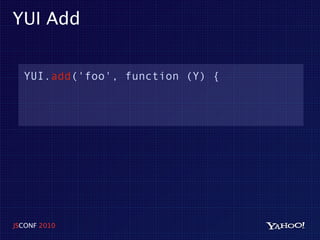
YUI Add


  YUI.add('foo', function (Y) {


JSCONF 2010
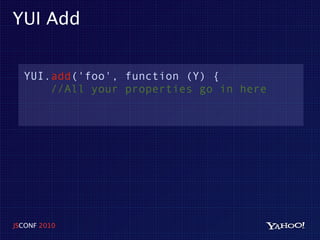
YUI Add


  YUI.add('foo', function (Y) {
      //All your properties go in here


JSCONF 2010
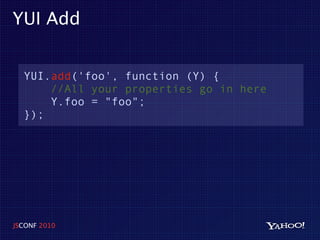
YUI Add


  YUI.add('foo', function (Y) {
      //All your properties go in here
      Y.foo = "foo";


JSCONF 2010
YUI Add


  YUI.add('foo', function (Y) {
      //All your properties go in here
      Y.foo = "foo";
  });


JSCONF 2010
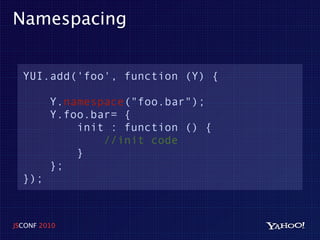
Namespacing


  YUI.add('foo', function (Y) {

         Y.namespace("foo.bar");
         Y.foo.bar= {
             init : function () {
                 //init code
             }
         };
  });


JSCONF 2010
YUI.add() - Version and
requirements


JSCONF 2010
YUI.add() - Version and
requirements

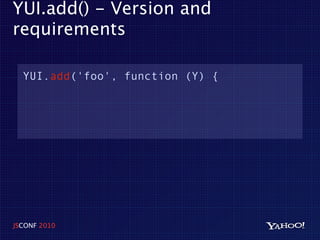
  YUI.add('foo', function (Y) {


JSCONF 2010
YUI.add() - Version and
requirements

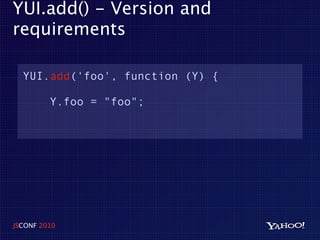
  YUI.add('foo', function (Y) {

         Y.foo = "foo";


JSCONF 2010
YUI.add() - Version and
requirements

  YUI.add('foo', function (Y) {

         Y.foo = "foo";

  },'0.0.1’, { requires: ['node'] });


JSCONF 2010
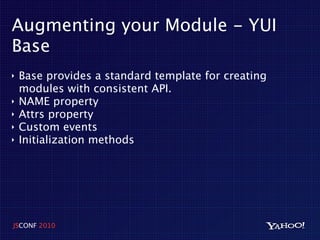
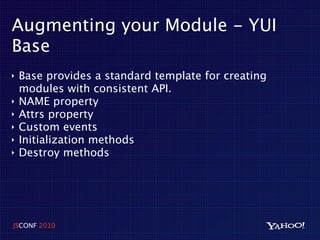
Augmenting your Module - YUI
Base


JSCONF 2010
Augmenting your Module - YUI
Base
‣   Base provides a standard template for creating
    modules with consistent API.


JSCONF 2010
Augmenting your Module - YUI
Base
‣   Base provides a standard template for creating
    modules with consistent API.
‣   NAME property


JSCONF 2010
Augmenting your Module - YUI
Base
‣   Base provides a standard template for creating
    modules with consistent API.
‣   NAME property
‣   Attrs property


JSCONF 2010
Augmenting your Module - YUI
Base
‣   Base provides a standard template for creating
    modules with consistent API.
‣   NAME property
‣   Attrs property
‣   Custom events


JSCONF 2010
Augmenting your Module - YUI
Base
‣   Base provides a standard template for creating
    modules with consistent API.
‣   NAME property
‣   Attrs property
‣   Custom events
‣   Initialization methods


JSCONF 2010
Augmenting your Module - YUI
Base
‣   Base provides a standard template for creating
    modules with consistent API.
‣   NAME property
‣   Attrs property
‣   Custom events
‣   Initialization methods
‣   Destroy methods


JSCONF 2010
YUI Base: Attribute


JSCONF 2010
YUI Base: Attribute


‣   Consistent API and documentation - Blue prints


JSCONF 2010
YUI Base: Attribute


‣   Consistent API and documentation - Blue prints
‣   Built in Setters and Getters


JSCONF 2010
YUI Base: Attribute


‣   Consistent API and documentation - Blue prints
‣   Built in Setters and Getters
‣   NameSpacing


JSCONF 2010
YUI Base: Attribute


‣   Consistent API and documentation - Blue prints
‣   Built in Setters and Getters
‣   NameSpacing

       http://developer.yahoo.com/yui/3/attribute/


JSCONF 2010
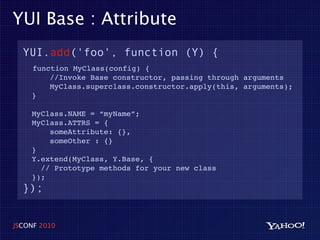
YUI Base : Attribute
  YUI.add('foo', function (Y) {
    function MyClass(config) {
        //Invoke Base constructor, passing through arguments
        MyClass.superclass.constructor.apply(this, arguments);
    }

    MyClass.NAME = “myName”;
    MyClass.ATTRS = {
        someAttribute: {},
        someOther : {}
    }
    Y.extend(MyClass, Y.Base, {
      // Prototype methods for your new class
    });
  });


JSCONF 2010
YUI Base - Events


JSCONF 2010
YUI Base - Events


‣   Custom events


JSCONF 2010
YUI Base - Events


‣   Custom events
‣   Bubbling


JSCONF 2010
YUI Base - Events


‣   Custom events
‣   Bubbling
‣   Event Broadcasting


JSCONF 2010
YUI Base - Events


‣   Custom events
‣   Bubbling
‣   Event Broadcasting

        http://developer.yahoo.com/yui/3/base/


JSCONF 2010
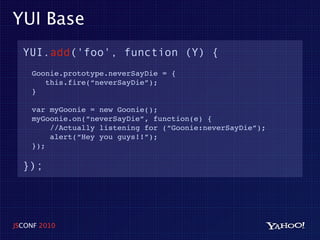
YUI Base
  YUI.add('foo', function (Y) {
    Goonie.prototype.neverSayDie = {
       this.fire(“neverSayDie”);
    }

    var myGoonie = new Goonie();
    myGoonie.on(“neverSayDie”, function(e) {
        //Actually listening for (“Goonie:neverSayDie”);
        alert(“Hey you guys!!”);
    });

  });


JSCONF 2010
Loading Strategies - By Inclusion

    YUI.add('today', function (Y) {
        Y.today = new Date();

    },0.0.1,{requires[‘node’]});


    YUI.use('today', function (Y) {
        Y.one('#when').setContent( Y.today );

    });


JSCONF 2010
Loading Strategies - By
Configuration

  YUI({
  modules: {
          'foo': {
              fullpath: 'foo.js',
              requires: ['node']
          }
  }).use('foo', function (Y) {
   //foo ready to use
  });


JSCONF 2010
Loading strategies


               Or...


JSCONF 2010
Introducing The YUI Gallery


YUICONF 2009
I can haz YUI Gallery


              Image Title
JSCONF 2010
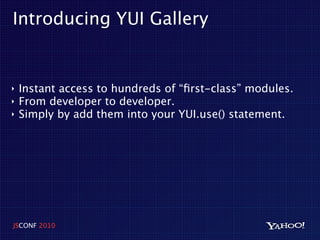
Introducing YUI Gallery


JSCONF 2010
Introducing YUI Gallery


‣   Instant access to hundreds of “first-class” modules.


JSCONF 2010
Introducing YUI Gallery


‣   Instant access to hundreds of “first-class” modules.
‣   From developer to developer.


JSCONF 2010
Introducing YUI Gallery


‣   Instant access to hundreds of “first-class” modules.
‣   From developer to developer.
‣   Simply by add them into your YUI.use() statement.


JSCONF 2010
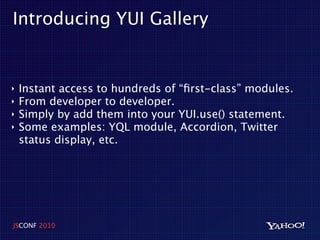
Introducing YUI Gallery


‣   Instant access to hundreds of “first-class” modules.
‣   From developer to developer.
‣   Simply by add them into your YUI.use() statement.
‣   Some examples: YQL module, Accordion, Twitter
    status display, etc.


JSCONF 2010
JSCONF 2010
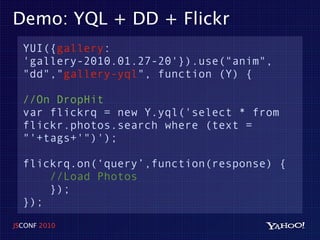
Demo: YQL + DD + Flickr
  YUI({gallery:
  'gallery-2010.01.27-20'}).use("anim",
  "dd","gallery-yql", function (Y) {

  //On DropHit
  var flickrq = new Y.yql('select * from
  flickr.photos.search where (text =
  "'+tags+'")');

  flickrq.on(‘query’,function(response) {
      //Load Photos
      });
  });
JSCONF 2010
Contributing to the YUI Gallery


JSCONF 2010
Benefits


JSCONF 2010
Benefits


‣   Your code in our CDN!


JSCONF 2010
Benefits


‣   Your code in our CDN!
‣   Your module live within one week


JSCONF 2010
Benefits


‣   Your code in our CDN!
‣   Your module live within one week
‣   Visibility


JSCONF 2010
Benefits


‣   Your code in our CDN!
‣   Your module live within one week
‣   Visibility
‣   Easy access within your YUI().use statament.


JSCONF 2010
Benefits


‣   Your code in our CDN!
‣   Your module live within one week
‣   Visibility
‣   Easy access within your YUI().use statament.
‣   Contributing and being part of the JS community.


JSCONF 2010
How to contribute


JSCONF 2010
How to contribute
‣   1 - Create your module


JSCONF 2010
How to contribute
‣   1 - Create your module
‣   2 - Create a YUI Library account


JSCONF 2010
How to contribute
‣   1 - Create your module
‣   2 - Create a YUI Library account
‣   3- Fork YUI3 on github


JSCONF 2010
How to contribute
‣   1 - Create your module
‣   2 - Create a YUI Library account
‣   3- Fork YUI3 on github
‣   4- Submit your module


JSCONF 2010
How to contribute
‣   1 - Create your module
‣   2 - Create a YUI Library account
‣   3- Fork YUI3 on github
‣   4- Submit your module
‣   5- Get approved - Your code now live on Yahoo! CDN
    servers.


JSCONF 2010
How to contribute
‣   1 - Create your module
‣   2 - Create a YUI Library account
‣   3- Fork YUI3 on github
‣   4- Submit your module
‣   5- Get approved - Your code now live on Yahoo! CDN
    servers.

              http://yuilibrary.com/gallery/


JSCONF 2010
YUI3 - Custom Modules

                           Gonzalo
                           Cordero
                 yuilibrary: gonzalocordero
                          github: goonieiam
                        twitter: @goonieiam


JSCONF 2009

Creating custom modules using YUI3

  • 1.
    YUI3 - CreatingCustom Modules Gonzalo Cordero Yahoo! Front End Engineer JSCONF 2010
  • 2.
  • 3.
  • 4.
  • 5.
    YUI Add YUI.add('foo', function (Y) { JSCONF 2010
  • 6.
    YUI Add YUI.add('foo', function (Y) { //All your properties go in here JSCONF 2010
  • 7.
    YUI Add YUI.add('foo', function (Y) { //All your properties go in here Y.foo = "foo"; JSCONF 2010
  • 8.
    YUI Add YUI.add('foo', function (Y) { //All your properties go in here Y.foo = "foo"; }); JSCONF 2010
  • 9.
    Namespacing YUI.add('foo',function (Y) { Y.namespace("foo.bar"); Y.foo.bar= { init : function () { //init code } }; }); JSCONF 2010
  • 10.
    YUI.add() - Versionand requirements JSCONF 2010
  • 11.
    YUI.add() - Versionand requirements YUI.add('foo', function (Y) { JSCONF 2010
  • 12.
    YUI.add() - Versionand requirements YUI.add('foo', function (Y) { Y.foo = "foo"; JSCONF 2010
  • 13.
    YUI.add() - Versionand requirements YUI.add('foo', function (Y) { Y.foo = "foo"; },'0.0.1’, { requires: ['node'] }); JSCONF 2010
  • 14.
    Augmenting your Module- YUI Base JSCONF 2010
  • 15.
    Augmenting your Module- YUI Base ‣ Base provides a standard template for creating modules with consistent API. JSCONF 2010
  • 16.
    Augmenting your Module- YUI Base ‣ Base provides a standard template for creating modules with consistent API. ‣ NAME property JSCONF 2010
  • 17.
    Augmenting your Module- YUI Base ‣ Base provides a standard template for creating modules with consistent API. ‣ NAME property ‣ Attrs property JSCONF 2010
  • 18.
    Augmenting your Module- YUI Base ‣ Base provides a standard template for creating modules with consistent API. ‣ NAME property ‣ Attrs property ‣ Custom events JSCONF 2010
  • 19.
    Augmenting your Module- YUI Base ‣ Base provides a standard template for creating modules with consistent API. ‣ NAME property ‣ Attrs property ‣ Custom events ‣ Initialization methods JSCONF 2010
  • 20.
    Augmenting your Module- YUI Base ‣ Base provides a standard template for creating modules with consistent API. ‣ NAME property ‣ Attrs property ‣ Custom events ‣ Initialization methods ‣ Destroy methods JSCONF 2010
  • 21.
  • 22.
    YUI Base: Attribute ‣ Consistent API and documentation - Blue prints JSCONF 2010
  • 23.
    YUI Base: Attribute ‣ Consistent API and documentation - Blue prints ‣ Built in Setters and Getters JSCONF 2010
  • 24.
    YUI Base: Attribute ‣ Consistent API and documentation - Blue prints ‣ Built in Setters and Getters ‣ NameSpacing JSCONF 2010
  • 25.
    YUI Base: Attribute ‣ Consistent API and documentation - Blue prints ‣ Built in Setters and Getters ‣ NameSpacing http://developer.yahoo.com/yui/3/attribute/ JSCONF 2010
  • 26.
    YUI Base :Attribute YUI.add('foo', function (Y) { function MyClass(config) { //Invoke Base constructor, passing through arguments MyClass.superclass.constructor.apply(this, arguments); } MyClass.NAME = “myName”; MyClass.ATTRS = { someAttribute: {}, someOther : {} } Y.extend(MyClass, Y.Base, { // Prototype methods for your new class }); }); JSCONF 2010
  • 27.
    YUI Base -Events JSCONF 2010
  • 28.
    YUI Base -Events ‣ Custom events JSCONF 2010
  • 29.
    YUI Base -Events ‣ Custom events ‣ Bubbling JSCONF 2010
  • 30.
    YUI Base -Events ‣ Custom events ‣ Bubbling ‣ Event Broadcasting JSCONF 2010
  • 31.
    YUI Base -Events ‣ Custom events ‣ Bubbling ‣ Event Broadcasting http://developer.yahoo.com/yui/3/base/ JSCONF 2010
  • 32.
    YUI Base YUI.add('foo', function (Y) { Goonie.prototype.neverSayDie = { this.fire(“neverSayDie”); } var myGoonie = new Goonie(); myGoonie.on(“neverSayDie”, function(e) { //Actually listening for (“Goonie:neverSayDie”); alert(“Hey you guys!!”); }); }); JSCONF 2010
  • 33.
    Loading Strategies -By Inclusion YUI.add('today', function (Y) { Y.today = new Date(); },0.0.1,{requires[‘node’]}); YUI.use('today', function (Y) { Y.one('#when').setContent( Y.today ); }); JSCONF 2010
  • 34.
    Loading Strategies -By Configuration YUI({ modules: { 'foo': { fullpath: 'foo.js', requires: ['node'] } }).use('foo', function (Y) { //foo ready to use }); JSCONF 2010
  • 35.
    Loading strategies Or... JSCONF 2010
  • 36.
    Introducing The YUIGallery YUICONF 2009
  • 37.
    I can hazYUI Gallery Image Title JSCONF 2010
  • 38.
  • 39.
    Introducing YUI Gallery ‣ Instant access to hundreds of “first-class” modules. JSCONF 2010
  • 40.
    Introducing YUI Gallery ‣ Instant access to hundreds of “first-class” modules. ‣ From developer to developer. JSCONF 2010
  • 41.
    Introducing YUI Gallery ‣ Instant access to hundreds of “first-class” modules. ‣ From developer to developer. ‣ Simply by add them into your YUI.use() statement. JSCONF 2010
  • 42.
    Introducing YUI Gallery ‣ Instant access to hundreds of “first-class” modules. ‣ From developer to developer. ‣ Simply by add them into your YUI.use() statement. ‣ Some examples: YQL module, Accordion, Twitter status display, etc. JSCONF 2010
  • 43.
  • 44.
    Demo: YQL +DD + Flickr YUI({gallery: 'gallery-2010.01.27-20'}).use("anim", "dd","gallery-yql", function (Y) { //On DropHit var flickrq = new Y.yql('select * from flickr.photos.search where (text = "'+tags+'")'); flickrq.on(‘query’,function(response) { //Load Photos }); }); JSCONF 2010
  • 45.
    Contributing to theYUI Gallery JSCONF 2010
  • 46.
  • 47.
    Benefits ‣ Your code in our CDN! JSCONF 2010
  • 48.
    Benefits ‣ Your code in our CDN! ‣ Your module live within one week JSCONF 2010
  • 49.
    Benefits ‣ Your code in our CDN! ‣ Your module live within one week ‣ Visibility JSCONF 2010
  • 50.
    Benefits ‣ Your code in our CDN! ‣ Your module live within one week ‣ Visibility ‣ Easy access within your YUI().use statament. JSCONF 2010
  • 51.
    Benefits ‣ Your code in our CDN! ‣ Your module live within one week ‣ Visibility ‣ Easy access within your YUI().use statament. ‣ Contributing and being part of the JS community. JSCONF 2010
  • 52.
  • 53.
    How to contribute ‣ 1 - Create your module JSCONF 2010
  • 54.
    How to contribute ‣ 1 - Create your module ‣ 2 - Create a YUI Library account JSCONF 2010
  • 55.
    How to contribute ‣ 1 - Create your module ‣ 2 - Create a YUI Library account ‣ 3- Fork YUI3 on github JSCONF 2010
  • 56.
    How to contribute ‣ 1 - Create your module ‣ 2 - Create a YUI Library account ‣ 3- Fork YUI3 on github ‣ 4- Submit your module JSCONF 2010
  • 57.
    How to contribute ‣ 1 - Create your module ‣ 2 - Create a YUI Library account ‣ 3- Fork YUI3 on github ‣ 4- Submit your module ‣ 5- Get approved - Your code now live on Yahoo! CDN servers. JSCONF 2010
  • 58.
    How to contribute ‣ 1 - Create your module ‣ 2 - Create a YUI Library account ‣ 3- Fork YUI3 on github ‣ 4- Submit your module ‣ 5- Get approved - Your code now live on Yahoo! CDN servers. http://yuilibrary.com/gallery/ JSCONF 2010
  • 59.
    YUI3 - CustomModules Gonzalo Cordero yuilibrary: gonzalocordero github: goonieiam twitter: @goonieiam JSCONF 2009

Editor's Notes

  • #3 In YUI 3, the new global is YUI YUI is a function, not just an object bag ala YAHOO. It returns an instance, your sandbox. The library API is added to the YUI instance, not YUI. Facilitates having multiple sandboxes on a page w/o collision.
  • #5 - Custom modules are made available to YUI instances by registering themselves via YUI.add() - As with Y.use(), YUI.add() provides an applied module pattern - This gives you a truly private space to define vars and functions local to your module - Code defined inside add() is held by the YUI infrastructure to execute at the proper time - Module code is not executed until a YUI instance requests it via Y.use(&apos;my-module&apos;, function (Y) {...}); but it is executed at some point after its required modules and before the use callback.
  • #6 - Custom modules are made available to YUI instances by registering themselves via YUI.add() - As with Y.use(), YUI.add() provides an applied module pattern - This gives you a truly private space to define vars and functions local to your module - Code defined inside add() is held by the YUI infrastructure to execute at the proper time - Module code is not executed until a YUI instance requests it via Y.use(&apos;my-module&apos;, function (Y) {...}); but it is executed at some point after its required modules and before the use callback.
  • #7 - Custom modules are made available to YUI instances by registering themselves via YUI.add() - As with Y.use(), YUI.add() provides an applied module pattern - This gives you a truly private space to define vars and functions local to your module - Code defined inside add() is held by the YUI infrastructure to execute at the proper time - Module code is not executed until a YUI instance requests it via Y.use(&apos;my-module&apos;, function (Y) {...}); but it is executed at some point after its required modules and before the use callback.
  • #8 - Custom modules are made available to YUI instances by registering themselves via YUI.add() - As with Y.use(), YUI.add() provides an applied module pattern - This gives you a truly private space to define vars and functions local to your module - Code defined inside add() is held by the YUI infrastructure to execute at the proper time - Module code is not executed until a YUI instance requests it via Y.use(&apos;my-module&apos;, function (Y) {...}); but it is executed at some point after its required modules and before the use callback.
  • #10 - &apos;version&apos; has nothing to do with the YUI version you require - &apos;version&apos; allows you to define version information for your component - &apos;requires&apos; defines the dependancies for your component
  • #11 - &apos;version&apos; has nothing to do with the YUI version you require - &apos;version&apos; allows you to define version information for your component - &apos;requires&apos; defines the dependancies for your component
  • #12 - &apos;version&apos; has nothing to do with the YUI version you require - &apos;version&apos; allows you to define version information for your component - &apos;requires&apos; defines the dependancies for your component