S.S.P.M.’s College of Engineering, Kankavli
Computer Department
Create Your Own
Operating System
Presented by:
Mr.Ketan.M.Tapkikar
Mr.Dhiraj.A.Waghat
Mr.Omkar.G.Walavalkar
Under the guidance of:
Prof. D.P.Mahapsekar.
1
S.S.P.M.’s College of Engineering, Kankavli
Computer Department
2
INDEX
 Introduction
 Aims & Objective
 Existing system
 Problem Definition
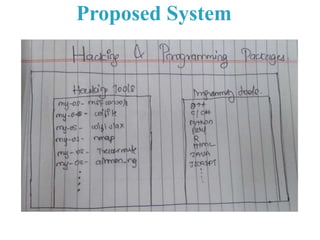
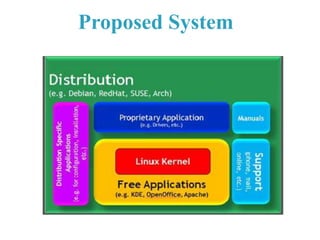
 Proposed system
 Implementation
 Conclusion
 References
S.S.P.M.’s College of Engineering, Kankavli
Computer Department
3
Introduction
• Create Your Own OS.
• HACKING , Authentication &
Programming.(HAP)
• Improved GUI & Better Performance.
S.S.P.M.’s College of Engineering, Kankavli
Computer Department
Aims & Objective
4
• To Developed our own Operating System
• Provide Hacking Tools & Packages.
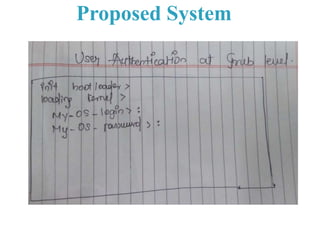
• Provide User Authentication.
• Provide Programming Environment.
• Provide Our own OS Flavour.
S.S.P.M.’s College of Engineering, Kankavli
Computer Department
• Existing system uses Vulnerable Athentication.
• Does not Contain Pre-Defined packages.
• No Pre-install Programming IDE.
• There Are Various Different System For
Different Need.
5
Existing System
S.S.P.M.’s College of Engineering, Kankavli
Computer Department
6
• Existing system uses Vulnerable Athentication.
• Does not Contain Pre-Defined packages.
• No Pre-install Programming IDE.
Problem Definition
S.S.P.M.’s College of Engineering, Kankavli
Computer Department
7
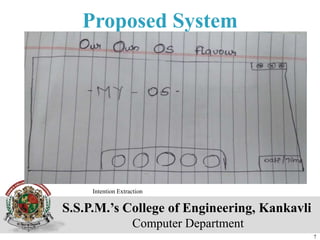
Proposed System
Attitude Detection
Intention Extraction
Proposed System
Proposed System
Proposed System
S.S.P.M.’s College of Engineering, Kankavli
Computer Department
11
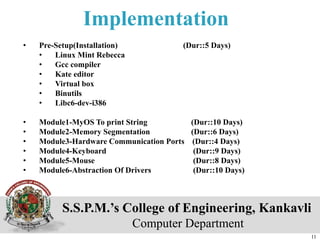
• Pre-Setup(Installation) (Dur::5 Days)
• Linux Mint Rebecca
• Gcc compiler
• Kate editor
• Virtual box
• Binutils
• Libc6-dev-i386
• Module1-MyOS To print String (Dur::10 Days)
• Module2-Memory Segmentation (Dur::6 Days)
• Module3-Hardware Communication Ports (Dur::4 Days)
• Module4-Keyboard (Dur::9 Days)
• Module5-Mouse (Dur::8 Days)
• Module6-Abstraction Of Drivers (Dur::10 Days)
Implementation
S.S.P.M.’s College of Engineering, Kankavli
Computer Department
12
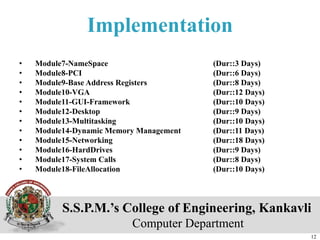
• Module7-NameSpace (Dur::3 Days)
• Module8-PCI (Dur::6 Days)
• Module9-Base Address Registers (Dur::8 Days)
• Module10-VGA (Dur::12 Days)
• Module11-GUI-Framework (Dur::10 Days)
• Module12-Desktop (Dur::9 Days)
• Module13-Multitasking (Dur::10 Days)
• Module14-Dynamic Memory Management (Dur::11 Days)
• Module15-Networking (Dur::18 Days)
• Module16-HardDrives (Dur::9 Days)
• Module17-System Calls (Dur::8 Days)
• Module18-FileAllocation (Dur::10 Days)
Implementation
S.S.P.M.’s College of Engineering, Kankavli
Computer Department
13
• How a computer boots
• How to write low-level programs in the barren
landscape where no operating system yet exists
• How to configure the CPU so that we can begin to
use its extended functionality
• How to bootstrap code written in a higher-level
language, so that we can really start to make
some progress towards our own operating system
• How to create some fundamental operating
system services, such as device drivers,file
systems, multi-tasking processing.
Conclusion
S.S.P.M.’s College of Engineering, Kankavli
Computer Department
14
[1] D. R. Brownbridge, L.F. Marshall, and B. Randell. The newcastle
connec-
tion, or UNIXes of the world unite! Software - Practice and Experience,
20, 1982.
[2] M. Satyanarayanan et al. The ITC distributed file ssystem: Principles
and
design. pages 35–50. ACM, December 1985.
References
S.S.P.M.’s College of Engineering, Kankavli
Computer Department
15
THANK YOU…

Create Your Own Operating System

  • 1.
    S.S.P.M.’s College ofEngineering, Kankavli Computer Department Create Your Own Operating System Presented by: Mr.Ketan.M.Tapkikar Mr.Dhiraj.A.Waghat Mr.Omkar.G.Walavalkar Under the guidance of: Prof. D.P.Mahapsekar. 1
  • 2.
    S.S.P.M.’s College ofEngineering, Kankavli Computer Department 2 INDEX  Introduction  Aims & Objective  Existing system  Problem Definition  Proposed system  Implementation  Conclusion  References
  • 3.
    S.S.P.M.’s College ofEngineering, Kankavli Computer Department 3 Introduction • Create Your Own OS. • HACKING , Authentication & Programming.(HAP) • Improved GUI & Better Performance.
  • 4.
    S.S.P.M.’s College ofEngineering, Kankavli Computer Department Aims & Objective 4 • To Developed our own Operating System • Provide Hacking Tools & Packages. • Provide User Authentication. • Provide Programming Environment. • Provide Our own OS Flavour.
  • 5.
    S.S.P.M.’s College ofEngineering, Kankavli Computer Department • Existing system uses Vulnerable Athentication. • Does not Contain Pre-Defined packages. • No Pre-install Programming IDE. • There Are Various Different System For Different Need. 5 Existing System
  • 6.
    S.S.P.M.’s College ofEngineering, Kankavli Computer Department 6 • Existing system uses Vulnerable Athentication. • Does not Contain Pre-Defined packages. • No Pre-install Programming IDE. Problem Definition
  • 7.
    S.S.P.M.’s College ofEngineering, Kankavli Computer Department 7 Proposed System Attitude Detection Intention Extraction
  • 8.
  • 9.
  • 10.
  • 11.
    S.S.P.M.’s College ofEngineering, Kankavli Computer Department 11 • Pre-Setup(Installation) (Dur::5 Days) • Linux Mint Rebecca • Gcc compiler • Kate editor • Virtual box • Binutils • Libc6-dev-i386 • Module1-MyOS To print String (Dur::10 Days) • Module2-Memory Segmentation (Dur::6 Days) • Module3-Hardware Communication Ports (Dur::4 Days) • Module4-Keyboard (Dur::9 Days) • Module5-Mouse (Dur::8 Days) • Module6-Abstraction Of Drivers (Dur::10 Days) Implementation
  • 12.
    S.S.P.M.’s College ofEngineering, Kankavli Computer Department 12 • Module7-NameSpace (Dur::3 Days) • Module8-PCI (Dur::6 Days) • Module9-Base Address Registers (Dur::8 Days) • Module10-VGA (Dur::12 Days) • Module11-GUI-Framework (Dur::10 Days) • Module12-Desktop (Dur::9 Days) • Module13-Multitasking (Dur::10 Days) • Module14-Dynamic Memory Management (Dur::11 Days) • Module15-Networking (Dur::18 Days) • Module16-HardDrives (Dur::9 Days) • Module17-System Calls (Dur::8 Days) • Module18-FileAllocation (Dur::10 Days) Implementation
  • 13.
    S.S.P.M.’s College ofEngineering, Kankavli Computer Department 13 • How a computer boots • How to write low-level programs in the barren landscape where no operating system yet exists • How to configure the CPU so that we can begin to use its extended functionality • How to bootstrap code written in a higher-level language, so that we can really start to make some progress towards our own operating system • How to create some fundamental operating system services, such as device drivers,file systems, multi-tasking processing. Conclusion
  • 14.
    S.S.P.M.’s College ofEngineering, Kankavli Computer Department 14 [1] D. R. Brownbridge, L.F. Marshall, and B. Randell. The newcastle connec- tion, or UNIXes of the world unite! Software - Practice and Experience, 20, 1982. [2] M. Satyanarayanan et al. The ITC distributed file ssystem: Principles and design. pages 35–50. ACM, December 1985. References
  • 15.
    S.S.P.M.’s College ofEngineering, Kankavli Computer Department 15 THANK YOU…