C++ Operators
Jim Fawcett
Copyright © 2002-2006
CSE687 – Object Oriented Design Class Notes
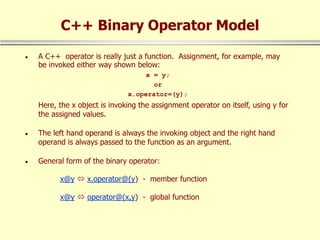
 A C++ operator is really just a function. Assignment, for example, may
be invoked either way shown below:
x = y;
or
x.operator=(y);
Here, the x object is invoking the assignment operator on itself, using y for
the assigned values.
 The left hand operand is always the invoking object and the right hand
operand is always passed to the function as an argument.
 General form of the binary operator:
x@y  x.operator@(y) - member function
x@y  operator@(x,y) - global function
C++ Binary Operator Model
Indexing Operators
 Indexing operators should usually come in pairs:
val& X::operator[](int n); x[3] = ‘a’;
val X::operator[](int n) const; char ch = x[2];
 The second form allows you to pass an indexed object into a
function by const reference and still be able to read indexed
values.
With only the first form, any indexing in the function will result
in a compile time error since the operator does not guarantee
not to change the const object.
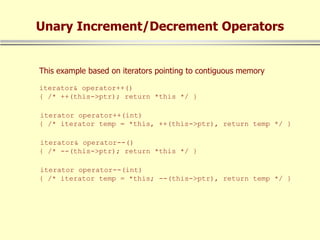
Unary Increment/Decrement Operators
This example based on iterators pointing to contiguous memory
iterator& operator++()
{ /* ++(this->ptr); return *this */ }
iterator operator++(int)
{ /* iterator temp = *this, ++(this->ptr), return temp */ }
iterator& operator--()
{ /* --(this->ptr); return *this */ }
iterator operator--(int)
{ /* iterator temp = *this; --(this->ptr), return temp */ }
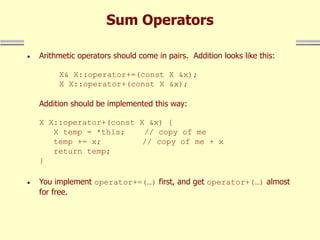
Sum Operators
 Arithmetic operators should come in pairs. Addition looks like this:
X& X::operator+=(const X &x);
X X::operator+(const X &x);
Addition should be implemented this way:
X X::operator+(const X &x) {
X temp = *this; // copy of me
temp += x; // copy of me + x
return temp;
}
 You implement operator+=(…) first, and get operator+(…) almost
for free.
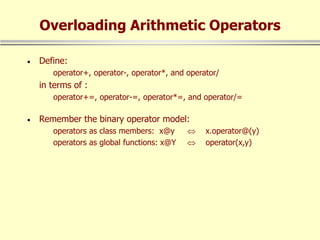
Overloading Arithmetic Operators
 Define:
operator+, operator-, operator*, and operator/
in terms of :
operator+=, operator-=, operator*=, and operator/=
 Remember the binary operator model:
operators as class members: x@y  x.operator@(y)
operators as global functions: x@Y  operator(x,y)
Insertion
 The insertion and extraction operators:
ostream& operator(ostream& out, const X &x);
istream& operator(ostream& in, const X &x);
Have to be implemented as global (non-member) functions since they
are invoked with the statements:
out << x; and in >> x;
 Since the streams, out and in, appear on the left side of the operator,
and are not objects of the X class, we must use the global form shown
at the top of this slide.
 You should try to implement them without making them friends of the
X class. You may need to implement public helper functions to do that.
End of Presentation

CppOperators.ppt

  • 1.
    C++ Operators Jim Fawcett Copyright© 2002-2006 CSE687 – Object Oriented Design Class Notes
  • 2.
     A C++operator is really just a function. Assignment, for example, may be invoked either way shown below: x = y; or x.operator=(y); Here, the x object is invoking the assignment operator on itself, using y for the assigned values.  The left hand operand is always the invoking object and the right hand operand is always passed to the function as an argument.  General form of the binary operator: x@y  x.operator@(y) - member function x@y  operator@(x,y) - global function C++ Binary Operator Model
  • 3.
    Indexing Operators  Indexingoperators should usually come in pairs: val& X::operator[](int n); x[3] = ‘a’; val X::operator[](int n) const; char ch = x[2];  The second form allows you to pass an indexed object into a function by const reference and still be able to read indexed values. With only the first form, any indexing in the function will result in a compile time error since the operator does not guarantee not to change the const object.
  • 4.
    Unary Increment/Decrement Operators Thisexample based on iterators pointing to contiguous memory iterator& operator++() { /* ++(this->ptr); return *this */ } iterator operator++(int) { /* iterator temp = *this, ++(this->ptr), return temp */ } iterator& operator--() { /* --(this->ptr); return *this */ } iterator operator--(int) { /* iterator temp = *this; --(this->ptr), return temp */ }
  • 5.
    Sum Operators  Arithmeticoperators should come in pairs. Addition looks like this: X& X::operator+=(const X &x); X X::operator+(const X &x); Addition should be implemented this way: X X::operator+(const X &x) { X temp = *this; // copy of me temp += x; // copy of me + x return temp; }  You implement operator+=(…) first, and get operator+(…) almost for free.
  • 6.
    Overloading Arithmetic Operators Define: operator+, operator-, operator*, and operator/ in terms of : operator+=, operator-=, operator*=, and operator/=  Remember the binary operator model: operators as class members: x@y  x.operator@(y) operators as global functions: x@Y  operator(x,y)
  • 7.
    Insertion  The insertionand extraction operators: ostream& operator(ostream& out, const X &x); istream& operator(ostream& in, const X &x); Have to be implemented as global (non-member) functions since they are invoked with the statements: out << x; and in >> x;  Since the streams, out and in, appear on the left side of the operator, and are not objects of the X class, we must use the global form shown at the top of this slide.  You should try to implement them without making them friends of the X class. You may need to implement public helper functions to do that.
  • 8.