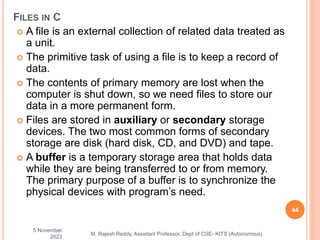
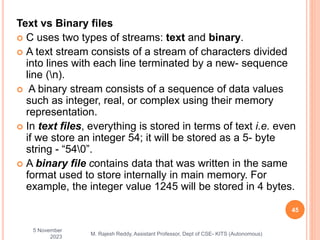
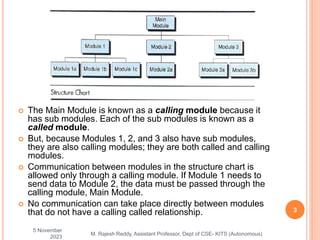
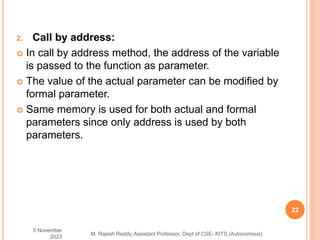
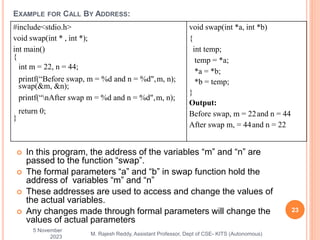
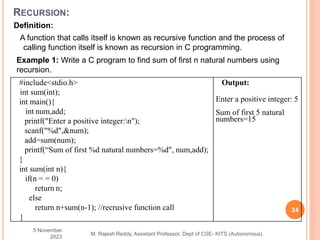
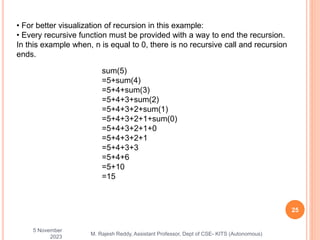
This document discusses functions in the C programming language. It begins by explaining the top-down design approach of breaking complex problems into smaller, modular parts called modules. It then defines functions as independent modules that perform specific tasks. Functions are declared with a return type and parameter list, defined with a body of code, and called by name with arguments. There are two main types of functions - library functions and user-defined functions. The document also covers function parameters, return values, and the different ways functions can be designed. It concludes by explaining the two techniques of passing arguments to functions: call by value and call by address.
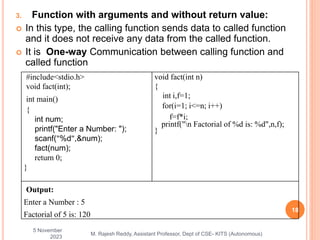
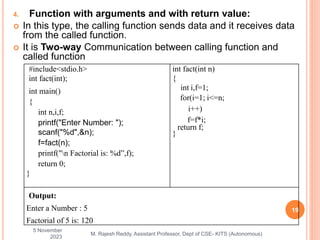
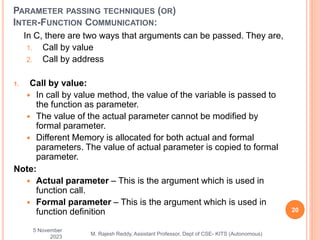
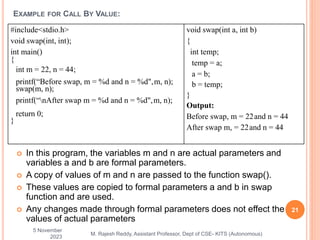
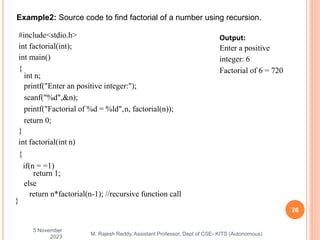
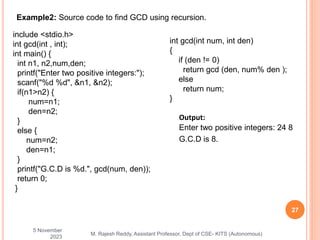
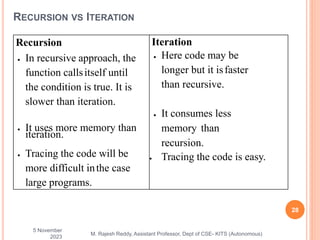
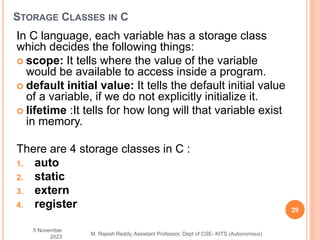
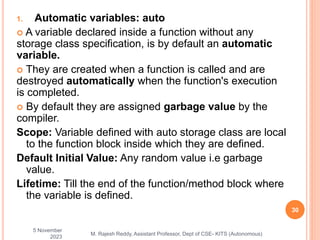
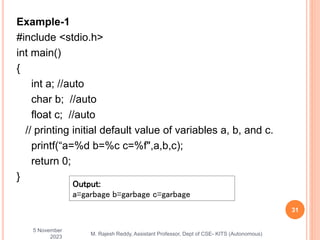
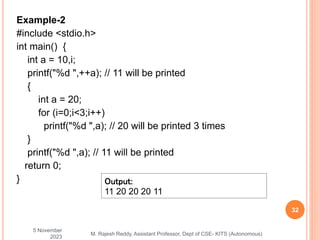
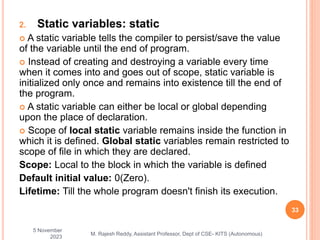
![ Whenever we need to pass a list of elements as argument to any
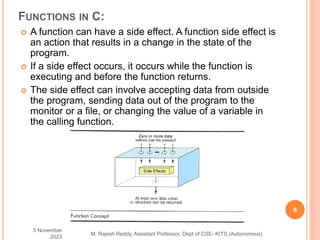
function in C language, it is preferred to do so using an array.
An array is passed to a function by using call by address
mechanism.
Ex:- float findAverage (int marks[ ]);
/*passing the array arr to the function sum()*/
5 November
2023
40
M. Rajesh Reddy, Assistant Professor, Dept of CSE- KITS (Autonomous)
PASSING AN ARRAY TO FUNCTION:
Example Program:
#include<stdio.h>
float findAverage(int marks[ ]);
int main() {
float avg;
int marks[ ] = {99, 90, 96, 93, 95};
avg = findAverage(marks);
//name of the array is passed as argument.
printf("Average marks = %.lf", avg);
return 0;
}
float findAverage(int marks[ ])
{
int i, sum = 0;
float avg;
for (i = 0; i <= 4; i++)
sum += marks[i];
avg = (sum / 5);
return avg;
}
Output:
94.6](https://image.slidesharecdn.com/cpfunctions-files-231105141704-eedeb23c/85/cpFunctions-Files-pptx-40-320.jpg)
![ The arguments passed from command line are called
command line arguments. These arguments are
handled by main() function.
To support command line argument, you need to
change the structure of main() function as given below.
Syntax: int main(int argc, char *argv[] )
argc counts the number of arguments on the
command line.
argv[ ] is a pointer array which holds pointers of type
char which points to the arguments passed to the
program.
5 November
2023
42
M. Rajesh Reddy, Assistant Professor, Dept of CSE- KITS (Autonomous)
COMMAND LINE ARGUMENTS IN C](https://image.slidesharecdn.com/cpfunctions-files-231105141704-eedeb23c/85/cpFunctions-Files-pptx-42-320.jpg)
![#include <stdio.h>
int main( int argc, char *argv[] )
{
if( argc >= 2 )
{
printf("The argument supplied are:n”);
for(i = 1; i < argc; i++)
printf("%st", argv[i]);
}
else
printf("argument list is empty.n");
return 0;
}
5 November
2023
43
M. Rajesh Reddy, Assistant Professor, Dept of CSE- KITS (Autonomous)
EXAMPLE PROGRAM FOR COMMAND LINE ARGUMENTS IN C
During compilation, pass the below arguments
through Command line
Mokshith 19 Male
Output:
The argument supplied are:
Mokshith 19 Male](https://image.slidesharecdn.com/cpfunctions-files-231105141704-eedeb23c/85/cpFunctions-Files-pptx-43-320.jpg)