4/24/2018 OpHouse
Team CPE
Grant Haven, Andrew Hoster, Joey Rudolph,
Michaela Schuch, Isaac Shubert, & Isaac Stacks
LIBERTY UNIVERSITY
Habitat for Humanity
1
Table of Contents
Executive Summary …………………………………………………………………………….2
Organizational/ Cultural Overview of Habitat of Humanity ………………………………….. 4
CPE Overview …………………………………………………………………………….........9
Project Proposal …………………………………………………………………………...…..10
Risk Overview ……………………………………………………………………….....……..11
Risk Assessment Form ………………………………………………………………...…..…..12
Risk Severity Matrix …………………………………………………………………..…...….13
Risk Response Matrix …………………………………………………………………….…...14
Communication Plan …………………………………………………………………….…….15
RACI Chart ………………………………………………………………………….………...16
Conclusion …………………………………………………………………………………….17
References ……………………………………………………………………………………. 18
Habitat for Humanity
2
Executive Summary
The Collaborative Project Enterprise (CPE) is a partnership of Pinnacle Custom Home
Builders, a subsidiary company of Vines and Branches, and the nonprofit organization Habitat
for Humanity. Vine and Branches owners, John and Mary, wish to utilize their financial success
by undertaking a global outreach project through a philanthropic endeavor in a developing
country. The decision was made to partner with Habitat for Humanity due to the organization’s
vision of creating a world where everyone has a decent place to live and mission of
implementing God’s love into action aligned immensely with the views of John, Mary, and
Pinnacle Custom Home Builders. Vine and Branches is comprised of three construction related
entities, Pinnacle Custom Home Builders, Walnut Grove, and Sunflower Designs which
complement the focus and function of Habitat for Humanity. Habitat for Humanity is
construction-centric, through the avenues of construction, disaster relief reconstruction, and their
“ReStore” stores.
The vision of the end product of the partnership is a 4-room group home in Haiti. This
building is crucial in Haiti, in light of recent disasters and a lack of affordable, safe housing for
families. The house will serve as a suitable shelter for multiple families in the local area of Haiti.
Haiti was chosen to be the location of the new group home because its demand for housing, its
alignment to the type of project John and Mary wanted to implement and support, and Habitat
for Humanity’s previous experience in Haiti.
The budget for the project is determined from the total revenue of Pinnacle Custom
Home Builders for the Nine Months Ended December 31, 2015, which is $1,185,000. Of the
total revenue the budget is to be 1%, resulting in a budget of $11,850 USD. The average cost to
construct a home in Haiti is approximately $7,000. It has been determined that the cost of
sending four members from Pinnacle Custom Home Builders to Haiti for the duration of the
project and the return back to the United States will be $2,800. $8,000 is budgeted for the
supplies to construct the home. This establishes a budget of $10,800 dollars, $1,050 below
budget. The $1,050 will be set aside as contingency funds. It is important to note that one United
States dollar (USD) is equal to 64.87 Haitian gourdes. The project of constructing the house,
from breaking ground on the foundation to handing over the key to the new residents, will take
one month of eight hours work days, five days a week to complete. This completion estimate
excludes the effects that may possibly be implemented by severe weather and other risks. The
numeric values have been determined from calculations, expert judgement, and analogous
estimating.
This CPE project utilizes stakeholder management by identifying all the stakeholders for
the project early on. The key stakeholders for the project are: the people the house is being built
for, Habitat for Humanity, and Pinnacle Custom Home Builders. Other stakeholders include the
Haitian government, the volunteers involved with the project, and the community the house will
be constructed in.
Since Haiti is a developing country, there are certain risks that need to be addressed in
risk management. First of all, Haiti is a country in the Caribbean and so it is prone to severe
weather at times, including hurricanes, and therefore is subject to the hurricane season from June
to October. Haiti has recently been hit by Hurricane Irma, a category five hurricane that caused
major devastation in the Atlantic region. Government corruption is another risk that would be
Habitat for Humanity
3
prevalent during the project. Corruption can cause problems with the financial aspect of the
project and the timeline of the project. Money and supplies are needed in Haiti, so the risk of
looting will be an issue as well. Steps will be taken to avoid this risk. Another risk is supplies
and contractors not showing up. Selecting reputable vendors and suppliers will be done to deter
this from happening. Despite the possible risks, partnering with Habitat for Humanity in Haiti
provides Pinnacle Custom Home Builders an excellent opportunity to implement a global project
that represents their values and beliefs well, while openly benefiting others.
Habitat for Humanity
4
Organizational/ Cultural Overview
Organizational Name/Vision/Mission
Habitat for Humanity
Our mission
Seeking to put God’s love into action, Habitat for Humanity brings people together to
build homes, communities and hope. (Habitat for Humanity, n.d.)
Our vision
A world where everyone has a decent place to live.
Our principles
1. Demonstrate the love of Jesus Christ.
2. Focus on shelter.
3. Advocate for affordable housing.
4. Promote dignity and hope.
5. Support sustainable and transformative development.
Who we are
Habitat for Humanity partners with people in your community, and all over the
world, to help them build or improve a place they can call home. Habitat homeowners
help build their own homes alongside volunteers and pay an affordable mortgage. With
your support, Habitat homeowners achieve the strength, stability and independence they
need to build a better life for themselves and for their families. Through our 2020
Strategic Plan, Habitat for Humanity will serve more people than ever before through
decent and affordable housing. (Habitat for Humanity, n.d.)
Non-proselytizing policy
Habitat for Humanity and its affiliate organizations will not proselytize. Nor will
Habitat work with entities or individuals who insist on proselytizing as part of their work
with Habitat. This means that Habitat will not offer assistance on the expressed or
implied condition that people must adhere to or convert to a particular faith or listen and
respond to messaging designed to induce conversion to a particular faith. (Habitat for
Humanity, n.d.)
History/Values
The idea that became Habitat for Humanity first grew from the fertile soil of Koinonia
Farm, a community farm outside of Americus, Georgia, founded by farmer and biblical scholar
Clarence Jordan.
On the farm, Jordan and Habitat’s eventual founders Millard and Linda Fuller developed
the concept of “partnership housing.” The concept centered on those in need of adequate shelter
working side by side with volunteers to build decent, affordable houses. The houses would be
built at no profit. New homeowners’ house payments would be combined with no-interest loans
Habitat for Humanity
5
provided by supporters and money earned by fundraising to create “The Fund for Humanity,”
which would then be used to build more homes.
Beau and Emma were the owners of the first home built by Koinonia’s Partnership
Housing Program. They and their five children moved into a concrete-block home with a modern
kitchen, indoor bathroom and heating system, replacing the unpainted, uninsulated shack with no
plumbing where they had previously lived.
In 1973, the Fullers decided to take the Fund for Humanity concept to Zaire, now the
Democratic Republic of Congo. After three years of hard work to launch a successful house
building program there, the Fullers then returned to the United States and called together a group
of supporters to discuss the future of their dream: Habitat for Humanity International, founded in
1976.
The times have changed, the build site locations have grown in number, but the very real
change that Beau and Emma’s family experienced is shared by families today who partner with
Habitat to build or improve a place they can call home. Thanks in no small part to the personal
involvement of U.S. President Jimmy Carter and his wife Rosalynn and the awareness they have
raised, Habitat now works in nearly 1,400 communities across the U.S. and in approximately 70
countries and has helped 9.8 million people achieve strength, stability and independence through
safe, decent and affordable shelter.
Structure/Leadership
❖ Habitat for Humanity International’s work is overseen by an international board of
directors and senior leadership staff who deeply believe that all people deserve a
decent place to call home.
❖ Habitat’s board is responsible for establishing policy and guiding Habitat’s work to
construct, rehabilitate, repair and improve housing in approximately 70 countries.
❖ Habitat for Humanity International is managed by an administrative staff, led by CEO
Jonathan Reckford and senior leadership dedicated to the cause of decent and
affordable housing. (Habitat for Humanity, n.d.)
Approach to business/ outreach
Habitat for Humanity’s approach to business and outreach arises from a focus on
providing shelter for individuals in communities who cannot provide the shelter for themselves
through renting, owning, or building. Through this Habitat for Humanity promotes affordable
housing, while also creating a positive impact on the sustainability and transformation of the
communities they work in. Through their actions of outreach, Habitat for Humanity’s goal is to
promote dignity and hope.
Synopsis of current service/nations served
❖ United States and Canada: all 50 states, the District of Columbia and Puerto Rico.
Canada in all 10 provinces and each of the 3 territories
Habitat for Humanity
6
❖ Latin America and Caribbean: more than 15 countries including Argentina, Bolivia,
Brazil, Chile, Colombia, Dominican Republic, El Salvador, Guatemala, Haití,
Honduras, Jamaica, México, Nicaragua, Paraguay, Trinidad and Tobago.
❖ Europe, the Middle East and Africa: 25 countries in EMEA region include the
following countries: United Kingdom, Germany, South Africa, Ireland, Jordan,
Poland, Egypt, and more.
❖ Asia and the Pacific: more than 15 countries including the Philippines, India,
Australia, China, Japan, Hong Kong, New Zealand, and more. (Habitat for Humanity,
n.d.)
Habitat for Humanity
7
Country Cultural Overview
Name of Country
Haiti
Location/Region
Haiti is located in the Caribbean, on the island of Hispaniola. Haiti makes up one-third of
the island, while the Dominican Republic makes up the other two-thirds. It is located between
the Caribbean Sea and North Atlantic Ocean (Central Intelligence Agency, 2018).
Primary/Business Language
The official languages of the country of Haiti are French and Haitian Creole. English is
widely spoken in the business realm of Haiti, and serves as the primary business language. The
language of Spanish is also present in the business realm of Haiti but is not as widely spoken as
English (Export.gov, 2017).
Current Monetary Status/Exchange Rate
The Haitian Gourde is the current currency of the country of Haiti. It is composed of one
hundred centimes, and the letter G serves as its symbol (Investopedia, 2018). Currently, the
Haitian Gourde is issued in paper bills, and is in the denominations of 1, 2, 5, 20, 25, 50, 100 and
500. Two-thirds of Haitians are dependent on the agricultural sector, particular small-scale
subsistence farming, for their income and ability to contribute to the economy. In 2009, Haiti
qualified for the IMF and World Bank’s Heavily Indebted Poor Countries (HIPC), and was
forgiven of $1 billion of debt (Oanda, 2018). As of April 15, 2018 the exchange rate of the
Haitian Gourde (HTG) to USD was 1.00 HTG is the equivalent of 0.015 USD. Due to this
exchange rate, 1.00 USD is the equivalent of 65.1814 HTG (XE, 2018).
Topography/Geography/Climate
Haiti shares the Island of Hispaniola with the Dominican Republic in between the
Caribbean Sea and the North Atlantic Ocean located in the area referred to as the Caribbean or
part of Central America. The total land area of Haiti is 27,560 sq. km, and its total area including
water is 27,750 sq. km. The land has a border of 376 km, and the only border country is the
Dominican Republic. The coastline of Haiti is 1,771 km. Haiti's terrain is mostly rough and
mountainous. Of the land 66.4% is used for agriculture, 3.6% is forest, and 30% is used for
others focuses. The coastline is where a majority of Haiti’s population is concentrated. Haiti has
a tropical climate and is semiarid due to the mountains blocking the trade winds in the east. It is
important to note that Haiti is located in the hurricane belt, and is subject to severe storms and
flooding. Also, Haiti is sometimes subject to periods of drought, along with the risk of
earthquakes (Central Intelligence Agency, 2018).
Government
Over the course of history, Haiti has struggled with instability and violence amongst the
nation and within its own government. The country declared its independence in 1803, however,
there has been continuous issues within the country since that time. Today, the country of Haiti
is led by a semi-presidential republic system. Under this method, there is a president that serves
as head of state and a prime minister that serves as head of government. The Haitian government
Habitat for Humanity
8
is similar to the United States in that they have a legislative, judicial, and executive branch,
however, there is still a struggle within the nation.
Given the past turmoil within the country, there has been a struggle to manage the
economy effectively, which has opened up issues with violence, corruption, and drugs. These
issues have caused Haiti to be one of the poorest countries in the western hemisphere and caused
extreme poverty for a vast portion of the population. According to heritage.org, Haiti is the 124th
freest country as of 2018 (Haiti, 2018). Under their new president, Jovenel Moise, there have
been major improvements in an attempt to help the country and end a majority of the issues
faced within Haiti. There are still issues with corruption, however, the willingness of the current
administration to help the country is a good sign for those hoping to do missions work within the
country.
Economic
Due to past turmoil, the economy of Haiti is struggling. There is a significant deficit and
only 1% economic growth is expected this year (Overview, 2018). This is partly due to a poor
agricultural sector. The political instability has significantly affected business. However, there
have been attempts to increase growth by opening up ports to foreign investment and create an
easier electronic data system. Safety has also increased for workers in the country. Foreign
subsidies have hindered Haitian entrepreneurs. However, it would be recommended to work
alongside entrepreneurs in the country to help them become independent.
Religious/Cultural
According to aidforhaiti.org, a large number of Haitians claim to be Roman Catholic and
an increasing number of Protestants in the country. However, a major aspect to consider is that
almost all people in Haiti, regardless of religious affiliation, still have beliefs in Voodoo (Aid for
Haiti, 2018). This aspect of the Haitian culture would be a major aspect to be aware of for a
Christian organization to consider and know how to handle such a situation.
General Business Practices
Haiti has low labor costs and tariff-free access to the United States, which is a very good
opportunity to for American organizations to consider. However, there can be very different
aspects of business etiquette and practices to consider. Most businessmen in Haiti speak english
fluently and is considered the language of business. Appointments are expected to be made in
advance and much business is discussed in restaurants and hotels (export.gov, 2017). Another
aspect to be aware of is the extreme gender division in business in Haiti (haitiobserver.com).
Men typically dominate the business field and women are not found in business. This would be
an aspect to be aware of if women are hoping to do business in Haiti.
Volunteer Considerations
Typically, the Haitian community is very grateful for volunteer work that helps alleviate
issues that are plaguing the country. However, it seems that Haitians want to become
independent and would prefer to have aid from external sources that come alongside the Haitians
to help them become independent.
CPE Overview
Habitat for Humanity
9
IPM
The IPM for this CPE will be Hans Hansen, a project manager from Habitat for
Humanity. He has worked for the NPO for 13 years and has lead hundreds of budget-constrained
construction projects to fruition. He has experience in Haiti, and his work-related connections in
Haiti will help him find appropriate volunteers effortlessly.
Oversight, Scheduling, Changes, Etc.
The key to prevent oversight is through rigorous and extensive planning. However, oversights,
schedule changes and such will occur. Below is an explanation of who will handle issues, and
why.
❖ Oversight: Vine and Branches
▪ Rational- Vine and Branches is initiating the project, and they are the ones
looking to perform an environmental deed. Even though they may be
partnering with a large NPO, V&B must Any issues, regardless of who bring
them up, will be handles by Vines and Branches.
❖ Schedule: Habitat for Humanity
▪ Rational- Habitat for Humanity will be responsible for the majority of the
employees working on the group home, and they will be hiring these
individuals. It would be most efficient for them to make these decisions.
❖ Changes: Habitat for Humanity
▪ Rational- The NPO will also be handling changes for two reasons. One, they
already have a deep-rooted presence in Haiti. It would make risky to have
V&B make changes, when they have little experience of the country and the
effects changes could have Two, their volunteers will be doing most of the
work.
❖ Employee Performance: Will be handled by both parties
▪ Rational- If the employees are employed by V&B, then said organization will
handle performance. If the volunteers work for the NPO, then said NPO will
handle employee performance.
Organization Differences
Organizational differences will be minimal, due to both organizations aligning in vision and in
cultural. However, any differences must be established and handled in the early stages of the
project. Both companies must host transparency and present any presuppositions before the
project is underway. Both companies will speak with one another via SKYPE, to speak on
organizational difference before the American team flies to Haiti.
Budget
The budget will be established in the initiate phase of the project. Vine and Branches agreed to
put forward 1% of their Total Revenue, which is $11,850. The project will cost $10,500, which
is under budget!
Habitat for Humanity
10
Project Proposal Form
Project classification
Strategic
What business problem does this project solve?
Corporate Social Responsibility
How does this project align with Vine and Branches strategy?
By building a house that is quality, affordable, and sustainable.
What are the major deliverables?
Blueprint, Foundation, Walls, Roof, Electrical, Plumbing, Sheetrock, Painting, Finish
work, and Ribbon Cutting
What is the impact of not doing this project?
A group home in Haiti will not be available for tenants, keeping those individuals on the
streets
What are the three major risk for this project?
Weather
Supplies not being delivered
Looting
How will we measure success?
By completing all 10 deliverables, and having a group home that is ready for occupants
Will this project require internal resources?
Yes
What is estimated cost of this project?
$11,850
How long will this project take?
1 month
Signature
Habitat for Humanity
11
Risk Overview
There are five main risks that are identified below. They are weather, supplies not being
delivered, government corruption, looting, and contractor not showing up. Weather is an
identified risk because Haiti has been hit by some tragic weather conditions in the past few years
and it is likely that poor weather would happen again, especially during hurricane season. The
type of weather that we chose to identify specifically is major thunderstorms. The impact of that
could vary between three and five on a five-point scale but with three being the average. While
there is not much of a choice other than accept this risk, there are ways to help lessen the impact.
Continuously checking weather updates for the week and days as the project goes along is one.
Third world countries can be known for government corruption and Haiti is no different.
While the likelihood of this to happen is low, it is hard to detect, and the impact will be great.
Avoiding this risk by keeping money between two individuals will be preferred.
Looting is a problem that is found anywhere in the world but is a problem that can affect
the project greatly. While this is likely to happen, there are ways to mitigate the risk to lessen the
impact. Having contact with the local police is one way to find out the history of looting in the
area. Using the information gathered from the police, it is possible to hire watchmen for the
worksite to prevent looting from happening.
Supplies not being delivered is another risk associated with building a house in Haiti.
While the likelihood of this is happening is low, the effect that it would have would be great.
Supplies not being delivered is also harder to detect until it is passed the delivery date.
Mitigating this risk would be preferable so finding local or nearby vendors that can deliver last
minute would help the project greatly. Contact these vendors as soon as possible after the
original supplies were not delivered would be critical.
The final risk identified is contractors not showing up. This event is unlikely but would
have disastrous effects to the project. Hiring contractors that have a strong record of
communication would help mitigate this risk. On the off chance that the team does not show,
having a team of volunteers who are willing to help out last minute would help lessen the impact
of the original contractors not showing up.
Habitat for Humanity
12
Risk Assessment Form
Risk Identified Likelihood Impact
Detection
Difficulty
When
Weather
5 3 3 Duration
Supplies not
delivered 2 4 5 Construction Phase
Government
Corruption 2 5 2 Duration
Looting
4 3
2
Duration
Contractor no
show 2 5
2 Planning/
Construction
Habitat for Humanity
13
Risk Severity Matrix
5
1
1 5
Red Zone (Major Risk)
Blue Zone (Moderate Risk)
White Zone (Minor Risk)
Weather
Looting
Supplies
not
delivered
Corruption
Contractor/team
no show
L
i
k
e
l
i
h
o
o
d
Impact
Habitat for Humanity
14
Risk Response Matrix
Risk Response
Contingency
Plan
Trigger
Who is
responsible
Weather
Accept: Embrace
the potential
Check weather
every 3 hrs., and
plan to keep tools
and electrical
items inside
Alert from
weather app
General
Contractor
Corruption
Avoid: Keeping
money between
two individuals
Project Manager
Looting
Avoid: Hire
guards to watch
over the worksite
and supplies.
Involve police
Suspicious
individuals
General
Contractor
Contractor/Team
no show
Mitigate: Keep in
contact with
contractor teams
prior to them
starting and have
back up volunteer
teams ready to
step in if need be
Contact back up
volunteer team
Team not
showing up
General
Contractor
Supplies not
delivered
Mitigate: Contact
nearby vendors
and find out who
can make last
minute deliveries
Contact chosen
last minute
vendor
Supplies
undelivered
Project Manager
Habitat for Humanity
15
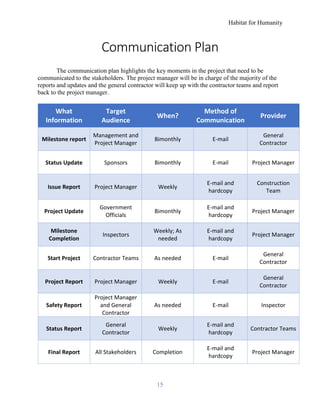
Communication Plan
The communication plan highlights the key moments in the project that need to be
communicated to the stakeholders. The project manager will be in charge of the majority of the
reports and updates and the general contractor will keep up with the contractor teams and report
back to the project manager.
What
Information
Target
Audience
When?
Method of
Communication
Provider
Milestone report
Management and
Project Manager
Bimonthly E-mail
General
Contractor
Status Update Sponsors Bimonthly E-mail Project Manager
Issue Report Project Manager Weekly
E-mail and
hardcopy
Construction
Team
Project Update
Government
Officials
Bimonthly
E-mail and
hardcopy
Project Manager
Milestone
Completion
Inspectors
Weekly; As
needed
E-mail and
hardcopy
Project Manager
Start Project Contractor Teams As needed E-mail
General
Contractor
Project Report Project Manager Weekly E-mail
General
Contractor
Safety Report
Project Manager
and General
Contractor
As needed E-mail Inspector
Status Report
General
Contractor
Weekly
E-mail and
hardcopy
Contractor Teams
Final Report All Stakeholders Completion
E-mail and
hardcopy
Project Manager
Habitat for Humanity
16
RACI CHART
This is a RACI chart for a group home, a collaboration of Vine and Branches and Habitat for
Humanity. As shown below, 9 individuals or teams are presented and assigned. The Architecture
team is based in America. The rest of the teams are based in Haiti, and were sourced and
contracted though Habitat for Humanity’s Haiti team.
Habitat for Humanity
17
Team CPE Conclusion
Overall the purpose of this partnership was to create a group home in Haiti. Haiti was
chosen because it has a high demand for housing, its project similarities to Vines and branches,
and Habitat for Humanity’s previous involvement in this country. We delegated resources to
transportation, and supplies. We flew John and Mary, the general contractor, and the inspector to
Haiti.
The Currency transfers from 64.87 Haitian Gourds to one United States dollar. The
budget was $11,850 which is 1% of Pinnacle Home Builders total revenue. With this budget, and
resources that were used, we were able to complete this project $1,050 under budget. The Group
home was successfully completed on schedule and the new families were able to move in and are
now living with a sturdy roof and basic amenities to meet their everyday needs.
Habitat for Humanity
18
References
A. (2018). Religion in Haiti. Retrieved April 19, 2018, from http://www.aidforhaiti.org/learn-
more/about-haiti/religion-in-haiti
Central Intelligence Agency. (2018). The World Factbook. Retrieved
from https://www.cia.gov/library/publications/the-world-factbook/geos/ha.html
Export.gov. (2017). Haiti – Language. Retrieved from https://www.export.gov/article?id=Haiti-
Language
Habitat for Humanity. (n.d.). Retrieved April 24, 2018, from https://www.habitat.org/
Haiti. (2018). Retrieved April 19, 2018, from https://www.heritage.org/index/country/haiti
Investopedia. (2018). Htg Haitian Gourde. Retrieved from
https://www.investopedia.com/terms/forex/h/htg-haitian-gourde.asp
Oanda. (2018). Haitian Gourde. Retrieved from https://www.oanda.com/currency/iso-currency-
codes/HTG
Observer, H. (2012, November 01). Business Etiquette in Haiti - Gender Division in The Labor
Market. Retrieved April 19, 2018, from http://www.haitiobserver.com/blog/business-
etiquette-in-haiti-gender-division-in-the-labor-mar.html
Overview. (2018, April 02). Retrieved April 19, 2018, from
http://www.worldbank.org/en/country/haiti/overview
XE. (2018). XE Currency Converter: Usd to Htg. Retrieved from
https://www.xe.com/currencyconverter/convert/?Amount=1&From=USD&To=HTG

CPE Project

  • 1.
    4/24/2018 OpHouse Team CPE GrantHaven, Andrew Hoster, Joey Rudolph, Michaela Schuch, Isaac Shubert, & Isaac Stacks LIBERTY UNIVERSITY
  • 2.
    Habitat for Humanity 1 Tableof Contents Executive Summary …………………………………………………………………………….2 Organizational/ Cultural Overview of Habitat of Humanity ………………………………….. 4 CPE Overview …………………………………………………………………………….........9 Project Proposal …………………………………………………………………………...…..10 Risk Overview ……………………………………………………………………….....……..11 Risk Assessment Form ………………………………………………………………...…..…..12 Risk Severity Matrix …………………………………………………………………..…...….13 Risk Response Matrix …………………………………………………………………….…...14 Communication Plan …………………………………………………………………….…….15 RACI Chart ………………………………………………………………………….………...16 Conclusion …………………………………………………………………………………….17 References ……………………………………………………………………………………. 18
  • 3.
    Habitat for Humanity 2 ExecutiveSummary The Collaborative Project Enterprise (CPE) is a partnership of Pinnacle Custom Home Builders, a subsidiary company of Vines and Branches, and the nonprofit organization Habitat for Humanity. Vine and Branches owners, John and Mary, wish to utilize their financial success by undertaking a global outreach project through a philanthropic endeavor in a developing country. The decision was made to partner with Habitat for Humanity due to the organization’s vision of creating a world where everyone has a decent place to live and mission of implementing God’s love into action aligned immensely with the views of John, Mary, and Pinnacle Custom Home Builders. Vine and Branches is comprised of three construction related entities, Pinnacle Custom Home Builders, Walnut Grove, and Sunflower Designs which complement the focus and function of Habitat for Humanity. Habitat for Humanity is construction-centric, through the avenues of construction, disaster relief reconstruction, and their “ReStore” stores. The vision of the end product of the partnership is a 4-room group home in Haiti. This building is crucial in Haiti, in light of recent disasters and a lack of affordable, safe housing for families. The house will serve as a suitable shelter for multiple families in the local area of Haiti. Haiti was chosen to be the location of the new group home because its demand for housing, its alignment to the type of project John and Mary wanted to implement and support, and Habitat for Humanity’s previous experience in Haiti. The budget for the project is determined from the total revenue of Pinnacle Custom Home Builders for the Nine Months Ended December 31, 2015, which is $1,185,000. Of the total revenue the budget is to be 1%, resulting in a budget of $11,850 USD. The average cost to construct a home in Haiti is approximately $7,000. It has been determined that the cost of sending four members from Pinnacle Custom Home Builders to Haiti for the duration of the project and the return back to the United States will be $2,800. $8,000 is budgeted for the supplies to construct the home. This establishes a budget of $10,800 dollars, $1,050 below budget. The $1,050 will be set aside as contingency funds. It is important to note that one United States dollar (USD) is equal to 64.87 Haitian gourdes. The project of constructing the house, from breaking ground on the foundation to handing over the key to the new residents, will take one month of eight hours work days, five days a week to complete. This completion estimate excludes the effects that may possibly be implemented by severe weather and other risks. The numeric values have been determined from calculations, expert judgement, and analogous estimating. This CPE project utilizes stakeholder management by identifying all the stakeholders for the project early on. The key stakeholders for the project are: the people the house is being built for, Habitat for Humanity, and Pinnacle Custom Home Builders. Other stakeholders include the Haitian government, the volunteers involved with the project, and the community the house will be constructed in. Since Haiti is a developing country, there are certain risks that need to be addressed in risk management. First of all, Haiti is a country in the Caribbean and so it is prone to severe weather at times, including hurricanes, and therefore is subject to the hurricane season from June to October. Haiti has recently been hit by Hurricane Irma, a category five hurricane that caused major devastation in the Atlantic region. Government corruption is another risk that would be
  • 4.
    Habitat for Humanity 3 prevalentduring the project. Corruption can cause problems with the financial aspect of the project and the timeline of the project. Money and supplies are needed in Haiti, so the risk of looting will be an issue as well. Steps will be taken to avoid this risk. Another risk is supplies and contractors not showing up. Selecting reputable vendors and suppliers will be done to deter this from happening. Despite the possible risks, partnering with Habitat for Humanity in Haiti provides Pinnacle Custom Home Builders an excellent opportunity to implement a global project that represents their values and beliefs well, while openly benefiting others.
  • 5.
    Habitat for Humanity 4 Organizational/Cultural Overview Organizational Name/Vision/Mission Habitat for Humanity Our mission Seeking to put God’s love into action, Habitat for Humanity brings people together to build homes, communities and hope. (Habitat for Humanity, n.d.) Our vision A world where everyone has a decent place to live. Our principles 1. Demonstrate the love of Jesus Christ. 2. Focus on shelter. 3. Advocate for affordable housing. 4. Promote dignity and hope. 5. Support sustainable and transformative development. Who we are Habitat for Humanity partners with people in your community, and all over the world, to help them build or improve a place they can call home. Habitat homeowners help build their own homes alongside volunteers and pay an affordable mortgage. With your support, Habitat homeowners achieve the strength, stability and independence they need to build a better life for themselves and for their families. Through our 2020 Strategic Plan, Habitat for Humanity will serve more people than ever before through decent and affordable housing. (Habitat for Humanity, n.d.) Non-proselytizing policy Habitat for Humanity and its affiliate organizations will not proselytize. Nor will Habitat work with entities or individuals who insist on proselytizing as part of their work with Habitat. This means that Habitat will not offer assistance on the expressed or implied condition that people must adhere to or convert to a particular faith or listen and respond to messaging designed to induce conversion to a particular faith. (Habitat for Humanity, n.d.) History/Values The idea that became Habitat for Humanity first grew from the fertile soil of Koinonia Farm, a community farm outside of Americus, Georgia, founded by farmer and biblical scholar Clarence Jordan. On the farm, Jordan and Habitat’s eventual founders Millard and Linda Fuller developed the concept of “partnership housing.” The concept centered on those in need of adequate shelter working side by side with volunteers to build decent, affordable houses. The houses would be built at no profit. New homeowners’ house payments would be combined with no-interest loans
  • 6.
    Habitat for Humanity 5 providedby supporters and money earned by fundraising to create “The Fund for Humanity,” which would then be used to build more homes. Beau and Emma were the owners of the first home built by Koinonia’s Partnership Housing Program. They and their five children moved into a concrete-block home with a modern kitchen, indoor bathroom and heating system, replacing the unpainted, uninsulated shack with no plumbing where they had previously lived. In 1973, the Fullers decided to take the Fund for Humanity concept to Zaire, now the Democratic Republic of Congo. After three years of hard work to launch a successful house building program there, the Fullers then returned to the United States and called together a group of supporters to discuss the future of their dream: Habitat for Humanity International, founded in 1976. The times have changed, the build site locations have grown in number, but the very real change that Beau and Emma’s family experienced is shared by families today who partner with Habitat to build or improve a place they can call home. Thanks in no small part to the personal involvement of U.S. President Jimmy Carter and his wife Rosalynn and the awareness they have raised, Habitat now works in nearly 1,400 communities across the U.S. and in approximately 70 countries and has helped 9.8 million people achieve strength, stability and independence through safe, decent and affordable shelter. Structure/Leadership ❖ Habitat for Humanity International’s work is overseen by an international board of directors and senior leadership staff who deeply believe that all people deserve a decent place to call home. ❖ Habitat’s board is responsible for establishing policy and guiding Habitat’s work to construct, rehabilitate, repair and improve housing in approximately 70 countries. ❖ Habitat for Humanity International is managed by an administrative staff, led by CEO Jonathan Reckford and senior leadership dedicated to the cause of decent and affordable housing. (Habitat for Humanity, n.d.) Approach to business/ outreach Habitat for Humanity’s approach to business and outreach arises from a focus on providing shelter for individuals in communities who cannot provide the shelter for themselves through renting, owning, or building. Through this Habitat for Humanity promotes affordable housing, while also creating a positive impact on the sustainability and transformation of the communities they work in. Through their actions of outreach, Habitat for Humanity’s goal is to promote dignity and hope. Synopsis of current service/nations served ❖ United States and Canada: all 50 states, the District of Columbia and Puerto Rico. Canada in all 10 provinces and each of the 3 territories
  • 7.
    Habitat for Humanity 6 ❖Latin America and Caribbean: more than 15 countries including Argentina, Bolivia, Brazil, Chile, Colombia, Dominican Republic, El Salvador, Guatemala, Haití, Honduras, Jamaica, México, Nicaragua, Paraguay, Trinidad and Tobago. ❖ Europe, the Middle East and Africa: 25 countries in EMEA region include the following countries: United Kingdom, Germany, South Africa, Ireland, Jordan, Poland, Egypt, and more. ❖ Asia and the Pacific: more than 15 countries including the Philippines, India, Australia, China, Japan, Hong Kong, New Zealand, and more. (Habitat for Humanity, n.d.)
  • 8.
    Habitat for Humanity 7 CountryCultural Overview Name of Country Haiti Location/Region Haiti is located in the Caribbean, on the island of Hispaniola. Haiti makes up one-third of the island, while the Dominican Republic makes up the other two-thirds. It is located between the Caribbean Sea and North Atlantic Ocean (Central Intelligence Agency, 2018). Primary/Business Language The official languages of the country of Haiti are French and Haitian Creole. English is widely spoken in the business realm of Haiti, and serves as the primary business language. The language of Spanish is also present in the business realm of Haiti but is not as widely spoken as English (Export.gov, 2017). Current Monetary Status/Exchange Rate The Haitian Gourde is the current currency of the country of Haiti. It is composed of one hundred centimes, and the letter G serves as its symbol (Investopedia, 2018). Currently, the Haitian Gourde is issued in paper bills, and is in the denominations of 1, 2, 5, 20, 25, 50, 100 and 500. Two-thirds of Haitians are dependent on the agricultural sector, particular small-scale subsistence farming, for their income and ability to contribute to the economy. In 2009, Haiti qualified for the IMF and World Bank’s Heavily Indebted Poor Countries (HIPC), and was forgiven of $1 billion of debt (Oanda, 2018). As of April 15, 2018 the exchange rate of the Haitian Gourde (HTG) to USD was 1.00 HTG is the equivalent of 0.015 USD. Due to this exchange rate, 1.00 USD is the equivalent of 65.1814 HTG (XE, 2018). Topography/Geography/Climate Haiti shares the Island of Hispaniola with the Dominican Republic in between the Caribbean Sea and the North Atlantic Ocean located in the area referred to as the Caribbean or part of Central America. The total land area of Haiti is 27,560 sq. km, and its total area including water is 27,750 sq. km. The land has a border of 376 km, and the only border country is the Dominican Republic. The coastline of Haiti is 1,771 km. Haiti's terrain is mostly rough and mountainous. Of the land 66.4% is used for agriculture, 3.6% is forest, and 30% is used for others focuses. The coastline is where a majority of Haiti’s population is concentrated. Haiti has a tropical climate and is semiarid due to the mountains blocking the trade winds in the east. It is important to note that Haiti is located in the hurricane belt, and is subject to severe storms and flooding. Also, Haiti is sometimes subject to periods of drought, along with the risk of earthquakes (Central Intelligence Agency, 2018). Government Over the course of history, Haiti has struggled with instability and violence amongst the nation and within its own government. The country declared its independence in 1803, however, there has been continuous issues within the country since that time. Today, the country of Haiti is led by a semi-presidential republic system. Under this method, there is a president that serves as head of state and a prime minister that serves as head of government. The Haitian government
  • 9.
    Habitat for Humanity 8 issimilar to the United States in that they have a legislative, judicial, and executive branch, however, there is still a struggle within the nation. Given the past turmoil within the country, there has been a struggle to manage the economy effectively, which has opened up issues with violence, corruption, and drugs. These issues have caused Haiti to be one of the poorest countries in the western hemisphere and caused extreme poverty for a vast portion of the population. According to heritage.org, Haiti is the 124th freest country as of 2018 (Haiti, 2018). Under their new president, Jovenel Moise, there have been major improvements in an attempt to help the country and end a majority of the issues faced within Haiti. There are still issues with corruption, however, the willingness of the current administration to help the country is a good sign for those hoping to do missions work within the country. Economic Due to past turmoil, the economy of Haiti is struggling. There is a significant deficit and only 1% economic growth is expected this year (Overview, 2018). This is partly due to a poor agricultural sector. The political instability has significantly affected business. However, there have been attempts to increase growth by opening up ports to foreign investment and create an easier electronic data system. Safety has also increased for workers in the country. Foreign subsidies have hindered Haitian entrepreneurs. However, it would be recommended to work alongside entrepreneurs in the country to help them become independent. Religious/Cultural According to aidforhaiti.org, a large number of Haitians claim to be Roman Catholic and an increasing number of Protestants in the country. However, a major aspect to consider is that almost all people in Haiti, regardless of religious affiliation, still have beliefs in Voodoo (Aid for Haiti, 2018). This aspect of the Haitian culture would be a major aspect to be aware of for a Christian organization to consider and know how to handle such a situation. General Business Practices Haiti has low labor costs and tariff-free access to the United States, which is a very good opportunity to for American organizations to consider. However, there can be very different aspects of business etiquette and practices to consider. Most businessmen in Haiti speak english fluently and is considered the language of business. Appointments are expected to be made in advance and much business is discussed in restaurants and hotels (export.gov, 2017). Another aspect to be aware of is the extreme gender division in business in Haiti (haitiobserver.com). Men typically dominate the business field and women are not found in business. This would be an aspect to be aware of if women are hoping to do business in Haiti. Volunteer Considerations Typically, the Haitian community is very grateful for volunteer work that helps alleviate issues that are plaguing the country. However, it seems that Haitians want to become independent and would prefer to have aid from external sources that come alongside the Haitians to help them become independent. CPE Overview
  • 10.
    Habitat for Humanity 9 IPM TheIPM for this CPE will be Hans Hansen, a project manager from Habitat for Humanity. He has worked for the NPO for 13 years and has lead hundreds of budget-constrained construction projects to fruition. He has experience in Haiti, and his work-related connections in Haiti will help him find appropriate volunteers effortlessly. Oversight, Scheduling, Changes, Etc. The key to prevent oversight is through rigorous and extensive planning. However, oversights, schedule changes and such will occur. Below is an explanation of who will handle issues, and why. ❖ Oversight: Vine and Branches ▪ Rational- Vine and Branches is initiating the project, and they are the ones looking to perform an environmental deed. Even though they may be partnering with a large NPO, V&B must Any issues, regardless of who bring them up, will be handles by Vines and Branches. ❖ Schedule: Habitat for Humanity ▪ Rational- Habitat for Humanity will be responsible for the majority of the employees working on the group home, and they will be hiring these individuals. It would be most efficient for them to make these decisions. ❖ Changes: Habitat for Humanity ▪ Rational- The NPO will also be handling changes for two reasons. One, they already have a deep-rooted presence in Haiti. It would make risky to have V&B make changes, when they have little experience of the country and the effects changes could have Two, their volunteers will be doing most of the work. ❖ Employee Performance: Will be handled by both parties ▪ Rational- If the employees are employed by V&B, then said organization will handle performance. If the volunteers work for the NPO, then said NPO will handle employee performance. Organization Differences Organizational differences will be minimal, due to both organizations aligning in vision and in cultural. However, any differences must be established and handled in the early stages of the project. Both companies must host transparency and present any presuppositions before the project is underway. Both companies will speak with one another via SKYPE, to speak on organizational difference before the American team flies to Haiti. Budget The budget will be established in the initiate phase of the project. Vine and Branches agreed to put forward 1% of their Total Revenue, which is $11,850. The project will cost $10,500, which is under budget!
  • 11.
    Habitat for Humanity 10 ProjectProposal Form Project classification Strategic What business problem does this project solve? Corporate Social Responsibility How does this project align with Vine and Branches strategy? By building a house that is quality, affordable, and sustainable. What are the major deliverables? Blueprint, Foundation, Walls, Roof, Electrical, Plumbing, Sheetrock, Painting, Finish work, and Ribbon Cutting What is the impact of not doing this project? A group home in Haiti will not be available for tenants, keeping those individuals on the streets What are the three major risk for this project? Weather Supplies not being delivered Looting How will we measure success? By completing all 10 deliverables, and having a group home that is ready for occupants Will this project require internal resources? Yes What is estimated cost of this project? $11,850 How long will this project take? 1 month Signature
  • 12.
    Habitat for Humanity 11 RiskOverview There are five main risks that are identified below. They are weather, supplies not being delivered, government corruption, looting, and contractor not showing up. Weather is an identified risk because Haiti has been hit by some tragic weather conditions in the past few years and it is likely that poor weather would happen again, especially during hurricane season. The type of weather that we chose to identify specifically is major thunderstorms. The impact of that could vary between three and five on a five-point scale but with three being the average. While there is not much of a choice other than accept this risk, there are ways to help lessen the impact. Continuously checking weather updates for the week and days as the project goes along is one. Third world countries can be known for government corruption and Haiti is no different. While the likelihood of this to happen is low, it is hard to detect, and the impact will be great. Avoiding this risk by keeping money between two individuals will be preferred. Looting is a problem that is found anywhere in the world but is a problem that can affect the project greatly. While this is likely to happen, there are ways to mitigate the risk to lessen the impact. Having contact with the local police is one way to find out the history of looting in the area. Using the information gathered from the police, it is possible to hire watchmen for the worksite to prevent looting from happening. Supplies not being delivered is another risk associated with building a house in Haiti. While the likelihood of this is happening is low, the effect that it would have would be great. Supplies not being delivered is also harder to detect until it is passed the delivery date. Mitigating this risk would be preferable so finding local or nearby vendors that can deliver last minute would help the project greatly. Contact these vendors as soon as possible after the original supplies were not delivered would be critical. The final risk identified is contractors not showing up. This event is unlikely but would have disastrous effects to the project. Hiring contractors that have a strong record of communication would help mitigate this risk. On the off chance that the team does not show, having a team of volunteers who are willing to help out last minute would help lessen the impact of the original contractors not showing up.
  • 13.
    Habitat for Humanity 12 RiskAssessment Form Risk Identified Likelihood Impact Detection Difficulty When Weather 5 3 3 Duration Supplies not delivered 2 4 5 Construction Phase Government Corruption 2 5 2 Duration Looting 4 3 2 Duration Contractor no show 2 5 2 Planning/ Construction
  • 14.
    Habitat for Humanity 13 RiskSeverity Matrix 5 1 1 5 Red Zone (Major Risk) Blue Zone (Moderate Risk) White Zone (Minor Risk) Weather Looting Supplies not delivered Corruption Contractor/team no show L i k e l i h o o d Impact
  • 15.
    Habitat for Humanity 14 RiskResponse Matrix Risk Response Contingency Plan Trigger Who is responsible Weather Accept: Embrace the potential Check weather every 3 hrs., and plan to keep tools and electrical items inside Alert from weather app General Contractor Corruption Avoid: Keeping money between two individuals Project Manager Looting Avoid: Hire guards to watch over the worksite and supplies. Involve police Suspicious individuals General Contractor Contractor/Team no show Mitigate: Keep in contact with contractor teams prior to them starting and have back up volunteer teams ready to step in if need be Contact back up volunteer team Team not showing up General Contractor Supplies not delivered Mitigate: Contact nearby vendors and find out who can make last minute deliveries Contact chosen last minute vendor Supplies undelivered Project Manager
  • 16.
    Habitat for Humanity 15 CommunicationPlan The communication plan highlights the key moments in the project that need to be communicated to the stakeholders. The project manager will be in charge of the majority of the reports and updates and the general contractor will keep up with the contractor teams and report back to the project manager. What Information Target Audience When? Method of Communication Provider Milestone report Management and Project Manager Bimonthly E-mail General Contractor Status Update Sponsors Bimonthly E-mail Project Manager Issue Report Project Manager Weekly E-mail and hardcopy Construction Team Project Update Government Officials Bimonthly E-mail and hardcopy Project Manager Milestone Completion Inspectors Weekly; As needed E-mail and hardcopy Project Manager Start Project Contractor Teams As needed E-mail General Contractor Project Report Project Manager Weekly E-mail General Contractor Safety Report Project Manager and General Contractor As needed E-mail Inspector Status Report General Contractor Weekly E-mail and hardcopy Contractor Teams Final Report All Stakeholders Completion E-mail and hardcopy Project Manager
  • 17.
    Habitat for Humanity 16 RACICHART This is a RACI chart for a group home, a collaboration of Vine and Branches and Habitat for Humanity. As shown below, 9 individuals or teams are presented and assigned. The Architecture team is based in America. The rest of the teams are based in Haiti, and were sourced and contracted though Habitat for Humanity’s Haiti team.
  • 18.
    Habitat for Humanity 17 TeamCPE Conclusion Overall the purpose of this partnership was to create a group home in Haiti. Haiti was chosen because it has a high demand for housing, its project similarities to Vines and branches, and Habitat for Humanity’s previous involvement in this country. We delegated resources to transportation, and supplies. We flew John and Mary, the general contractor, and the inspector to Haiti. The Currency transfers from 64.87 Haitian Gourds to one United States dollar. The budget was $11,850 which is 1% of Pinnacle Home Builders total revenue. With this budget, and resources that were used, we were able to complete this project $1,050 under budget. The Group home was successfully completed on schedule and the new families were able to move in and are now living with a sturdy roof and basic amenities to meet their everyday needs.
  • 19.
    Habitat for Humanity 18 References A.(2018). Religion in Haiti. Retrieved April 19, 2018, from http://www.aidforhaiti.org/learn- more/about-haiti/religion-in-haiti Central Intelligence Agency. (2018). The World Factbook. Retrieved from https://www.cia.gov/library/publications/the-world-factbook/geos/ha.html Export.gov. (2017). Haiti – Language. Retrieved from https://www.export.gov/article?id=Haiti- Language Habitat for Humanity. (n.d.). Retrieved April 24, 2018, from https://www.habitat.org/ Haiti. (2018). Retrieved April 19, 2018, from https://www.heritage.org/index/country/haiti Investopedia. (2018). Htg Haitian Gourde. Retrieved from https://www.investopedia.com/terms/forex/h/htg-haitian-gourde.asp Oanda. (2018). Haitian Gourde. Retrieved from https://www.oanda.com/currency/iso-currency- codes/HTG Observer, H. (2012, November 01). Business Etiquette in Haiti - Gender Division in The Labor Market. Retrieved April 19, 2018, from http://www.haitiobserver.com/blog/business- etiquette-in-haiti-gender-division-in-the-labor-mar.html Overview. (2018, April 02). Retrieved April 19, 2018, from http://www.worldbank.org/en/country/haiti/overview XE. (2018). XE Currency Converter: Usd to Htg. Retrieved from https://www.xe.com/currencyconverter/convert/?Amount=1&From=USD&To=HTG