F
or all the noise China might make
internationally, its community at
the UvA and HvA remains relatively
silent. If there’s one place this could
change, however, it’s at the Fraijlemaborg, home
of many international students and some of the
best business courses the Hogeschool has to of-
fer. Here, a group of Chinese International Busi-
ness Studies students has been congregating to
celebrate holidays such as Chinese New Year,
both with each other and with any non-Chinese
who want to join in the fun. And from the rapid
increase in membership numbers, it’s evident
that there are a fair few who want to do so.
One of the driving forces behind this fledgling
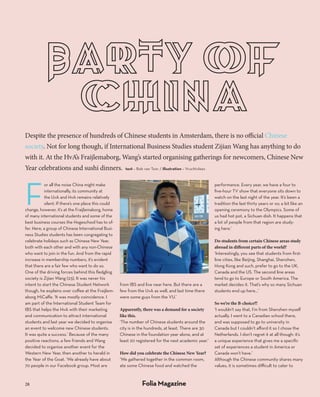
society is Zijian Wang (23). It was never his
intent to start the Chinese Student Network
though, he explains over coffee at the Fraijlem-
aborg MiCaffe. ‘It was mostly coincidence. I
am part of the International Student Team for
IBS that helps the HvA with their marketing
and communication to attract international
students and last year we decided to organise
an event to welcome new Chinese students.
It was quite a success.’ Because of the many
positive reactions, a few friends and Wang
decided to organise another event for the
Western New Year, then another to herald in
the Year of the Goat. ‘We already have about
70 people in our Facebook group. Most are
from IBS and live near here. But there are a
few from the UvA as well, and last time there
were some guys from the VU.’
Apparently, there was a demand for a society
like this.
‘The number of Chinese students around the
city is in the hundreds, at least. There are 30
Chinese in the foundation year alone, and at
least 20 registered for the next academic year.’
How did you celebrate the Chinese New Year?
‘We gathered together in the common room,
ate some Chinese food and watched the
performance. Every year, we have a four to
five-hour TV show that everyone sits down to
watch on the last night of the year. It’s been a
tradition the last thirty years or so; a bit like an
opening ceremony to the Olympics. Some of
us had hot pot, a Sichuan dish. It happens that
a lot of people from that region are study-
ing here.’
Do students from certain Chinese areas study
abroad in different parts of the world?
‘Interestingly, you see that students from first-
line cities, like Beijing, Shanghai, Shenzhen,
Hong Kong and such, prefer to go to the UK,
Canada and the US. The second line areas
tend to go to Europe or South America. The
market decides it. That’s why so many Sichuan
students end up here...’
So we’re the B-choice?!
‘I wouldn’t say that, I’m from Shenzhen myself
actually. I went to a Canadian school there,
and was supposed to go to university in
Canada but I couldn’t afford it so I chose the
Netherlands. I don’t regret it at all though: it’s
a unique experience that gives me a specific
set of experiences a student in America or
Canada won’t have.’
Although the Chinese community shares many
values, it is sometimes difficult to cater to
Despite the presence of hundreds of Chinese students in Amsterdam, there is no official Chinese
society. Not for long though, if International Business Studies student Zijian Wang has anything to do
with it. At the HvA’s Fraijlemaborg, Wang’s started organising gatherings for newcomers, Chinese New
Year celebrations and sushi dinners. text – Bob van Toor / illustration – Vruchtvlees
28 Folia Magazine28
FOL_1511_23_02.indd 28 09-03-15 20:11
Keys to
the city
David Kubovsky
(23, International Business &
Management)
From: Germany
Space to think ‘I like to look out of the window
when I study. If I want a bird’s eye view, then I
go to the public library next to Centraal Station.
Otherwise I enjoy looking at one of the canals,
for instance from the Bagels and Beans on
Roetersstraat and Nieuwe Prinsengracht. I love
watching people biking around.’
Those crazy Dutch ‘Now I get why those
Dutchies are recorded to have the highest
coffee consumption in the world – they drink it
all day! After dinner, it’s completely normal to
be invited for a cup of coffee along with some
cake. I’ve never experienced this in Germany;
we would just have a beer!’
Best bite ‘MIU on the Nieuwezijds Voorburg-
wal serves the best sushi in town. Not only is
their Dragon Roll amazing, its luxurious interior
makes you feel like a celebrity.’
Hidden treasure ‘Park Frankendael is an amazing
piece of nature in the middle of a busy neigh-
bourhood just five minutes from Amstelstation. If
you live in Oost, you might often go around it
but the park is really worth going through. Its got
some unique water birds and pretty flowers.’
Feels like home ‘Vapiano, the Italian-style res-
taurant chain, originated in Germany. Especial-
ly if you’re young and live on a budget, it offers
great value for money. Since the restaurants
look alike all over the world, it always feels like
being home in Germany’
Best bike route ‘The variety of the scenery
you can see from your bike is amazing. I love
to bike along the Amstel in the old city, up and
down those bridges. Then I would ride along
the Stadhouderskade through the Rijksmuseum
passage: on Museumplein the sky opens up.
Finally, find a cozy place in De Pijp to sit down
for a coffee and do some reading.’
all different backgrounds and regions, Wang
admits. ‘We once followed the majority and
went to a Sichuan restaurant, but because it’s
impossible to satisfy all the different back-
grounds, last time we went to a sushi restau-
rant. That surprised mostly the non-Chinese
who went with us. Maybe next time it’ll be an
Argentinian steak house.’ Wang’s not always
mingled with his compatriots, he says. ‘The
first two years I was here, I wanted to stay
out of the Chinese circle to avoid speaking
Mandarin all the time – although, in the end, if
you have trouble, you know that you have that
circle to fall back on.’ Instead, he focused on
exploring Western culture, though internation-
al students proved easier to befriend than the
Dutch. ‘Luckily, people in my classes were very
open, but I’ve heard of Chinese friends who
were alone in classes where everyone revert-
ed to Dutch, and very quickly became isolated.
Not out of malice, just because the rest of the
group could speak with one another.’
Is that something you will encourage your
society members to speak up about?
‘Yes, they should definitely step up more in sit-
uations like that. Of course I understand why a
group of Dutch students would switch to their
own language; it’s more efficient for them. But
if that would happen to a Spanish student they
would get so mad! A Chinese wouldn’t say
anything – it’s a cultural thing. Actually, I think
we should tell new students that the problem
lies partly with us: it’s not only the Dutch that
need to change their attitude, the Chinese
need to be more confident and say: I’m sorry,
I don’t understand what you’re saying and I’d
like to contribute. Newcomers especially are
very hesitant to say things like that.’
Recently there has been more of a debate on
age-old Dutch assumptions and jokes at the
expense of Chinese people in this country.
What’s your opinion on Dutch stereotyping?
‘The assumption that Chinese won’t mind
when you judge their appearance or accent,
is wrong. What you see in a Chinese person’s
face is, very often, not what they’re feeling.
That has several reasons: again, the language
and cultural barrier. But it’s also because it’s
considered impolite to show too much emo-
tion.  At first, I might think I’ve misunderstood
what a foreign person means when they make
fun of me. But then after two days, after some
reflection I may realise what actually was
meant. I have gotten so angry several times
‘English, well, that’s one
area the Chinese don’t
have a competitive
advantage in’
‘The Dutch drink
coffee all day’
during my first years here. Like the time a
close friend got drunk at a party and started
insisting that I “open my eyes”. It made me so
angry. But even when I’m really upset, some-
times people cannot see it in my face. Who
knows, maybe our faces aren’t that expressive,
maybe westerners just don’t notice it. As a so-
ciety, we could create more awareness of this.
But some stereotypes are true. We are, for
instance, more close-minded. That’s another
reason why I tried to avoid making too many
Chinese friends when I first came here: we
like each other’s company. It’s in our nature.
At a table with foreigners, the language is
often difficult for us, and what we find funny,
others might not. And conversely, we have
such trouble with German, Dutch and British
people’s sarcasm. Half the time, we just can’t
tell whether they are joking or not. Especially
the British, they never laugh while they tell a
joke – it’s really difficult!’ lll
Folia Magazine 2929
FOL_1511_23_02.indd 29 09-03-15 20:11

Coverage Folia_Zijian Wang

  • 1.
    F or all thenoise China might make internationally, its community at the UvA and HvA remains relatively silent. If there’s one place this could change, however, it’s at the Fraijlemaborg, home of many international students and some of the best business courses the Hogeschool has to of- fer. Here, a group of Chinese International Busi- ness Studies students has been congregating to celebrate holidays such as Chinese New Year, both with each other and with any non-Chinese who want to join in the fun. And from the rapid increase in membership numbers, it’s evident that there are a fair few who want to do so. One of the driving forces behind this fledgling society is Zijian Wang (23). It was never his intent to start the Chinese Student Network though, he explains over coffee at the Fraijlem- aborg MiCaffe. ‘It was mostly coincidence. I am part of the International Student Team for IBS that helps the HvA with their marketing and communication to attract international students and last year we decided to organise an event to welcome new Chinese students. It was quite a success.’ Because of the many positive reactions, a few friends and Wang decided to organise another event for the Western New Year, then another to herald in the Year of the Goat. ‘We already have about 70 people in our Facebook group. Most are from IBS and live near here. But there are a few from the UvA as well, and last time there were some guys from the VU.’ Apparently, there was a demand for a society like this. ‘The number of Chinese students around the city is in the hundreds, at least. There are 30 Chinese in the foundation year alone, and at least 20 registered for the next academic year.’ How did you celebrate the Chinese New Year? ‘We gathered together in the common room, ate some Chinese food and watched the performance. Every year, we have a four to five-hour TV show that everyone sits down to watch on the last night of the year. It’s been a tradition the last thirty years or so; a bit like an opening ceremony to the Olympics. Some of us had hot pot, a Sichuan dish. It happens that a lot of people from that region are study- ing here.’ Do students from certain Chinese areas study abroad in different parts of the world? ‘Interestingly, you see that students from first- line cities, like Beijing, Shanghai, Shenzhen, Hong Kong and such, prefer to go to the UK, Canada and the US. The second line areas tend to go to Europe or South America. The market decides it. That’s why so many Sichuan students end up here...’ So we’re the B-choice?! ‘I wouldn’t say that, I’m from Shenzhen myself actually. I went to a Canadian school there, and was supposed to go to university in Canada but I couldn’t afford it so I chose the Netherlands. I don’t regret it at all though: it’s a unique experience that gives me a specific set of experiences a student in America or Canada won’t have.’ Although the Chinese community shares many values, it is sometimes difficult to cater to Despite the presence of hundreds of Chinese students in Amsterdam, there is no official Chinese society. Not for long though, if International Business Studies student Zijian Wang has anything to do with it. At the HvA’s Fraijlemaborg, Wang’s started organising gatherings for newcomers, Chinese New Year celebrations and sushi dinners. text – Bob van Toor / illustration – Vruchtvlees 28 Folia Magazine28 FOL_1511_23_02.indd 28 09-03-15 20:11
  • 2.
    Keys to the city DavidKubovsky (23, International Business & Management) From: Germany Space to think ‘I like to look out of the window when I study. If I want a bird’s eye view, then I go to the public library next to Centraal Station. Otherwise I enjoy looking at one of the canals, for instance from the Bagels and Beans on Roetersstraat and Nieuwe Prinsengracht. I love watching people biking around.’ Those crazy Dutch ‘Now I get why those Dutchies are recorded to have the highest coffee consumption in the world – they drink it all day! After dinner, it’s completely normal to be invited for a cup of coffee along with some cake. I’ve never experienced this in Germany; we would just have a beer!’ Best bite ‘MIU on the Nieuwezijds Voorburg- wal serves the best sushi in town. Not only is their Dragon Roll amazing, its luxurious interior makes you feel like a celebrity.’ Hidden treasure ‘Park Frankendael is an amazing piece of nature in the middle of a busy neigh- bourhood just five minutes from Amstelstation. If you live in Oost, you might often go around it but the park is really worth going through. Its got some unique water birds and pretty flowers.’ Feels like home ‘Vapiano, the Italian-style res- taurant chain, originated in Germany. Especial- ly if you’re young and live on a budget, it offers great value for money. Since the restaurants look alike all over the world, it always feels like being home in Germany’ Best bike route ‘The variety of the scenery you can see from your bike is amazing. I love to bike along the Amstel in the old city, up and down those bridges. Then I would ride along the Stadhouderskade through the Rijksmuseum passage: on Museumplein the sky opens up. Finally, find a cozy place in De Pijp to sit down for a coffee and do some reading.’ all different backgrounds and regions, Wang admits. ‘We once followed the majority and went to a Sichuan restaurant, but because it’s impossible to satisfy all the different back- grounds, last time we went to a sushi restau- rant. That surprised mostly the non-Chinese who went with us. Maybe next time it’ll be an Argentinian steak house.’ Wang’s not always mingled with his compatriots, he says. ‘The first two years I was here, I wanted to stay out of the Chinese circle to avoid speaking Mandarin all the time – although, in the end, if you have trouble, you know that you have that circle to fall back on.’ Instead, he focused on exploring Western culture, though internation- al students proved easier to befriend than the Dutch. ‘Luckily, people in my classes were very open, but I’ve heard of Chinese friends who were alone in classes where everyone revert- ed to Dutch, and very quickly became isolated. Not out of malice, just because the rest of the group could speak with one another.’ Is that something you will encourage your society members to speak up about? ‘Yes, they should definitely step up more in sit- uations like that. Of course I understand why a group of Dutch students would switch to their own language; it’s more efficient for them. But if that would happen to a Spanish student they would get so mad! A Chinese wouldn’t say anything – it’s a cultural thing. Actually, I think we should tell new students that the problem lies partly with us: it’s not only the Dutch that need to change their attitude, the Chinese need to be more confident and say: I’m sorry, I don’t understand what you’re saying and I’d like to contribute. Newcomers especially are very hesitant to say things like that.’ Recently there has been more of a debate on age-old Dutch assumptions and jokes at the expense of Chinese people in this country. What’s your opinion on Dutch stereotyping? ‘The assumption that Chinese won’t mind when you judge their appearance or accent, is wrong. What you see in a Chinese person’s face is, very often, not what they’re feeling. That has several reasons: again, the language and cultural barrier. But it’s also because it’s considered impolite to show too much emo- tion.  At first, I might think I’ve misunderstood what a foreign person means when they make fun of me. But then after two days, after some reflection I may realise what actually was meant. I have gotten so angry several times ‘English, well, that’s one area the Chinese don’t have a competitive advantage in’ ‘The Dutch drink coffee all day’ during my first years here. Like the time a close friend got drunk at a party and started insisting that I “open my eyes”. It made me so angry. But even when I’m really upset, some- times people cannot see it in my face. Who knows, maybe our faces aren’t that expressive, maybe westerners just don’t notice it. As a so- ciety, we could create more awareness of this. But some stereotypes are true. We are, for instance, more close-minded. That’s another reason why I tried to avoid making too many Chinese friends when I first came here: we like each other’s company. It’s in our nature. At a table with foreigners, the language is often difficult for us, and what we find funny, others might not. And conversely, we have such trouble with German, Dutch and British people’s sarcasm. Half the time, we just can’t tell whether they are joking or not. Especially the British, they never laugh while they tell a joke – it’s really difficult!’ lll Folia Magazine 2929 FOL_1511_23_02.indd 29 09-03-15 20:11