1. Bloom’s Taxonomy
2. Program Outcomes and Program Specific Outcomes (POs and PSOs)
3. Sample Course Outcomes
4. CO-PO/PSO mapping with justification
ORGANIZATION OF PRESENTATION
1. Bloom’s Taxonomy
•Created in 1956, under the leadership of educational psychologist
Dr Benjamin Bloom
•Hierarchical model that categorizes learning objectives into varying
levels
of complexity
•From basic knowledge and comprehension to advanced evaluation and
creation.
•To promote higher forms of thinking in education.
•Analyze and evaluate the concepts, processes, procedures, and principles
•Used when designing educational training and learning processes.
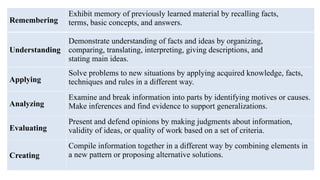
Bloom’s Taxonomy Question Model
Remembering
Exhibit memory of previously learned material by recalling facts,
terms, basic concepts, and answers.
Understanding
Demonstrate understanding of facts and ideas by organizing,
comparing, translating, interpreting, giving descriptions, and
stating main ideas.
Applying
Solve problems to new situations by applying acquired knowledge, facts,
techniques and rules in a different way.
Analyzing
Examine and break information into parts by identifying motives or causes.
Make inferences and find evidence to support generalizations.
Evaluating
Present and defend opinions by making judgments about information,
validity of ideas, or quality of work based on a set of criteria.
Creating
Compile information together in a different way by combining elements in
a new pattern or proposing alternative solutions.
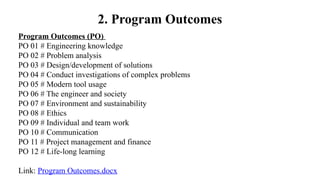
Program Outcomes (PO)
PO 01 # Engineering knowledge
PO 02 # Problem analysis
PO 03 # Design/development of solutions
PO 04 # Conduct investigations of complex problems
PO 05 # Modern tool usage
PO 06 # The engineer and society
PO 07 # Environment and sustainability
PO 08 # Ethics
PO 09 # Individual and team work
PO 10 # Communication
PO 11 # Project management and finance
PO 12 # Life-long learning
Link: Program Outcomes.docx
2. Program Outcomes
3. Sample Course Outcomes(COs)
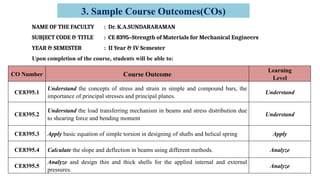
CO Number Course Outcome
Learning
Level
CE8395.1
Understand the concepts of stress and strain in simple and compound bars, the
importance of principal stresses and principal planes.
Understand
CE8395.2
Understand the load transferring mechanism in beams and stress distribution due
to shearing force and bending moment
Understand
CE8395.3 Apply basic equation of simple torsion in designing of shafts and helical spring Apply
CE8395.4 Calculate the slope and deflection in beams using different methods. Analyze
CE8395.5
Analyze and design thin and thick shells for the applied internal and external
pressures.
Analyze
NAME OF THE FACULTY : Dr. K.A.SUNDARARAMAN
SUBJECT CODE & TITLE : CE 8395–Strength of Materials for Mechanical Engineers
YEAR & SEMESTER : II Year & IV Semester
Upon completion of the course, students will be able to:
4. CO–PO/PSO MAPPING
NAME OF THE FACULTY : Dr. K.A.SUNDARARAMAN
SUBJECT CODE & TITLE : CE 8395–Strength of Materials for Mechanical Engineers
YEAR & SEMESTER : II Year & IV Semester
CO
PO
1
PO2
PO
3
PO
4
PO
5
PO
6
PO
7
PO
8
PO
9
PO
10
PO
11
PO
12
PSO
1
PSO
2
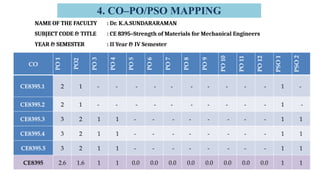
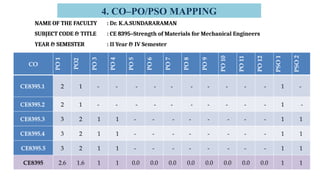
CE8395.1 2 1 - - - - - - - - - - 1 -
CE8395.2 2 1 - - - - - - - - - - 1 -
CE8395.3 3 2 1 1 - - - - - - - - 1 1
CE8395.4 3 2 1 1 - - - - - - - - 1 1
CE8395.5 3 2 1 1 - - - - - - - - 1 1
CE8395 2.6 1.6 1 1 0.0 0.0 0.0 0.0 0.0 0.0 0.0 0.0 1 1
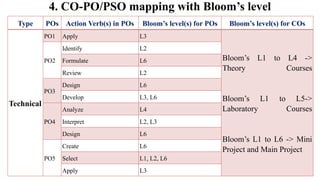
4. CO-PO/PSO mapping with Bloom’s level
Type POs Action Verb(s) in POs Bloom’s level(s) for POs Bloom’s level(s) for COs
Technical
PO1 Apply L3
Bloom’s L1 to L4 ->
Theory Courses
Bloom’s L1 to L5->
Laboratory Courses
Bloom’s L1 to L6 -> Mini
Project and Main Project
PO2
Identify L2
Formulate L6
Review L2
PO3
Design L6
Develop L3, L6
PO4
Analyze L4
Interpret L2, L3
Design L6
PO5
Create L6
Select L1, L2, L6
Apply L3
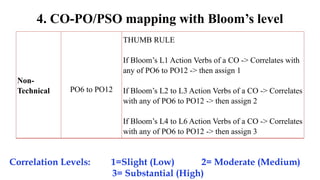
4. CO-PO/PSO mapping with Bloom’s level
Non-
Technical PO6 to PO12
THUMB RULE
If Bloom’s L1 Action Verbs of a CO -> Correlates with
any of PO6 to PO12 -> then assign 1
If Bloom’s L2 to L3 Action Verbs of a CO -> Correlates
with any of PO6 to PO12 -> then assign 2
If Bloom’s L4 to L6 Action Verbs of a CO -> Correlates
with any of PO6 to PO12 -> then assign 3
Correlation Levels: 1=Slight (Low) 2= Moderate (Medium)
3= Substantial (High)
4. CO–PO/PSO MAPPING
NAME OF THE FACULTY : Dr. K.A.SUNDARARAMAN
SUBJECT CODE & TITLE : CE 8395–Strength of Materials for Mechanical Engineers
YEAR & SEMESTER : II Year & IV Semester
CO
PO
1
PO2
PO
3
PO
4
PO
5
PO
6
PO
7
PO
8
PO
9
PO
10
PO
11
PO
12
PSO
1
PSO
2
CE8395.1 2 1 - - - - - - - - - - 1 -
CE8395.2 2 1 - - - - - - - - - - 1 -
CE8395.3 3 2 1 1 - - - - - - - - 1 1
CE8395.4 3 2 1 1 - - - - - - - - 1 1
CE8395.5 3 2 1 1 - - - - - - - - 1 1
CE8395 2.6 1.6 1 1 0.0 0.0 0.0 0.0 0.0 0.0 0.0 0.0 1 1
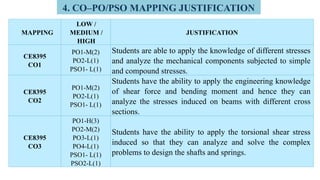
4. CO–PO/PSO MAPPING JUSTIFICATION
MAPPING
LOW /
MEDIUM /
HIGH
JUSTIFICATION
CE8395
CO1
PO1-M(2)
PO2-L(1)
PSO1- L(1)
Students are able to apply the knowledge of different stresses
and analyze the mechanical components subjected to simple
and compound stresses.
CE8395
CO2
PO1-M(2)
PO2-L(1)
PSO1- L(1)
Students have the ability to apply the engineering knowledge
of shear force and bending moment and hence they can
analyze the stresses induced on beams with different cross
sections.
CE8395
CO3
PO1-H(3)
PO2-M(2)
PO3-L(1)
PO4-L(1)
PSO1- L(1)
PSO2-L(1)
Students have the ability to apply the torsional shear stress
induced so that they can analyze and solve the complex
problems to design the shafts and springs.
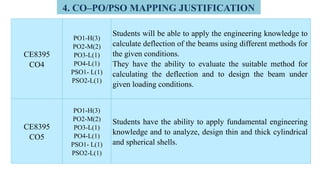
4. CO–PO/PSO MAPPING JUSTIFICATION
CE8395
CO4
PO1-H(3)
PO2-M(2)
PO3-L(1)
PO4-L(1)
PSO1- L(1)
PSO2-L(1)
Students will be able to apply the engineering knowledge to
calculate deflection of the beams using different methods for
the given conditions.
They have the ability to evaluate the suitable method for
calculating the deflection and to design the beam under
given loading conditions.
CE8395
CO5
PO1-H(3)
PO2-M(2)
PO3-L(1)
PO4-L(1)
PSO1- L(1)
PSO2-L(1)
Students have the ability to apply fundamental engineering
knowledge and to analyze, design thin and thick cylindrical
and spherical shells.
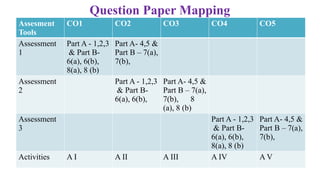
Question Paper Mapping
Assesment
Tools
CO1 CO2 CO3 CO4 CO5
Assessment
1
Part A - 1,2,3
& Part B-
6(a), 6(b),
8(a), 8 (b)
Part A- 4,5 &
Part B – 7(a),
7(b),
Assessment
2
Part A - 1,2,3
& Part B-
6(a), 6(b),
Part A- 4,5 &
Part B – 7(a),
7(b), 8
(a), 8 (b)
Assessment
3
Part A - 1,2,3
& Part B-
6(a), 6(b),
8(a), 8 (b)
Part A- 4,5 &
Part B – 7(a),
7(b),
Activities A I A II A III A IV A V
Thank you

Course outcome-Program outcome Mapping Presentation

  • 1.
    1. Bloom’s Taxonomy 2.Program Outcomes and Program Specific Outcomes (POs and PSOs) 3. Sample Course Outcomes 4. CO-PO/PSO mapping with justification ORGANIZATION OF PRESENTATION
  • 2.
    1. Bloom’s Taxonomy •Createdin 1956, under the leadership of educational psychologist Dr Benjamin Bloom •Hierarchical model that categorizes learning objectives into varying levels of complexity •From basic knowledge and comprehension to advanced evaluation and creation. •To promote higher forms of thinking in education. •Analyze and evaluate the concepts, processes, procedures, and principles •Used when designing educational training and learning processes.
  • 3.
  • 4.
    Remembering Exhibit memory ofpreviously learned material by recalling facts, terms, basic concepts, and answers. Understanding Demonstrate understanding of facts and ideas by organizing, comparing, translating, interpreting, giving descriptions, and stating main ideas. Applying Solve problems to new situations by applying acquired knowledge, facts, techniques and rules in a different way. Analyzing Examine and break information into parts by identifying motives or causes. Make inferences and find evidence to support generalizations. Evaluating Present and defend opinions by making judgments about information, validity of ideas, or quality of work based on a set of criteria. Creating Compile information together in a different way by combining elements in a new pattern or proposing alternative solutions.
  • 5.
    Program Outcomes (PO) PO01 # Engineering knowledge PO 02 # Problem analysis PO 03 # Design/development of solutions PO 04 # Conduct investigations of complex problems PO 05 # Modern tool usage PO 06 # The engineer and society PO 07 # Environment and sustainability PO 08 # Ethics PO 09 # Individual and team work PO 10 # Communication PO 11 # Project management and finance PO 12 # Life-long learning Link: Program Outcomes.docx 2. Program Outcomes
  • 6.
    3. Sample CourseOutcomes(COs) CO Number Course Outcome Learning Level CE8395.1 Understand the concepts of stress and strain in simple and compound bars, the importance of principal stresses and principal planes. Understand CE8395.2 Understand the load transferring mechanism in beams and stress distribution due to shearing force and bending moment Understand CE8395.3 Apply basic equation of simple torsion in designing of shafts and helical spring Apply CE8395.4 Calculate the slope and deflection in beams using different methods. Analyze CE8395.5 Analyze and design thin and thick shells for the applied internal and external pressures. Analyze NAME OF THE FACULTY : Dr. K.A.SUNDARARAMAN SUBJECT CODE & TITLE : CE 8395–Strength of Materials for Mechanical Engineers YEAR & SEMESTER : II Year & IV Semester Upon completion of the course, students will be able to:
  • 7.
    4. CO–PO/PSO MAPPING NAMEOF THE FACULTY : Dr. K.A.SUNDARARAMAN SUBJECT CODE & TITLE : CE 8395–Strength of Materials for Mechanical Engineers YEAR & SEMESTER : II Year & IV Semester CO PO 1 PO2 PO 3 PO 4 PO 5 PO 6 PO 7 PO 8 PO 9 PO 10 PO 11 PO 12 PSO 1 PSO 2 CE8395.1 2 1 - - - - - - - - - - 1 - CE8395.2 2 1 - - - - - - - - - - 1 - CE8395.3 3 2 1 1 - - - - - - - - 1 1 CE8395.4 3 2 1 1 - - - - - - - - 1 1 CE8395.5 3 2 1 1 - - - - - - - - 1 1 CE8395 2.6 1.6 1 1 0.0 0.0 0.0 0.0 0.0 0.0 0.0 0.0 1 1
  • 8.
    4. CO-PO/PSO mappingwith Bloom’s level Type POs Action Verb(s) in POs Bloom’s level(s) for POs Bloom’s level(s) for COs Technical PO1 Apply L3 Bloom’s L1 to L4 -> Theory Courses Bloom’s L1 to L5-> Laboratory Courses Bloom’s L1 to L6 -> Mini Project and Main Project PO2 Identify L2 Formulate L6 Review L2 PO3 Design L6 Develop L3, L6 PO4 Analyze L4 Interpret L2, L3 Design L6 PO5 Create L6 Select L1, L2, L6 Apply L3
  • 9.
    4. CO-PO/PSO mappingwith Bloom’s level Non- Technical PO6 to PO12 THUMB RULE If Bloom’s L1 Action Verbs of a CO -> Correlates with any of PO6 to PO12 -> then assign 1 If Bloom’s L2 to L3 Action Verbs of a CO -> Correlates with any of PO6 to PO12 -> then assign 2 If Bloom’s L4 to L6 Action Verbs of a CO -> Correlates with any of PO6 to PO12 -> then assign 3 Correlation Levels: 1=Slight (Low) 2= Moderate (Medium) 3= Substantial (High)
  • 10.
    4. CO–PO/PSO MAPPING NAMEOF THE FACULTY : Dr. K.A.SUNDARARAMAN SUBJECT CODE & TITLE : CE 8395–Strength of Materials for Mechanical Engineers YEAR & SEMESTER : II Year & IV Semester CO PO 1 PO2 PO 3 PO 4 PO 5 PO 6 PO 7 PO 8 PO 9 PO 10 PO 11 PO 12 PSO 1 PSO 2 CE8395.1 2 1 - - - - - - - - - - 1 - CE8395.2 2 1 - - - - - - - - - - 1 - CE8395.3 3 2 1 1 - - - - - - - - 1 1 CE8395.4 3 2 1 1 - - - - - - - - 1 1 CE8395.5 3 2 1 1 - - - - - - - - 1 1 CE8395 2.6 1.6 1 1 0.0 0.0 0.0 0.0 0.0 0.0 0.0 0.0 1 1
  • 11.
    4. CO–PO/PSO MAPPINGJUSTIFICATION MAPPING LOW / MEDIUM / HIGH JUSTIFICATION CE8395 CO1 PO1-M(2) PO2-L(1) PSO1- L(1) Students are able to apply the knowledge of different stresses and analyze the mechanical components subjected to simple and compound stresses. CE8395 CO2 PO1-M(2) PO2-L(1) PSO1- L(1) Students have the ability to apply the engineering knowledge of shear force and bending moment and hence they can analyze the stresses induced on beams with different cross sections. CE8395 CO3 PO1-H(3) PO2-M(2) PO3-L(1) PO4-L(1) PSO1- L(1) PSO2-L(1) Students have the ability to apply the torsional shear stress induced so that they can analyze and solve the complex problems to design the shafts and springs.
  • 12.
    4. CO–PO/PSO MAPPINGJUSTIFICATION CE8395 CO4 PO1-H(3) PO2-M(2) PO3-L(1) PO4-L(1) PSO1- L(1) PSO2-L(1) Students will be able to apply the engineering knowledge to calculate deflection of the beams using different methods for the given conditions. They have the ability to evaluate the suitable method for calculating the deflection and to design the beam under given loading conditions. CE8395 CO5 PO1-H(3) PO2-M(2) PO3-L(1) PO4-L(1) PSO1- L(1) PSO2-L(1) Students have the ability to apply fundamental engineering knowledge and to analyze, design thin and thick cylindrical and spherical shells.
  • 13.
    Question Paper Mapping Assesment Tools CO1CO2 CO3 CO4 CO5 Assessment 1 Part A - 1,2,3 & Part B- 6(a), 6(b), 8(a), 8 (b) Part A- 4,5 & Part B – 7(a), 7(b), Assessment 2 Part A - 1,2,3 & Part B- 6(a), 6(b), Part A- 4,5 & Part B – 7(a), 7(b), 8 (a), 8 (b) Assessment 3 Part A - 1,2,3 & Part B- 6(a), 6(b), 8(a), 8 (b) Part A- 4,5 & Part B – 7(a), 7(b), Activities A I A II A III A IV A V
  • 14.