Council Sustainability
Resource Guide
. . . . . . . . . . . . . . . . . . . . . . . . . . . . . . . . . . . . . . . . . . . . . . . . . . . . . .
A Toolkit for Incorporating Sustainability Practices
into Camp and Service Center Operations
Version 1 – October 26, 2015
Council Sustainability Resource Guide | 2
Contents
Contents .....................................................................................................................................................................2
Introduction................................................................................................................................................................4
About This Resource Guide ........................................................................................................................................4
Defining Sustainability................................................................................................................................................5
The Big Picture: Thinking in Systems..........................................................................................................................7
How Sustainability Benefits Local Councils ................................................................................................................8
Personal Sustainability Practices................................................................................................................................9
Sustainability and the Scout Law............................................................................................................................. 10
Local Council Success Stories................................................................................................................................... 11
Planning for Sustainability................................................................................................................................... 12
Getting Started ................................................................................................................................................ 12
Bridging Divides............................................................................................................................................... 12
Relying on the Experts..................................................................................................................................... 12
Food..................................................................................................................................................................... 13
Fruit for the Future.......................................................................................................................................... 13
Teaching Aquaponics....................................................................................................................................... 13
Water................................................................................................................................................................... 14
Using Water Wisely ......................................................................................................................................... 14
Reducing Water Consumption ........................................................................................................................ 14
Energy.................................................................................................................................................................. 15
Supplementing the Grid With Solar Power ..................................................................................................... 15
Living off the Grid............................................................................................................................................ 15
Insulating Against Energy Costs....................................................................................................................... 15
Harnessing the Sun.......................................................................................................................................... 16
Going Solar ...................................................................................................................................................... 16
Waste................................................................................................................................................................... 17
Reducing Waste............................................................................................................................................... 17
Reducing Dining Hall Waste ............................................................................................................................ 17
The Milk Carton Challenge .............................................................................................................................. 17
Council Sustainability Resource Guide | 3
Teaching Sustainability........................................................................................................................................ 18
Changing Personal Practices............................................................................................................................ 18
Promoting Biodiversity.................................................................................................................................... 18
A Center for Science Learning ......................................................................................................................... 18
Taking School to Camp .................................................................................................................................... 19
Teaching While Saving..................................................................................................................................... 19
Learning From the Experts .............................................................................................................................. 19
Forming Partnerships .......................................................................................................................................... 20
Partnering With Deer Hunters......................................................................................................................... 20
Helping the Bees Together.............................................................................................................................. 20
Being Good Neighbors..................................................................................................................................... 20
Helping in Emergencies ................................................................................................................................... 21
Sustainable Construction..................................................................................................................................... 22
Building Roads That Last.................................................................................................................................. 22
A Showplace of Sustainable Construction....................................................................................................... 22
Building for the Future .................................................................................................................................... 22
Going for the Platinum .................................................................................................................................... 23
Using Space Wisely.......................................................................................................................................... 23
Finances............................................................................................................................................................... 24
Making Camp Accessible to Inner-City Kids .................................................................................................... 24
Expanding a Camp’s Clientele.......................................................................................................................... 24
Catering to Outside Users................................................................................................................................ 24
Identifying Foundation Priorities..................................................................................................................... 25
From Money Pit to Money Machine ............................................................................................................... 25
Green Acres ..................................................................................................................................................... 25
Resources ................................................................................................................................................................ 26
Sustainability Principles Overviews..................................................................................................................... 27
Online Courses..................................................................................................................................................... 27
Other Online Resources....................................................................................................................................... 28
Share Your Stories ................................................................................................................................................... 29
Council Sustainability Resource Guide | 4
Introduction
For more than a century, the BSA has been an acknowledged leader in outdoor education and environmental
stewardship. We have taught generations of Scouts to take nothing but pictures and leave nothing but
footprints. For decades, the Outdoor Code has stood alongside the Scout Oath and Scout Law as a guide for
interacting with the world around us.
In our second century of service, we have moved from an emphasis on conservation to an embrace of
sustainability. We built the Summit Bechtel Reserve as a showplace for sustainable development, introduced
the Sustainability merit badge, and have held Sustainability Summits in West Virginia (in 2012, 2013, and
2014) and at National Geographic headquarters in Washington (in 2015).
This resource guide represents the next step in our sustainability journey. We hope you’ll use it to as both a
roadmap for your own council’s sustainability journey and as a place to share your successes with other
councils.
About This Resource Guide
This resource guide combines general information about sustainability with specific stories from local
councils around the major topics of water, food, energy, and waste. Our goal is not to create a
comprehensive handbook or to prescribe one-size-fits-all solutions. Instead, we seek to start conversations
both within and among local council leaders. Like the subject it covers, this resource guide is a living
document. We plan to update it frequently and look forward to incorporating your success stories in the next
future.
To learn more and submit your council’s story, visit http://www.greentodeepgreen.org.
Council Sustainability Resource Guide | 5
Defining Sustainability
In defining sustainability, most people rely on the Brundtland Commission (formally known as the World
Commission on Environment and Development), which stated that “sustainable development meets the
needs of the present without compromising the ability of future generations to meet their own needs.”
We embrace that definition, but we would add this description from the Sustainability merit badge pamphlet:
“It’s a big word with many aspects. But when you break it down, it goes hand in hand with being a good
Scout. Sustainability means the ability to endure. Conserving the land, forests, air, water, wildlife, and limited
resources we all share is everyone’s responsibility. Reducing what we consume and recycling, repurposing,
restoring, and repairing what we own all are parts of being thrifty, a key point of the Scout Law.”
Some people think sustainability is all about nature and the environment, but sustainability is more than
that. It encompasses a range of actions aimed at impacting the “triple bottom line” of people, planet, and
prosperity. By balancing these three factors, we can initiate practices that are both sustainable and
impactful.
People
Education, community development, and quality of life—those are key measures of social success and key
values that have guided Scouting for more than a century. In Scouting terms, our social impact means
ensuring that our suppliers have safe facilities and treat workers fairly, facilitating opportunities for
community service, and utilizing our camps as resources for community recreation and exploration. It also
means providing the people we serve—Scouts, leaders, and chartered organizations alike—with the tools and
resources they need to become responsible stewards of their communities and the planet.
Planet
Planet Earth is our common home and provides us with the fundamental natural resources for survival. By
thinking globally and acting locally, we do our part to reduce humanity’s impact on the Earth. That includes
conserving available resources, preserving critical environments, and regenerating the resources and
environments required for a healthy planet.
In Scouting terms, looking out for the planet means making outdoor ethics a given for every outing, whether
it takes place in the backcountry or an urban park. But it also means cutting carbon emissions by improving
the efficiency of our camps and offices, reducing travel and making transportation more efficient, and
utilizing resources that are certified for ethical and environmentally friendly practices.
Prosperity
Money is not the most important thing in life, but it is a primary influence in today’s global economy and a
critical component of our sustainability. To survive and thrive in our second century, we must identify
sustainable sources of funding and incorporate sustainability into our long-term goals. In doing so, we will
not only strengthen our financial position but also better serve our members and communities.
Once focused primarily on the environment, sustainability now takes into account the impact of action (or
inaction) on the economy and on people’s physical and mental health.
Council Sustainability Resource Guide | 6
In Scouting terms, fostering prosperity means ensuring that our business model remains viable. To serve an
ever-increasing number of young people, we must have the financial resources to continue to invest in
sustainability across the organization. That can mean reducing costs through energy-saving measures, but it
can also mean increasing revenue by forging partnerships with sustainability-minded organizations and
generating positive earned media.
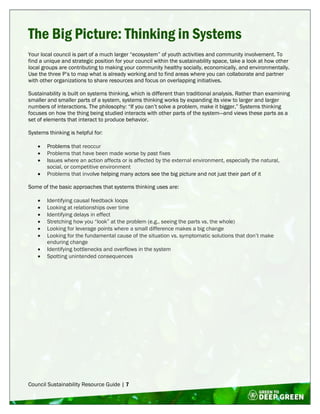
This diagram shows how sustainability intersects with the three P’s (people, planet, and prosperity) and
the three E’s (equity economy, and environment). Sustainability lies in the sweet spot where all those
concerns connect.
Council Sustainability Resource Guide | 7
The Big Picture: Thinking in Systems
Your local council is part of a much larger “ecosystem” of youth activities and community involvement. To
find a unique and strategic position for your council within the sustainability space, take a look at how other
local groups are contributing to making your community healthy socially, economically, and environmentally.
Use the three P’s to map what is already working and to find areas where you can collaborate and partner
with other organizations to share resources and focus on overlapping initiatives.
Sustainability is built on systems thinking, which is different than traditional analysis. Rather than examining
smaller and smaller parts of a system, systems thinking works by expanding its view to larger and larger
numbers of interactions. The philosophy: “If you can’t solve a problem, make it bigger.” Systems thinking
focuses on how the thing being studied interacts with other parts of the system—and views these parts as a
set of elements that interact to produce behavior.
Systems thinking is helpful for:
 Problems that reoccur
 Problems that have been made worse by past fixes
 Issues where an action affects or is affected by the external environment, especially the natural,
social, or competitive environment
 Problems that involve helping many actors see the big picture and not just their part of it
Some of the basic approaches that systems thinking uses are:
 Identifying causal feedback loops
 Looking at relationships over time
 Identifying delays in effect
 Stretching how you “look” at the problem (e.g., seeing the parts vs. the whole)
 Looking for leverage points where a small difference makes a big change
 Looking for the fundamental cause of the situation vs. symptomatic solutions that don’t make
enduring change
 Identifying bottlenecks and overflows in the system
 Spotting unintended consequences
Council Sustainability Resource Guide | 8
How Sustainability Benefits Local Councils
The triple bottom line of people, planet, and prosperity demonstrates the broad positive impact sustainability
can have. But sustainability can also have a positive impact on local councils.
Sustainability can be a “strange attractor,” a way to have a fresh conversation about what Scouting has been
doing for more than a century. It provides a broad platform to discuss the historic dedication that Scouting
has had to sustainability:
 People (Do a Good Turn Daily)
 Planet (the Outdoor Code, Leave No Trace)
 Prosperity (A Scout is thrifty)
Sustainability lets your council:
 Engage new community supporters and families
 Reengage community members who have a limited view of Scouting but a strong affinity with
sustainability
 Save money on operations by implementing practices to reduce the cost of running camps and
offices
 Tell a new story and increase community interest and media exposure
 Highlight Eagle Scout projects, Venturing Summit projects, and Hornaday Award projects from your
community and across the nation that relate to sustainability
 Draw connections between Scouting’s deep legacy of outdoor education and positive youth
development and issues that are top of mind with key stakeholders
Council Sustainability Resource Guide | 9
Personal Sustainability Practices
One of the most powerful ways you can move your council toward greater sustainability is by adopting
personal sustainability practices, things you do on an individual basis that positively impact the triple bottom
line. By adopting a personal sustainability practice, you set the example (much like a Friends of Scouting
chairperson submits the first pledge card at an event). You also ensure that sustainability will remain top of
mind for you and those in your immediate circle.
Here are some work-related possibilities:
 Carpooling to meetings at camp
 Using a reusable coffee mug instead of disposable cups
 Leaving the lights off in your office
 Cleaning out your car trunk to improve fuel efficiency
 Shutting down your computer at night
 Holding virtual meetings where possible
 Using caterers for events who source food locally
 Printing on the back of used copy paper
To change these kinds of behaviors requires practice and repetition. The rule of thumb is that it takes 21
days to add a new behavior or extinguish an unwanted behavior, a powerful indication of the effort and
attention required to change one behavior.
To conserve thinking resources, our brains are wired to create patterns, which is why changing habits is so
difficult. This understanding will help you to be more patient and persistent as you make changes in your
council.
Council Sustainability Resource Guide | 10
Sustainability and the Scout Law
A Scout is:
Trustworthy. Sustainability starts with you, and helps you to stand out as a young leader. You can help by
recycling, and advocating green solutions to everyday issues.
Loyal. Demonstrate sustainability by being the voice of reason and reminding others we all share limited
resources.
Helpful. You can make a difference in your family and in your community— and help our world—by using only
what you need. Take time to share with others what you are doing.
Friendly. Volunteer in your community at a community garden, recycling center, or other sustainable activity
and encourage others to do the same. This can be a fun and exciting way to see firsthand how, when we all
are working together, we can make a difference in this world.
Courteous. Always thank people for their help and understanding, because we all benefit from sustainability
and thinking about how our actions, no matter how small, affect others.
Kind. Treat this world with respect, save valuable resources and set an example for others to follow. Take
time to smile; it does make a difference.
Obedient. To protect the world’s resources you need to be true to yourself and believe in sustainability.
Cheerful. Tell your stories of sustainability activities and projects with a smile, knowing you are making a
difference, and others just might take action based on how you tell your story.
Thrifty. Track your savings at home or in your troop on solid sustainability actions.
Brave. You can be a leader at home or in your community when taking the appropriate actions. Stand up for
what is right; start with your actions so you and your family can lead others to engage in sustainable living.
Clean. Respect our world and the valuable resources we are consuming every day. You can always help by
understanding what is really needed and talking with others to protect the air we breathe, and the water we
drink.
Reverent. Always consider other points of view and be true to Earth, as we all live here together.
Remember that sustainability starts with you.
Developed by Camp Emerald Bay, Catalina Island, California
Council Sustainability Resource Guide | 11
Local Council Success Stories
. . . . . . . . . . . . . . . . . . . . . . . . . . . . . . . . . . . . . . . . . . . . . . . . . . . . . .
How Local Councils Are Impacting the Triple Bottom Line
Council Sustainability Resource Guide | 12
Planning for Sustainability
Getting Started
Blue Ridge Scout Reservation
Blue Ridge Mountains Council
Blue Ridge Scout Reservation encompasses 16,000 acres of wilderness terrain, so a major challenge was
figuring out where to get started. When a new conservation committee chairman with extensive land-
management experience came on board, the council began formulating an ecosystem management plan. It
then recruited experts in such fields as forestry, soils and erosion, and trails and recreation to form
subcommittees to create plans for dealing with their areas of expertise. Those plans came together to form
the council’s ecosystem management plan.
Bridging Divides
Forestburg Scout Reservation
Monmouth Council
Monmouth Council has historically had two committees related to its 1,200-acre camp: the camping
committee and the properties committee. Unfortunately, they haven’t always communicated, meaning the
properties committee wasn’t taking into account the program needs of the structures it built. Today, the two
committees function more as one group so that projects make sense and resources aren’t wasted.
At the same time, the council is bridging the divide between past, present, and future. As it has made
sustainability improvements at the camp, it has worked to maintain the camp’s traditional look and feel. In
terms of the future, the council always takes future maintenance costs into account when planning camp
improvement. As Spencer Morasch, chairman of the properties committee, explained, “If we put a
sustainable project on camp, it must be simple to build, simple to operate, and simple to maintain at very
low costs.”
Relying on the Experts
Silicon Valley Monterey Bay Council
The Monterey Bay area is awash in experts in conservation, nature, and land management. Rather than go it
alone in developing a sustainability plan, the Silicon Valley Monterey Bay Council enlisted the help of many
of these men and women. The council’s conservation committee includes representatives from the state
Department of Fish and Wildlife and the state Department of Forestry and Fire Protection, as well as local
botanists, biologists, and land-use experts. Other resources the council relies on include Monterrey County’s
Resource Conservation District and the sustainability office at Oracle Systems.
Council Sustainability Resource Guide | 13
Food
Fruit for the Future
Irvine Ranch Outdoor Education Center
Orange County Council
Thanks to donations by Griffith Farms, Irvine Ranch Outdoor Education Center boasts an orchard with 200
trees of many varieties, including navel oranges, mandarin oranges, lemons, limes, and even Buddha’s
hands. Students learn about topics like pest management and citrus’s role in California’s development. The
fruit is used as part of the camp’s food program and is sold to outside vendors.
Teaching Aquaponics
Camp Loud Thunder
Illowa Council
Aquaponics is a modern technology with ancient roots that combines aquaculture (raising edible fish) with
hydroponics (growing vegetables and herbs without soil). In a closed, symbiotic loop, waste products from
fish provide nutrients to plants, which in turn clean the water in which the fish live. Growing crops
aquaponically reduces water needs by almost 80 percent and recycles nutrients that would otherwise go to
waste.
The model aquaponics system at Camp Loud Thunder cost less than $500 to build and is helping Scouts
learn creative ways to enhance their families’ food and water security. Eventually, the camp hopes to build a
large-scale aquaponics system to grow fresh, locally farmed fish to sell in the community.
Council Sustainability Resource Guide | 14
Water
Using Water Wisely
Irvine Ranch Outdoor Education Center
Orange County Council
To cope with California’s frequent water shortages, Irvine Ranch Outdoor Education Center relies heavily on
native, drought-resistant landscaping. It also collects runoff from irrigation of its orchard to use in a
demonstration of aquaponics farming (in which fish and plants like lettuce rely on the same water, which is
recycled and filtered). And less water is needed for the camp’s citrus orchard thanks to mulching that
reduces runoff.
Reducing Water Consumption
Camp Emerald Bay
Orange County Council
Camp Emerald Bay has reduced its water usage by more than half through a comprehensive set of water-
conservation strategies—an important step considering that the camp’s 4,800 summer visitors use an
average of 35 gallons of water per person per day. At 4 cents per gallon, that means a water bill of more
than $6,700 for the season. The camp has installed spring-loaded water fountains and sinks, showers with
pull-string faucets, and low/high flush valves. It is diverting graywater into planter boxes and educating
campers about water conservation through signage and television monitors that show real-time water-usage
facts.
Council Sustainability Resource Guide | 15
Energy
Supplementing the Grid With Solar Power
Pioneer Scout Reservation
Erie Shores Council
Camp Frontier at Pioneer Scout Reservation has integrated off-the-grid solar power to support camp
operations. Each latrine includes a solar panel that charges batteries to keep the lights on at night, keep
water pumps running, keep fans circulating, and charge battery packs for adult leaders’ CPAP machines. The
camp has also switched to CFL lightbulbs to ensure maximum efficiency and affordability.
Living off the Grid
Camp Noyo
Redwood Empire Council
Camp Noyo is a small, primitive camp with beautiful campsites, a small river, a few cabins, and a large
kitchen. Given its remote location, the camp has no access to the power grid. Instead, electrical power is
provided by a 1000-watt off-the-grid solar panel system connected to a large battery bank, providing all
necessary power for the camp. The camp also uses back-up generators for emergencies.
Insulating Against Energy Costs
D Bar A Scout Ranch
Michigan Crossroads Council
D Bar A Scout Ranch’s cabins were built in the 1950s with single-pane windows and very little insulation. As
a result, the camp pays tens of thousands of dollars every year for propane. To reduce energy costs, the
council secured a grant that allowed it to add as much insulation as possible to the cabins. It has also tried,
albeit with mixed success, to convince campers to shut off lights when they aren’t in use and to keep cabin
windows and doors shut in cool weather.
Council Sustainability Resource Guide | 16
Harnessing the Sun
Camp Krietenstein
Crossroads of America Council
When Crossroads of America Council built a new shower house, it kept sustainability in mind. Solar panels
generate all the needed power, making the building free to operate, while solar tubes in the shower stalls
bring in natural light while protecting privacy. The building is also designed so that parts of it can be shut
down in the offseason, reducing maintenance costs.
Camp Krietenstein also installed a solar array in 2013. Aside from the winter months, the system generates
more than 300 kilowatt-hours of power per month—enough power to charge a cell phone for more than 10
years.
Going Solar
Treasure Valley Scout Reservation
Mohegan Council
Mohegan Council partnered with SunEdison and Nexamp to host an alternative clean energy project at
Treasure Valley. This 5.92-megawatt DC solar installation will provide the council with a source of
sustainable revenue that will fund additional summer programming and equipment for Cub Scouts, Boy
Scouts and Venturers. This program also provides the Upper Blackstone Water Pollution Abatement District,
the Dudley-Charlton Regional School District, and the Southern Worcester County Educational Collaborative
with reduced energy costs for the next 20 years. The solar plant will produce enough electricity to offset the
CO2 emissions from the electricity use of over 749 average American homes, taking 1,147 automobiles off
the road and equivalent to 5,447 metric tons of CO2 per year. The Mohegan Council has also committed to
designing an alternative energy curriculum for elementary schools, technical high schools, and Scouts.
Council Sustainability Resource Guide | 17
Waste
Reducing Waste
Camp Noyo
Redwood Empire Council
Given its remote location, Camp Noyo has no trash service. Instead, everything must be packed out—at a
price. To reduce costs and help the environment, the camp separates out cans, bottles, cardboard, and
paper for recycling. It also composts food waste and sends it to a local farmer. Recognizing that much of that
food waste should never have been generated in the first place, the camp encourages campers not to take
more food than they can eat, a simple step that reduces the amount of food going into the waste stream.
Reducing Dining Hall Waste
Camp Constantine
Circle Ten Council
When Camp Constantine built a new dining hall, it included a commercial-grade dishwasher that allowed it
stop using disposable plates, cups, and utensils. Making this change cut the camp’s trash output by two-
thirds. It also yielded financial savings. The camp went from changing out its trash compactor quarterly to
changing it out twice a year, for an annual savings of $2,000. And by not using open-top dumpsters, the
camp smells much better.
The Milk Carton Challenge
Camp Loud Thunder
Illowa Council
Like many camps, Camp Loud Thunder composts waste and recycles cardboard, plastic, and aluminum,
which reduces costs and saves landfill space. As for non-recyclable waxed-paper milk cartons, camp staffers
challenge campers to see how many cartons they can fold up and place inside an empty carton. At one point,
the record was 22. By turning throwing away trash into a game, the camp sends the message that
sustainability can be both fun and good for the environment.
Council Sustainability Resource Guide | 18
Teaching Sustainability
Changing Personal Practices
Blue Ridge Scout Reservation
Blue Ridge Mountains Council
Camps understandably focus on their campers, but Blue Ridge Scout Reservation also focuses on impacting
the seasonal staff members who work there for eight weeks each summer. “I really think that we need to
focus on our staff members because that’s where we can impact the greatest change, and personally I think
that one of the greatest gifts of being a leader with the Scouts is getting to know this next generation of
leadership, to going inside their heads to see what makes them excited, and to really help guide them to
make positive choices in the future,” said Greg Harmon, director of camping.
Promoting Biodiversity
Blue Ridge Scout Reservation
Blue Ridge Mountains Council
Understanding the critical importance of biodiversity, Blue Ridge Scout Reservation has undertaken such
projects as treating a grove of hemlock trees against pests like the hemlock woolly adelgid. Director of
Camping Greg Harmon explained that the trees help cool the water in the creek they overlook, while the
branches they drop into the water serve as nesting material for salamanders.
Projects like these are also incorporated into the Forestry merit badge curriculum during summer camp.
Instructors send Scouts out to find hemlock woolly adelgids. They then show Scouts healthy trees that have
been treated for a dozen years and have grown 8 to 10 feet in that time. Harmon said Scouts are usually
excited about what they’re learning.
“The culture’s changing a little bit where we’re starting to see the environment slightly differently. It’s not just
a resource that we harvest and use for our own purposes. We’re a part of that ecosystem itself; we’re on that
island that’s sort of floating through space, and we’ve got to all work together to keep everything in balance,”
Harmon said.
A Center for Science Learning
Camp Friedlander
Dan Beard Council
STEM (science, technology, engineering, and math) education is a hot trend across the BSA, but it’s business
as usual at Camp Friedlander. For a decade or so, the camp has featured a NEST (nature, ecology, science,
and technology) center that combines today’s technology with the beauty of the outdoors. In that program
area, Scouts can work on badges ranging from Environmental Science to Robotics.
Council Sustainability Resource Guide | 19
Taking School to Camp
Irvine Ranch Outdoor Education Center
Orange County Council
The Orange County Council has positioned Irvine Ranch Outdoor Education Center as an important resource
in teaching science and sustainability. The camp’s Connection to School curriculum lets school classes learn
lessons that directly relate to state and national standards and to Common Core standards. The flexible
curriculum allows any grade level to learn about some aspect of sustainability. In part because of the
program, three-quarters of camp participants are non-Scouts.
Teaching While Saving
Don Reynolds Scouting Resource Center
Las Vegas Area Council
Las Vegas Area Council worked with NV Energy to install a 100-killowatt solar-power system in its council
service center that generates enough electricity to cover a third of the building’s total energy needs. In the
lobby, visitors can view real-time statistics about the energy being produced by solar power and how much
carbon is being saved. Part of the monitoring system is right next to a display of the Outdoor Code,
demonstrating the connection between Scouting values and sustainability.
But the solar-power system teaches other people as well. Community groups use the building frequently,
including a church that meets there every Sunday.
Learning From the Experts
Camp Pico Blanco
Silicon Valley Monterey Bay Council
California State University, Monterey Bay and the University of California, Santa Cruz, which both focus
heavily on sustainability, have made Camp Pico Blanco a sort of living laboratory. Students doing internships
complete research projects there, and a UC Davis expert on sudden oak death is using the camp as a
primary research area. As a result, Scouts who attend the camp get to see real scientific research firsthand—
and perhaps glimpse careers they might pursue in the future.
Council Sustainability Resource Guide | 20
Forming Partnerships
Partnering With Deer Hunters
Blue Ridge Scout Reservation
Blue Ridge Mountains Council
Blue Ridge Scout Reservation examined its hunting regulations a few years ago and identified several
problems, including poor border security and difficulty regulating hunting. Rather than try harder to exclude
hunters, the camp found ways to make them part of the solution. It hosts twice-a-year hunter work days
where hunters spend a day working on projects around the camp, like painting buildings or constructing
shelters, in return for permission to hunt while Scouts aren’t present. Participants now have a sense of
ownership and alert the camp rangers when they see vandalism or other issues.
Helping the Bees Together
Irvine Ranch Outdoor Education Center
Orange County Council
Irvine Ranch Outdoor Education Center hosts 20 to 35 beehives through a partnership with the Orange
County Beekeepers Association. Not only do the hives help ensure the survival of critical pollinators, but they
also offer a great learning tool for students and visitors.
Being Good Neighbors
Forestburg Scout Reservation
Monmouth Council
Most campers at Forestburg Scout Reservation travel from a hundred miles or more away, so they aren’t a
part of the local community. To compensate, the camp works hard to foster local connections. The camp
ranger is active in the community, and the camp is happy to host community events. In return, local
residents keep the camp’s needs in mind when developing their property, for example by using buffer zones
and landscaping to help the camp maintain its secluded atmosphere.
Council Sustainability Resource Guide | 21
Helping in Emergencies
Camp Loud Thunder
Illowa Council
Camp Loud Thunder lies just five miles from the Mississippi River, which is subject to occasional flooding.
Illowa Council has committed to the Federal Emergency Management Administration to house up to 250
evacuees or emergency workers in tents with cots and to make its dining hall and other facilities available in
the event of an emergency. According to Scout Executive Tom McDermott, the gesture models Scouting’s
commitment to community service. “We hope that each and every generation has the helpful spirit and is
prepared with the skills, resources, and the ability to come to the aid of others if necessary,” he said.
Council Sustainability Resource Guide | 22
Sustainable Construction
Building Roads That Last
Camp Constantine
Circle Ten Council
Many of the roads at Camp Constantine have been in use since the camp opened in 1946. Maintaining
those roads is a challenge, but camp managers understand that the real key to sustainable camp roads is
not the roads themselves but their surroundings—culverts, bar ditches, and other features that control water.
By thinking holistically, the council is building roads that will last much longer—and keep campers’ feet dry.
A Showplace of Sustainable Construction
Marge Schott Scout Achievement Center
Dan Beard Council
The Marge Schott Scout Achievement Center was the first council service center in the country to achieve
LEED Silver certification. Among its green features: a light-colored cement parking lot and light-colored PVC
roofing that reduce the heat-island effect, a drainage system that captures and treats 80 percent of storm-
water runoff, low-power outdoor lighting to reduce light pollution, daylighting in 90 percent of regularly
occupied areas, and significant use of recycled and regionally sources building materials. The building, which
is accessible to the community, helps demonstrate the importance of sustainability to the BSA.
Building for the Future
Latimer Scout Reservation
Middle Tennessee Council
Latimer Scout Reservation opened in 2010 but was built to last a lifetime. The buildings were constructed of
Douglas fir with metal roofs, and builders used stone and other low-maintenance materials wherever
possible. To offset energy costs, the camp’s major structures rely on geothermal heating.
Perhaps the best, and most unusual, example of sustainable development at the camp is a bridge on the
property. Rather than build a new drive over the spillway, the council bought an 84-year-old road bridge at a
junkyard, brought it to the site, totally refurbished it, and put it into place. The cost: $27,000 vs. an
estimated $250,000.
Council Sustainability Resource Guide | 23
Going for the Platinum
Sea Scout Base Galveston
Bay Area Council
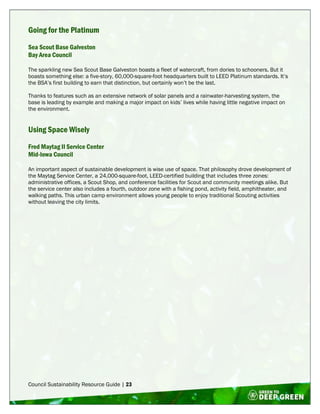
The sparkling new Sea Scout Base Galveston boasts a fleet of watercraft, from dories to schooners. But it
boasts something else: a five-story, 60,000-square-foot headquarters built to LEED Platinum standards. It’s
the BSA’s first building to earn that distinction, but certainly won’t be the last.
Thanks to features such as an extensive network of solar panels and a rainwater-harvesting system, the
base is leading by example and making a major impact on kids’ lives while having little negative impact on
the environment.
Using Space Wisely
Fred Maytag II Service Center
Mid-Iowa Council
An important aspect of sustainable development is wise use of space. That philosophy drove development of
the Maytag Service Center, a 24,000-square-foot, LEED-certified building that includes three zones:
administrative offices, a Scout Shop, and conference facilities for Scout and community meetings alike. But
the service center also includes a fourth, outdoor zone with a fishing pond, activity field, amphitheater, and
walking paths. This urban camp environment allows young people to enjoy traditional Scouting activities
without leaving the city limits.
Council Sustainability Resource Guide | 24
Finances
Making Camp Accessible to Inner-City Kids
Camp Constantine
Circle Ten Council
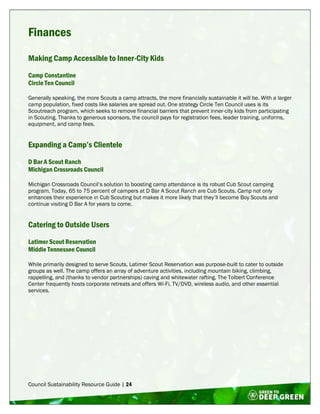
Generally speaking, the more Scouts a camp attracts, the more financially sustainable it will be. With a larger
camp population, fixed costs like salaries are spread out. One strategy Circle Ten Council uses is its
Scoutreach program, which seeks to remove financial barriers that prevent inner-city kids from participating
in Scouting. Thanks to generous sponsors, the council pays for registration fees, leader training, uniforms,
equipment, and camp fees.
Expanding a Camp’s Clientele
D Bar A Scout Ranch
Michigan Crossroads Council
Michigan Crossroads Council’s solution to boosting camp attendance is its robust Cub Scout camping
program. Today, 65 to 75 percent of campers at D Bar A Scout Ranch are Cub Scouts. Camp not only
enhances their experience in Cub Scouting but makes it more likely that they’ll become Boy Scouts and
continue visiting D Bar A for years to come.
Catering to Outside Users
Latimer Scout Reservation
Middle Tennessee Council
While primarily designed to serve Scouts, Latimer Scout Reservation was purpose-built to cater to outside
groups as well. The camp offers an array of adventure activities, including mountain biking, climbing,
rappelling, and (thanks to vendor partnerships) caving and whitewater rafting. The Tolbert Conference
Center frequently hosts corporate retreats and offers Wi-Fi, TV/DVD, wireless audio, and other essential
services.
Council Sustainability Resource Guide | 25
Identifying Foundation Priorities
Orange County Council
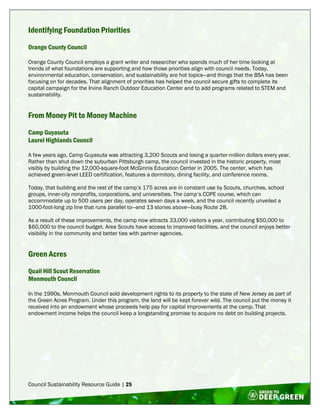
Orange County Council employs a grant writer and researcher who spends much of her time looking at
trends of what foundations are supporting and how those priorities align with council needs. Today,
environmental education, conservation, and sustainability are hot topics—and things that the BSA has been
focusing on for decades. That alignment of priorities has helped the council secure gifts to complete its
capital campaign for the Irvine Ranch Outdoor Education Center and to add programs related to STEM and
sustainability.
From Money Pit to Money Machine
Camp Guyasuta
Laurel Highlands Council
A few years ago, Camp Guyasuta was attracting 3,200 Scouts and losing a quarter-million dollars every year.
Rather than shut down the suburban Pittsburgh camp, the council invested in the historic property, most
visibly by building the 12,000-square-foot McGinnis Education Center in 2005. The center, which has
achieved green-level LEED certification, features a dormitory, dining facility, and conference rooms.
Today, that building and the rest of the camp’s 175 acres are in constant use by Scouts, churches, school
groups, inner-city nonprofits, corporations, and universities. The camp’s COPE course, which can
accommodate up to 500 users per day, operates seven days a week, and the council recently unveiled a
1000-foot-long zip line that runs parallel to—and 13 stories above—busy Route 28.
As a result of these improvements, the camp now attracts 33,000 visitors a year, contributing $50,000 to
$60,000 to the council budget. Area Scouts have access to improved facilities, and the council enjoys better
visibility in the community and better ties with partner agencies.
Green Acres
Quail Hill Scout Reservation
Monmouth Council
In the 1990s, Monmouth Council sold development rights to its property to the state of New Jersey as part of
the Green Acres Program. Under this program, the land will be kept forever wild. The council put the money it
received into an endowment whose proceeds help pay for capital improvements at the camp. That
endowment income helps the council keep a longstanding promise to acquire no debt on building projects.
Council Sustainability Resource Guide | 26
Resources
. . . . . . . . . . . . . . . . . . . . . . . . . . . . . . . . . . . . . . . . . . . . . . . . . . . . . .
Additional Tools to Use on Your Journey to Sustainability
Council Sustainability Resource Guide | 27
Sustainability Principles Overviews
Biomimicry http://biomimicry.net
Cradle to Cradle Framework http://www.mbdc.com/cradle-to-cradle/c2c-framework/
Hannover Principles: Design for
Sustainability
http://www.mcdonough.com/speaking-writing/the-hannover-
principles-design-for-sustainability/
Life Cycle Analysis and Assessment http://www.gdrc.org/uem/lca/life-cycle.html
Natural Capitalism http://www.rmi.org/Natural++Capitalism
Permaculture http://www.permacultureprinciples.com
The Natural Step http://www.naturalstep.org
The Product-Life Institute: Stahel’s
Five Pillars
http://www.product-life.org
Online Courses
AutoDesk Sustainability Workshop http://sustainabilityworkshop.autodesk.com/product-design
Cradle to Cradle Products Innovation
Institute
http://www.c2ccertified.org/education/design-for-the-circular-
economy
Ellen MacArthur Foundation http://www.ellenmacarthurfoundation.org
GreenCE: Sustainable Design
Continuing Education
http://www.greence.com
Council Sustainability Resource Guide | 28
Other Online Resources
B Corps http://www.bcorporation.net
Center for Biological Diversity http://www.biologicaldiversity.org
Cradle to Cradle Products Innovation
Institute
http://www.c2ccertified.org
Eartheasy http://eartheasy.com
Ecological Society of America http://www.esa.org
EnviroLink Network http://www.envirolink.org
Fair Trade USA http://fairtradeusa.org
Global Footprint Network http://www.footprintnetwork.org
National Resources Conservation
Service
http://www.nrcs.usda.gov
Reuseit http://www.reuseit.com
The City Repair Project http://cityrepair.org
U.S. Green Building Council http://www.usgbc.org
Council Sustainability Resource Guide | 29
Share Your Stories
Once you’ve explored the ideas and stories in this resource guide, we want to hear from you. What
challenges has your council overcome? How have you made your service center or camp more sustainable?
What impact have you had on the triple bottom line?
Complete this form to share your stories with us and your peers across the BSA. (You can also complete this
form online at http://www.greentodeepgreen.org/index.php/2015/10/26/share-your-story/.)
Name __________________________________________________
Position __________________________________________________
Council __________________________________________________
Email Address __________________________________________________
Phone Number __________________________________________________
Please complete a separate copy of this form for each story you want to tell.
What challenge did your council face? (Check all that apply.)
__ Planning for Sustainability
__ Food
__ Water
__ Energy
__ Waste
__ Teaching Sustainability
__ Forming Partnerships
__ Sustainable Construction
__ Finances
What solution did you implement?
What was the result?
Council Sustainability Resource Guide | 30
How much did the project cost?
Where did you get the funding?
Where can others go to learn more?
Feel free to send us before-and-after photos as well.
You may complete this form online at http://www.greentodeepgreen.org/index.php/2015/10/26/
share-your-story/or mail it to:
Sustainability Office
Boy Scouts of America
PO Box 152079
Irving, TX, 75015-2079

council_sustainability_guide

  • 1.
    Council Sustainability Resource Guide .. . . . . . . . . . . . . . . . . . . . . . . . . . . . . . . . . . . . . . . . . . . . . . . . . . . . . A Toolkit for Incorporating Sustainability Practices into Camp and Service Center Operations Version 1 – October 26, 2015
  • 2.
    Council Sustainability ResourceGuide | 2 Contents Contents .....................................................................................................................................................................2 Introduction................................................................................................................................................................4 About This Resource Guide ........................................................................................................................................4 Defining Sustainability................................................................................................................................................5 The Big Picture: Thinking in Systems..........................................................................................................................7 How Sustainability Benefits Local Councils ................................................................................................................8 Personal Sustainability Practices................................................................................................................................9 Sustainability and the Scout Law............................................................................................................................. 10 Local Council Success Stories................................................................................................................................... 11 Planning for Sustainability................................................................................................................................... 12 Getting Started ................................................................................................................................................ 12 Bridging Divides............................................................................................................................................... 12 Relying on the Experts..................................................................................................................................... 12 Food..................................................................................................................................................................... 13 Fruit for the Future.......................................................................................................................................... 13 Teaching Aquaponics....................................................................................................................................... 13 Water................................................................................................................................................................... 14 Using Water Wisely ......................................................................................................................................... 14 Reducing Water Consumption ........................................................................................................................ 14 Energy.................................................................................................................................................................. 15 Supplementing the Grid With Solar Power ..................................................................................................... 15 Living off the Grid............................................................................................................................................ 15 Insulating Against Energy Costs....................................................................................................................... 15 Harnessing the Sun.......................................................................................................................................... 16 Going Solar ...................................................................................................................................................... 16 Waste................................................................................................................................................................... 17 Reducing Waste............................................................................................................................................... 17 Reducing Dining Hall Waste ............................................................................................................................ 17 The Milk Carton Challenge .............................................................................................................................. 17
  • 3.
    Council Sustainability ResourceGuide | 3 Teaching Sustainability........................................................................................................................................ 18 Changing Personal Practices............................................................................................................................ 18 Promoting Biodiversity.................................................................................................................................... 18 A Center for Science Learning ......................................................................................................................... 18 Taking School to Camp .................................................................................................................................... 19 Teaching While Saving..................................................................................................................................... 19 Learning From the Experts .............................................................................................................................. 19 Forming Partnerships .......................................................................................................................................... 20 Partnering With Deer Hunters......................................................................................................................... 20 Helping the Bees Together.............................................................................................................................. 20 Being Good Neighbors..................................................................................................................................... 20 Helping in Emergencies ................................................................................................................................... 21 Sustainable Construction..................................................................................................................................... 22 Building Roads That Last.................................................................................................................................. 22 A Showplace of Sustainable Construction....................................................................................................... 22 Building for the Future .................................................................................................................................... 22 Going for the Platinum .................................................................................................................................... 23 Using Space Wisely.......................................................................................................................................... 23 Finances............................................................................................................................................................... 24 Making Camp Accessible to Inner-City Kids .................................................................................................... 24 Expanding a Camp’s Clientele.......................................................................................................................... 24 Catering to Outside Users................................................................................................................................ 24 Identifying Foundation Priorities..................................................................................................................... 25 From Money Pit to Money Machine ............................................................................................................... 25 Green Acres ..................................................................................................................................................... 25 Resources ................................................................................................................................................................ 26 Sustainability Principles Overviews..................................................................................................................... 27 Online Courses..................................................................................................................................................... 27 Other Online Resources....................................................................................................................................... 28 Share Your Stories ................................................................................................................................................... 29
  • 4.
    Council Sustainability ResourceGuide | 4 Introduction For more than a century, the BSA has been an acknowledged leader in outdoor education and environmental stewardship. We have taught generations of Scouts to take nothing but pictures and leave nothing but footprints. For decades, the Outdoor Code has stood alongside the Scout Oath and Scout Law as a guide for interacting with the world around us. In our second century of service, we have moved from an emphasis on conservation to an embrace of sustainability. We built the Summit Bechtel Reserve as a showplace for sustainable development, introduced the Sustainability merit badge, and have held Sustainability Summits in West Virginia (in 2012, 2013, and 2014) and at National Geographic headquarters in Washington (in 2015). This resource guide represents the next step in our sustainability journey. We hope you’ll use it to as both a roadmap for your own council’s sustainability journey and as a place to share your successes with other councils. About This Resource Guide This resource guide combines general information about sustainability with specific stories from local councils around the major topics of water, food, energy, and waste. Our goal is not to create a comprehensive handbook or to prescribe one-size-fits-all solutions. Instead, we seek to start conversations both within and among local council leaders. Like the subject it covers, this resource guide is a living document. We plan to update it frequently and look forward to incorporating your success stories in the next future. To learn more and submit your council’s story, visit http://www.greentodeepgreen.org.
  • 5.
    Council Sustainability ResourceGuide | 5 Defining Sustainability In defining sustainability, most people rely on the Brundtland Commission (formally known as the World Commission on Environment and Development), which stated that “sustainable development meets the needs of the present without compromising the ability of future generations to meet their own needs.” We embrace that definition, but we would add this description from the Sustainability merit badge pamphlet: “It’s a big word with many aspects. But when you break it down, it goes hand in hand with being a good Scout. Sustainability means the ability to endure. Conserving the land, forests, air, water, wildlife, and limited resources we all share is everyone’s responsibility. Reducing what we consume and recycling, repurposing, restoring, and repairing what we own all are parts of being thrifty, a key point of the Scout Law.” Some people think sustainability is all about nature and the environment, but sustainability is more than that. It encompasses a range of actions aimed at impacting the “triple bottom line” of people, planet, and prosperity. By balancing these three factors, we can initiate practices that are both sustainable and impactful. People Education, community development, and quality of life—those are key measures of social success and key values that have guided Scouting for more than a century. In Scouting terms, our social impact means ensuring that our suppliers have safe facilities and treat workers fairly, facilitating opportunities for community service, and utilizing our camps as resources for community recreation and exploration. It also means providing the people we serve—Scouts, leaders, and chartered organizations alike—with the tools and resources they need to become responsible stewards of their communities and the planet. Planet Planet Earth is our common home and provides us with the fundamental natural resources for survival. By thinking globally and acting locally, we do our part to reduce humanity’s impact on the Earth. That includes conserving available resources, preserving critical environments, and regenerating the resources and environments required for a healthy planet. In Scouting terms, looking out for the planet means making outdoor ethics a given for every outing, whether it takes place in the backcountry or an urban park. But it also means cutting carbon emissions by improving the efficiency of our camps and offices, reducing travel and making transportation more efficient, and utilizing resources that are certified for ethical and environmentally friendly practices. Prosperity Money is not the most important thing in life, but it is a primary influence in today’s global economy and a critical component of our sustainability. To survive and thrive in our second century, we must identify sustainable sources of funding and incorporate sustainability into our long-term goals. In doing so, we will not only strengthen our financial position but also better serve our members and communities. Once focused primarily on the environment, sustainability now takes into account the impact of action (or inaction) on the economy and on people’s physical and mental health.
  • 6.
    Council Sustainability ResourceGuide | 6 In Scouting terms, fostering prosperity means ensuring that our business model remains viable. To serve an ever-increasing number of young people, we must have the financial resources to continue to invest in sustainability across the organization. That can mean reducing costs through energy-saving measures, but it can also mean increasing revenue by forging partnerships with sustainability-minded organizations and generating positive earned media. This diagram shows how sustainability intersects with the three P’s (people, planet, and prosperity) and the three E’s (equity economy, and environment). Sustainability lies in the sweet spot where all those concerns connect.
  • 7.
    Council Sustainability ResourceGuide | 7 The Big Picture: Thinking in Systems Your local council is part of a much larger “ecosystem” of youth activities and community involvement. To find a unique and strategic position for your council within the sustainability space, take a look at how other local groups are contributing to making your community healthy socially, economically, and environmentally. Use the three P’s to map what is already working and to find areas where you can collaborate and partner with other organizations to share resources and focus on overlapping initiatives. Sustainability is built on systems thinking, which is different than traditional analysis. Rather than examining smaller and smaller parts of a system, systems thinking works by expanding its view to larger and larger numbers of interactions. The philosophy: “If you can’t solve a problem, make it bigger.” Systems thinking focuses on how the thing being studied interacts with other parts of the system—and views these parts as a set of elements that interact to produce behavior. Systems thinking is helpful for:  Problems that reoccur  Problems that have been made worse by past fixes  Issues where an action affects or is affected by the external environment, especially the natural, social, or competitive environment  Problems that involve helping many actors see the big picture and not just their part of it Some of the basic approaches that systems thinking uses are:  Identifying causal feedback loops  Looking at relationships over time  Identifying delays in effect  Stretching how you “look” at the problem (e.g., seeing the parts vs. the whole)  Looking for leverage points where a small difference makes a big change  Looking for the fundamental cause of the situation vs. symptomatic solutions that don’t make enduring change  Identifying bottlenecks and overflows in the system  Spotting unintended consequences
  • 8.
    Council Sustainability ResourceGuide | 8 How Sustainability Benefits Local Councils The triple bottom line of people, planet, and prosperity demonstrates the broad positive impact sustainability can have. But sustainability can also have a positive impact on local councils. Sustainability can be a “strange attractor,” a way to have a fresh conversation about what Scouting has been doing for more than a century. It provides a broad platform to discuss the historic dedication that Scouting has had to sustainability:  People (Do a Good Turn Daily)  Planet (the Outdoor Code, Leave No Trace)  Prosperity (A Scout is thrifty) Sustainability lets your council:  Engage new community supporters and families  Reengage community members who have a limited view of Scouting but a strong affinity with sustainability  Save money on operations by implementing practices to reduce the cost of running camps and offices  Tell a new story and increase community interest and media exposure  Highlight Eagle Scout projects, Venturing Summit projects, and Hornaday Award projects from your community and across the nation that relate to sustainability  Draw connections between Scouting’s deep legacy of outdoor education and positive youth development and issues that are top of mind with key stakeholders
  • 9.
    Council Sustainability ResourceGuide | 9 Personal Sustainability Practices One of the most powerful ways you can move your council toward greater sustainability is by adopting personal sustainability practices, things you do on an individual basis that positively impact the triple bottom line. By adopting a personal sustainability practice, you set the example (much like a Friends of Scouting chairperson submits the first pledge card at an event). You also ensure that sustainability will remain top of mind for you and those in your immediate circle. Here are some work-related possibilities:  Carpooling to meetings at camp  Using a reusable coffee mug instead of disposable cups  Leaving the lights off in your office  Cleaning out your car trunk to improve fuel efficiency  Shutting down your computer at night  Holding virtual meetings where possible  Using caterers for events who source food locally  Printing on the back of used copy paper To change these kinds of behaviors requires practice and repetition. The rule of thumb is that it takes 21 days to add a new behavior or extinguish an unwanted behavior, a powerful indication of the effort and attention required to change one behavior. To conserve thinking resources, our brains are wired to create patterns, which is why changing habits is so difficult. This understanding will help you to be more patient and persistent as you make changes in your council.
  • 10.
    Council Sustainability ResourceGuide | 10 Sustainability and the Scout Law A Scout is: Trustworthy. Sustainability starts with you, and helps you to stand out as a young leader. You can help by recycling, and advocating green solutions to everyday issues. Loyal. Demonstrate sustainability by being the voice of reason and reminding others we all share limited resources. Helpful. You can make a difference in your family and in your community— and help our world—by using only what you need. Take time to share with others what you are doing. Friendly. Volunteer in your community at a community garden, recycling center, or other sustainable activity and encourage others to do the same. This can be a fun and exciting way to see firsthand how, when we all are working together, we can make a difference in this world. Courteous. Always thank people for their help and understanding, because we all benefit from sustainability and thinking about how our actions, no matter how small, affect others. Kind. Treat this world with respect, save valuable resources and set an example for others to follow. Take time to smile; it does make a difference. Obedient. To protect the world’s resources you need to be true to yourself and believe in sustainability. Cheerful. Tell your stories of sustainability activities and projects with a smile, knowing you are making a difference, and others just might take action based on how you tell your story. Thrifty. Track your savings at home or in your troop on solid sustainability actions. Brave. You can be a leader at home or in your community when taking the appropriate actions. Stand up for what is right; start with your actions so you and your family can lead others to engage in sustainable living. Clean. Respect our world and the valuable resources we are consuming every day. You can always help by understanding what is really needed and talking with others to protect the air we breathe, and the water we drink. Reverent. Always consider other points of view and be true to Earth, as we all live here together. Remember that sustainability starts with you. Developed by Camp Emerald Bay, Catalina Island, California
  • 11.
    Council Sustainability ResourceGuide | 11 Local Council Success Stories . . . . . . . . . . . . . . . . . . . . . . . . . . . . . . . . . . . . . . . . . . . . . . . . . . . . . . How Local Councils Are Impacting the Triple Bottom Line
  • 12.
    Council Sustainability ResourceGuide | 12 Planning for Sustainability Getting Started Blue Ridge Scout Reservation Blue Ridge Mountains Council Blue Ridge Scout Reservation encompasses 16,000 acres of wilderness terrain, so a major challenge was figuring out where to get started. When a new conservation committee chairman with extensive land- management experience came on board, the council began formulating an ecosystem management plan. It then recruited experts in such fields as forestry, soils and erosion, and trails and recreation to form subcommittees to create plans for dealing with their areas of expertise. Those plans came together to form the council’s ecosystem management plan. Bridging Divides Forestburg Scout Reservation Monmouth Council Monmouth Council has historically had two committees related to its 1,200-acre camp: the camping committee and the properties committee. Unfortunately, they haven’t always communicated, meaning the properties committee wasn’t taking into account the program needs of the structures it built. Today, the two committees function more as one group so that projects make sense and resources aren’t wasted. At the same time, the council is bridging the divide between past, present, and future. As it has made sustainability improvements at the camp, it has worked to maintain the camp’s traditional look and feel. In terms of the future, the council always takes future maintenance costs into account when planning camp improvement. As Spencer Morasch, chairman of the properties committee, explained, “If we put a sustainable project on camp, it must be simple to build, simple to operate, and simple to maintain at very low costs.” Relying on the Experts Silicon Valley Monterey Bay Council The Monterey Bay area is awash in experts in conservation, nature, and land management. Rather than go it alone in developing a sustainability plan, the Silicon Valley Monterey Bay Council enlisted the help of many of these men and women. The council’s conservation committee includes representatives from the state Department of Fish and Wildlife and the state Department of Forestry and Fire Protection, as well as local botanists, biologists, and land-use experts. Other resources the council relies on include Monterrey County’s Resource Conservation District and the sustainability office at Oracle Systems.
  • 13.
    Council Sustainability ResourceGuide | 13 Food Fruit for the Future Irvine Ranch Outdoor Education Center Orange County Council Thanks to donations by Griffith Farms, Irvine Ranch Outdoor Education Center boasts an orchard with 200 trees of many varieties, including navel oranges, mandarin oranges, lemons, limes, and even Buddha’s hands. Students learn about topics like pest management and citrus’s role in California’s development. The fruit is used as part of the camp’s food program and is sold to outside vendors. Teaching Aquaponics Camp Loud Thunder Illowa Council Aquaponics is a modern technology with ancient roots that combines aquaculture (raising edible fish) with hydroponics (growing vegetables and herbs without soil). In a closed, symbiotic loop, waste products from fish provide nutrients to plants, which in turn clean the water in which the fish live. Growing crops aquaponically reduces water needs by almost 80 percent and recycles nutrients that would otherwise go to waste. The model aquaponics system at Camp Loud Thunder cost less than $500 to build and is helping Scouts learn creative ways to enhance their families’ food and water security. Eventually, the camp hopes to build a large-scale aquaponics system to grow fresh, locally farmed fish to sell in the community.
  • 14.
    Council Sustainability ResourceGuide | 14 Water Using Water Wisely Irvine Ranch Outdoor Education Center Orange County Council To cope with California’s frequent water shortages, Irvine Ranch Outdoor Education Center relies heavily on native, drought-resistant landscaping. It also collects runoff from irrigation of its orchard to use in a demonstration of aquaponics farming (in which fish and plants like lettuce rely on the same water, which is recycled and filtered). And less water is needed for the camp’s citrus orchard thanks to mulching that reduces runoff. Reducing Water Consumption Camp Emerald Bay Orange County Council Camp Emerald Bay has reduced its water usage by more than half through a comprehensive set of water- conservation strategies—an important step considering that the camp’s 4,800 summer visitors use an average of 35 gallons of water per person per day. At 4 cents per gallon, that means a water bill of more than $6,700 for the season. The camp has installed spring-loaded water fountains and sinks, showers with pull-string faucets, and low/high flush valves. It is diverting graywater into planter boxes and educating campers about water conservation through signage and television monitors that show real-time water-usage facts.
  • 15.
    Council Sustainability ResourceGuide | 15 Energy Supplementing the Grid With Solar Power Pioneer Scout Reservation Erie Shores Council Camp Frontier at Pioneer Scout Reservation has integrated off-the-grid solar power to support camp operations. Each latrine includes a solar panel that charges batteries to keep the lights on at night, keep water pumps running, keep fans circulating, and charge battery packs for adult leaders’ CPAP machines. The camp has also switched to CFL lightbulbs to ensure maximum efficiency and affordability. Living off the Grid Camp Noyo Redwood Empire Council Camp Noyo is a small, primitive camp with beautiful campsites, a small river, a few cabins, and a large kitchen. Given its remote location, the camp has no access to the power grid. Instead, electrical power is provided by a 1000-watt off-the-grid solar panel system connected to a large battery bank, providing all necessary power for the camp. The camp also uses back-up generators for emergencies. Insulating Against Energy Costs D Bar A Scout Ranch Michigan Crossroads Council D Bar A Scout Ranch’s cabins were built in the 1950s with single-pane windows and very little insulation. As a result, the camp pays tens of thousands of dollars every year for propane. To reduce energy costs, the council secured a grant that allowed it to add as much insulation as possible to the cabins. It has also tried, albeit with mixed success, to convince campers to shut off lights when they aren’t in use and to keep cabin windows and doors shut in cool weather.
  • 16.
    Council Sustainability ResourceGuide | 16 Harnessing the Sun Camp Krietenstein Crossroads of America Council When Crossroads of America Council built a new shower house, it kept sustainability in mind. Solar panels generate all the needed power, making the building free to operate, while solar tubes in the shower stalls bring in natural light while protecting privacy. The building is also designed so that parts of it can be shut down in the offseason, reducing maintenance costs. Camp Krietenstein also installed a solar array in 2013. Aside from the winter months, the system generates more than 300 kilowatt-hours of power per month—enough power to charge a cell phone for more than 10 years. Going Solar Treasure Valley Scout Reservation Mohegan Council Mohegan Council partnered with SunEdison and Nexamp to host an alternative clean energy project at Treasure Valley. This 5.92-megawatt DC solar installation will provide the council with a source of sustainable revenue that will fund additional summer programming and equipment for Cub Scouts, Boy Scouts and Venturers. This program also provides the Upper Blackstone Water Pollution Abatement District, the Dudley-Charlton Regional School District, and the Southern Worcester County Educational Collaborative with reduced energy costs for the next 20 years. The solar plant will produce enough electricity to offset the CO2 emissions from the electricity use of over 749 average American homes, taking 1,147 automobiles off the road and equivalent to 5,447 metric tons of CO2 per year. The Mohegan Council has also committed to designing an alternative energy curriculum for elementary schools, technical high schools, and Scouts.
  • 17.
    Council Sustainability ResourceGuide | 17 Waste Reducing Waste Camp Noyo Redwood Empire Council Given its remote location, Camp Noyo has no trash service. Instead, everything must be packed out—at a price. To reduce costs and help the environment, the camp separates out cans, bottles, cardboard, and paper for recycling. It also composts food waste and sends it to a local farmer. Recognizing that much of that food waste should never have been generated in the first place, the camp encourages campers not to take more food than they can eat, a simple step that reduces the amount of food going into the waste stream. Reducing Dining Hall Waste Camp Constantine Circle Ten Council When Camp Constantine built a new dining hall, it included a commercial-grade dishwasher that allowed it stop using disposable plates, cups, and utensils. Making this change cut the camp’s trash output by two- thirds. It also yielded financial savings. The camp went from changing out its trash compactor quarterly to changing it out twice a year, for an annual savings of $2,000. And by not using open-top dumpsters, the camp smells much better. The Milk Carton Challenge Camp Loud Thunder Illowa Council Like many camps, Camp Loud Thunder composts waste and recycles cardboard, plastic, and aluminum, which reduces costs and saves landfill space. As for non-recyclable waxed-paper milk cartons, camp staffers challenge campers to see how many cartons they can fold up and place inside an empty carton. At one point, the record was 22. By turning throwing away trash into a game, the camp sends the message that sustainability can be both fun and good for the environment.
  • 18.
    Council Sustainability ResourceGuide | 18 Teaching Sustainability Changing Personal Practices Blue Ridge Scout Reservation Blue Ridge Mountains Council Camps understandably focus on their campers, but Blue Ridge Scout Reservation also focuses on impacting the seasonal staff members who work there for eight weeks each summer. “I really think that we need to focus on our staff members because that’s where we can impact the greatest change, and personally I think that one of the greatest gifts of being a leader with the Scouts is getting to know this next generation of leadership, to going inside their heads to see what makes them excited, and to really help guide them to make positive choices in the future,” said Greg Harmon, director of camping. Promoting Biodiversity Blue Ridge Scout Reservation Blue Ridge Mountains Council Understanding the critical importance of biodiversity, Blue Ridge Scout Reservation has undertaken such projects as treating a grove of hemlock trees against pests like the hemlock woolly adelgid. Director of Camping Greg Harmon explained that the trees help cool the water in the creek they overlook, while the branches they drop into the water serve as nesting material for salamanders. Projects like these are also incorporated into the Forestry merit badge curriculum during summer camp. Instructors send Scouts out to find hemlock woolly adelgids. They then show Scouts healthy trees that have been treated for a dozen years and have grown 8 to 10 feet in that time. Harmon said Scouts are usually excited about what they’re learning. “The culture’s changing a little bit where we’re starting to see the environment slightly differently. It’s not just a resource that we harvest and use for our own purposes. We’re a part of that ecosystem itself; we’re on that island that’s sort of floating through space, and we’ve got to all work together to keep everything in balance,” Harmon said. A Center for Science Learning Camp Friedlander Dan Beard Council STEM (science, technology, engineering, and math) education is a hot trend across the BSA, but it’s business as usual at Camp Friedlander. For a decade or so, the camp has featured a NEST (nature, ecology, science, and technology) center that combines today’s technology with the beauty of the outdoors. In that program area, Scouts can work on badges ranging from Environmental Science to Robotics.
  • 19.
    Council Sustainability ResourceGuide | 19 Taking School to Camp Irvine Ranch Outdoor Education Center Orange County Council The Orange County Council has positioned Irvine Ranch Outdoor Education Center as an important resource in teaching science and sustainability. The camp’s Connection to School curriculum lets school classes learn lessons that directly relate to state and national standards and to Common Core standards. The flexible curriculum allows any grade level to learn about some aspect of sustainability. In part because of the program, three-quarters of camp participants are non-Scouts. Teaching While Saving Don Reynolds Scouting Resource Center Las Vegas Area Council Las Vegas Area Council worked with NV Energy to install a 100-killowatt solar-power system in its council service center that generates enough electricity to cover a third of the building’s total energy needs. In the lobby, visitors can view real-time statistics about the energy being produced by solar power and how much carbon is being saved. Part of the monitoring system is right next to a display of the Outdoor Code, demonstrating the connection between Scouting values and sustainability. But the solar-power system teaches other people as well. Community groups use the building frequently, including a church that meets there every Sunday. Learning From the Experts Camp Pico Blanco Silicon Valley Monterey Bay Council California State University, Monterey Bay and the University of California, Santa Cruz, which both focus heavily on sustainability, have made Camp Pico Blanco a sort of living laboratory. Students doing internships complete research projects there, and a UC Davis expert on sudden oak death is using the camp as a primary research area. As a result, Scouts who attend the camp get to see real scientific research firsthand— and perhaps glimpse careers they might pursue in the future.
  • 20.
    Council Sustainability ResourceGuide | 20 Forming Partnerships Partnering With Deer Hunters Blue Ridge Scout Reservation Blue Ridge Mountains Council Blue Ridge Scout Reservation examined its hunting regulations a few years ago and identified several problems, including poor border security and difficulty regulating hunting. Rather than try harder to exclude hunters, the camp found ways to make them part of the solution. It hosts twice-a-year hunter work days where hunters spend a day working on projects around the camp, like painting buildings or constructing shelters, in return for permission to hunt while Scouts aren’t present. Participants now have a sense of ownership and alert the camp rangers when they see vandalism or other issues. Helping the Bees Together Irvine Ranch Outdoor Education Center Orange County Council Irvine Ranch Outdoor Education Center hosts 20 to 35 beehives through a partnership with the Orange County Beekeepers Association. Not only do the hives help ensure the survival of critical pollinators, but they also offer a great learning tool for students and visitors. Being Good Neighbors Forestburg Scout Reservation Monmouth Council Most campers at Forestburg Scout Reservation travel from a hundred miles or more away, so they aren’t a part of the local community. To compensate, the camp works hard to foster local connections. The camp ranger is active in the community, and the camp is happy to host community events. In return, local residents keep the camp’s needs in mind when developing their property, for example by using buffer zones and landscaping to help the camp maintain its secluded atmosphere.
  • 21.
    Council Sustainability ResourceGuide | 21 Helping in Emergencies Camp Loud Thunder Illowa Council Camp Loud Thunder lies just five miles from the Mississippi River, which is subject to occasional flooding. Illowa Council has committed to the Federal Emergency Management Administration to house up to 250 evacuees or emergency workers in tents with cots and to make its dining hall and other facilities available in the event of an emergency. According to Scout Executive Tom McDermott, the gesture models Scouting’s commitment to community service. “We hope that each and every generation has the helpful spirit and is prepared with the skills, resources, and the ability to come to the aid of others if necessary,” he said.
  • 22.
    Council Sustainability ResourceGuide | 22 Sustainable Construction Building Roads That Last Camp Constantine Circle Ten Council Many of the roads at Camp Constantine have been in use since the camp opened in 1946. Maintaining those roads is a challenge, but camp managers understand that the real key to sustainable camp roads is not the roads themselves but their surroundings—culverts, bar ditches, and other features that control water. By thinking holistically, the council is building roads that will last much longer—and keep campers’ feet dry. A Showplace of Sustainable Construction Marge Schott Scout Achievement Center Dan Beard Council The Marge Schott Scout Achievement Center was the first council service center in the country to achieve LEED Silver certification. Among its green features: a light-colored cement parking lot and light-colored PVC roofing that reduce the heat-island effect, a drainage system that captures and treats 80 percent of storm- water runoff, low-power outdoor lighting to reduce light pollution, daylighting in 90 percent of regularly occupied areas, and significant use of recycled and regionally sources building materials. The building, which is accessible to the community, helps demonstrate the importance of sustainability to the BSA. Building for the Future Latimer Scout Reservation Middle Tennessee Council Latimer Scout Reservation opened in 2010 but was built to last a lifetime. The buildings were constructed of Douglas fir with metal roofs, and builders used stone and other low-maintenance materials wherever possible. To offset energy costs, the camp’s major structures rely on geothermal heating. Perhaps the best, and most unusual, example of sustainable development at the camp is a bridge on the property. Rather than build a new drive over the spillway, the council bought an 84-year-old road bridge at a junkyard, brought it to the site, totally refurbished it, and put it into place. The cost: $27,000 vs. an estimated $250,000.
  • 23.
    Council Sustainability ResourceGuide | 23 Going for the Platinum Sea Scout Base Galveston Bay Area Council The sparkling new Sea Scout Base Galveston boasts a fleet of watercraft, from dories to schooners. But it boasts something else: a five-story, 60,000-square-foot headquarters built to LEED Platinum standards. It’s the BSA’s first building to earn that distinction, but certainly won’t be the last. Thanks to features such as an extensive network of solar panels and a rainwater-harvesting system, the base is leading by example and making a major impact on kids’ lives while having little negative impact on the environment. Using Space Wisely Fred Maytag II Service Center Mid-Iowa Council An important aspect of sustainable development is wise use of space. That philosophy drove development of the Maytag Service Center, a 24,000-square-foot, LEED-certified building that includes three zones: administrative offices, a Scout Shop, and conference facilities for Scout and community meetings alike. But the service center also includes a fourth, outdoor zone with a fishing pond, activity field, amphitheater, and walking paths. This urban camp environment allows young people to enjoy traditional Scouting activities without leaving the city limits.
  • 24.
    Council Sustainability ResourceGuide | 24 Finances Making Camp Accessible to Inner-City Kids Camp Constantine Circle Ten Council Generally speaking, the more Scouts a camp attracts, the more financially sustainable it will be. With a larger camp population, fixed costs like salaries are spread out. One strategy Circle Ten Council uses is its Scoutreach program, which seeks to remove financial barriers that prevent inner-city kids from participating in Scouting. Thanks to generous sponsors, the council pays for registration fees, leader training, uniforms, equipment, and camp fees. Expanding a Camp’s Clientele D Bar A Scout Ranch Michigan Crossroads Council Michigan Crossroads Council’s solution to boosting camp attendance is its robust Cub Scout camping program. Today, 65 to 75 percent of campers at D Bar A Scout Ranch are Cub Scouts. Camp not only enhances their experience in Cub Scouting but makes it more likely that they’ll become Boy Scouts and continue visiting D Bar A for years to come. Catering to Outside Users Latimer Scout Reservation Middle Tennessee Council While primarily designed to serve Scouts, Latimer Scout Reservation was purpose-built to cater to outside groups as well. The camp offers an array of adventure activities, including mountain biking, climbing, rappelling, and (thanks to vendor partnerships) caving and whitewater rafting. The Tolbert Conference Center frequently hosts corporate retreats and offers Wi-Fi, TV/DVD, wireless audio, and other essential services.
  • 25.
    Council Sustainability ResourceGuide | 25 Identifying Foundation Priorities Orange County Council Orange County Council employs a grant writer and researcher who spends much of her time looking at trends of what foundations are supporting and how those priorities align with council needs. Today, environmental education, conservation, and sustainability are hot topics—and things that the BSA has been focusing on for decades. That alignment of priorities has helped the council secure gifts to complete its capital campaign for the Irvine Ranch Outdoor Education Center and to add programs related to STEM and sustainability. From Money Pit to Money Machine Camp Guyasuta Laurel Highlands Council A few years ago, Camp Guyasuta was attracting 3,200 Scouts and losing a quarter-million dollars every year. Rather than shut down the suburban Pittsburgh camp, the council invested in the historic property, most visibly by building the 12,000-square-foot McGinnis Education Center in 2005. The center, which has achieved green-level LEED certification, features a dormitory, dining facility, and conference rooms. Today, that building and the rest of the camp’s 175 acres are in constant use by Scouts, churches, school groups, inner-city nonprofits, corporations, and universities. The camp’s COPE course, which can accommodate up to 500 users per day, operates seven days a week, and the council recently unveiled a 1000-foot-long zip line that runs parallel to—and 13 stories above—busy Route 28. As a result of these improvements, the camp now attracts 33,000 visitors a year, contributing $50,000 to $60,000 to the council budget. Area Scouts have access to improved facilities, and the council enjoys better visibility in the community and better ties with partner agencies. Green Acres Quail Hill Scout Reservation Monmouth Council In the 1990s, Monmouth Council sold development rights to its property to the state of New Jersey as part of the Green Acres Program. Under this program, the land will be kept forever wild. The council put the money it received into an endowment whose proceeds help pay for capital improvements at the camp. That endowment income helps the council keep a longstanding promise to acquire no debt on building projects.
  • 26.
    Council Sustainability ResourceGuide | 26 Resources . . . . . . . . . . . . . . . . . . . . . . . . . . . . . . . . . . . . . . . . . . . . . . . . . . . . . . Additional Tools to Use on Your Journey to Sustainability
  • 27.
    Council Sustainability ResourceGuide | 27 Sustainability Principles Overviews Biomimicry http://biomimicry.net Cradle to Cradle Framework http://www.mbdc.com/cradle-to-cradle/c2c-framework/ Hannover Principles: Design for Sustainability http://www.mcdonough.com/speaking-writing/the-hannover- principles-design-for-sustainability/ Life Cycle Analysis and Assessment http://www.gdrc.org/uem/lca/life-cycle.html Natural Capitalism http://www.rmi.org/Natural++Capitalism Permaculture http://www.permacultureprinciples.com The Natural Step http://www.naturalstep.org The Product-Life Institute: Stahel’s Five Pillars http://www.product-life.org Online Courses AutoDesk Sustainability Workshop http://sustainabilityworkshop.autodesk.com/product-design Cradle to Cradle Products Innovation Institute http://www.c2ccertified.org/education/design-for-the-circular- economy Ellen MacArthur Foundation http://www.ellenmacarthurfoundation.org GreenCE: Sustainable Design Continuing Education http://www.greence.com
  • 28.
    Council Sustainability ResourceGuide | 28 Other Online Resources B Corps http://www.bcorporation.net Center for Biological Diversity http://www.biologicaldiversity.org Cradle to Cradle Products Innovation Institute http://www.c2ccertified.org Eartheasy http://eartheasy.com Ecological Society of America http://www.esa.org EnviroLink Network http://www.envirolink.org Fair Trade USA http://fairtradeusa.org Global Footprint Network http://www.footprintnetwork.org National Resources Conservation Service http://www.nrcs.usda.gov Reuseit http://www.reuseit.com The City Repair Project http://cityrepair.org U.S. Green Building Council http://www.usgbc.org
  • 29.
    Council Sustainability ResourceGuide | 29 Share Your Stories Once you’ve explored the ideas and stories in this resource guide, we want to hear from you. What challenges has your council overcome? How have you made your service center or camp more sustainable? What impact have you had on the triple bottom line? Complete this form to share your stories with us and your peers across the BSA. (You can also complete this form online at http://www.greentodeepgreen.org/index.php/2015/10/26/share-your-story/.) Name __________________________________________________ Position __________________________________________________ Council __________________________________________________ Email Address __________________________________________________ Phone Number __________________________________________________ Please complete a separate copy of this form for each story you want to tell. What challenge did your council face? (Check all that apply.) __ Planning for Sustainability __ Food __ Water __ Energy __ Waste __ Teaching Sustainability __ Forming Partnerships __ Sustainable Construction __ Finances What solution did you implement? What was the result?
  • 30.
    Council Sustainability ResourceGuide | 30 How much did the project cost? Where did you get the funding? Where can others go to learn more? Feel free to send us before-and-after photos as well. You may complete this form online at http://www.greentodeepgreen.org/index.php/2015/10/26/ share-your-story/or mail it to: Sustainability Office Boy Scouts of America PO Box 152079 Irving, TX, 75015-2079