a. Identify thedifferent electrical hand tools;
b. Discuss the uses of each hand tools;
c. Value the importance of hand tools.
LEARNING OBJECTIVES:
At the end of the lesson, the
students should be able to:
13.
1. Listen whensomeone is talking.
2. Follow directions quickly and quietly.
3. If you have questions, just raise your
hand to be recognized.
CLASSROOM RULES:
14.
1. Why isit important to use the correct electrical
hand tool for specific tasks?
2. How do different types of pliers contribute to
electrical work and safety?
3. What are the advantages of using a digital
multimeter over an analog multimeter?
ESSENTIAL QUESTIONS:
COMMON HAND TOOLS
Thesetools are important for anyone who wants
to understand electrical work. By knowing the
right tools and their uses, we can work more
safely and efficiently when handling electricity.
SCREWDRIVER - isa hand
tool used for driving
(tightening or loosening)
screws. It consists of a
handle, a shaft, and a tip
that fits into the head of a
screw. Screwdrivers come in
different shapes and sizes
to match various screw
types.
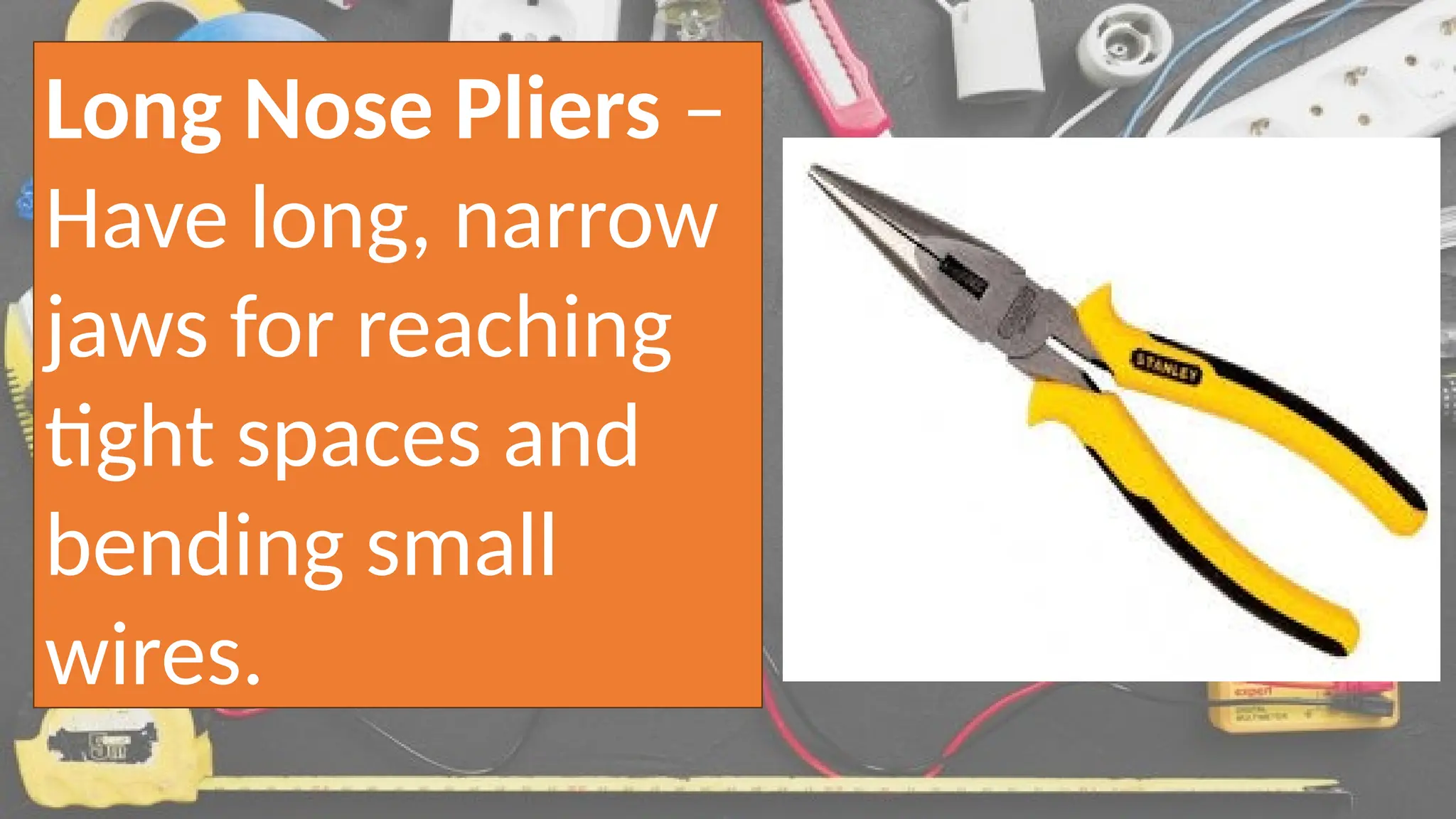
PLIERS - area hand tool
used for gripping,
bending, cutting, and
holding objects firmly.
They have two handles, a
pivot point, and jaws
designed for different
tasks. Pliers are
commonly used in
electrical work.
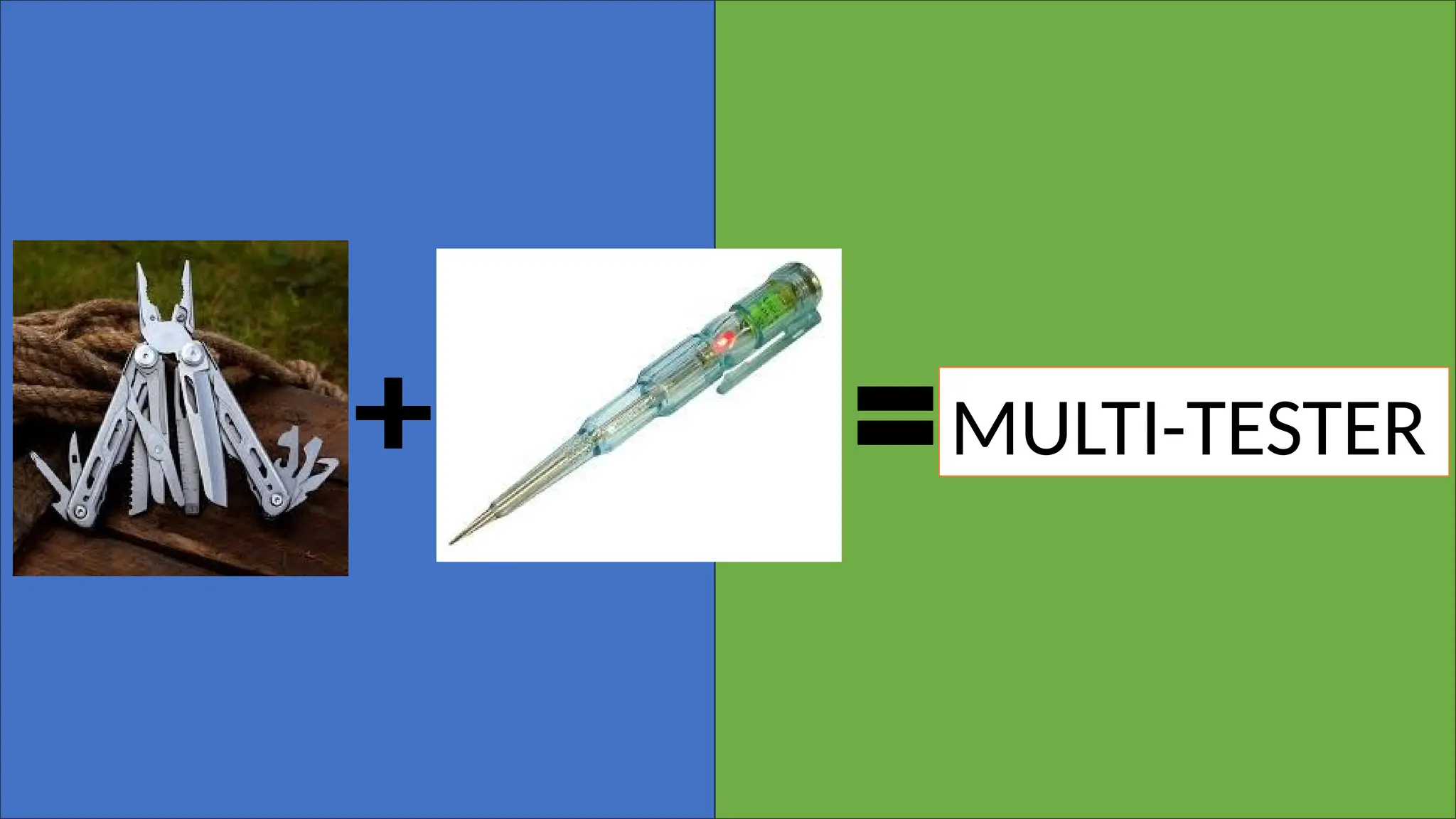
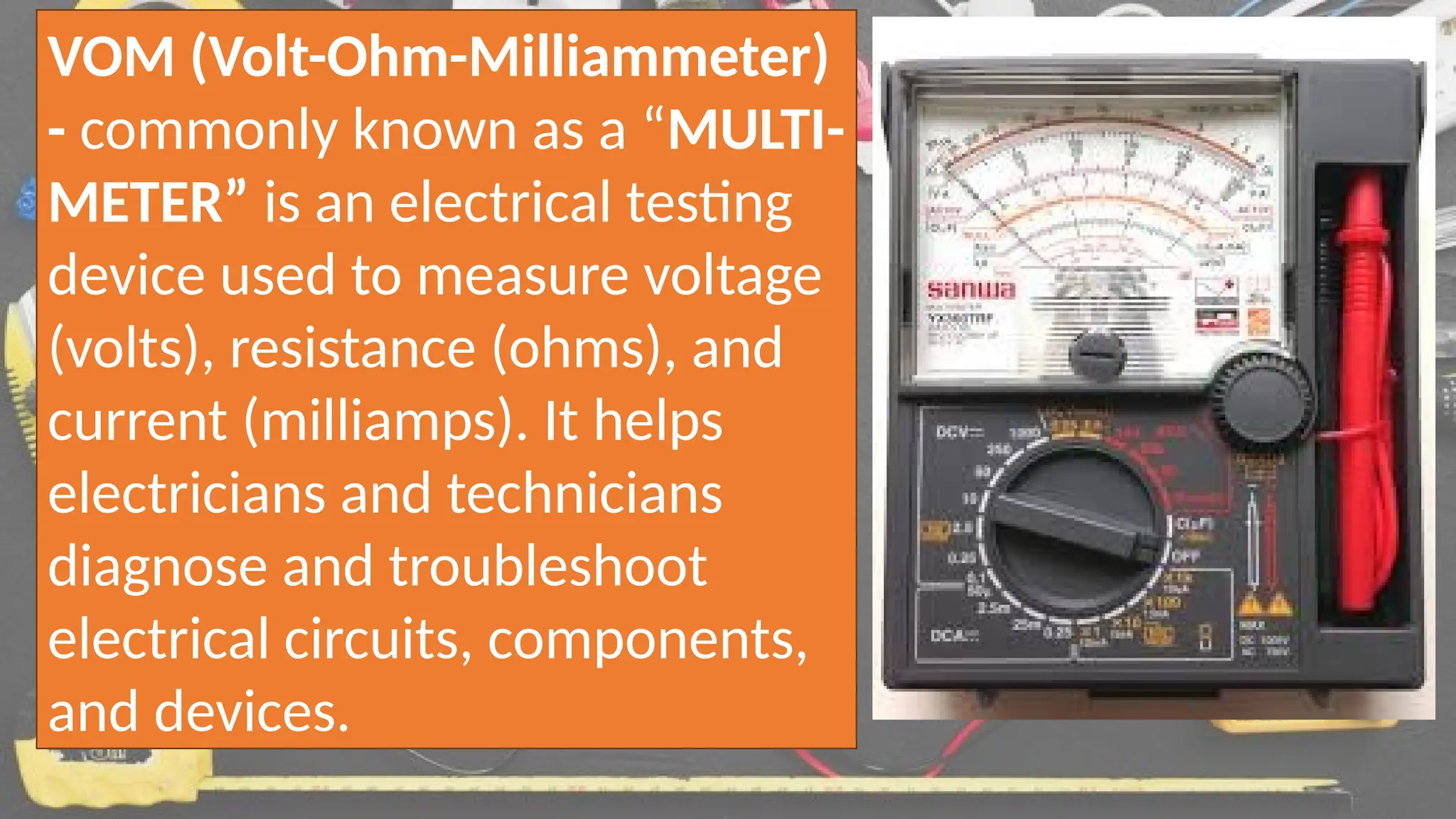
VOM (Volt-Ohm-Milliammeter)
- commonlyknown as a “MULTI-
METER” is an electrical testing
device used to measure voltage
(volts), resistance (ohms), and
current (milliamps). It helps
electricians and technicians
diagnose and troubleshoot
electrical circuits, components,
and devices.
The class willbe divided
into 4 groups. Each
group will draw one
electrical hand tool and
present its function to
the class.
43.
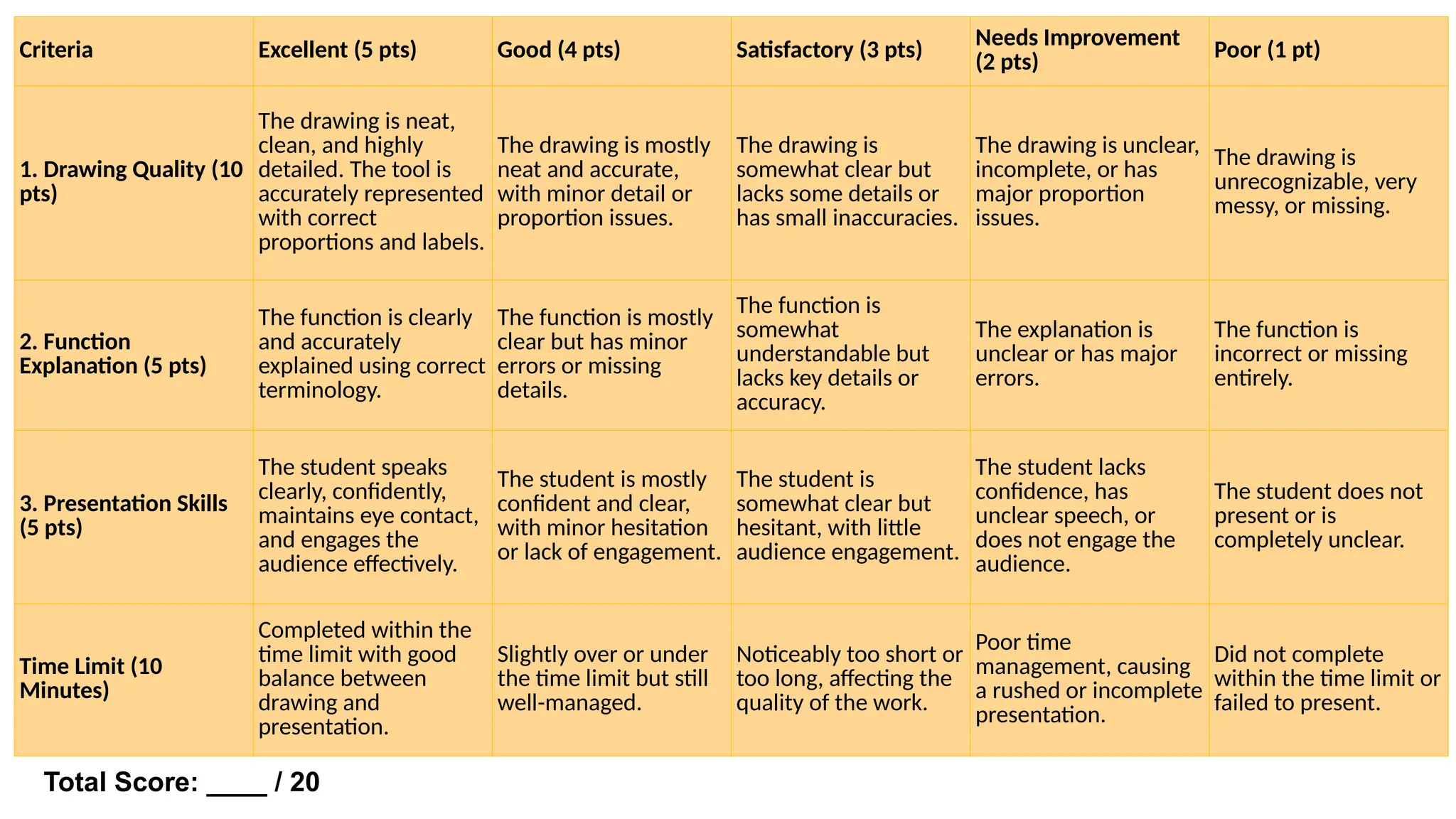
Total Score: ____/ 20
Criteria Excellent (5 pts) Good (4 pts) Satisfactory (3 pts)
Needs Improvement
(2 pts)
Poor (1 pt)
1. Drawing Quality (10
pts)
The drawing is neat,
clean, and highly
detailed. The tool is
accurately represented
with correct
proportions and labels.
The drawing is mostly
neat and accurate,
with minor detail or
proportion issues.
The drawing is
somewhat clear but
lacks some details or
has small inaccuracies.
The drawing is unclear,
incomplete, or has
major proportion
issues.
The drawing is
unrecognizable, very
messy, or missing.
2. Function
Explanation (5 pts)
The function is clearly
and accurately
explained using correct
terminology.
The function is mostly
clear but has minor
errors or missing
details.
The function is
somewhat
understandable but
lacks key details or
accuracy.
The explanation is
unclear or has major
errors.
The function is
incorrect or missing
entirely.
3. Presentation Skills
(5 pts)
The student speaks
clearly, confidently,
maintains eye contact,
and engages the
audience effectively.
The student is mostly
confident and clear,
with minor hesitation
or lack of engagement.
The student is
somewhat clear but
hesitant, with little
audience engagement.
The student lacks
confidence, has
unclear speech, or
does not engage the
audience.
The student does not
present or is
completely unclear.
Time Limit (10
Minutes)
Completed within the
time limit with good
balance between
drawing and
presentation.
Slightly over or under
the time limit but still
well-managed.
Noticeably too short or
too long, affecting the
quality of the work.
Poor time
management, causing
a rushed or incomplete
presentation.
Did not complete
within the time limit or
failed to present.
46.
WHY IS ITIMPORTANT
TO USE THE CORRECT
ELECTRICAL HAND
TOOLS FOR SPECIFIC
TASKS?
47.
How do differenttypes
of pliers contribute to
electrical work and
safety?
Multiple choice: Readand
analyze the questions
carefully. Write the correct
answer in ¼ sheet of
paper.
52.
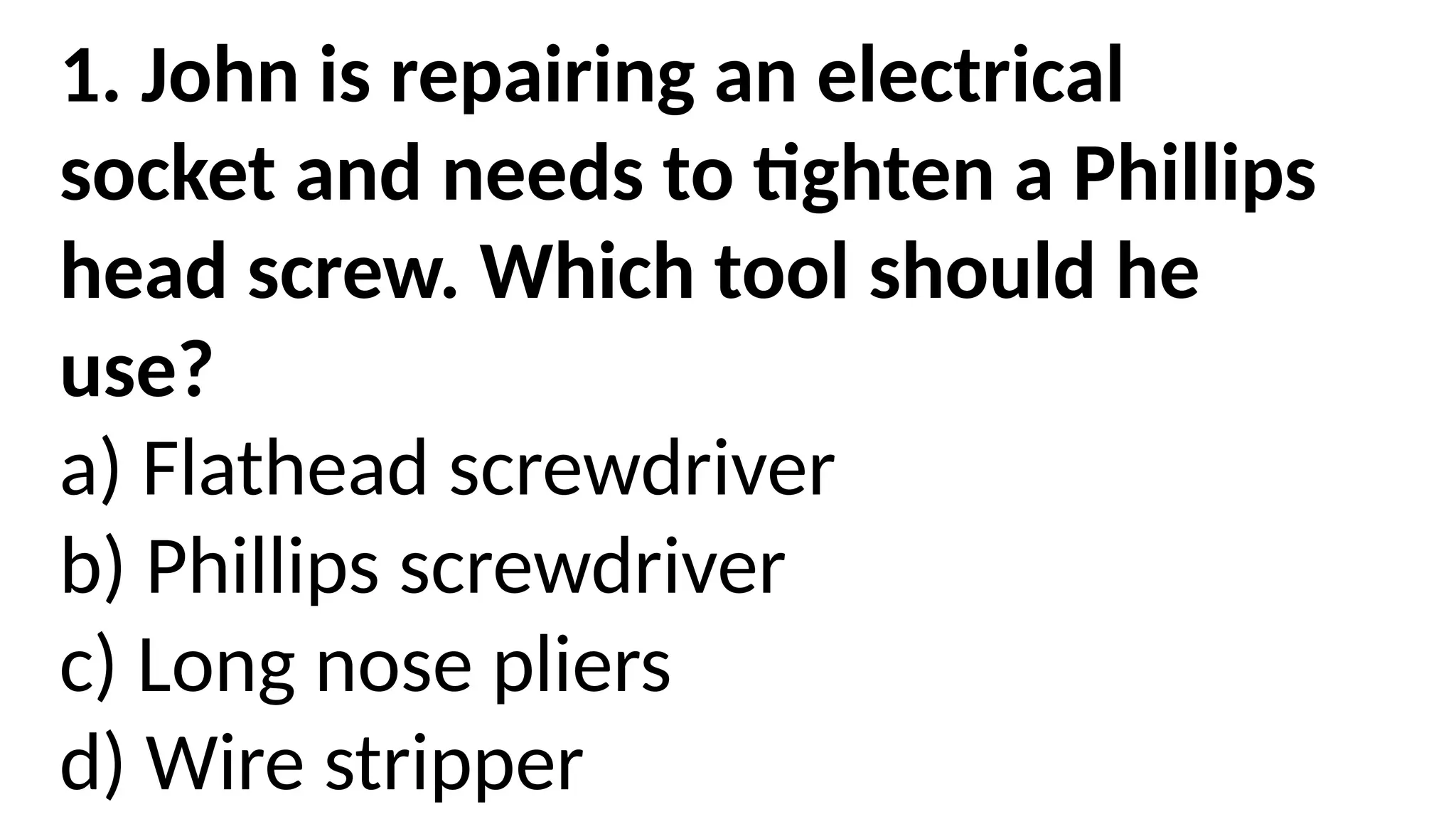
1. John isrepairing an electrical
socket and needs to tighten a Phillips
head screw. Which tool should he
use?
a) Flathead screwdriver
b) Phillips screwdriver
c) Long nose pliers
d) Wire stripper
53.
2. Lisa needsto remove the insulation
from a wire without damaging the
conductor inside. What tool should she
use?
a) Diagonal cutting pliers
b) Combination pliers
c) Wire stripper
d) Multi-tester
54.
3. If anelectrician wants to measure the
resistance of a resistor in an electrical
circuit, which device should be used?
a) Screwdriver
b) Pliers
c) Multimeter
d) Wire stripper
55.
4. Which ofthe following hand tools
is most suitable for gripping and
bending small wires in a tight space?
a) Combination pliers
b) Long nose pliers
c) Diagonal cutting pliers
d) Wire stripper
56.
5. A technicianneeds to cut a wire as
close to the surface as possible. What
tool should they use?
a) Long nose pliers
b) Combination pliers
c) Diagonal cutting pliers
d) Wire stripper
57.
6. Why isit important to use a multimeter
before working on an electrical circuit?
a) To check if the tools are functional
b) To measure the voltage, resistance, or
current and ensure safety
c) To ensure the wires are properly stripped
d) To check if the screwdrivers are magnetic
58.
7. Which ofthe following is NOT
a common type of screwdriver?
a) Flathead screwdriver
b) Phillips screwdriver
c) Combination screwdriver
d) Multi-tester
59.
8. If atechnician prefers a device with a
digital display for higher accuracy, which
multimeter should they choose?
a) Analog multimeter
b) Volt tester
c) Digital multimeter
d) Ohmmeter
60.
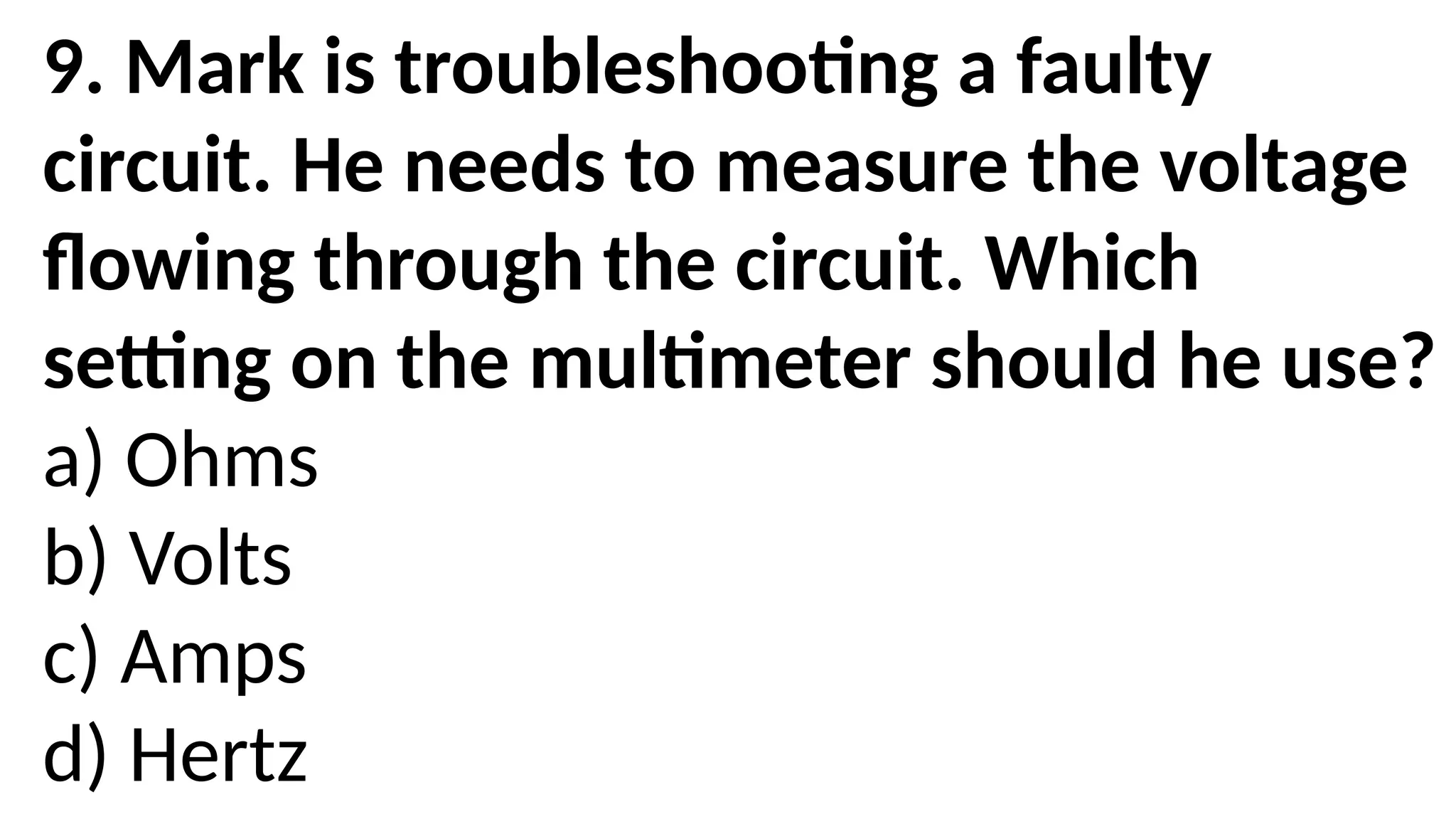
9. Mark istroubleshooting a faulty
circuit. He needs to measure the voltage
flowing through the circuit. Which
setting on the multimeter should he use?
a) Ohms
b) Volts
c) Amps
d) Hertz
61.
10. Which ofthe following best explains why
pliers are important in electrical work?
a) They help tighten screws efficiently
b) They allow users to strip wires without
damaging the conductor
c) They are used to measure voltage and
resistance
d) They provide a firm grip for bending and
cutting wires