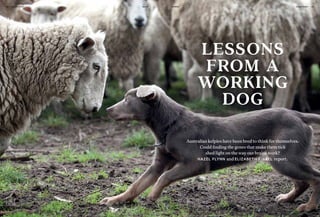
Australian kelpies have been bred to think for themselves.
Could finding the genes that make them tick
shed light on the way our brains work?
HAZEL FLYNN and ELIZABETH FINKEL report.
LESSONS
FROM A
WORKING
DOG
01
50 — COVER STORY Issue 66 COVER STORY — 51COSMOS
BART SEES IT ALL without ever seeming to shift
his attention from the flock, backing away or racing
to the head of the mob as required. Now and then
O’Connell issues a terse whistle or word. No more is
needed. Balgalla Bart is assessing and responding,
not mechanically waiting for orders.
Bart, a handsome 20 month old black and
tan kelpie, and his renowned trainer are running
through their paces before hundreds of onlookers
at the Australian Kelpie Muster, an annual event in
the tiny town of Casterton 350 kilometres west of
Melbourne. The crowd can’t help but be awed by
the sight of this dog – even experienced observers
such as breeder Chris Malcolm and trainer
Daniel Ball. “You watch them working, and they
actually think. They don’t just follow instruction,”
says Malcolm. Ball agrees there is something
extraordinary about kelpie intelligence. “Border
collies keep asking questions: ‘Is that what you want
me to do?’ Kelpies go, ‘So you want the stock moved
from there to there? OK.’ And then they start
figuring out how to get it done.”
Not all dogs have this ability to problem-solve;
it has been bred into the kelpie by concentrating
particular genes. Now Australian researchers are
trying to identify them – not only to breed better
kelpies but also to shed light on how something as
intangible as behaviour can be writ large in DNA.
CASTERTON NESTLES IN A VALLEY surrounded by
fertile hills dotted with sprawling flocks of grazing
sheep. The kelpie was first bred here to keep these
unruly flocks under control. In 1871 grazier George
Robertson of nearby Worrock station mated two
black and tan collies brought from Scotland.
One of the female puppies drew the eye of Jack
Gleeson, a doughty drover at a neighbouring
property. A deal was finally made: the pup for one of
Gleeson’s stockhorses. On the bank of the Glenelg
River in the dead of night, pup and horse were
traded. Gleeson gave the pup the Celtic name for
water spirit: Kelpie.
The young stockman moved to New South
Wales where Kelpie produced several litters, some
sired by an all-black collie, others by a red one. One
of the pups, named for her mother, tied for first
place in the country’s inaugural sheepdog trials at
the 1879 Forbes Show. Word spread and soon the
description “Kelpie’s pups” was replaced by the
general term “kelpie” for any similar dog.
For Malcolm, an elegantly dressed entrepreneur
who grew up in Zimbabwe, this story brings
Australia’s past to life. Leaning forward, eyes
sparkling, he sketches the scene in his modulated
accent. “Think back to that time. Australia was
built on the sheep’s back. Can you imagine what it
would be like if you had bred those dogs? It would
be like inventing a tractor when everybody else is
ploughing by hand. In the way the steam engine
changed the industrial world, that kelpie changed
the farming world overnight.”
But not all kelpies are created equal. To discover
why, a team from Sydney University Veterinary
Science Faculty led by Paul McGreevy and Claire
Wade is carrying out the Farm Dog Project. Funded
by Meat and Livestock Australia to the tune of half a
million dollars, it aims to identify the most desirable
traits in working dogs and locate their signature in
the dog’s DNA.
For most of the 30,000 years or so since wolves
first made themselves welcome at our campfires,
dog breeding has been an art. Armed with a DNA
map of traits as a guide, it is set to become a science.
An estimated 300,000 farm dogs work in Australia
“IN THE WAY
THE STEAM
ENGINE
CHANGED THE
INDUSTRIAL
WORLD,
THAT KELPIE
CHANGED
FARMING.”
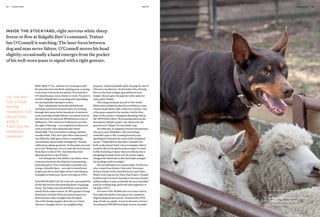
INSIDE THE STOCKYARD, eight nervous white sheep
freeze or flow at Balgalla Bart’s command. Trainer
Ian O’Connell is watching. The laser focus between
dog and man never falters. O’Connell moves his head
slightly; occasionally a hand emerges from the pocket
of his well-worn jeans to signal with a tight gesture.
02
Backing: a kelpie will jump on the backs
of sheep to control the flock.
52 — COVER STORY Issue 66 COVER STORY — 53COSMOS
with blue-grey eyes that seek the horizon. He now
splits his working life between farming sheep and
training people to handle working dogs; around
500 people a year take his courses. He also breeds
kelpies – selectively. “Perhaps two litters a year.
I’ve got this thing about quality not quantity,” he
says. “My hobby is to find the perfect working dog. I
hope it never happens, otherwise I don’t know what
I’m going to do with the rest of my life.”
They might not be perfect yet, but the dogs
O’Connell breeds are exceptional as evidenced
by the top auction prices he has claimed over the
years. Sitting on the back of his ute, O’Connell
affectionately rubs Bart’s handsome head. Bart’s
brother Balgalla Coke topped the 2014 auction,
selling for $10,000.
Calm and relaxed in the lead up to the auction,
which has drawn a paying crowd of 3,000,
O’Connell has set Bart’s reserve at $5,100.
He says: “If he doesn’t make that I’m only too happy
to take him back with me. I just want him to go to
a good home. I’ve spoken to a lot of people about
him and I’ve told some of them they won’t suit him.”
So what kind of owner-handler would be suitable?
“Someone that understands traits, which is hard
to find.”
THE FARM DOG PROJECT TEAM has homed in
on 10 traits. O’Connell focuses on six: “The most
important one is heading instinct, which most
kelpies have. That’s the desire to get to the head
of the stock: if stock are trying to escape they do
whatever it takes to get to the head, turn it, and
bring it back to me. Then there’s calmness, so
they’re not what we call ‘fizzy’.
“Presence is another big trait I look for. It’s an
aura: stock just don’t like being near a kelpie with
presence. And that makes them a great work dog,
because you put a kelpie in a paddock and the stock
move away from it. If a kelpie’s got the calm trait
and it’s got great presence, well, it really doesn’t
have to do an awful lot. It will work all day without
wearing itself out.”
Backing, O’Connell explains, is the willingness
of a dog to jump up on the back of sheep and run
over them to control their movements, while
barking is, as you’d guess, the dog’s use of its voice
to control stock. “The more of these good traits
you’ve got in a dog the less you have to really train
them. For a dog with all the desirable traits there are
only two things you should have to teach it. One is
to cease work and the other is to get it to go left or
right: ‘brakes’ and ‘steering’.”
Different traits are required for different jobs –
from the close, tight work of moving stock through
narrow runs and on to trucks to the much greater
coverage required in a paddock. This is where
casting is needed. The handler can send the dog off
to round up sheep at a significant distance, knowing
it will go wide to get behind the animals without
spooking them while ensuring the mob doesn’t
break up.
The casting trait comes from the breed’s two
distinct forebears, says Nancy Withers, who
manages to look elegant in a bush hat and dusty
boots and exudes an air of easy authority. Her 40
years as a breeder have given her an encyclopaedic
knowledge. “The original kelpie family were mostly
what were called hill gathering or North County
collies from northern Scotland. They would work a
long, long way away from the shepherds. They were
independent and you could trust them to work with
sheep alone.”
“SHE JUST
WANTS TO
DO WHATEVER
IT IS YOU ARE
ASKING OF
HER AND SHE
WILL DO IT
TO THE N-TH
DEGREE.”
After three years of coming second, Daniel Ball
and nine and a half year old Denny finally triumph
in the 2015 pinball. The dog also gives her all in the
50-metre dash and the hill climb, events she won in
her younger years. The climb has the dog handlers
standing on the lip of a hill so high it affords views
of the entire district, and so steep they lose sight
of their animals as soon as they begin their gallop
to reach them. All they can do is call continuously
at the top of their lungs, hoping the dog is still
following the sound of their voice. This year Denny
doesn’t place, but that she made it to the top says
and their breeders are keen to learn what they can
from other industries. For instance DNA-assisted
breeding has been worth $20 million a year to the
Australian dairy industry alone.
Malcolm has seen the successes of science with
the prize-winning cattle he breeds as a hobby in
Victoria’s Yarra Ranges. He first acquired kelpies
to work with the cattle but then they too became
a breeding passion. One of his pups achieved a
record price at Casterton two years ago. “Part of the
excitement is finding a [genetic] match that creates
something quite extraordinary,” he says.
CASTERTON IS A CLASSIC AUSTRALIAN country
town with a main street wide enough to drive
three tractors abreast, shade offered by the shops’
bullnose verandas and nothing taller than the two-
storey historic pubs. The 1,800-strong population
grows to a festive 10,000 during the muster
weekend. Families and owners of pet kelpies flood
in for the Saturday fun day, with sprint, high-jump
and hill-climb competitions to test their dogs’
strength and stamina and crowd-pleaser novelty
events such as kelpie pinball, where ducks are
herded through a course.
03
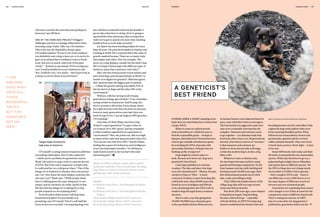
Top dog Balgalla Bart with trainer Ian O’Connell.
everything about her as an exemplar of the breed:
“She’s got heart and stamina. She just wants to do
whatever it is you’re asking of her and she will do it
to the nth degree.”
Sunday, auction day, is when the event becomes
serious. There are three categories: pups three
months and under; ‘started dogs’, with some
training aged three to 12 months; and ‘fully trained’
dogs, usually over 12 months. Some breeders bring
seven dogs or more to sell.
O’Connell is here to sell Bart. Born to the
farming life, O’Connell is fit, lean and weathered,
04
Not having the casting trait doesn’t make a dog
inferior – it just means it won’t suit paddock work.
Bart is a good example, O’Connell says. “He’s a very
confident dog. He loves backing and barking. But
he hasn’t got the trait of casting, so he’s going to be
a dog for working in trucks or sheds or yards where
he can be in amongst them.” That’s fine with Angus
Kirton, a merino farmer who finally secures Bart
with a winning bid of $11,000. Kirton paid $6,000
for an O’Connell dog in 2009. Kelpies, he says, are
“worth more than 10 men” on his property. The
Farm Dog Project team estimates a working dog is
worth at least $40,000 to a farmer over its lifetime.
In Bart’s case, stud service fees are likely to
add to that return. But sharing a bloodline doesn’t
necessarily mean sharing traits. “In one litter
of six pups you might have two that work a bit
more towards the paddock, two that might work
54 — COVER STORY Issue 66 COVER STORY — 55COSMOS
a bit more towards the yard and some perhaps in
between,” says Withers.
ONE OF THE FARM DOG PROJECT’S biggest
challenges was how to manage subjectivity when
assessing a dog’s traits. Take ‘eye’, for instance.
This is the way the dog holds a sheep’s gaze.
O’Connell explains: “If you’re out in the paddock
you definitely want a dog to have eye so it can fix its
gaze on an animal that’s tending to want to break
away. But not too much, otherwise it becomes
‘sticky’ – fixated on one animal. If I’m scoring eye,
‘one’ would probably be no eye whatsoever and
‘five’ would be very, very sticky – they’d just look at
a sheep or cow for hours if you let them.”
have all those wonderful traits but the handler’s
got no idea what they’re doing. If we’re going to
spend all this time and money discovering these
traits we’ve got to spend a lot more time teaching
handlers how to work dogs correctly.”
Joe Spicer has been breeding kelpies for more
than 20 years. He puts the breakdown of genes and
training at 50:50. He’s sceptical about the value of
genetic analysis because “there are so many traits
that negate each other. Eye, for example. The
more eye a dog displays, usually the less bark it has.
We’re trying to breed dogs with different types of
instincts, many that counteract each other.”
Ball, who has owned pound-rescue kelpies and
pure-bred dogs, puts his guesstimate at 60:40 “or
maybe even higher for genetics”. Malcolm agrees
that “genetics play the biggest part in animals
… I think the genetic mixing is probably 70% of
the key factor in dogs and the other 30% is the
environment.”
Withers, with her strong recall of many
generations of dogs, goes further: “I can remember
seeing certain work patterns. And if a pup, the
first or second or third time it sees sheep, shows
for a split second a trait that you know its ancestor
however many generations away had, then you
know it’s got it too. I say my dogs are 85% genetics,
15% training.”
And what of Claire Wade, the Farm Dog
Project’s expert geneticist? “I expect what we
see is about 20 to 30% ‘genes’ and the remainder
is what would be regarded by as a geneticist as
‘environment’.” But, she points out, this is as high
as many of the traits that sheep breeders select for.
“You can do a lot with 20 to 30%.” And for Wade,
finding these genes for behaviour and intelligence
won’t just help kelpie breeders. “It will help us
understand ourselves; for me that’s the most
interesting part.”
“I SEE
AMAZING
DOGS WHO
HAVE ALL
THOSE
WONDERFUL
TRAITS
BUT THE
HANDLER’S
GOT NO
IDEA.”
HAZEL FLYNN is a feature writer, editor, author
and former publisher. Her seventh book, Working
Dog Heroes co-written with Steve Austin, will be
published by ABC Books in March.
IMAGES
01 Melanie Faith Dove / Paul Macphail of Beloka 	
	Kelpies
02 Melanie Faith Dove / Paul Macphail of Beloka 	
	Kelpies
03 Australian Kelpie Muster 2015, Casterton
04 Australian Kelpie Muster 2015, Casterton
05 Australian Kelpie Muster 2015, Casterton
STARING DOWN A SHEEP, jumping on its
back: how are such behaviours written into
a dog’s DNA?
When it comes to a physical trait
such as dwarfism, it’s relatively easy to
find the responsible genes – in dogs or
humans. But behaviour? Geneticists have
tried to get a handle on behaviour genes
by searching the DNA of people with
personality disorders. Perhaps they are
barking up the wrong tree?
Dogs might be a better place to
look. Because as it turns out, dogs are a
geneticist’s best friend.
Canis lupus familiaris is a human
creation. The date and place that dogs
were first domesticated – Siberia, Europe,
southern China or Tibet – is hotly
contested. Evidence comes from dog-like
wolf fossils more than 30,000 years old,
found in caves in Belgium and Siberia,
or by calculating when the DNA code in
modern dogs diverged from a common
ancestor.
But it’s safe to say that going back
15,000-30,0000 years, Eurasian grey
wolves probably kicked off the process.
As human hunters outcompeted them for
prey, some tried their luck as scavengers.
The less fearful, less aggressive and cuter
ones were eventually welcomed by the
campfire. Tameness and cuteness seem
to go together – as a Russian study that
bred tame silver foxes over 30 generations
showed. (One theory, known as “neoteny”
is that tameness and cuteness are
holdovers from the juvenile wolf stage,
so that the modern dog is, in fact, a big
baby wolf.)
Whatever route evolution took,
the interlopers became useful as camp
guards and hunting companions. By the
time humans took up cattle herding and
farming around 10,000 years ago, their
first domesticated animal was by their
side, ready and willing to help.
That’s likely the family history of the
village dogs that still scavenge around
Asian and African hearths.
But about 200 years ago, a new chapter
in dog history began. Dog breeding
became a fad in Europe – especially
with the British. In 1873 Victorian dog
fanciers established the Kennel Club and
breeding became strictly controlled. Only
registered dogs with explicit traits were
bred, ensuring bloodline purity. What
followed was extraordinary: boxers and
greyhounds, spaniels and fox terriers,
collies and Jack Russells. They were bred
to herd, hunt, protect, fetch, fight – or just
to be cute.
Some 400 breeds exist today and their
diversity is unmatched by any mammalian
species. With only the bones to go on, a
palaeontologist might class a chihuahua
and a great dane as different species. Yet
the DNA of dogs does not change much.
Across their 2.4-billion-letter genome
– their complete DNA code – there is
one difference every 1,500 letters or so:
the same degree of difference you’d see
between any two unrelated people.
Geneticists are examining these minor
code changes to see if they account for the
conspicuous traits of different dog breeds.
They’ve had great success. In 2007,
just two years after the dog genome’s
publication, geneticists fished out the
05
Teagan Eagle winning the
high jump at Casterton.
O’Connell’s scoring system is based on a lifetime
of working with kelpies. But it’s also subjective
– which can be a problem for geneticists such as
Wade. Her goal is to map a trait to a precise stretch
of DNA. But if the trait is imprecise to begin with,
it could send her on a wild goose chase. “One of the
things we’ve looked at is whether when one person
says ‘eye’ they mean the same thing as someone else
who says ‘eye’,” Wade says. “While people think
they’re talking about the same thing they’re not
always, and we needed to be really careful of that.
We describe the things we’re asking for so that
people respond on a level playing field.”
So do breeders think science will help them
breed better kelpies? It’s potentially very
promising, says O’Connell, “but it’s only half the
story; in fact not even half. I see amazing dogs who
A GENETICIST’S
BEST FRIEND
CREDIT: AUSTRALIAN KELPIE MUSTER 2015 CASTERTON
COVER STORY — 57COSMOS56 — COVER STORY Issue 66
height-related genes, each with a tiny
effect.
Even so, they only scratched the
surface. Together, these genes only
account for 20% of height variation in
people. For dogs it is much simpler. In
2010, Adam Boyko at Cornell University
and colleagues used the DNA of 915 dogs
to unearth 12 genes that explain 80% of the
normal variation of dog height.
The fact that breeds were created
through strict selection from large litters
and often descended from a handful of
sires and dames resulted in a dramatic
shortcut in the way their physical traits
were constructed. Geneticists believe
this may also be the case for complex
traits such as intelligence and behaviour.
And if we can find out which genes are
responsible for behaviour in a dog, there
might be a payoff for humans. In the
time-honoured tradition of studying
fruitflies and lab rats, understanding a
simpler system can give us a foothold for
understanding ourselves.
One example: the genes that cause
obsessive-compulsive disorder (OCD) in
dogs. OCD is common in Dobermans, they
curl up in a ball and suck their flanks for
hours, or incessantly chase their tail. In
humans up to 3% of the population have a
comparable disorder that can manifest in
obsessive hand-washing or hoarding.
Humans and dogs with OCD are now
treated with antidepressants that have
about a 50% response rate. For these
people and dogs, something seems to
have gone awry in the way their brain
is wired. Comparing the DNA of 1,500
people with OCD to that of more than
5,000 unaffected people proved fruitless.
But in 2014, a study comparing the DNA
of 90 Dobermans suffering from OCD
with 60 healthy Dobermans uncovered
four genes –all known to be involved in
making connections between brain cells.
The discovery gave researchers new leads
to develop drugs that might treat the
disorder.
Some geneticists are now convinced
canine DNA is the best place to look for
the genes that control human behaviour.
Witness the titles of these recent scientific
papers: “The canid genome: behavioural
geneticists’ best friend?” or “A fetching
model organism” or “Both ends of the
leash — the human links to good dogs with
bad genes”.
Geneticist Claire Wade at the
University of Sydney agrees. “They’re so
much a part of our lives and we observe
them so closely.” Her main quest is to find
the individual genes behind behaviour.
“It’s not obvious how they work. I’m keen
to find out.”
Kelpies are a great place to look. They
have extraordinary problem-solving
behaviours – most likely passed down
from the border collies they were bred
from. Patrolling sheep through the rough
wilds of the Scottish borders, collies
needed to solve problems independently
and think on the fly, explains University
of Sydney vet Paul McGreevy. And their
ability to learn is legendary: McGreevey
cites the example of Chaser, the border
collie who can decipher sentences and
recognises more than a 1,000 words.
But kelpies also combine other curious
psychological traits such as the ability
to intimidate a sheep by giving it ‘eye’,
fearlessness, or phenomenal resistance to
pain as epitomised by the legendary Coil
that won an 1898 Sydney dog trial, despite
fracturing his foreleg in the first round.
How do you write those traits into DNA?
That’s what Wade and McGreevey
are trying to find out with the Farm Dog
Project. But they face two obstacles.
The first is that behavioural traits are
harder to score objectively than physical
traits. And if you want to find a trait’s
DNA signature, you need to be sure that
handlers, breeders and geneticists are all
talking about the same thing.
So the first task has been to get an
objective measure of these behavioural
traits. To do that, dog owners were asked
to answer 100 questions to rank their dogs
according to 10 traits. Were the owners
objective enough? Wade believes they
were. A comparison of owner assessments
with those of an expert trainer showed
good agreement.
Questionnaires have been filled in
for 200 dogs. Stage two will compare the
dogs’ genomes to see if particular traits
correspond to stretches of DNA.
Wade already suspects at least some of
the traits associated with working kelpies
are likely to lie on a chunk of chromosome
3. This part stood out as being different
But finding these genes is like panning
for alluvial gold; the individual genes have
a way of falling though the sifters. So far
fossicking for them has largely proved
fruitless in human studies. But there
is good reason to believe the quest for
behavioural genes might yield results if we
look for them in dogs first.
That’s because dogs generate complex
traits in a much simpler way than humans.
Take height – the normal variation
you might found within a breed, not the
mutations that give rise to dwarfism. As of
2014, an international team of researchers,
sifting through the DNA of more than
250,000 people, managed to uncover 700
bit of altered code that gave little breeds
their short stature. It was a mutation in
a growth-stimulating gene called
insulin-like growth factor 1. In 2009,
they found the code change that gave
dachshunds their stumpy legs, a condition
known as chondrodysplasia, that also
causes some kinds of human dwarfism.
It corresponded to a mutated extra copy
of a gene called fibroblast growth factor.
In its altered state, it causes the growing
cartilage near the tips of the leg bones
to solidify into bone too early, resulting
in legs that fail to reach their full length.
Discovering how extraordinary breeds had
been created by the mutation of a single
gene was a revelation.
But this genetic bounty was the low-
hanging fruit.
FOR GENETICISTS, the holy grail is to
decipher genes that give rise to so-called
“complex traits” – those controlled by
more than a single gene. Our complexity
as human beings is matched by our genetic
make-up. A predisposition to mental
illness or intelligence, for instance, is
controlled by hundreds of genes – each
individually having rather a small effect.
But together they play a major role – as we
know from twin studies that tell us genes
account for at least 50% when it comes
to explaining who is intelligent or who is
likely to develop schizophrenia.
in the DNA of working kelpies compared
to pet kelpies. Intriguingly, this chunk
of DNA also carries genes associated
with pain perception. “It wasn’t what
we expected,” says Wade. “But it makes
perfect sense – a working dog needs to be
able to go out into a field full of prickles
like rapiers.” But whether these pain
tolerance genes explain kelpie traits is still
an educated guess. The next step is to drill
into the DNA to match traits such as eye to
specific DNA signatures.
The barrier is dollars. It costs around
$200 to analyse one dog’s DNA code.
Ferreting out the genes for intelligence
and behaviour requires an estimated 5,000
dogs. An extra million might be beyond
Meat and Livestock Australia’s budget.
But it’s a drop in the bucket when one
considers the vast sums spent trying to
find genes that explain human behaviour
and intelligence. The European Union’s
Human Brain Project has spent more than
a billion, promising to decode mental
illness and disease by simulating the
workings of the brain on a supercomputer.
So far they have little to show for it.
Adam Boyko who studies the DNA of
village dogs knows why: “That’s because
they’re not funding dog work.”
— ELIZABETH FINKEL
THE QUEST FOR BEHAVIOURAL GENES
MIGHT YIELD GOOD RESULTS IF WE
LOOK FOR THEM IN DOGS FIRST.
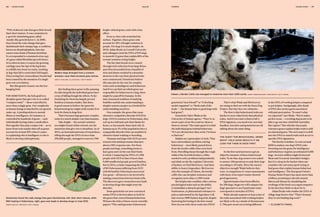
Geneticists found the code change that gave Dachshunds, left, their short stature, while
DNA testing in Dobermans, right, gave new leads to develop drugs to treat OCD.
CREDITS: BELIVE / ANETAPICS / GETTY IMAGES
Modern dogs diverged from a common
ancestor, most likely Eurasian grey wolves.
CREDIT: CUVELAND / ULLSTEIN BILD / GETTY IMAGES
Chaser, a Border Collie, has managed to memorise more than 1,000 words. CREDIT: SEBASTIEN MICKE / PARIS MATCH / GETTY IMAGES
58 — COVER STORY Issue 66 COVER STORY — 59COSMOS

Cosmos - Working Dogs

  • 1.
    Australian kelpies havebeen bred to think for themselves. Could finding the genes that make them tick shed light on the way our brains work? HAZEL FLYNN and ELIZABETH FINKEL report. LESSONS FROM A WORKING DOG 01 50 — COVER STORY Issue 66 COVER STORY — 51COSMOS
  • 2.
    BART SEES ITALL without ever seeming to shift his attention from the flock, backing away or racing to the head of the mob as required. Now and then O’Connell issues a terse whistle or word. No more is needed. Balgalla Bart is assessing and responding, not mechanically waiting for orders. Bart, a handsome 20 month old black and tan kelpie, and his renowned trainer are running through their paces before hundreds of onlookers at the Australian Kelpie Muster, an annual event in the tiny town of Casterton 350 kilometres west of Melbourne. The crowd can’t help but be awed by the sight of this dog – even experienced observers such as breeder Chris Malcolm and trainer Daniel Ball. “You watch them working, and they actually think. They don’t just follow instruction,” says Malcolm. Ball agrees there is something extraordinary about kelpie intelligence. “Border collies keep asking questions: ‘Is that what you want me to do?’ Kelpies go, ‘So you want the stock moved from there to there? OK.’ And then they start figuring out how to get it done.” Not all dogs have this ability to problem-solve; it has been bred into the kelpie by concentrating particular genes. Now Australian researchers are trying to identify them – not only to breed better kelpies but also to shed light on how something as intangible as behaviour can be writ large in DNA. CASTERTON NESTLES IN A VALLEY surrounded by fertile hills dotted with sprawling flocks of grazing sheep. The kelpie was first bred here to keep these unruly flocks under control. In 1871 grazier George Robertson of nearby Worrock station mated two black and tan collies brought from Scotland. One of the female puppies drew the eye of Jack Gleeson, a doughty drover at a neighbouring property. A deal was finally made: the pup for one of Gleeson’s stockhorses. On the bank of the Glenelg River in the dead of night, pup and horse were traded. Gleeson gave the pup the Celtic name for water spirit: Kelpie. The young stockman moved to New South Wales where Kelpie produced several litters, some sired by an all-black collie, others by a red one. One of the pups, named for her mother, tied for first place in the country’s inaugural sheepdog trials at the 1879 Forbes Show. Word spread and soon the description “Kelpie’s pups” was replaced by the general term “kelpie” for any similar dog. For Malcolm, an elegantly dressed entrepreneur who grew up in Zimbabwe, this story brings Australia’s past to life. Leaning forward, eyes sparkling, he sketches the scene in his modulated accent. “Think back to that time. Australia was built on the sheep’s back. Can you imagine what it would be like if you had bred those dogs? It would be like inventing a tractor when everybody else is ploughing by hand. In the way the steam engine changed the industrial world, that kelpie changed the farming world overnight.” But not all kelpies are created equal. To discover why, a team from Sydney University Veterinary Science Faculty led by Paul McGreevy and Claire Wade is carrying out the Farm Dog Project. Funded by Meat and Livestock Australia to the tune of half a million dollars, it aims to identify the most desirable traits in working dogs and locate their signature in the dog’s DNA. For most of the 30,000 years or so since wolves first made themselves welcome at our campfires, dog breeding has been an art. Armed with a DNA map of traits as a guide, it is set to become a science. An estimated 300,000 farm dogs work in Australia “IN THE WAY THE STEAM ENGINE CHANGED THE INDUSTRIAL WORLD, THAT KELPIE CHANGED FARMING.” INSIDE THE STOCKYARD, eight nervous white sheep freeze or flow at Balgalla Bart’s command. Trainer Ian O’Connell is watching. The laser focus between dog and man never falters. O’Connell moves his head slightly; occasionally a hand emerges from the pocket of his well-worn jeans to signal with a tight gesture. 02 Backing: a kelpie will jump on the backs of sheep to control the flock. 52 — COVER STORY Issue 66 COVER STORY — 53COSMOS
  • 3.
    with blue-grey eyesthat seek the horizon. He now splits his working life between farming sheep and training people to handle working dogs; around 500 people a year take his courses. He also breeds kelpies – selectively. “Perhaps two litters a year. I’ve got this thing about quality not quantity,” he says. “My hobby is to find the perfect working dog. I hope it never happens, otherwise I don’t know what I’m going to do with the rest of my life.” They might not be perfect yet, but the dogs O’Connell breeds are exceptional as evidenced by the top auction prices he has claimed over the years. Sitting on the back of his ute, O’Connell affectionately rubs Bart’s handsome head. Bart’s brother Balgalla Coke topped the 2014 auction, selling for $10,000. Calm and relaxed in the lead up to the auction, which has drawn a paying crowd of 3,000, O’Connell has set Bart’s reserve at $5,100. He says: “If he doesn’t make that I’m only too happy to take him back with me. I just want him to go to a good home. I’ve spoken to a lot of people about him and I’ve told some of them they won’t suit him.” So what kind of owner-handler would be suitable? “Someone that understands traits, which is hard to find.” THE FARM DOG PROJECT TEAM has homed in on 10 traits. O’Connell focuses on six: “The most important one is heading instinct, which most kelpies have. That’s the desire to get to the head of the stock: if stock are trying to escape they do whatever it takes to get to the head, turn it, and bring it back to me. Then there’s calmness, so they’re not what we call ‘fizzy’. “Presence is another big trait I look for. It’s an aura: stock just don’t like being near a kelpie with presence. And that makes them a great work dog, because you put a kelpie in a paddock and the stock move away from it. If a kelpie’s got the calm trait and it’s got great presence, well, it really doesn’t have to do an awful lot. It will work all day without wearing itself out.” Backing, O’Connell explains, is the willingness of a dog to jump up on the back of sheep and run over them to control their movements, while barking is, as you’d guess, the dog’s use of its voice to control stock. “The more of these good traits you’ve got in a dog the less you have to really train them. For a dog with all the desirable traits there are only two things you should have to teach it. One is to cease work and the other is to get it to go left or right: ‘brakes’ and ‘steering’.” Different traits are required for different jobs – from the close, tight work of moving stock through narrow runs and on to trucks to the much greater coverage required in a paddock. This is where casting is needed. The handler can send the dog off to round up sheep at a significant distance, knowing it will go wide to get behind the animals without spooking them while ensuring the mob doesn’t break up. The casting trait comes from the breed’s two distinct forebears, says Nancy Withers, who manages to look elegant in a bush hat and dusty boots and exudes an air of easy authority. Her 40 years as a breeder have given her an encyclopaedic knowledge. “The original kelpie family were mostly what were called hill gathering or North County collies from northern Scotland. They would work a long, long way away from the shepherds. They were independent and you could trust them to work with sheep alone.” “SHE JUST WANTS TO DO WHATEVER IT IS YOU ARE ASKING OF HER AND SHE WILL DO IT TO THE N-TH DEGREE.” After three years of coming second, Daniel Ball and nine and a half year old Denny finally triumph in the 2015 pinball. The dog also gives her all in the 50-metre dash and the hill climb, events she won in her younger years. The climb has the dog handlers standing on the lip of a hill so high it affords views of the entire district, and so steep they lose sight of their animals as soon as they begin their gallop to reach them. All they can do is call continuously at the top of their lungs, hoping the dog is still following the sound of their voice. This year Denny doesn’t place, but that she made it to the top says and their breeders are keen to learn what they can from other industries. For instance DNA-assisted breeding has been worth $20 million a year to the Australian dairy industry alone. Malcolm has seen the successes of science with the prize-winning cattle he breeds as a hobby in Victoria’s Yarra Ranges. He first acquired kelpies to work with the cattle but then they too became a breeding passion. One of his pups achieved a record price at Casterton two years ago. “Part of the excitement is finding a [genetic] match that creates something quite extraordinary,” he says. CASTERTON IS A CLASSIC AUSTRALIAN country town with a main street wide enough to drive three tractors abreast, shade offered by the shops’ bullnose verandas and nothing taller than the two- storey historic pubs. The 1,800-strong population grows to a festive 10,000 during the muster weekend. Families and owners of pet kelpies flood in for the Saturday fun day, with sprint, high-jump and hill-climb competitions to test their dogs’ strength and stamina and crowd-pleaser novelty events such as kelpie pinball, where ducks are herded through a course. 03 Top dog Balgalla Bart with trainer Ian O’Connell. everything about her as an exemplar of the breed: “She’s got heart and stamina. She just wants to do whatever it is you’re asking of her and she will do it to the nth degree.” Sunday, auction day, is when the event becomes serious. There are three categories: pups three months and under; ‘started dogs’, with some training aged three to 12 months; and ‘fully trained’ dogs, usually over 12 months. Some breeders bring seven dogs or more to sell. O’Connell is here to sell Bart. Born to the farming life, O’Connell is fit, lean and weathered, 04 Not having the casting trait doesn’t make a dog inferior – it just means it won’t suit paddock work. Bart is a good example, O’Connell says. “He’s a very confident dog. He loves backing and barking. But he hasn’t got the trait of casting, so he’s going to be a dog for working in trucks or sheds or yards where he can be in amongst them.” That’s fine with Angus Kirton, a merino farmer who finally secures Bart with a winning bid of $11,000. Kirton paid $6,000 for an O’Connell dog in 2009. Kelpies, he says, are “worth more than 10 men” on his property. The Farm Dog Project team estimates a working dog is worth at least $40,000 to a farmer over its lifetime. In Bart’s case, stud service fees are likely to add to that return. But sharing a bloodline doesn’t necessarily mean sharing traits. “In one litter of six pups you might have two that work a bit more towards the paddock, two that might work 54 — COVER STORY Issue 66 COVER STORY — 55COSMOS
  • 4.
    a bit moretowards the yard and some perhaps in between,” says Withers. ONE OF THE FARM DOG PROJECT’S biggest challenges was how to manage subjectivity when assessing a dog’s traits. Take ‘eye’, for instance. This is the way the dog holds a sheep’s gaze. O’Connell explains: “If you’re out in the paddock you definitely want a dog to have eye so it can fix its gaze on an animal that’s tending to want to break away. But not too much, otherwise it becomes ‘sticky’ – fixated on one animal. If I’m scoring eye, ‘one’ would probably be no eye whatsoever and ‘five’ would be very, very sticky – they’d just look at a sheep or cow for hours if you let them.” have all those wonderful traits but the handler’s got no idea what they’re doing. If we’re going to spend all this time and money discovering these traits we’ve got to spend a lot more time teaching handlers how to work dogs correctly.” Joe Spicer has been breeding kelpies for more than 20 years. He puts the breakdown of genes and training at 50:50. He’s sceptical about the value of genetic analysis because “there are so many traits that negate each other. Eye, for example. The more eye a dog displays, usually the less bark it has. We’re trying to breed dogs with different types of instincts, many that counteract each other.” Ball, who has owned pound-rescue kelpies and pure-bred dogs, puts his guesstimate at 60:40 “or maybe even higher for genetics”. Malcolm agrees that “genetics play the biggest part in animals … I think the genetic mixing is probably 70% of the key factor in dogs and the other 30% is the environment.” Withers, with her strong recall of many generations of dogs, goes further: “I can remember seeing certain work patterns. And if a pup, the first or second or third time it sees sheep, shows for a split second a trait that you know its ancestor however many generations away had, then you know it’s got it too. I say my dogs are 85% genetics, 15% training.” And what of Claire Wade, the Farm Dog Project’s expert geneticist? “I expect what we see is about 20 to 30% ‘genes’ and the remainder is what would be regarded by as a geneticist as ‘environment’.” But, she points out, this is as high as many of the traits that sheep breeders select for. “You can do a lot with 20 to 30%.” And for Wade, finding these genes for behaviour and intelligence won’t just help kelpie breeders. “It will help us understand ourselves; for me that’s the most interesting part.” “I SEE AMAZING DOGS WHO HAVE ALL THOSE WONDERFUL TRAITS BUT THE HANDLER’S GOT NO IDEA.” HAZEL FLYNN is a feature writer, editor, author and former publisher. Her seventh book, Working Dog Heroes co-written with Steve Austin, will be published by ABC Books in March. IMAGES 01 Melanie Faith Dove / Paul Macphail of Beloka Kelpies 02 Melanie Faith Dove / Paul Macphail of Beloka Kelpies 03 Australian Kelpie Muster 2015, Casterton 04 Australian Kelpie Muster 2015, Casterton 05 Australian Kelpie Muster 2015, Casterton STARING DOWN A SHEEP, jumping on its back: how are such behaviours written into a dog’s DNA? When it comes to a physical trait such as dwarfism, it’s relatively easy to find the responsible genes – in dogs or humans. But behaviour? Geneticists have tried to get a handle on behaviour genes by searching the DNA of people with personality disorders. Perhaps they are barking up the wrong tree? Dogs might be a better place to look. Because as it turns out, dogs are a geneticist’s best friend. Canis lupus familiaris is a human creation. The date and place that dogs were first domesticated – Siberia, Europe, southern China or Tibet – is hotly contested. Evidence comes from dog-like wolf fossils more than 30,000 years old, found in caves in Belgium and Siberia, or by calculating when the DNA code in modern dogs diverged from a common ancestor. But it’s safe to say that going back 15,000-30,0000 years, Eurasian grey wolves probably kicked off the process. As human hunters outcompeted them for prey, some tried their luck as scavengers. The less fearful, less aggressive and cuter ones were eventually welcomed by the campfire. Tameness and cuteness seem to go together – as a Russian study that bred tame silver foxes over 30 generations showed. (One theory, known as “neoteny” is that tameness and cuteness are holdovers from the juvenile wolf stage, so that the modern dog is, in fact, a big baby wolf.) Whatever route evolution took, the interlopers became useful as camp guards and hunting companions. By the time humans took up cattle herding and farming around 10,000 years ago, their first domesticated animal was by their side, ready and willing to help. That’s likely the family history of the village dogs that still scavenge around Asian and African hearths. But about 200 years ago, a new chapter in dog history began. Dog breeding became a fad in Europe – especially with the British. In 1873 Victorian dog fanciers established the Kennel Club and breeding became strictly controlled. Only registered dogs with explicit traits were bred, ensuring bloodline purity. What followed was extraordinary: boxers and greyhounds, spaniels and fox terriers, collies and Jack Russells. They were bred to herd, hunt, protect, fetch, fight – or just to be cute. Some 400 breeds exist today and their diversity is unmatched by any mammalian species. With only the bones to go on, a palaeontologist might class a chihuahua and a great dane as different species. Yet the DNA of dogs does not change much. Across their 2.4-billion-letter genome – their complete DNA code – there is one difference every 1,500 letters or so: the same degree of difference you’d see between any two unrelated people. Geneticists are examining these minor code changes to see if they account for the conspicuous traits of different dog breeds. They’ve had great success. In 2007, just two years after the dog genome’s publication, geneticists fished out the 05 Teagan Eagle winning the high jump at Casterton. O’Connell’s scoring system is based on a lifetime of working with kelpies. But it’s also subjective – which can be a problem for geneticists such as Wade. Her goal is to map a trait to a precise stretch of DNA. But if the trait is imprecise to begin with, it could send her on a wild goose chase. “One of the things we’ve looked at is whether when one person says ‘eye’ they mean the same thing as someone else who says ‘eye’,” Wade says. “While people think they’re talking about the same thing they’re not always, and we needed to be really careful of that. We describe the things we’re asking for so that people respond on a level playing field.” So do breeders think science will help them breed better kelpies? It’s potentially very promising, says O’Connell, “but it’s only half the story; in fact not even half. I see amazing dogs who A GENETICIST’S BEST FRIEND CREDIT: AUSTRALIAN KELPIE MUSTER 2015 CASTERTON COVER STORY — 57COSMOS56 — COVER STORY Issue 66
  • 5.
    height-related genes, eachwith a tiny effect. Even so, they only scratched the surface. Together, these genes only account for 20% of height variation in people. For dogs it is much simpler. In 2010, Adam Boyko at Cornell University and colleagues used the DNA of 915 dogs to unearth 12 genes that explain 80% of the normal variation of dog height. The fact that breeds were created through strict selection from large litters and often descended from a handful of sires and dames resulted in a dramatic shortcut in the way their physical traits were constructed. Geneticists believe this may also be the case for complex traits such as intelligence and behaviour. And if we can find out which genes are responsible for behaviour in a dog, there might be a payoff for humans. In the time-honoured tradition of studying fruitflies and lab rats, understanding a simpler system can give us a foothold for understanding ourselves. One example: the genes that cause obsessive-compulsive disorder (OCD) in dogs. OCD is common in Dobermans, they curl up in a ball and suck their flanks for hours, or incessantly chase their tail. In humans up to 3% of the population have a comparable disorder that can manifest in obsessive hand-washing or hoarding. Humans and dogs with OCD are now treated with antidepressants that have about a 50% response rate. For these people and dogs, something seems to have gone awry in the way their brain is wired. Comparing the DNA of 1,500 people with OCD to that of more than 5,000 unaffected people proved fruitless. But in 2014, a study comparing the DNA of 90 Dobermans suffering from OCD with 60 healthy Dobermans uncovered four genes –all known to be involved in making connections between brain cells. The discovery gave researchers new leads to develop drugs that might treat the disorder. Some geneticists are now convinced canine DNA is the best place to look for the genes that control human behaviour. Witness the titles of these recent scientific papers: “The canid genome: behavioural geneticists’ best friend?” or “A fetching model organism” or “Both ends of the leash — the human links to good dogs with bad genes”. Geneticist Claire Wade at the University of Sydney agrees. “They’re so much a part of our lives and we observe them so closely.” Her main quest is to find the individual genes behind behaviour. “It’s not obvious how they work. I’m keen to find out.” Kelpies are a great place to look. They have extraordinary problem-solving behaviours – most likely passed down from the border collies they were bred from. Patrolling sheep through the rough wilds of the Scottish borders, collies needed to solve problems independently and think on the fly, explains University of Sydney vet Paul McGreevy. And their ability to learn is legendary: McGreevey cites the example of Chaser, the border collie who can decipher sentences and recognises more than a 1,000 words. But kelpies also combine other curious psychological traits such as the ability to intimidate a sheep by giving it ‘eye’, fearlessness, or phenomenal resistance to pain as epitomised by the legendary Coil that won an 1898 Sydney dog trial, despite fracturing his foreleg in the first round. How do you write those traits into DNA? That’s what Wade and McGreevey are trying to find out with the Farm Dog Project. But they face two obstacles. The first is that behavioural traits are harder to score objectively than physical traits. And if you want to find a trait’s DNA signature, you need to be sure that handlers, breeders and geneticists are all talking about the same thing. So the first task has been to get an objective measure of these behavioural traits. To do that, dog owners were asked to answer 100 questions to rank their dogs according to 10 traits. Were the owners objective enough? Wade believes they were. A comparison of owner assessments with those of an expert trainer showed good agreement. Questionnaires have been filled in for 200 dogs. Stage two will compare the dogs’ genomes to see if particular traits correspond to stretches of DNA. Wade already suspects at least some of the traits associated with working kelpies are likely to lie on a chunk of chromosome 3. This part stood out as being different But finding these genes is like panning for alluvial gold; the individual genes have a way of falling though the sifters. So far fossicking for them has largely proved fruitless in human studies. But there is good reason to believe the quest for behavioural genes might yield results if we look for them in dogs first. That’s because dogs generate complex traits in a much simpler way than humans. Take height – the normal variation you might found within a breed, not the mutations that give rise to dwarfism. As of 2014, an international team of researchers, sifting through the DNA of more than 250,000 people, managed to uncover 700 bit of altered code that gave little breeds their short stature. It was a mutation in a growth-stimulating gene called insulin-like growth factor 1. In 2009, they found the code change that gave dachshunds their stumpy legs, a condition known as chondrodysplasia, that also causes some kinds of human dwarfism. It corresponded to a mutated extra copy of a gene called fibroblast growth factor. In its altered state, it causes the growing cartilage near the tips of the leg bones to solidify into bone too early, resulting in legs that fail to reach their full length. Discovering how extraordinary breeds had been created by the mutation of a single gene was a revelation. But this genetic bounty was the low- hanging fruit. FOR GENETICISTS, the holy grail is to decipher genes that give rise to so-called “complex traits” – those controlled by more than a single gene. Our complexity as human beings is matched by our genetic make-up. A predisposition to mental illness or intelligence, for instance, is controlled by hundreds of genes – each individually having rather a small effect. But together they play a major role – as we know from twin studies that tell us genes account for at least 50% when it comes to explaining who is intelligent or who is likely to develop schizophrenia. in the DNA of working kelpies compared to pet kelpies. Intriguingly, this chunk of DNA also carries genes associated with pain perception. “It wasn’t what we expected,” says Wade. “But it makes perfect sense – a working dog needs to be able to go out into a field full of prickles like rapiers.” But whether these pain tolerance genes explain kelpie traits is still an educated guess. The next step is to drill into the DNA to match traits such as eye to specific DNA signatures. The barrier is dollars. It costs around $200 to analyse one dog’s DNA code. Ferreting out the genes for intelligence and behaviour requires an estimated 5,000 dogs. An extra million might be beyond Meat and Livestock Australia’s budget. But it’s a drop in the bucket when one considers the vast sums spent trying to find genes that explain human behaviour and intelligence. The European Union’s Human Brain Project has spent more than a billion, promising to decode mental illness and disease by simulating the workings of the brain on a supercomputer. So far they have little to show for it. Adam Boyko who studies the DNA of village dogs knows why: “That’s because they’re not funding dog work.” — ELIZABETH FINKEL THE QUEST FOR BEHAVIOURAL GENES MIGHT YIELD GOOD RESULTS IF WE LOOK FOR THEM IN DOGS FIRST. Geneticists found the code change that gave Dachshunds, left, their short stature, while DNA testing in Dobermans, right, gave new leads to develop drugs to treat OCD. CREDITS: BELIVE / ANETAPICS / GETTY IMAGES Modern dogs diverged from a common ancestor, most likely Eurasian grey wolves. CREDIT: CUVELAND / ULLSTEIN BILD / GETTY IMAGES Chaser, a Border Collie, has managed to memorise more than 1,000 words. CREDIT: SEBASTIEN MICKE / PARIS MATCH / GETTY IMAGES 58 — COVER STORY Issue 66 COVER STORY — 59COSMOS