COSMOS:
DevOps for Complex Cyber-physical Systems
Sebastiano Panichella
Zurich University of Applied Sciences (ZHAW)
Workshop on Adaptive CPSoS (WASOS) 2023
1
www.COSMOS-DevOps.org
@COSMOS_DEVOPS
The COSMOS Project has
received funding from
the European Union’s
Horizon 2020 Research
and InnovaCon
Programme under grant
agreement No. 957254.
■ Context & Challenges
■ Vision & Objectives
■ Work Packages (WPs)
⧫ WPs and Progress
■ Impact
Outline
2
COSMOS Technology Vision 3
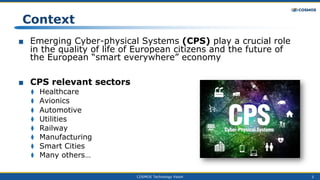
■ Emerging Cyber-physical Systems (CPS) play a crucial role
in the quality of life of European citizens and the future of
the European “smart everywhere” economy
■ CPS relevant sectors
⧫ Healthcare
⧫ Avionics
⧫ Automotive
⧫ Utilities
⧫ Railway
⧫ Manufacturing
⧫ Smart Cities
⧫ Many others…
Context
COSMOS Technology Vision 4
Challenges
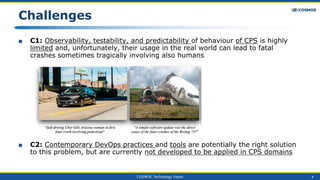
■ C1: Observability, testability, and predictability of behaviour of CPS is highly
limited and, unfortunately, their usage in the real world can lead to fatal
crashes sometimes tragically involving also humans
■ C2: Contemporary DevOps practices and tools are potentially the right solution
to this problem, but are currently not developed to be applied in CPS domains
COSMOS Technology Vision 5
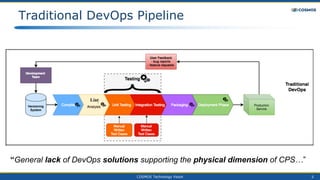
Traditional DevOps Pipeline
Lint
“General lack of DevOps solutions supporting the physical dimension of CPS…”
COSMOS Technology Vision 6
COSMOS Vision
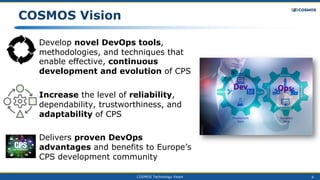
■ Develop novel DevOps tools,
methodologies, and techniques that
enable effective, continuous
development and evolution of CPS
■ Increase the level of reliability,
dependability, trustworthiness, and
adaptability of CPS
■ Delivers proven DevOps
advantages and benefits to Europe’s
CPS development community
COSMOS Technology Vision 7
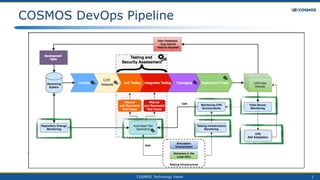
COSMOS DevOps Pipeline
Lint
COSMOS Technology Vision 8
Project Objectives
Technical objectives
■ Realise innovative DevOps automation solutions specifically tailored for CPS
■ Automate V&V and security assessment of CPS within DevOps pipelines to ensure
high levels of dependability
■ Enable monitoring and evolving CPS behaviour in the field to provide high
adaptability of CPS to unexpected changes
Integration and Evaluation objectives
■ Develop and evolve COSMOS approaches, technologies, and services so they can be
integrated into different DevOps and CPS toolchains
■ Validate effectiveness of COSMOS technologies in 5 industrial demonstrators
■ Broadly disseminate the COSMOS technologies to create a European DevOps for
CPS ecosystem
COSMOS Technology Vision 9
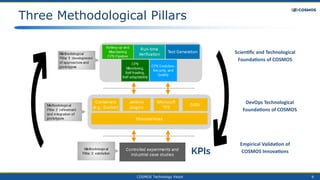
Three Methodological Pillars
KPIs
Scien&fic and Technological
Founda&ons of COSMOS
Empirical Valida&on of
COSMOS Innova&ons
DevOps Technological
Founda&ons of COSMOS
COSMOS Technology Vision 10
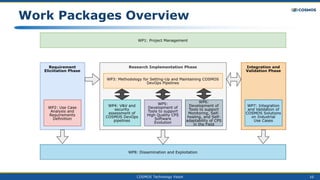
Work Packages Overview
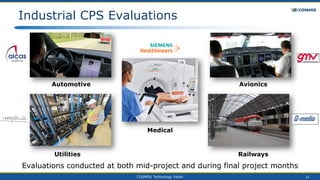
Automotive
11
Industrial CPS Evaluations
Railways
Medical
Evaluations conducted at both mid-project and during final project months
Avionics
Utilities
COSMOS Technology Vision
12
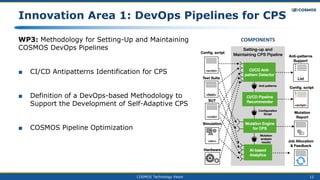
Innovation Area 1: DevOps Pipelines for CPS
WP3: Methodology for Setting-Up and Maintaining
COSMOS DevOps Pipelines
■ CI/CD Antipatterns Identification for CPS
■ Definition of a DevOps-based Methodology to
Support the Development of Self-Adaptive CPS
■ COSMOS Pipeline Optimization
COMPONENTS
COSMOS Technology Vision
13
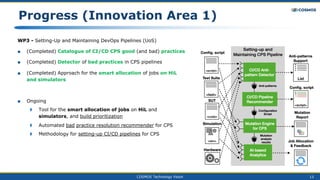
Progress (Innovation Area 1)
COSMOS Technology Vision
WP3 - Setting-Up and Maintaining DevOps Pipelines (UoS)
■ (Completed) Catalogue of CI/CD CPS good (and bad) practices
■ (Completed) Detector of bad practices in CPS pipelines
■ (Completed) Approach for the smart allocation of jobs on HiL
and simulators
■ Ongoing
⧫ Tool for the smart allocation of jobs on HiL and
simulators, and build prioritization
⧫ Automated bad practice resolution recommender for CPS
⧫ Methodology for setting-up CI/CD pipelines for CPS
Modular extension of specification-based vulnerability
analysis
14
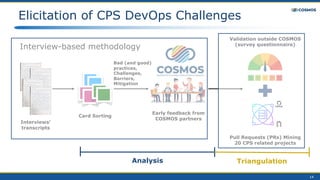
Elicitation of CPS DevOps Challenges
Interview-based methodology
Interviews’
transcripts
Card Sorting
Early feedback from
COSMOS partners
Validation outside COSMOS
(survey questionnaire)
Pull Requests (PRs) Mining
20 CPS related projects
Bad (and good)
practices,
Challenges,
Barriers,
Mitigation
Analysis Triangulation
15
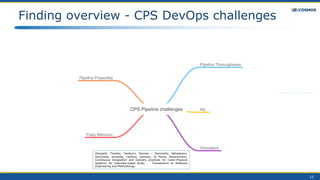
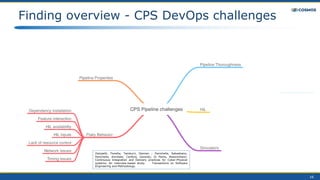
Finding overview - CPS DevOps challenges
Zampetti, Fiorella; Tamburri, Damian ; Panichella, Sebastiano;
Panichella, Annibale; Canfora, Gerardo; Di Penta, Massimiliano:
Continuous Integration and Delivery practices for Cyber-Physical
systems: An interview-based study. Transactions on Software
Engineering and Methodology.
16
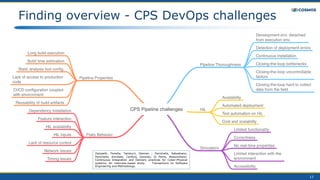
Finding overview - CPS DevOps challenges
Zampetti, Fiorella; Tamburri, Damian ; Panichella, Sebastiano;
Panichella, Annibale; Canfora, Gerardo; Di Penta, Massimiliano:
Continuous Integration and Delivery practices for Cyber-Physical
systems: An interview-based study. Transactions on Software
Engineering and Methodology.
17
Finding overview - CPS DevOps challenges
Zampetti, Fiorella; Tamburri, Damian ; Panichella, Sebastiano;
Panichella, Annibale; Canfora, Gerardo; Di Penta, Massimiliano:
Continuous Integration and Delivery practices for Cyber-Physical
systems: An interview-based study. Transactions on Software
Engineering and Methodology.
18
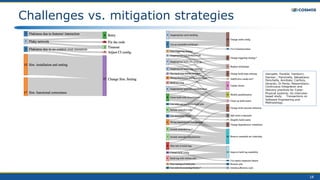
Challenges vs. mitigation strategies
Zampetti, Fiorella; Tamburri,
Damian ; Panichella, Sebastiano;
Panichella, Annibale; Canfora,
Gerardo; Di Penta, Massimiliano:
Continuous Integration and
Delivery practices for Cyber-
Physical systems: An interview-
based study. Transactions on
Software Engineering and
Methodology.
19
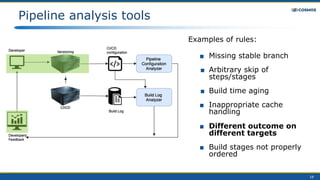
Pipeline analysis tools
Examples of rules:
■ Missing stable branch
■ Arbitrary skip of
steps/stages
■ Build time aging
■ Inappropriate cache
handling
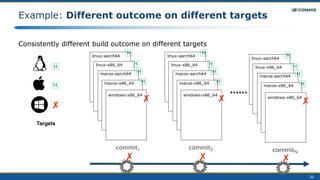
■ Different outcome on
different targets
■ Build stages not properly
ordered
20
Example: Different outcome on different targets
Consistently different build outcome on different targets
linux-aarch64
linux-x86_64
macos-x86_64
macos-aarch64
windows-x86_64
✘
🇭
🇭
🇭
🇭
commit1
linux-aarch64
linux-x86_64
macos-x86_64
macos-aarch64
windows-x86_64
✘
🇭
🇭
🇭
🇭
commit2
……
linux-aarch64
linux-x86_64
macos-x86_64
macos-aarch64
windows-x86_64
✘
🇭
🇭
🇭
🇭
commitN
✘ ✘ ✘
✘
🇭
🇭
Targets
21
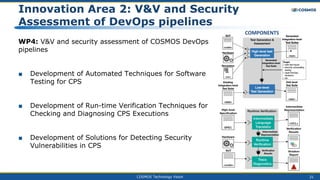
Innovation Area 2: V&V and Security
Assessment of DevOps pipelines
WP4: V&V and security assessment of COSMOS DevOps
pipelines
■ Development of Automated Techniques for Software
Testing for CPS
■ Development of Run-time Verification Techniques for
Checking and Diagnosing CPS Executions
■ Development of Solutions for Detecting Security
Vulnerabilities in CPS
COMPONENTS
COSMOS Technology Vision
22
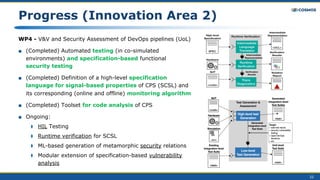
Progress (Innovation Area 2)
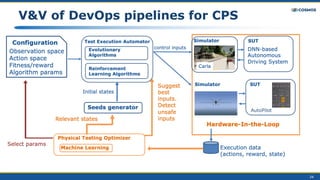
WP4 - V&V and Security Assessment of DevOps pipelines (UoL)
■ (Completed) Automated testing (in co-simulated
environments) and specification-based functional
security testing
■ (Completed) Definition of a high-level specification
language for signal-based properties of CPS (SCSL) and
its corresponding (online and offline) monitoring algorithm
■ (Completed) Toolset for code analysis of CPS
■ Ongoing:
⧫ HIL Testing
⧫ Runtime verification for SCSL
⧫ ML-based generation of metamorphic security relations
⧫ Modular extension of specification-based vulnerability
analysis
23
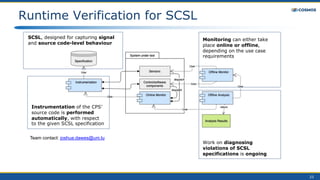
Runtime Verification for SCSL
SCSL, designed for capturing signal
and source code-level behaviour
Instrumentation of the CPS’
source code is performed
automatically, with respect
to the given SCSL specification
Monitoring can either take
place online or offline,
depending on the use case
requirements
Work on diagnosing
violations of SCSL
specifications is ongoing
Team contact: joshua.dawes@uni.lu
24
V&V of DevOps pipelines for CPS
AutoPilot
25
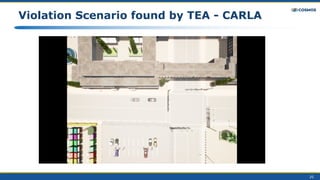
Violation Scenario found by TEA - CARLA
26
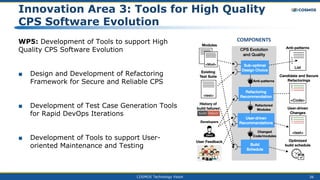
Innovation Area 3: Tools for High Quality
CPS Software Evolution
WP5: Development of Tools to support High
Quality CPS Software Evolution
■ Design and Development of Refactoring
Framework for Secure and Reliable CPS
■ Development of Test Case Generation Tools
for Rapid DevOps Iterations
■ Development of Tools to support User-
oriented Maintenance and Testing
COMPONENTS
COSMOS Technology Vision
27
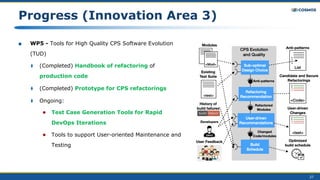
Progress (Innovation Area 3)
■ WP5 - Tools for High Quality CPS Software Evolution
(TUD)
⧫ (Completed) Handbook of refactoring of
production code
⧫ (Completed) Prototype for CPS refactorings
⧫ Ongoing:
● Test Case Generation Tools for Rapid
DevOps Iterations
● Tools to support User-oriented Maintenance and
Testing
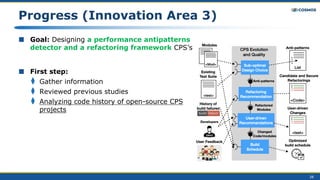
■ Goal: Designing a performance antipatterns
detector and a refactoring framework CPS’s
■ First step:
⧫ Gather information
⧫ Reviewed previous studies
⧫ Analyzing code history of open-source CPS
projects
28
Progress (Innovation Area 3)
29
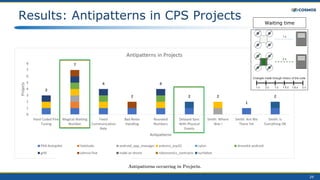
Results: Antipatterns in CPS Projects Waiting time
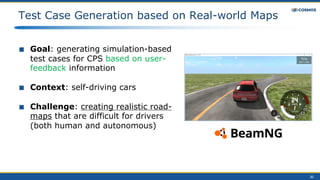
■ Goal: generating simulation-based
test cases for CPS based on user-
feedback information
■ Context: self-driving cars
■ Challenge: creating realistic road-
maps that are difficult for drivers
(both human and autonomous)
Test Case Generation based on Real-world Maps
30
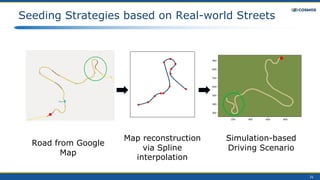
Seeding Strategies based on Real-world Streets
31
Road from Google
Map
Simulation-based
Driving Scenario
Map reconstruction
via Spline
interpolation
Seeding Strategies based on Real-world Streets
32
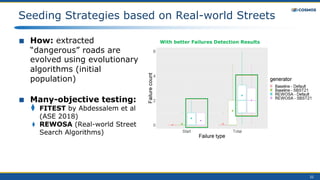
■ How: extracted
“dangerous” roads are
evolved using evolutionary
algorithms (initial
population)
■ Many-objective testing:
⧫ FITEST by Abdessalem et al
(ASE 2018)
⧫ REWOSA (Real-world Street
Search Algorithms)
With better Failures Detection Results
33
Innovation Area 4: Tools for Monitoring,
Self-healing and Self-adaptability of CPS
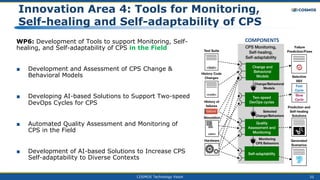
WP6: Development of Tools to support Monitoring, Self-
healing, and Self-adaptability of CPS in the Field
■ Development and Assessment of CPS Change &
Behavioral Models
■ Developing AI-based Solutions to Support Two-speed
DevOps Cycles for CPS
■ Automated Quality Assessment and Monitoring of
CPS in the Field
■ Development of AI-based Solutions to Increase CPS
Self-adaptability to Diverse Contexts
COMPONENTS
COSMOS Technology Vision
34
Progress (Innovation Area 4)
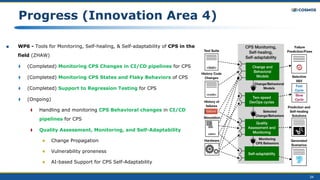
■ WP6 - Tools for Monitoring, Self-healing, & Self-adaptability of CPS in the
field (ZHAW)
⧫ (Completed) Monitoring CPS Changes in CI/CD pipelines for CPS
⧫ (Completed) Monitoring CPS States and Flaky Behaviors of CPS
⧫ (Completed) Support to Regression Testing for CPS
⧫ (Ongoing)
⧫ Handling and monitoring CPS Behavioral changes in CI/CD
pipelines for CPS
⧫ Quality Assessment, Monitoring, and Self-Adaptability
● Change Propagation
● Vulnerability proneness
● AI-based Support for CPS Self-Adaptability
35
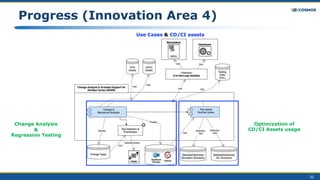
Progress (Innovation Area 4)
Use Cases & CD/CI assets
Change Analysis
&
Regression Testing
Optimization of
CD/CI Assets usage
CPS Safety Related Issues of UAVs
Andrea Di Sorbo, Fiorella Zampetti, Corrado A. Visaggio, Massimiliano Di Penta, and Sebastiano
Panichella: Automated Identification and Qualitative Characterization of Safety Concerns Reported
in UAV Software Platforms. Transactions on Software Engineering and Methodology.
36
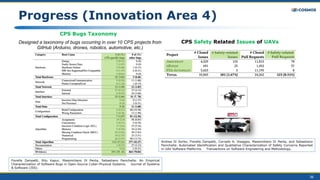
Progress (Innovation Area 4)
CPS Bugs Taxonomy
Designed a taxonomy of bugs occurring in over 10 CPS projects from
GitHub (Arduino, drones, robotics, automotive, etc.)
Fiorella Zampetti, Ritu Kapur, Massimiliano Di Penta, Sebastiano Panichella: An Empirical
Characterization of Software Bugs in Open-Source Cyber-Physical Systems. Journal of Systems
& Software (JSS).
37
Progress (Innovation Area 4)
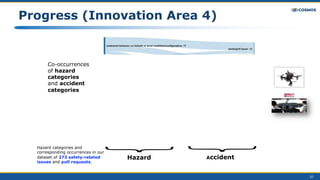
Co-occurrences
of hazard
categories
and accident
categories
Hazard Accident
Hazard categories and
corresponding occurrences in our
dataset of 273 safety-related
issues and pull requests.
38
Progress (Innovation Area 4)
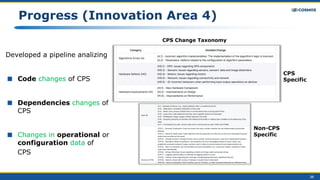
CPS Change Taxonomy
CPS
Specific
Non-CPS
Specific
Developed a pipeline analizing
■ Code changes of CPS
■ Dependencies changes of
CPS
■ Changes in operational or
configuration data of
CPSto Diverse Context
39
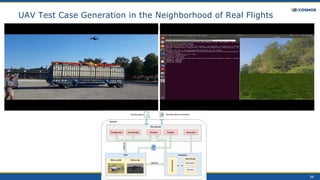
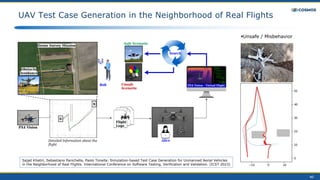
UAV Test Case Generation in the Neighborhood of Real Flights
40
UAV Test Case Generation in the Neighborhood of Real Flights
Sajad Khatiri, Sebastiano Panichella, Paolo Tonella: Simulation-based Test Case Generation for Unmanned Aerial Vehicles
in the Neighborhood of Real Flights. International Conference on Software Testing, Verification and Validation. (ICST 2023)
§Unsafe / Misbehavior
41
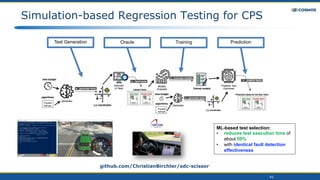
Simulation-based Regression Testing for CPS
Test Generation Oracle Training Prediction
github.com/ChristianBirchler/sdc-scissor
ML-based test selection:
• reduces test execution time of
about 50%
• with identical fault detection
effectiveness
42
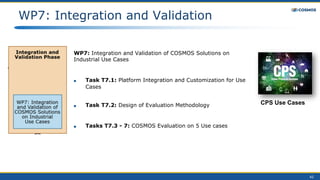
WP7: Integration and Validation
WP7: Integration and Validation of COSMOS Solutions on
Industrial Use Cases
■ Task T7.1: Platform Integration and Customization for Use
Cases
■ Task T7.2: Design of Evaluation Methodology
■ Tasks T7.3 - 7: COSMOS Evaluation on 5 Use cases
CPS Use Cases
43
Targeted Impacts
■ Industrial Impacts
⧫ Decreasing percentage of changes that result in CPS failure
⧫ Reducing CPS test execution time and computational resource consumption
⧫ Replacing manually generated tests with automated CPS test coverage
⧫ Improving test effectiveness through tests able to discover more bugs
⧫ Reducing number of security vulnerabilities in CPS
⧫ Reducing component integration and deployment time
⧫ Reducing time to implement a change and make updated CPS operational
⧫ Reducing downtime when deploying new CPS hardware or software
44
Targeted Impacts
■ CPS DevOps Ecosystem
⧫ Project technologies available in open source with actions to build a
European community and ecosystem exploiting DevOps for CPS
■ Standardisation
⧫ Usage of existing industry standards and proposed new standards and
extensions to ensure “plug-n-play” of DevOps tools for CPS
development
■ Academic impact
⧫ Partners produced publications and are contributing to educational
content
DevOps for Complex Cyber-physical Systems
45
www.COSMOS-DevOps.org
@COSMOS_DEVOPS
The COSMOS Project has
received funding from
the European Union’s
Horizon 2020 Research
and InnovaCon
Programme under grant
agreement No. 957254.
COSMOS Technology Vision

COSMOS: DevOps for Complex Cyber-physical Systems

  • 1.
    COSMOS: DevOps for ComplexCyber-physical Systems Sebastiano Panichella Zurich University of Applied Sciences (ZHAW) Workshop on Adaptive CPSoS (WASOS) 2023 1 www.COSMOS-DevOps.org @COSMOS_DEVOPS The COSMOS Project has received funding from the European Union’s Horizon 2020 Research and InnovaCon Programme under grant agreement No. 957254.
  • 2.
    ■ Context &Challenges ■ Vision & Objectives ■ Work Packages (WPs) ⧫ WPs and Progress ■ Impact Outline 2
  • 3.
    COSMOS Technology Vision3 ■ Emerging Cyber-physical Systems (CPS) play a crucial role in the quality of life of European citizens and the future of the European “smart everywhere” economy ■ CPS relevant sectors ⧫ Healthcare ⧫ Avionics ⧫ Automotive ⧫ Utilities ⧫ Railway ⧫ Manufacturing ⧫ Smart Cities ⧫ Many others… Context
  • 4.
    COSMOS Technology Vision4 Challenges ■ C1: Observability, testability, and predictability of behaviour of CPS is highly limited and, unfortunately, their usage in the real world can lead to fatal crashes sometimes tragically involving also humans ■ C2: Contemporary DevOps practices and tools are potentially the right solution to this problem, but are currently not developed to be applied in CPS domains
  • 5.
    COSMOS Technology Vision5 Traditional DevOps Pipeline Lint “General lack of DevOps solutions supporting the physical dimension of CPS…”
  • 6.
    COSMOS Technology Vision6 COSMOS Vision ■ Develop novel DevOps tools, methodologies, and techniques that enable effective, continuous development and evolution of CPS ■ Increase the level of reliability, dependability, trustworthiness, and adaptability of CPS ■ Delivers proven DevOps advantages and benefits to Europe’s CPS development community
  • 7.
    COSMOS Technology Vision7 COSMOS DevOps Pipeline Lint
  • 8.
    COSMOS Technology Vision8 Project Objectives Technical objectives ■ Realise innovative DevOps automation solutions specifically tailored for CPS ■ Automate V&V and security assessment of CPS within DevOps pipelines to ensure high levels of dependability ■ Enable monitoring and evolving CPS behaviour in the field to provide high adaptability of CPS to unexpected changes Integration and Evaluation objectives ■ Develop and evolve COSMOS approaches, technologies, and services so they can be integrated into different DevOps and CPS toolchains ■ Validate effectiveness of COSMOS technologies in 5 industrial demonstrators ■ Broadly disseminate the COSMOS technologies to create a European DevOps for CPS ecosystem
  • 9.
    COSMOS Technology Vision9 Three Methodological Pillars KPIs Scien&fic and Technological Founda&ons of COSMOS Empirical Valida&on of COSMOS Innova&ons DevOps Technological Founda&ons of COSMOS
  • 10.
    COSMOS Technology Vision10 Work Packages Overview
  • 11.
    Automotive 11 Industrial CPS Evaluations Railways Medical Evaluationsconducted at both mid-project and during final project months Avionics Utilities COSMOS Technology Vision
  • 12.
    12 Innovation Area 1:DevOps Pipelines for CPS WP3: Methodology for Setting-Up and Maintaining COSMOS DevOps Pipelines ■ CI/CD Antipatterns Identification for CPS ■ Definition of a DevOps-based Methodology to Support the Development of Self-Adaptive CPS ■ COSMOS Pipeline Optimization COMPONENTS COSMOS Technology Vision
  • 13.
    13 Progress (Innovation Area1) COSMOS Technology Vision WP3 - Setting-Up and Maintaining DevOps Pipelines (UoS) ■ (Completed) Catalogue of CI/CD CPS good (and bad) practices ■ (Completed) Detector of bad practices in CPS pipelines ■ (Completed) Approach for the smart allocation of jobs on HiL and simulators ■ Ongoing ⧫ Tool for the smart allocation of jobs on HiL and simulators, and build prioritization ⧫ Automated bad practice resolution recommender for CPS ⧫ Methodology for setting-up CI/CD pipelines for CPS Modular extension of specification-based vulnerability analysis
  • 14.
    14 Elicitation of CPSDevOps Challenges Interview-based methodology Interviews’ transcripts Card Sorting Early feedback from COSMOS partners Validation outside COSMOS (survey questionnaire) Pull Requests (PRs) Mining 20 CPS related projects Bad (and good) practices, Challenges, Barriers, Mitigation Analysis Triangulation
  • 15.
    15 Finding overview -CPS DevOps challenges Zampetti, Fiorella; Tamburri, Damian ; Panichella, Sebastiano; Panichella, Annibale; Canfora, Gerardo; Di Penta, Massimiliano: Continuous Integration and Delivery practices for Cyber-Physical systems: An interview-based study. Transactions on Software Engineering and Methodology.
  • 16.
    16 Finding overview -CPS DevOps challenges Zampetti, Fiorella; Tamburri, Damian ; Panichella, Sebastiano; Panichella, Annibale; Canfora, Gerardo; Di Penta, Massimiliano: Continuous Integration and Delivery practices for Cyber-Physical systems: An interview-based study. Transactions on Software Engineering and Methodology.
  • 17.
    17 Finding overview -CPS DevOps challenges Zampetti, Fiorella; Tamburri, Damian ; Panichella, Sebastiano; Panichella, Annibale; Canfora, Gerardo; Di Penta, Massimiliano: Continuous Integration and Delivery practices for Cyber-Physical systems: An interview-based study. Transactions on Software Engineering and Methodology.
  • 18.
    18 Challenges vs. mitigationstrategies Zampetti, Fiorella; Tamburri, Damian ; Panichella, Sebastiano; Panichella, Annibale; Canfora, Gerardo; Di Penta, Massimiliano: Continuous Integration and Delivery practices for Cyber- Physical systems: An interview- based study. Transactions on Software Engineering and Methodology.
  • 19.
    19 Pipeline analysis tools Examplesof rules: ■ Missing stable branch ■ Arbitrary skip of steps/stages ■ Build time aging ■ Inappropriate cache handling ■ Different outcome on different targets ■ Build stages not properly ordered
  • 20.
    20 Example: Different outcomeon different targets Consistently different build outcome on different targets linux-aarch64 linux-x86_64 macos-x86_64 macos-aarch64 windows-x86_64 ✘ 🇭 🇭 🇭 🇭 commit1 linux-aarch64 linux-x86_64 macos-x86_64 macos-aarch64 windows-x86_64 ✘ 🇭 🇭 🇭 🇭 commit2 …… linux-aarch64 linux-x86_64 macos-x86_64 macos-aarch64 windows-x86_64 ✘ 🇭 🇭 🇭 🇭 commitN ✘ ✘ ✘ ✘ 🇭 🇭 Targets
  • 21.
    21 Innovation Area 2:V&V and Security Assessment of DevOps pipelines WP4: V&V and security assessment of COSMOS DevOps pipelines ■ Development of Automated Techniques for Software Testing for CPS ■ Development of Run-time Verification Techniques for Checking and Diagnosing CPS Executions ■ Development of Solutions for Detecting Security Vulnerabilities in CPS COMPONENTS COSMOS Technology Vision
  • 22.
    22 Progress (Innovation Area2) WP4 - V&V and Security Assessment of DevOps pipelines (UoL) ■ (Completed) Automated testing (in co-simulated environments) and specification-based functional security testing ■ (Completed) Definition of a high-level specification language for signal-based properties of CPS (SCSL) and its corresponding (online and offline) monitoring algorithm ■ (Completed) Toolset for code analysis of CPS ■ Ongoing: ⧫ HIL Testing ⧫ Runtime verification for SCSL ⧫ ML-based generation of metamorphic security relations ⧫ Modular extension of specification-based vulnerability analysis
  • 23.
    23 Runtime Verification forSCSL SCSL, designed for capturing signal and source code-level behaviour Instrumentation of the CPS’ source code is performed automatically, with respect to the given SCSL specification Monitoring can either take place online or offline, depending on the use case requirements Work on diagnosing violations of SCSL specifications is ongoing Team contact: joshua.dawes@uni.lu
  • 24.
    24 V&V of DevOpspipelines for CPS AutoPilot
  • 25.
  • 26.
    26 Innovation Area 3:Tools for High Quality CPS Software Evolution WP5: Development of Tools to support High Quality CPS Software Evolution ■ Design and Development of Refactoring Framework for Secure and Reliable CPS ■ Development of Test Case Generation Tools for Rapid DevOps Iterations ■ Development of Tools to support User- oriented Maintenance and Testing COMPONENTS COSMOS Technology Vision
  • 27.
    27 Progress (Innovation Area3) ■ WP5 - Tools for High Quality CPS Software Evolution (TUD) ⧫ (Completed) Handbook of refactoring of production code ⧫ (Completed) Prototype for CPS refactorings ⧫ Ongoing: ● Test Case Generation Tools for Rapid DevOps Iterations ● Tools to support User-oriented Maintenance and Testing
  • 28.
    ■ Goal: Designinga performance antipatterns detector and a refactoring framework CPS’s ■ First step: ⧫ Gather information ⧫ Reviewed previous studies ⧫ Analyzing code history of open-source CPS projects 28 Progress (Innovation Area 3)
  • 29.
    29 Results: Antipatterns inCPS Projects Waiting time
  • 30.
    ■ Goal: generatingsimulation-based test cases for CPS based on user- feedback information ■ Context: self-driving cars ■ Challenge: creating realistic road- maps that are difficult for drivers (both human and autonomous) Test Case Generation based on Real-world Maps 30
  • 31.
    Seeding Strategies basedon Real-world Streets 31 Road from Google Map Simulation-based Driving Scenario Map reconstruction via Spline interpolation
  • 32.
    Seeding Strategies basedon Real-world Streets 32 ■ How: extracted “dangerous” roads are evolved using evolutionary algorithms (initial population) ■ Many-objective testing: ⧫ FITEST by Abdessalem et al (ASE 2018) ⧫ REWOSA (Real-world Street Search Algorithms) With better Failures Detection Results
  • 33.
    33 Innovation Area 4:Tools for Monitoring, Self-healing and Self-adaptability of CPS WP6: Development of Tools to support Monitoring, Self- healing, and Self-adaptability of CPS in the Field ■ Development and Assessment of CPS Change & Behavioral Models ■ Developing AI-based Solutions to Support Two-speed DevOps Cycles for CPS ■ Automated Quality Assessment and Monitoring of CPS in the Field ■ Development of AI-based Solutions to Increase CPS Self-adaptability to Diverse Contexts COMPONENTS COSMOS Technology Vision
  • 34.
    34 Progress (Innovation Area4) ■ WP6 - Tools for Monitoring, Self-healing, & Self-adaptability of CPS in the field (ZHAW) ⧫ (Completed) Monitoring CPS Changes in CI/CD pipelines for CPS ⧫ (Completed) Monitoring CPS States and Flaky Behaviors of CPS ⧫ (Completed) Support to Regression Testing for CPS ⧫ (Ongoing) ⧫ Handling and monitoring CPS Behavioral changes in CI/CD pipelines for CPS ⧫ Quality Assessment, Monitoring, and Self-Adaptability ● Change Propagation ● Vulnerability proneness ● AI-based Support for CPS Self-Adaptability
  • 35.
    35 Progress (Innovation Area4) Use Cases & CD/CI assets Change Analysis & Regression Testing Optimization of CD/CI Assets usage
  • 36.
    CPS Safety RelatedIssues of UAVs Andrea Di Sorbo, Fiorella Zampetti, Corrado A. Visaggio, Massimiliano Di Penta, and Sebastiano Panichella: Automated Identification and Qualitative Characterization of Safety Concerns Reported in UAV Software Platforms. Transactions on Software Engineering and Methodology. 36 Progress (Innovation Area 4) CPS Bugs Taxonomy Designed a taxonomy of bugs occurring in over 10 CPS projects from GitHub (Arduino, drones, robotics, automotive, etc.) Fiorella Zampetti, Ritu Kapur, Massimiliano Di Penta, Sebastiano Panichella: An Empirical Characterization of Software Bugs in Open-Source Cyber-Physical Systems. Journal of Systems & Software (JSS).
  • 37.
    37 Progress (Innovation Area4) Co-occurrences of hazard categories and accident categories Hazard Accident Hazard categories and corresponding occurrences in our dataset of 273 safety-related issues and pull requests.
  • 38.
    38 Progress (Innovation Area4) CPS Change Taxonomy CPS Specific Non-CPS Specific Developed a pipeline analizing ■ Code changes of CPS ■ Dependencies changes of CPS ■ Changes in operational or configuration data of CPSto Diverse Context
  • 39.
    39 UAV Test CaseGeneration in the Neighborhood of Real Flights
  • 40.
    40 UAV Test CaseGeneration in the Neighborhood of Real Flights Sajad Khatiri, Sebastiano Panichella, Paolo Tonella: Simulation-based Test Case Generation for Unmanned Aerial Vehicles in the Neighborhood of Real Flights. International Conference on Software Testing, Verification and Validation. (ICST 2023) §Unsafe / Misbehavior
  • 41.
    41 Simulation-based Regression Testingfor CPS Test Generation Oracle Training Prediction github.com/ChristianBirchler/sdc-scissor ML-based test selection: • reduces test execution time of about 50% • with identical fault detection effectiveness
  • 42.
    42 WP7: Integration andValidation WP7: Integration and Validation of COSMOS Solutions on Industrial Use Cases ■ Task T7.1: Platform Integration and Customization for Use Cases ■ Task T7.2: Design of Evaluation Methodology ■ Tasks T7.3 - 7: COSMOS Evaluation on 5 Use cases CPS Use Cases
  • 43.
    43 Targeted Impacts ■ IndustrialImpacts ⧫ Decreasing percentage of changes that result in CPS failure ⧫ Reducing CPS test execution time and computational resource consumption ⧫ Replacing manually generated tests with automated CPS test coverage ⧫ Improving test effectiveness through tests able to discover more bugs ⧫ Reducing number of security vulnerabilities in CPS ⧫ Reducing component integration and deployment time ⧫ Reducing time to implement a change and make updated CPS operational ⧫ Reducing downtime when deploying new CPS hardware or software
  • 44.
    44 Targeted Impacts ■ CPSDevOps Ecosystem ⧫ Project technologies available in open source with actions to build a European community and ecosystem exploiting DevOps for CPS ■ Standardisation ⧫ Usage of existing industry standards and proposed new standards and extensions to ensure “plug-n-play” of DevOps tools for CPS development ■ Academic impact ⧫ Partners produced publications and are contributing to educational content
  • 45.
    DevOps for ComplexCyber-physical Systems 45 www.COSMOS-DevOps.org @COSMOS_DEVOPS The COSMOS Project has received funding from the European Union’s Horizon 2020 Research and InnovaCon Programme under grant agreement No. 957254. COSMOS Technology Vision