Cosmetic Inspection Standard
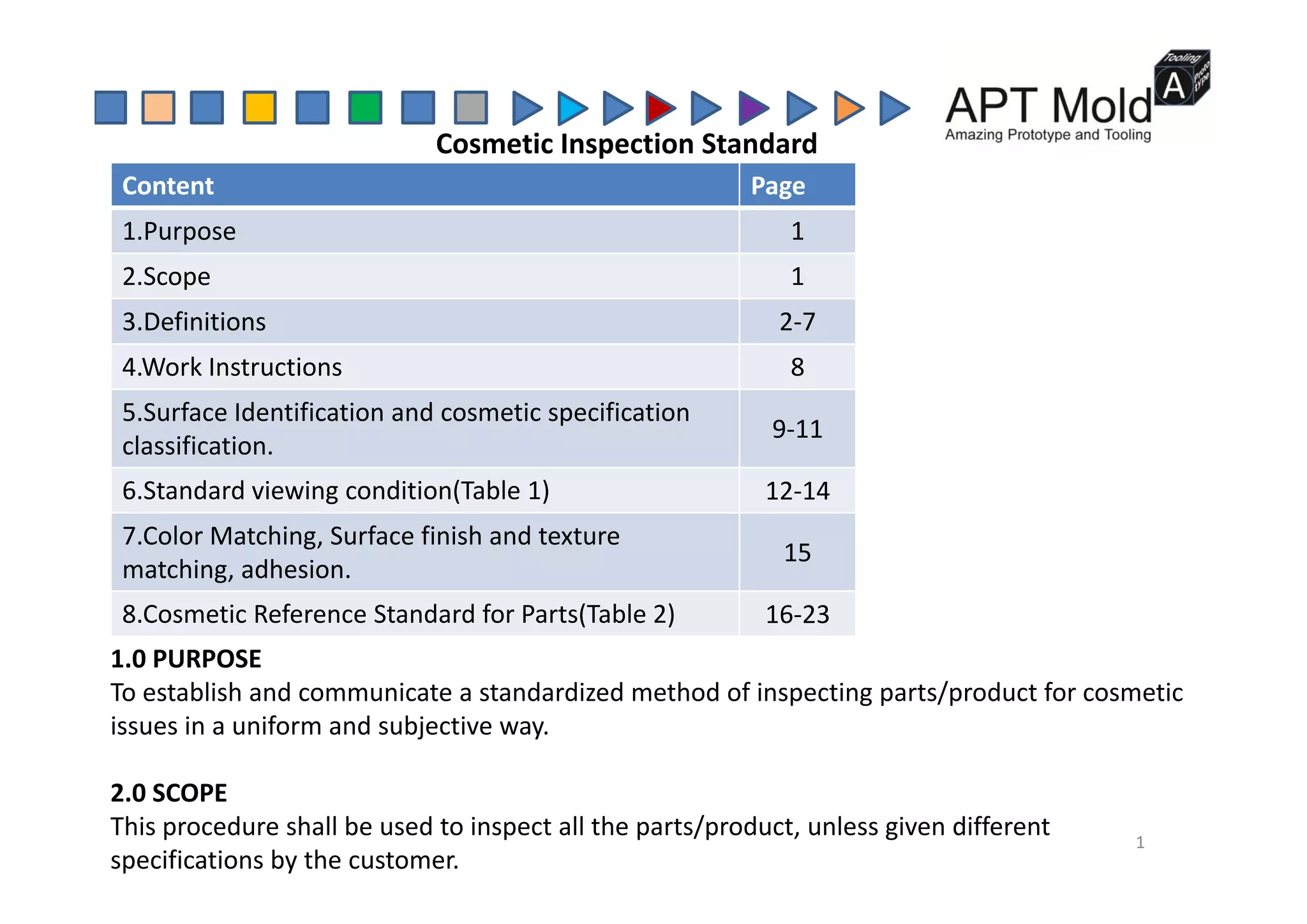
Cosmetic Inspection Standard
ContentPage
1.Purpose 1
2.Scope 1
3.Definitions 2‐7
k
4.Work Instructions 8
5.Surface Identification and cosmetic specification
classification.
9‐11
6.Standard viewing condition(Table 1) 12‐14
7.Color Matching, Surface finish and texture
matching adhesion
15
1.0 PURPOSE
matching, adhesion.
8.Cosmetic Reference Standard for Parts(Table 2) 16‐23
To establish and communicate a standardized method of inspecting parts/product for cosmetic
issues in a uniform and subjective way.
2.0 SCOPE
This procedure shall be used to inspect all the parts/product, unless given different
specifications by the customer.
1
Pi P hP t i di t ti d b j t i hi i t t th l
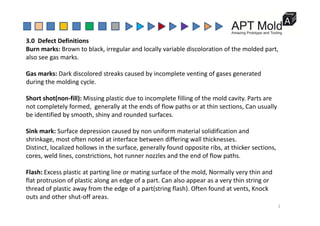
Pin Push: Protrusion or distortion caused by an ejector pin pushing into part more than normal.
The protrusion is most evident on the surface opposite the ejector pin.
Orange Peel: Rippled or mottled appearance view able as concentric lines Caused by under
Orange Peel: Rippled or mottled appearance view able as concentric lines. Caused by under‐
pressurizing. Orange peel is often the first sign of possible sink or shorting.
Nicks: Like gouges but of short length Cause by impact rather than abrasion
Nicks: Like gouges but of short length. Cause by impact rather than abrasion.
Marbling: Colored streaks caused by incomplete mixing of 2 different colored plastics. Also
referred to as streaking.
referred to as streaking.
Insert Problems (Not a true “cosmetic” defect. More functional than cosmetic)
Errors related to the installation of inserts into plastic parts. Inserts can be set too high or too
p p g
low in a socket or boss. They can also be damaged or misaligned and may even be missing.
Cracking: Stress induced splitting or fissures causing separation of material.
Crazing: Multiple tiny cracks due to stress exerted on the part.
Delamination: Separation(peeling) of layers of plastic.
Discoloration: Any change from the original color standard. Unintended, Inconsistent color.
5
4 0 WorkInstructions
4.1 At time of RFQ, the Sales Engineer and customer will review the product and determine
surface classification (see sections 5.0 for more information on part classification).
4.0 Work Instructions
surface classification (see sections 5.0 for more information on part classification).
4.2 After these surfaces have been reviewed and agreed upon with the customer, the
internal controlled prints will note the corresponding surface classification.
p p g
4.3 During the fabrication of product, per Work Instruction Form, auditor will verify that
product conforms to this specification.
4.4 If product does not conform to this specification, defect will be documented on the
Inspection History Form and Quality will determine part disposition.
8
9.
5 0 SurfaceIdentification and cosmetic specification classification
5.0 Surface Identification and cosmetic specification classification.
5.1 General‐ For components or assemblies , cosmetic inspection shall use the Time and
Distance Inspection procedure described below (Table 1) and shall rely on the judgement of
Distance Inspection procedure described below (Table 1) and shall rely on the judgement of
trained auditor and suppliers. If flaws are noticeable within this specification, refer to the
Cosmetic Reference Standard (Table 2). This added specification will assist our trained auditor in
making an accept/ reject decision. If the product does not conform to this specification, product
making an accept/ reject decision. If the product does not conform to this specification, product
will be placed on hold.
5.2 Surface finish:
Grade 1
Highly polished(e.g.SPI‐B1 or lower).
Clear transparent.
Fluid contact‐(Primarily applies to medical parts).
Grade 2
Low grade polish, non‐textured: (e.g.SPI‐B2 or higher).
Textured.
Clear translucent.
Grade 3
Painted parts. 9
10.
G d
Grade 4
Ink stamped, printed, silk screened.
Other decorative processes.
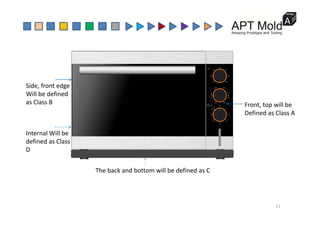
5.3 Cosmetic Class Codes‐ The cosmetic class codes used in this Standard use letters from “A”
through “D”.
Class“A” is reserved for the top or front most often viewed surface
Class A is reserved for the top or front, most often viewed surface.
Class “B” is generally the front edge and sides of a part. Not viewed as often as an “A” surface
but easily seen by user.
Class “C” is generally specified for most often the back and bottom surface
Class C is generally specified for most often, the back and bottom surface.
Class “D” is generally internal surface. Normally D surfaces are not inspected for cosmetic
attributes. Where, necessary, D surface inspection will be specified as an exception.
5.4 Application‐ “External” applications include front panels, covers, and frames that are readily
visible in the final assembly. “Internal” components are generally seen only by assembly and
technical personnel and are less important cosmetically. Some components, such as the inside
of a door, may have both an internal and external application. This will be our default code
unless directed otherwise by the customer.
10
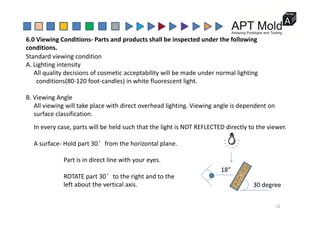
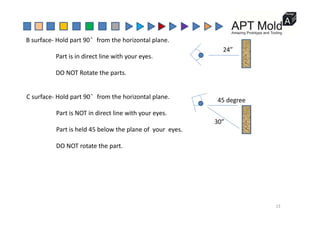
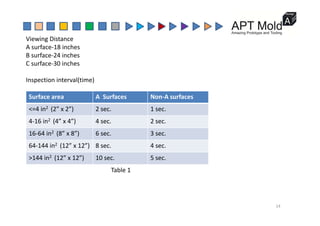
Viewing Distance
A surface‐18 inches
B surface‐24 inches
C f 30i h
C surface‐30 inches
Inspection interval(time)
Surface area A Surfaces Non‐A surfaces
<=4 in2 (2” x 2”) 2 sec. 1 sec.
4‐16 in2 (4” x 4”) 4 sec. 2 sec.
16‐64 in2 (8” x 8”) 6 sec. 3 sec.
64‐144 in2 (12” x 12”) 8 sec. 4 sec.
>144 in2 (12” x 12”) 10 sec. 5 sec.
Table 1
14
( )
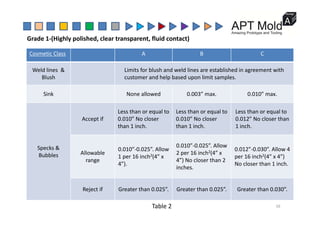
Cosmetic Class AB C
Grade 1‐(Highly polished, clear transparent, fluid contact)
Weld lines &
Blush
Limits for blush and weld lines are established in agreement with
customer and help based upon limit samples.
Sink None allowed 0.003” max. 0.010” max.
Less than or equal to Less than or equal to Less than or equal to
Accept if
Less than or equal to
0.010” No closer
than 1 inch.
Less than or equal to
0.010” No closer
than 1 inch.
Less than or equal to
0.012” No closer than
1 inch.
Specks &
Bubbles Allowable
range
0.010”‐0.025”. Allow
1 per 16 inch2(4” x
4”)
0.010”‐0.025”. Allow
2 per 16 inch2(4” x
4”) No closer than 2
0.012”‐0.030”. Allow 4
per 16 inch2(4” x 4”)
No closer than 1 inch
4 ).
inches.
No closer than 1 inch.
Reject if Greater than 0 025” Greater than 0 025” Greater than 0 030”
Reject if Greater than 0.025 . Greater than 0.025 . Greater than 0.030 .
Table 2 16
17.
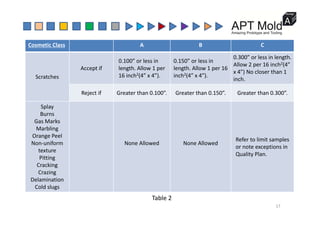
Cosmetic Class A BC
0 100” or less in 0 150” or less in
0.300” or less in length.
Scratches
Accept if
0.100 or less in
length. Allow 1 per
16 inch2(4” x 4”).
0.150 or less in
length. Allow 1 per 16
inch2(4” x 4”).
Allow 2 per 16 inch2(4”
x 4”) No closer than 1
inch.
Reject if Greater than 0.100”. Greater than 0.150”. Greater than 0.300”.
Splay
B
Burns
Gas Marks
Marbling
Orange Peel
Refer to limit samples
g
Non‐uniform
texture
Pitting
Cracking
None Allowed None Allowed
Refer to limit samples
or note exceptions in
Quality Plan.
Cracking
Crazing
Delamination
Cold slugs
g
Table 2
17
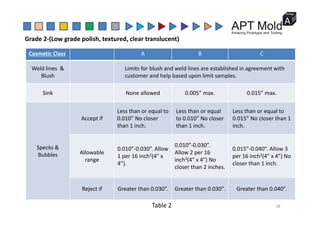
18.
Cosmetic Class A BC
Grade 2‐(Low grade polish, textured, clear translucent)
Weld lines &
Blush
Limits for blush and weld lines are established in agreement with
customer and help based upon limit samples.
Sink None allowed 0.005” max. 0.015” max.
Less than or equal to Less than or equal Less than or equal to
Accept if
Less than or equal to
0.010” No closer
than 1 inch.
Less than or equal
to 0.010” No closer
than 1 inch.
Less than or equal to
0.015” No closer than 1
inch.
Specks &
Bubbles Allowable
range
0.010”‐0.030”. Allow
1 per 16 inch2(4” x
4”)
0.010”‐0.030”.
Allow 2 per 16
inch2(4” x 4”) No
0.015”‐0.040”. Allow 3
per 16 inch2(4” x 4”) No
closer than 1 inch
4 ).
closer than 2 inches.
closer than 1 inch.
Reject if Greater than 0 030” Greater than 0 030” Greater than 0 040”
Reject if Greater than 0.030 . Greater than 0.030 . Greater than 0.040 .
Table 2 18
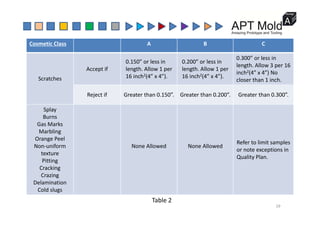
19.
Cosmetic Class A BC
0 150” or less in 0 200” or less in
0.300” or less in
Scratches
Accept if
0.150 or less in
length. Allow 1 per
16 inch2(4” x 4”).
0.200 or less in
length. Allow 1 per
16 inch2(4” x 4”).
length. Allow 3 per 16
inch2(4” x 4”) No
closer than 1 inch.
Reject if Greater than 0.150”. Greater than 0.200”. Greater than 0.300”.
Splay
Burns
Gas Marks
Marbling
Orange Peel
Orange Peel
Non‐uniform
texture
Pitting
None Allowed None Allowed
Refer to limit samples
or note exceptions in
Quality Plan.
Cracking
Crazing
Delamination
Cold slugs
Cold slugs
Table 2
19
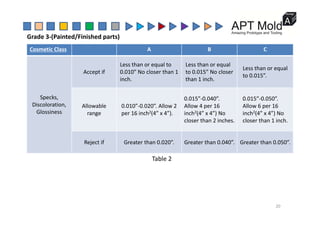
20.
Grade 3 (Painted/Finishedparts)
Cosmetic Class A B C
Grade 3‐(Painted/Finished parts)
Accept if
Less than or equal to
0.010” No closer than 1
inch.
Less than or equal
to 0.015” No closer
than 1 inch.
Less than or equal
to 0.015”.
Specks,
Discoloration,
Glossiness
Allowable
range
0.010”‐0.020”. Allow 2
per 16 inch2(4” x 4”)
0.015”‐0.040”.
Allow 4 per 16
inch2(4” x 4”) No
0.015”‐0.050”.
Allow 6 per 16
inch2(4” x 4”) No
Glossiness range per 16 inch2(4 x 4 ). inch2(4 x 4 ) No
closer than 2 inches.
inch2(4 x 4 ) No
closer than 1 inch.
Reject if Greater than 0.020”. Greater than 0.040”. Greater than 0.050”.
Table 2
20
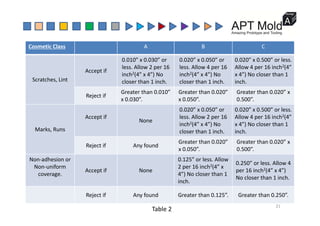
21.
Cosmetic Class A BC
0.010” x 0.030” or 0.020” x 0.050” or 0.020” x 0.500” or less.
Scratches, Lint
Accept if
0.010 x 0.030 or
less. Allow 2 per 16
inch2(4” x 4”) No
closer than 1 inch.
0.020 x 0.050 or
less. Allow 4 per 16
inch2(4” x 4”) No
closer than 1 inch.
0.020 x 0.500 or less.
Allow 4 per 16 inch2(4”
x 4”) No closer than 1
inch.
Reject if
Greater than 0.010”
x 0.030”.
Greater than 0.020”
x 0.050”.
Greater than 0.020” x
0.500”.
0.020” x 0.050” or 0.020” x 0.500” or less.
Marks, Runs
Accept if
None
less. Allow 2 per 16
inch2(4” x 4”) No
closer than 1 inch.
Allow 4 per 16 inch2(4”
x 4”) No closer than 1
inch.
Reject if Any found
Greater than 0.020”
x 0.050”.
Greater than 0.020” x
0.500”.
Non‐adhesion or 0.125” or less. Allow
2 0 250” or less Allow 4
Non‐uniform
coverage.
Accept if None
2 per 16 inch2(4” x
4”) No closer than 1
inch.
0.250 or less. Allow 4
per 16 inch2(4” x 4”)
No closer than 1 inch.
Reject if Any found Greater than 0.125”. Greater than 0.250”.
Table 2
21
22.
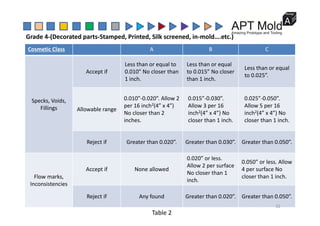
Grade 4 (Decoratedparts Stamped Printed Silk screened in mold etc )
Cosmetic Class A B C
Grade 4‐(Decorated parts‐Stamped, Printed, Silk screened, in‐mold….etc.)
Accept if
Less than or equal to
0.010” No closer than
1 inch.
Less than or equal
to 0.015” No closer
than 1 inch.
Less than or equal
to 0.025”.
Specks, Voids,
Fillings Allowable range
0.010”‐0.020”. Allow 2
per 16 inch2(4” x 4”)
No closer than 2
0.015”‐0.030”.
Allow 3 per 16
inch2(4” x 4”) No
0.025”‐0.050”.
Allow 5 per 16
inch2(4” x 4”) No
No closer than 2
inches.
inch2(4 x 4 ) No
closer than 1 inch.
inch2(4 x 4 ) No
closer than 1 inch.
Reject if Greater than 0.020”. Greater than 0.030”. Greater than 0.050”.
0.020” or less.
All 2 f
0.050” or less. Allow
Flow marks,
Inconsistencies
Accept if None allowed
Allow 2 per surface
No closer than 1
inch.
4 per surface No
closer than 1 inch.
Reject if Any found Greater than 0.020”. Greater than 0.050”.
Table 2
22
23.
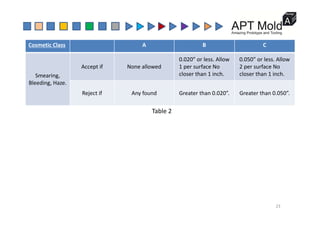
Cosmetic Class A BC
0.020” or less. Allow 0.050” or less. Allow
Smearing,
Bleeding, Haze.
Accept if None allowed 1 per surface No
closer than 1 inch.
2 per surface No
closer than 1 inch.
Reject if Any found Greater than 0.020”. Greater than 0.050”.
Table 2
Table 2
23