TS-754, Correct and Efficient Synchronization of Java Threads1
Correct and Efficient
Synchronization of
Java™ Technology-
based Threads
Doug Lea and William Pugh
http://gee.cs.oswego.edu
http://www.cs.umd.edu/~pugh
TS-754, Correct and Efficient Synchronization of Java Threads2
Audience
• Assume you are familiar with basics
of Java™ technology-based threads
(“Java threads”)
– Creating, starting and joining threads
– Synchronization
– wait and notifyAll
• Will talk about things that surprised a lot
of experts
– Including us, James Gosling, Guy Steele, …
(others discovered many of these)
TS-754, Correct and Efficient Synchronization of Java Threads3
Java Thread Specification
• Chapter 17 of the Java Language Spec
– Chapter 8 of the Virtual Machine Spec
• Very, very hard to understand
– Not even the authors understood it
– Has subtle implications
• That forbid standard compiler optimizations
– All existing JVMs violate the specification
• Some parts should be violated
TS-754, Correct and Efficient Synchronization of Java Threads4
Safety Issues in
Multithreaded Systems
• Many intuitive assumptions do not hold
• Some widely used idioms are not safe
– Double-check idiom
– Checking non-volatile flag for
thread termination
• Can’t use testing to check for errors
– Some anomalies will occur only on
some platforms
• e.g., multiprocessors
TS-754, Correct and Efficient Synchronization of Java Threads5
Revising the Thread Spec
• Work is underway to consider revising the
Java Thread Spec
– http://www.cs.umd.edu/~pugh/java/memoryModel
• Goals
– Clear and easy to understand
– Foster reliable multithreaded code
– Allow for high performance JVMs
• Will effect JVMs
– And badly written existing code
• Including parts of Sun’s JDK
TS-754, Correct and Efficient Synchronization of Java Threads6
What To Do Today?
• Guidelines we will provide should
work under both existing and future
thread specs
• Don’t try to read the official specs
• Avoid corner cases of the thread spec
– Not needed for efficient and reliable programs
TS-754, Correct and Efficient Synchronization of Java Threads7
Three Aspects of
Synchronization
• Atomicity
– Locking to obtain mutual exclusion
• Visibility
– Ensuring that changes to object fields made in
one thread are seen in other threads
• Ordering
– Ensuring that you aren’t surprised by the order
in which statements are executed
TS-754, Correct and Efficient Synchronization of Java Threads8
Don’t Be Too Clever
• People worry about the cost of
synchronization
– Try to devise schemes to communicate
between threads
• Without using synchronization
• Very difficult to do correctly
– Inter-thread communication without
synchronization is not intuitive
TS-754, Correct and Efficient Synchronization of Java Threads9
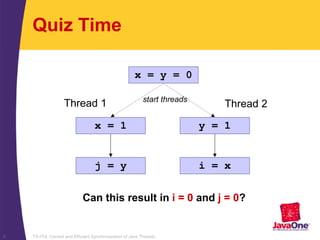
Quiz Time
x = y = 0
x = 1
j = y
Thread 1
y = 1
i = x
Thread 2
Can this result in i = 0 and j = 0?
start threads
TS-754, Correct and Efficient Synchronization of Java Threads10
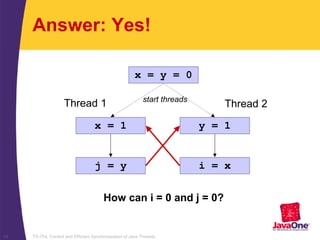
Answer: Yes!
x = y = 0
x = 1
j = y
Thread 1
y = 1
i = x
Thread 2
How can i = 0 and j = 0?
start threads
TS-754, Correct and Efficient Synchronization of Java Threads11
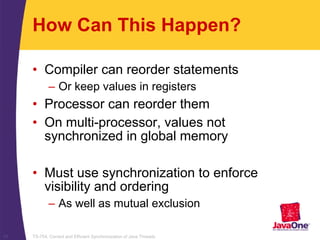
How Can This Happen?
• Compiler can reorder statements
– Or keep values in registers
• Processor can reorder them
• On multi-processor, values not
synchronized in global memory
• Must use synchronization to enforce
visibility and ordering
– As well as mutual exclusion
TS-754, Correct and Efficient Synchronization of Java Threads12
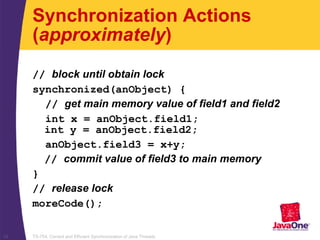
Synchronization Actions
(approximately)
// block until obtain lock
synchronized(anObject) {
// get main memory value of field1 and field2
int x = anObject.field1;
int y = anObject.field2;
anObject.field3 = x+y;
// commit value of field3 to main memory
}
// release lock
moreCode();
TS-754, Correct and Efficient Synchronization of Java Threads13
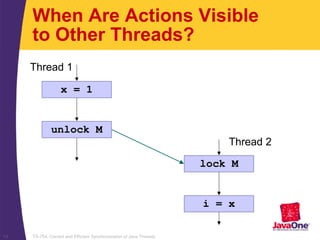
When Are Actions Visible
to Other Threads?
x = 1
unlock M
Thread 1
lock M
i = x
Thread 2
TS-754, Correct and Efficient Synchronization of Java Threads14
What Does Volatile Mean?
• C/C++ spec
– There is no implementation independent
meaning of volatile
• Situation a little better with Java technology
– Volatile reads/writes guaranteed to go directly
to main memory
• Can’t be cached in registers or local memory
TS-754, Correct and Efficient Synchronization of Java Threads15
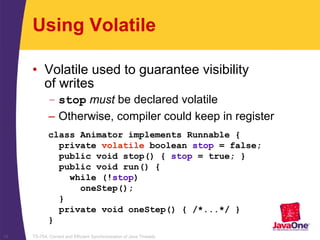
class Animator implements Runnable {
private volatile boolean stop = false;
public void stop() { stop = true; }
public void run() {
while (!stop)
oneStep();
}
private void oneStep() { /*...*/ }
}
Using Volatile
• Volatile used to guarantee visibility
of writes
– stop must be declared volatile
– Otherwise, compiler could keep in register
TS-754, Correct and Efficient Synchronization of Java Threads16
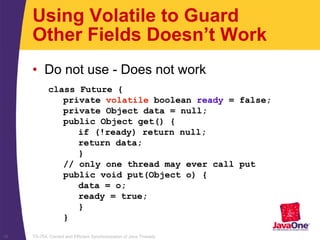
class Future {
private volatile boolean ready = false;
private Object data = null;
public Object get() {
if (!ready) return null;
return data;
}
// only one thread may ever call put
public void put(Object o) {
data = o;
ready = true;
}
}
Using Volatile to Guard
Other Fields Doesn’t Work
• Do not use - Does not work
TS-754, Correct and Efficient Synchronization of Java Threads17
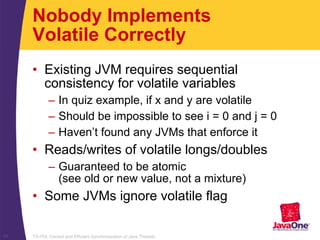
Nobody Implements
Volatile Correctly
• Existing JVM requires sequential
consistency for volatile variables
– In quiz example, if x and y are volatile
– Should be impossible to see i = 0 and j = 0
– Haven’t found any JVMs that enforce it
• Reads/writes of volatile longs/doubles
– Guaranteed to be atomic
(see old or new value, not a mixture)
• Some JVMs ignore volatile flag
TS-754, Correct and Efficient Synchronization of Java Threads18
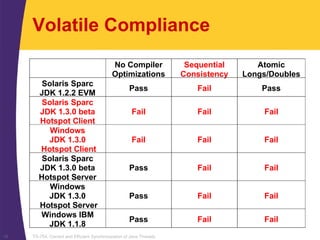
Volatile Compliance
No Compiler
Optimizations
Sequential
Consistency
Atomic
Longs/Doubles
Solaris Sparc
JDK 1.2.2 EVM
Pass Fail Pass
Solaris Sparc
JDK 1.3.0 beta
Hotspot Client
Fail Fail Fail
Windows
JDK 1.3.0
Hotspot Client
Fail Fail Fail
Solaris Sparc
JDK 1.3.0 beta
Hotspot Server
Pass Fail Fail
Windows
JDK 1.3.0
Hotspot Server
Pass Fail Fail
Windows IBM
JDK 1.1.8
Pass Fail Fail
TS-754, Correct and Efficient Synchronization of Java Threads19
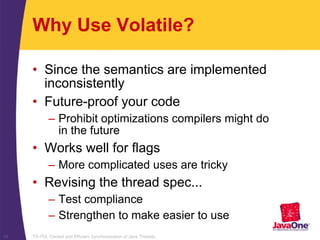
Why Use Volatile?
• Since the semantics are implemented
inconsistently
• Future-proof your code
– Prohibit optimizations compilers might do
in the future
• Works well for flags
– More complicated uses are tricky
• Revising the thread spec...
– Test compliance
– Strengthen to make easier to use
TS-754, Correct and Efficient Synchronization of Java Threads20
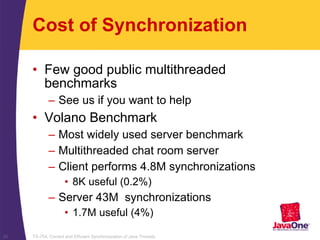
Cost of Synchronization
• Few good public multithreaded
benchmarks
– See us if you want to help
• Volano Benchmark
– Most widely used server benchmark
– Multithreaded chat room server
– Client performs 4.8M synchronizations
• 8K useful (0.2%)
– Server 43M synchronizations
• 1.7M useful (4%)
TS-754, Correct and Efficient Synchronization of Java Threads21
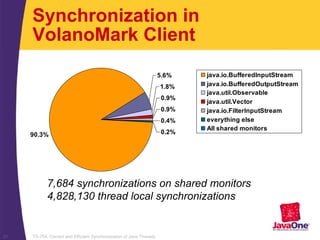
Synchronization in
VolanoMark Client
90.3%
5.6%
1.8%
0.9%
0.9%
0.4%
0.2%
java.io.BufferedInputStream
java.io.BufferedOutputStream
java.util.Observable
java.util.Vector
java.io.FilterInputStream
everything else
All shared monitors
7,684 synchronizations on shared monitors
4,828,130 thread local synchronizations
TS-754, Correct and Efficient Synchronization of Java Threads22
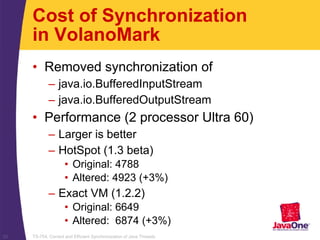
Cost of Synchronization
in VolanoMark
• Removed synchronization of
– java.io.BufferedInputStream
– java.io.BufferedOutputStream
• Performance (2 processor Ultra 60)
– Larger is better
– HotSpot (1.3 beta)
• Original: 4788
• Altered: 4923 (+3%)
– Exact VM (1.2.2)
• Original: 6649
• Altered: 6874 (+3%)
TS-754, Correct and Efficient Synchronization of Java Threads23
Most Synchronization is on
Thread Local Objects
• Synchronization on thread local object
– Is useless
– Current spec says it isn’t quite a no-op
• But very hard to use usefully
– Revised spec will likely make it a no-op
• Largely arises from using synchronized
classes
– In places where not required
TS-754, Correct and Efficient Synchronization of Java Threads24
Synchronize When Needed
• Places where threads interact
– Need synchronization
– Need careful thought
– Need documentation
– Cost of required synchronization not significant
• For most applications
• No need to get tricky
• Elsewhere, using a synchronized class can
be expensive
TS-754, Correct and Efficient Synchronization of Java Threads25
Synchronized Classes
• Some classes are synchronized
– Vector, Hashtable, Stack
– Most Input/Output Streams
• Contrast with 1.2 Collection classes
– By default, not synchronized
– Can request synchronized version
• Using synchronized classes
– Often doesn’t suffice for concurrent interaction
TS-754, Correct and Efficient Synchronization of Java Threads26
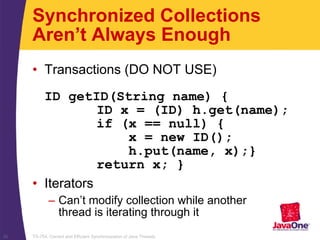
Synchronized Collections
Aren’t Always Enough
• Transactions (DO NOT USE)
ID getID(String name) {
ID x = (ID) h.get(name);
if (x == null) {
x = new ID();
h.put(name, x);}
return x; }
• Iterators
– Can’t modify collection while another
thread is iterating through it
TS-754, Correct and Efficient Synchronization of Java Threads27
Concurrent Interactions
• Often need entire transactions to
be atomic
– Reading and updating a Map
– Writing a record to an OutputStream
• OutputStreams are synchronized
– Can have multiple threads trying to write to the
same OutputStream
– Output from each thread is nondeterministicly
interleaved
– Essentially useless
TS-754, Correct and Efficient Synchronization of Java Threads28
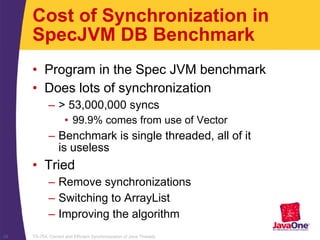
Cost of Synchronization in
SpecJVM DB Benchmark
• Program in the Spec JVM benchmark
• Does lots of synchronization
– > 53,000,000 syncs
• 99.9% comes from use of Vector
– Benchmark is single threaded, all of it
is useless
• Tried
– Remove synchronizations
– Switching to ArrayList
– Improving the algorithm
TS-754, Correct and Efficient Synchronization of Java Threads29
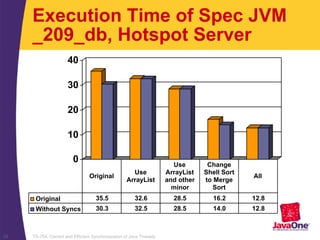
Execution Time of Spec JVM
_209_db, Hotspot Server
0
10
20
30
40
Original 35.5 32.6 28.5 16.2 12.8
Without Syncs 30.3 32.5 28.5 14.0 12.8
Original
Use
ArrayList
Use
ArrayList
and other
minor
Change
Shell Sort
to Merge
Sort
All
TS-754, Correct and Efficient Synchronization of Java Threads30
Lessons
• Synchronization cost can be substantial
– 10-20% for DB benchmark
– Consider replacing all uses of Vector,
Hashtable and Stack
• Use profiling
• Use better algorithms!
– Cost of stupidity higher than cost of
synchronization
– Used built-in merge sort rather than
hand-coded shell sort
TS-754, Correct and Efficient Synchronization of Java Threads31
Designing Fast Code
• Make it right before you make it fast
• Avoid synchronization
– Avoid sharing across threads
– Don’t lock already-protected objects
– Use immutable fields and objects
– Use volatile
• Avoid contention
– Reduce lock scopes
– Reduce lock durations
TS-754, Correct and Efficient Synchronization of Java Threads32
Isolation in Java™ Foundation
Classes (JFC)/Swing
• JFC/Swing relies entirely on Isolation
– AWT thread owns all Swing components
• No other thread may access them
– Eliminates need for locking
• Still need care during initialization
• Can be fragile
– Every programmer must obey rules
– Rules are usually easy to follow
– Most Swing components accessed in
handlers triggered within AWT thread
TS-754, Correct and Efficient Synchronization of Java Threads33
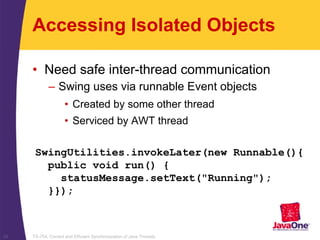
Accessing Isolated Objects
• Need safe inter-thread communication
– Swing uses via runnable Event objects
• Created by some other thread
• Serviced by AWT thread
SwingUtilities.invokeLater(new Runnable(){
public void run() {
statusMessage.setText("Running");
}});
TS-754, Correct and Efficient Synchronization of Java Threads34
GetX/SetX Access Methods
• Not synchronizing access methods
– int thermometer.getTemperature()
(doesn’t work for references)
• Synchronizing access methods
– account.getTotalBalance()
• Omitting access methods
– queue doesn’t need getSize()
TS-754, Correct and Efficient Synchronization of Java Threads35
Things That Don’t Work
• Double-Check Idiom
– Also, unsynchronized reads/writes of refs
• Non-volatile flags
• Depending on sleep for visibility
TS-754, Correct and Efficient Synchronization of Java Threads36
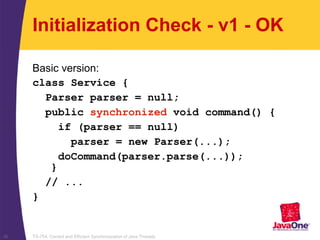
Initialization Check - v1 - OK
Basic version:
class Service {
Parser parser = null;
public synchronized void command() {
if (parser == null)
parser = new Parser(...);
doCommand(parser.parse(...));
}
// ...
}
TS-754, Correct and Efficient Synchronization of Java Threads37
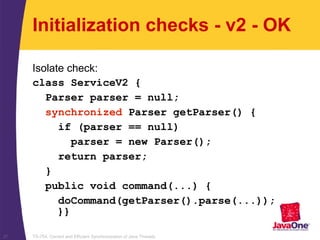
Initialization checks - v2 - OK
Isolate check:
class ServiceV2 {
Parser parser = null;
synchronized Parser getParser() {
if (parser == null)
parser = new Parser();
return parser;
}
public void command(...) {
doCommand(getParser().parse(...));
}}
TS-754, Correct and Efficient Synchronization of Java Threads38
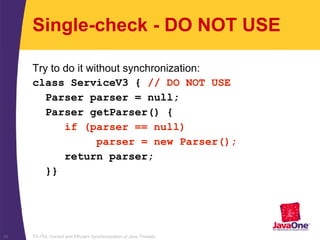
Single-check - DO NOT USE
Try to do it without synchronization:
class ServiceV3 { // DO NOT USE
Parser parser = null;
Parser getParser() {
if (parser == null)
parser = new Parser();
return parser;
}}
TS-754, Correct and Efficient Synchronization of Java Threads39
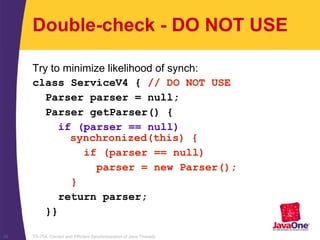
Double-check - DO NOT USE
Try to minimize likelihood of synch:
class ServiceV4 { // DO NOT USE
Parser parser = null;
Parser getParser() {
if (parser == null)
synchronized(this) {
if (parser == null)
parser = new Parser();
}
return parser;
}}
TS-754, Correct and Efficient Synchronization of Java Threads40
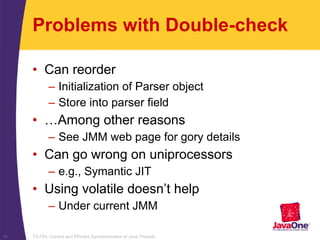
Problems with Double-check
• Can reorder
– Initialization of Parser object
– Store into parser field
• …Among other reasons
– See JMM web page for gory details
• Can go wrong on uniprocessors
– e.g., Symantic JIT
• Using volatile doesn’t help
– Under current JMM
TS-754, Correct and Efficient Synchronization of Java Threads41
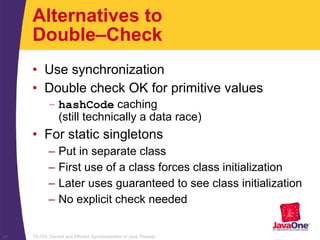
Alternatives to
Double–Check
• Use synchronization
• Double check OK for primitive values
– hashCode caching
(still technically a data race)
• For static singletons
– Put in separate class
– First use of a class forces class initialization
– Later uses guaranteed to see class initialization
– No explicit check needed
TS-754, Correct and Efficient Synchronization of Java Threads42
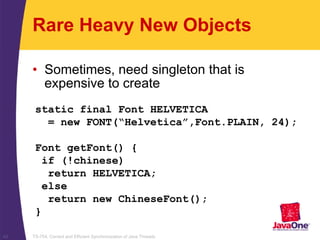
Rare Heavy New Objects
• Sometimes, need singleton that is
expensive to create
static final Font HELVETICA
= new FONT(“Helvetica”,Font.PLAIN, 24);
Font getFont() {
if (!chinese)
return HELVETICA;
else
return new ChineseFont();
}
TS-754, Correct and Efficient Synchronization of Java Threads43
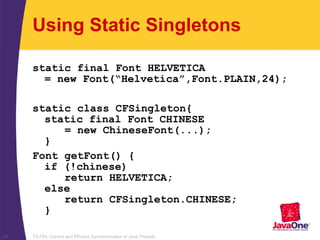
Using Static Singletons
static final Font HELVETICA
= new Font(“Helvetica”,Font.PLAIN,24);
static class CFSingleton{
static final Font CHINESE
= new ChineseFont(...);
}
Font getFont() {
if (!chinese)
return HELVETICA;
else
return CFSingleton.CHINESE;
}
TS-754, Correct and Efficient Synchronization of Java Threads44
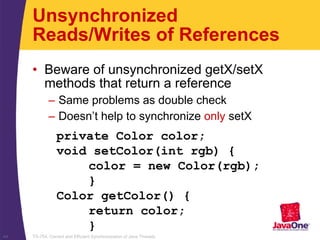
Unsynchronized
Reads/Writes of References
• Beware of unsynchronized getX/setX
methods that return a reference
– Same problems as double check
– Doesn’t help to synchronize only setX
private Color color;
void setColor(int rgb) {
color = new Color(rgb);
}
Color getColor() {
return color;
}
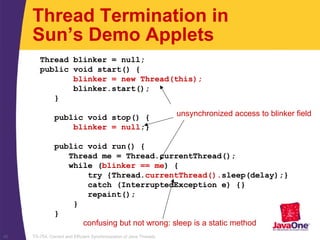
TS-754, Correct and Efficient Synchronization of Java Threads45
Thread blinker = null;
public void start() {
blinker = new Thread(this);
blinker.start();
}
public void stop() {
blinker = null;}
public void run() {
Thread me = Thread.currentThread();
while (blinker == me) {
try {Thread.currentThread().sleep(delay);}
catch (InterruptedException e) {}
repaint();
}
}
Thread Termination in
Sun’s Demo Applets
unsynchronized access to blinker field
confusing but not wrong: sleep is a static method
TS-754, Correct and Efficient Synchronization of Java Threads46
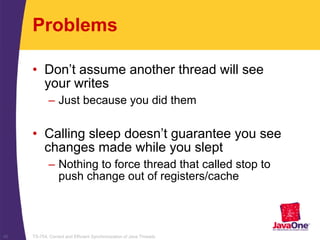
Problems
• Don’t assume another thread will see
your writes
– Just because you did them
• Calling sleep doesn’t guarantee you see
changes made while you slept
– Nothing to force thread that called stop to
push change out of registers/cache
TS-754, Correct and Efficient Synchronization of Java Threads47
Wrap-up
• Cost of synchronization operations
can be significant
– But cost of needed synchronization rarely is
• Thread interaction needs careful thought
– But not too clever
• Need for synchronization...
TS-754, Correct and Efficient Synchronization of Java Threads48
Wrapup - Synchronization
• Communication between threads
– Requires both threads to synchronize
• Or communication through volatile fields
• Synchronizing everything
– Is rarely necessary
– Can be expensive (3%-20% overhead)
– May lead to deadlock
– May not provide enough synchronization
• e.g., transactions
TS-754, Correct and Efficient Synchronization of Java Threads49

Correct and efficient synchronization of java thread

  • 1.
    TS-754, Correct andEfficient Synchronization of Java Threads1 Correct and Efficient Synchronization of Java™ Technology- based Threads Doug Lea and William Pugh http://gee.cs.oswego.edu http://www.cs.umd.edu/~pugh
  • 2.
    TS-754, Correct andEfficient Synchronization of Java Threads2 Audience • Assume you are familiar with basics of Java™ technology-based threads (“Java threads”) – Creating, starting and joining threads – Synchronization – wait and notifyAll • Will talk about things that surprised a lot of experts – Including us, James Gosling, Guy Steele, … (others discovered many of these)
  • 3.
    TS-754, Correct andEfficient Synchronization of Java Threads3 Java Thread Specification • Chapter 17 of the Java Language Spec – Chapter 8 of the Virtual Machine Spec • Very, very hard to understand – Not even the authors understood it – Has subtle implications • That forbid standard compiler optimizations – All existing JVMs violate the specification • Some parts should be violated
  • 4.
    TS-754, Correct andEfficient Synchronization of Java Threads4 Safety Issues in Multithreaded Systems • Many intuitive assumptions do not hold • Some widely used idioms are not safe – Double-check idiom – Checking non-volatile flag for thread termination • Can’t use testing to check for errors – Some anomalies will occur only on some platforms • e.g., multiprocessors
  • 5.
    TS-754, Correct andEfficient Synchronization of Java Threads5 Revising the Thread Spec • Work is underway to consider revising the Java Thread Spec – http://www.cs.umd.edu/~pugh/java/memoryModel • Goals – Clear and easy to understand – Foster reliable multithreaded code – Allow for high performance JVMs • Will effect JVMs – And badly written existing code • Including parts of Sun’s JDK
  • 6.
    TS-754, Correct andEfficient Synchronization of Java Threads6 What To Do Today? • Guidelines we will provide should work under both existing and future thread specs • Don’t try to read the official specs • Avoid corner cases of the thread spec – Not needed for efficient and reliable programs
  • 7.
    TS-754, Correct andEfficient Synchronization of Java Threads7 Three Aspects of Synchronization • Atomicity – Locking to obtain mutual exclusion • Visibility – Ensuring that changes to object fields made in one thread are seen in other threads • Ordering – Ensuring that you aren’t surprised by the order in which statements are executed
  • 8.
    TS-754, Correct andEfficient Synchronization of Java Threads8 Don’t Be Too Clever • People worry about the cost of synchronization – Try to devise schemes to communicate between threads • Without using synchronization • Very difficult to do correctly – Inter-thread communication without synchronization is not intuitive
  • 9.
    TS-754, Correct andEfficient Synchronization of Java Threads9 Quiz Time x = y = 0 x = 1 j = y Thread 1 y = 1 i = x Thread 2 Can this result in i = 0 and j = 0? start threads
  • 10.
    TS-754, Correct andEfficient Synchronization of Java Threads10 Answer: Yes! x = y = 0 x = 1 j = y Thread 1 y = 1 i = x Thread 2 How can i = 0 and j = 0? start threads
  • 11.
    TS-754, Correct andEfficient Synchronization of Java Threads11 How Can This Happen? • Compiler can reorder statements – Or keep values in registers • Processor can reorder them • On multi-processor, values not synchronized in global memory • Must use synchronization to enforce visibility and ordering – As well as mutual exclusion
  • 12.
    TS-754, Correct andEfficient Synchronization of Java Threads12 Synchronization Actions (approximately) // block until obtain lock synchronized(anObject) { // get main memory value of field1 and field2 int x = anObject.field1; int y = anObject.field2; anObject.field3 = x+y; // commit value of field3 to main memory } // release lock moreCode();
  • 13.
    TS-754, Correct andEfficient Synchronization of Java Threads13 When Are Actions Visible to Other Threads? x = 1 unlock M Thread 1 lock M i = x Thread 2
  • 14.
    TS-754, Correct andEfficient Synchronization of Java Threads14 What Does Volatile Mean? • C/C++ spec – There is no implementation independent meaning of volatile • Situation a little better with Java technology – Volatile reads/writes guaranteed to go directly to main memory • Can’t be cached in registers or local memory
  • 15.
    TS-754, Correct andEfficient Synchronization of Java Threads15 class Animator implements Runnable { private volatile boolean stop = false; public void stop() { stop = true; } public void run() { while (!stop) oneStep(); } private void oneStep() { /*...*/ } } Using Volatile • Volatile used to guarantee visibility of writes – stop must be declared volatile – Otherwise, compiler could keep in register
  • 16.
    TS-754, Correct andEfficient Synchronization of Java Threads16 class Future { private volatile boolean ready = false; private Object data = null; public Object get() { if (!ready) return null; return data; } // only one thread may ever call put public void put(Object o) { data = o; ready = true; } } Using Volatile to Guard Other Fields Doesn’t Work • Do not use - Does not work
  • 17.
    TS-754, Correct andEfficient Synchronization of Java Threads17 Nobody Implements Volatile Correctly • Existing JVM requires sequential consistency for volatile variables – In quiz example, if x and y are volatile – Should be impossible to see i = 0 and j = 0 – Haven’t found any JVMs that enforce it • Reads/writes of volatile longs/doubles – Guaranteed to be atomic (see old or new value, not a mixture) • Some JVMs ignore volatile flag
  • 18.
    TS-754, Correct andEfficient Synchronization of Java Threads18 Volatile Compliance No Compiler Optimizations Sequential Consistency Atomic Longs/Doubles Solaris Sparc JDK 1.2.2 EVM Pass Fail Pass Solaris Sparc JDK 1.3.0 beta Hotspot Client Fail Fail Fail Windows JDK 1.3.0 Hotspot Client Fail Fail Fail Solaris Sparc JDK 1.3.0 beta Hotspot Server Pass Fail Fail Windows JDK 1.3.0 Hotspot Server Pass Fail Fail Windows IBM JDK 1.1.8 Pass Fail Fail
  • 19.
    TS-754, Correct andEfficient Synchronization of Java Threads19 Why Use Volatile? • Since the semantics are implemented inconsistently • Future-proof your code – Prohibit optimizations compilers might do in the future • Works well for flags – More complicated uses are tricky • Revising the thread spec... – Test compliance – Strengthen to make easier to use
  • 20.
    TS-754, Correct andEfficient Synchronization of Java Threads20 Cost of Synchronization • Few good public multithreaded benchmarks – See us if you want to help • Volano Benchmark – Most widely used server benchmark – Multithreaded chat room server – Client performs 4.8M synchronizations • 8K useful (0.2%) – Server 43M synchronizations • 1.7M useful (4%)
  • 21.
    TS-754, Correct andEfficient Synchronization of Java Threads21 Synchronization in VolanoMark Client 90.3% 5.6% 1.8% 0.9% 0.9% 0.4% 0.2% java.io.BufferedInputStream java.io.BufferedOutputStream java.util.Observable java.util.Vector java.io.FilterInputStream everything else All shared monitors 7,684 synchronizations on shared monitors 4,828,130 thread local synchronizations
  • 22.
    TS-754, Correct andEfficient Synchronization of Java Threads22 Cost of Synchronization in VolanoMark • Removed synchronization of – java.io.BufferedInputStream – java.io.BufferedOutputStream • Performance (2 processor Ultra 60) – Larger is better – HotSpot (1.3 beta) • Original: 4788 • Altered: 4923 (+3%) – Exact VM (1.2.2) • Original: 6649 • Altered: 6874 (+3%)
  • 23.
    TS-754, Correct andEfficient Synchronization of Java Threads23 Most Synchronization is on Thread Local Objects • Synchronization on thread local object – Is useless – Current spec says it isn’t quite a no-op • But very hard to use usefully – Revised spec will likely make it a no-op • Largely arises from using synchronized classes – In places where not required
  • 24.
    TS-754, Correct andEfficient Synchronization of Java Threads24 Synchronize When Needed • Places where threads interact – Need synchronization – Need careful thought – Need documentation – Cost of required synchronization not significant • For most applications • No need to get tricky • Elsewhere, using a synchronized class can be expensive
  • 25.
    TS-754, Correct andEfficient Synchronization of Java Threads25 Synchronized Classes • Some classes are synchronized – Vector, Hashtable, Stack – Most Input/Output Streams • Contrast with 1.2 Collection classes – By default, not synchronized – Can request synchronized version • Using synchronized classes – Often doesn’t suffice for concurrent interaction
  • 26.
    TS-754, Correct andEfficient Synchronization of Java Threads26 Synchronized Collections Aren’t Always Enough • Transactions (DO NOT USE) ID getID(String name) { ID x = (ID) h.get(name); if (x == null) { x = new ID(); h.put(name, x);} return x; } • Iterators – Can’t modify collection while another thread is iterating through it
  • 27.
    TS-754, Correct andEfficient Synchronization of Java Threads27 Concurrent Interactions • Often need entire transactions to be atomic – Reading and updating a Map – Writing a record to an OutputStream • OutputStreams are synchronized – Can have multiple threads trying to write to the same OutputStream – Output from each thread is nondeterministicly interleaved – Essentially useless
  • 28.
    TS-754, Correct andEfficient Synchronization of Java Threads28 Cost of Synchronization in SpecJVM DB Benchmark • Program in the Spec JVM benchmark • Does lots of synchronization – > 53,000,000 syncs • 99.9% comes from use of Vector – Benchmark is single threaded, all of it is useless • Tried – Remove synchronizations – Switching to ArrayList – Improving the algorithm
  • 29.
    TS-754, Correct andEfficient Synchronization of Java Threads29 Execution Time of Spec JVM _209_db, Hotspot Server 0 10 20 30 40 Original 35.5 32.6 28.5 16.2 12.8 Without Syncs 30.3 32.5 28.5 14.0 12.8 Original Use ArrayList Use ArrayList and other minor Change Shell Sort to Merge Sort All
  • 30.
    TS-754, Correct andEfficient Synchronization of Java Threads30 Lessons • Synchronization cost can be substantial – 10-20% for DB benchmark – Consider replacing all uses of Vector, Hashtable and Stack • Use profiling • Use better algorithms! – Cost of stupidity higher than cost of synchronization – Used built-in merge sort rather than hand-coded shell sort
  • 31.
    TS-754, Correct andEfficient Synchronization of Java Threads31 Designing Fast Code • Make it right before you make it fast • Avoid synchronization – Avoid sharing across threads – Don’t lock already-protected objects – Use immutable fields and objects – Use volatile • Avoid contention – Reduce lock scopes – Reduce lock durations
  • 32.
    TS-754, Correct andEfficient Synchronization of Java Threads32 Isolation in Java™ Foundation Classes (JFC)/Swing • JFC/Swing relies entirely on Isolation – AWT thread owns all Swing components • No other thread may access them – Eliminates need for locking • Still need care during initialization • Can be fragile – Every programmer must obey rules – Rules are usually easy to follow – Most Swing components accessed in handlers triggered within AWT thread
  • 33.
    TS-754, Correct andEfficient Synchronization of Java Threads33 Accessing Isolated Objects • Need safe inter-thread communication – Swing uses via runnable Event objects • Created by some other thread • Serviced by AWT thread SwingUtilities.invokeLater(new Runnable(){ public void run() { statusMessage.setText("Running"); }});
  • 34.
    TS-754, Correct andEfficient Synchronization of Java Threads34 GetX/SetX Access Methods • Not synchronizing access methods – int thermometer.getTemperature() (doesn’t work for references) • Synchronizing access methods – account.getTotalBalance() • Omitting access methods – queue doesn’t need getSize()
  • 35.
    TS-754, Correct andEfficient Synchronization of Java Threads35 Things That Don’t Work • Double-Check Idiom – Also, unsynchronized reads/writes of refs • Non-volatile flags • Depending on sleep for visibility
  • 36.
    TS-754, Correct andEfficient Synchronization of Java Threads36 Initialization Check - v1 - OK Basic version: class Service { Parser parser = null; public synchronized void command() { if (parser == null) parser = new Parser(...); doCommand(parser.parse(...)); } // ... }
  • 37.
    TS-754, Correct andEfficient Synchronization of Java Threads37 Initialization checks - v2 - OK Isolate check: class ServiceV2 { Parser parser = null; synchronized Parser getParser() { if (parser == null) parser = new Parser(); return parser; } public void command(...) { doCommand(getParser().parse(...)); }}
  • 38.
    TS-754, Correct andEfficient Synchronization of Java Threads38 Single-check - DO NOT USE Try to do it without synchronization: class ServiceV3 { // DO NOT USE Parser parser = null; Parser getParser() { if (parser == null) parser = new Parser(); return parser; }}
  • 39.
    TS-754, Correct andEfficient Synchronization of Java Threads39 Double-check - DO NOT USE Try to minimize likelihood of synch: class ServiceV4 { // DO NOT USE Parser parser = null; Parser getParser() { if (parser == null) synchronized(this) { if (parser == null) parser = new Parser(); } return parser; }}
  • 40.
    TS-754, Correct andEfficient Synchronization of Java Threads40 Problems with Double-check • Can reorder – Initialization of Parser object – Store into parser field • …Among other reasons – See JMM web page for gory details • Can go wrong on uniprocessors – e.g., Symantic JIT • Using volatile doesn’t help – Under current JMM
  • 41.
    TS-754, Correct andEfficient Synchronization of Java Threads41 Alternatives to Double–Check • Use synchronization • Double check OK for primitive values – hashCode caching (still technically a data race) • For static singletons – Put in separate class – First use of a class forces class initialization – Later uses guaranteed to see class initialization – No explicit check needed
  • 42.
    TS-754, Correct andEfficient Synchronization of Java Threads42 Rare Heavy New Objects • Sometimes, need singleton that is expensive to create static final Font HELVETICA = new FONT(“Helvetica”,Font.PLAIN, 24); Font getFont() { if (!chinese) return HELVETICA; else return new ChineseFont(); }
  • 43.
    TS-754, Correct andEfficient Synchronization of Java Threads43 Using Static Singletons static final Font HELVETICA = new Font(“Helvetica”,Font.PLAIN,24); static class CFSingleton{ static final Font CHINESE = new ChineseFont(...); } Font getFont() { if (!chinese) return HELVETICA; else return CFSingleton.CHINESE; }
  • 44.
    TS-754, Correct andEfficient Synchronization of Java Threads44 Unsynchronized Reads/Writes of References • Beware of unsynchronized getX/setX methods that return a reference – Same problems as double check – Doesn’t help to synchronize only setX private Color color; void setColor(int rgb) { color = new Color(rgb); } Color getColor() { return color; }
  • 45.
    TS-754, Correct andEfficient Synchronization of Java Threads45 Thread blinker = null; public void start() { blinker = new Thread(this); blinker.start(); } public void stop() { blinker = null;} public void run() { Thread me = Thread.currentThread(); while (blinker == me) { try {Thread.currentThread().sleep(delay);} catch (InterruptedException e) {} repaint(); } } Thread Termination in Sun’s Demo Applets unsynchronized access to blinker field confusing but not wrong: sleep is a static method
  • 46.
    TS-754, Correct andEfficient Synchronization of Java Threads46 Problems • Don’t assume another thread will see your writes – Just because you did them • Calling sleep doesn’t guarantee you see changes made while you slept – Nothing to force thread that called stop to push change out of registers/cache
  • 47.
    TS-754, Correct andEfficient Synchronization of Java Threads47 Wrap-up • Cost of synchronization operations can be significant – But cost of needed synchronization rarely is • Thread interaction needs careful thought – But not too clever • Need for synchronization...
  • 48.
    TS-754, Correct andEfficient Synchronization of Java Threads48 Wrapup - Synchronization • Communication between threads – Requires both threads to synchronize • Or communication through volatile fields • Synchronizing everything – Is rarely necessary – Can be expensive (3%-20% overhead) – May lead to deadlock – May not provide enough synchronization • e.g., transactions
  • 49.
    TS-754, Correct andEfficient Synchronization of Java Threads49