

WELCOME TO MY
PRESENTATION
TOPIC ON MULTITHREADING
SUBMITTED TO:-
Prof:- Navneet
SUBMITTED By:-
Abhishek
Sharma
BCA 5th Sem
Govt. College,
Introduction
Benefits From Multithreading
Life Cycle a Thread
Creating Thread
Thread Priority
Thread Communication
Dead lock
Content of multithreading
WHAT IS
MULTITHREADING ?
• Multithreading is a conceptual programming paradigm where a
program (process) is divided into two or more subprograms
(process), which can be implemented at the same time in
parallel.
• For example, one subprogram can display an animation on the
screen while another may build the next animation to be
displayed.
• A program that contains multiple flow of control is known as
multithreaded program.
• ‘threads running in parallel’ does not really mean that they
actually run at the same time.
• Multithreading enables programmers to do multiple things at
Improving Application Responsiveness
Any program in which many activities are not dependent upon each other can be redesigned
so that each activity is defined as a thread. For example, the user of a multithreaded GUI
does not have to wait for one activity to complete before starting another.
Using Multiprocessors Efficiently
Typically, applications that express concurrency requirements with threads need not take
into account the number of available processors. The performance of the application
improves transparently with additional processors.
Numerical algorithms and applications with a high degree of parallelism, such as matrix
multiplications, can run much faster when implemented with threads on a multiprocessor.
Improving Program Structure
Many programs are more efficiently structured as multiple independent or semi-
independent units of execution instead of as a single, monolithic thread. Multithreaded
programs can be more adaptive to variations in user demands than single-threaded
programs.
Using Fewer System Resources
Programs that use two or more processes that access common data through shared
memory are applying more than one thread of control.
However, each process has a full address space and operating environment state. The
cost of creating and maintaining this large amount of state information makes each
process much more expensive than a thread in both time and space.
In addition, the inherent separation between processes can require a major effort by
the programmer to communicate between the threads in different processes, or to
synchronize their actions.
Combining Threads and RPC
By combining threads and a remote procedure call (RPC) package, you can exploit nonshared-
memory multiprocessors (such as a collection of workstations). This combination distributes
your application relatively easily and treats the collection of workstations as a multiprocessor.
For example, one thread might create child threads. Each of these children could then place a
remote procedure call, invoking a procedure on another workstation. Although the original
thread has merely created threads that are now running in parallel, this parallelism involves
other computers.
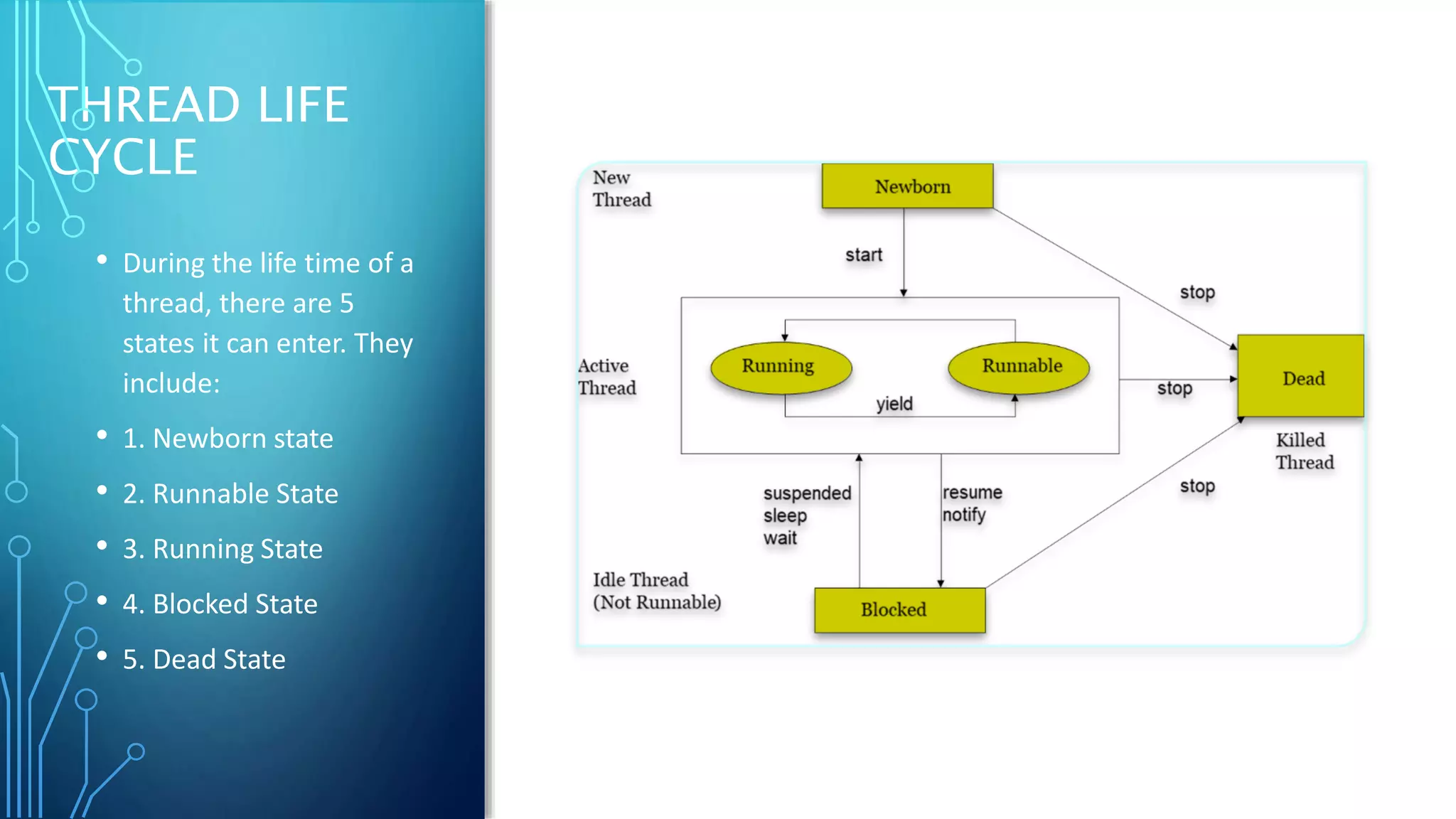
THREAD LIFE
CYCLE
• During the life time of a
thread, there are 5
states it can enter. They
include:
• 1. Newborn state
• 2. Runnable State
• 3. Running State
• 4. Blocked State
• 5. Dead State
1. Newborn State
When we create a thread object, the thread is born and is said
to be in newborn state. The thread is not yet scheduled for
running. At this state, we can do only one of the following with
it: Schedule it for running using start() method. Kill it using
stop() method If scheduled, it moves to the runnable state. If
we attempt to use any other method at this stage, an exception
will be thrown.
2. Runnable state (start())
The runnable state means that the thread is ready for execution and is waiting for the availability of
the processor.
That is, the thread has joined the queue of threads that are waiting for execution.
If all threads have equal priority, then they are given time slots for execution in round robin
fashion. i.e. first-come, first-serve manner.
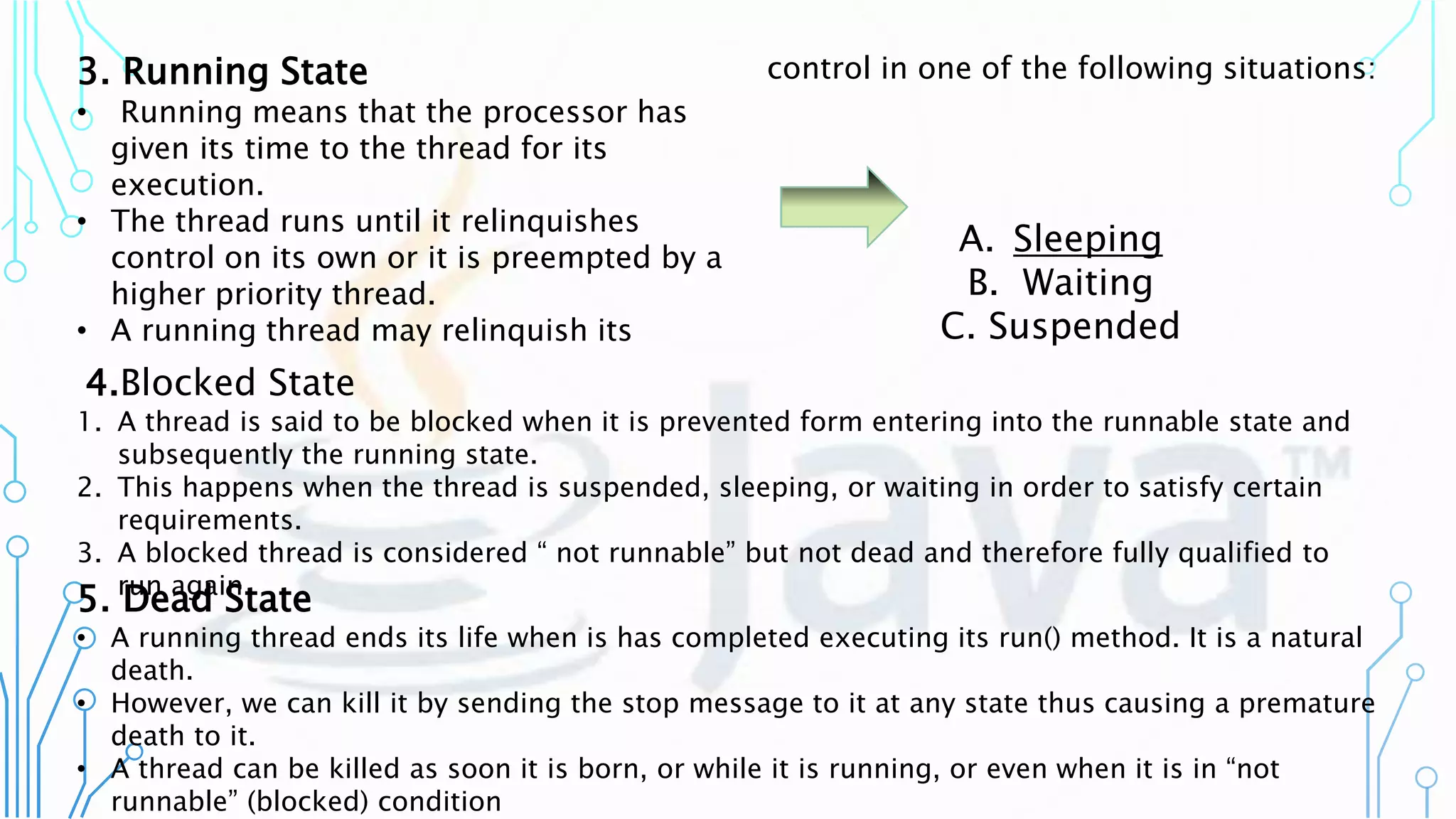
3. Running State
• Running means that the processor has
given its time to the thread for its
execution.
• The thread runs until it relinquishes
control on its own or it is preempted by a
higher priority thread.
• A running thread may relinquish its
control in one of the following situations:
A. Sleeping
B. Waiting
C. Suspended
4.Blocked State
1. A thread is said to be blocked when it is prevented form entering into the runnable state and
subsequently the running state.
2. This happens when the thread is suspended, sleeping, or waiting in order to satisfy certain
requirements.
3. A blocked thread is considered “ not runnable” but not dead and therefore fully qualified to
run again.
5. Dead State
• A running thread ends its life when is has completed executing its run() method. It is a natural
death.
• However, we can kill it by sending the stop message to it at any state thus causing a premature
death to it.
• A thread can be killed as soon it is born, or while it is running, or even when it is in “not
runnable” (blocked) condition
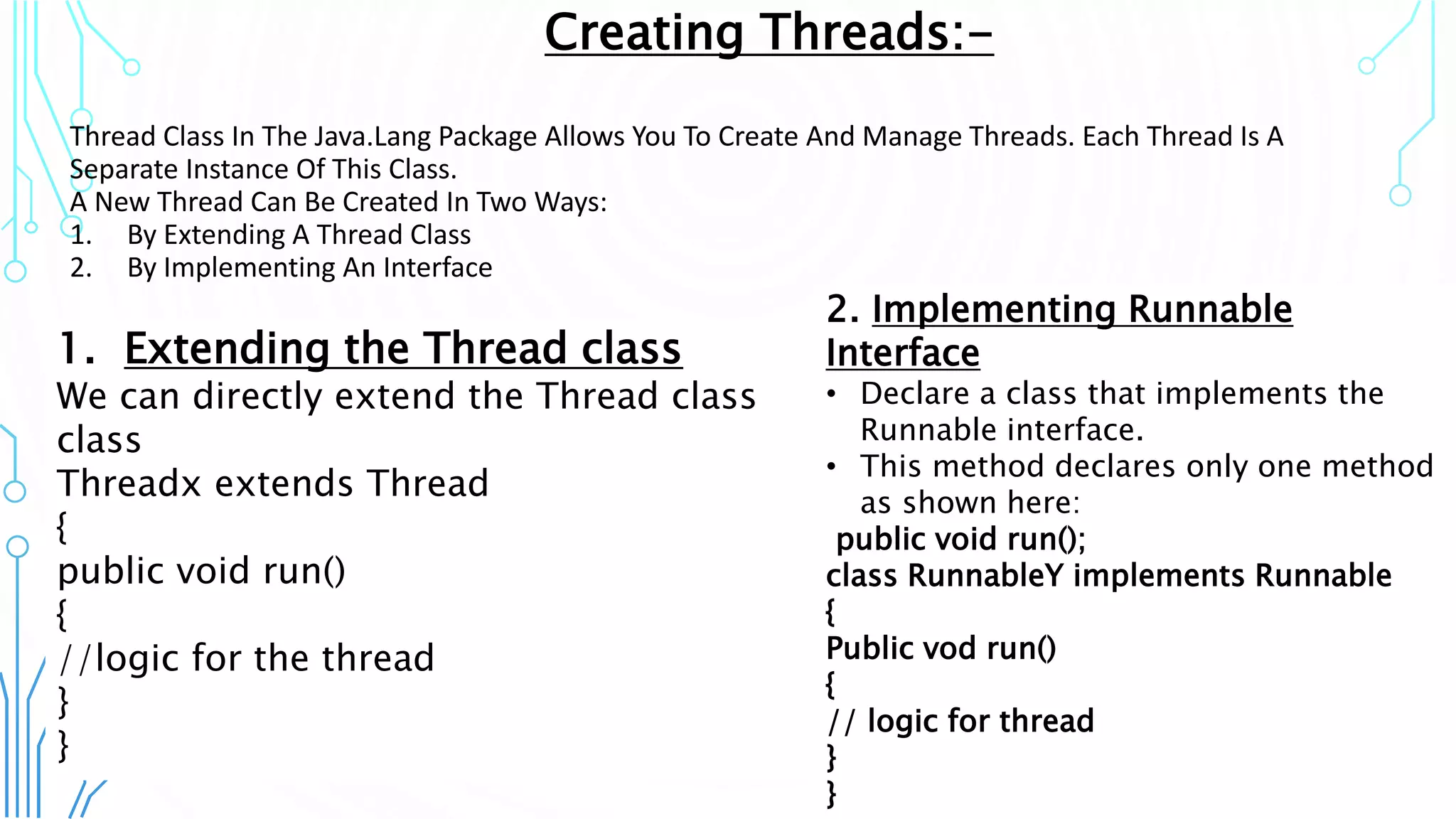
Thread Class In The Java.Lang Package Allows You To Create And Manage Threads. Each Thread Is A
Separate Instance Of This Class.
A New Thread Can Be Created In Two Ways:
1. By Extending A Thread Class
2. By Implementing An Interface
Creating Threads:-
1. Extending the Thread class
We can directly extend the Thread class
class
Threadx extends Thread
{
public void run()
{
//logic for the thread
}
}
2. Implementing Runnable
Interface
• Declare a class that implements the
Runnable interface.
• This method declares only one method
as shown here:
public void run();
class RunnableY implements Runnable
{
Public vod run()
{
// logic for thread
}
}
Thread Priority
1.In java, each thread is assigned a priority, which affects
the order in which it is scheduled for running.
2.Java permits us to set the priority of a thread using the
setPriority() method as follows:
ThreadName.setPriority(intNumber);
A.The intNumber may assume one of these constants or
any value between 1 and 10.
B.The intNumber is an integer value to which the thread’s
priority is set. The Thread class defines several priority
constants:
C.MIN_PRIORITY=1
D.NORM_PRIORITY=5
E.MAX_PRIORITY=10
F.The default setting is NORM_PRIORITY.
Polling is usually implemented by a loop that is used to check
some condition repeatedly. Once the condition is true,
appropriate action is taken. This wastes CPU time.
 For example, consider the classic queuing problem, where one
thread is producing some data and another is consuming it.
 In a polling system, the consumer would waste many CPU
cycles while it waited for the producer to produce. Once the
producer was finished, it would start polling, wasting more
CPU cycles waiting for the consumer to finish, and so on.
Clearly, this situation is undesirable.
 To avoid polling, Java includes an elegant interprocess
communication mechanism via the wait( ), notify( ), and
notifyAll( ) methods. These methods are implemented as final
methods in Object, so all classes have them.
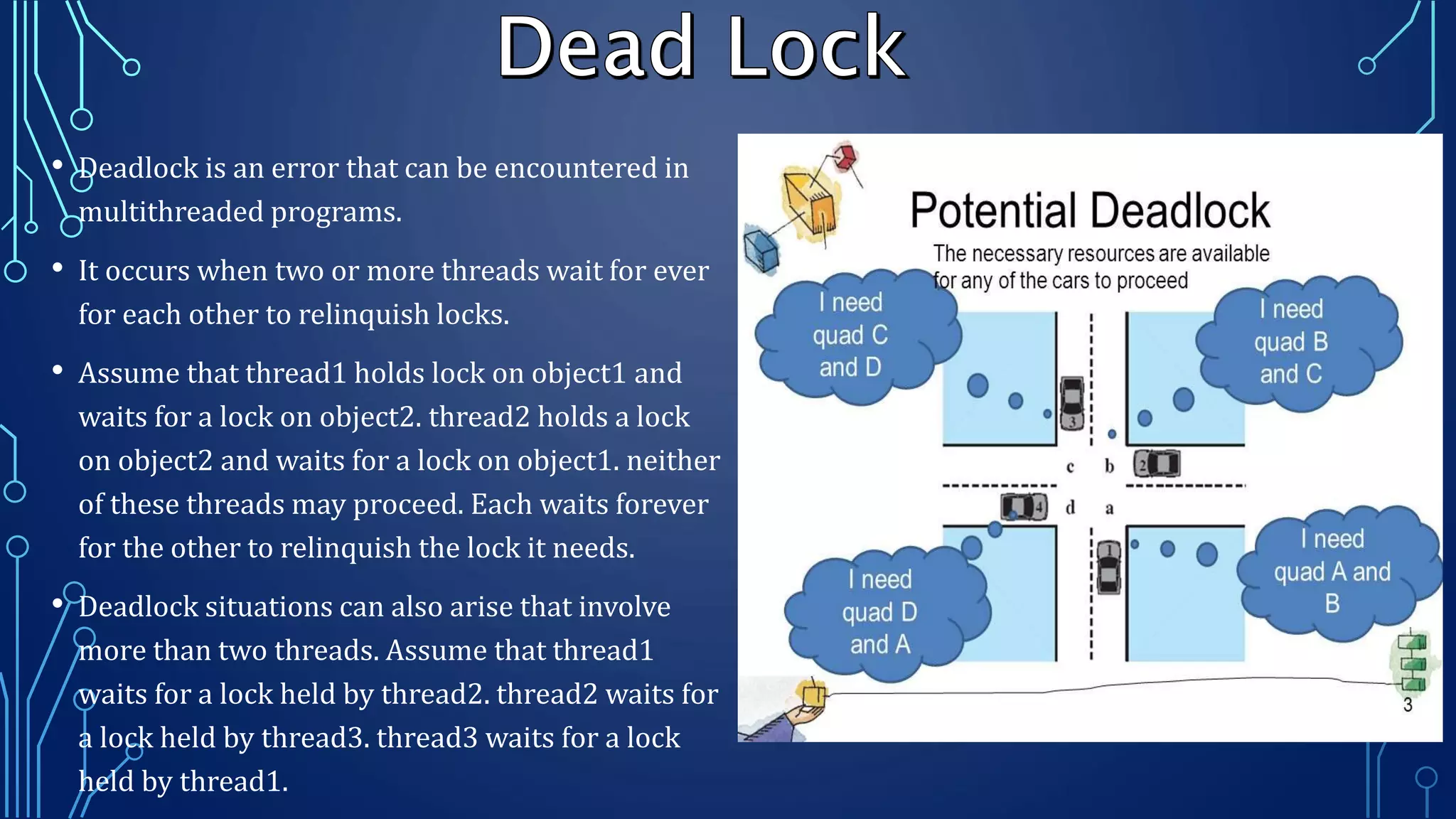
• Deadlock is an error that can be encountered in
multithreaded programs.
• It occurs when two or more threads wait for ever
for each other to relinquish locks.
• Assume that thread1 holds lock on object1 and
waits for a lock on object2. thread2 holds a lock
on object2 and waits for a lock on object1. neither
of these threads may proceed. Each waits forever
for the other to relinquish the lock it needs.
• Deadlock situations can also arise that involve
more than two threads. Assume that thread1
waits for a lock held by thread2. thread2 waits for
a lock held by thread3. thread3 waits for a lock
held by thread1.
Multi threading

Multi threading

  • 1.
    WELCOME TO MY PRESENTATION TOPICON MULTITHREADING SUBMITTED TO:- Prof:- Navneet SUBMITTED By:- Abhishek Sharma BCA 5th Sem Govt. College,
  • 2.
    Introduction Benefits From Multithreading LifeCycle a Thread Creating Thread Thread Priority Thread Communication Dead lock Content of multithreading
  • 3.
    WHAT IS MULTITHREADING ? •Multithreading is a conceptual programming paradigm where a program (process) is divided into two or more subprograms (process), which can be implemented at the same time in parallel. • For example, one subprogram can display an animation on the screen while another may build the next animation to be displayed. • A program that contains multiple flow of control is known as multithreaded program. • ‘threads running in parallel’ does not really mean that they actually run at the same time. • Multithreading enables programmers to do multiple things at
  • 4.
    Improving Application Responsiveness Anyprogram in which many activities are not dependent upon each other can be redesigned so that each activity is defined as a thread. For example, the user of a multithreaded GUI does not have to wait for one activity to complete before starting another. Using Multiprocessors Efficiently Typically, applications that express concurrency requirements with threads need not take into account the number of available processors. The performance of the application improves transparently with additional processors. Numerical algorithms and applications with a high degree of parallelism, such as matrix multiplications, can run much faster when implemented with threads on a multiprocessor. Improving Program Structure Many programs are more efficiently structured as multiple independent or semi- independent units of execution instead of as a single, monolithic thread. Multithreaded programs can be more adaptive to variations in user demands than single-threaded programs.
  • 5.
    Using Fewer SystemResources Programs that use two or more processes that access common data through shared memory are applying more than one thread of control. However, each process has a full address space and operating environment state. The cost of creating and maintaining this large amount of state information makes each process much more expensive than a thread in both time and space. In addition, the inherent separation between processes can require a major effort by the programmer to communicate between the threads in different processes, or to synchronize their actions. Combining Threads and RPC By combining threads and a remote procedure call (RPC) package, you can exploit nonshared- memory multiprocessors (such as a collection of workstations). This combination distributes your application relatively easily and treats the collection of workstations as a multiprocessor. For example, one thread might create child threads. Each of these children could then place a remote procedure call, invoking a procedure on another workstation. Although the original thread has merely created threads that are now running in parallel, this parallelism involves other computers.
  • 7.
    THREAD LIFE CYCLE • Duringthe life time of a thread, there are 5 states it can enter. They include: • 1. Newborn state • 2. Runnable State • 3. Running State • 4. Blocked State • 5. Dead State
  • 8.
    1. Newborn State Whenwe create a thread object, the thread is born and is said to be in newborn state. The thread is not yet scheduled for running. At this state, we can do only one of the following with it: Schedule it for running using start() method. Kill it using stop() method If scheduled, it moves to the runnable state. If we attempt to use any other method at this stage, an exception will be thrown. 2. Runnable state (start()) The runnable state means that the thread is ready for execution and is waiting for the availability of the processor. That is, the thread has joined the queue of threads that are waiting for execution. If all threads have equal priority, then they are given time slots for execution in round robin fashion. i.e. first-come, first-serve manner.
  • 9.
    3. Running State •Running means that the processor has given its time to the thread for its execution. • The thread runs until it relinquishes control on its own or it is preempted by a higher priority thread. • A running thread may relinquish its control in one of the following situations: A. Sleeping B. Waiting C. Suspended 4.Blocked State 1. A thread is said to be blocked when it is prevented form entering into the runnable state and subsequently the running state. 2. This happens when the thread is suspended, sleeping, or waiting in order to satisfy certain requirements. 3. A blocked thread is considered “ not runnable” but not dead and therefore fully qualified to run again. 5. Dead State • A running thread ends its life when is has completed executing its run() method. It is a natural death. • However, we can kill it by sending the stop message to it at any state thus causing a premature death to it. • A thread can be killed as soon it is born, or while it is running, or even when it is in “not runnable” (blocked) condition
  • 10.
    Thread Class InThe Java.Lang Package Allows You To Create And Manage Threads. Each Thread Is A Separate Instance Of This Class. A New Thread Can Be Created In Two Ways: 1. By Extending A Thread Class 2. By Implementing An Interface Creating Threads:- 1. Extending the Thread class We can directly extend the Thread class class Threadx extends Thread { public void run() { //logic for the thread } } 2. Implementing Runnable Interface • Declare a class that implements the Runnable interface. • This method declares only one method as shown here: public void run(); class RunnableY implements Runnable { Public vod run() { // logic for thread } }
  • 11.
    Thread Priority 1.In java,each thread is assigned a priority, which affects the order in which it is scheduled for running. 2.Java permits us to set the priority of a thread using the setPriority() method as follows: ThreadName.setPriority(intNumber); A.The intNumber may assume one of these constants or any value between 1 and 10. B.The intNumber is an integer value to which the thread’s priority is set. The Thread class defines several priority constants: C.MIN_PRIORITY=1 D.NORM_PRIORITY=5 E.MAX_PRIORITY=10 F.The default setting is NORM_PRIORITY.
  • 12.
    Polling is usuallyimplemented by a loop that is used to check some condition repeatedly. Once the condition is true, appropriate action is taken. This wastes CPU time.  For example, consider the classic queuing problem, where one thread is producing some data and another is consuming it.  In a polling system, the consumer would waste many CPU cycles while it waited for the producer to produce. Once the producer was finished, it would start polling, wasting more CPU cycles waiting for the consumer to finish, and so on. Clearly, this situation is undesirable.  To avoid polling, Java includes an elegant interprocess communication mechanism via the wait( ), notify( ), and notifyAll( ) methods. These methods are implemented as final methods in Object, so all classes have them.
  • 13.
    • Deadlock isan error that can be encountered in multithreaded programs. • It occurs when two or more threads wait for ever for each other to relinquish locks. • Assume that thread1 holds lock on object1 and waits for a lock on object2. thread2 holds a lock on object2 and waits for a lock on object1. neither of these threads may proceed. Each waits forever for the other to relinquish the lock it needs. • Deadlock situations can also arise that involve more than two threads. Assume that thread1 waits for a lock held by thread2. thread2 waits for a lock held by thread3. thread3 waits for a lock held by thread1.