Idea Expression Dichotomy
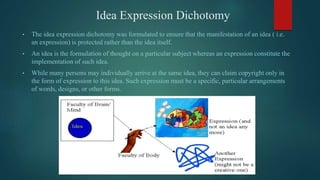
• The idea expression dichotomy was formulated to ensure that the manifestation of an idea ( i.e.
an expression) is protected rather than the idea itself.
• An idea is the formulation of thought on a particular subject whereas an expression constitute the
implementation of such idea.
• While many persons may individually arrive at the same idea, they can claim copyright only in
the form of expression to this idea. Such expression must be a specific, particular arrangements
of words, designs, or other forms.
 On the international level, the idea and expression dichotomy has been mentioned under Art 9(2)
of the TRIPS convention which provides that: ‘Copyright protection shall extend to expression
and not to ideas, procedures, and methods of operation or mathematical concepts as such
 On the domestic level, there is no shortage of authorities to show that the idea and expression
dichotomy is an ‘axiom of copyright law'. This concept can be summed up in Lindley LJ's
statement that: “Copyright does not extend to ideas, or schemes, or systems, or methods; it is
confined to their expression; and if their expression is not copied, the copyright is not infringed.”
 Idea is conception of a thought or a theory or a mental image. The expression of the idea has to
be original. The idea may be however original or creative but until unless expressed in any form
and reduced to writing is not protected.
History
 The idea-expression dichotomy in America is said to have originated in the United States
Supreme Court case of Baker v. Selden, 101 U.S. 99 (1879).
In this particular case, the plaintiff had a copyright over a book which represented a method
of double entry book keeping with a peculiar arrangement of headings and columns. The
defendant used the similar plan of the book keeping but with a different arrangement of the
columns and headings and publishes it. The US Supreme Court ruled in favour of
defendant stating that the description of the art in the book (expression in this case) lays no
foundation for a claim on the art of book keeping (idea). Also the purpose of publishing a
book is to communicate the ideas of the author which can be useful to others. And if that
knowledge cannot be used then it would frustrate the whole motive behind publishing a
book.
Law in United Kingdom
Before 1911
 The law with regard to idea
expression dichotomy is identical to
the United States of America law but
it has been diversified later.
 the courts were of the opinion that an
idea cannot be protected under law
and it is the expression of the idea
that can be protected. Therefore,
developing and expressing on the
same idea does not amount to
copyright infringement.
After 1911
 The court still held on to the law that
ideas, thoughts and plans existing
mentally in an individual is not a
“work” under the Copyright Act. But
their expression is protected under the
law.
 A second proviso being that a general
idea is not eligible for protection. A
detailed or an elaborate proposition or
a collection of ideas, pattern of
incidents or a compilation of
information is subject to Copyright
protection.
 The principle has been well explained in the case of Ibcos Computers Ltd v Barclays
Finance Ltd. [1994] FSR 275, The Court had said an original work embodying a
sufficiently general principle, then the mere taking of that idea would not infringe the
copyright.
 The UK law has taken the stand as in the above said case that a general principle
cannot be protected but it can protect a detailed literary or artistic expression.
 The rationale behind this that the Courts might have adopted must be that a general
principle is available at the common parlance and open to all, thereby, cannot be
protected.
 Anyone can utilize the resources available in the public domain but if somebody
utilizes it adds on to it through a detailed expression, then it is subject to copyright
protection.
The Law in India
 The idea expression dichotomy in the Indian law has not been specifically stated but has
developed through the case laws.
 In the case of R.G. Anand v. Deluxe Films, AIR 1978 SC 1613, the Supreme Court had held that
there can be no copyright in an idea, subject matter, themes, plots or historical or legendary facts
and violation of the copyright in such cases is confined to the form, manner and arrangement
and expression of the idea by the author of the copyright work.
 This law has been accepted by almost every country through their national legislations. But the
Court must take into consideration the protection of those ideas which are not expressed where an
individual has put in a large substantial amount of time, skill and effort, like the Delhi High Court
had held in the case of Anil Gupta v Kunal Dasgupta, IA 8883/2001 in Suit no 1970 of 2001.
The courts have to be very cautious while distinguishing between the copy of an idea or a plot and an
expression of the author. The courts have to be also careful while deciding the distinguishing point between
an idea and from where its expression starts. There are no answers to these and no answers can also be set
for the above. No exhaustive list can be set for these questions. Therefore, it is upon the courts to decide and
provide protection.
 But the law allows authors or creators to develop on the same idea or plot. The reason being
if the authors or creators are restricted to develop on the same idea or plot then there will be
no creativity. Before starting anything new they will be more worried if they are not violating
any other person’s work.
 The basic reasons behind this are two reason:
i. First, the author or the creator of the work shall be allowed to enjoy his own work
economically and morally.
ii. Secondly, the protection shall not be such that it hinders further creation.
Requirements for Copyright Protection
 Fixation: The ideas must be fixed in some tangible medium of expression.
 Originality: A fixed expression of ideas is protected by copyright if and only if it is original.
Neither quality nor uniqueness are required. Even bad work is subject to copyright protection.
Works that are similar, but independently created, are individually subject to copyright
protection.
 Minimal Creativity: Hard work is not enough to gain copyright protection. At
least minimal creativity is also required.
Examples:
A list of parts for a child's toy is probably not subject to copyright.
A web-site that provides the means for searching a white pages database may be subject
to copyright.
Originality
INTRODUCTION
• Originality is the aspect of a created or invented work that makes it new or novel, and thereby
distinguishes it from reproductions, clones, forgeries, or derivative works.
• “Original” means a work created through the “fruits of intellectual labor.”
• “Originality” therefore requires not only that the author has not copied the work from another, but
also that there is “at least some minimal degree of creativity.”
• The way in which an author chooses to arrange the known forms of expression (words, musical
notes, objects, etc.) is unique for each author and that uniqueness is what we call originality.
• Originality is a constitutional requirement for copyright applicability even though it was first
stated explicitly by statute only with the introduction of the 1976 Copyright Act.
Feist Publications, Inc. v. Rural Telephone Service
 Rural Telephone Service Company, Inc. is a telephone cooperative providing services for areas in
northwest Kansas, with headquarters in the small town of Lenora, in Norton County.
 The company was under a statutory obligation to compile a phone directory of all their customers free
of charge as a condition of their monopoly franchise.
 Feist Publications, Inc. specialized in compiling telephone directories from larger geographic areas
than Rural from other areas of Kansas. They had licensed the directory of 11 other local directories,
with Rural being the only hold-out in the region.
 Despite Rural's denial of a license to Feist, Feist copied some 4000 entries from Rural's directory.
Because Rural had placed a small number of phony entries to detect copying, Feist was caught.
 The U.S. Supreme Court explained that the requirement of originality is not particularly
stringent and is comprised of two elements: that the work be independently created by
the author (as opposed to copied from other works) and that it possesses at least some
minimal degree of creativity. A work satisfies the “independent creation” element so
long as it was not literally copied from another, even if it is fortuitously identical to an
existing work. The “creativity” element sets an extremely low bar that is cleared quite
easily. It requires only that a work possess some creative spark, no matter how crude,
humble, or obvious it might be.
 The Supreme Court for the first time squarely addressed the issue of the degree of
creativity necessary to sustain a copyright in a compilation of factual material. On the
immediate issue before it, the Court held that a directory containing an alphabetical list
of telephone subscribers, together with their towns and telephone numbers failed to
satisfy the constitutional standard of originality necessary for copyright protection. In
doing so, the Court engaged in a fundamental reexamination and reformulation of the
concept of originality applicable to all works of authorship, not merely those consisting
of compilations of factual material. Feist provides a new basic starting point that
promises to have a broad impact on not only the concept of originality, but on the
underlying jurisprudence of copyright.
Originality: Tests
 Quality of a work Irrelevent
Bleistein v. Donaldson Lithographing Company, 188 U.S. 239 (1903), is a case in which
the United States Supreme Court found that advertisements were protected by copyright.
The case is now cited for the proposition that commercial speech can be protected by
copyright.
The named plaintiff was George Bleistein, an employee of the Courier Lithographing Company. The
company had been hired by Benjamin Wallace, owner of a traveling circus called the "Great Wallace
Show" (which would later become the Hagenbeck-Wallace Circus) to design and produce a number
of chromolithographs used to produce posters to promote the circus. The posters featured images from
the circus, such as ballet dancers and acrobats. When Wallace ran out of posters, rather than ordering
more from the plaintiff, Wallace hired the Donaldson Lithographing Company - a competitor of the
plaintiff - to manufacture copies of three of those posters. Courier (and Bleistein, in name) sued
Donaldson for copyright infringement
Justice Oliver Wendell Holmes, Jr., held
that the copy is the personal reaction of an
individual upon nature. Personality always
contains something unique. It express its
singularity even in handwriting, and a very
modest grade of art has in it something
irreducible which is one man’s alone. That’s
something he may copyright unless there is
a restriction in the words of the act.
Derivative Works: The Bigger issue
Walter v Lane [1900] AC 539
Reporters from The Times newspaper took down shorthand notes of a
series of speeches given by the Earl of Roseberry, a prominent
politician, and later transcribed them, adding punctuation, corrections
and revisions to reproduce verbatim the speeches. These were then
published in The Times.
The respondent in the case published a book including these speeches,
taken substantially from the reports of those speeches in The Times. The
question for the court was whether the reporters of the speech could be
considered "authors" under the terms of the Copyright Act.
The House of Lords, by a 4-1 majority, held that the reporters were
authors under the Copyright Act 1842. The effort, skill and time that
spent was sufficient to make them original.
Eastern Book Company and Ors. v. D.B. Modak and Anr. (2008) 1 SCC 1
Appellants were involved in the printing and publishing of various books relating to the field of law.
One of the well-known publications was the law report “Supreme Court Cases”. The original
Judgments were copy-edited by a team of assistant staff of the Appellant and various inputs were put
in the judgments and orders to make them user friendly by making an addition of cross-references,
standardization or formatting of the text, paragraph numbering, verification and by putting other
inputs. The Appellants also prepared the headnotes comprising of two portions, the short note
consisting of catch/lead words written in bold; and the long note, which is comprised of a brief
discussion of the facts and the relevant extracts from the judgments and orders of the Court.
Respondent No. 1 Spectrum Business Support Ltd., had launched a software called “Grand Jurix”
published on CD-ROMs and the Respondent No. 2 Regent Data Tech Pvt. Ltd., had brought out a
software package called “The Laws” published on CD-ROMS.
As per the Appellants, all the modules in the Respondents’ software packages have been lifted
verbatim from the Appellants’ work; the Respondents have copied the Appellants’ sequencing,
selection and arrangement of the cases coupled with the entire text of copy-edited judgments as
published in the Appellants’ law report SCC, along with and including the style and formatting, the
copy-editing paragraph numbers, footnote numbers, cross-references, etc.; and such acts of the
Respondents constitute infringement of the Appellants’ exclusive right to the same.
• Section 52(1)(iv)(q) excludes the reproduction or publication of any judgment or
order of a court, Tribunal or other judicial authority from copying unless the
court, tribunal or any other judicial authority makes it copyrightable.
• The copyright act is not concerned with the originality or literary merit.
• A copyrightable derivative work should be original in the sense that by virtue of
selection, coordination or arrangements of pre-existing data contained in the
original work, the new derivative work is somewhat different in character.
• To secure a copyright in the judgments delivered by the court, it is not sufficient
to show that the author has produced the material with merely labor and capital.
• Derivative work produced by the author must have some distinguishable
features and add flavors to raw text of the judgments delivered by the courts.
Copyright
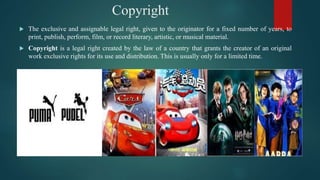
 The exclusive and assignable legal right, given to the originator for a fixed number of years, to
print, publish, perform, film, or record literary, artistic, or musical material.
 Copyright is a legal right created by the law of a country that grants the creator of an original
work exclusive rights for its use and distribution. This is usually only for a limited time.
Kinds of work
Copyright in Cinematographic Work
 A Cinematograph film can be defined as any work of visual recording on any medium produced
through a process from which a moving image may be produced by any means and includes a
sound recording accompanying such visual recording and 'cinematograph' shall be constructed as
including any work produced by any process analogous to cinematograph including video films.
 The author of cinematograph film is the producer, as par section 2(d)(v) of the copyright Act.
Video films are deemed to be work produced by a process analogous to cinematography.
 Section 13 of Copyright Act, 1957 says that cinematographic work are subject matter of copyright
infringement.
Block vs Yashraj Films Pvt Ltd, 2014
 The Plaintiff is the author of the film script “ONCE”. It is claimed that the recently released film
“DHOOM 3” infringes the Plaintiff’s copyright in the aforesaid script. The Plaintiff sought an
order asking for credit in the titles of the film and interim injunction against release via satellite
broadcast. The film was already released in December 2013. It was also released in various other
media and forums for which the Plaintiff did not obtain any injunction. According to the Plaintiff,
the script was handed over to the Defendant in early 2010 for their perusal which was later used
by the Defendant for “DHOOM 3” without the consent of the Plaintiff.
 The judgment re-affirmed the principles laid out in R.G. Anand. Further, there can be no
copyright in elements that constitute scene a faire genre. It is a French word which means “scene
to be made” or “scene that must be done” connoting a scene in a book or film customary to the
genre. For example, a robbery followed by a chase will fall under scene a faire.
 The Plaintiff lost out on all the vital issues: a) couldn’t prove that the Defendant had access to his
work; b) failed on intrinsic test; and c) couldn’t prove that there was substantial and material
overlapping or commonality of the original elements in the plaintiff’s work.
S. VICTOR WHITMILL v. WARNER BROS. ENTERTAINMENT
INC
 Tattoo artist S. Victor Whitmill sued Warner Bros. for a copyright infringement in the film The
Hangover Part II. In the film, Stu (Ed Helms) wakes up after a night of debauchery in a Bangkok
hotel with a replica of Mike Tyson’s tribal face tattoo. The plaintiff designed the tattoo
specifically for Mike Tyson and therefore claimed it was a copyrighted work. Whitmill claimed
that Warner Bros. had no right to put his work in the film or in any promotional materials attached
to The Hangover Part II.
 Ultimately, Warner Bros. settled Whitmill’s claim for an undisclosed amount,
and The Hangover Part II went on to gross $581.4 million worldwide.
 Therefore, the exact reproduction of the Original Tattoo constitutes a copyright
infringement by the defendant's wrongful acts.
Jabardast case
 Yash Raj Films sued the producers of the Telugu movie “Jabardast” on grounds of copyright
violation.
 YRF successfully gained an interim order in their favor from the Delhi High Court after
convincing them that “Jabardast”, the Telugu movie was nothing more than a blatant copy of the
popular movie “Band Baaja Baaraat”.
 While the makers of “Jabardast” planned to release a Tamil version of the movie, YRF also
successfully restrained them from such a release claiming that they were due to release their own
Tamil version of the popular romantic comedy. While the fate of the case is yet to be sealed, YRF
rides high on its victory of the first battle.
RG Anand v. Delux Films, (AIR 1978 SC 1613)
 The plaintiff wrote the play Ham Hindustani and it soon became very popular. In 1954, the
defendant Mohan Sehgal sent a letter to the plaintiff that he wishes to make a movie based on the
play. The plaintiff met the defendant and discussed the entire play. The defendant did not commit
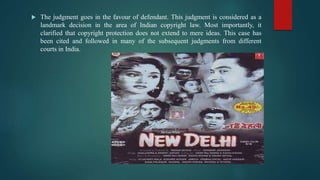
anything, but the plaintiff later came to know that the defendant released a movie titled New
Delhi. After watching the movie, the plaintiff was of the opinion that it is based on the story of his
play. So he filed a suit against the defendant for permanent injunction and damages.
 ISSUES
Is the film New Delhi an infringement of the plaintiff's copyright in the play Hum Hindustani?
Have defendants or any of them infringed the plaintiff's copyright by producing, or distributing or
exhibiting the film New Delhi?
 The judgment goes in the favour of defendant. This judgment is considered as a
landmark decision in the area of Indian copyright law. Most importantly, it
clarified that copyright protection does not extend to mere ideas. This case has
been cited and followed in many of the subsequent judgments from different
courts in India.

Copyright_Idea expression.pptx

  • 1.
    Idea Expression Dichotomy •The idea expression dichotomy was formulated to ensure that the manifestation of an idea ( i.e. an expression) is protected rather than the idea itself. • An idea is the formulation of thought on a particular subject whereas an expression constitute the implementation of such idea. • While many persons may individually arrive at the same idea, they can claim copyright only in the form of expression to this idea. Such expression must be a specific, particular arrangements of words, designs, or other forms.
  • 2.
     On theinternational level, the idea and expression dichotomy has been mentioned under Art 9(2) of the TRIPS convention which provides that: ‘Copyright protection shall extend to expression and not to ideas, procedures, and methods of operation or mathematical concepts as such  On the domestic level, there is no shortage of authorities to show that the idea and expression dichotomy is an ‘axiom of copyright law'. This concept can be summed up in Lindley LJ's statement that: “Copyright does not extend to ideas, or schemes, or systems, or methods; it is confined to their expression; and if their expression is not copied, the copyright is not infringed.”  Idea is conception of a thought or a theory or a mental image. The expression of the idea has to be original. The idea may be however original or creative but until unless expressed in any form and reduced to writing is not protected.
  • 3.
    History  The idea-expressiondichotomy in America is said to have originated in the United States Supreme Court case of Baker v. Selden, 101 U.S. 99 (1879). In this particular case, the plaintiff had a copyright over a book which represented a method of double entry book keeping with a peculiar arrangement of headings and columns. The defendant used the similar plan of the book keeping but with a different arrangement of the columns and headings and publishes it. The US Supreme Court ruled in favour of defendant stating that the description of the art in the book (expression in this case) lays no foundation for a claim on the art of book keeping (idea). Also the purpose of publishing a book is to communicate the ideas of the author which can be useful to others. And if that knowledge cannot be used then it would frustrate the whole motive behind publishing a book.
  • 4.
    Law in UnitedKingdom Before 1911  The law with regard to idea expression dichotomy is identical to the United States of America law but it has been diversified later.  the courts were of the opinion that an idea cannot be protected under law and it is the expression of the idea that can be protected. Therefore, developing and expressing on the same idea does not amount to copyright infringement. After 1911  The court still held on to the law that ideas, thoughts and plans existing mentally in an individual is not a “work” under the Copyright Act. But their expression is protected under the law.  A second proviso being that a general idea is not eligible for protection. A detailed or an elaborate proposition or a collection of ideas, pattern of incidents or a compilation of information is subject to Copyright protection.
  • 5.
     The principlehas been well explained in the case of Ibcos Computers Ltd v Barclays Finance Ltd. [1994] FSR 275, The Court had said an original work embodying a sufficiently general principle, then the mere taking of that idea would not infringe the copyright.  The UK law has taken the stand as in the above said case that a general principle cannot be protected but it can protect a detailed literary or artistic expression.  The rationale behind this that the Courts might have adopted must be that a general principle is available at the common parlance and open to all, thereby, cannot be protected.  Anyone can utilize the resources available in the public domain but if somebody utilizes it adds on to it through a detailed expression, then it is subject to copyright protection.
  • 6.
    The Law inIndia  The idea expression dichotomy in the Indian law has not been specifically stated but has developed through the case laws.  In the case of R.G. Anand v. Deluxe Films, AIR 1978 SC 1613, the Supreme Court had held that there can be no copyright in an idea, subject matter, themes, plots or historical or legendary facts and violation of the copyright in such cases is confined to the form, manner and arrangement and expression of the idea by the author of the copyright work.
  • 7.
     This lawhas been accepted by almost every country through their national legislations. But the Court must take into consideration the protection of those ideas which are not expressed where an individual has put in a large substantial amount of time, skill and effort, like the Delhi High Court had held in the case of Anil Gupta v Kunal Dasgupta, IA 8883/2001 in Suit no 1970 of 2001. The courts have to be very cautious while distinguishing between the copy of an idea or a plot and an expression of the author. The courts have to be also careful while deciding the distinguishing point between an idea and from where its expression starts. There are no answers to these and no answers can also be set for the above. No exhaustive list can be set for these questions. Therefore, it is upon the courts to decide and provide protection.
  • 8.
     But thelaw allows authors or creators to develop on the same idea or plot. The reason being if the authors or creators are restricted to develop on the same idea or plot then there will be no creativity. Before starting anything new they will be more worried if they are not violating any other person’s work.  The basic reasons behind this are two reason: i. First, the author or the creator of the work shall be allowed to enjoy his own work economically and morally. ii. Secondly, the protection shall not be such that it hinders further creation.
  • 9.
    Requirements for CopyrightProtection  Fixation: The ideas must be fixed in some tangible medium of expression.  Originality: A fixed expression of ideas is protected by copyright if and only if it is original. Neither quality nor uniqueness are required. Even bad work is subject to copyright protection. Works that are similar, but independently created, are individually subject to copyright protection.  Minimal Creativity: Hard work is not enough to gain copyright protection. At least minimal creativity is also required. Examples: A list of parts for a child's toy is probably not subject to copyright. A web-site that provides the means for searching a white pages database may be subject to copyright.
  • 10.
    Originality INTRODUCTION • Originality isthe aspect of a created or invented work that makes it new or novel, and thereby distinguishes it from reproductions, clones, forgeries, or derivative works. • “Original” means a work created through the “fruits of intellectual labor.” • “Originality” therefore requires not only that the author has not copied the work from another, but also that there is “at least some minimal degree of creativity.” • The way in which an author chooses to arrange the known forms of expression (words, musical notes, objects, etc.) is unique for each author and that uniqueness is what we call originality. • Originality is a constitutional requirement for copyright applicability even though it was first stated explicitly by statute only with the introduction of the 1976 Copyright Act.
  • 11.
    Feist Publications, Inc.v. Rural Telephone Service  Rural Telephone Service Company, Inc. is a telephone cooperative providing services for areas in northwest Kansas, with headquarters in the small town of Lenora, in Norton County.  The company was under a statutory obligation to compile a phone directory of all their customers free of charge as a condition of their monopoly franchise.  Feist Publications, Inc. specialized in compiling telephone directories from larger geographic areas than Rural from other areas of Kansas. They had licensed the directory of 11 other local directories, with Rural being the only hold-out in the region.  Despite Rural's denial of a license to Feist, Feist copied some 4000 entries from Rural's directory. Because Rural had placed a small number of phony entries to detect copying, Feist was caught.
  • 12.
     The U.S.Supreme Court explained that the requirement of originality is not particularly stringent and is comprised of two elements: that the work be independently created by the author (as opposed to copied from other works) and that it possesses at least some minimal degree of creativity. A work satisfies the “independent creation” element so long as it was not literally copied from another, even if it is fortuitously identical to an existing work. The “creativity” element sets an extremely low bar that is cleared quite easily. It requires only that a work possess some creative spark, no matter how crude, humble, or obvious it might be.  The Supreme Court for the first time squarely addressed the issue of the degree of creativity necessary to sustain a copyright in a compilation of factual material. On the immediate issue before it, the Court held that a directory containing an alphabetical list of telephone subscribers, together with their towns and telephone numbers failed to satisfy the constitutional standard of originality necessary for copyright protection. In doing so, the Court engaged in a fundamental reexamination and reformulation of the concept of originality applicable to all works of authorship, not merely those consisting of compilations of factual material. Feist provides a new basic starting point that promises to have a broad impact on not only the concept of originality, but on the underlying jurisprudence of copyright.
  • 13.
    Originality: Tests  Qualityof a work Irrelevent Bleistein v. Donaldson Lithographing Company, 188 U.S. 239 (1903), is a case in which the United States Supreme Court found that advertisements were protected by copyright. The case is now cited for the proposition that commercial speech can be protected by copyright. The named plaintiff was George Bleistein, an employee of the Courier Lithographing Company. The company had been hired by Benjamin Wallace, owner of a traveling circus called the "Great Wallace Show" (which would later become the Hagenbeck-Wallace Circus) to design and produce a number of chromolithographs used to produce posters to promote the circus. The posters featured images from the circus, such as ballet dancers and acrobats. When Wallace ran out of posters, rather than ordering more from the plaintiff, Wallace hired the Donaldson Lithographing Company - a competitor of the plaintiff - to manufacture copies of three of those posters. Courier (and Bleistein, in name) sued Donaldson for copyright infringement
  • 14.
    Justice Oliver WendellHolmes, Jr., held that the copy is the personal reaction of an individual upon nature. Personality always contains something unique. It express its singularity even in handwriting, and a very modest grade of art has in it something irreducible which is one man’s alone. That’s something he may copyright unless there is a restriction in the words of the act.
  • 15.
    Derivative Works: TheBigger issue Walter v Lane [1900] AC 539 Reporters from The Times newspaper took down shorthand notes of a series of speeches given by the Earl of Roseberry, a prominent politician, and later transcribed them, adding punctuation, corrections and revisions to reproduce verbatim the speeches. These were then published in The Times. The respondent in the case published a book including these speeches, taken substantially from the reports of those speeches in The Times. The question for the court was whether the reporters of the speech could be considered "authors" under the terms of the Copyright Act. The House of Lords, by a 4-1 majority, held that the reporters were authors under the Copyright Act 1842. The effort, skill and time that spent was sufficient to make them original.
  • 16.
    Eastern Book Companyand Ors. v. D.B. Modak and Anr. (2008) 1 SCC 1 Appellants were involved in the printing and publishing of various books relating to the field of law. One of the well-known publications was the law report “Supreme Court Cases”. The original Judgments were copy-edited by a team of assistant staff of the Appellant and various inputs were put in the judgments and orders to make them user friendly by making an addition of cross-references, standardization or formatting of the text, paragraph numbering, verification and by putting other inputs. The Appellants also prepared the headnotes comprising of two portions, the short note consisting of catch/lead words written in bold; and the long note, which is comprised of a brief discussion of the facts and the relevant extracts from the judgments and orders of the Court. Respondent No. 1 Spectrum Business Support Ltd., had launched a software called “Grand Jurix” published on CD-ROMs and the Respondent No. 2 Regent Data Tech Pvt. Ltd., had brought out a software package called “The Laws” published on CD-ROMS. As per the Appellants, all the modules in the Respondents’ software packages have been lifted verbatim from the Appellants’ work; the Respondents have copied the Appellants’ sequencing, selection and arrangement of the cases coupled with the entire text of copy-edited judgments as published in the Appellants’ law report SCC, along with and including the style and formatting, the copy-editing paragraph numbers, footnote numbers, cross-references, etc.; and such acts of the Respondents constitute infringement of the Appellants’ exclusive right to the same.
  • 17.
    • Section 52(1)(iv)(q)excludes the reproduction or publication of any judgment or order of a court, Tribunal or other judicial authority from copying unless the court, tribunal or any other judicial authority makes it copyrightable. • The copyright act is not concerned with the originality or literary merit. • A copyrightable derivative work should be original in the sense that by virtue of selection, coordination or arrangements of pre-existing data contained in the original work, the new derivative work is somewhat different in character. • To secure a copyright in the judgments delivered by the court, it is not sufficient to show that the author has produced the material with merely labor and capital. • Derivative work produced by the author must have some distinguishable features and add flavors to raw text of the judgments delivered by the courts.
  • 18.
    Copyright  The exclusiveand assignable legal right, given to the originator for a fixed number of years, to print, publish, perform, film, or record literary, artistic, or musical material.  Copyright is a legal right created by the law of a country that grants the creator of an original work exclusive rights for its use and distribution. This is usually only for a limited time.
  • 20.
  • 21.
    Copyright in CinematographicWork  A Cinematograph film can be defined as any work of visual recording on any medium produced through a process from which a moving image may be produced by any means and includes a sound recording accompanying such visual recording and 'cinematograph' shall be constructed as including any work produced by any process analogous to cinematograph including video films.  The author of cinematograph film is the producer, as par section 2(d)(v) of the copyright Act. Video films are deemed to be work produced by a process analogous to cinematography.  Section 13 of Copyright Act, 1957 says that cinematographic work are subject matter of copyright infringement.
  • 24.
    Block vs YashrajFilms Pvt Ltd, 2014  The Plaintiff is the author of the film script “ONCE”. It is claimed that the recently released film “DHOOM 3” infringes the Plaintiff’s copyright in the aforesaid script. The Plaintiff sought an order asking for credit in the titles of the film and interim injunction against release via satellite broadcast. The film was already released in December 2013. It was also released in various other media and forums for which the Plaintiff did not obtain any injunction. According to the Plaintiff, the script was handed over to the Defendant in early 2010 for their perusal which was later used by the Defendant for “DHOOM 3” without the consent of the Plaintiff.  The judgment re-affirmed the principles laid out in R.G. Anand. Further, there can be no copyright in elements that constitute scene a faire genre. It is a French word which means “scene to be made” or “scene that must be done” connoting a scene in a book or film customary to the genre. For example, a robbery followed by a chase will fall under scene a faire.  The Plaintiff lost out on all the vital issues: a) couldn’t prove that the Defendant had access to his work; b) failed on intrinsic test; and c) couldn’t prove that there was substantial and material overlapping or commonality of the original elements in the plaintiff’s work.
  • 26.
    S. VICTOR WHITMILLv. WARNER BROS. ENTERTAINMENT INC  Tattoo artist S. Victor Whitmill sued Warner Bros. for a copyright infringement in the film The Hangover Part II. In the film, Stu (Ed Helms) wakes up after a night of debauchery in a Bangkok hotel with a replica of Mike Tyson’s tribal face tattoo. The plaintiff designed the tattoo specifically for Mike Tyson and therefore claimed it was a copyrighted work. Whitmill claimed that Warner Bros. had no right to put his work in the film or in any promotional materials attached to The Hangover Part II.
  • 27.
     Ultimately, WarnerBros. settled Whitmill’s claim for an undisclosed amount, and The Hangover Part II went on to gross $581.4 million worldwide.  Therefore, the exact reproduction of the Original Tattoo constitutes a copyright infringement by the defendant's wrongful acts.
  • 29.
    Jabardast case  YashRaj Films sued the producers of the Telugu movie “Jabardast” on grounds of copyright violation.  YRF successfully gained an interim order in their favor from the Delhi High Court after convincing them that “Jabardast”, the Telugu movie was nothing more than a blatant copy of the popular movie “Band Baaja Baaraat”.  While the makers of “Jabardast” planned to release a Tamil version of the movie, YRF also successfully restrained them from such a release claiming that they were due to release their own Tamil version of the popular romantic comedy. While the fate of the case is yet to be sealed, YRF rides high on its victory of the first battle.
  • 31.
    RG Anand v.Delux Films, (AIR 1978 SC 1613)  The plaintiff wrote the play Ham Hindustani and it soon became very popular. In 1954, the defendant Mohan Sehgal sent a letter to the plaintiff that he wishes to make a movie based on the play. The plaintiff met the defendant and discussed the entire play. The defendant did not commit anything, but the plaintiff later came to know that the defendant released a movie titled New Delhi. After watching the movie, the plaintiff was of the opinion that it is based on the story of his play. So he filed a suit against the defendant for permanent injunction and damages.  ISSUES Is the film New Delhi an infringement of the plaintiff's copyright in the play Hum Hindustani? Have defendants or any of them infringed the plaintiff's copyright by producing, or distributing or exhibiting the film New Delhi?
  • 32.
     The judgmentgoes in the favour of defendant. This judgment is considered as a landmark decision in the area of Indian copyright law. Most importantly, it clarified that copyright protection does not extend to mere ideas. This case has been cited and followed in many of the subsequent judgments from different courts in India.