Copyright vs. Copy Sharing


      EDTC 603: Web Development
         Research Project 6.1
             Betty Hustead
            February 15, 2011
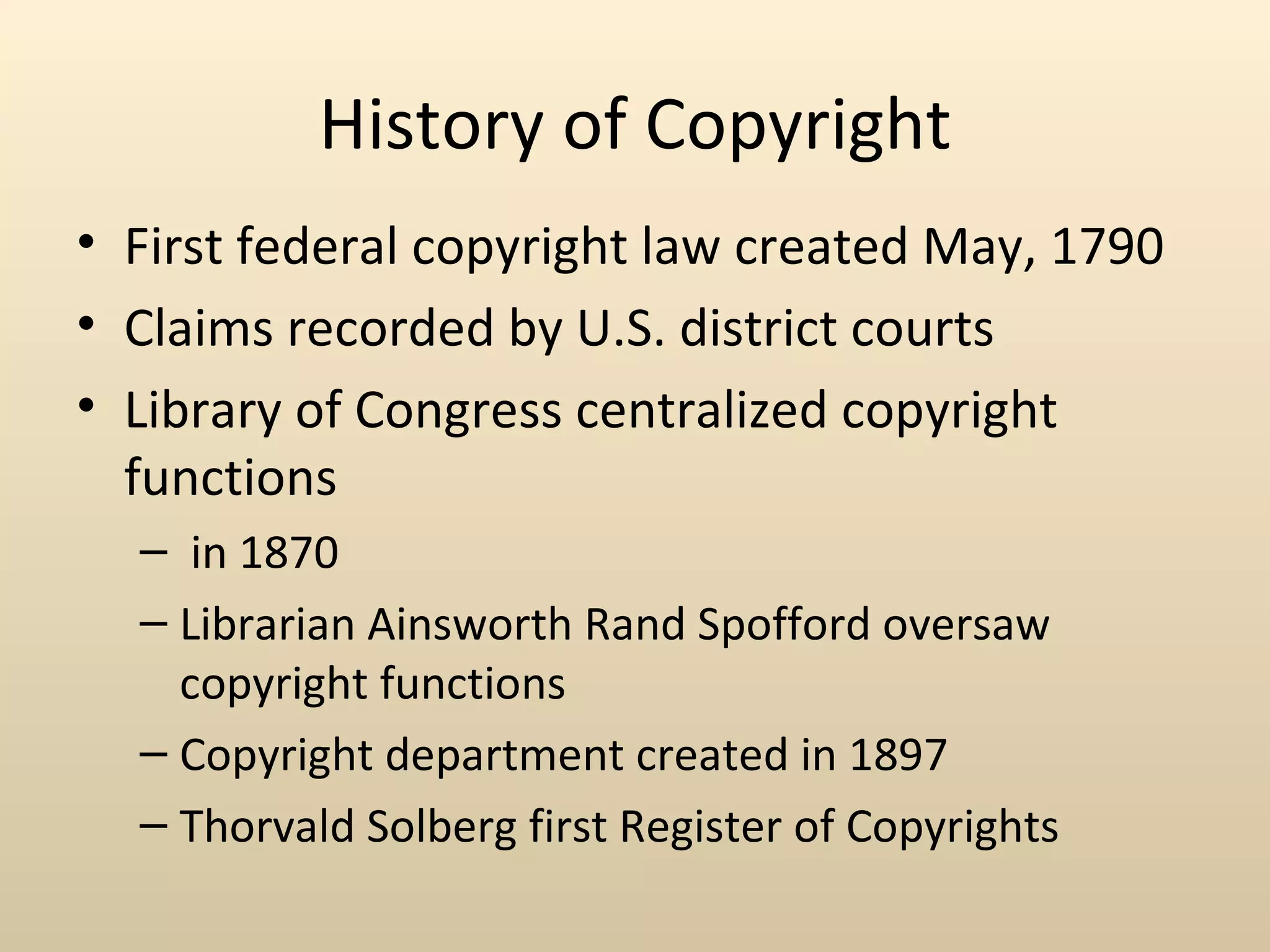
History of Copyright
• First federal copyright law created May, 1790
• Claims recorded by U.S. district courts
• Library of Congress centralized copyright
  functions
  – in 1870
  – Librarian Ainsworth Rand Spofford oversaw
    copyright functions
  – Copyright department created in 1897
  – Thorvald Solberg first Register of Copyrights
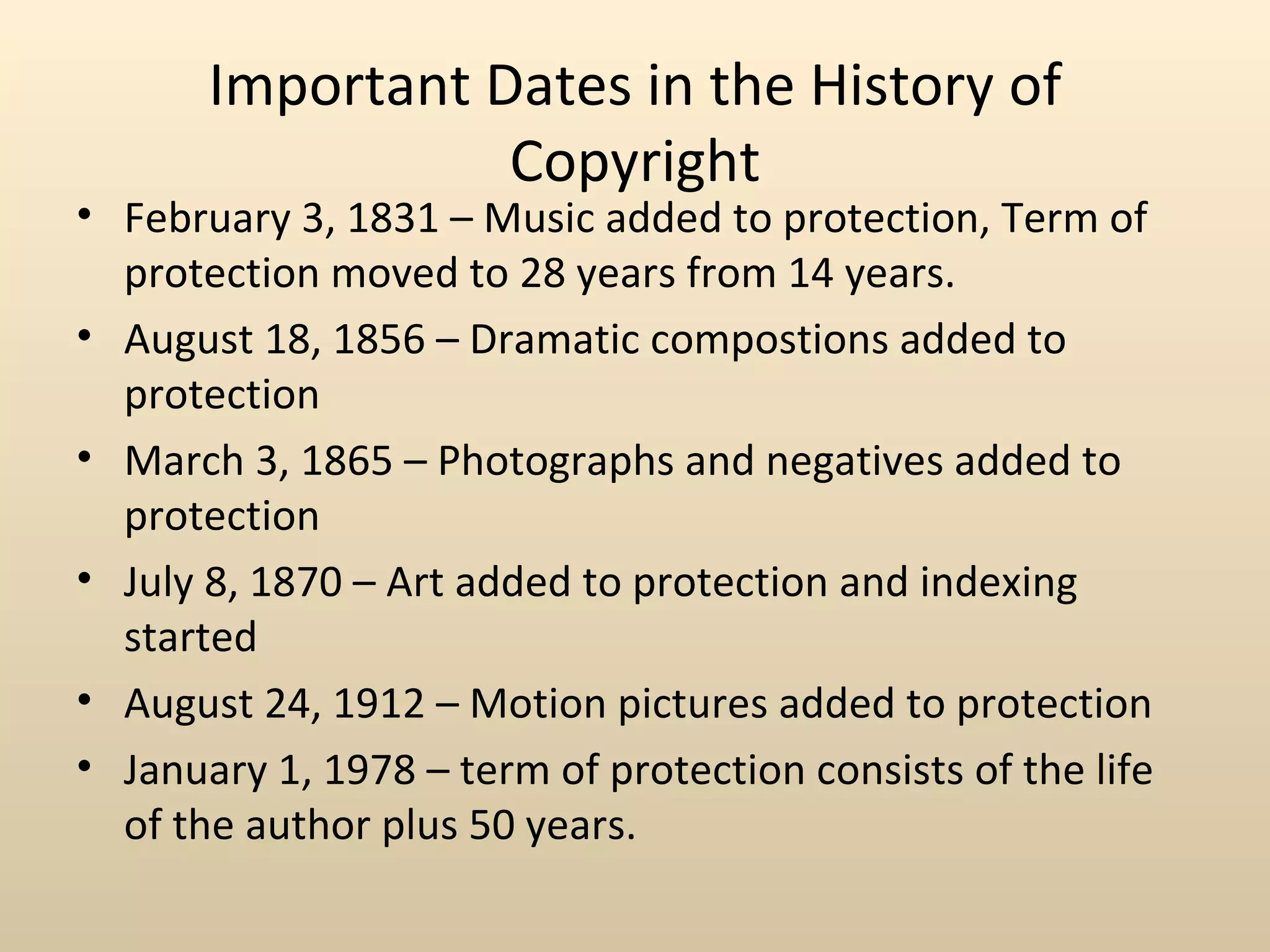
Important Dates in the History of
                  Copyright
• February 3, 1831 – Music added to protection, Term of
  protection moved to 28 years from 14 years.
• August 18, 1856 – Dramatic compostions added to
  protection
• March 3, 1865 – Photographs and negatives added to
  protection
• July 8, 1870 – Art added to protection and indexing
  started
• August 24, 1912 – Motion pictures added to protection
• January 1, 1978 – term of protection consists of the life
  of the author plus 50 years.
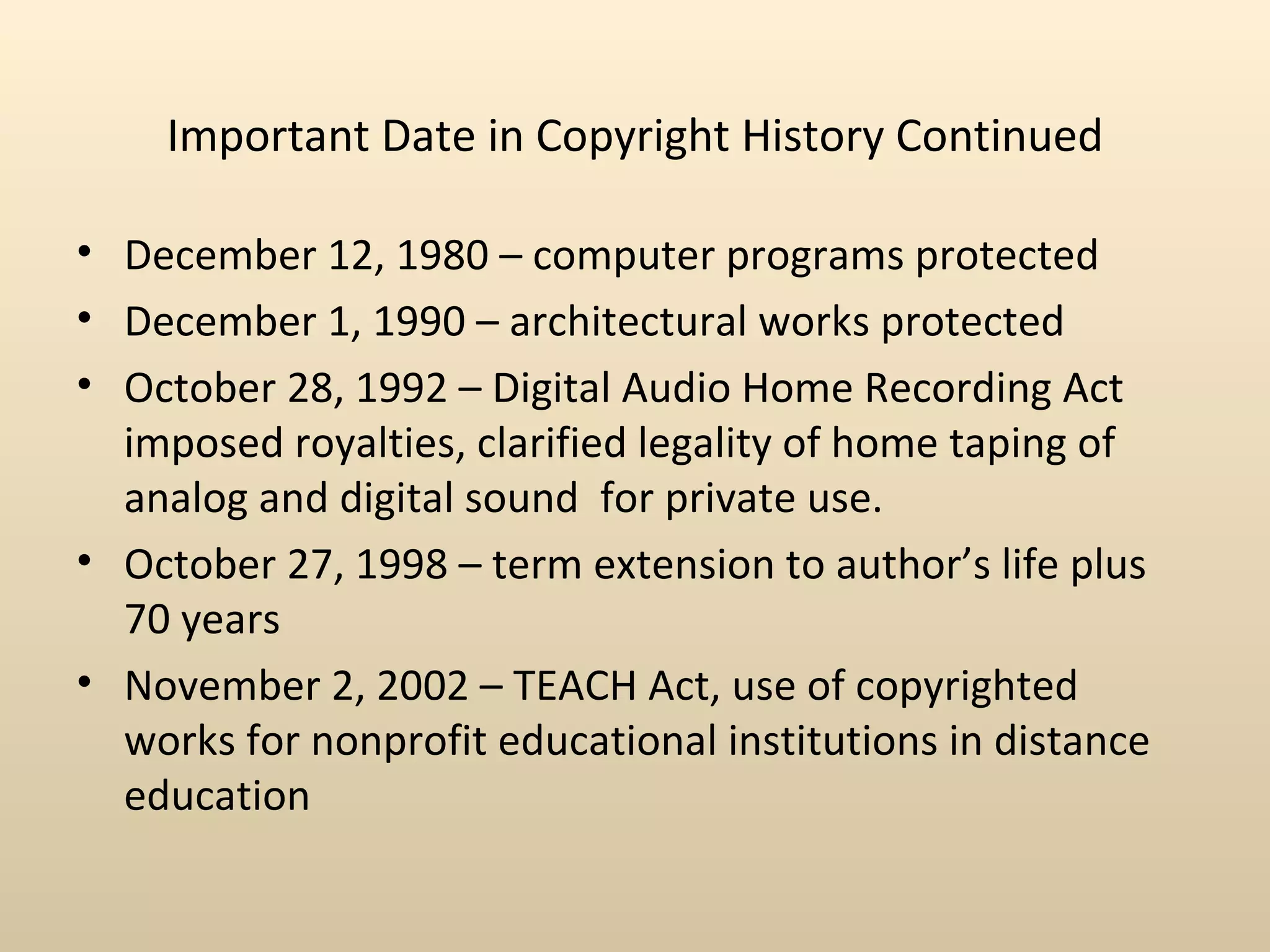
Important Date in Copyright History Continued

• December 12, 1980 – computer programs protected
• December 1, 1990 – architectural works protected
• October 28, 1992 – Digital Audio Home Recording Act
  imposed royalties, clarified legality of home taping of
  analog and digital sound for private use.
• October 27, 1998 – term extension to author’s life plus
  70 years
• November 2, 2002 – TEACH Act, use of copyrighted
  works for nonprofit educational institutions in distance
  education
Current Copyright
• Copyright office employs 475 people
• Half a million copyright claims per year
• Since 1870, registered 33,654,000 copyright
  claims
• July 1, 2008 – electronic registration made
  available to the public

       (http://www.copyright.gov/circs/circ1a.html#, 2011)
Copyright
• Purpose: To promote creativity, innovation,
  and the spread of knowledge while
  considering the rights of the owners and the
  rights of the users.
• From the creator’s point of view, copyright
  laws are designed to protect the creator’s
  work. No one else can sell their work.
• Artistic productions and paperwork remain
  the property of the creator.
Copyright and the Internet
The internet has drastically changed how people
  think about copyright.
  *most students feel internet information is all
  free and available to use
  * reality is, nearly everything on the Net is
  protected by copyright law
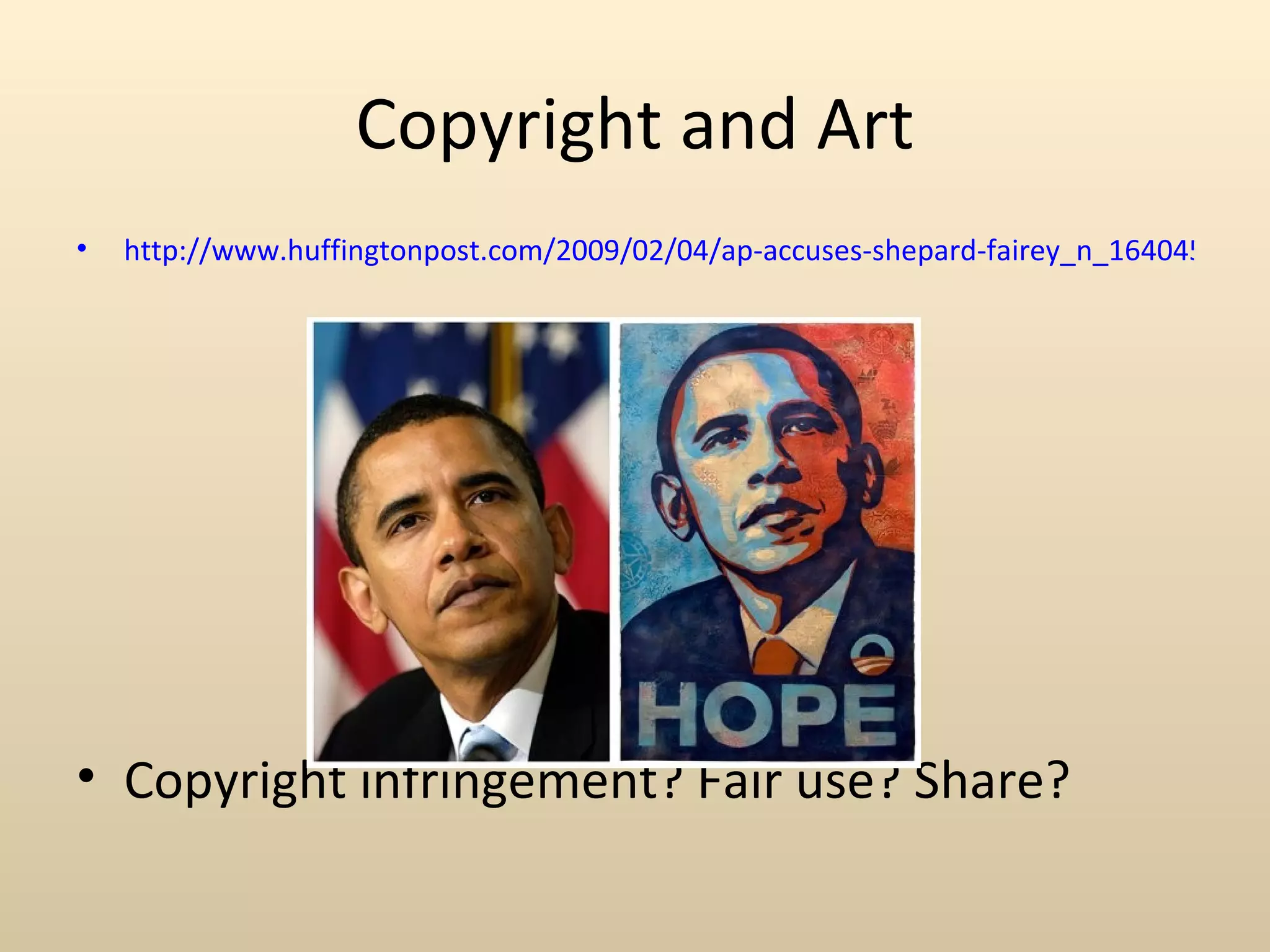
Copyright and Art
•   http://www.huffingtonpost.com/2009/02/04/ap-accuses-shepard-fairey_n_164045.html


• Copyright infringement? Fair use? Share?
Copyright and Art
• If the artist puts their work on the internet, is it fair
  game for people to use?
• If the artist puts their work on a shared service,
  creative commons for example, is it fair game to
  use?
• If a person changes an artist’s original work but it is
  still recognizable, is it still the artist’s property?
• If the original work is no longer recognizable is it the
  original artist’s property or the new artist’s property?
• If the artist is deceased, who owns the art? (Public,
  museum, family, ?)
Fair Use
                         (from copyright law)
• According to the Code of Best Practices in Fair Use for Media
  Literacy...

  Teachers can:

  1. make copies of newspaper articles, TV shows, and other
  copyrighted works and use them and keep them for educational
  use

  2. create curriculum materials and scholarship with copyrighted
  materials embedded

  3. share, sell and distribute curriculum materials with copyrighted
  materials embedded

          (http://copyrightconfusion.wikispaces.com/, 2011)
Section 107's four-factor fair use test...
             (American Library Association, 2011)


• The character of the use (education purposes)
• The nature of the work to be used (character
  of the materials)
• The amount used (of the original work)
• The effect of the use on the market for or
  value of the work (access during class only)
What needs to be evaluated
Did the unlicensed use “transform” the material
  taken from the copyrighted work by using it
  for a different purpose than that of the
  original, or did it just repeat the work for the
  same intent and value as the original?
Was the material taken appropriate in kind and
  amount, considering the nature of the
  copyrighted work and of the use?
Copy Sharing
Creative needs and practices change within the
  field of use, with ever changing technology,
  and with the amount of time.

New technology makes it easy to distribute,
 recreate, share, and duplicate owner’s work.

Copy share allows repurposing the original work
  into a new product, not duplicating for profit.
Copy Share
Licenses
• Creative Commons licenses provide simple,
   standardized alternatives to the “all rights
   reserved” paradigm of traditional copyright.
Creative Commons Mission
• Creative Commons develops, supports, and
   stewards legal and technical infrastructure that
   maximizes digital creativity, sharing, and
   innovation.
Future Issues
• When copyright was created, the purpose and
  process was effective. With the emergence of
  the Internet, normal every day tasks would be
  considered copyright issues, such as copy, paste,
  and post to the web.
• The copyright law requires permission for all of
  these actions no matter who you are or how you
  are using the material.
• This process needs to change along with the
  times.
Fair Use Limitations
• Currently no fair use guidelines for latest
  digital technologies
• Publishers retain the right to work produced
  for their company (author not protected)
• Creative commons licenses restricted by
  publishers
• Teachers are expected to educate students on
  appropriate copyright standard uses.
Opinion
• After researching copyright vs. copy sharing, I
  feel the law needs to evolve with the
  advanced technologies that are now available.
• I do feel the government has tried to keep up
  with the changes they have made to the law,
  but it is impossible to make laws as fast as
  technology changes.
• The Fair Use portion of the law is open
  enough, that it does work fairly well.
Opinion continued

• Creative Commons was created in 2001 and has
  effectively created copyright licenses for free
  through the Center for the Public Domain.
• They have worked to create a global
  infrastructure for sharing public domain tools,
  technologies, and more.
• In order to allow creative processes to flourish,
  people need to be able to bounce ideas and new
  information off each other. This is the way of the
  future.
Can’t We All Just Get Along?
• Both copyright and copy share should coexist
  because they both serve a different purpose.
• For creators who want to share their work
  with the world for free or with limited
  copyright, they can choose a copy share or
  creative commons license.
• For creators who want to maintain all
  copyright privileges, they can choose to keep
  the traditional copyright.
Conclusion
 There was a time for just the copyright law of the U.S.
  Library of Congress.

 Now, is the time for an additional option, sharing
  works.

 In order for this to work, people still need to follow
  the:
   Best Practices in Fair Use for Media Literacy
   Four Factors Fair Use Test
   tools and licensing available on Creative Commons.
Conclusion continued


As teachers, the creative commons and fair use
  section of the copyright law are the best
  options.
Educators do not have the money or time to
  create their own, when showing examples of
  work for understanding and sharing what is
  available makes more sense.
Bibliography
About creative commons. (n.d.). Retrieved February, 2011, from creative
    commons website: http://creativecommons.org/about/‌
Copyright basics. (n.d.). Retrieved February, 2011, from United States
                                                          ‌    ‌
    Copyright Office website: http://www.copyright.gov/circs/circ01.pdf
Copyright - fair use. (2009, November). Retrieved February, 2011, from
    United States Copyright Office website:
                                 ‌ ‌
    http://www.copyright.gov/fls/fl102.html
Fair use for media literacy educators. (2011). Retrieved February, 2011, from
                                                                         ‌
    American University website: http://www.centerforsocialmedia.org/fair-
    use
Italie, H. (2009, February 4). AP accuses Obama artist Shepard Fairey of
    copyright infringement [The huffington post]. Retrieved February, 2011,
    from Huff post politics website:
                                       ‌    ‌ ‌ ‌
    http://www.huffingtonpost.com/2009/02/04/ap-accuses-shepard-
    fairey_n_164045.html
Bibliography continued
Nash, S. (2009, February 2). The educational remix- at odds with copyright?
    Retrieved February, 2011, from
                                      ‌       ‌ ‌ ‌
    http://nashworld.edublogs.org/2009/02/02/the-educational-remix-at-
    odds-with-copyright/
Riley, F. (2010, September 17). Image repositories for e-Learning. Retrieved
    February, 2011, from The University of Nottingham website:
                                    ‌       ‌     ‌          ‌
    http://www.nottingham.ac.uk/nmp/sonet/resources/image_repositories.
    html#Wikipedia: Public domain image resources
Section 107’s four-factor fair use test... (2011). Fair use and electronic
    reserves. Retrieved February, 2011, from American Library Association
    website:
                         ‌   ‌                  ‌         ‌       ‌
    http://www.ala.org/ala/issuesadvocacy/copyright/fairuse/fairuseandelect
                   ‌
    ronicreserves/index.cfm
Bibliography continued
Section 1. Understanding copyright. (2009). Retrieved February, 2011, from
                                                                   ‌
   Temple University website: http://mediaeducationlab.com/section-1-
   understanding-copyright
Spinello, R. A., & Tavani, H. T. (2005). Recent copyright protection schemes:
   Implications for sharing digital information. In Intellectual property rights
   in a networked world: Theory and practice (chap. 7). Retrieved from
                                                   ‌     ‌           ‌
   http://library.books24x7.com.dml.regis.edu/book/id_8539/viewer.asp?
   bookid=8539&chunkid=479221667
Taking the mystery out of copyright. (n.d.). Retrieved February, 2011, from
   The Library of Congress website:
                          ‌         ‌
   http://www.loc.gov/teachers/copyrightmystery/#      ‌
Website copyright. (2010). Retrieved February, 2010, from
   http://www.benedict.com

Copyright vs copy share

  • 1.
    Copyright vs. CopySharing EDTC 603: Web Development Research Project 6.1 Betty Hustead February 15, 2011
  • 2.
    History of Copyright •First federal copyright law created May, 1790 • Claims recorded by U.S. district courts • Library of Congress centralized copyright functions – in 1870 – Librarian Ainsworth Rand Spofford oversaw copyright functions – Copyright department created in 1897 – Thorvald Solberg first Register of Copyrights
  • 3.
    Important Dates inthe History of Copyright • February 3, 1831 – Music added to protection, Term of protection moved to 28 years from 14 years. • August 18, 1856 – Dramatic compostions added to protection • March 3, 1865 – Photographs and negatives added to protection • July 8, 1870 – Art added to protection and indexing started • August 24, 1912 – Motion pictures added to protection • January 1, 1978 – term of protection consists of the life of the author plus 50 years.
  • 4.
    Important Date inCopyright History Continued • December 12, 1980 – computer programs protected • December 1, 1990 – architectural works protected • October 28, 1992 – Digital Audio Home Recording Act imposed royalties, clarified legality of home taping of analog and digital sound for private use. • October 27, 1998 – term extension to author’s life plus 70 years • November 2, 2002 – TEACH Act, use of copyrighted works for nonprofit educational institutions in distance education
  • 5.
    Current Copyright • Copyrightoffice employs 475 people • Half a million copyright claims per year • Since 1870, registered 33,654,000 copyright claims • July 1, 2008 – electronic registration made available to the public (http://www.copyright.gov/circs/circ1a.html#, 2011)
  • 6.
    Copyright • Purpose: Topromote creativity, innovation, and the spread of knowledge while considering the rights of the owners and the rights of the users. • From the creator’s point of view, copyright laws are designed to protect the creator’s work. No one else can sell their work. • Artistic productions and paperwork remain the property of the creator.
  • 7.
    Copyright and theInternet The internet has drastically changed how people think about copyright. *most students feel internet information is all free and available to use * reality is, nearly everything on the Net is protected by copyright law
  • 8.
    Copyright and Art • http://www.huffingtonpost.com/2009/02/04/ap-accuses-shepard-fairey_n_164045.html • Copyright infringement? Fair use? Share?
  • 9.
    Copyright and Art •If the artist puts their work on the internet, is it fair game for people to use? • If the artist puts their work on a shared service, creative commons for example, is it fair game to use? • If a person changes an artist’s original work but it is still recognizable, is it still the artist’s property? • If the original work is no longer recognizable is it the original artist’s property or the new artist’s property? • If the artist is deceased, who owns the art? (Public, museum, family, ?)
  • 10.
    Fair Use (from copyright law) • According to the Code of Best Practices in Fair Use for Media Literacy... Teachers can: 1. make copies of newspaper articles, TV shows, and other copyrighted works and use them and keep them for educational use 2. create curriculum materials and scholarship with copyrighted materials embedded 3. share, sell and distribute curriculum materials with copyrighted materials embedded (http://copyrightconfusion.wikispaces.com/, 2011)
  • 11.
    Section 107's four-factorfair use test... (American Library Association, 2011) • The character of the use (education purposes) • The nature of the work to be used (character of the materials) • The amount used (of the original work) • The effect of the use on the market for or value of the work (access during class only)
  • 12.
    What needs tobe evaluated Did the unlicensed use “transform” the material taken from the copyrighted work by using it for a different purpose than that of the original, or did it just repeat the work for the same intent and value as the original? Was the material taken appropriate in kind and amount, considering the nature of the copyrighted work and of the use?
  • 13.
    Copy Sharing Creative needsand practices change within the field of use, with ever changing technology, and with the amount of time. New technology makes it easy to distribute, recreate, share, and duplicate owner’s work. Copy share allows repurposing the original work into a new product, not duplicating for profit.
  • 14.
    Copy Share Licenses • CreativeCommons licenses provide simple, standardized alternatives to the “all rights reserved” paradigm of traditional copyright. Creative Commons Mission • Creative Commons develops, supports, and stewards legal and technical infrastructure that maximizes digital creativity, sharing, and innovation.
  • 15.
    Future Issues • Whencopyright was created, the purpose and process was effective. With the emergence of the Internet, normal every day tasks would be considered copyright issues, such as copy, paste, and post to the web. • The copyright law requires permission for all of these actions no matter who you are or how you are using the material. • This process needs to change along with the times.
  • 16.
    Fair Use Limitations •Currently no fair use guidelines for latest digital technologies • Publishers retain the right to work produced for their company (author not protected) • Creative commons licenses restricted by publishers • Teachers are expected to educate students on appropriate copyright standard uses.
  • 17.
    Opinion • After researchingcopyright vs. copy sharing, I feel the law needs to evolve with the advanced technologies that are now available. • I do feel the government has tried to keep up with the changes they have made to the law, but it is impossible to make laws as fast as technology changes. • The Fair Use portion of the law is open enough, that it does work fairly well.
  • 18.
    Opinion continued • CreativeCommons was created in 2001 and has effectively created copyright licenses for free through the Center for the Public Domain. • They have worked to create a global infrastructure for sharing public domain tools, technologies, and more. • In order to allow creative processes to flourish, people need to be able to bounce ideas and new information off each other. This is the way of the future.
  • 19.
    Can’t We AllJust Get Along? • Both copyright and copy share should coexist because they both serve a different purpose. • For creators who want to share their work with the world for free or with limited copyright, they can choose a copy share or creative commons license. • For creators who want to maintain all copyright privileges, they can choose to keep the traditional copyright.
  • 20.
    Conclusion  There wasa time for just the copyright law of the U.S. Library of Congress.  Now, is the time for an additional option, sharing works.  In order for this to work, people still need to follow the: Best Practices in Fair Use for Media Literacy Four Factors Fair Use Test tools and licensing available on Creative Commons.
  • 21.
    Conclusion continued As teachers,the creative commons and fair use section of the copyright law are the best options. Educators do not have the money or time to create their own, when showing examples of work for understanding and sharing what is available makes more sense.
  • 22.
    Bibliography About creative commons.(n.d.). Retrieved February, 2011, from creative commons website: http://creativecommons.org/about/‌ Copyright basics. (n.d.). Retrieved February, 2011, from United States ‌ ‌ Copyright Office website: http://www.copyright.gov/circs/circ01.pdf Copyright - fair use. (2009, November). Retrieved February, 2011, from United States Copyright Office website: ‌ ‌ http://www.copyright.gov/fls/fl102.html Fair use for media literacy educators. (2011). Retrieved February, 2011, from ‌ American University website: http://www.centerforsocialmedia.org/fair- use Italie, H. (2009, February 4). AP accuses Obama artist Shepard Fairey of copyright infringement [The huffington post]. Retrieved February, 2011, from Huff post politics website: ‌ ‌ ‌ ‌ http://www.huffingtonpost.com/2009/02/04/ap-accuses-shepard- fairey_n_164045.html
  • 23.
    Bibliography continued Nash, S.(2009, February 2). The educational remix- at odds with copyright? Retrieved February, 2011, from ‌ ‌ ‌ ‌ http://nashworld.edublogs.org/2009/02/02/the-educational-remix-at- odds-with-copyright/ Riley, F. (2010, September 17). Image repositories for e-Learning. Retrieved February, 2011, from The University of Nottingham website: ‌ ‌ ‌ ‌ http://www.nottingham.ac.uk/nmp/sonet/resources/image_repositories. html#Wikipedia: Public domain image resources Section 107’s four-factor fair use test... (2011). Fair use and electronic reserves. Retrieved February, 2011, from American Library Association website: ‌ ‌ ‌ ‌ ‌ http://www.ala.org/ala/issuesadvocacy/copyright/fairuse/fairuseandelect ‌ ronicreserves/index.cfm
  • 24.
    Bibliography continued Section 1.Understanding copyright. (2009). Retrieved February, 2011, from ‌ Temple University website: http://mediaeducationlab.com/section-1- understanding-copyright Spinello, R. A., & Tavani, H. T. (2005). Recent copyright protection schemes: Implications for sharing digital information. In Intellectual property rights in a networked world: Theory and practice (chap. 7). Retrieved from ‌ ‌ ‌ http://library.books24x7.com.dml.regis.edu/book/id_8539/viewer.asp? bookid=8539&chunkid=479221667 Taking the mystery out of copyright. (n.d.). Retrieved February, 2011, from The Library of Congress website: ‌ ‌ http://www.loc.gov/teachers/copyrightmystery/# ‌ Website copyright. (2010). Retrieved February, 2010, from http://www.benedict.com